
Courts and the Civil Litigation Process in Ontario
- Slides: 35
Courts and the Civil Litigation Process in Ontario by Garth Low, Barrister LL. B
Overview of the courts system in Ontario Two court systems (but with one final appellate court, the Supreme Court of Canada) reflecting the federal character of the country and more specifically the division of powers between the federal and provincial governments 1. Federal Court of Canada, including a Federal Court of Appeal 2. Provincial and/or territorial courts
Federal Court has limited jurisdiction, limited to areas arising under the federal government’s legislative jurisdiction In contrast, the Ontario Superior Court of Justice has inherent jurisdiction The Constitution provides for a division of powers, between the federal Parliament and the provincial legislatures Property and civil rights, municipalities, school, hospitals, administration of civil and criminal law, celebration of marriage fall within provincial jurisdiction The rules of the Federal court are different from those in the Superior Court and are not the subject matter of today’s presentation
Courts within the province of Ontario • The administration of justice is something the provinces have jurisdiction over. • In Ontario, we have: • an appellate court, called the Court of Appeal for Ontario; • a court of inherent jurisdiction, being the Superior Court of Justice; and • the Ontario Court of Justice, a provincial court
Today’s Focus • Will be on the Superior Court of Justice and the civil litigation process in that court • But we will nevertheless touch on the other courts, briefly
Court of Appeal for Ontario • informally called the Ontario Court of Appeal • sits in Toronto at Osgoode Hall, 130 Queen Street, Toronto • Only an appellate court and therefore interpretation services are not generally required
The Court of Ontario • The Court of Ontario is the formal legal title describing the combination of both Ontario trial courts – the Superior Court of Justice and the Ontario Court of Justice • Although the Superior Court of Justice and Ontario Court of Justice are formally divisions of the Court of Ontario, the two courts have different rules, powers and jurisdictions, and their judges are appointed by different levels of government. In practice, the Superior Court of Justice and the Ontario Court of Justice operate as separate courts, but under the legislation, they are formally divisions of the Court of Ontario.
Ontario Court of Justice • This court is subordinate in relationship to the "superior" courts. The phrase “provincial court” or "territorial court" is often used to mean a low level court whose decisions can be reviewed by a superior court. Decades ago, they were managed at the local municipal level. • Deals with certain Family cases, criminal matters, and provincial offences • Courts are located throughout the province, in small towns and big cities
Family matters in the Ontario Court of Justice • Family law cases deal with matters of custody, access and support, child protection so long as these are not incidental of or were not previously a part of a divorce application. Cases are heard by a judge only. Appeals from these cases are heard by the Superior Court of Justice. • 311 Jarvis Street is where the Toronto region of the Family division of the Ontario Court of Justice is located
Criminal matters in the Ontario Court of Justice • The Court deals with approximately 95% of criminal charges laid within the province and has responsibility for other matters pertaining to criminal law, including authorizing search warrants, bail hearings, and peace bonds • Lots of work for interpreters • 2201 Finch W (Metro West) 1000 Finch E 47 Sheppard E 130 Markham E 1911 Eglington E (Metro East) 444 Young (College Park) 60 Queen (Old City Hall)
Superior Court of Justice • Is the court of inherent jurisdiction in Ontario • Inherent jurisdiction is a doctrine of the English common law that a superior courthas the jurisdiction to hear any matter that comes before it, unless a statute or rule limits that authority or grants exclusive jurisdiction to some other court or tribunal. • The Superior Court has inherent jurisdiction over civil, criminal, and family law matters at common law. • Although the Court has inherent jurisdiction, the authority of the Court has been entrenched in the Canadian Constitution
Divisional Court • The Divisional Court is a branch of the Superior Court of Justice • It is one of the busiest appellate courts in Canada. • Hears statutory appeals from administrative tribunals in the province, and is the primary forum for judicial review of government action in Ontario. • hears appeals from some judgments and orders of judges of the Superior Court of Justice • It hears all appeals from a final order of the Superior Court where the award does not exceed $50, 000. The Divisional Court also hears appeals from Small Claims Court judgments exceeding $2, 500. 00 (there is no statutory right of appeal from a Small Claims Court judgment of less than $2, 500. 00). • As an appellate court, interpreters are not called to assist litigants in the Divisional Court
Monetary jurisdiction in the Superior Court Monetary jurisdiction revised as of January 1, 2020 less than $35, 000 - Small Claims Court of the Superior Court of Justice more than $35, 000 - the Superior Court of Justice
Superior Court Masters • In certain locations, including Toronto and Newmarket, some of the judicial work is shared, in part, by Case Management Masters • Jurisdiction of Case Management Masters is severely restricted • CMM are provincially appointed judicial officers who have the authority to hear and determine certain matters in civil cases, including motions, pretrials and case conferences. Masters and case management masters may also adjudicate construction lien trials, as well as mortgage and general references, provide dispute resolution services, and serve as registrars in Bankruptcy under the Bankruptcy and Insolvency Act. • In Toronto, motions and other interlocutory proceedings are heard generally at 393 University, 330 University and less so at 130 Queen Street
Small Claims Court • The Small Claims Court is a branch of the Superior Court of Justice, and handles nearly half of all civil claims in the province. • The Court has civil jurisdiction over monetary claims up to $35, 000, and provides an efficient and cost-effective forum for Ontarians to bring or defend these claims. • The Rules of the Small Claims Court provide for streamlined procedures so that cases can be determined at a lower cost and in less time for litigants than cases commenced in the Superior Court. • Interpreters are sometimes called to assist litigants
Actions commenced in the Small Claims Court have a very simplified procedure Small Claims procedure can be summarized as: 1. Exchange of the pleadings 2. Settlement meeting before a deputy judge 3. Trial
The Civil Litigation process in the Superior Court • Two types of legal proceedings • Actions and Applications
Actions commenced in the Superior Court of Justice are more complex and involve more steps 1. Pleadings stage 2. Discovery Stage 3. Mandatory Mediation Stage 4. Trial Stage
Pleadings Step 1 On the part of the plaintiff, the commencement of legal proceedings by causing to be issued either a Statement of Claim, or Notice of Action
Pleadings Step 2 - Serving the claim
Pleadings Step 3 - Responding to the Claim by: - delivering a Statement of Defence and/or a Statement of Defence and Counterclaim - other possible proceedings include Crossclaims, Third. Party Claims, etc.
Pleadings Step 4 - Replying to the Defendant’s Response and Defending any Counterclaims or crossclaims.
Discovery stage To be presented by Atoosa Mahdavian in detail
Mandatory Mediation Stage Mandatory mediation exists in Toronto, Ottawa, and the county of Essex (i. e. Windsor). - Timing: ordinarily to take place within 180 days after the first defence has been filed but may be postponed if the parties consent in writing and consent is filed with the mediation coordinator. - Mediations are conducted in person, with all parties expected to be in attendance. - Interpreters are sometimes asked to assist in a mediation since the parties are required to participate in the mediation. More often than not, however, litigants will bring an untrained friend or family member to help quietly translate what is being said by counsel and the mediator.
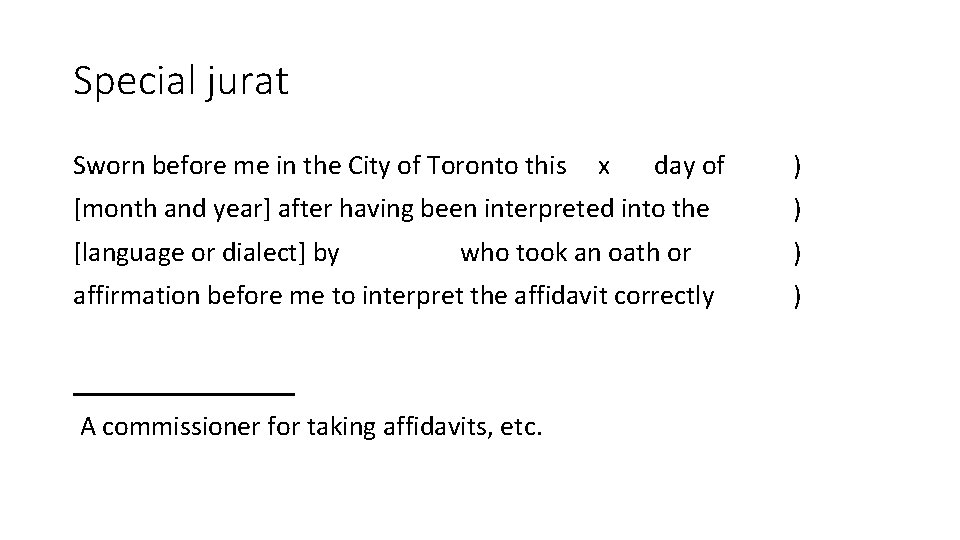
Motions • During the litigation there may situations where the litigants need or desire to seek the assistance and/or intervention of the Court. • Court orders to require a party to produce documents, to attend for examination for discovery, for injunctive relief, that is, to prevent someone from doing something; for an order requiring a non-resident plaintiff to post security for costs, etc. are examples of relief sought by motion. • Affidavit evidence is filed and sometimes there is need for an interpreter • Affidavits interpreted are required to include a special jurat
Special jurat Sworn before me in the City of Toronto this x day of ) [month and year] after having been interpreted into the ) [language or dialect] by ) who took an oath or affirmation before me to interpret the affidavit correctly A commissioner for taking affidavits, etc. )
Trial Stage 1. Setting action down for trial 2. Pre-Trial Conference 3. Final Trial Preparation 4. Trial
Pre-Trial Conference • Presiding is a judge • The parties prepare and exchange before the pre-trial conference a pre-trial memorandum • Parties are expected to attend with their lawyers • Pre-trial conference is an opportunity to further discuss settlement and trial management • Interpreters are sometimes called to assist
Trial • Presided by a judge • Parties give live evidence • Witnesses are sworn • Expert evidence may be called • Interpreters are called to assist in the actual giving of evidence • Some litigants will hire an interpreter to sit with them during the proceeding so that the litigant fully understands what is being said in court
Post-Trial Stages 1. Appeal, or 2. Enforcement
Appeal • An appeal is based on the trial record • No use for interpreters in an appeal
Applications - a civil proceeding commenced by way of a Notice of Application • the relief is statute based, and the procedure is stipulated by statute • an order directing executors, administrators or trustees to do or abstain from doing something in respect of an estate or trust • interpretation of a will • declaration of an interest in land • a remedy under the Charter of Rights and Freedoms • in respect of any matter where it is unlikely that there will be any material facts in dispute • commercial matters
Commercial matters • Bankruptcy and Insolvency Act; • Bank Act, relating to realizations and priority disputes; • Business Corporations Act (Ontario) and Canada Business Corporations Act; • Companies’ Creditors Arrangement Act; • Limited Partnerships Act; • Pension Benefits Act; • Personal Property Security Act; • receivership applications and all interlocutory motions to appoint, or give directions to, receivers and receiver/managers; • Securities Act; • Winding-Up and Restructuring Act; • Credit Unions and Caisses Populaires Act, relating to credit unions and caisses populaires under administration or that are being wound up or liquidated.
Evidence in an application • Submitted by way of affidavit evidence • Opportunity to cross-examine affidavit evidence prior to the hearing • No live evidence given at the hearing • If necessary, the court will convert the application into an action and thus allow for examinations for discovery and/or a trial
Final Determination in Application v. Action The real big difference between the an application and action is that the final determination of the matters in dispute will not involve the judge hearing viva voce evidence. There will be no trial in an application, but the court will make a determination solely based on affidavit and transcript evidence.