
COURTORDERED EVALUATIONS Presented by Dr Tonya Martin and
COURT-ORDERED EVALUATIONS Presented by: Dr. Tonya Martin and Dr. Danielle Todaro Fort Bend County Behavioral Health Services
PSYCHOLOGICAL AND IDD EVALUATIONS Dr. Martin
PSYCHOLOGICAL EVALUATIONS Evaluations designed to provide information regarding history, psychological diagnoses, substance abuse issues and clinical recommendations to the court NOT competency to stand trial evaluations DO NOT provide recommendations regarding punishment/sentencing decisions
WHAT TO PROVIDE THE EXPERT Previous mental health evaluation and treatment records § Texana/MHMRA treatment records § Records from psychiatric hospitalizations(local and state hospitals) § Private psychiatrist/psychologist records § Current medications Educational records (IDD evaluations) Contact info for collateral sources (parents, spouse, children, etc. )

EVALUATION PROCESS Review all available records Detailed clinical interview with defendant § Background history § Mental status exam Consultation with collateral sources
EVALUATION PROCESS Psychological testing is sometimes included to help provide additional clinical information § Testing alone can not be used to render a diagnosis or clinical opinion § Examples of commonly used tests: § Intellectual (WAIS, WISC, WASI) § Adaptive functioning (Vineland, SSSQ) § Personality/clinical (MMPI, MCMI, PAI) § ADHD/Anger measures (Conner’s, ARES) § Memory (WMS, Rey 15 Item, BETA-4) § Response Style (M-FAST, TOMM, SIMS)
PSYCHOLOGICAL EVALUATIONS Evaluation Template Specific Issues of Examination Disclosures (court-ordered evaluation) Current Allegations Sources of Information Background and Demeanor of Defendant Relevant History (as self-reported by defendant, obtained from collateral sources and available records) § Family § Academic § Employment § Substance abuse § Legal § Trauma § Psychiatric and Medical
PSYCHOLOGICAL EVALUATIONS Current Mental Status Examination § Behavior/Demeanor § Orientation § Attention/Concentration § Memory § Mood § Affect § Thought Content § Thought Process § Perception § Insight
PSYCHOLOGICAL EVALUATIONS Results of Testing Diagnostic Impressions Summary Recommendations
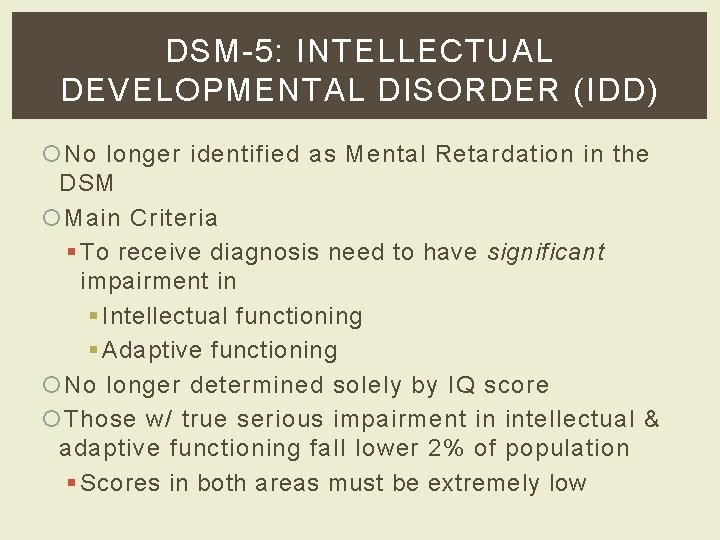
DSM-5: INTELLECTUAL DEVELOPMENTAL DISORDER (IDD) No longer identified as Mental Retardation in the DSM Main Criteria § To receive diagnosis need to have significant impairment in § Intellectual functioning § Adaptive functioning No longer determined solely by IQ score Those w/ true serious impairment in intellectual & adaptive functioning fall lower 2% of population § Scores in both areas must be extremely low
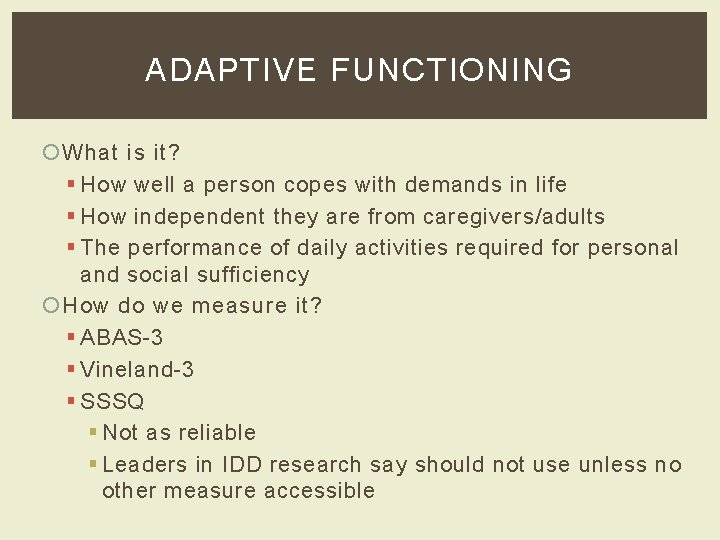
ADAPTIVE FUNCTIONING What is it? § How well a person copes with demands in life § How independent they are from caregivers/adults § The performance of daily activities required for personal and social sufficiency How do we measure it? § ABAS-3 § Vineland-3 § SSSQ § Not as reliable § Leaders in IDD research say should not use unless no other measure accessible
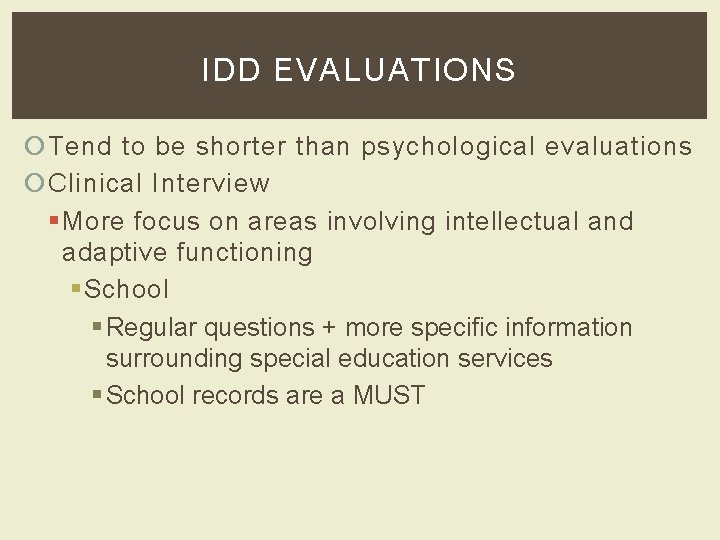
IDD EVALUATIONS Tend to be shorter than psychological evaluations Clinical Interview § More focus on areas involving intellectual and adaptive functioning § School § Regular questions + more specific information surrounding special education services § School records are a MUST
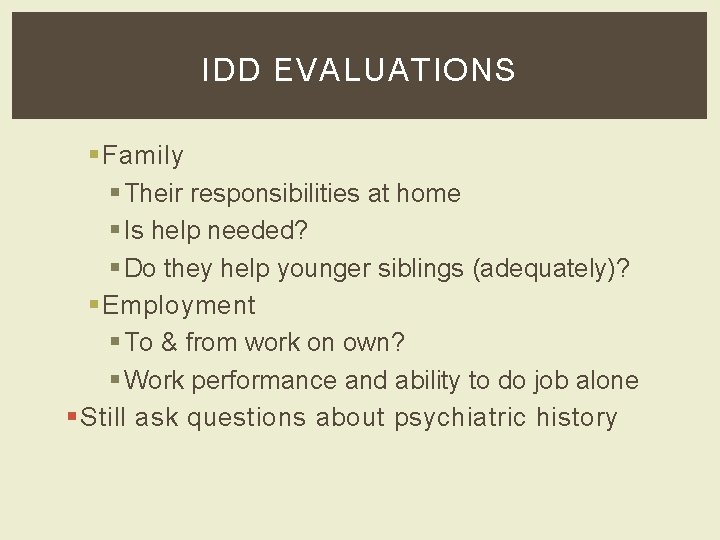
IDD EVALUATIONS § Family § Their responsibilities at home § Is help needed? § Do they help younger siblings (adequately)? § Employment § To & from work on own? § Work performance and ability to do job alone § Still ask questions about psychiatric history
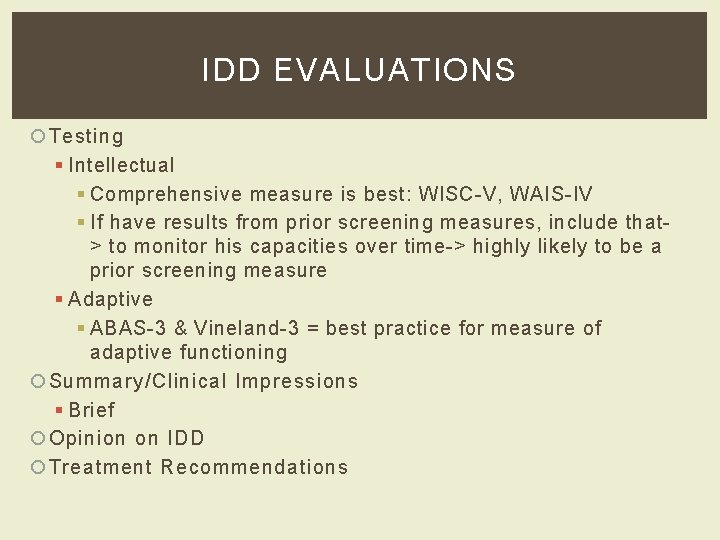
IDD EVALUATIONS Testing § Intellectual § Comprehensive measure is best: WISC-V, WAIS-IV § If have results from prior screening measures, include that> to monitor his capacities over time-> highly likely to be a prior screening measure § Adaptive § ABAS-3 & Vineland-3 = best practice for measure of adaptive functioning Summary/Clinical Impressions § Brief Opinion on IDD Treatment Recommendations
COMPETENCY TO STAND TRIAL EVALUATIONS Dr. Todaro
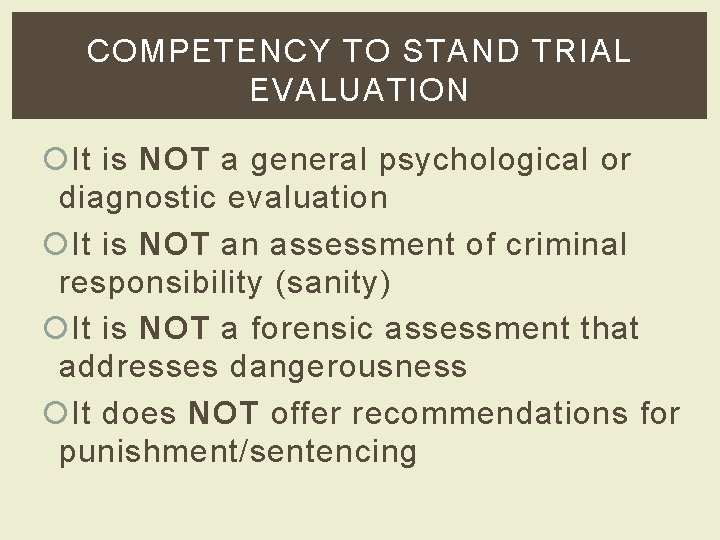
COMPETENCY TO STAND TRIAL EVALUATION It is NOT a general psychological or diagnostic evaluation It is NOT an assessment of criminal responsibility (sanity) It is NOT a forensic assessment that addresses dangerousness It does NOT offer recommendations for punishment/sentencing
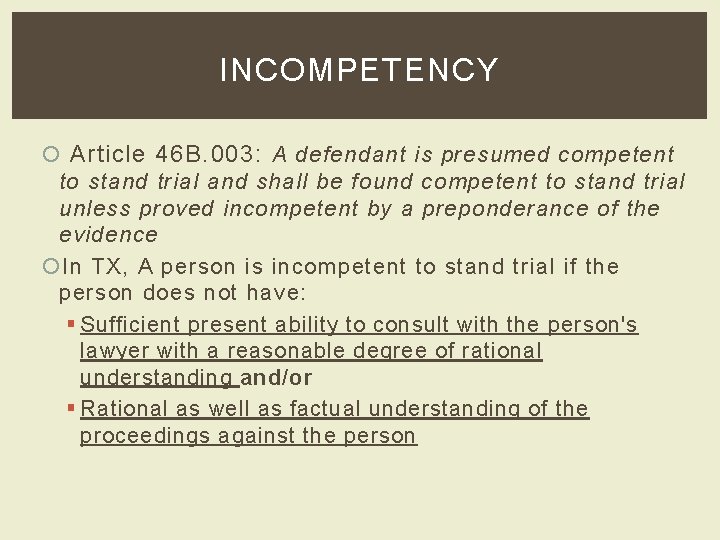
INCOMPETENCY Article 46 B. 003: A defendant is presumed competent to stand trial and shall be found competent to stand trial unless proved incompetent by a preponderance of the evidence In TX, A person is incompetent to stand trial if the person does not have: § Sufficient present ability to consult with the person's lawyer with a reasonable degree of rational understanding and/or § Rational as well as factual understanding of the proceedings against the person
INCOMPETENCY “ Incompetence and mental illness are not synonymous” (Grisso, 2014) § A defendant may be psychotic, manic, depressed or intellectually or developmentally disabled and still be competent to stand trial
WHO CAN CONDUCT COMPETENCY EVALUATIONS? Article 46 B. 021: Qualifications of Experts § Court may appoint a qualified psychiatrist or psychologist as an expert with following qualifications: § At least 24 hours of specialized forensic training relating to incompetency or insanity evaluations § Eight or more hours of continuing education relating to forensic evaluations, completed in the 12 months preceding the appointment
WHAT TO PROVIDE THE EXPERT Your impressions/concerns regarding the defendant’s CST Contact info for collateral sources (parents, spouse, etc. ) Previous mental health evaluation and treatment records § Previous CST evaluations § Texana/MHMRA treatment records § State Hospital records (if there for restoration or for treatment) § Records from other psychiatric hospitalizations § Private psychiatrist/psychologist records § Current medications § Educational records § Social security/disability records § VA records § TDCJ Records
EVALUATION PROCESS Review all available records Clinical interview with defendant § Background history § Mental status exam § Competency-specific questions Consultation with collateral sources Psychological testing § This is done as needed-typically not in every evaluation § CST measures are not necessary
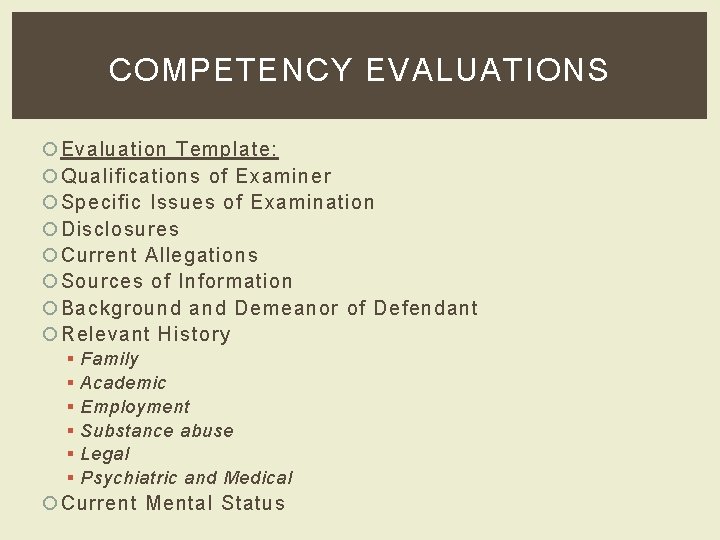
COMPETENCY EVALUATIONS Evaluation Template: Qualifications of Examiner Specific Issues of Examination Disclosures Current Allegations Sources of Information Background and Demeanor of Defendant Relevant History § § § Family Academic Employment Substance abuse Legal Psychiatric and Medical Current Mental Status
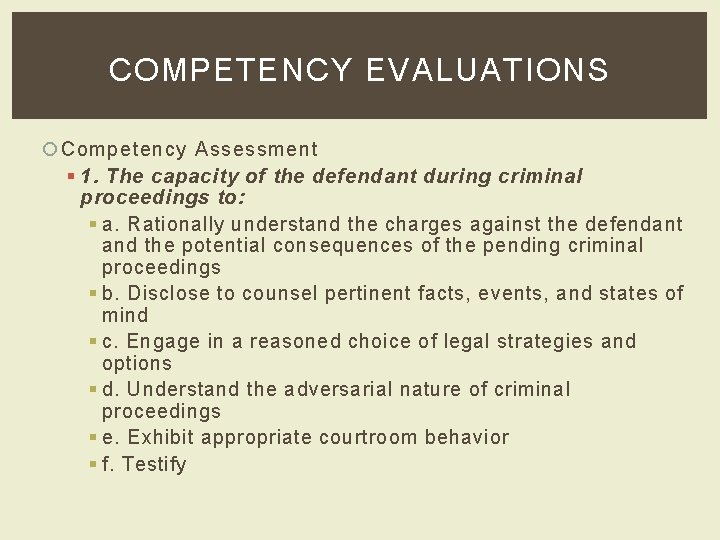
COMPETENCY EVALUATIONS Competency Assessment § 1. The capacity of the defendant during criminal proceedings to: § a. Rationally understand the charges against the defendant and the potential consequences of the pending criminal proceedings § b. Disclose to counsel pertinent facts, events, and states of mind § c. Engage in a reasoned choice of legal strategies and options § d. Understand the adversarial nature of criminal proceedings § e. Exhibit appropriate courtroom behavior § f. Testify
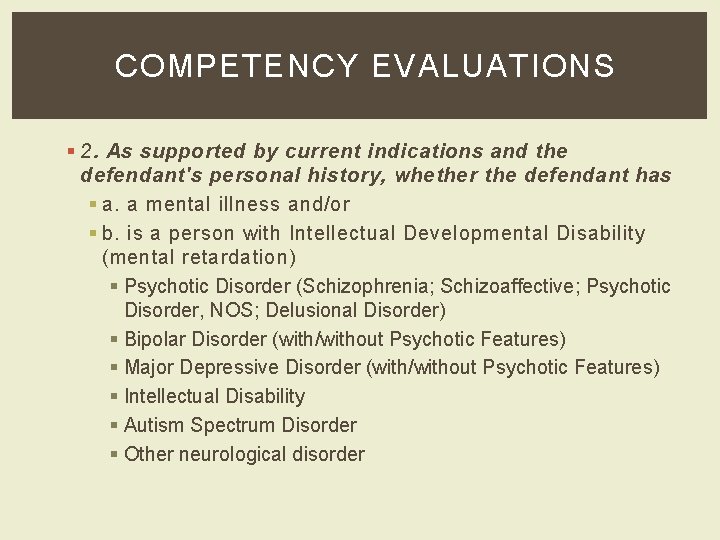
COMPETENCY EVALUATIONS § 2. As supported by current indications and the defendant's personal history, whether the defendant has § a. a mental illness and/or § b. is a person with Intellectual Developmental Disability (mental retardation) § Psychotic Disorder (Schizophrenia; Schizoaffective; Psychotic Disorder, NOS; Delusional Disorder) § Bipolar Disorder (with/without Psychotic Features) § Major Depressive Disorder (with/without Psychotic Features) § Intellectual Disability § Autism Spectrum Disorder § Other neurological disorder
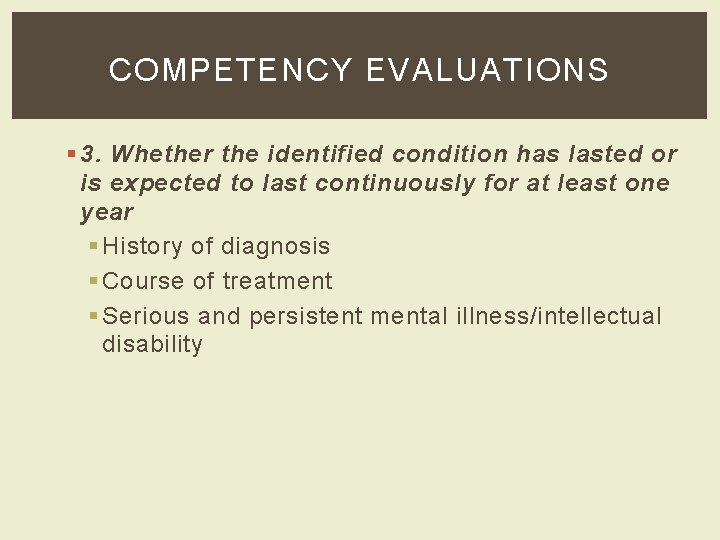
COMPETENCY EVALUATIONS § 3. Whether the identified condition has lasted or is expected to last continuously for at least one year § History of diagnosis § Course of treatment § Serious and persistent mental illness/intellectual disability
COMPETENCY EVALUATIONS § 4. The degree of impairment resulting from the mental illness or mental retardation, if existent, and the specific impact on the defendant's capacity to engage with counsel in a reasonable and rational manner § Symptoms which may interfere § Auditory/visual hallucinations § Delusions § Thought disorder/disorganized speech § Attentional difficulties § Cognitive processing difficulties § Language difficulties
COMPETENCY EVALUATIONS § 5. If the defendant is taking psychoactive or other medication: § a. whether the medication is necessary to maintain the defendant's competency § b. the effect, if any, of the medication on the defendant's appearance, demeanor, or ability to participate in the proceedings § Medication compliance/noncompliance § Side effects
COMPETENCY EVALUATIONS Opinion on Competency to Stand Trial § In Texas, the examiner is required to provide an opinion on competency § Must also provide whether defendant is likely to be restored in the foreseeable future § Opinion may not be based solely on the defendant's refusal to communicate during the examination § Explain any issues on which the expert could not provide an opinion
NEXT STEPS: INCOMPETENCY Either trial before judge or jury OR uncontested finding of incompetency On a determination that a defendant is incompetent to stand trial, the court shall: § Commit the defendant to a facility for competency restoration OR § Release the defendant on bail to attend outpatient restoration treatment
NEXT STEPS: INCOMPETENCY The court shall commit a defendant as follows: § Misdemeanors: 60 days § Felony: 120 days § One 60 -day extension is allowed if defendant has not attained competency The defendant will receive psychiatric treatment and competency restoration programming services § § Psychoactive medications Court-ordered medications Recreational programming Court education § § Classes Quizzes/tests Mock trial Watching videos
NEXT STEPS: INCOMPETENCY The head of the facility or outpatient treatment program provider will notify the court when it is believed that: § 1. The defendant has attained competency to stand trial OR § 2. The defendant is not likely to attain competency in the foreseeable future If the Court determines that an individual has been restored to competency-proceedings continue If the Court determines that an individual remains incompetent: § Charges can be dismissed § Civil commitment can be pursued with or without pending legal charges
THINGS TO REMEMBER An opinion of incompetency is not equated with innocence Incompetency is not equated with insanity MI and IDD are not equated with incompetency Evaluation occurs over a brief span of time
THINGS TO REMEMBER Competency is a here and now issue § Someone who was previously incompetent could currently be competent and vice versa § Historical information is important but may not be relevant to current competency Important to know if defendant was previously determined to be not competent, not likely to be restored The final decision regarding competency to stand trial is a legal issue which is ultimately decided upon by the Court
FITNESS TO PROCEED EVALAUTIONS Dr. Todaro
FITNESS TO PROCEED Sec. 55. 31 Texas Family Code: § “A child alleged by petition or found to have engaged in delinquent conduct or conduct indicating a need for supervision who as a result of mental illness or mental retardation lacks capacity to understand the proceedings in juvenile court or to assist in the child's own defense is unfit to proceed and shall not be subjected to discretionary transfer to criminal court, adjudication, disposition, or modification of disposition as long as such incapacity endures. ”
FITNESS TO PROCEED Same as 46 B: § Expert qualifications § Factors to consider in examination § Report guidelines Unlike 46 B: Lacks capacity to understand the proceedings in juvenile court or to assist in the child's own defense Fitness evaluations require an actual diagnosis
FITNESS TO PROCEED Clinical interview with juvenile § Background history § Developmental history § Mental status exam § Specific fitness related questions May require more than one interview with juvenile, as their presentation can be less stable that adult defendant
FITNESS TO PROCEED Unlike adult CST evaluations, fitness evaluations may require more consultation with outside sources § Parents/guardians/caretakers § CPS § Probation/detention staff § Teachers § Mental health providers
FITNESS TO PROCEED EVALUATIONS Diagnoses to consider in fitness evaluations will differ from CST evaluations § Attention-Deficit/Hyperactivity Disorder (ADHD) § Autism Spectrum Disorder § Intellectual/Developmental Disorder § Mood disorders (Depression, Anxiety, Bipolar) § Psychotic disorders (less common in juveniles) § Behavioral disorders (ODD, Conduct)-less likely to be related to fitness
FITNESS TO PROCEED EVALUATIONS Evaluation Template: Qualifications of Examiner Specific Issues of Examination Disclosures Current Allegations Sources of Information Background and Demeanor of Defendant Relevant History § § § § Family Developmental* Academic Employment Substance abuse Delinquency Trauma Psychiatric and Medical Current Mental Status
FITNESS TO PROCEED EVALUATIONS Diagnostic Impressions Areas of Fitness § Rationally understand the charges against the defendant and the potential consequences of the pending criminal proceedings § Disclose to counsel pertinent facts, events, and states of mind § Engage in a reasoned choice of legal strategies and options § Understand the adversarial nature of criminal proceedings § Exhibit appropriate courtroom behavior § Testify § Ability to assist in own defense Opinion on Fitness Recommendations
NEXT STEPS: FITNESS TO PROCEED If child is unfit to proceed-stay court proceedings Juvenile will likely be committed to a facility for a period of up to 90 days for evaluation After initial 90 days facility can confirm that the juvenile is either fit or unfit to proceed If the court or jury finds that the child is fit: § Juvenile proceedings resume If the court or jury finds that the child is unfit: § Commitment proceedings § Dismissal of charges § Transfer to criminal court upon 18 th birthday

SANITY EVALUATIONS Dr. Martin
THE STATUTE: TEXAS Texas Code of Criminal Procedure, Chapter 46 C Texas Penal Code 8. 01 § “It is an affirmative defense to prosecution that, at the time of the conduct charged, the actor, as a result of severe mental disease or defect, did not know that his conduct was wrong. ” § Cognitive Prong only, not Volitional Prong
SIGNS THE DEFENDANT MAY NEED A SANITY EVALUATION Serious mental illness or IDD Client does not understand why they were arrested and charged even after given explanation Explanation of offense and reasoning for behavior not reality-based or completely disorganized
THINGS TO KEEP IN MIND Sanity assesses mental state at the time of the offense If you need a Sanity Eval don’t need to file a motion for a CST Eval at the same Chapter 46 C: If CST done at a previous time by an expert, the same expert can do the Sanity Eval Sanity is a legal decision ultimately decided by the Court
WHO CAN CONDUCT SANITY EVALUATIONS? Article 46 C. 102: Qualifications of Experts § (a) Court may appoint a qualified psychiatrist or psychologist as an expert with following qualifications: § At least 24 hours of specialized forensic training relating to incompetency or insanity evaluations § At least five years of experience in performing criminal forensic evaluations for courts; and § Eight or more hours of continuing education relating to forensic evaluations, completed in the 12 months preceding the appointment
CONDUCTING THE EVALUATION Three types of information needed: § Historical Info about Defendant’s Background: relevant to forming an opinion about mental disorder § Current Mental Status Information: may be related to defendant’s mental state at the time of the alleged offense § Observations of Defendant’s Mental State & Behavior: Around at the time of alleged offense
WHAT YOU NEED TO PROVIDE THE EXPERT Records § Police Reports § Records on past incarcerations § TDCJ records § TJJD records § Past psychiatric treatment § County or state psychiatric hospitalizations § Texana/MHMRA Records § Substance abuse treatment records § Educational Records Contact information for collateral sources § Family members § Friends
CONDUCTING THE INTERVIEW Interview Template § Background Information § Family & Developmental History § Abuse & Trauma History § Educational History § Social History § Employment History § Criminal History § Religious History (in some cases) § Substance Abuse History § Mental Health History § Medical History
SUBSTANCE ABUSE & THE INSANITY DEFENSE If defendant was under the influence at time of the crime, this alone does not satisfy the insanity defense How do we determine this? § Client interview § Collateral records § Interviews with family members § Offense report-> collateral information about defendant’s behavior at time of the crime (observations of being under influence)
SUBSTANCE ABUSE AND THE INSANITY DEFENSE Data to collect § Patterns of use at and around the time of alleged offense § Whether defendant was intoxicated at the time § The last time defendant used substances prior to the alleged offense § Any evidence of withdrawal symptoms in period following the incident
SUBSTANCE ABUSE AND THE INSANITY DEFENSE Relationship of substance use to defendant’s presentation of symptoms of mental illness § Data regarding episodes of psychosis, depression, mania, paranoia, or other disorders that have occurred in the context of alcohol or substance use § Does the defendant have hx of such symptoms, independent of such use? § Are the symptoms exacerbated by use of alcohol or drugs? § Are psychotic episodes induced by alcohol/substance use, but then continue past the period of intoxication?
CONDUCTING THE INTERVIEW Current Mental Status Examination § Behavior/Demeanor § Orientation § Attention/Concentration § Memory § Mood § Affect § Thought Content § Thought Process § Perception § Insight
CONDUCTING THE INTERVIEW Factors Relevant to Sanity (Texas: Cognitive Prong only) § Events Preceding the Offense § When did the offense happen? (day, time) § What happened that day (or weeks) leading up to offense? § Contextual Information about defendant’s relationship to victim (if not already gathered) § Defendant’s Account of the Offense § Behaviors and mental state related to offense § Detailed account
CONDUCTING THE INTERVIEW § Defendant’s Perception of the Offense § Ask main question flat out: Whether or not he/she thought at the time that their particular behaviors would be considered illegal or wrong § Note: If defendant says they knew it was wrong during evaluation, this does not “prove” it was true at time of the offense § Seek data consistent/inconsistent with defendant’s assertion § What were you thinking/feeling after the offense occurred?
CONDUCTING THE INTERVIEW § What do you think might have been another way to handle the situation(s)? (Volitional Prong) § Notable Events Following the Offense (Volitional Prong) § What happened after the offense? § Trying to avoid detection, cover up actions, etc. Competency-related factors Opinion on sanity § 46 C requires that the expert give an opinion on sanity
IF ACQUITTED BY REASON OF INSANITY If defendant is found NGRI, does that mean they’re “getting away” with their crime? § NO; not skirting confinement § Could end up in hospital for the rest of their life § Depending on severity of illness & dangerousness of offense If judge or jury rules NGRI-> determine if offense involved dangerous conduct: § Caused serious bodily injury to another person § Placed another person in imminent danger of serious bodily injury, or § Consisted of a threat of serious bodily injury to another person through use of a deadly weapon
DISPOSITION FOLLOWING NGRI: NO DANGEROUS CONDUCT Subchapter E, Article 46 C. 201 § Court determines whether evidence to support finding that the person has a mental illness or IDD presently § If there is evidence of such: § Court orders transfer of defendant to appropriate court for civil commitment proceedings § Determine whether person can receive court-ordered mental health services under Health and Safety Code Title 7, Subchapter C; or § Be committed to a residential care facility to receive IDD services (Health and Safety Code, Title 7, Subchapter D)
DISPOSITION FOLLOWING NGRI: NO DANGEROUS CONDUCT The Court may also order the person: § Detained in jail or “any other suitable place” pending prompt initiation and prosecution of civil proceedings § Placed in care of a responsible person on “satisfactory security” being given for the acquitted person’s proper care and protection If the court does not detain or place the person under 46 C. 201, the court shall release the person
DISPOSITION FOLLOWING NGRI: DANGEROUS CONDUCT Subchapter F, Article 46 C. 251 § Step 1: Court shall order acquitted person to be committed to evaluation of their present mental condition and for treatment to maximum security unit of facility designated by department. § Commitment cannot exceed 30 days-> hearing no later than 30 th day after date of acquittal
DISPOSITION FOLLOWING NGRI: DANGEROUS CONDUCT Step 2: Evaluation (Article 46 C. 252) § Presence of MI or IDD and whether it is severe § If as a result of any severe MI or IDD, person is likely to cause serious harm to another § If as a result of any impairment, is subject to commitment under Health and Safety Code, Title 7, Subchapters C or D (court-ordered MH or IDD services) § Prospective treatment and supervision options, if any § If any required treatment and supervision can be safely and effectively provided as outpatient or communitybased treatment and supervision
DISPOSITION FOLLOWING NGRI: DANGEROUS CONDUCT Step 3: Hearing to determine above (Article 46 C. 253) § Commit to either an inpatient facility, outpatient/community-based setting, or court-ordered MH or IDD services under Health and Safety Code, Title 7, Subchapters C or D § Or Court will discharge and immediately release if evidence fails to establish that disposition for any of above is appropriate
DISPOSITION FOLLOWING NGRI: DANGEROUS CONDUCT Step 3 a: Order of Commitment to Inpatient Treatment or Residential Care (Article 46 C. 256) § State establishes by “clear and convincing evidence” that: § Person has severe MI or IDD § Person as a result of MI or IDD is likely to cause serious bodily injury to another person if not provided treatment and supervision § Commitment = necessary to protect safety of others § Order of commitment expires on the 181 st day following date the order is issued, but is subject to renewal
DISPOSITION FOLLOWING NGRI: DANGEROUS CONDUCT Step 3 b: Order to Receive Outpatient or Community-Based Treatment and Supervision § Same criteria above, but State fails to establish that inpatient treatment in necessary § Renewal after one year
DISPOSITION FOLLOWING NGRI: DANGEROUS CONDUCT Step 4: Renewal of Orders for Inpatient Commitment or Outpatient or Community-Based Treatment and Supervision (Article 46 C. 261) § Not later than 30 th day before date an order scheduled to expire-> facility or State’s attorney may file request that order be renewed § Request must be accompanied by re-evaluation for mental illness within previous 30 days
DISPOSITION FOLLOWING NGRI: DANGEROUS CONDUCT § Court shall renew order only if the court finds that the party who requested renewal has established by clear and convincing evidence that continued mandatory supervision and treatment are appropriate § Renewal = not more than one year Step 5: After Inpatient Commitment, court can order outpatient or community-based treatment and supervision (Article 46 C. 262)

QUESTIONS?
- Slides: 68