
Courtesy Chicago Historical Society The Amistad Federal Trials
- Slides: 13
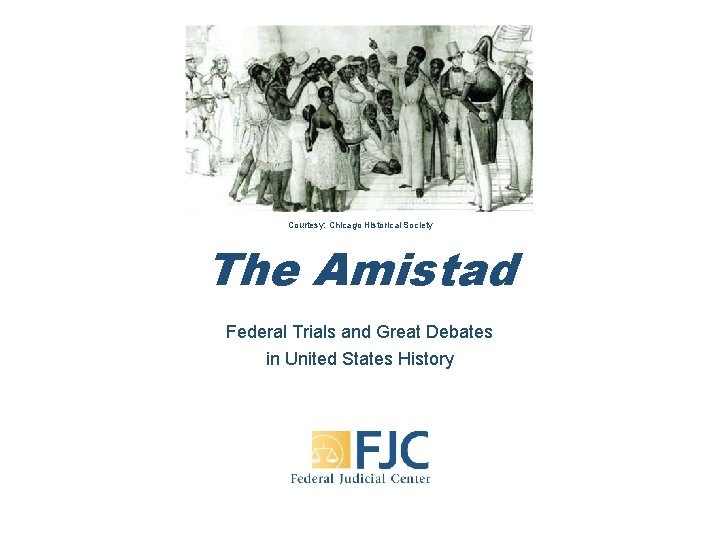
Courtesy: Chicago Historical Society The Amistad Federal Trials and Great Debates in United States History
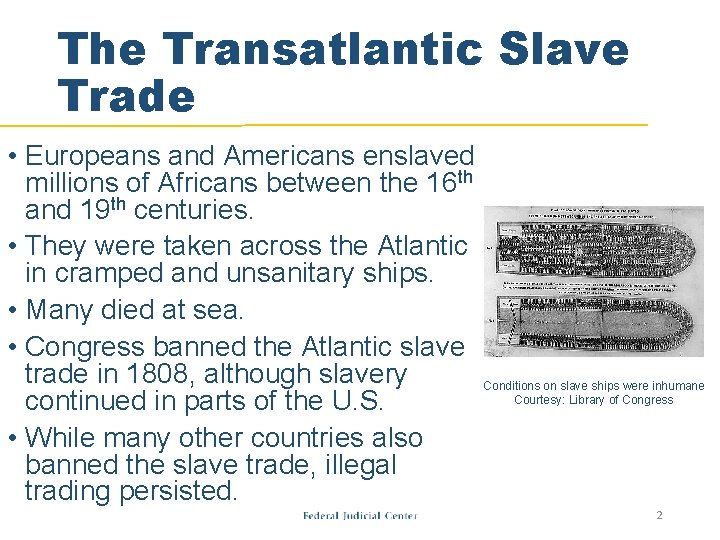
The Transatlantic Slave Trade • Europeans and Americans enslaved millions of Africans between the 16 th and 19 th centuries. • They were taken across the Atlantic in cramped and unsanitary ships. • Many died at sea. • Congress banned the Atlantic slave trade in 1808, although slavery continued in parts of the U. S. • While many other countries also banned the slave trade, illegal trading persisted. Conditions on slave ships were inhumane Courtesy: Library of Congress 2
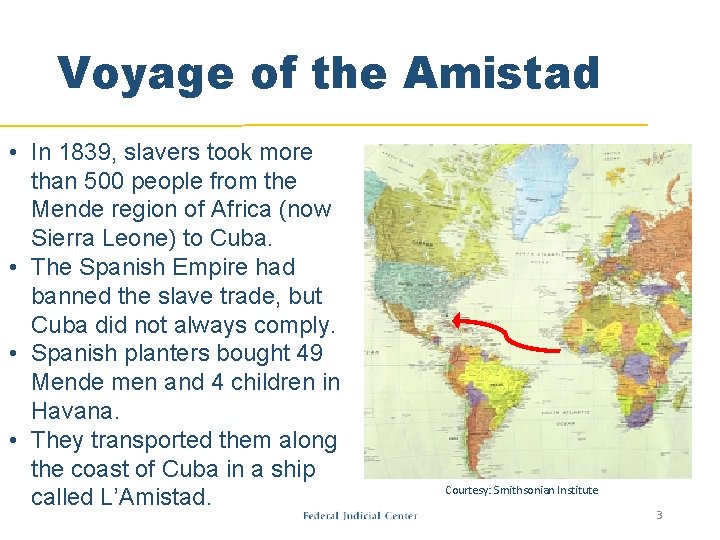
Voyage of the Amistad • In 1839, slavers took more than 500 people from the Mende region of Africa (now Sierra Leone) to Cuba. • The Spanish Empire had banned the slave trade, but Cuba did not always comply. • Spanish planters bought 49 Mende men and 4 children in Havana. • They transported them along the coast of Cuba in a ship called L’Amistad. Courtesy: Smithsonian Institute 3
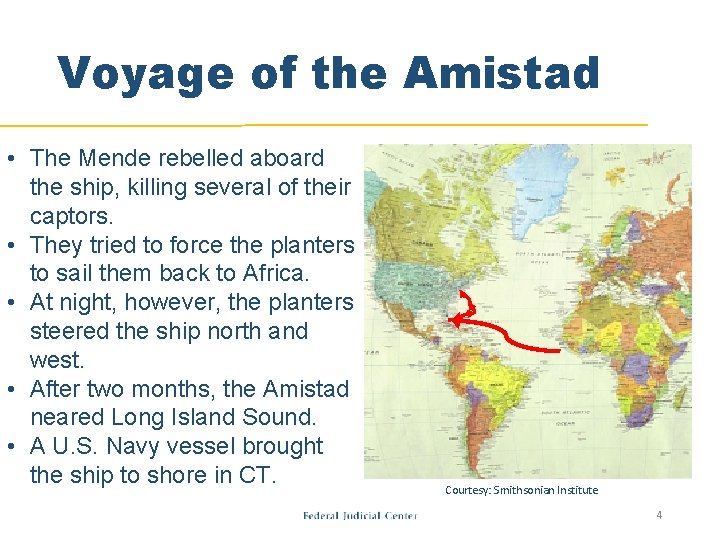
Voyage of the Amistad • The Mende rebelled aboard the ship, killing several of their captors. • They tried to force the planters to sail them back to Africa. • At night, however, the planters steered the ship north and west. • After two months, the Amistad neared Long Island Sound. • A U. S. Navy vessel brought the ship to shore in CT. Courtesy: Smithsonian Institute 4
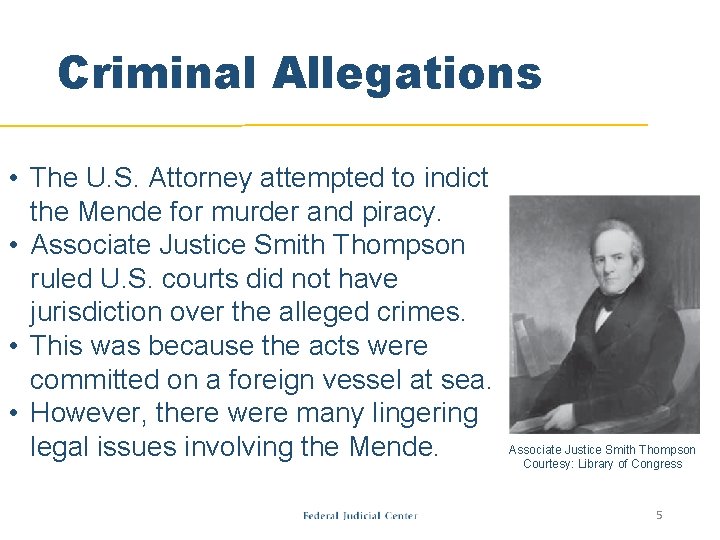
Criminal Allegations • The U. S. Attorney attempted to indict the Mende for murder and piracy. • Associate Justice Smith Thompson ruled U. S. courts did not have jurisdiction over the alleged crimes. • This was because the acts were committed on a foreign vessel at sea. • However, there were many lingering legal issues involving the Mende. Associate Justice Smith Thompson Courtesy: Library of Congress 5
Competing Legal Claims • The Mende claimed they had been kidnapped and should be free to return home. • The naval officer who brought the Amistad ashore made a “salvage” claim for saving the ship and its human “cargo. ” • The planters produced falsified documents claiming the Mende were slaves from Cuba and demanded their return. • The Spanish government demanded the Mende be sent back to Cuba under a treaty with the U. S. • President Martin Van Buren’s administration supported Spain’s position and claimed the courts could not question the Spanish legal documents. 6
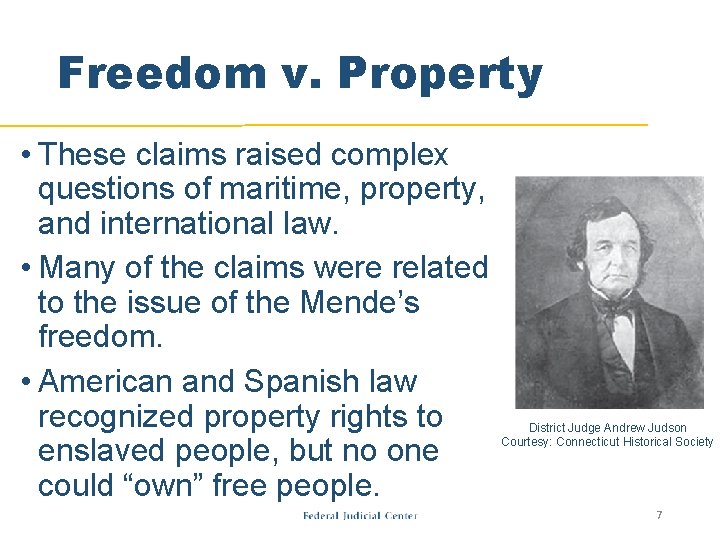
Freedom v. Property • These claims raised complex questions of maritime, property, and international law. • Many of the claims were related to the issue of the Mende’s freedom. • American and Spanish law recognized property rights to enslaved people, but no one could “own” free people. District Judge Andrew Judson Courtesy: Connecticut Historical Society 7
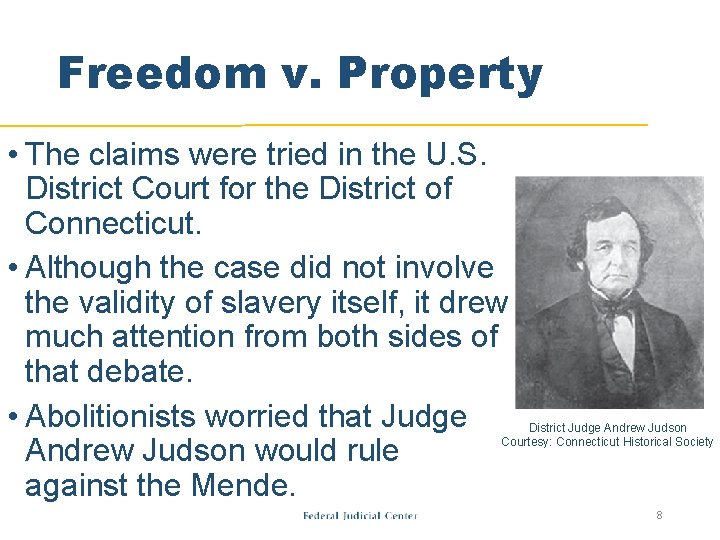
Freedom v. Property • The claims were tried in the U. S. District Court for the District of Connecticut. • Although the case did not involve the validity of slavery itself, it drew much attention from both sides of that debate. • Abolitionists worried that Judge Andrew Judson would rule against the Mende. District Judge Andrew Judson Courtesy: Connecticut Historical Society 8
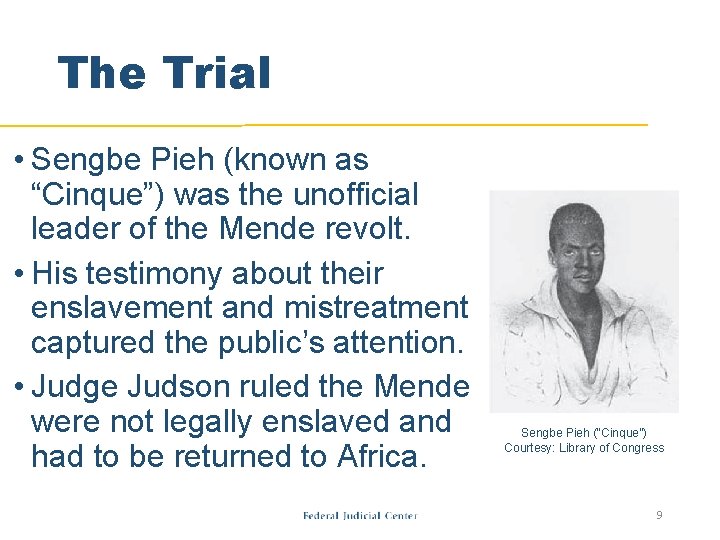
The Trial • Sengbe Pieh (known as “Cinque”) was the unofficial leader of the Mende revolt. • His testimony about their enslavement and mistreatment captured the public’s attention. • Judge Judson ruled the Mende were not legally enslaved and had to be returned to Africa. Sengbe Pieh (“Cinque”) Courtesy: Library of Congress 9
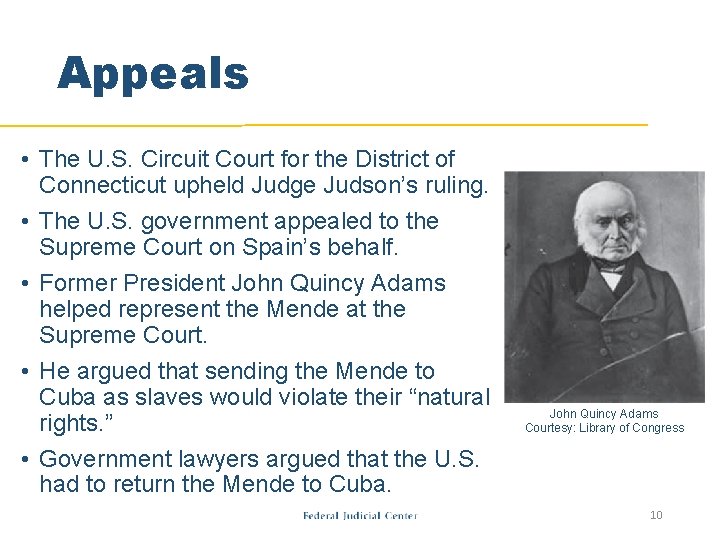
Appeals • The U. S. Circuit Court for the District of Connecticut upheld Judge Judson’s ruling. • The U. S. government appealed to the Supreme Court on Spain’s behalf. • Former President John Quincy Adams helped represent the Mende at the Supreme Court. • He argued that sending the Mende to Cuba as slaves would violate their “natural rights. ” • Government lawyers argued that the U. S. had to return the Mende to Cuba. John Quincy Adams Courtesy: Library of Congress 10
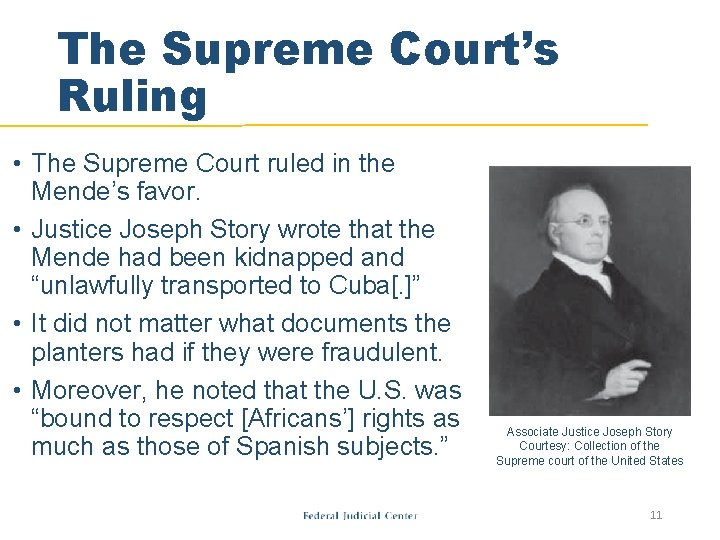
The Supreme Court’s Ruling • The Supreme Court ruled in the Mende’s favor. • Justice Joseph Story wrote that the Mende had been kidnapped and “unlawfully transported to Cuba[. ]” • It did not matter what documents the planters had if they were fraudulent. • Moreover, he noted that the U. S. was “bound to respect [Africans’] rights as much as those of Spanish subjects. ” Associate Justice Joseph Story Courtesy: Collection of the Supreme court of the United States 11
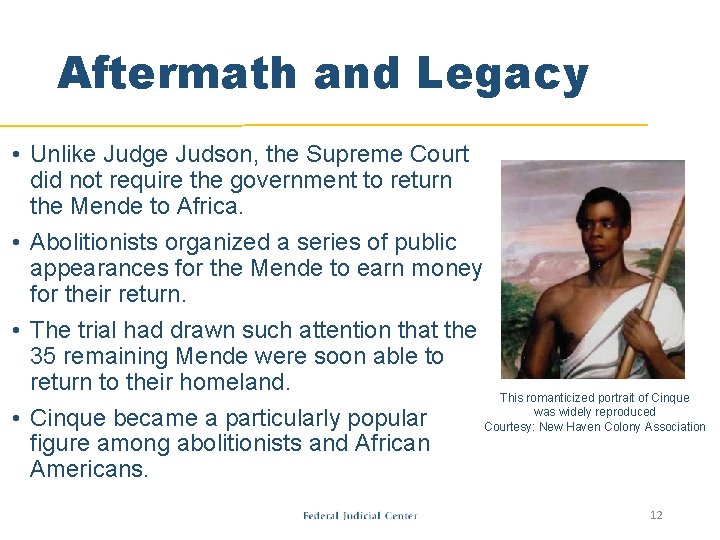
Aftermath and Legacy • Unlike Judge Judson, the Supreme Court did not require the government to return the Mende to Africa. • Abolitionists organized a series of public appearances for the Mende to earn money for their return. • The trial had drawn such attention that the 35 remaining Mende were soon able to return to their homeland. This romanticized portrait of Cinque was widely reproduced • Cinque became a particularly popular Courtesy: New Haven Colony Association figure among abolitionists and African Americans. 12
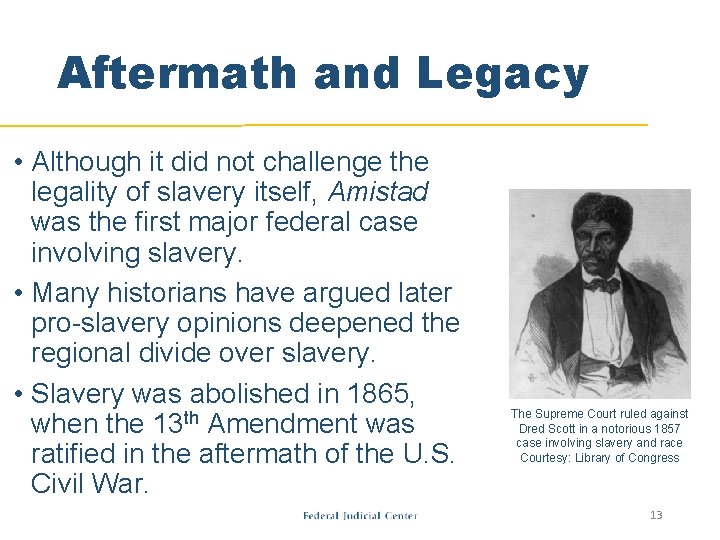
Aftermath and Legacy • Although it did not challenge the legality of slavery itself, Amistad was the first major federal case involving slavery. • Many historians have argued later pro-slavery opinions deepened the regional divide over slavery. • Slavery was abolished in 1865, when the 13 th Amendment was ratified in the aftermath of the U. S. Civil War. The Supreme Court ruled against Dred Scott in a notorious 1857 case involving slavery and race Courtesy: Library of Congress 13