
Court Interpreter Credentialing Process Orientation to Testing May
- Slides: 18
Court Interpreter Credentialing Process: Orientation to Testing May 22, 2016 NATIONAL CENTER FOR STATE COURTS
Court Interpreter Credentialing Process § Court Interpreter Credentialing Process (certification, licensure, approval) is determined by state language access programs § Process may include training, testing, continuing education, background checks, etc. 2 | Page
NCSC Role § Serves as the repository for court interpreter exam materials § Standardizes exam development and administration practices § Performs candidate history checks, exam version assignments, and maintenance of database § Conducts recruitment and training of oral exam raters 3 | Page
State Role § Recruits and trains candidates § Audits rated exams § Registers candidates § Disseminates exam results § Administers tests per NCSC protocols § Processes appeals § Coordinates exam rating § Communicates with candidates
Building a Credentialing Process § Factors to Consider: • Program costs and fee structures • Candidate recruitment and training processes • Volume of candidates • Language use and need • Pre- and post-exam requirements 5 | Page
Exams Maintained by NCSC § Written Exam § Oral Court Interpreter Exams § Abbreviated Exams 6 | Page
Written Exam § English only § 135 multiple choice questions § Part I: General Language Proficiency § Part II: Court-Related Terms & Usage, and Ethics & Professional Conduct § 80% passing score 7 | Page
Oral Court Interpreter Exams § The oral exam measures a candidate’s ability to successfully interpret in three modes: • Sight translation of documents • Consecutive interpretation • Simultaneous interpretation 8 | Page
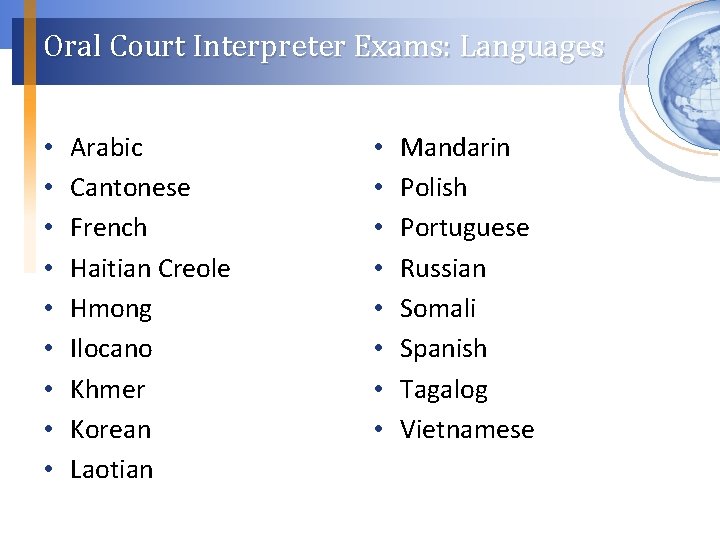
Oral Court Interpreter Exams: Languages • • • Arabic Cantonese French Haitian Creole Hmong Ilocano Khmer Korean Laotian • • Mandarin Polish Portuguese Russian Somali Spanish Tagalog Vietnamese
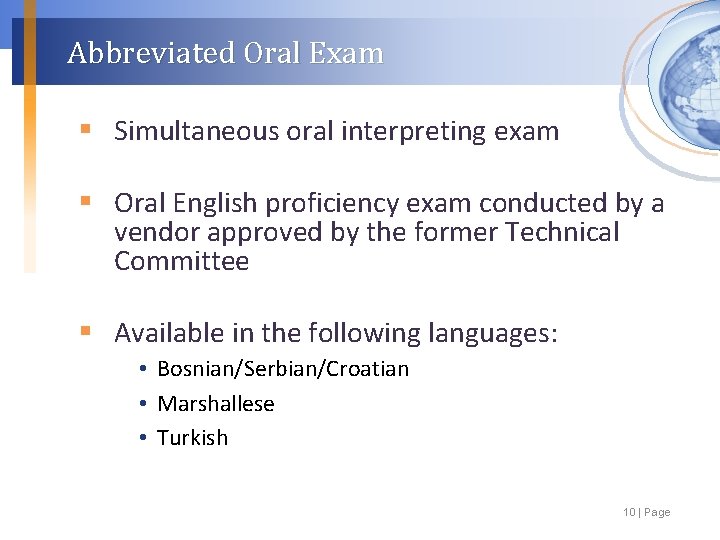
Abbreviated Oral Exam § Simultaneous oral interpreting exam § Oral English proficiency exam conducted by a vendor approved by the former Technical Committee § Available in the following languages: • Bosnian/Serbian/Croatian • Marshallese • Turkish 10 | Page
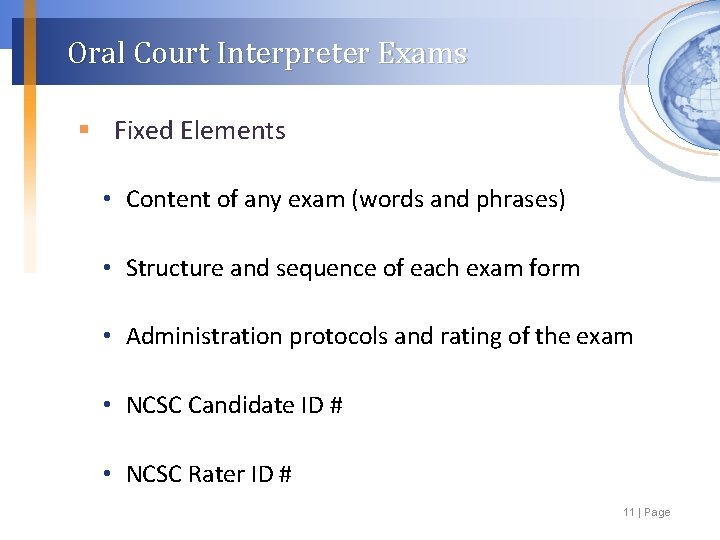
Oral Court Interpreter Exams § Fixed Elements • Content of any exam (words and phrases) • Structure and sequence of each exam form • Administration protocols and rating of the exam • NCSC Candidate ID # • NCSC Rater ID # 11 | Page
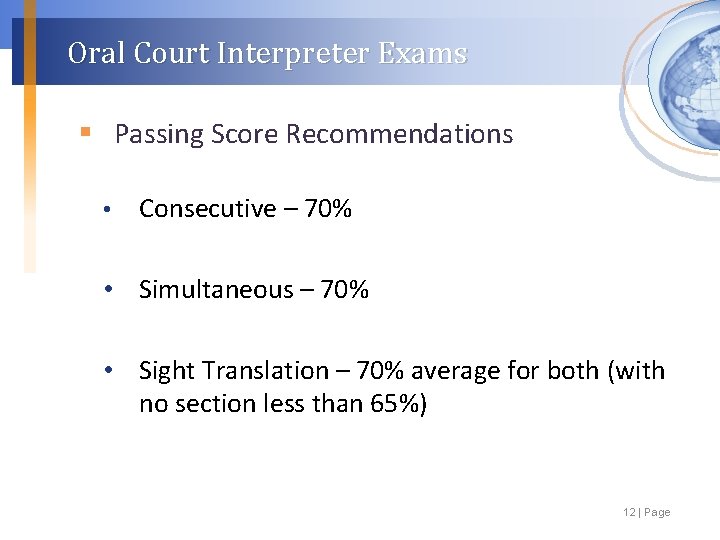
Oral Court Interpreter Exams § Passing Score Recommendations • Consecutive – 70% • Simultaneous – 70% • Sight Translation – 70% average for both (with no section less than 65%) 12 | Page
Retest Limitations § Recommendations for Retest Limitations: • Retest with different test versions • A candidate may only be given a test version previously taken after all other available test versions have been administered to that candidate • NCSC maintains records of test versions administered to candidates • Candidates are required to wait at least 6 months before retaking the same version of an examination 13 | Page
The Rating Process § Raters review the audio recording of the performance and mark scripts individually for each candidate in real time § Lead rater (or rater supervisor) guides a consensus process and records all consensus decisions § Lead rater/rater supervisor fills out rater results form 14 | Page
Before Rating § Materials sent to raters: • Candidate recordings • Test scripts and scoring dictionaries • Rater results forms • Scoring unit suggestion forms 15 | Page
After Rating § Materials received from raters: • Rater results forms • Marked scripts • Candidate recordings 16 | Page
After Rating • Audit all rated exams • Prepare final materials for NCSC • Report any issues with the exam administration or rating process 17 | Page
Q&A Session Questions? 18 | Page