
Courses of Wireless Communication at Aalto University Hilsinki
- Slides: 45
Courses of Wireless Communication at Aalto University Hilsinki, Finland Bingli JIAO, Prof. Dr. rer. Dept. of Electronics Peking University Oct. 20 -21, 2010 Tel. +861062763003 Email: jiaobl@pku. edu. cn 1
Content I. An Intuitive Understanding on Diversity 2010 -10 -20 ………………………. 3 II. Smart Antenna and an Intuitive Explanation of MIMO 2010 -10 -21 ………………. . . ……………… 28 2
I. An Intuitive Understanding on Diversity Outline I. 1. Fading Channel I. 2. Selective Diversity at Receiver I. 3. Diversity of CDMA 2000 I. 4. Transmit Diversity (Time Space code) I. 5. Multipath Diversity with RAKE receiver 3
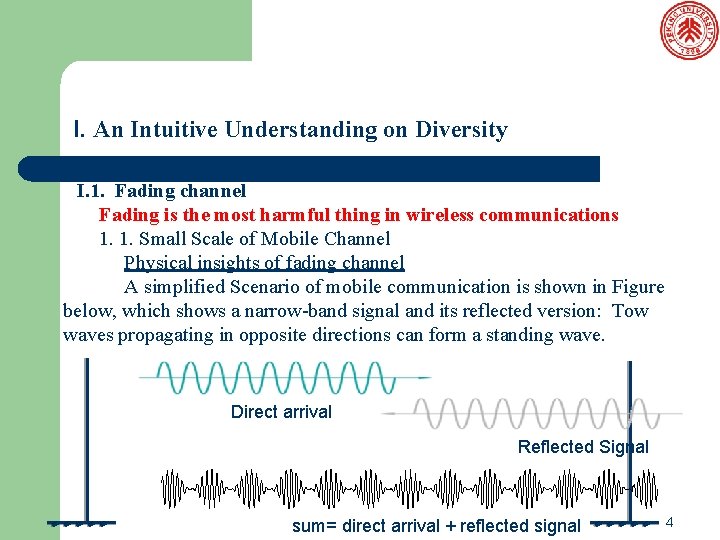
I. An Intuitive Understanding on Diversity I. 1. Fading channel Fading is the most harmful thing in wireless communications 1. 1. Small Scale of Mobile Channel Physical insights of fading channel A simplified Scenario of mobile communication is shown in Figure below, which shows a narrow-band signal and its reflected version: Tow waves propagating in opposite directions can form a standing wave. Direct arrival Reflected Signal sum= direct arrival + reflected signal 4
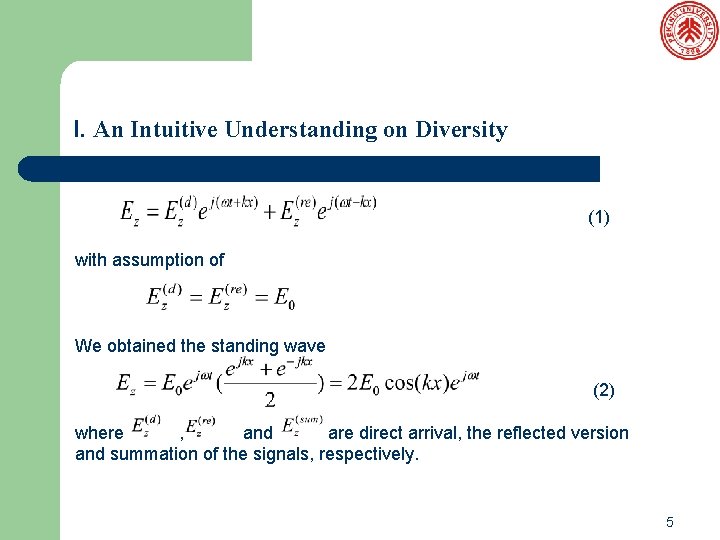
I. An Intuitive Understanding on Diversity (1) with assumption of We obtained the standing wave (2) where , and are direct arrival, the reflected version and summation of the signals, respectively. 5
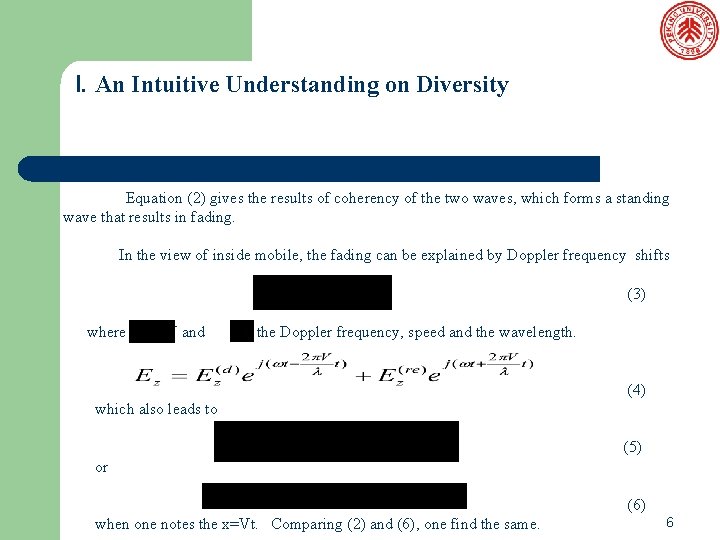
I. An Intuitive Understanding on Diversity Equation (2) gives the results of coherency of the two waves, which forms a standing wave that results in fading. In the view of inside mobile, the fading can be explained by Doppler frequency shifts (3) where , V and are the Doppler frequency, speed and the wavelength. (4) which also leads to (5) or (6) when one notes the x=Vt. Comparing (2) and (6), one find the same. 6
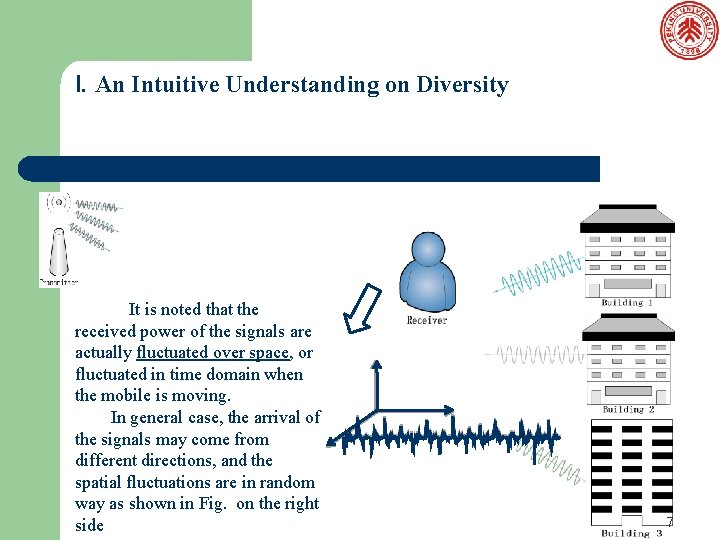
I. An Intuitive Understanding on Diversity It is noted that the received power of the signals are actually fluctuated over space, or fluctuated in time domain when the mobile is moving. In general case, the arrival of the signals may come from different directions, and the spatial fluctuations are in random way as shown in Fig. on the right side 7
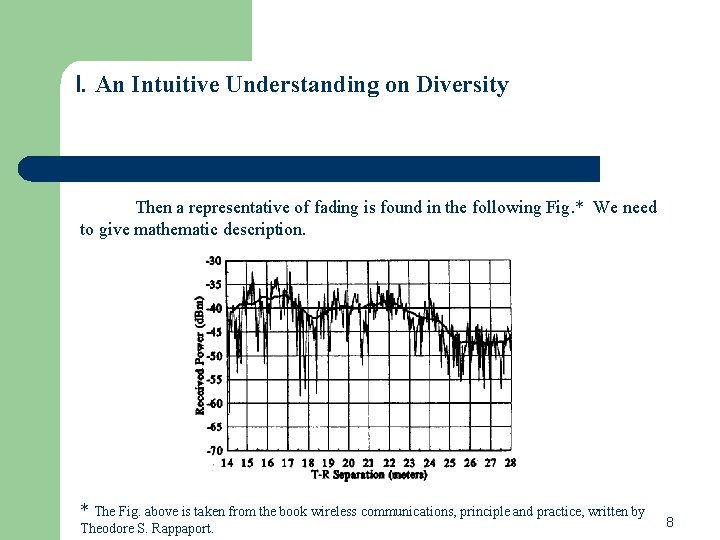
I. An Intuitive Understanding on Diversity Then a representative of fading is found in the following Fig. * We need to give mathematic description. * The Fig. above is taken from the book wireless communications, principle and practice, written by Theodore S. Rappaport. 8
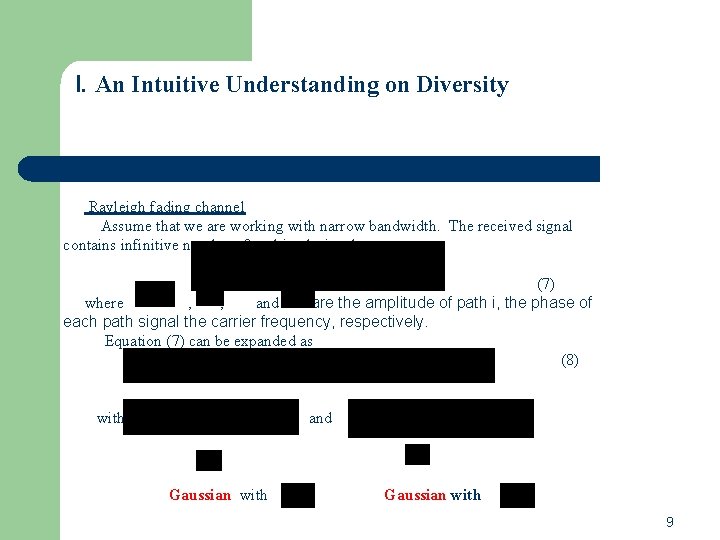
I. An Intuitive Understanding on Diversity Rayleigh fading channel Assume that we are working with narrow bandwidth. The received signal contains infinitive number of multipath signals (7) where , , and are the amplitude of path i, the phase of each path signal the carrier frequency, respectively. Equation (7) can be expanded as (8) with and Gaussian with 9
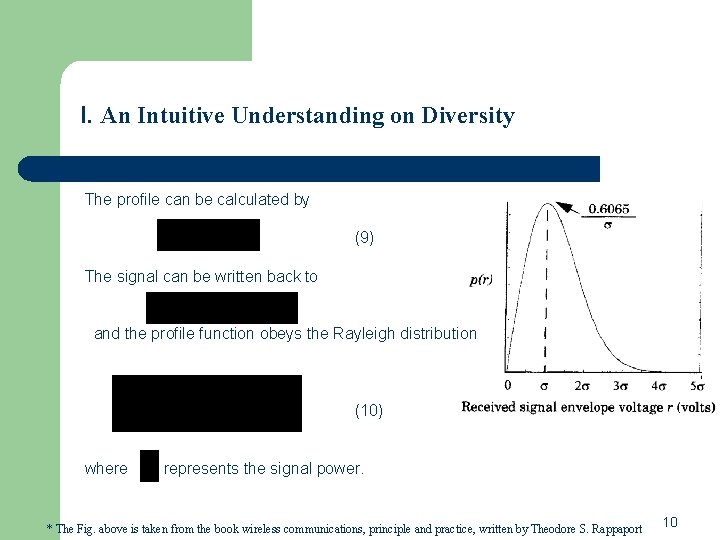
I. An Intuitive Understanding on Diversity The profile can be calculated by (9) The signal can be written back to and the profile function obeys the Rayleigh distribution (10) where represents the signal power. * The Fig. above is taken from the book wireless communications, principle and practice, written by Theodore S. Rappaport 10
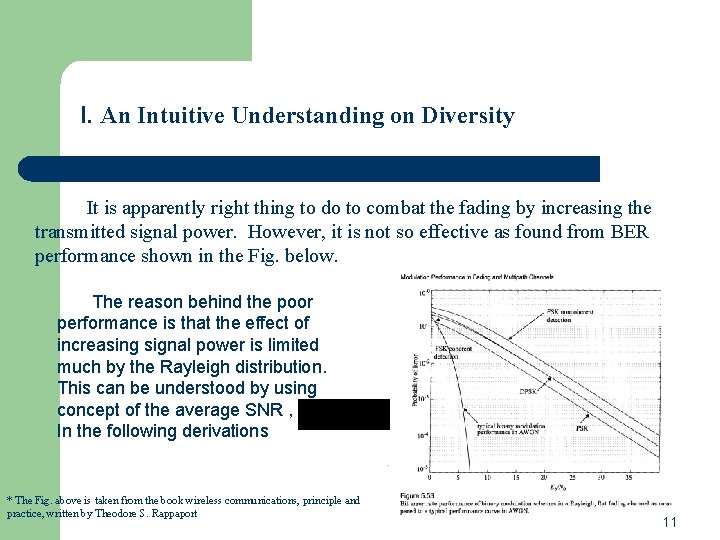
I. An Intuitive Understanding on Diversity It is apparently right thing to do to combat the fading by increasing the transmitted signal power. However, it is not so effective as found from BER performance shown in the Fig. below. The reason behind the poor performance is that the effect of increasing signal power is limited much by the Rayleigh distribution. This can be understood by using concept of the average SNR , In the following derivations * The Fig. above is taken from the book wireless communications, principle and practice, written by Theodore S. Rappaport 11
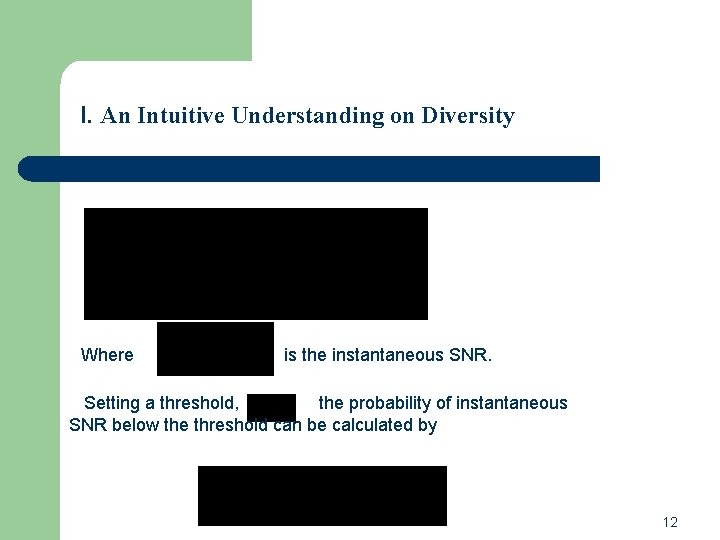
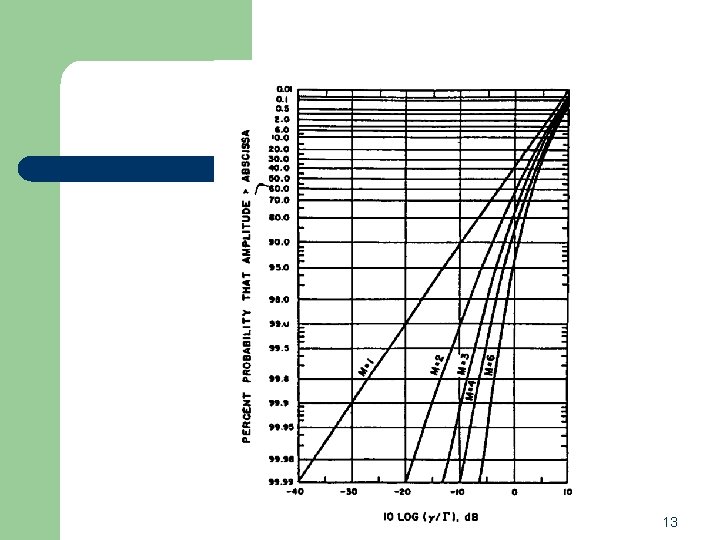
I. An Intuitive Understanding on Diversity Where is the instantaneous SNR. Setting a threshold, the probability of instantaneous SNR below the threshold can be calculated by 12
13
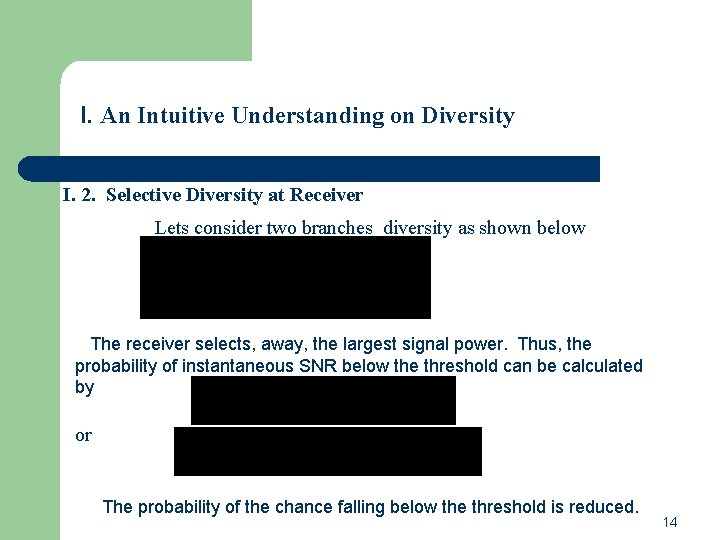
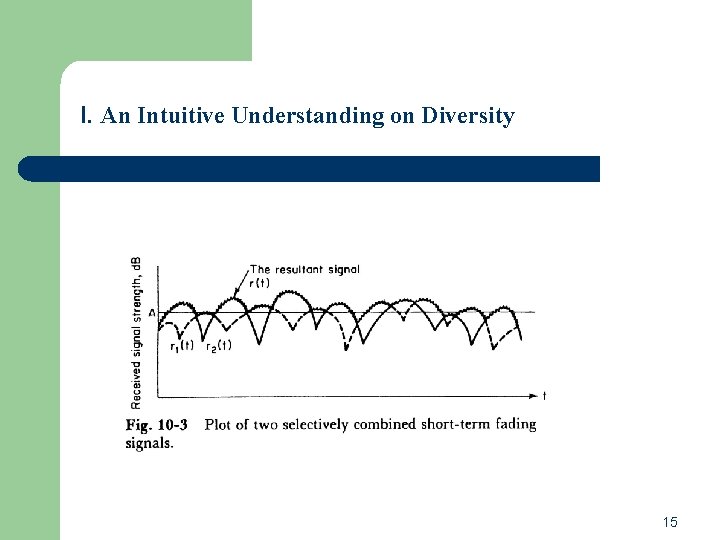
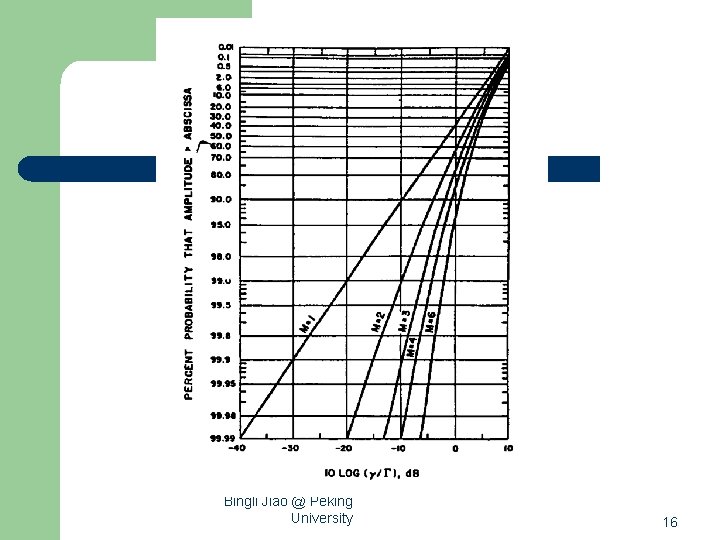
I. An Intuitive Understanding on Diversity I. 2. Selective Diversity at Receiver Lets consider two branches diversity as shown below The receiver selects, away, the largest signal power. Thus, the probability of instantaneous SNR below the threshold can be calculated by or The probability of the chance falling below the threshold is reduced. 14
I. An Intuitive Understanding on Diversity 15
Bingli Jiao @ Peking University 16
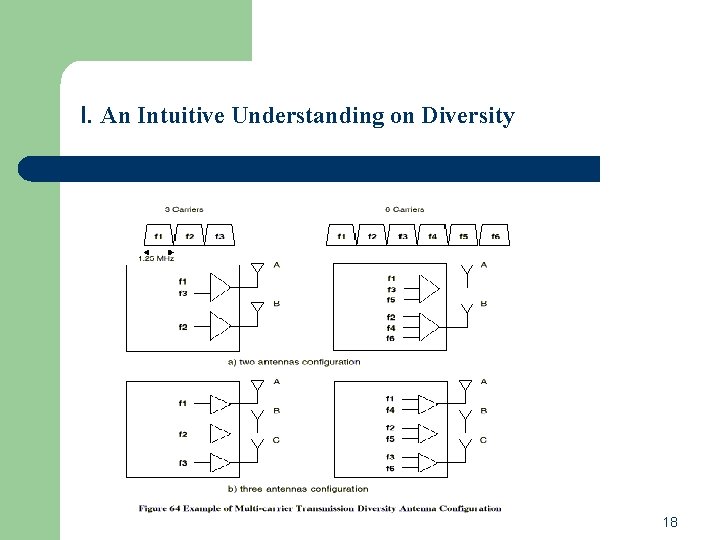
I. An Intuitive Understanding on Diversity I. 3. Diversity of CDMA 2000 Let consider a BS Diversity scheme of CDMA 2000 In practical application, the independence of the diversity braches does not hold. Thus, we use the coherent factor is to measure the channels According to 3 G standard, is used as the criterion of the diversity. The transmit diversity of the standard is proposed by the use of combination of frequency- and spatial diversity as 17
I. An Intuitive Understanding on Diversity 18
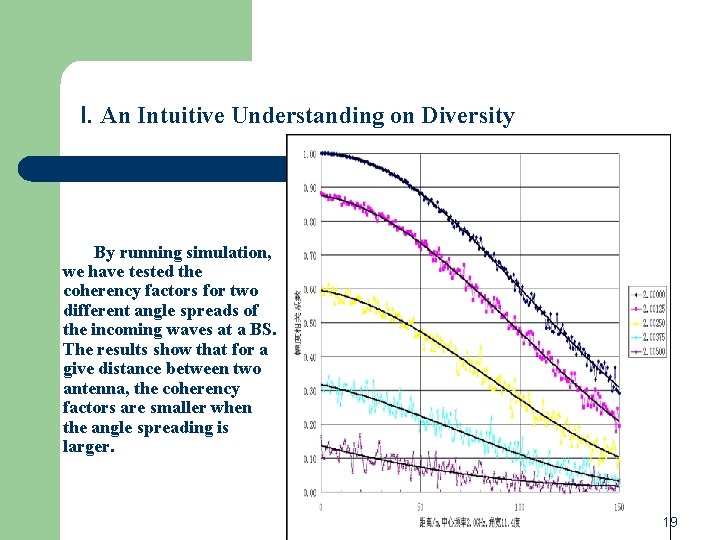
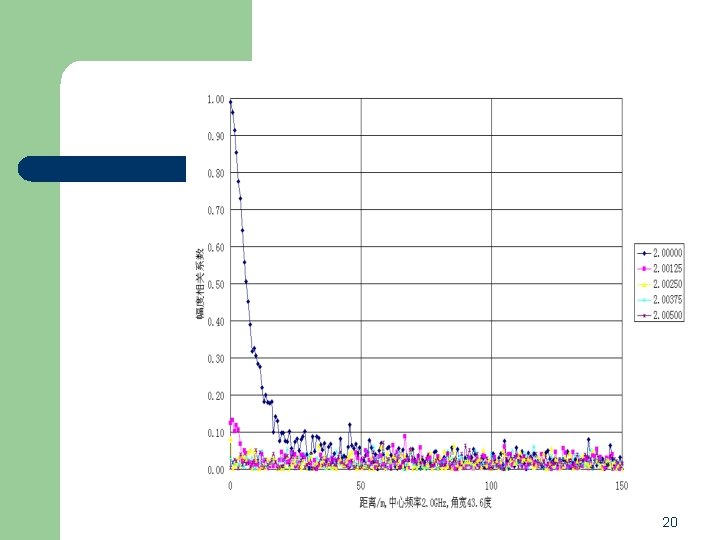
I. An Intuitive Understanding on Diversity By running simulation, we have tested the coherency factors for two different angle spreads of the incoming waves at a BS. The results show that for a give distance between two antenna, the coherency factors are smaller when the angle spreading is larger. 19
20
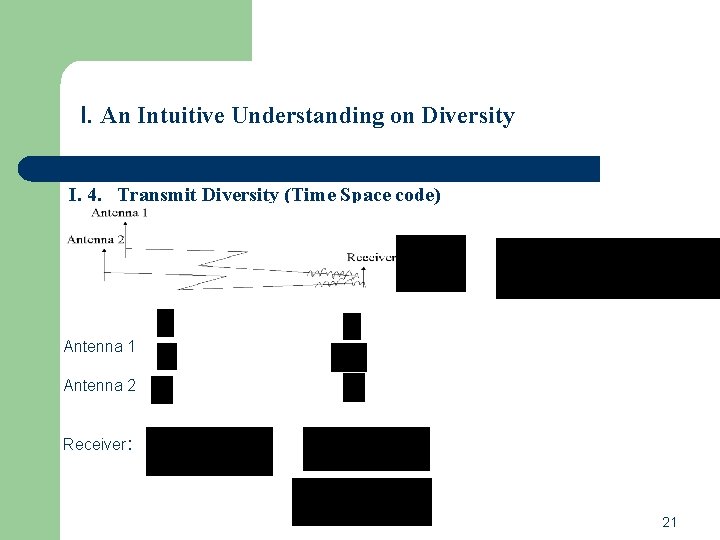
I. An Intuitive Understanding on Diversity I. 4. Transmit Diversity (Time Space code) Antenna 1 Antenna 2 Receiver: 21
I. An Intuitive Understanding on Diversity 22
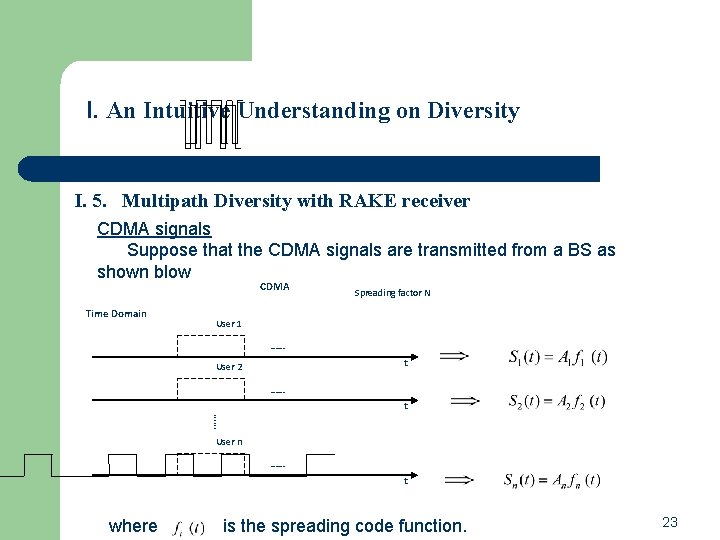
I. An Intuitive Understanding on Diversity I. 5. Multipath Diversity with RAKE receiver CDMA signals Suppose that the CDMA signals are transmitted from a BS as shown blow CDMA Time Domain Spreading factor N User 1 …… t User 2 …… t …… User n …… t where is the spreading code function. 23
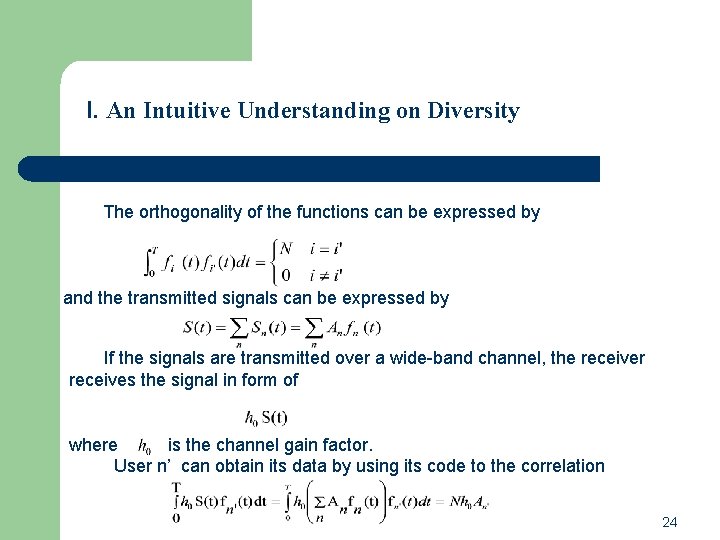
I. An Intuitive Understanding on Diversity The orthogonality of the functions can be expressed by and the transmitted signals can be expressed by If the signals are transmitted over a wide-band channel, the receiver receives the signal in form of where is the channel gain factor. User n’ can obtain its data by using its code to the correlation 24
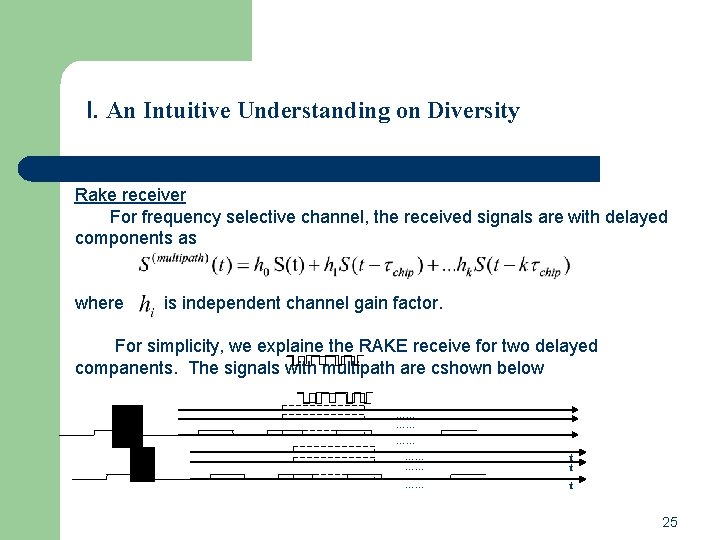
I. An Intuitive Understanding on Diversity Rake receiver For frequency selective channel, the received signals are with delayed components as where is independent channel gain factor. For simplicity, we explaine the RAKE receive for two delayed companents. The signals with multipath are cshown below …… …… …… t t …… t 25
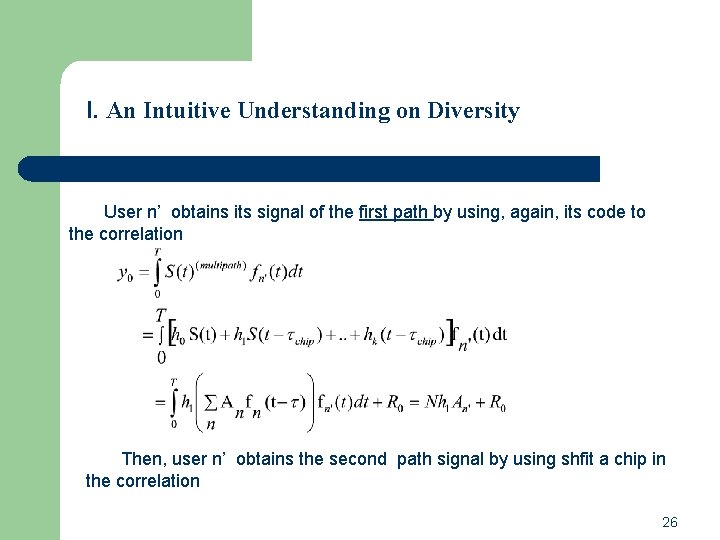
I. An Intuitive Understanding on Diversity User n’ obtains its signal of the first path by using, again, its code to the correlation Then, user n’ obtains the second path signal by using shfit a chip in the correlation 26
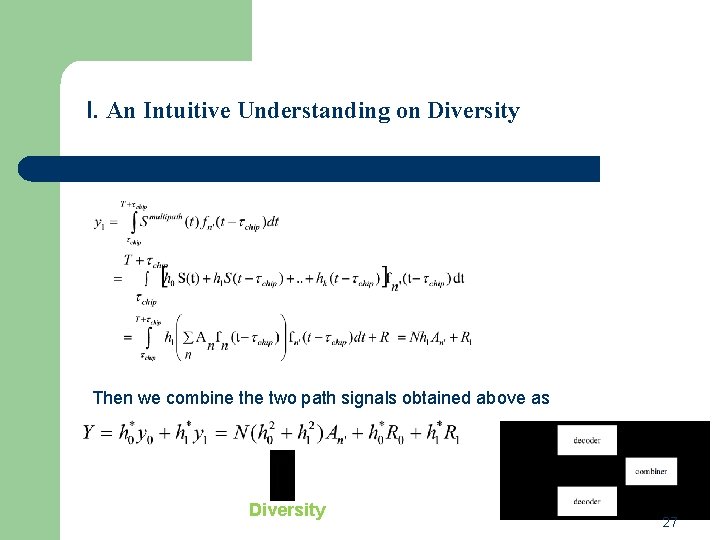
I. An Intuitive Understanding on Diversity Then we combine the two path signals obtained above as Diversity 27
II. Smart Antenna and MIMO II. 1. Smart antenna II. 2. Application of Smart antenna in CDMA system II. 3 An intuitive Understanding of MIMO 28
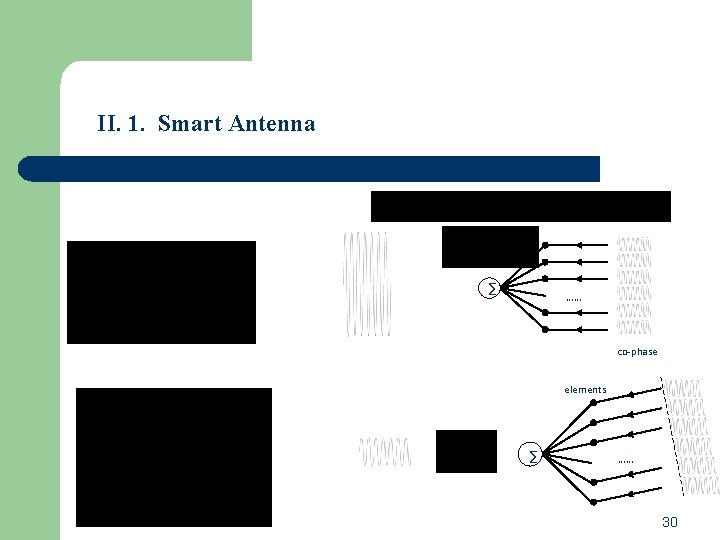
II. 1. Smart Antenna Smart anteena was proposed in 3 G systems for suppressing, over reverse link channel, the interference arriving in difference angles from that of the desired user. Consequuently, the capacity will be increased. In addition, the use of smart antenna over forward link channe can limit the interference in angel spread. Smart antenna consists of antenna array and adaptive filter. The directivity can be found from an antenna array in the following examples. 29
II. 1. Smart Antenna ∑ …… co-phase elements ∑ …… 30
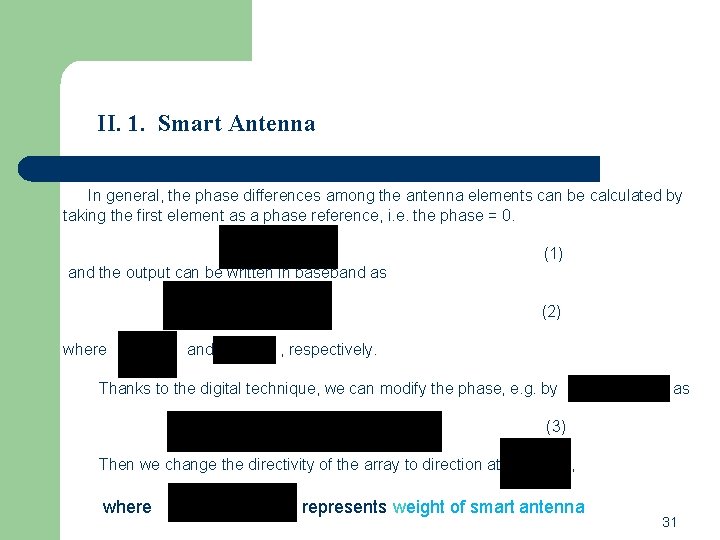
II. 1. Smart Antenna In general, the phase differences among the antenna elements can be calculated by taking the first element as a phase reference, i. e. the phase = 0. (1) and the output can be written in baseband as (2) where and , respectively. Thanks to the digital technique, we can modify the phase, e. g. by as (3) Then we change the directivity of the array to direction at where , represents weight of smart antenna 31
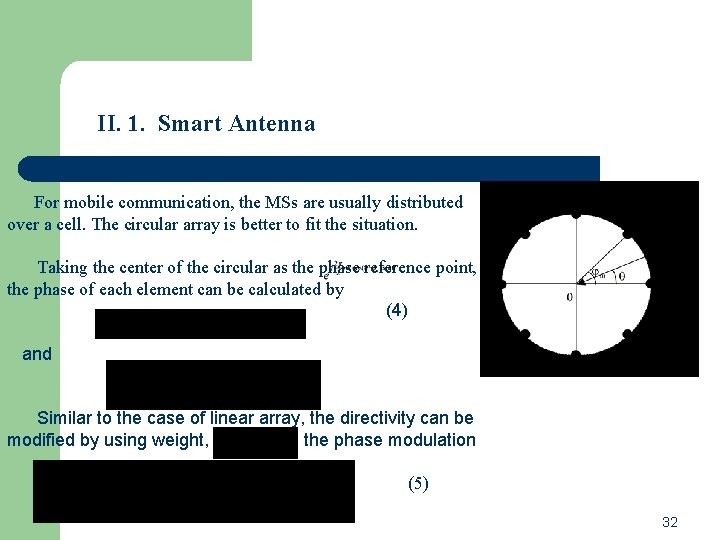
II. 1. Smart Antenna For mobile communication, the MSs are usually distributed over a cell. The circular array is better to fit the situation. Taking the center of the circular as the phase reference point, the phase of each element can be calculated by (4) and Similar to the case of linear array, the directivity can be modified by using weight, , the phase modulation (5) 32
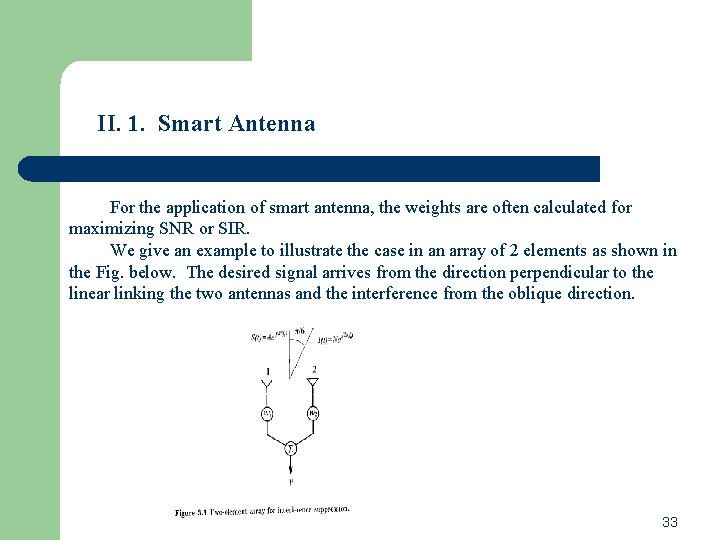
II. 1. Smart Antenna For the application of smart antenna, the weights are often calculated for maximizing SNR or SIR. We give an example to illustrate the case in an array of 2 elements as shown in the Fig. below. The desired signal arrives from the direction perpendicular to the linear linking the two antennas and the interference from the oblique direction. 33
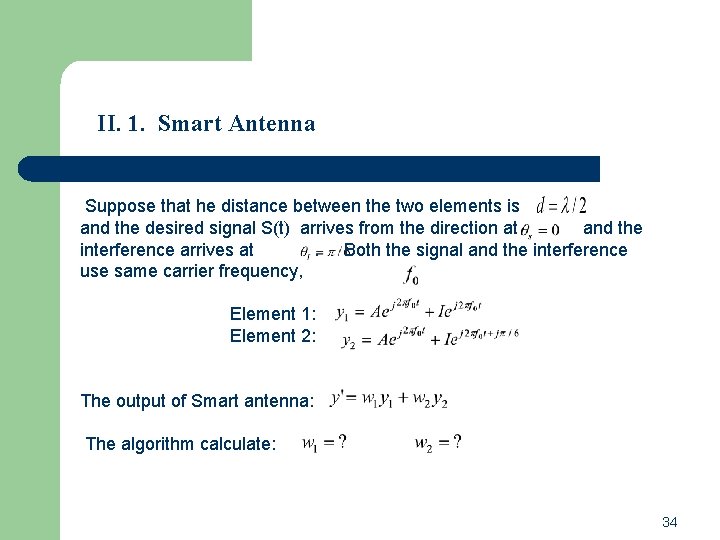
II. 1. Smart Antenna Suppose that he distance between the two elements is and the desired signal S(t) arrives from the direction at and the interference arrives at. Both the signal and the interference use same carrier frequency, Element 1: Element 2: The output of Smart antenna: The algorithm calculate: 34
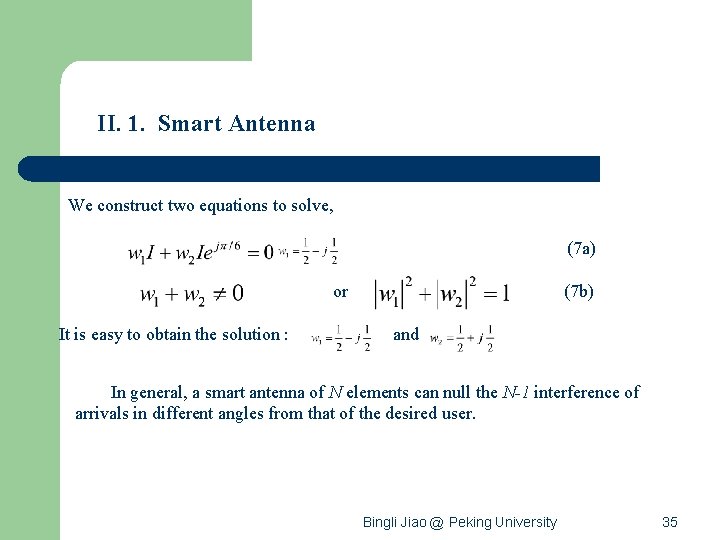
II. 1. Smart Antenna We construct two equations to solve, (7 a) or It is easy to obtain the solution : (7 b) and In general, a smart antenna of N elements can null the N-1 interference of arrivals in different angles from that of the desired user. Bingli Jiao @ Peking University 35
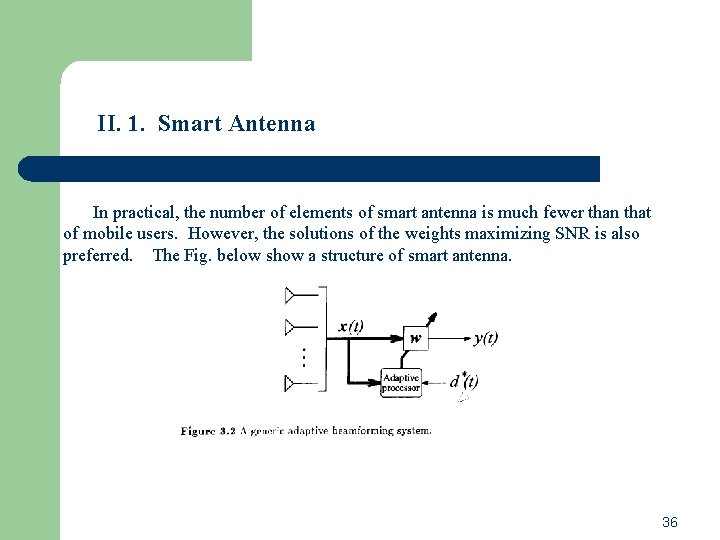
II. 1. Smart Antenna In practical, the number of elements of smart antenna is much fewer than that of mobile users. However, the solutions of the weights maximizing SNR is also preferred. The Fig. below show a structure of smart antenna. 36
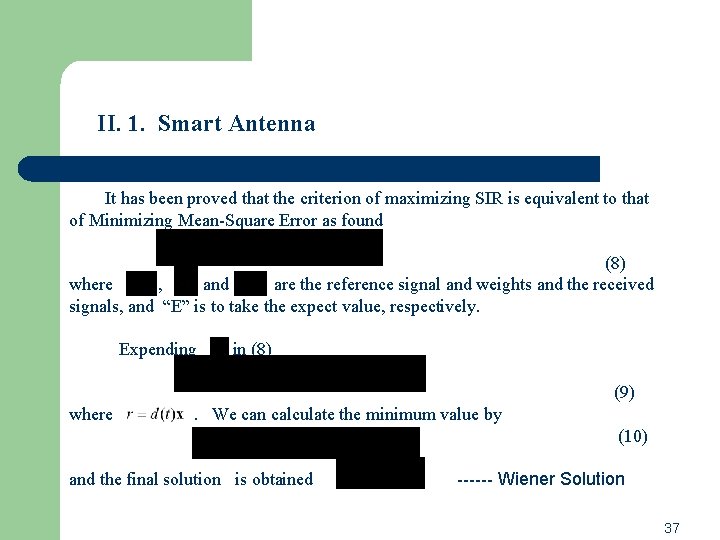
II. 1. Smart Antenna It has been proved that the criterion of maximizing SIR is equivalent to that of Minimizing Mean-Square Error as found (8) where , and are the reference signal and weights and the received signals, and “E” is to take the expect value, respectively. Expending in (8) (9) where . We can calculate the minimum value by (10) and the final solution is obtained ------ Wiener Solution 37
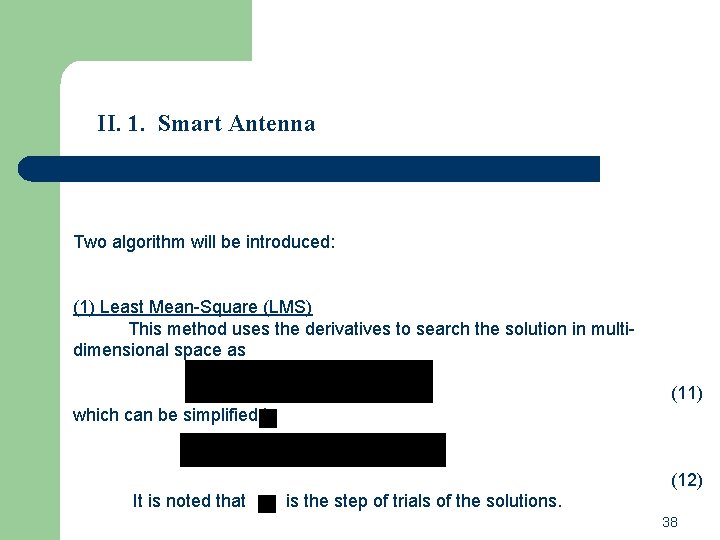
II. 1. Smart Antenna Two algorithm will be introduced: (1) Least Mean-Square (LMS) This method uses the derivatives to search the solution in multidimensional space as (11) which can be simplified to (12) It is noted that is the step of trials of the solutions. 38
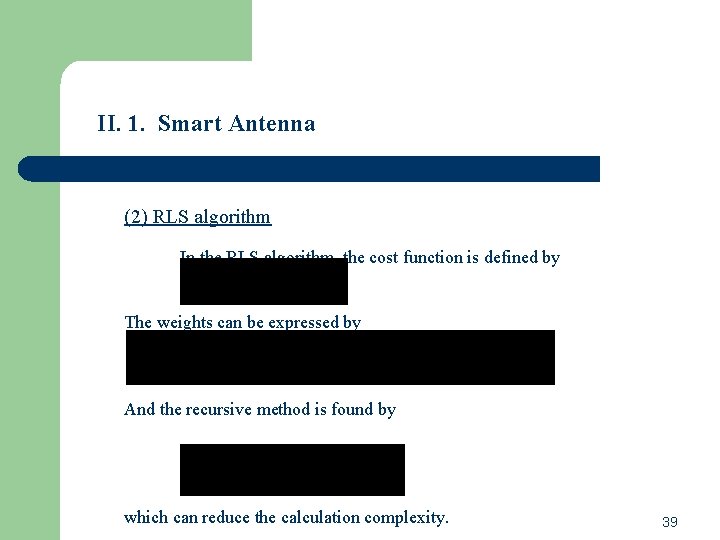
II. 1. Smart Antenna (2) RLS algorithm In the RLS algorithm, the cost function is defined by The weights can be expressed by And the recursive method is found by which can reduce the calculation complexity. 39
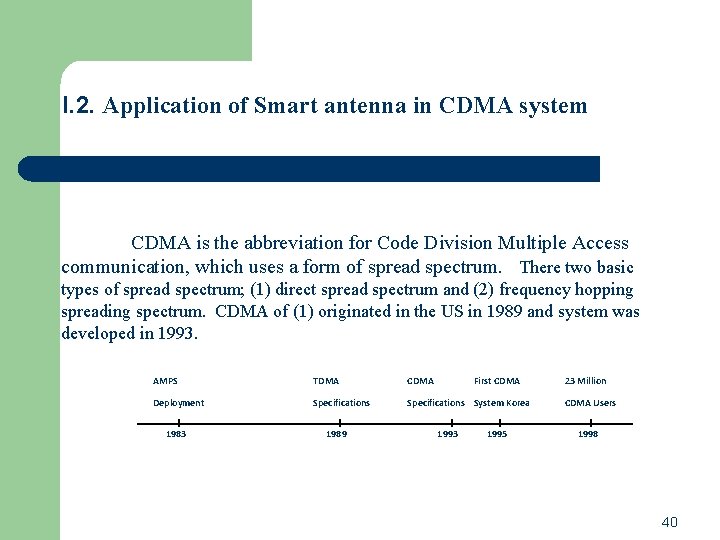
I. 2. Application of Smart antenna in CDMA system CDMA is the abbreviation for Code Division Multiple Access communication, which uses a form of spread spectrum. There two basic types of spread spectrum; (1) direct spread spectrum and (2) frequency hopping spreading spectrum. CDMA of (1) originated in the US in 1989 and system was developed in 1993. AMPS TDMA CDMA Deployment Specifications System Korea 1983 1989 First CDMA 1993 1995 23 Million CDMA Users 1998 40
I. 2. Application of Smart antenna in CDMA system In the application of smart antenna in CDMA system, we use the pilot code as the reference signals, as d(t 0 in equation (7) and (8) for calculate the weights. 41
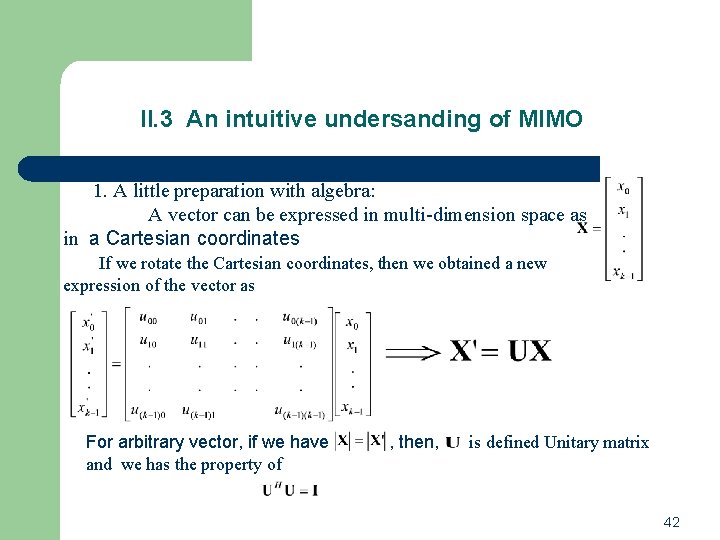
II. 3 An intuitive undersanding of MIMO 1. A little preparation with algebra: A vector can be expressed in multi-dimension space as in a Cartesian coordinates If we rotate the Cartesian coordinates, then we obtained a new expression of the vector as For arbitrary vector, if we have and we has the property of , then, is defined Unitary matrix 42
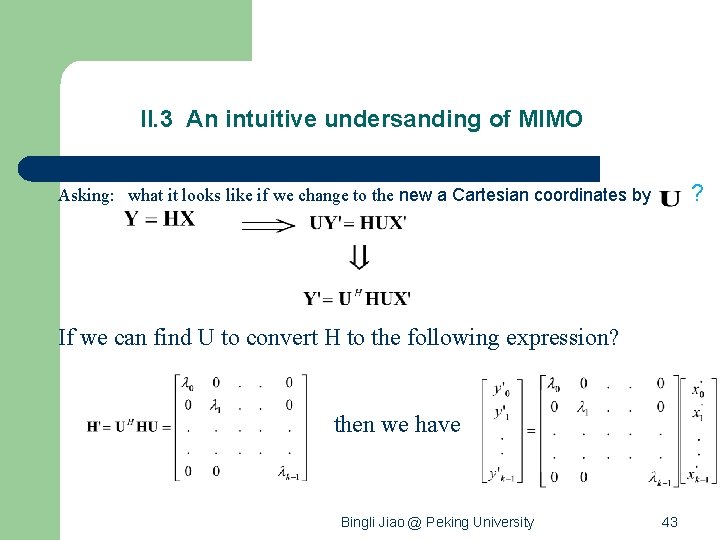
II. 3 An intuitive undersanding of MIMO ? Asking: what it looks like if we change to the new a Cartesian coordinates by If we can find U to convert H to the following expression? then we have Bingli Jiao @ Peking University 43
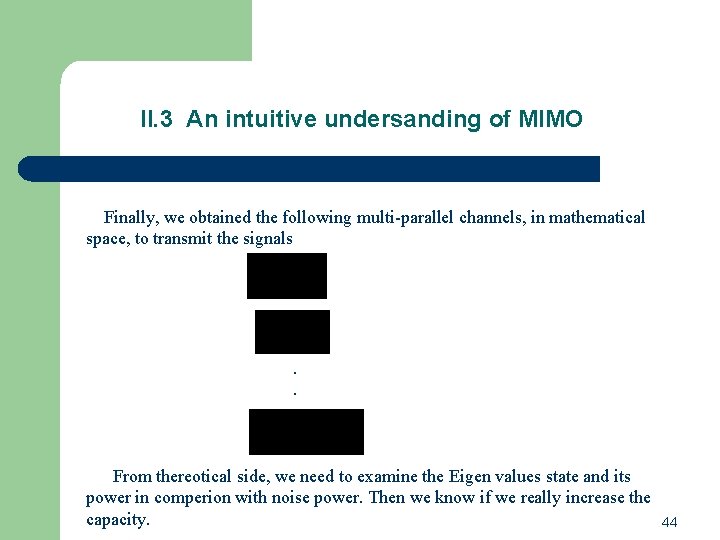
II. 3 An intuitive undersanding of MIMO Finally, we obtained the following multi-parallel channels, in mathematical space, to transmit the signals . . From thereotical side, we need to examine the Eigen values state and its power in comperion with noise power. Then we know if we really increase the capacity. 44
Thanks! 45