
Coursebased Program Assessment Helmut Knaust Joe A Guthrie
Course-based Program Assessment Helmut Knaust & Joe A. Guthrie Department of Mathematical Sciences The University of Texas at El Paso Joint Mathematics Meetings ∙ New ©Orleans LAof·Texas January 9, 2011 The University at El Paso
Overview 1. 2. 3. 4. 5. UTEP and its Math Department Vision, Mission, Competencies Assessment Plan Assessment in the Analysis course Results and Challenges © The University of Texas at El Paso
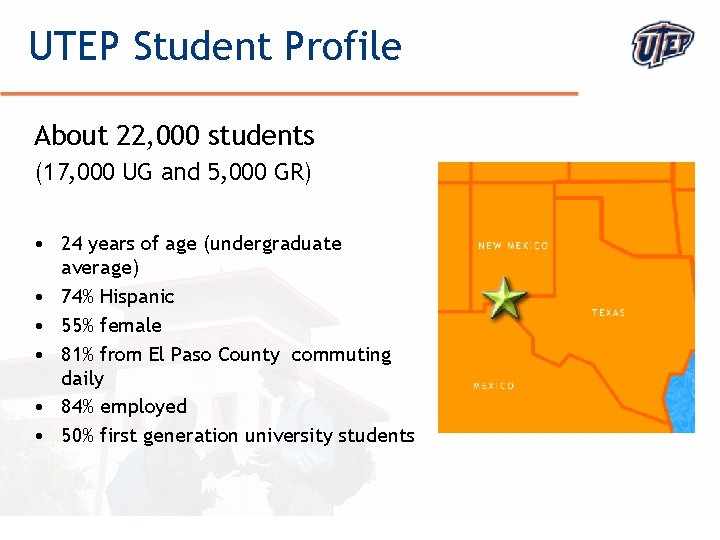
UTEP Student Profile About 22, 000 students (17, 000 UG and 5, 000 GR) • 24 years of age (undergraduate average) • 74% Hispanic • 55% female • 81% from El Paso County commuting daily • 84% employed • 50% first generation university students © The University of Texas at El Paso
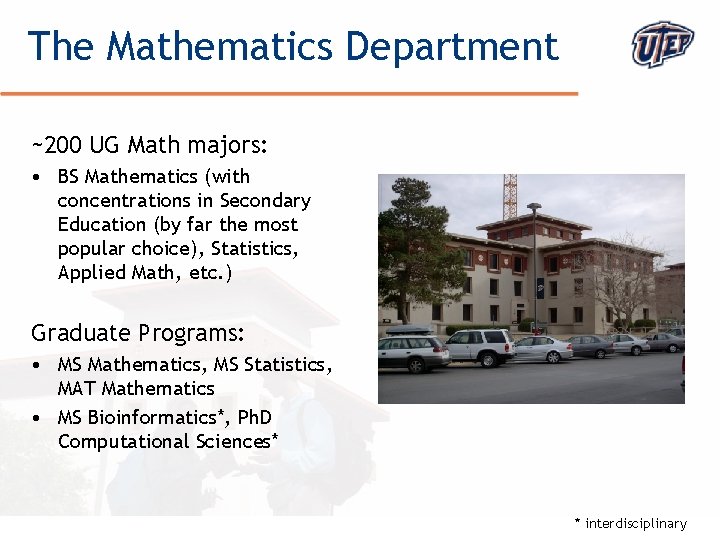
The Mathematics Department ~200 UG Math majors: • BS Mathematics (with concentrations in Secondary Education (by far the most popular choice), Statistics, Applied Math, etc. ) Graduate Programs: • MS Mathematics, MS Statistics, MAT Mathematics • MS Bioinformatics*, Ph. D Computational Sciences* © The University of Texas at El Paso * interdisciplinary
Getting Started Process driven by Accreditation Requirements (SACS) Creation of a Strategic Planning Committee Consisting of five department members • • “High profile”: Department chair as committee chair “Departmental opinion leaders” Representing all sub-disciplines within the department Varying experience from Assistant Professor to Full Professor Working on a Vision and Mission Statement • Lots of “talking” • Slowly coming to an understanding about the future path of the department • Very slow but steady progress • Surprise: All committee members envision quite similar student outcomes! Spring & Fall 2004 © The University of Texas at El Paso
Basic Student Competencies Department agrees on the following student learning outcomes: 1. Given initial information and data from various domains, students will be able to identify problems, and using appropriate mathematical tools, formulate and solve them. 2. Students will be able to understand, create and analyze mathematical proofs. 3. Students will be able to communicate mathematics clearly in oral and written form. Early 2005 © The University of Texas at El Paso
Assessment in Seven Courses (I) 1. Discrete Mathematics 2. Introduction to Higher Mathematics • Sophomore courses; students take one of these two courses. “Intro to Higher Math” is “Math as a Laboratory Science”. Discrete Math is also taken by Computer Science majors. 3. Principles of Mathematics • Junior level proof course; taken by (almost) all math majors. 4. Introduction to Analysis • Junior level course; “Analysis on the Real Line”. 5. Fundamental Mathematics from an Advanced Standpoint • Spring 2008 Senior level capstone course for future secondary education teachers; topic is high school algebra. © The University of Texas at El Paso

Assessment in Seven Courses (II) 6. Statistics • Senior level course; has probability course as a prerequisite. Not a requirement for Math majors. 7. Numerical Analysis • Senior level introductory numerical methods course; also taken by Computer Science majors. Faculty groups design the assessment details for each course. Fall 2008 © The University of Texas at El Paso
Example- Analysis (I) # Course Goal Linked to Outcome 1 Student will become familiar with the fundamental results of "Analysis 2 on the Real Line" (highlights of the course include the Intermediate Value Theorem, the Mean Value Theorem and possibly the Fundamental Theorem of Calculus) 2 Students will thoroughly understand the definitions of the basic concepts of Analysis such as convergence, continuity, differentiation and integration 2 3 Students will be able to apply definitions and theorems in Analysis 4 Students will continue to develop their ability to use the method of proof to establish the fundamental results in Analysis 2 2 5 Students will employ effective strategies to decide the truth or falsity of mathematical propositions 2 6 Students will be able to write down proofs in a clear, concise manner using correct English and mathematical grammar. 3 7 Students will be able to present and defend a proof to a group of their peers. 3 © The University of Texas at El Paso
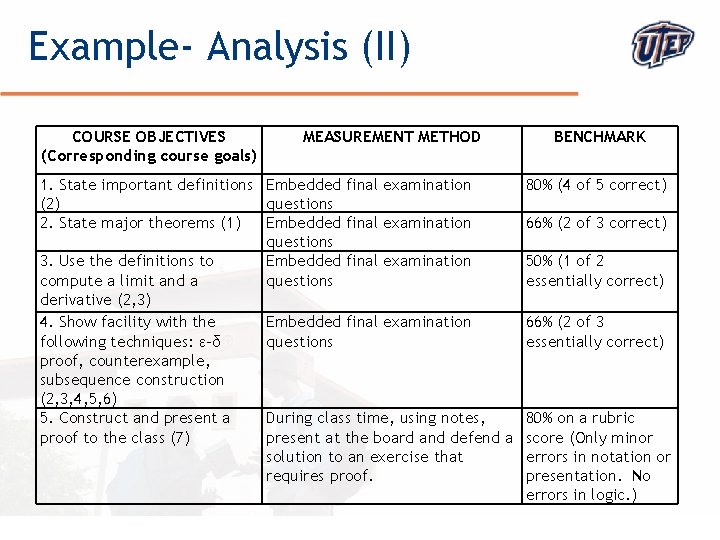
Example- Analysis (II) COURSE OBJECTIVES (Corresponding course goals) MEASUREMENT METHOD BENCHMARK 1. State important definitions Embedded final examination 80% (4 of 5 correct) (2) questions 2. State major theorems (1) Embedded final examination 66% (2 of 3 correct) questions 3. Use the definitions to Embedded final examination 50% (1 of 2 compute a limit and a questions essentially correct) derivative (2, 3) 4. Show facility with the Embedded final examination 66% (2 of 3 following techniques: ε-δ questions essentially correct) proof, counterexample, subsequence construction (2, 3, 4, 5, 6) 5. Construct and present a During class time, using notes, 80% on a rubric proof to the class (7) present at the board and defend a score (Only minor solution to an exercise that errors in notation or requires proof. presentation. No errors in logic. ) © The University of Texas at El Paso
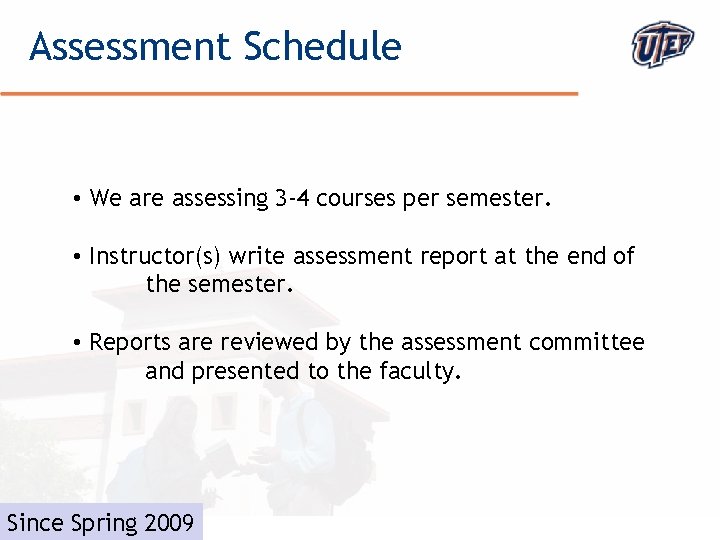
Assessment Schedule • We are assessing 3 -4 courses per semester. • Instructor(s) write assessment report at the end of the semester. • Reports are reviewed by the assessment committee and presented to the faculty. Since Spring 2009 © The University of Texas at El Paso
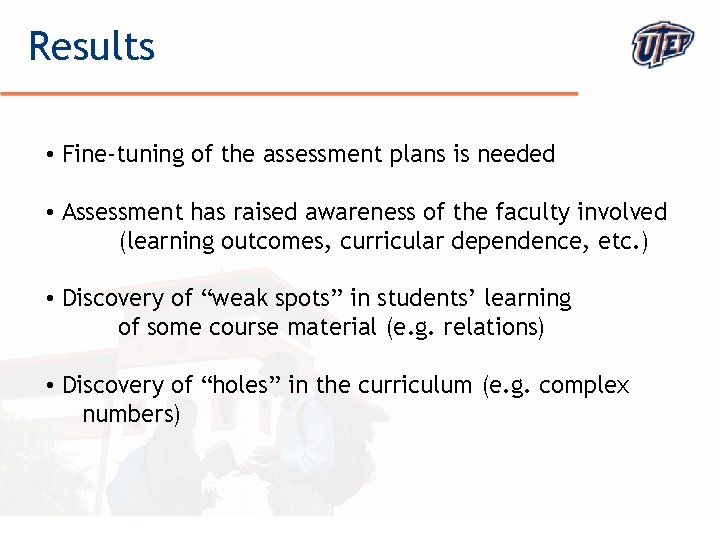
Results • Fine-tuning of the assessment plans is needed • Assessment has raised awareness of the faculty involved (learning outcomes, curricular dependence, etc. ) • Discovery of “weak spots” in students’ learning of some course material (e. g. relations) • Discovery of “holes” in the curriculum (e. g. complex numbers) © The University of Texas at El Paso
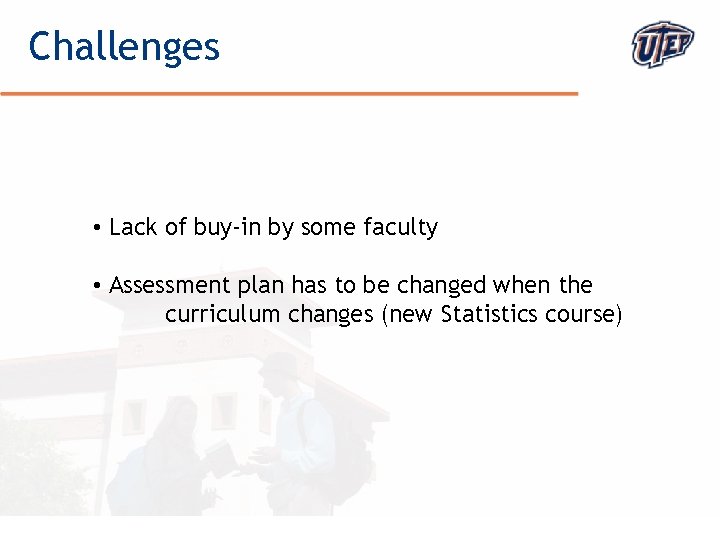
Challenges • Lack of buy-in by some faculty • Assessment plan has to be changed when the curriculum changes (new Statistics course) © The University of Texas at El Paso
Contact Info Helmut Knaust hknaust@utep. edu Joe A. Guthrie jguthrie@utep. edu © The University of Texas at El Paso
- Slides: 14