
Course Welcome The Emergency Management Institute developed the
- Slides: 20
Course Welcome The Emergency Management Institute developed the IS-200. c Basic Incident Command System for Initial Response, ICS 200 course in collaboration with: • National Wildfire Coordinating Group (NWCG) • U. S. Department of Agriculture (USDA) • U. S. Fire Administration's National Fire Programs Branch • United States Coast Guard (USCG) IS-200. c follows NIMS guidelines and meets the National Incident Management System (NIMS) Baseline Training requirements for ICS 200. 1
Course Objectives This course is designed to enable personnel to operate efficiently during an incident or event within the Incident Command System (ICS) and focuses on the management of an initial response to an incident. Overall Course Objectives At the end of the course, you should be able to: • Describe the course objectives and summarize basic information about the Incident Command System (ICS) and National Incident Management System (NIMS). • Describe how the NIMS Management Characteristics relate to Incident Command Unified Command. • Describe the delegation of authority process, implementing authorities, management by objectives, and preparedness plans and objectives. • Identify ICS organizational components, the Command Staff, the General Staff, and ICS tools. • Describe different types of briefings and meetings. • Explain flexibility within the standard ICS organizational structure. • Explain transfer of command briefings and procedures. • Use ICS to manage an incident or event. 2
Student Introductions Introduce yourself by providing: • Your name • Your job title • A brief statement of your overall experience with emergency or incident response • Your possible roles in responding to incidents 3
Student Expectations What do you expect to gain from this course? 4
Instructor Expectations • Cooperate with the group. • Be open minded to new ideas. • Participate actively in all of the training activities. • Return to class at the stated time. • Use what you learn in the course to perform effectively within an ICS organization. 5
Course Structure This course is divided into eight units plus the Course Summary. • Unit 1: Course Overview • Unit 2: Incident Command Unified Command • Unit 3: Delegation of Authority and Management by Objectives • Unit 4: Functional Areas and Positions • Unit 5: Incident Briefings and Meetings • Unit 6: Organizational Flexibility • Unit 7: Transfer of Command • Unit 8: Application Activity • Unit 9: Course Summary 6
Course Logistics Review the following information: • Course agenda • Sign-in sheet • Breaks • Message and telephone location • Cell phone policy • Facilities • Other concerns 7
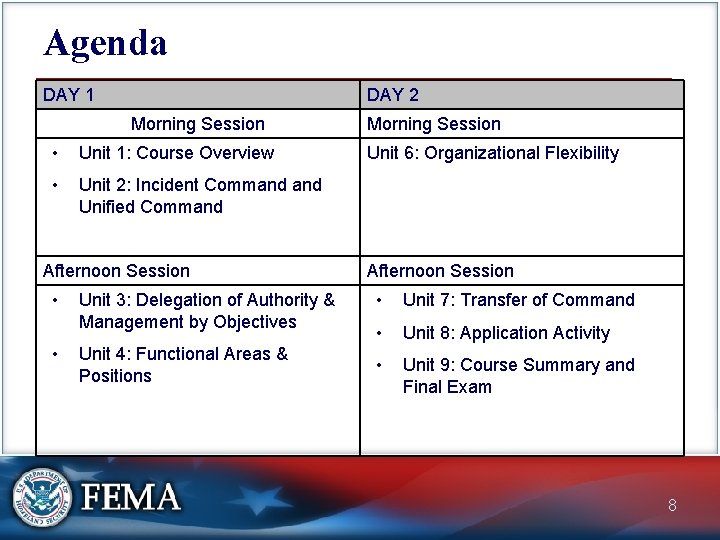
Agenda DAY 1 DAY 2 Morning Session • Unit 1: Course Overview • Unit 2: Incident Command Unified Command Afternoon Session • • Unit 3: Delegation of Authority & Management by Objectives Unit 4: Functional Areas & Positions Morning Session Unit 6: Organizational Flexibility Afternoon Session • Unit 7: Transfer of Command • Unit 8: Application Activity • Unit 9: Course Summary and Final Exam 8
Course Completion In order to successfully complete this course, you must: • Participate in unit activities. • Achieve 75% or higher on the final exam. • Complete the end-of-course evaluation. 9
Lesson 1 Overview This lesson provides an overview of the Incident Command System (ICS) and the National Incident Management System (NIMS). Lesson Objectives At the end of this lesson, you should be able to: • Describe the Incident Command System (ICS). • Describe the National Incident Management System (NIMS). 10
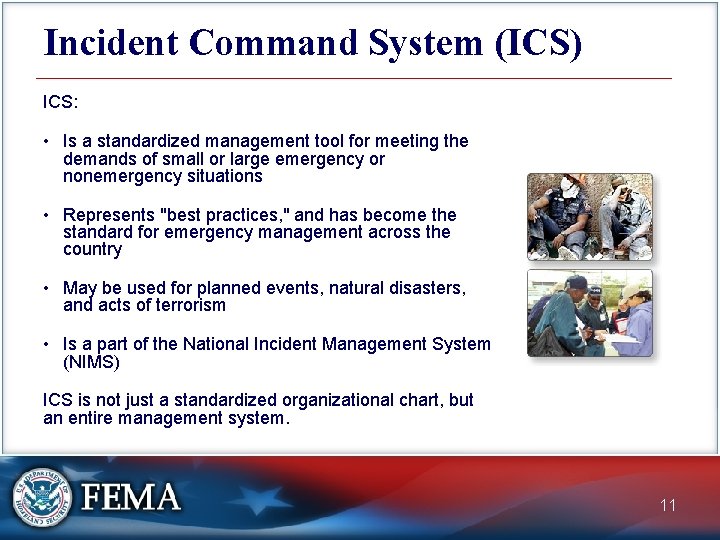
Incident Command System (ICS) ICS: • Is a standardized management tool for meeting the demands of small or large emergency or nonemergency situations • Represents "best practices, " and has become the standard for emergency management across the country • May be used for planned events, natural disasters, and acts of terrorism • Is a part of the National Incident Management System (NIMS) ICS is not just a standardized organizational chart, but an entire management system. 11
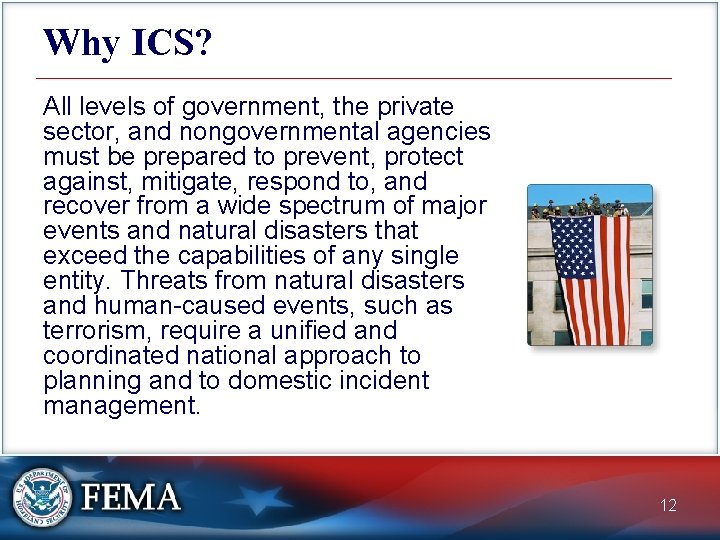
Why ICS? All levels of government, the private sector, and nongovernmental agencies must be prepared to prevent, protect against, mitigate, respond to, and recover from a wide spectrum of major events and natural disasters that exceed the capabilities of any single entity. Threats from natural disasters and human-caused events, such as terrorism, require a unified and coordinated national approach to planning and to domestic incident management. 12
Homeland Security Presidential Directives HSPD-5, Management of Domestic Incidents, identified steps for improved coordination in response to incidents. It required the Department of Homeland Security (DHS) to coordinate with other Federal departments and agencies and State, local, and tribal governments to establish a National Response Framework (NRF) and a National Incident Management System (NIMS). HSPD-8, National Preparedness, directed DHS to lead a national initiative to develop a National Preparedness System—a common, unified approach to “strengthen the preparedness of the United States to prevent and respond to threatened or actual domestic terrorist attacks, major disasters, and other emergencies. ” Presidential Policy Directive 8 (PPD-8), National Preparedness, describes the Nation's approach to preparedness-one that involves the whole community, including individuals, businesses, communityand faith-based organizations, schools, tribes, and all levels of government (Federal, State, local, tribal and territorial). 13
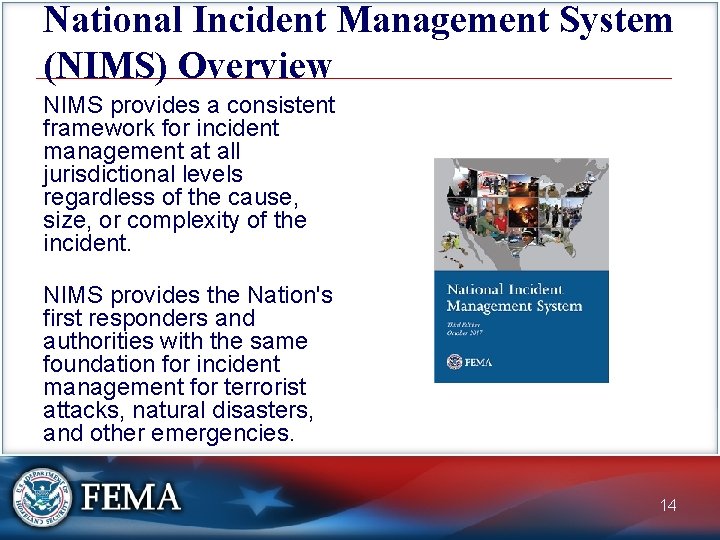
National Incident Management System (NIMS) Overview NIMS provides a consistent framework for incident management at all jurisdictional levels regardless of the cause, size, or complexity of the incident. NIMS provides the Nation's first responders and authorities with the same foundation for incident management for terrorist attacks, natural disasters, and other emergencies. 14
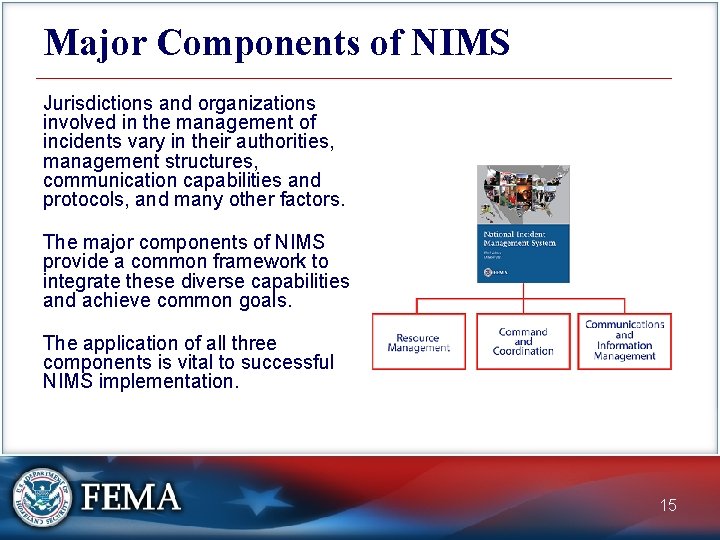
Major Components of NIMS Jurisdictions and organizations involved in the management of incidents vary in their authorities, management structures, communication capabilities and protocols, and many other factors. The major components of NIMS provide a common framework to integrate these diverse capabilities and achieve common goals. The application of all three components is vital to successful NIMS implementation. 15
NIMS Management Characteristics: Overview 16
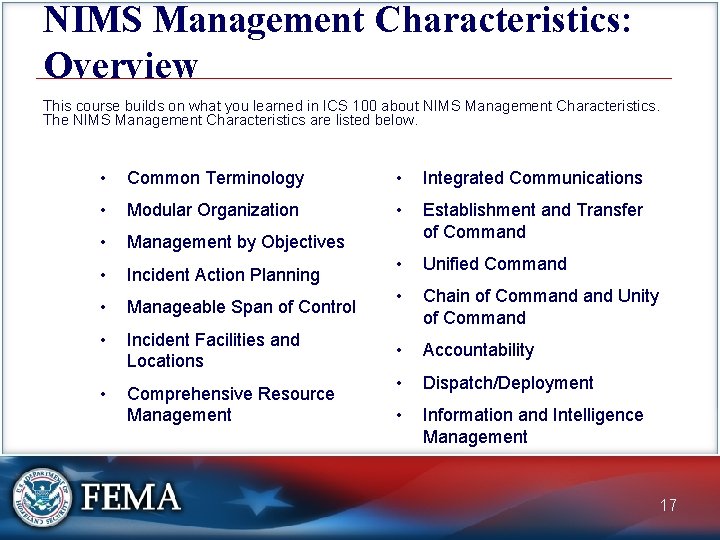
NIMS Management Characteristics: Overview This course builds on what you learned in ICS 100 about NIMS Management Characteristics. The NIMS Management Characteristics are listed below. • Common Terminology • Integrated Communications • Modular Organization • • Management by Objectives Establishment and Transfer of Command • Incident Action Planning • Unified Command • Manageable Span of Control • Chain of Command Unity of Command • Incident Facilities and Locations • Accountability • Comprehensive Resource Management • Dispatch/Deployment • Information and Intelligence Management 17
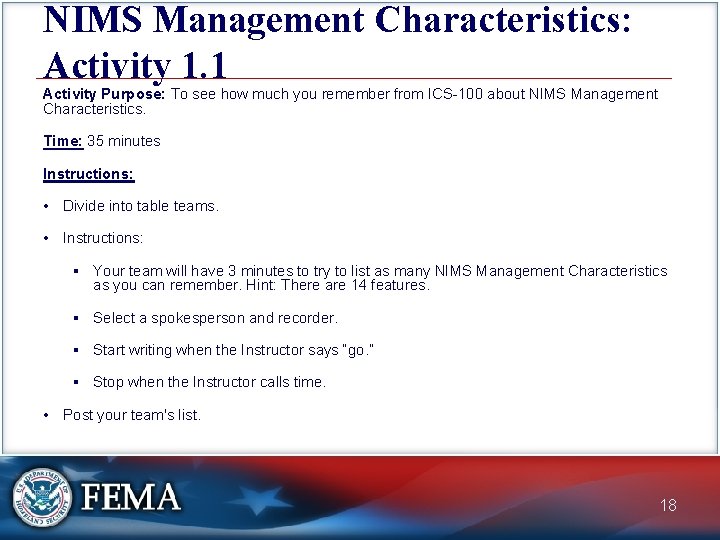
NIMS Management Characteristics: Activity 1. 1 Activity Purpose: To see how much you remember from ICS-100 about NIMS Management Characteristics. Time: 35 minutes Instructions: • Divide into table teams. • Instructions: § Your team will have 3 minutes to try to list as many NIMS Management Characteristics as you can remember. Hint: There are 14 features. § Select a spokesperson and recorder. § Start writing when the Instructor says “go. ” § Stop when the Instructor calls time. • Post your team's list. 18
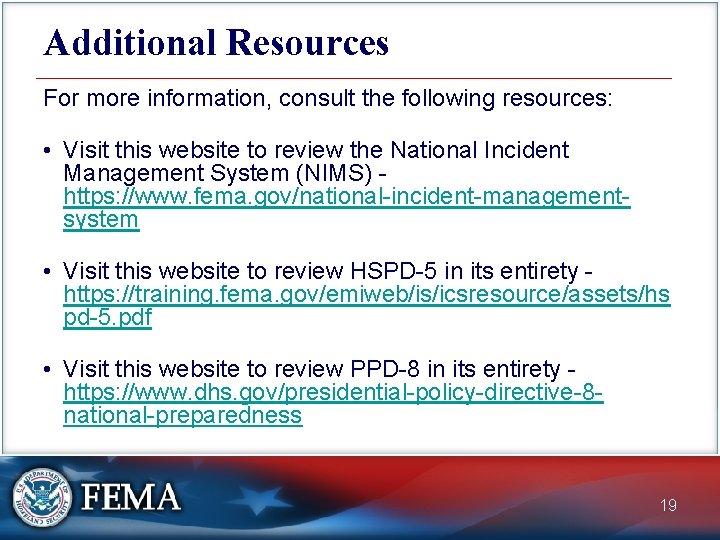
Additional Resources For more information, consult the following resources: • Visit this website to review the National Incident Management System (NIMS) https: //www. fema. gov/national-incident-managementsystem • Visit this website to review HSPD-5 in its entirety https: //training. fema. gov/emiweb/is/icsresource/assets/hs pd-5. pdf • Visit this website to review PPD-8 in its entirety https: //www. dhs. gov/presidential-policy-directive-8 national-preparedness 19
Lesson Summary You have completed the Course Overview lesson. The next lesson will describe how ICS is incorporated within the overall emergency management program. 20