
COURSE TITLE Intermediate Child Abuse TCOLE Course 2105

COURSE TITLE Intermediate Child Abuse TCOLE Course # 2105 UNIT SIX (Final Unit) AND BCCO PCT #4 Power. Point UNIT SIX
UNIT 6 During this unit of instruction the participant will be able to recognize techniques of investigation performed by specialists who have received advanced training. Participant should realize that they can and should receive assistance from specialists in burn investigations, in picture drawing interviews, in play interviewing with dolls or puppets, in preparing the child to be a witness, and in videotaping interviews or testimony. 6. 0
Learning Objectives Learning Objective 6. 1 : The participant will be able to identify investigative considerations in immersion burns. Learning Objective 6. 2 : The participant will be able to identify investigative considerations in branding iron burns. Learning Objective 6. 3 : The participant will be able to identify investigative considerations in retaliation burns. Learning Objective 6. 4 : The participant will be able to identify miscellaneous investigative considerations in various types of burn cases.
Learning Objective 6. 5 : The participant will be able to identify investigative considerations of intentional poisoning. Learning Objective 6. 6: The participant will be able to identify investigative considerations of bite marks. Learning Objective 6. 7 : The participant will be able to identify advanced investigative techniques that are available from specialists with advanced training Learning Objective 6. 8: The participant will be able to identify factors that should be considered in presenting testimony of a child in a child abuse case.
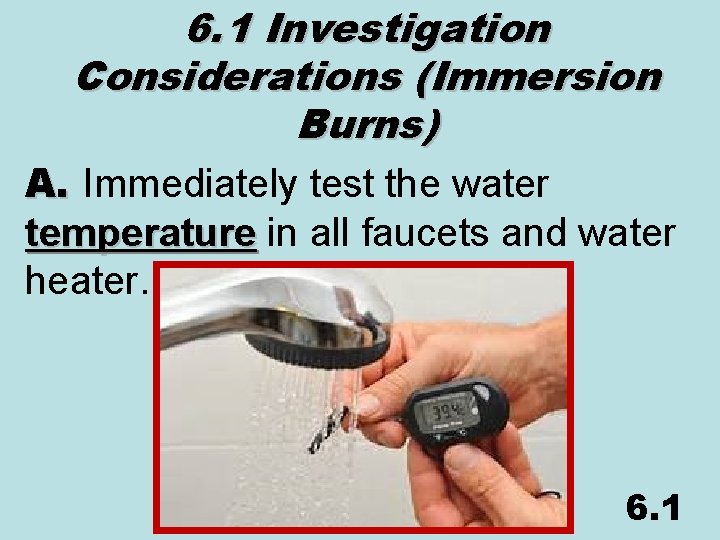
6. 1 Investigation Considerations (Immersion Burns) A. Immediately test the water temperature in all faucets and water heater. 6. 1
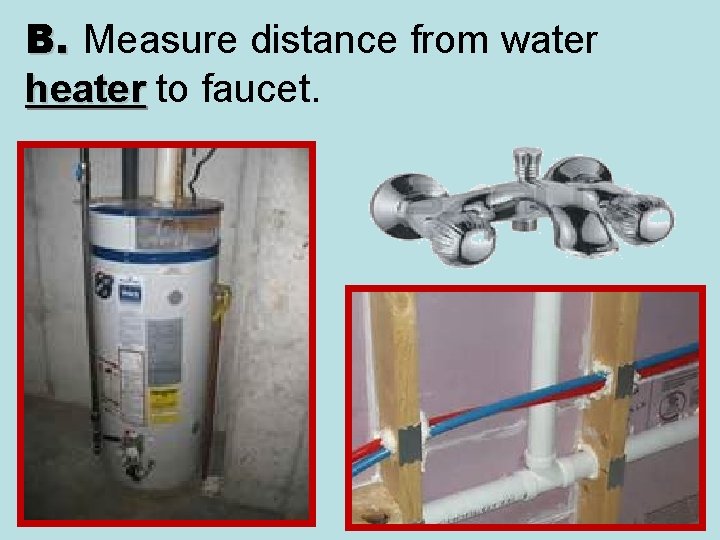
B. Measure distance from water heater to faucet.
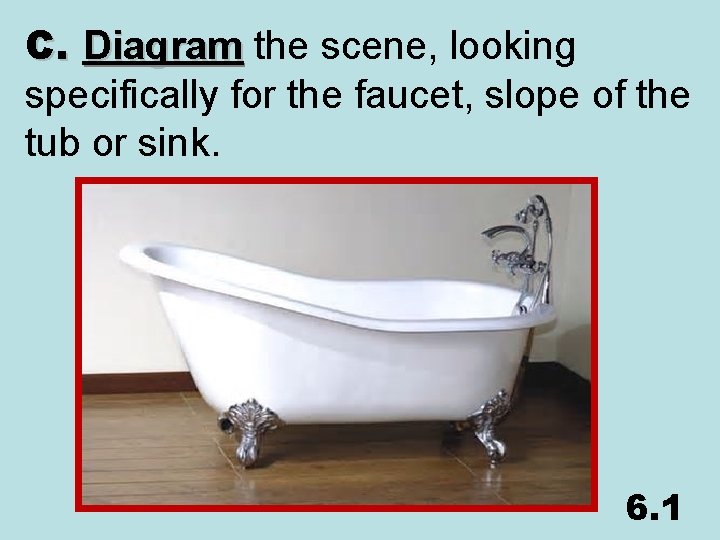
C. Diagram the scene, looking specifically for the faucet, slope of the tub or sink. 6. 1
D. Photographs required: 1. Overview of complete room. 2. Faucet and tub or sink. 3. Water heater 4. Controls of water heater and brand name and size labels. 6. 1
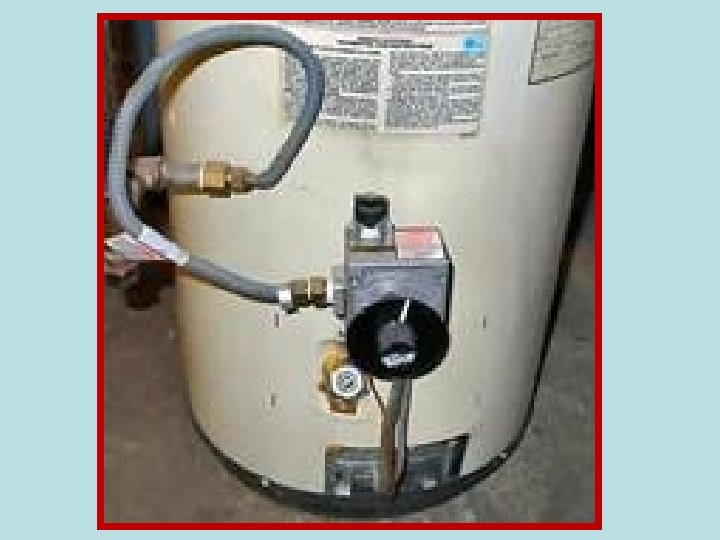
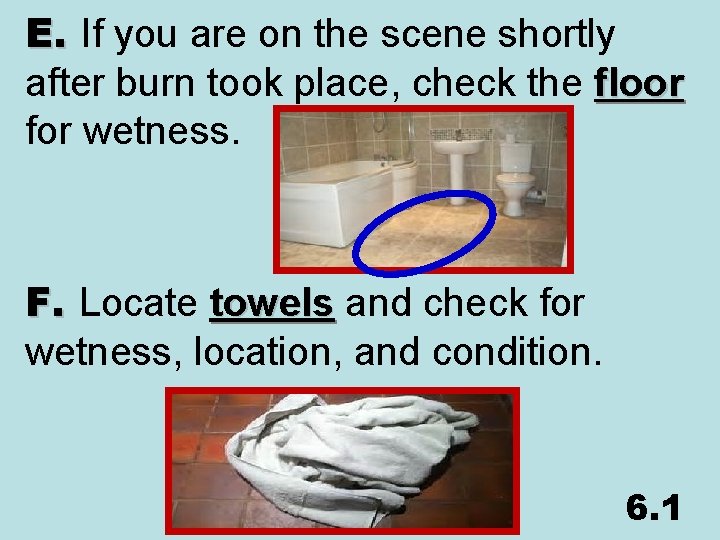
E. If you are on the scene shortly after burn took place, check the floor for wetness. F. Locate towels and check for wetness, location, and condition. 6. 1
G. Measure height of tub and height of child from floor to hip. H. Determine if tub or sink is made of cast iron, steel, plastic or fiberglass. I. Determine amount of time it took to get medical treatment. 6. 1
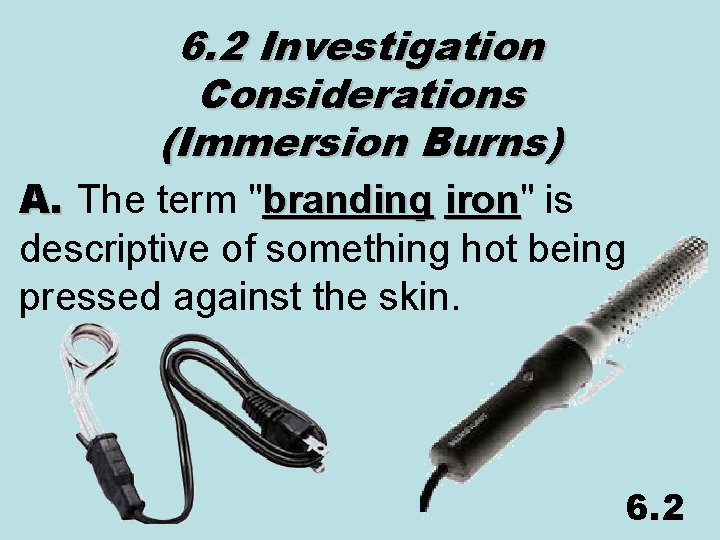
6. 2 Investigation Considerations (Immersion Burns) A. The term "branding iron" iron is descriptive of something hot being pressed against the skin. 6. 2
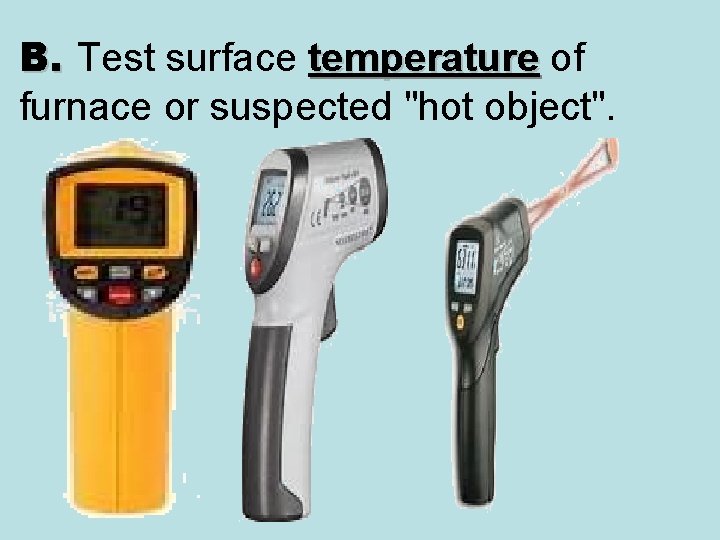
B. Test surface temperature of furnace or suspected "hot object".
C. Diagram suspected area, measuring height of grate, size of grate, and grate pattern. D. Check thermostat to verify if it is in working condition. 6. 2
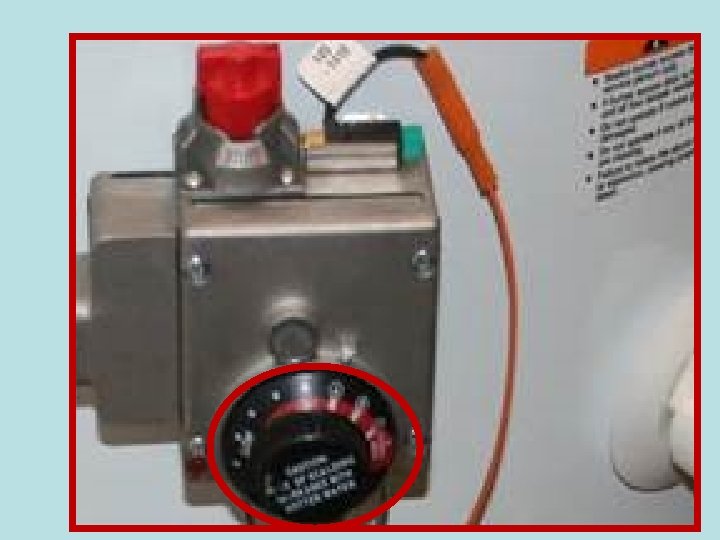
E. Photographs needed: 1. Overview of scene. 2. All angles of actual heated surface (with ruler included). 3. Of heater, heater controls and thermostat 4. Injury area from all angles. 5. Injury 24 hours and 48 hours after 6. 2 incidents.
F. Furnace grates taken into evidence and tested for body residue. G. Photograph re-creation of burn pattern. H. If a suspect object is identified, collect and handle as evidence 6. 2

IMMERSION BURNS
6. 3 Investigation Considerations (Retaliation Burns) A. Photographs needed of: 1. Actual burn 2. Overview of child 3. Reported burn location. 4. Close up of lighter, matches, or 6. 3 burner of stove.
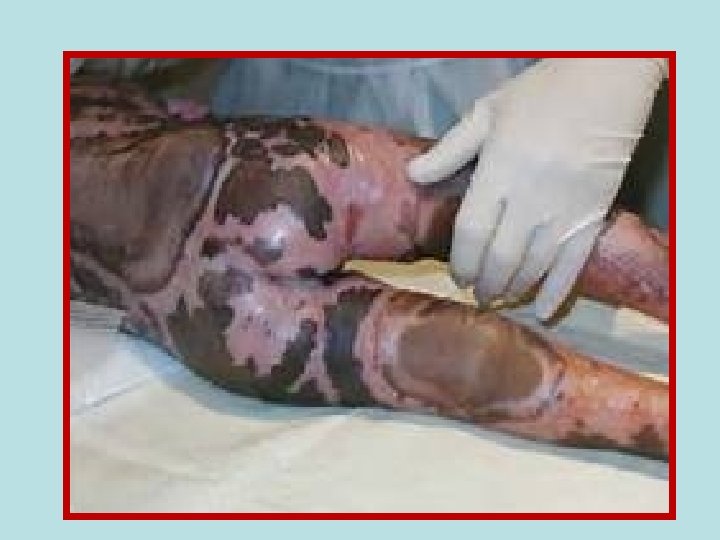
B. If a stove is involved: 1. Measure height from floor to top of stove. 2. Measure inset of burner. C. Measure child: 1. Overall height 2. Floor to raised hand. 6. 3
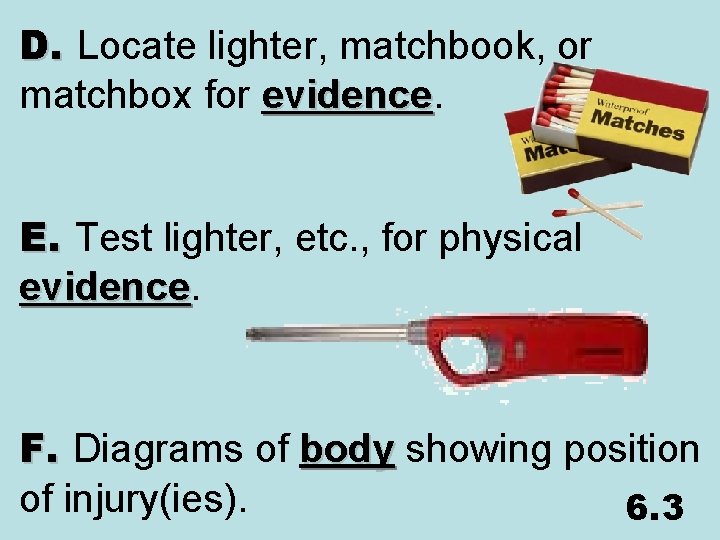
D. Locate lighter, matchbook, or matchbox for evidence E. Test lighter, etc. , for physical evidence F. Diagrams of body showing position of injury(ies). 6. 3
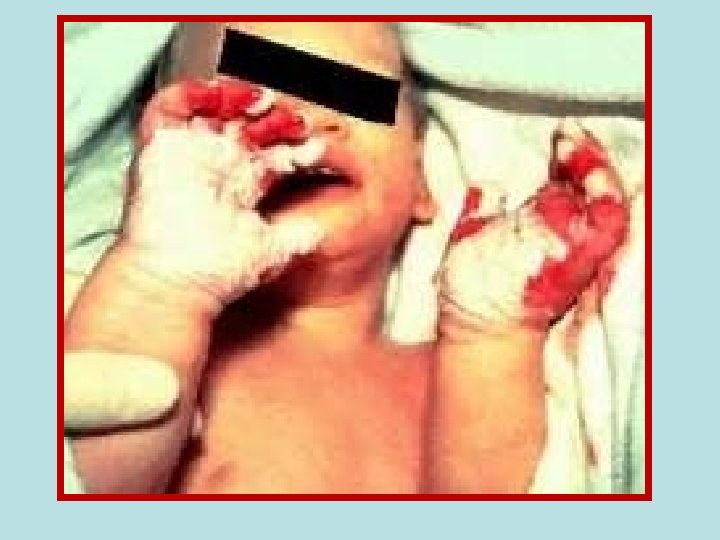
6. 4 Investigation Considerations (Various Types of Burns) A. Head Immersion An immersion burn to the head is unusual and does not frequently occur. Some children are born with an indentation over their soft spot, In some cultures; it is believed dipping the head into hot water can cure this. Partial involvement of the shoulders or arms is common when this occurs. 6. 4
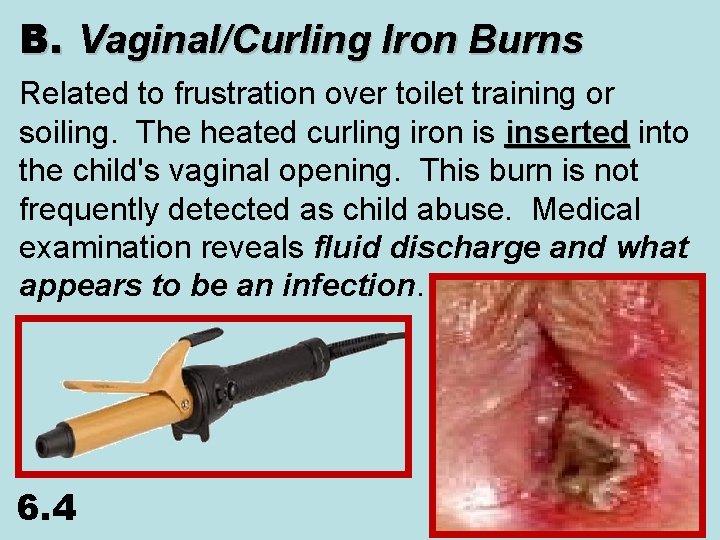
B. Vaginal/Curling Iron Burns Related to frustration over toilet training or soiling. The heated curling iron is inserted into the child's vaginal opening. This burn is not frequently detected as child abuse. Medical examination reveals fluid discharge and what appears to be an infection. 6. 4
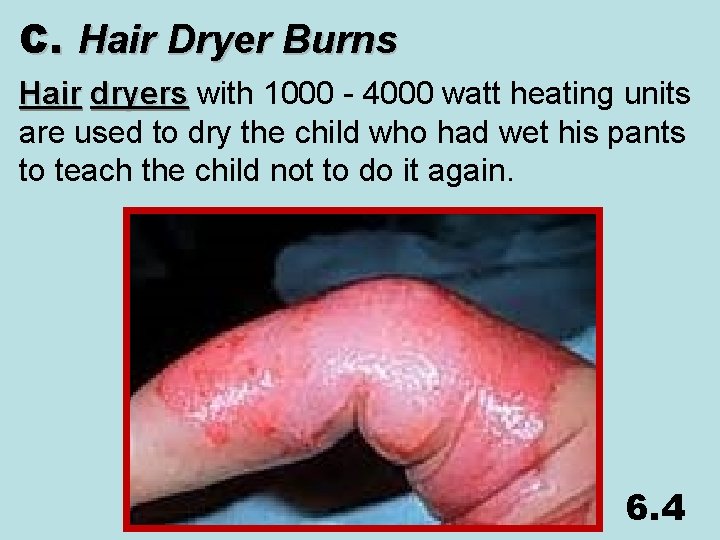
C. Hair Dryer Burns Hair dryers with 1000 - 4000 watt heating units are used to dry the child who had wet his pants to teach the child not to do it again. 6. 4
D. Pour and Splash Burns This type of burn is caused by hot liquid, liquid usually water, being poured or thrown at the child's body. Splash burns have very irregular outlines and irregular patterns of burn penetration. These irregularities are caused by closeness to the heat source, the body position when burned, and the expected irregular pattern of uncontrolled water movement. 6. 4
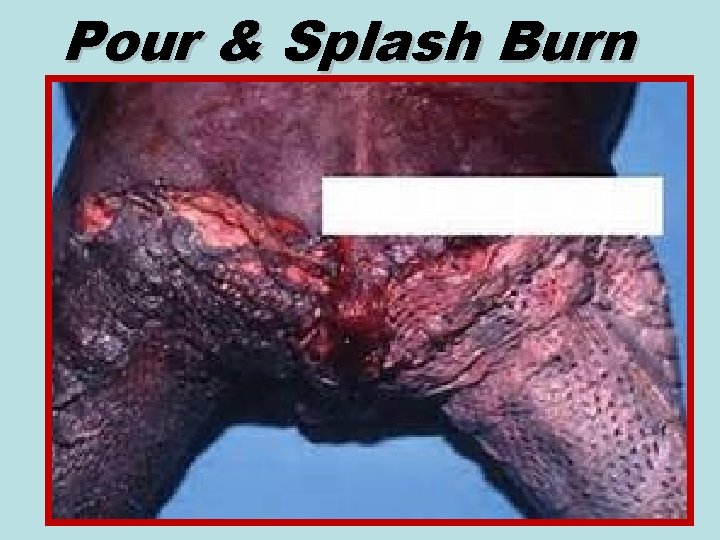
Pour & Splash Burn
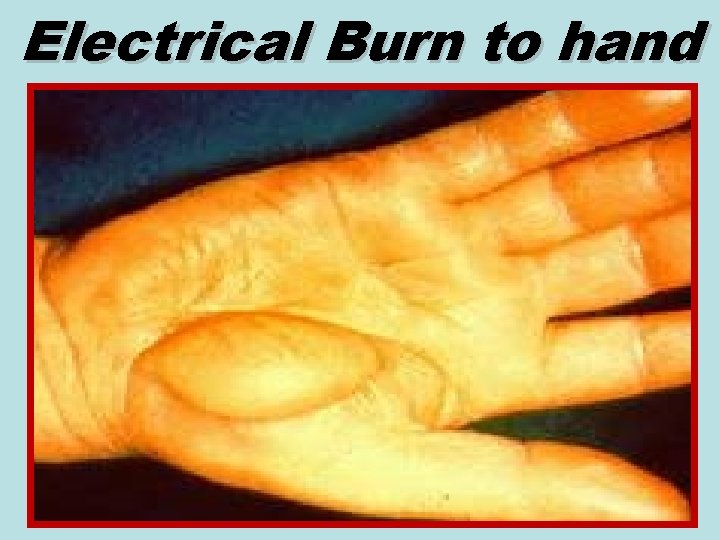
Electrical Burn to hand
E. Twenty percent of all physical injuries to children are by intentional burns of infants and small children. F. Parents who have burned a child will frequently make references to purifying, cleansing, and cauterizing. 6. 4
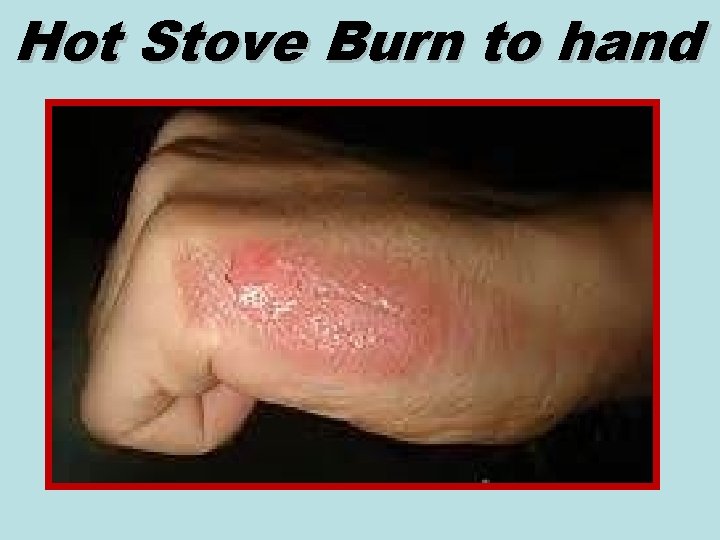
Hot Stove Burn to hand
G. Burns are usually signs of extreme parental frustration, frustration frequently from; ü toilet training, ü bed-wetting, or ü playing with fire. 6. 4
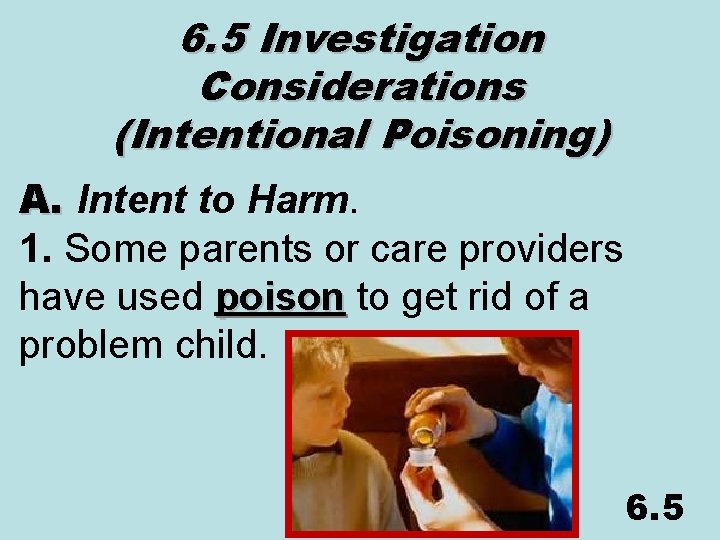
6. 5 Investigation Considerations (Intentional Poisoning) A. Intent to Harm. 1. Some parents or care providers have used poison to get rid of a problem child. 6. 5
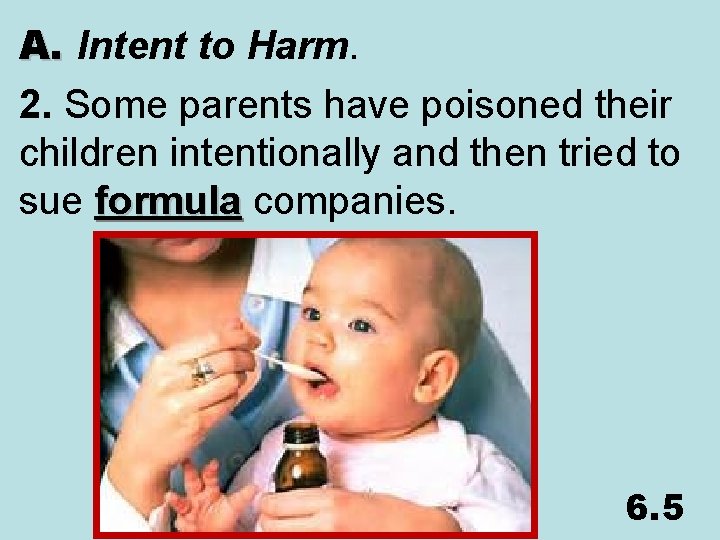
A. Intent to Harm. 2. Some parents have poisoned their children intentionally and then tried to sue formula companies. 6. 5
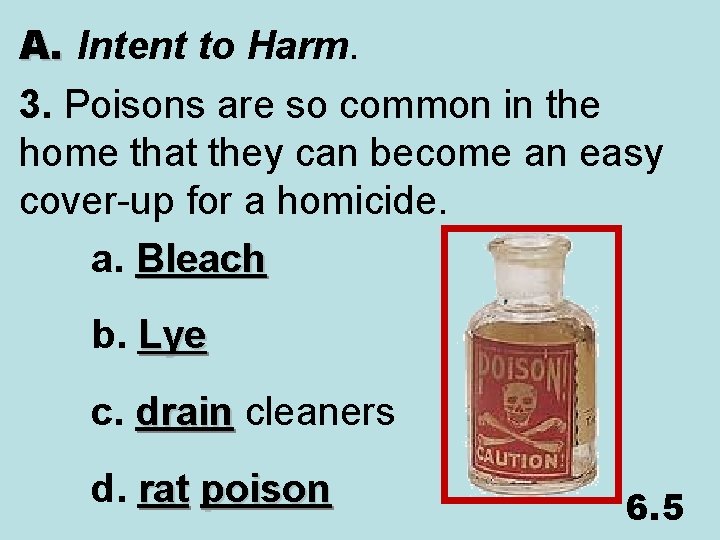
A. Intent to Harm. 3. Poisons are so common in the home that they can become an easy cover-up for a homicide. a. Bleach b. Lye c. drain cleaners d. rat poison 6. 5
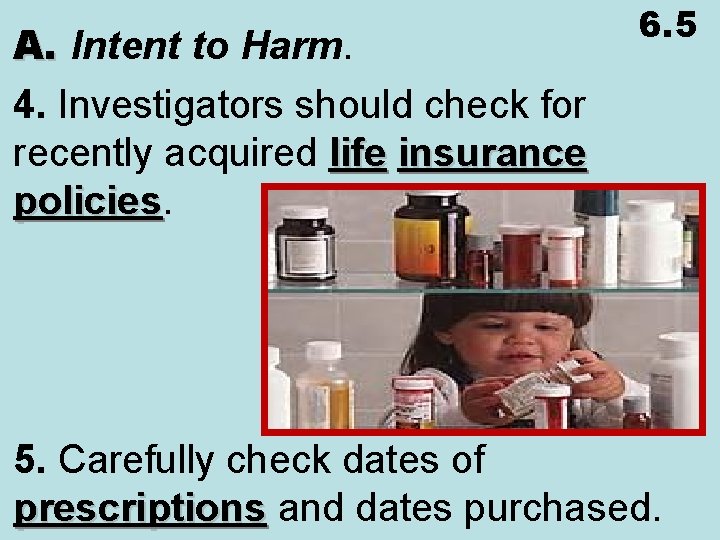
A. Intent to Harm. 4. Investigators should check for recently acquired life insurance policies 6. 5 5. Carefully check dates of prescriptions and dates purchased.
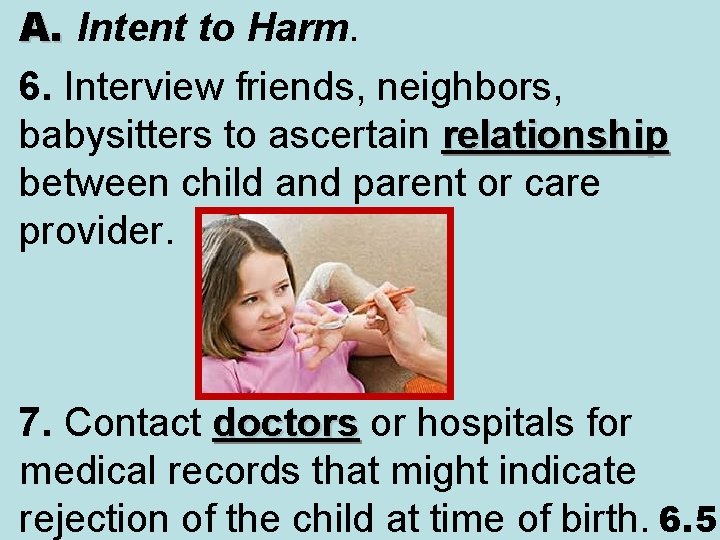
A. Intent to Harm. 6. Interview friends, neighbors, babysitters to ascertain relationship between child and parent or care provider. 7. Contact doctors or hospitals for medical records that might indicate rejection of the child at time of birth. 6. 5
B. Intent to Calm 1. Overview a. Parents or care providers frustrated with prolonged crying or restless nights sometimes use prescription drugs to make child sleep. b. Sedatives are most commonly used. 6. 5
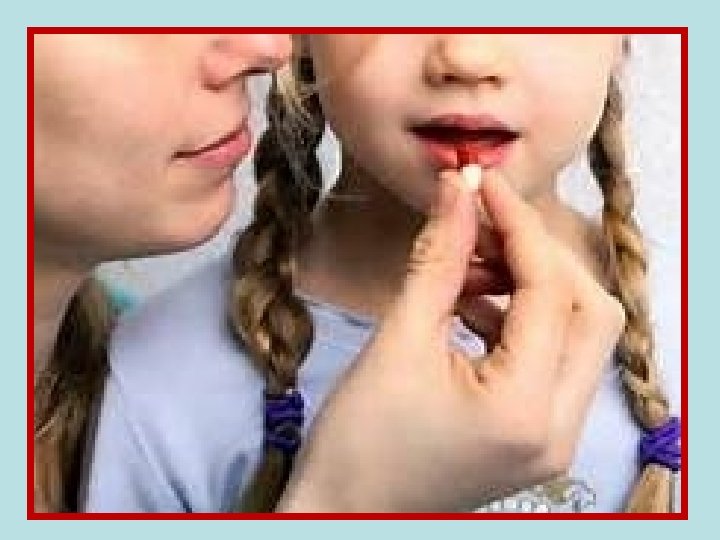
B. Intent to Calm 1. Overview c. Some parents use alcoholic beverages to get children to sleep. d. Some parents have put marijuana in children's bottles to quiet them. 6. 5
B. Intent to Calm 2. Investigative Actions. a. Chemical analysis of the child's; ü blood, blood ü urine, urine and ü body fluids may indicate what substance was used. 6. 5
B. Intent to Calm 2. Investigative Actions. b. Locate and take into evidence all; ü bottles, bottles ü food jars, ü spoons or other ü utensils used to feed the child.
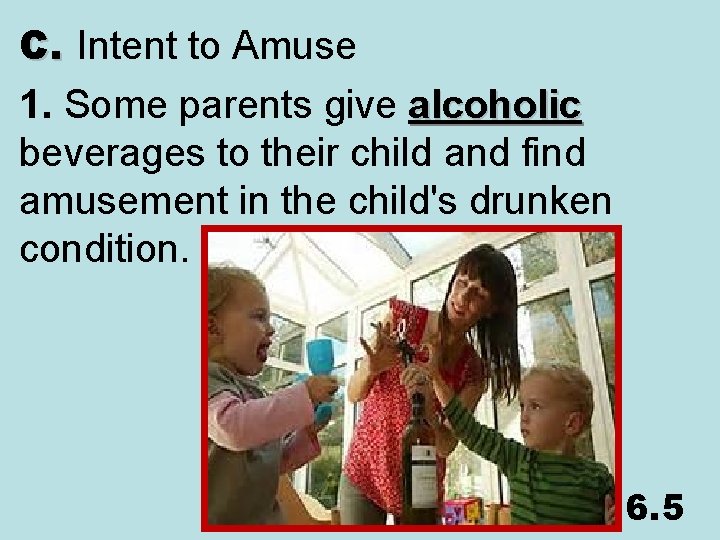
C. Intent to Amuse 1. Some parents give alcoholic beverages to their child and find amusement in the child's drunken condition. 6. 5
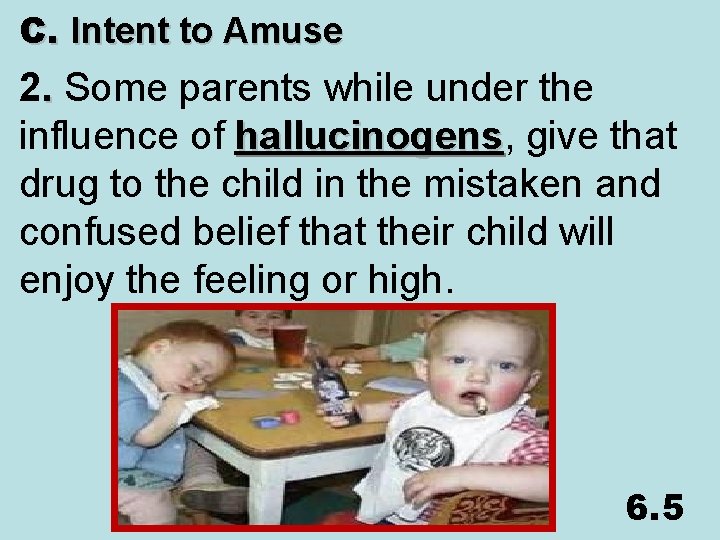
C. Intent to Amuse 2. Some parents while under the influence of hallucinogens, hallucinogens give that drug to the child in the mistaken and confused belief that their child will enjoy the feeling or high. 6. 5
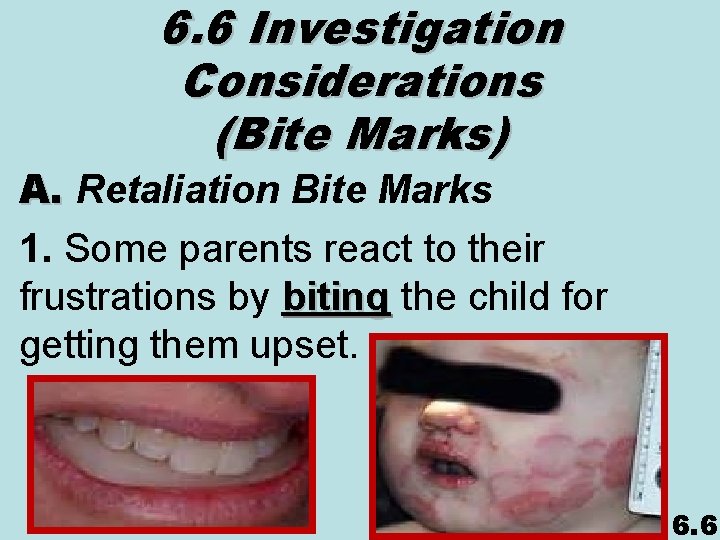
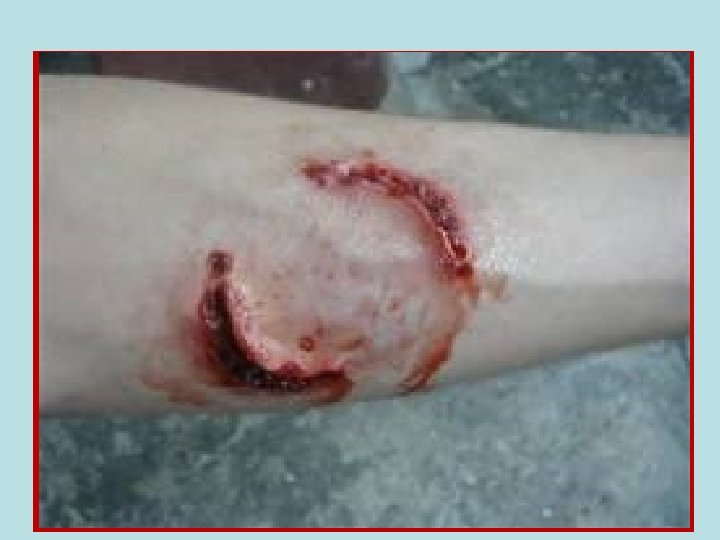
6. 6 Investigation Considerations (Bite Marks) A. Retaliation Bite Marks 1. Some parents react to their frustrations by biting the child for getting them upset. 6. 6
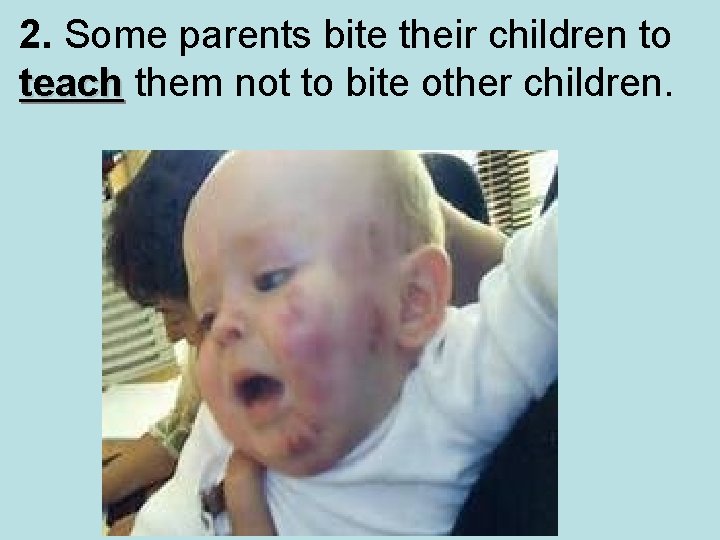
2. Some parents bite their children to teach them not to bite other children.
A. Retaliation Bite Marks 3. Bites usually occur on the; ü hand, hand ü arm, arm or ü shoulder area of the child. 4. Most parents or care providers that react this way bite just once 6. 6
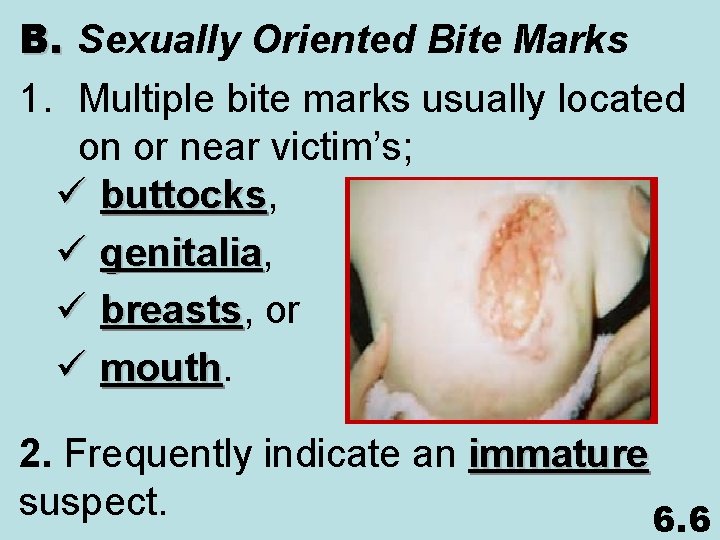
B. Sexually Oriented Bite Marks 1. Multiple bite marks usually located on or near victim’s; ü buttocks, buttocks ü genitalia, genitalia ü breasts, breasts or ü mouth 2. Frequently indicate an immature suspect. 6. 6
C. General Information 1. Bite marks can be photographed, photographed chemical tests can be taken, and impressions can be made that can identify a suspect. 2. Even bite marks made through clothing may reveal marks that can be identified. 6. 6
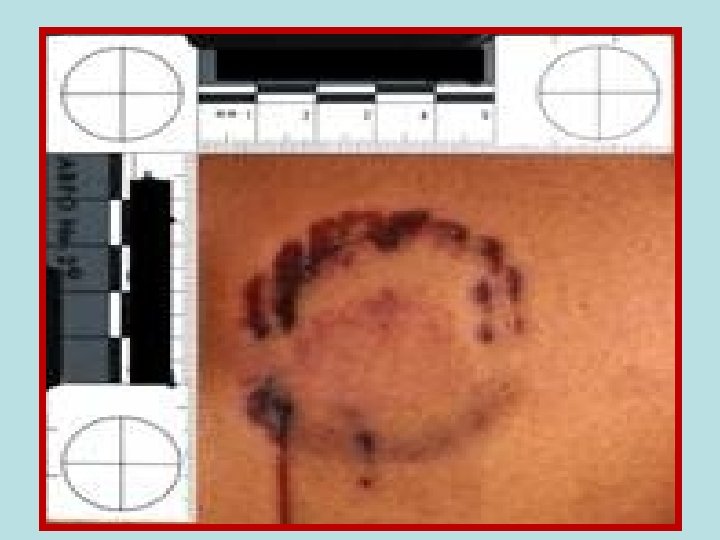
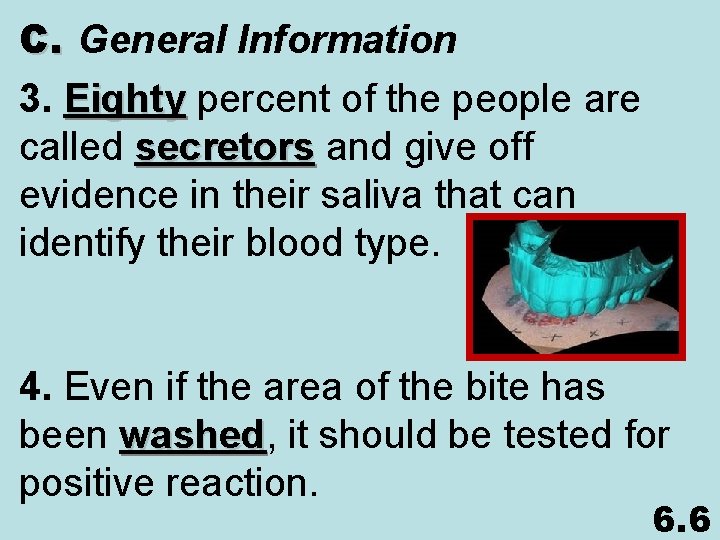
C. General Information 3. Eighty percent of the people are called secretors and give off evidence in their saliva that can identify their blood type. 4. Even if the area of the bite has been washed, washed it should be tested for positive reaction. 6. 6
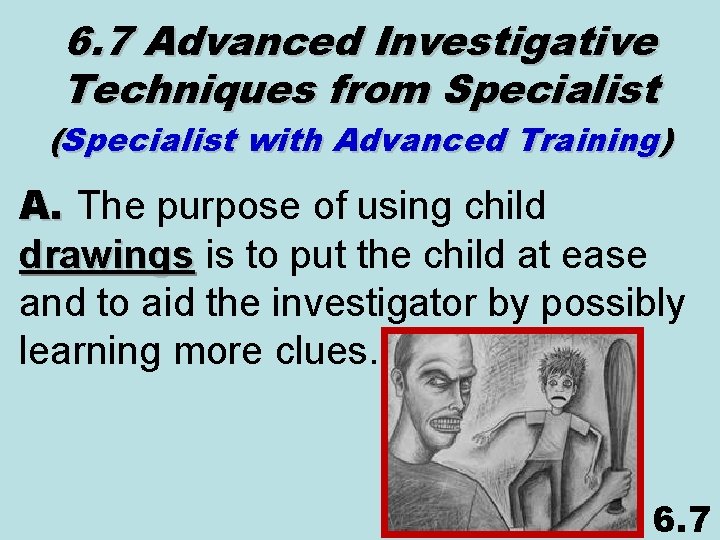
6. 7 Advanced Investigative Techniques from Specialist (Specialist with Advanced Training) A. The purpose of using child drawings is to put the child at ease and to aid the investigator by possibly learning more clues. 6. 7
B. The use of drawings as an initial interview technique is especially good for "breaking the ice" ice with young children. Drawing is a natural form of communication for the child and the child will be eager to draw a picture. A progression of pictures may be drawn: 1. Draw a picture of yourself. 6. 7
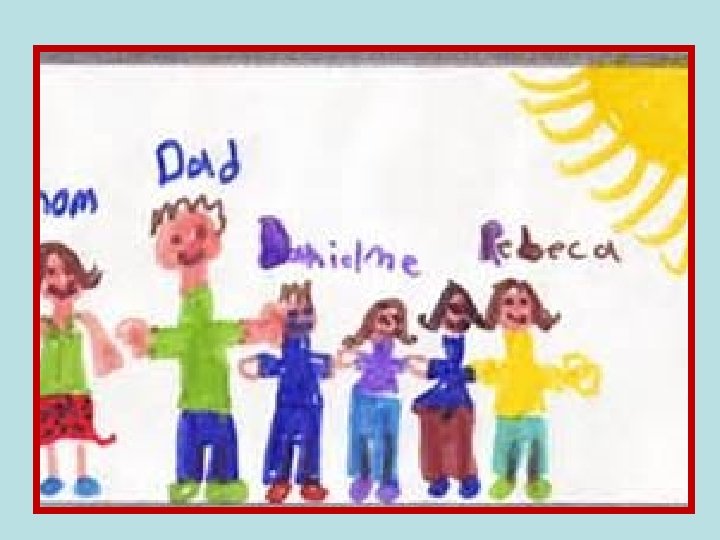
B. 2. Draw a picture of family doing something. 3. Draw a picture of what (crime) crime happened. 4. Draw a picture of where the crime happened. 6. 7
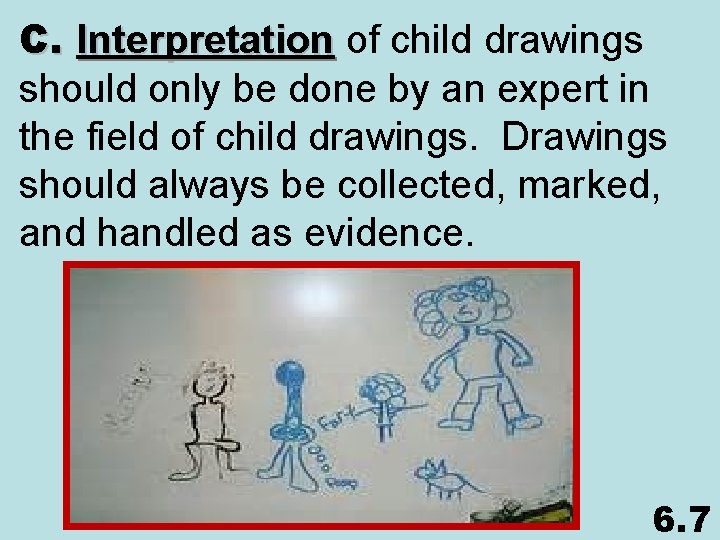
C. Interpretation of child drawings should only be done by an expert in the field of child drawings. Drawings should always be collected, marked, and handled as evidence. 6. 7
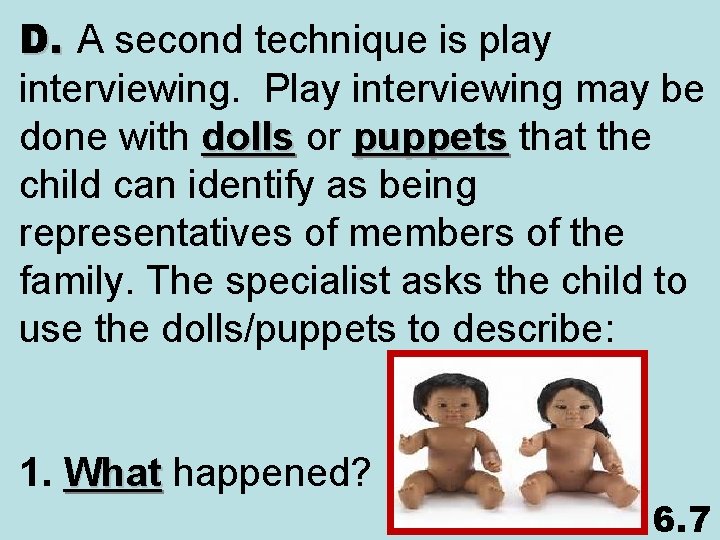
D. A second technique is play interviewing. Play interviewing may be done with dolls or puppets that the child can identify as being representatives of members of the family. The specialist asks the child to use the dolls/puppets to describe: 1. What happened? 6. 7
D. A second technique is play – Cont’d 2. Conversation between child and offender. 3. Child's fears about talking about the abuse. 6. 7
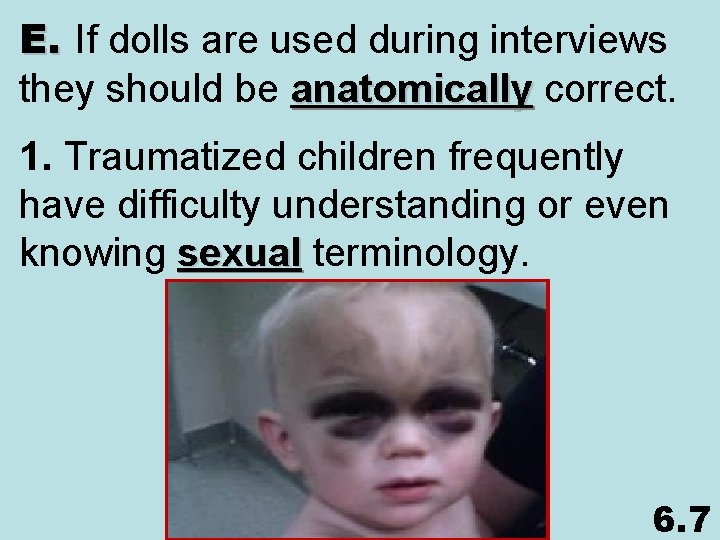
E. If dolls are used during interviews they should be anatomically correct. 1. Traumatized children frequently have difficulty understanding or even knowing sexual terminology. 6. 7
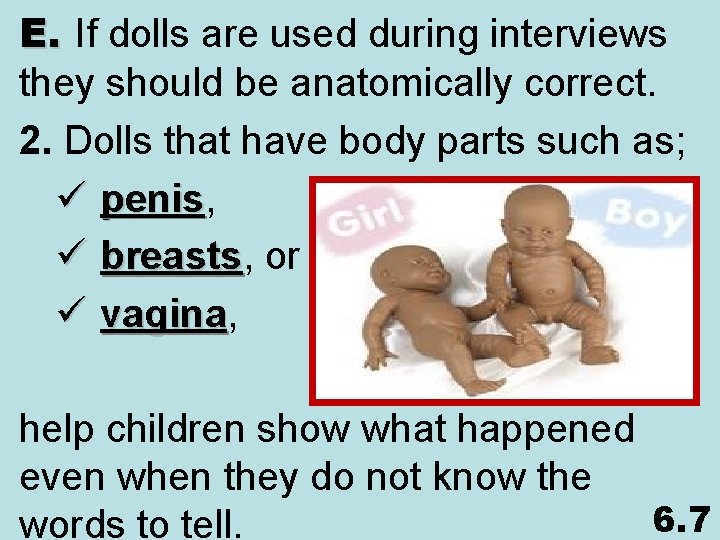
E. If dolls are used during interviews they should be anatomically correct. 2. Dolls that have body parts such as; ü penis, penis ü breasts, breasts or ü vagina, vagina help children show what happened even when they do not know the 6. 7 words to tell.
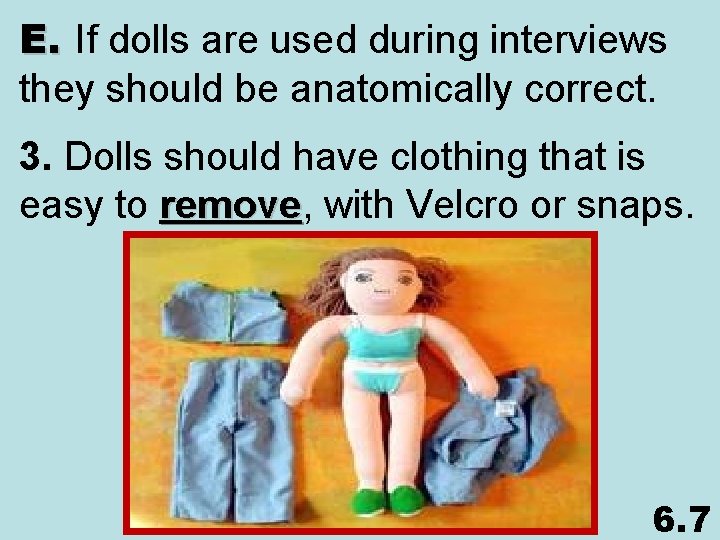
E. If dolls are used during interviews they should be anatomically correct. 3. Dolls should have clothing that is easy to remove, remove with Velcro or snaps. 6. 7
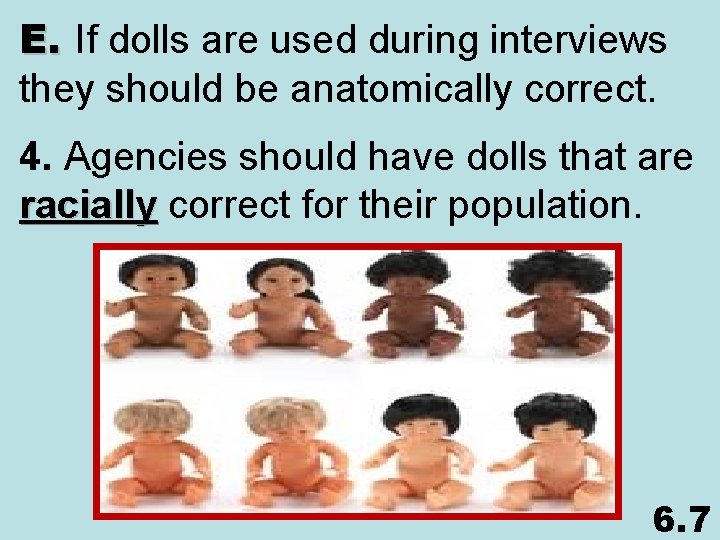
E. If dolls are used during interviews they should be anatomically correct. 4. Agencies should have dolls that are racially correct for their population. 6. 7
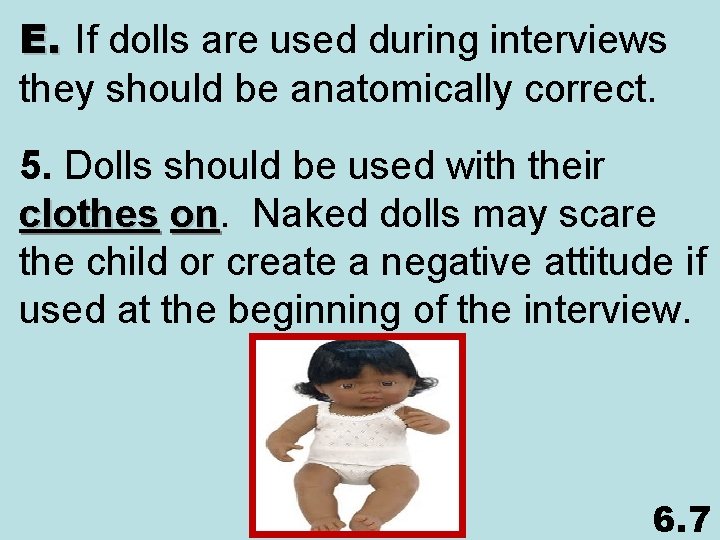
E. If dolls are used during interviews they should be anatomically correct. 5. Dolls should be used with their clothes on. on Naked dolls may scare the child or create a negative attitude if used at the beginning of the interview. 6. 7
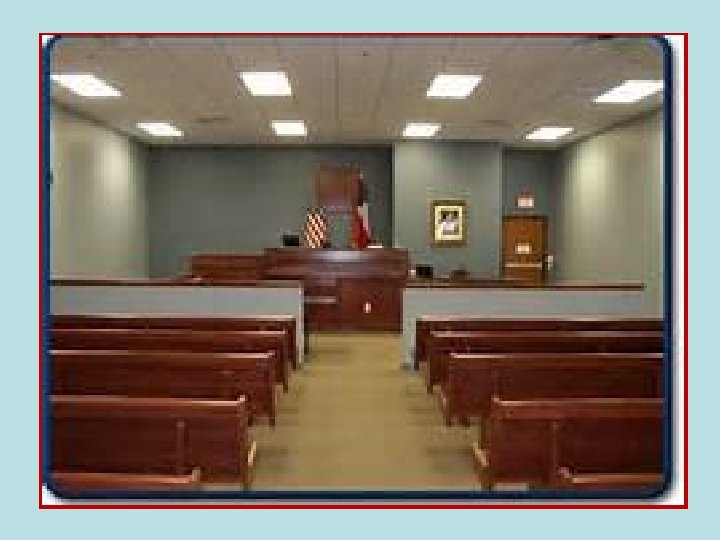
6. 8 Presenting Child Testimony in a Child Abuse Court Case A. It is important for the specialist investigator to be aware of local court policies regarding competency of a child victim to testify because child witnesses testimony may be the most important factor in the trial. 6. 8
B. Children and the Court. 1. A child's ability to cope with the judicial process varies depending on age, circumstances and what his/her perceptions of the court process are (i. e. through TV, only men are judges, etc. ). 2. Children often fear facing the defendants 6. 8
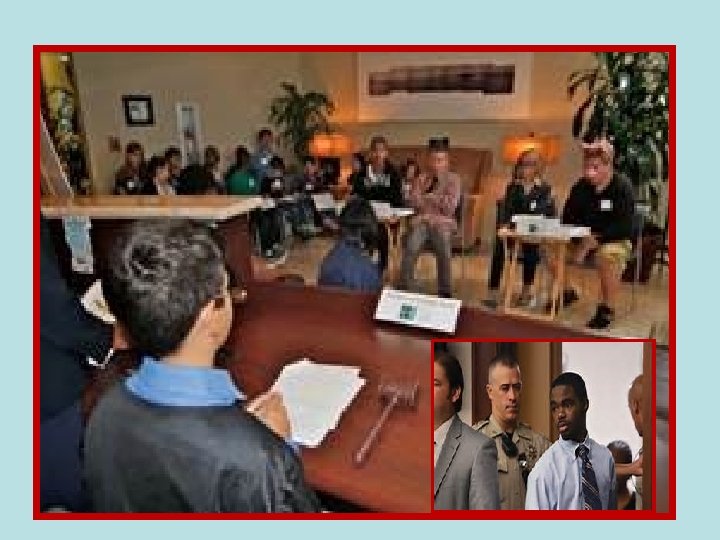
B. Children and the Court. 3. Children may be overwhelmed by certain aspects of the courtroom (i. e. ); ü the judge ü the witness stand, stand ü strange people asking questions of them). 4. Children feel anxiety over having to repeat their stories so many times. 6. 8
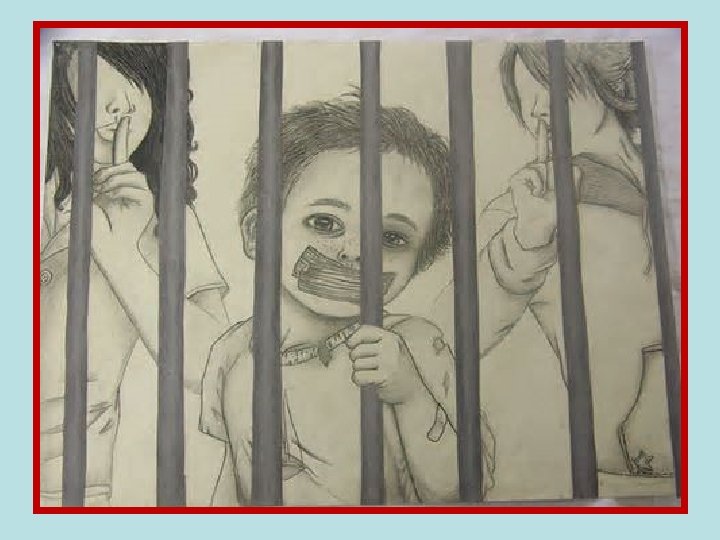
B. Children and the Court. 5. Children often feel they are in court because they have done something wrong and are being punished 6. Children often feel no one will believe them. 6. 8
C. Evaluation of a child's ability to testify is judged on several factors, including: 1. Capacity for truthfulness, truthfulness 2. Mental capacity, 3. Memory 4. Ability to communicate 6. 8
D. Attempts are being made to avoid direct confrontations between child victims and criminal defendants who are often a relative or friend of the family. This is being done to help alleviate much of the stress a child witness feels about going to court. 1. Use closed circuit television (CCTV). 6. 8
D. Attempts are being made to avoid direct confrontations between child victims and criminal defendants who are often a relative or friend of the family. This is being done to help alleviate much of the stress a child witness feels about going to court. 2. Visual contact as a requirement of confrontation with accuser is an unsettled legal issue. 6. 8
E. Videotaping Children 1. Key Legislation: Criminal Procedure Code, Art. 38. 071 2. Videotaping a child’s first statement a. Required elements 1. ) Only Certain offenses that are alleged to have been committed against a child 12 years of age or younger. (see “offenses included” below. 6. 8
E. Videotaping Children 2. Videotaping a child’s first statement a. Required elements 2. ) Trial court finds that the child is unavailable to testify at the trial of the offense and applies only to the statements or testimony of that child 6. 8
E. Videotaping Children 2. Videotaping a child’s first statement a. Required elements 3. ) Offenses include: (a) Section 21. 11 (Indecency with a Child). (b) Section 22. 011 (Sexual Assault). 6. 8
E. Videotaping Children 2. Videotaping a child’s first statement a. Required elements 3. ) Offenses include: (c) Section 22. 02 (Aggravated Assault ). . (d) Section 22. 021 (Aggravated Sexual Assault). Assault 6. 8
E. Videotaping Children 2. Videotaping a child’s first statement a. Required elements 3. ) Offenses include: (e) Section 22. 04(e) and (f) (Injury to a Child, Elderly Individual, or Disabled Individual). (f) Section 25. 02 (Prohibited Sexual Conduct). Conduc 6. 8
E. Videotaping Children 2. Videotaping a child’s first statement a. Required elements 3. ) Offenses include: (g) Section 43. 25 (Sexual Performance by a Child). Child 6. 8
E. Videotaping Children 2. Videotaping a child’s first statement b. Benefits include: 1. ) Child's memory is vivid and he/she can describe the incident in detail. 2. ) In family cases, the family often pressures a child to retract stories. 6. 8
E. Videotaping Children 2. Videotaping a child’s first statement b. Benefits include: 3. ) May reduce the number of interviews. 4. ) May preclude the need for a child to testify in a grand jury hearing. 6. 8
E. Videotaping Children 2. Videotaping a child’s first statement c. Problems include: 1. ) First interviews are often not productive and child victims often have to be interviewed several times so a detailed statement can be made.
E. Videotaping Children 2. Videotaping a child’s first statement c. Problems include: 2. ) If the child victim expands his/her story, prepre recorded first statement could be used to impeach the child. 6. 8
E. Videotaping Children 2. Videotaping a child’s first statement c. Problems include: 3. ) Any discrepancies between the first and subsequent statement may be exculpatory 6. 8
E. Videotaping Children 3. Videotaping trial testimony. a. Court may order the testimony of the child be taken during the trial in a room other than the courtroom and be televised by closed circuit equipment in the courtroom to be viewed by the court and the finder of fact. 6. 8
E. Videotaping Children 3. Videotaping trial testimony. a. 1. ) Usually only the judge, the court reporter, the attorneys for the defendant and for the state, persons necessary to operate the equipment, and any person whose presence would contribute to the welfare and well-being of the child may be Present 6. 8
E. Videotaping Children 3. Videotaping trial testimony. a. 2. ) Only the attorneys and the judge may question the child. a. 3. ) The defendant will be permitted to observe and hear the testimony of the child 6. 8
E. Videotaping Children 3. Videotaping trial testimony. a. 4. ) The defendant must be able to communicate contemporaneously with his attorney during periods of recess or by audio contact, and be able to confer with the defense attorney during cross-examination of the child. 6. 8
E. Videotaping Children 3. Videotaping trial testimony. a. 5. ) The court must attempt to ensure that the child cannot hear or see the defendant 6. 8
E. Videotaping Children 3. Videotaping trial testimony. b. Benefits include: 1. ) Allowing for a child to testify in a private setting without facing the defendant may decrease trauma for the child victim 6. 8
E. Videotaping Children 3. Videotaping trial testimony. b. Benefits include: 2. ) In cases with multiple continuances, the videotaped testimony will prevent a child from having to appear in court repeatedly 6. 8
E. Videotaping Children 3. Videotaping trial testimony. c. Problems with videotaping trial testimony. 1. ) There is disagreement in the legal community regarding whether videotaped testimony is a form of hearsay
E. Videotaping Children 3. Videotaping trial testimony. c. Problems with videotaping trial testimony. 2. ) Some legal theorists argue that videotaped testimony does not satisfy the defendant's right of presence and confrontation FACE his/her Accuser(s) “Due Process” 6. 8
E. Videotaping Children 3. Videotaping trial testimony. c. Problems with videotaping trial testimony. 3. ) Some legal theorists argue that the right of a public and/or jury trial is not satisfied if the public and the jury are not physically present.
E. Videotaping Children 3. Videotaping trial testimony. c. Problems with videotaping trial testimony. 4. ) Some empirical research indicates videotaping may interfere with a juror's perception of the trial. 6. 8

Questions?
SOURCES All Course Sources and/or Resources are listed in your Participant Handout
COURSE & INSTRUCTOR EVALUATION Form • Please complete a course and instructor evaluation form. • If you rate 2 or below you must justify on reverse side. • Constructive Criticism helps all, being negative helps no one.

• Exam • Graduation
- Slides: 101