
Course Software Engineering Design I Formal Specifications Course
![Course: Software Engineering – Design I Notation Prems [X] a: X f: X X](https://slidetodoc.com/presentation_image_h2/6c4332577b7f378ccbc688f930eb9a95/image-20.jpg "Course: Software Engineering – Design I Notation Prems [X] a: X f: X X")
![Course: Software Engineering – Design I Example of a schema S: Func. S[ ]](https://slidetodoc.com/presentation_image_h2/6c4332577b7f378ccbc688f930eb9a95/image-21.jpg "Course: Software Engineering – Design I Example of a schema S: Func. S[ ]")
![Course: Software Engineering – Design I A list example Scrub. Fn [X] scrub: X](https://slidetodoc.com/presentation_image_h2/6c4332577b7f378ccbc688f930eb9a95/image-22.jpg "Course: Software Engineering – Design I A list example Scrub. Fn [X] scrub: X")
![Course: Software Engineering – Design I Schema inclusion (definition) Prems[X] written in Ext. Prems](https://slidetodoc.com/presentation_image_h2/6c4332577b7f378ccbc688f930eb9a95/image-24.jpg "Course: Software Engineering – Design I Schema inclusion (definition) Prems[X] written in Ext. Prems")
- Slides: 30
Course: Software Engineering – Design I Formal Specifications • Course: Software Engineering - Design I • Lecturer: Dr. Alessandra Russo Ø email: homepage: a. russo@imperial. ac. uk http: //www. doc. ic. ac. uk/~ar 3 Ø office hours: available in my office (Room 560) between 12: 30 -13: 30 pm on Wednesday. Ø • Duration: Unit 1: Theories and Schemas 9 hours (lectures and tutorials) Slide Number 1
Course: Software Engineering – Design I Aims and Objectives This part of the course is about formal specification and its role in software development. It aims to illustrate: what are the basic logical ideas underlying formal specification, what are the main components of a formal specification, how to write simple formal specifications from some given informal requirements. Unit 1: Theories and Schemas Slide Number 2
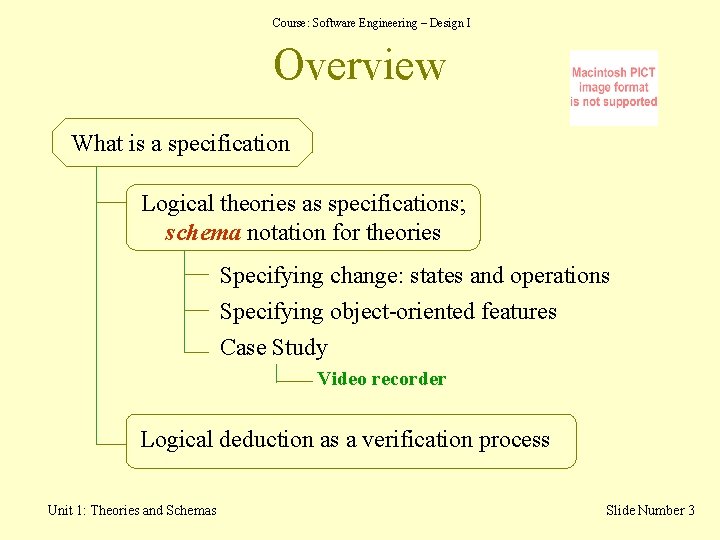
Course: Software Engineering – Design I Overview What is a specification Logical theories as specifications; schema notation for theories Specifying change: states and operations Specifying object-oriented features Case Study Video recorder Logical deduction as a verification process Unit 1: Theories and Schemas Slide Number 3
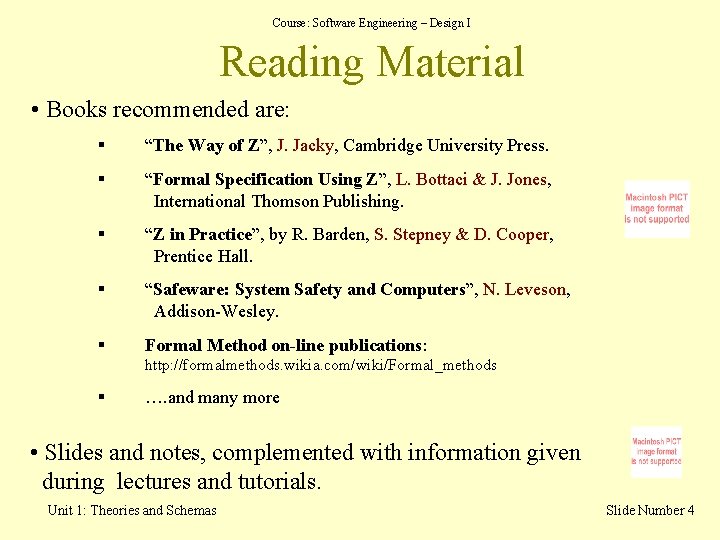
Course: Software Engineering – Design I Reading Material • Books recommended are: § “The Way of Z”, J. Jacky, Cambridge University Press. § “Formal Specification Using Z”, L. Bottaci & J. Jones, International Thomson Publishing. § “Z in Practice”, by R. Barden, S. Stepney & D. Cooper, Prentice Hall. § “Safeware: System Safety and Computers”, N. Leveson, Addison-Wesley. § Formal Method on-line publications: http: //formalmethods. wikia. com/wiki/Formal_methods § …. and many more • Slides and notes, complemented with information given during lectures and tutorials. Unit 1: Theories and Schemas Slide Number 4
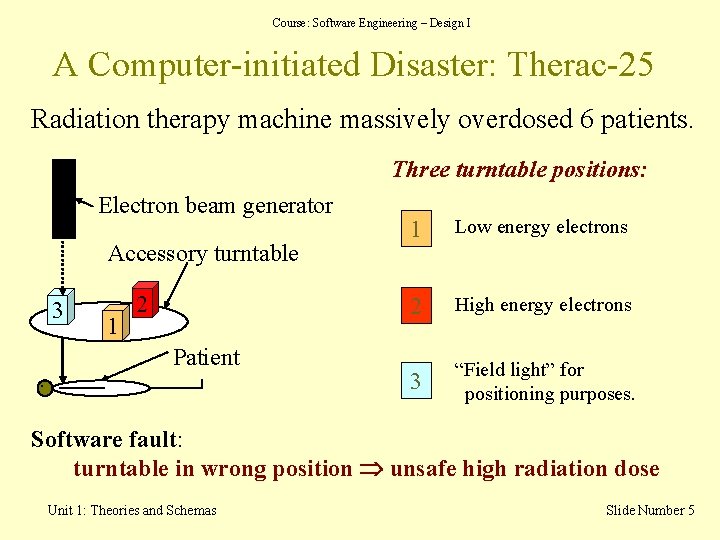
Course: Software Engineering – Design I A Computer-initiated Disaster: Therac-25 Radiation therapy machine massively overdosed 6 patients. Three turntable positions: Electron beam generator Accessory turntable 3 1 2 Patient • 1 Low energy electrons 2 High energy electrons 3 “Field light” for positioning purposes. Software fault: turntable in wrong position unsafe high radiation dose Unit 1: Theories and Schemas Slide Number 5
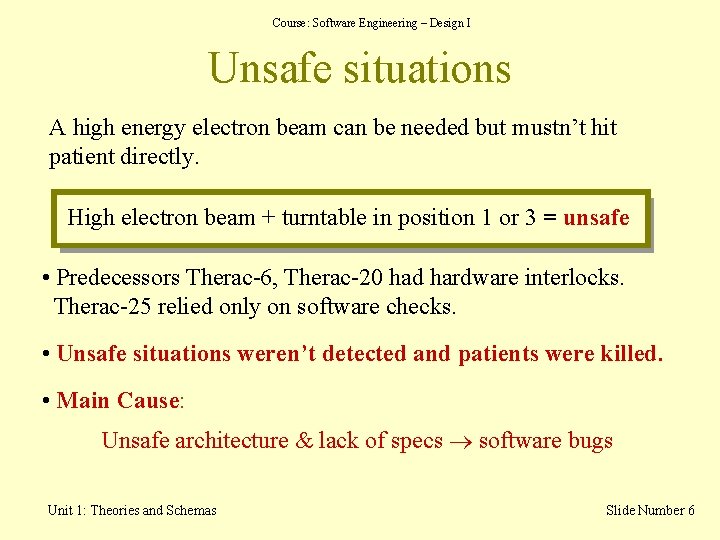
Course: Software Engineering – Design I Unsafe situations A high energy electron beam can be needed but mustn’t hit patient directly. High electron beam + turntable in position 1 or 3 = unsafe • Predecessors Therac-6, Therac-20 had hardware interlocks. Therac-25 relied only on software checks. • Unsafe situations weren’t detected and patients were killed. • Main Cause: Unsafe architecture & lack of specs software bugs Unit 1: Theories and Schemas Slide Number 6
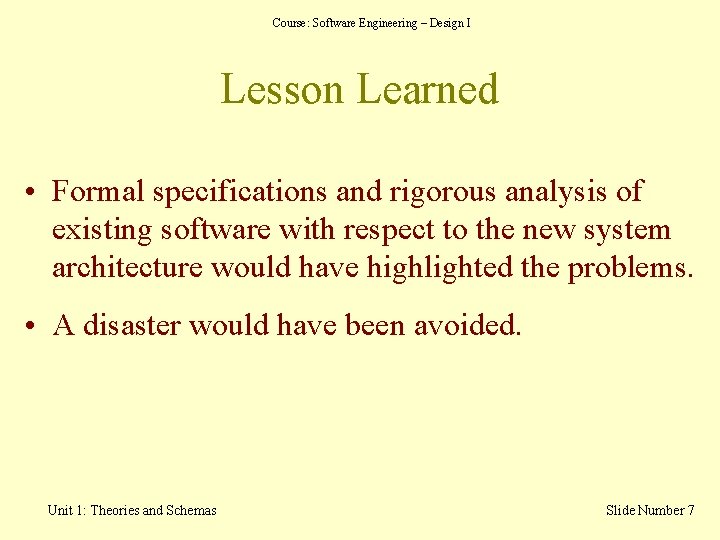
Course: Software Engineering – Design I Lesson Learned • Formal specifications and rigorous analysis of existing software with respect to the new system architecture would have highlighted the problems. • A disaster would have been avoided. Unit 1: Theories and Schemas Slide Number 7
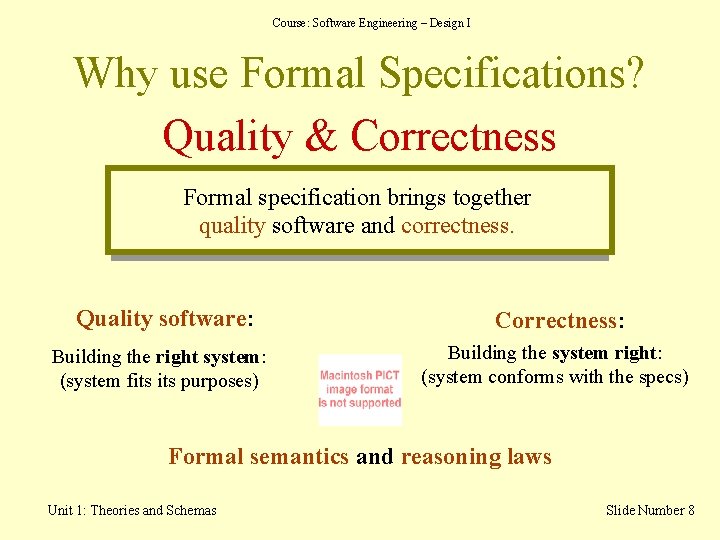
Course: Software Engineering – Design I Why use Formal Specifications? Quality & Correctness Formal specification brings together quality software and correctness. Quality software: Correctness: Building the right system: (system fits purposes) Building the system right: (system conforms with the specs) Formal semantics and reasoning laws Unit 1: Theories and Schemas Slide Number 8
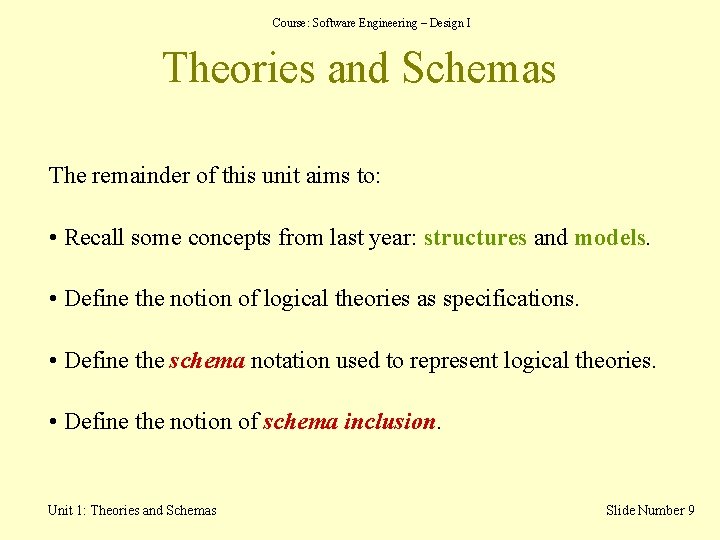
Course: Software Engineering – Design I Theories and Schemas The remainder of this unit aims to: • Recall some concepts from last year: structures and models. • Define the notion of logical theories as specifications. • Define the schema notation used to represent logical theories. • Define the notion of schema inclusion. Unit 1: Theories and Schemas Slide Number 9
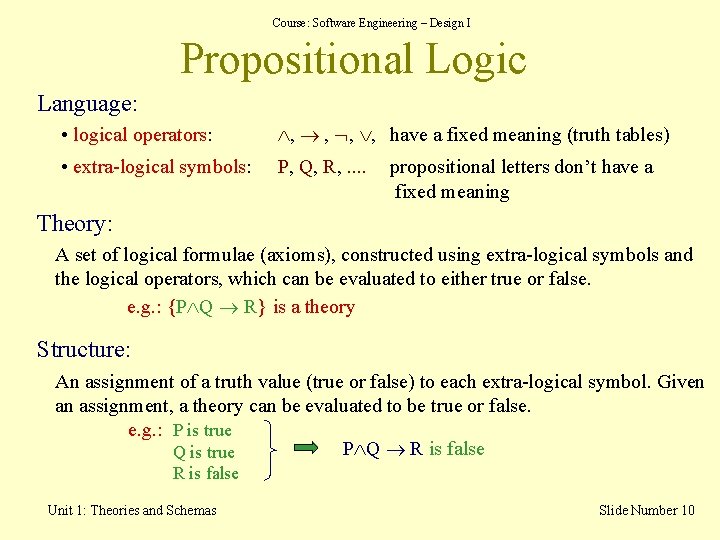
Course: Software Engineering – Design I Propositional Logic Language: • logical operators: , , have a fixed meaning (truth tables) • extra-logical symbols: P, Q, R, . . propositional letters don’t have a fixed meaning Theory: A set of logical formulae (axioms), constructed using extra-logical symbols and the logical operators, which can be evaluated to either true or false. e. g. : {P Q R} is a theory Structure: An assignment of a truth value (true or false) to each extra-logical symbol. Given an assignment, a theory can be evaluated to be true or false. e. g. : P is true P Q R is false Q is true R is false Unit 1: Theories and Schemas Slide Number 10
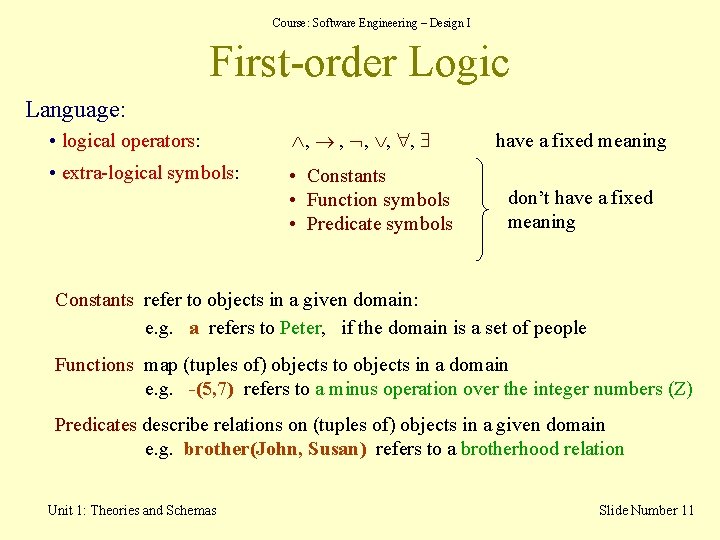
Course: Software Engineering – Design I First-order Logic Language: • logical operators: , , , • extra-logical symbols: • Constants • Function symbols • Predicate symbols have a fixed meaning don’t have a fixed meaning Constants refer to objects in a given domain: e. g. a refers to Peter, if the domain is a set of people Functions map (tuples of) objects to objects in a domain e. g. -(5, 7) refers to a minus operation over the integer numbers (Z) Predicates describe relations on (tuples of) objects in a given domain e. g. brother(John, Susan) refers to a brotherhood relation Unit 1: Theories and Schemas Slide Number 11
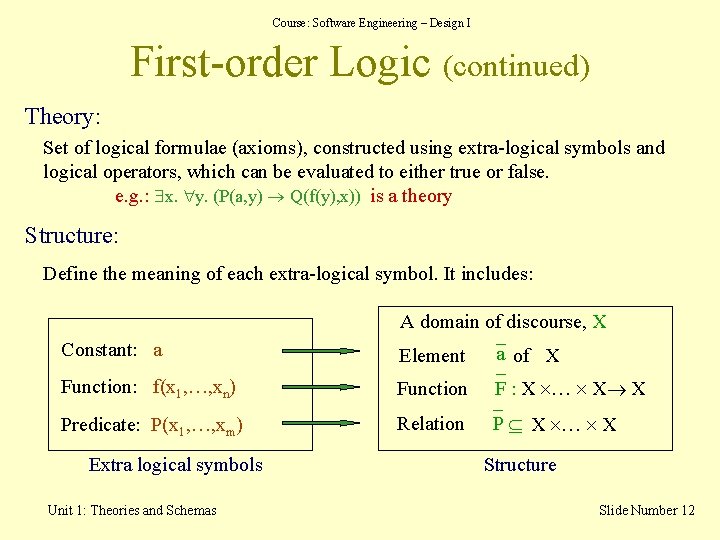
Course: Software Engineering – Design I First-order Logic (continued) Theory: Set of logical formulae (axioms), constructed using extra-logical symbols and logical operators, which can be evaluated to either true or false. e. g. : x. y. (P(a, y) Q(f(y), x)) is a theory Structure: Define the meaning of each extra-logical symbol. It includes: A domain of discourse, X Constant: a Element Function: f(x 1, …, xn) Function a of X F¯ : X … X X Predicate: P(x 1, …, xm) Relation ¯ X … X P Extra logical symbols Unit 1: Theories and Schemas Structure Slide Number 12
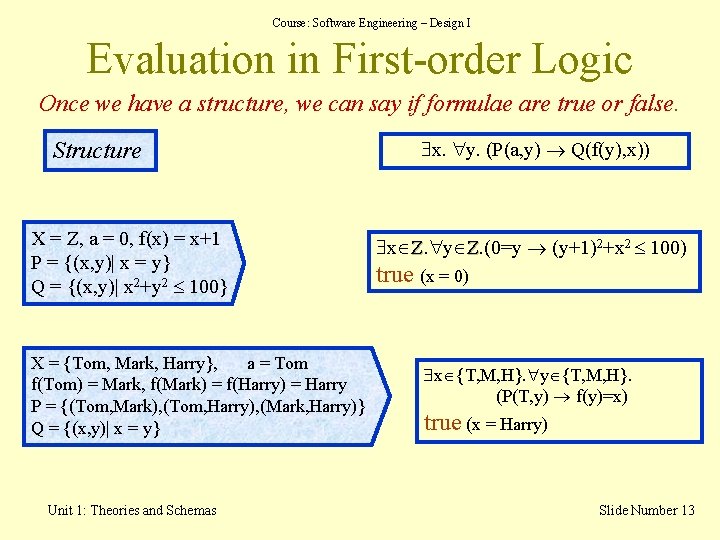
Course: Software Engineering – Design I Evaluation in First-order Logic Once we have a structure, we can say if formulae are true or false. Structure X = Z, a = 0, f(x) = x+1 P = {(x, y)| x = y} Q = {(x, y)| x 2+y 2 100} X = {Tom, Mark, Harry}, a = Tom f(Tom) = Mark, f(Mark) = f(Harry) = Harry P = {(Tom, Mark), (Tom, Harry), (Mark, Harry)} Q = {(x, y)| x = y} Unit 1: Theories and Schemas x. y. (P(a, y) Q(f(y), x)) x Z. y Z. (0=y (y+1)2+x 2 100) true (x = 0) x {T, M, H}. y {T, M, H}. (P(T, y) f(y)=x) true (x = Harry) Slide Number 13
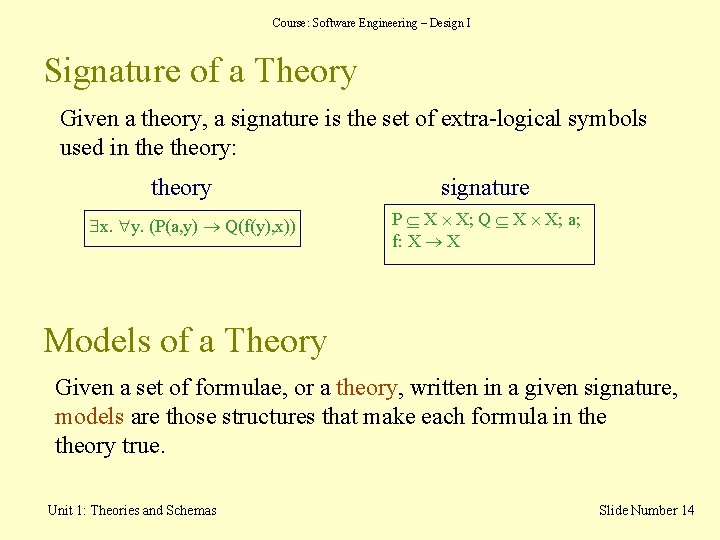
Course: Software Engineering – Design I Signature of a Theory Given a theory, a signature is the set of extra-logical symbols used in theory: theory x. y. (P(a, y) Q(f(y), x)) signature P X X; Q X X; a; f: X X Models of a Theory Given a set of formulae, or a theory, written in a given signature, models are those structures that make each formula in theory true. Unit 1: Theories and Schemas Slide Number 14
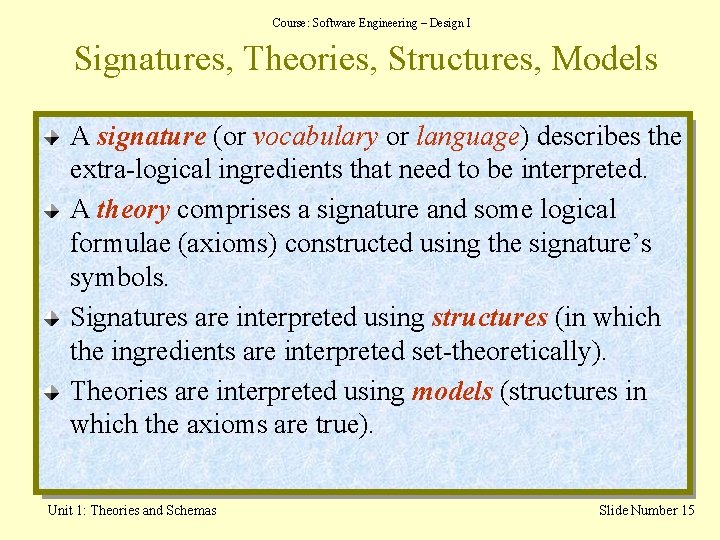
Course: Software Engineering – Design I Signatures, Theories, Structures, Models A signature (or vocabulary or language) describes the extra-logical ingredients that need to be interpreted. A theory comprises a signature and some logical formulae (axioms) constructed using the signature’s symbols. Signatures are interpreted using structures (in which the ingredients are interpreted set-theoretically). Theories are interpreted using models (structures in which the axioms are true). Unit 1: Theories and Schemas Slide Number 15
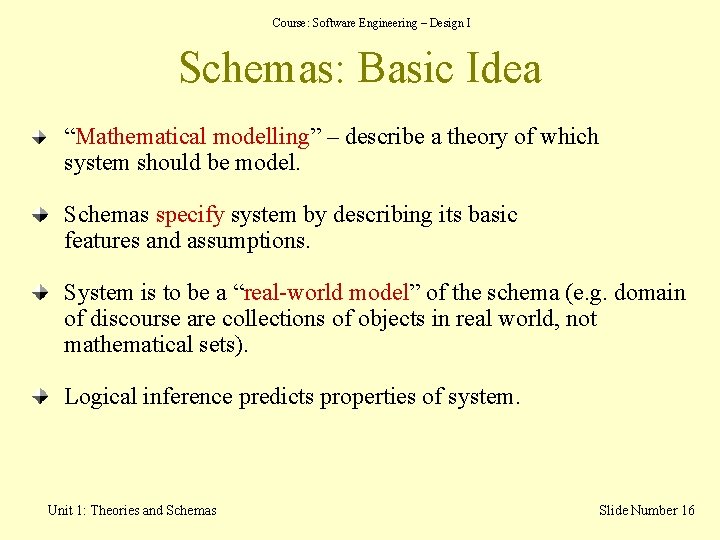
Course: Software Engineering – Design I Schemas: Basic Idea “Mathematical modelling” – describe a theory of which system should be model. Schemas specify system by describing its basic features and assumptions. System is to be a “real-world model” of the schema (e. g. domain of discourse are collections of objects in real world, not mathematical sets). Logical inference predicts properties of system. Unit 1: Theories and Schemas Slide Number 16
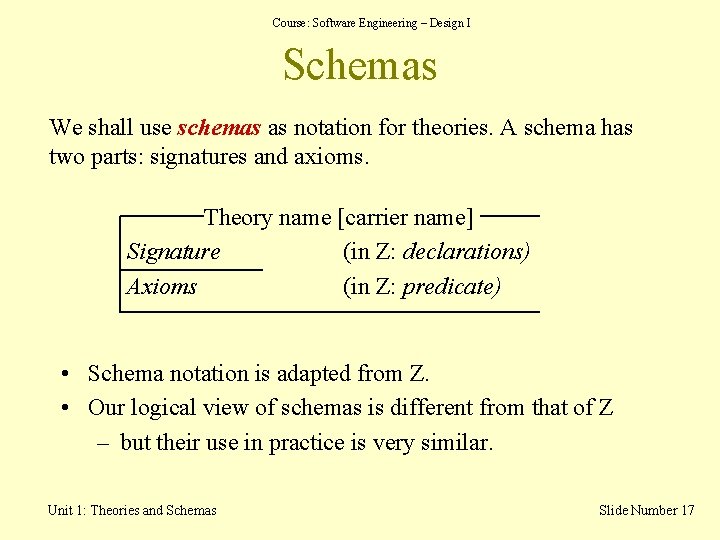
Course: Software Engineering – Design I Schemas We shall use schemas as notation for theories. A schema has two parts: signatures and axioms. Theory name [carrier name] Signature (in Z: declarations) Axioms (in Z: predicate) • Schema notation is adapted from Z. • Our logical view of schemas is different from that of Z – but their use in practice is very similar. Unit 1: Theories and Schemas Slide Number 17
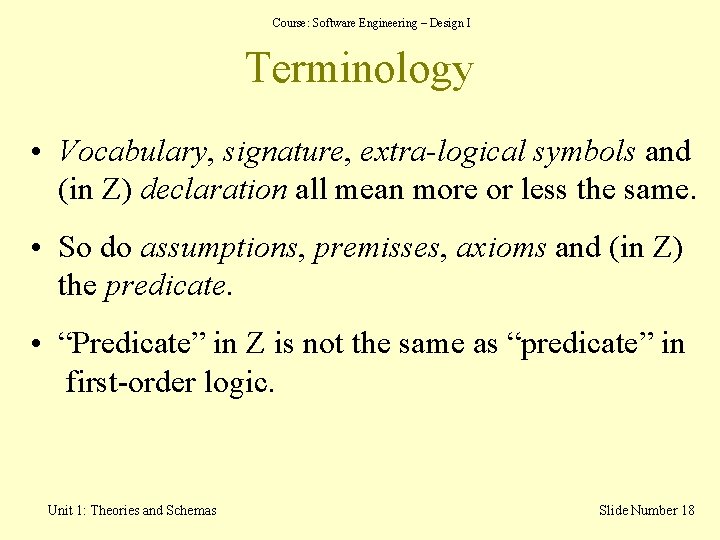
Course: Software Engineering – Design I Terminology • Vocabulary, signature, extra-logical symbols and (in Z) declaration all mean more or less the same. • So do assumptions, premisses, axioms and (in Z) the predicate. • “Predicate” in Z is not the same as “predicate” in first-order logic. Unit 1: Theories and Schemas Slide Number 18
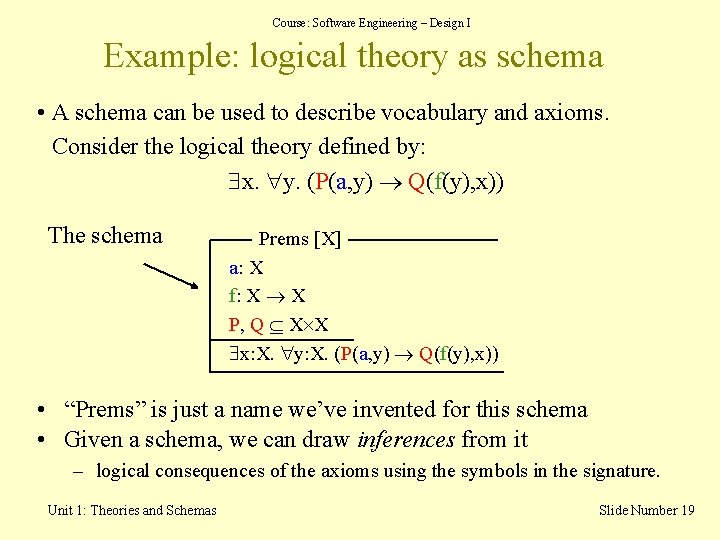
Course: Software Engineering – Design I Example: logical theory as schema • A schema can be used to describe vocabulary and axioms. Consider the logical theory defined by: x. y. (P(a, y) Q(f(y), x)) The schema Prems [X] a: X f: X X P, Q X X x: X. y: X. (P(a, y) Q(f(y), x)) • “Prems” is just a name we’ve invented for this schema • Given a schema, we can draw inferences from it – logical consequences of the axioms using the symbols in the signature. Unit 1: Theories and Schemas Slide Number 19
Course: Software Engineering – Design I Notation Prems [X] a: X f: X X P, Q X X x: X. y: X. (P(a, y) Q(f(y), x))) • • “: ” means “of type” “ ” means functions - so f: X X means f is a function with one argument “ ” is used for predicates “ ” means Cartesian product - so P X X means P is a predicate with two arguments • The bound variables, x and y, don’t need declaring in the signature. Unit 1: Theories and Schemas Slide Number 20
Course: Software Engineering – Design I Example of a schema S: Func. S[ ] N N S(0) = 0 x: N. S(x+1) = S(x)+x+1 N is a special purpose set with its own operators, predicates and reasoning principles already defined. No carrier needed! Structure needs carrier to show “domain specific” range of variation of variables - but in this case, the carrier is fixed for variables of type N. No need to declare 0 or + in the signature. Unit 1: Theories and Schemas Slide Number 21
Course: Software Engineering – Design I A list example Scrub. Fn [X] scrub: X seq. X y: X. scrub(y, [ ]) = [ ] y, x: X. xs: seq. X. (y x scrub(y, x: xs) = [x] ++ scrub(y, xs)) x: X. xs: seq. X. scrub(x, x: xs) = scrub(x, xs) seq. X is the type of finite sequences (lists) from X “: ” is sometimes “of type”, sometimes “cons” » you can tell which by the context ++ and […] are ordinary list notation Unit 1: Theories and Schemas Slide Number 22
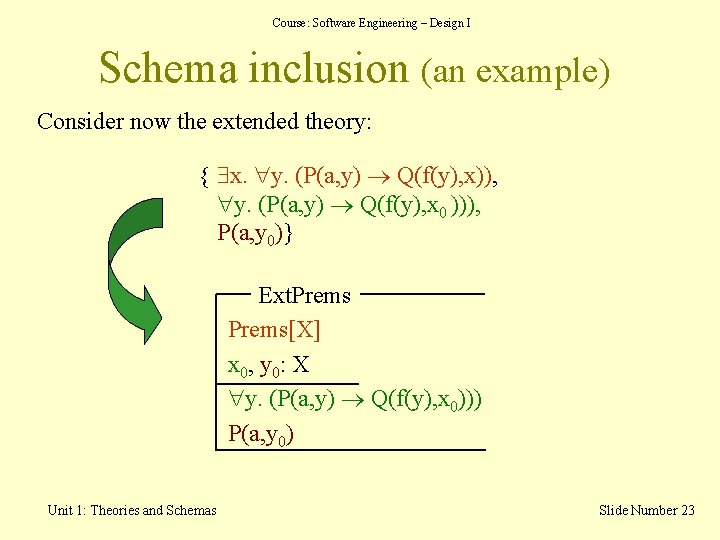
Course: Software Engineering – Design I Schema inclusion (an example) Consider now the extended theory: { x. y. (P(a, y) Q(f(y), x)), y. (P(a, y) Q(f(y), x 0 ))), P(a, y 0)} Ext. Prems[X] x 0, y 0: X y. (P(a, y) Q(f(y), x 0))) P(a, y 0) Unit 1: Theories and Schemas Slide Number 23
Course: Software Engineering – Design I Schema inclusion (definition) Prems[X] written in Ext. Prems is a schema inclusion It means everything in schema Prems is also part of schema Ext. Prems with Prems as inclusion. Ext. Prems[X] x 0, y 0: X y. (P(a, y) Q(f(y), x 0)) P(a, y 0) Very useful shorthand Shows hierarchy of schemas and sub-schemas Unit 1: Theories and Schemas Ext. Prems written out in full. Ext. Prems[X] a, x 0, y 0: X f: X X P, Q X X x. y. (P(a, y) Q(f(y), x)) y. (P(a, y) Q(f(y), x 0)) P(a, y 0) Slide Number 24
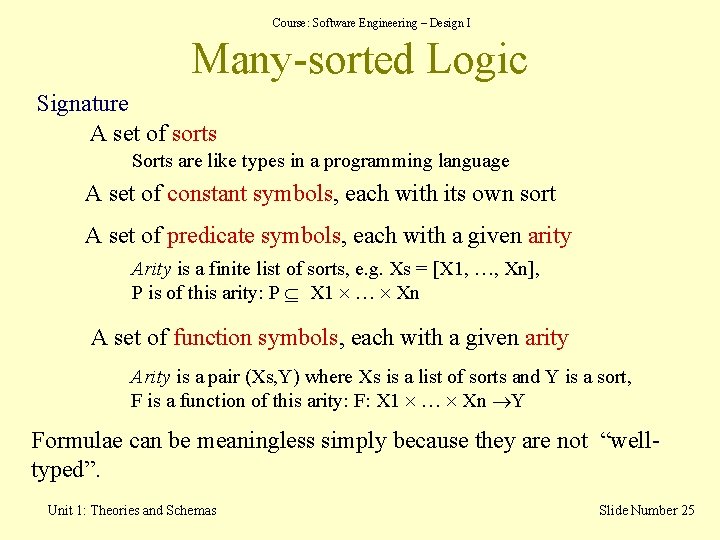
Course: Software Engineering – Design I Many-sorted Logic Signature A set of sorts Sorts are like types in a programming language A set of constant symbols, each with its own sort A set of predicate symbols, each with a given arity Arity is a finite list of sorts, e. g. Xs = [X 1, …, Xn], P is of this arity: P X 1 … Xn A set of function symbols, each with a given arity Arity is a pair (Xs, Y) where Xs is a list of sorts and Y is a sort, F is a function of this arity: F: X 1 … Xn Y Formulae can be meaningless simply because they are not “welltyped”. Unit 1: Theories and Schemas Slide Number 25
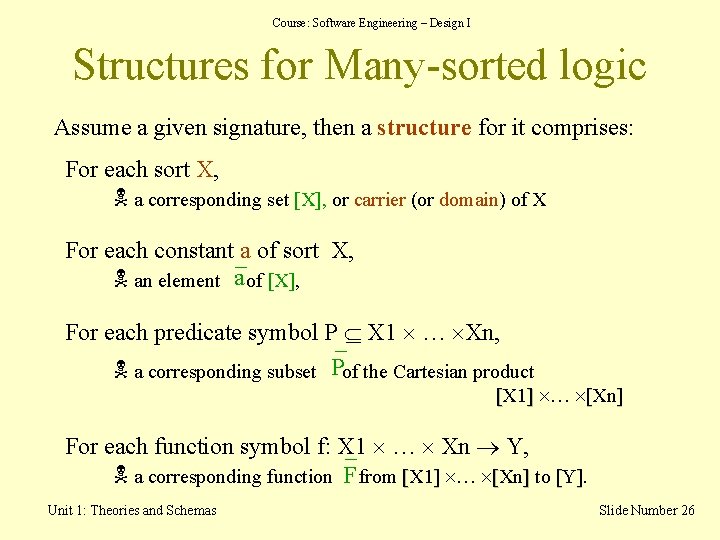
Course: Software Engineering – Design I Structures for Many-sorted logic Assume a given signature, then a structure for it comprises: For each sort X, a corresponding set [X], or carrier (or domain) of X For each constant a of sort X, an element a of [X], For each predicate symbol P X 1 … Xn, a corresponding subset P of the Cartesian product [X 1] … [Xn] For each function symbol f: X 1 … Xn Y, a corresponding function F from [X 1] … [Xn] to [Y]. Unit 1: Theories and Schemas Slide Number 26
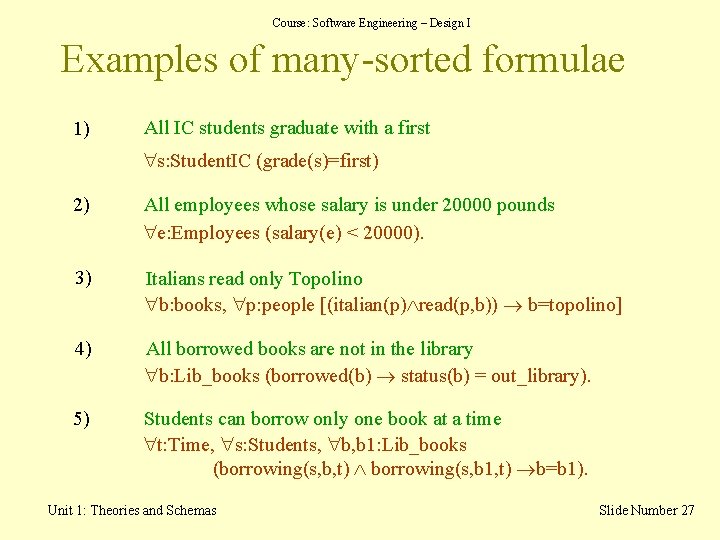
Course: Software Engineering – Design I Examples of many-sorted formulae 1) All IC students graduate with a first s: Student. IC (grade(s)=first) 2) All employees whose salary is under 20000 pounds e: Employees (salary(e) < 20000). 3) Italians read only Topolino b: books, p: people [(italian(p) read(p, b)) b=topolino] 4) All borrowed books are not in the library b: Lib_books (borrowed(b) status(b) = out_library). 5) Students can borrow only one book at a time t: Time, s: Students, b, b 1: Lib_books (borrowing(s, b, t) borrowing(s, b 1, t) b=b 1). Unit 1: Theories and Schemas Slide Number 27
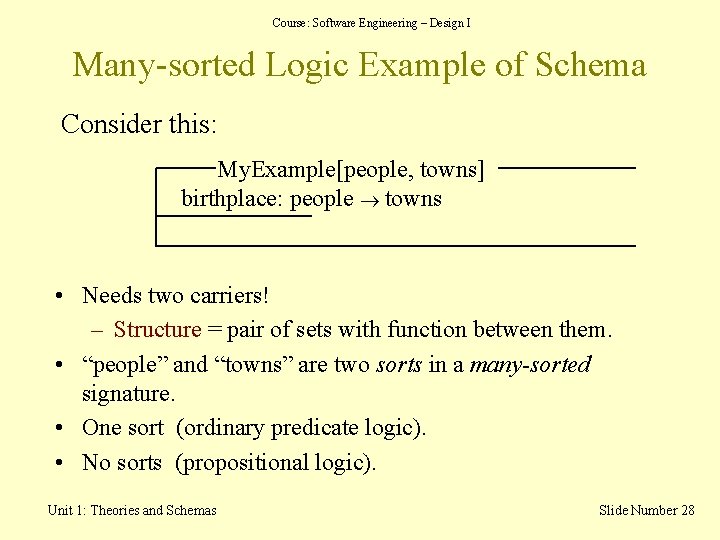
Course: Software Engineering – Design I Many-sorted Logic Example of Schema Consider this: My. Example[people, towns] birthplace: people towns • Needs two carriers! – Structure = pair of sets with function between them. • “people” and “towns” are two sorts in a many-sorted signature. • One sort (ordinary predicate logic). • No sorts (propositional logic). Unit 1: Theories and Schemas Slide Number 28
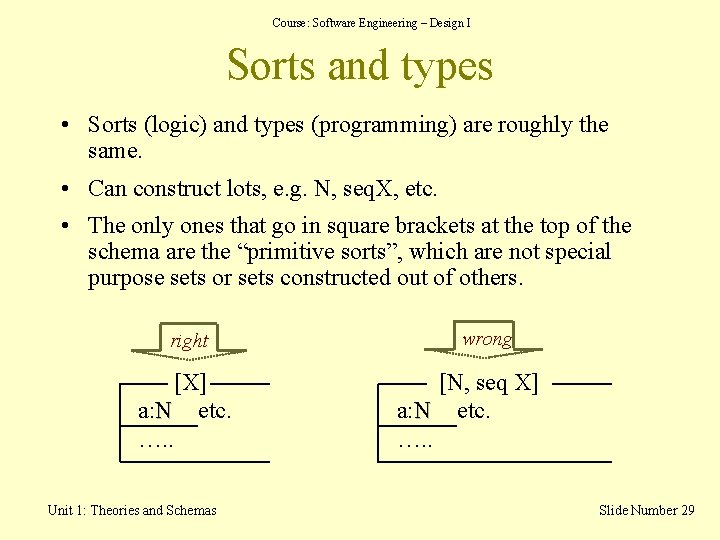
Course: Software Engineering – Design I Sorts and types • Sorts (logic) and types (programming) are roughly the same. • Can construct lots, e. g. N, seq. X, etc. • The only ones that go in square brackets at the top of the schema are the “primitive sorts”, which are not special purpose sets or sets constructed out of others. right [X] a: N etc. …. . Unit 1: Theories and Schemas wrong [N, seq X] a: N etc. …. . Slide Number 29
Course: Software Engineering – Design I Summary • A schema is a way of describing a logical theory. • The description has – sorts (primitive sorts, constructed sorts like N, seq. X) – constants, functions, predicates, propositions – axioms. • A schema inclusion is a shorthand notation for schemas. • A schema has models. • If the schema is a specification, then a model is a system implementation that satisfies it. Unit 1: Theories and Schemas Slide Number 30