
Course Selection Step 1 Review Degree and Subject
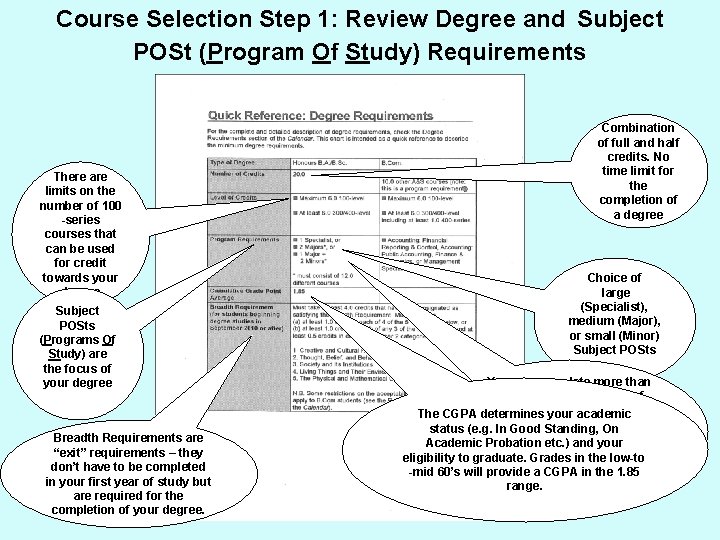
Course Selection Step 1: Review Degree and Subject POSt (Program Of Study) Requirements There are limits on the number of 100 -series courses that can be used for credit towards your degree Subject POSts (Programs Of Study) are the focus of your degree Breadth Requirements are “exit” requirements – they don’t have to be completed in your first year of study but are required for the completion of your degree. Combination of full and half credits. No time limit for the completion of a degree Choice of large (Specialist), medium (Major), or small (Minor) Subject POSts You can complete more than the “minimum” number of Subject POSts. can select The CGPA determines your. You academic 3 Subject POSts status (e. g. up Into Good Standing, Onwith a maximum of 2 large Subject Academic Probation etc. ) and your POSts ( e. g. in Majors or eligibility to graduate. Grades the low-to -mid 60’s will provide a. Specialists). CGPA in the 1. 85 range.
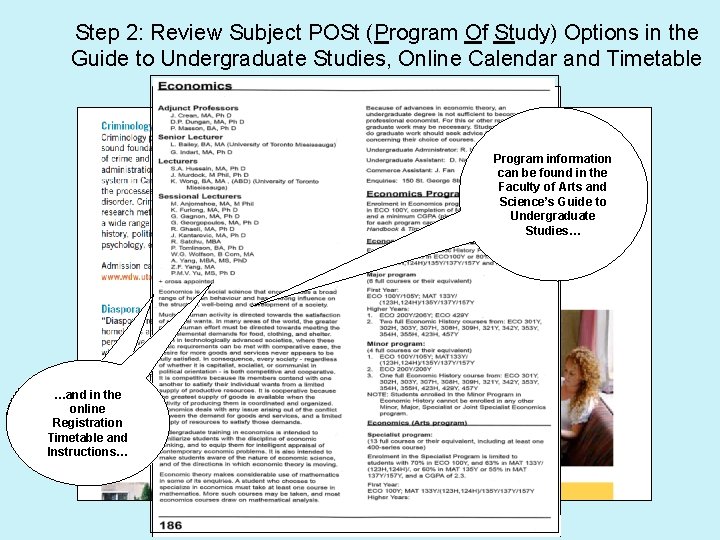
Step 2: Review Subject POSt (Program Of Study) Options in the Guide to Undergraduate Studies, Online Calendar and Timetable Program information can be found in the Faculty of Arts and Science’s Guide to Undergraduate Studies… …and in the …in the online Arts and Registration Science Timetable and Calendar… Instructions…
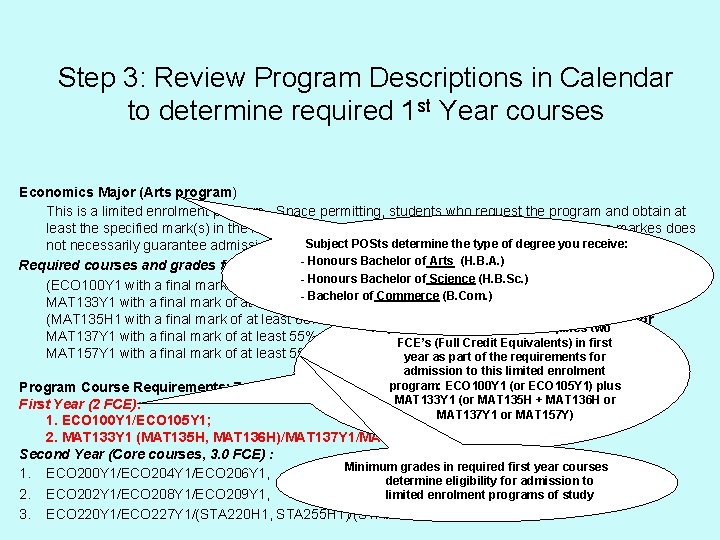
Step 3: Review Program Descriptions in Calendar to determine required 1 st Year courses Economics Major (Arts program) This is a limited enrolment program. Space permitting, students who request the program and obtain at least the specified mark(s) in the required course(s) will be eligible to enrol. Achieving these markes does POSts the type of degree you receive: not necessarily guarantee admission to the. Subject program in adetermine given year. Honours Bachelor of Arts (H. B. A. ) Required courses and grades for program -enrolment: - Honours Bachelor of Science (H. B. Sc. ) (ECO 100 Y 1 with a final mark of at least 67%, or ECO 105 Y 1 with a final mark of at least 80%), AND - Bachelor of Commerce (B. Com. ) MAT 133 Y 1 with a final mark of at least 63%, or (MAT 135 H 1 with a final mark of at least 60% and MAT 136 H 1 with a final mark of at least 60%), or Major program in Economics requires two MAT 137 Y 1 with a final mark of at least 55%, or FCE’s (Full Credit Equivalents) in first MAT 157 Y 1 with a final mark of at least 55%. year as part of the requirements for admission to this limited enrolment program: ECO 100 Y 1 (or ECO 105 Y 1) plus Program Course Requirements: 7 full courses or their equivalent MAT 133 Y 1 (or MAT 135 H + MAT 136 H or First Year (2 FCE): MAT 137 Y 1 or MAT 157 Y) 1. ECO 100 Y 1/ECO 105 Y 1; 2. MAT 133 Y 1 (MAT 135 H, MAT 136 H)/MAT 137 Y 1/MAT 157 Y 1 Second Year (Core courses, 3. 0 FCE) : Minimum grades in required first year courses 1. ECO 200 Y 1/ECO 204 Y 1/ECO 206 Y 1, determine eligibility for admission to 2. ECO 202 Y 1/ECO 208 Y 1/ECO 209 Y 1, limited enrolment programs of study 3. ECO 220 Y 1/ECO 227 Y 1/(STA 220 H 1, STA 255 H 1)/(STA 257 H 1, STA 261 H 1)
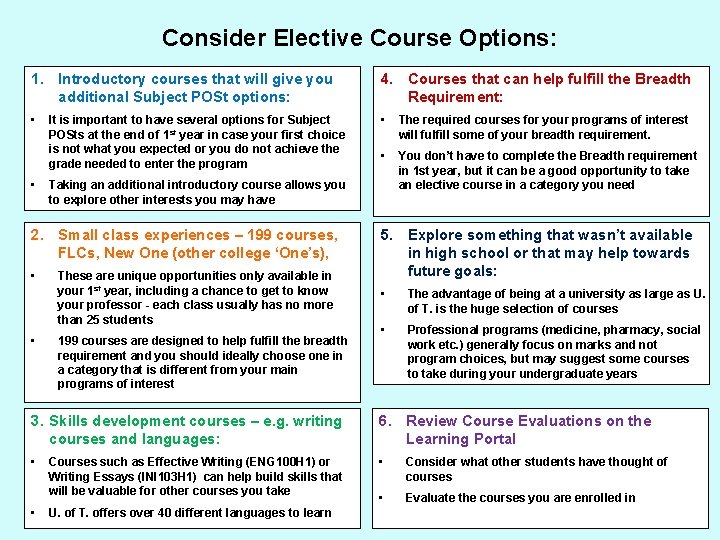
Consider Elective Course Options: 1. Introductory courses that will give you additional Subject POSt options: 4. Courses that can help fulfill the Breadth Requirement: • • The required courses for your programs of interest will fulfill some of your breadth requirement. • You don’t have to complete the Breadth requirement in 1 st year, but it can be a good opportunity to take an elective course in a category you need • It is important to have several options for Subject POSts at the end of 1 st year in case your first choice is not what you expected or you do not achieve the grade needed to enter the program Taking an additional introductory course allows you to explore other interests you may have 2. Small class experiences – 199 courses, FLCs, New One (other college ‘One’s), • • These are unique opportunities only available in your 1 st year, including a chance to get to know your professor - each class usually has no more than 25 students 199 courses are designed to help fulfill the breadth requirement and you should ideally choose one in a category that is different from your main programs of interest 5. Explore something that wasn’t available in high school or that may help towards future goals: • The advantage of being at a university as large as U. of T. is the huge selection of courses • Professional programs (medicine, pharmacy, social work etc. ) generally focus on marks and not program choices, but may suggest some courses to take during your undergraduate years 3. Skills development courses – e. g. writing courses and languages: 6. Review Course Evaluations on the Learning Portal • • Consider what other students have thought of courses • Evaluate the courses you are enrolled in • Courses such as Effective Writing (ENG 100 H 1) or Writing Essays (INI 103 H 1) can help build skills that will be valuable for other courses you take U. of T. offers over 40 different languages to learn

Step 4: Understand Course codes and descriptions in the Faculty of Arts and Science Calendar Course code Campus code indicator. 1 = course offered on the St. George campus Y = 1. 0 credit, H = 0. 5 credit First digit indicates level PHY year = Departmental Identifier (Physics Department) PHY 131 H 1 Introduction to Physics I Course Description Course title A first university physics course primarily for students not intending to pursue a Specialist or Major program in Physical or Mathematical Sciences. Topics include: classical kinematics and dynamics, momentum, energy, force, friction, work, power, angular momentum, oscillations, fluids, viscosity. Prerequisite: MCV 4 U Calculus & Vectors / MHF 4 U Functions & Calculus Corequisite: MAT 135 H 1/MAT 137 Y 1/MAT 157 Y 1 Lists courses you must have Course is a Breadth Requirement completed you 5 can (BR) frombefore Category ‘The take PHY 131 H 1 Physical and Mathematical Universes’ Exclusion: PHY 151 H 1 Recommended Preparation: SPH 4 U Physics and SCH 4 U Chemistry Lists courses that must be taken concurrently with Distribution Requirement Status: This is a Science course PHY 131 H 1 Courses that arecourse recommended Courses with similar content. by the Breadth Requirement: The Physical and Mathematical If. Universes (5) a course pre-requisites you. Department have takenas listed or co- requisites for PHY 131 H 1, but not required as an exclusion, then you can’t take PHY 131 H 1 for credit
- Slides: 5