
Course Outline Introduction and Algorithm Analysis Ch 2
- Slides: 49
Course Outline Introduction and Algorithm Analysis (Ch. 2) n Hash Tables: dictionary data structure (Ch. 5, CLRS) n Heaps: priority queue data structures (Ch. 6) n Balanced Search Trees: general search structures (Ch. 4. 1 -4. 5) n Union-Find data structure (Ch. 8. 1– 8. 5, Notes) n Graphs: Representations and basic algorithms £ Topological Sort (Ch. 9. 1 -9. 2) £ Minimum spanning trees (Ch. 9. 5) £ Shortest-path algorithms (Ch. 9. 3. 2) n B-Trees: External-Memory data structures (CLRS, Ch. 4. 7) n k. D-Trees: Multi-Dimensional data structures (Notes, Ch. 12. 6) n Misc. : Streaming data, randomization (Notes) n 0
Introduction: 2 Motivating Applications n n n 1 Imagine you are in charge of maintaining a corporate network (or a major website such as Amazon) £ High speed, high traffic volume, lots of users. Expected to perform with near perfect reliability, but is also under constant attack from malicious hackers Monitoring what is going through the network is complex: £ Why is it slow? £ Which machines have become compromised? £ Which applications are eating up too much bandwidth etc.
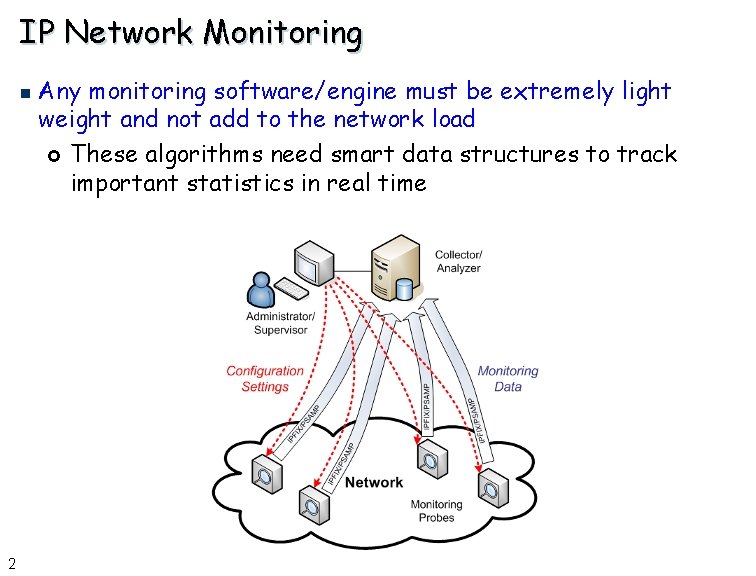
IP Network Monitoring n 2 Any monitoring software/engine must be extremely light weight and not add to the network load £ These algorithms need smart data structures to track important statistics in real time
IP Network Monitoring n n Consider a simple (toy) example Is some IP address sending a lot of data to my network? £ Which IP address sent the most data in last 1 minute? £ How many different IP addresses in last 5 minutes? £ Have I seen this IP address in the last 5 minutes? IP address format: 192. 168. 0. 0 (10001011001… 0010) n IPv 4 has 32 bits, IPv 6 has 128 bits n Cannot afford to maintain a table of all possible IP addresses to see how much traffic each is sending. n These are data structure problems, where obvious/naïve solutions are no good, and require creative/clever ideas. n 3
Microprocessor Profiling Modern microprocessors run at GHz or higher speeds n Yet they do an incredible amount of optimization for instruction scheduling, branch prediction etc n Profiling or monitoring code tracks performance bottlenecks, and looks for anomalies. £ Compute memory access statistics £ Correlations across resources etc n Toy examples: £ Which memory locations used the most in the last 1 sec? £ Usage map over sliding time window n n 4 Need for highly efficient dynamic data structures
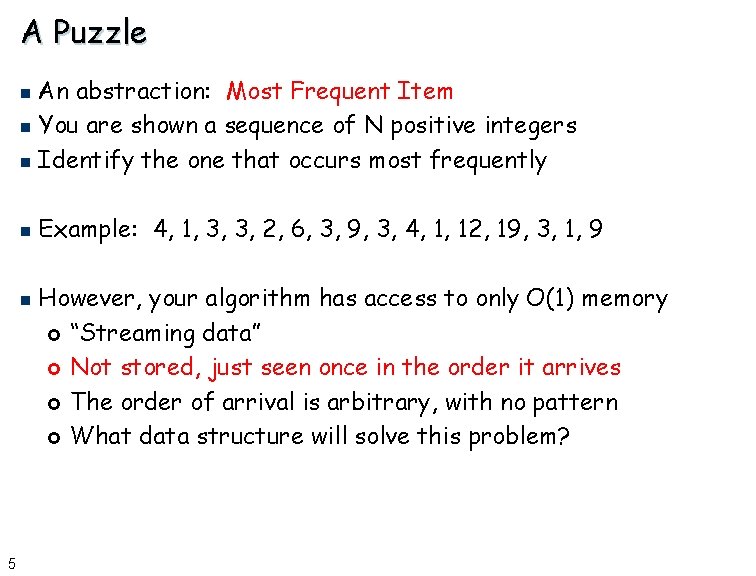
A Puzzle An abstraction: Most Frequent Item n You are shown a sequence of N positive integers n Identify the one that occurs most frequently n n n 5 Example: 4, 1, 3, 3, 2, 6, 3, 9, 3, 4, 1, 12, 19, 3, 1, 9 However, your algorithm has access to only O(1) memory £ “Streaming data” £ Not stored, just seen once in the order it arrives £ The order of arrival is arbitrary, with no pattern £ What data structure will solve this problem?
A Puzzle: Most Frequent Items can be source IP addresses at a router n The most frequent IP address can be useful to monitor suspicious traffic source n More generally, find the top K frequent items £ Targeted advertising £ Amazon, Google, e. Bay, Alibaba may track items bought most frequently by various demographics n 6
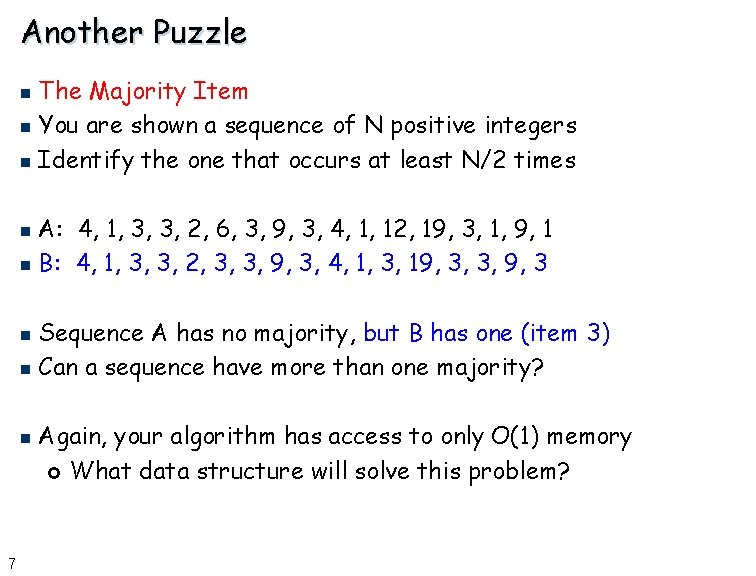
Another Puzzle The Majority Item n You are shown a sequence of N positive integers n Identify the one that occurs at least N/2 times n A: 4, 1, 3, 3, 2, 6, 3, 9, 3, 4, 1, 12, 19, 3, 1, 9, 1 n B: 4, 1, 3, 3, 2, 3, 3, 9, 3, 4, 1, 3, 19, 3, 3, 9, 3 n Sequence A has no majority, but B has one (item 3) n Can a sequence have more than one majority? n n 7 Again, your algorithm has access to only O(1) memory £ What data structure will solve this problem?
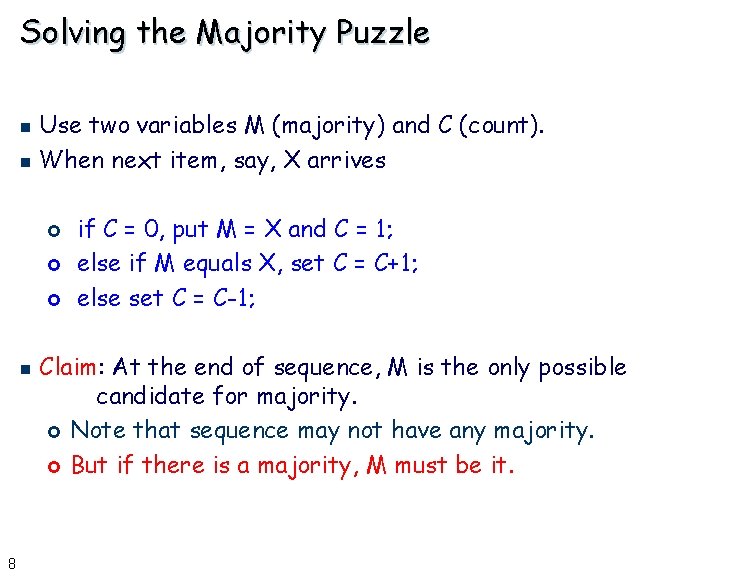
Solving the Majority Puzzle Use two variables M (majority) and C (count). n When next item, say, X arrives n £ £ £ n 8 if C = 0, put M = X and C = 1; else if M equals X, set C = C+1; else set C = C-1; Claim: At the end of sequence, M is the only possible candidate for majority. £ Note that sequence may not have any majority. £ But if there is a majority, M must be it.
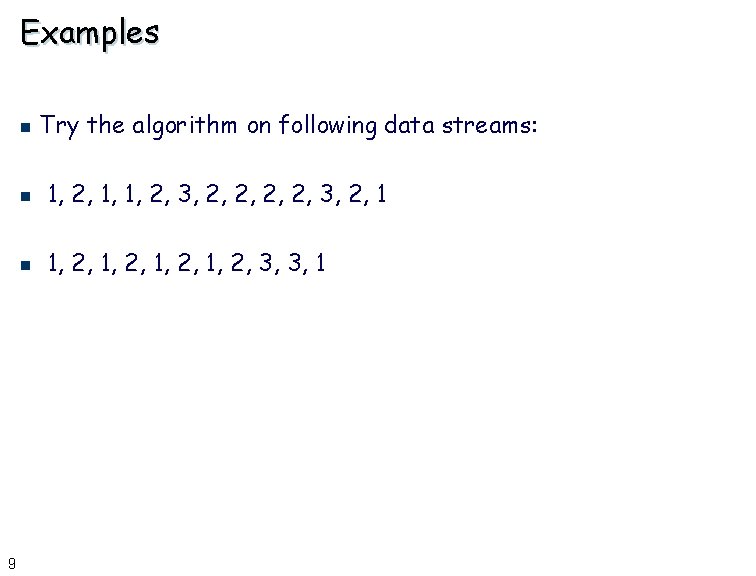
Examples n 9 Try the algorithm on following data streams: n 1, 2, 1, 1, 2, 3, 2, 1 n 1, 2, 3, 3, 1
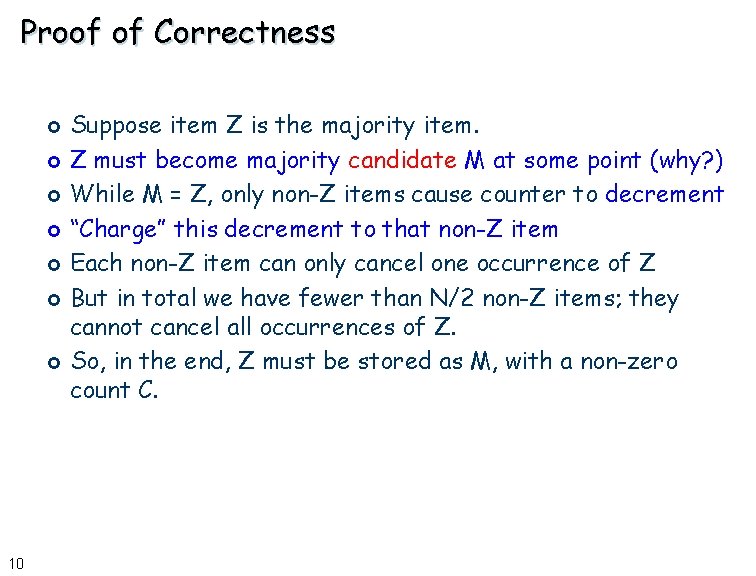
Proof of Correctness £ £ £ £ 10 Suppose item Z is the majority item. Z must become majority candidate M at some point (why? ) While M = Z, only non-Z items cause counter to decrement “Charge” this decrement to that non-Z item Each non-Z item can only cancel one occurrence of Z But in total we have fewer than N/2 non-Z items; they cannot cancel all occurrences of Z. So, in the end, Z must be stored as M, with a non-zero count C.
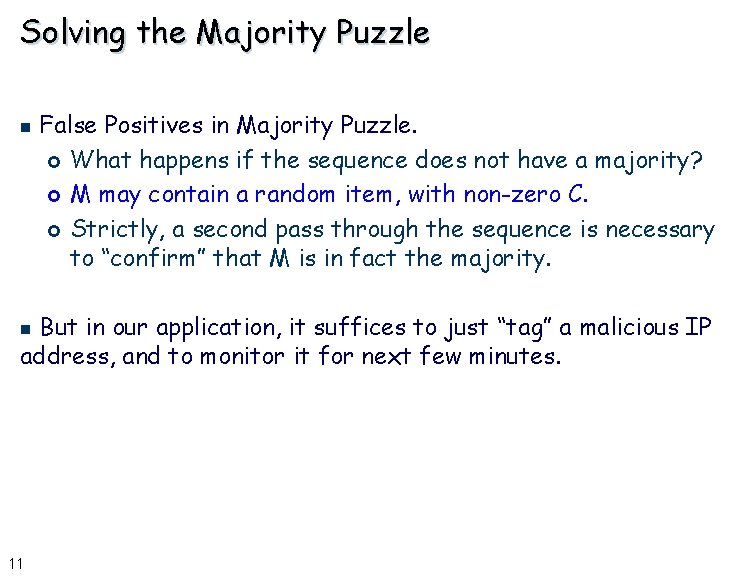
Solving the Majority Puzzle n False Positives in Majority Puzzle. £ What happens if the sequence does not have a majority? £ M may contain a random item, with non-zero C. £ Strictly, a second pass through the sequence is necessary to “confirm” that M is in fact the majority. But in our application, it suffices to just “tag” a malicious IP address, and to monitor it for next few minutes. n 11
Generalizing the Majority Problem Identify k items, each appearing more than N/(k+1) times. n Note that simple majority is the case of k = 1. n 12
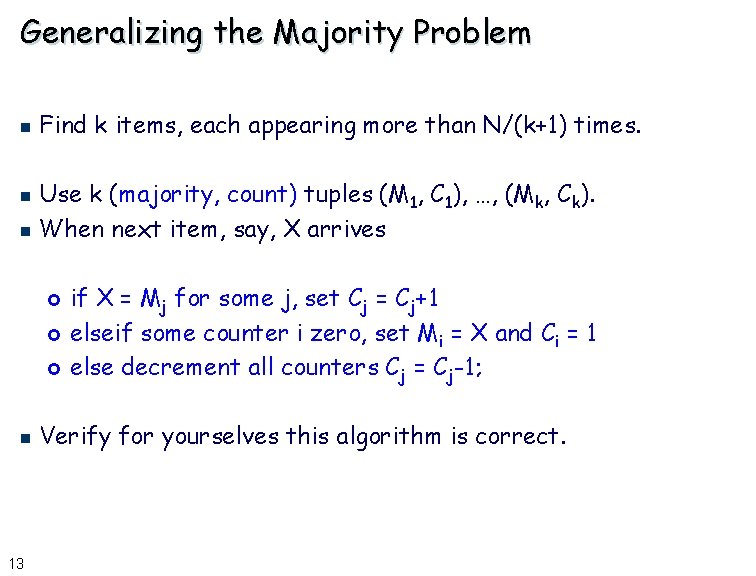
Generalizing the Majority Problem n Find k items, each appearing more than N/(k+1) times. Use k (majority, count) tuples (M 1, C 1), …, (Mk, Ck). n When next item, say, X arrives n £ £ £ n 13 if X = Mj for some j, set Cj = Cj+1 elseif some counter i zero, set Mi = X and Ci = 1 else decrement all counters Cj = Cj-1; Verify for yourselves this algorithm is correct.
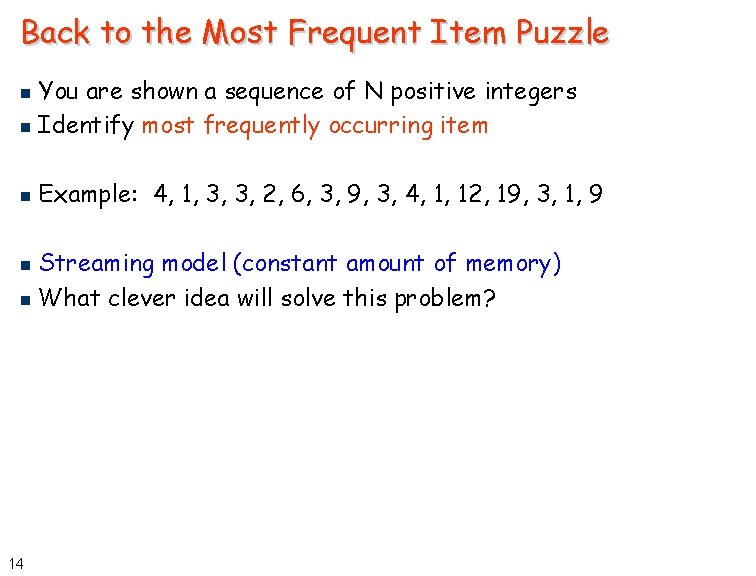
Back to the Most Frequent Item Puzzle You are shown a sequence of N positive integers n Identify most frequently occurring item n n Example: 4, 1, 3, 3, 2, 6, 3, 9, 3, 4, 1, 12, 19, 3, 1, 9 Streaming model (constant amount of memory) n What clever idea will solve this problem? n 14
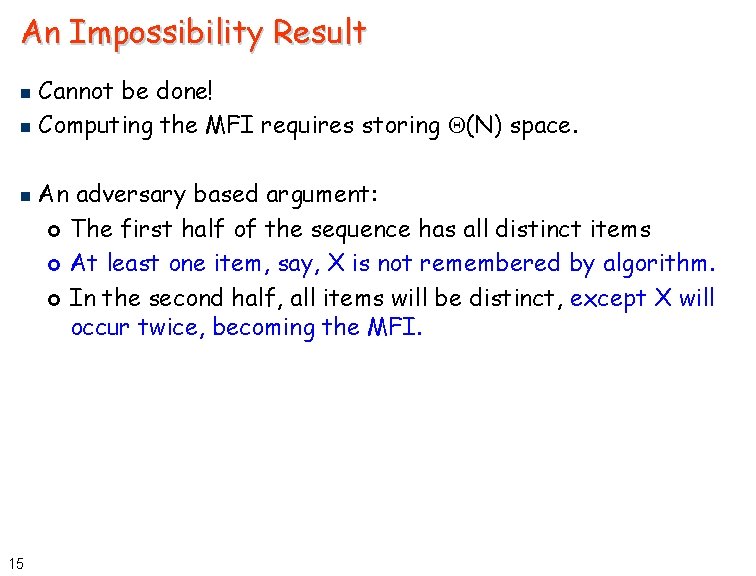
An Impossibility Result Cannot be done! n Computing the MFI requires storing Q(N) space. n n 15 An adversary based argument: £ The first half of the sequence has all distinct items £ At least one item, say, X is not remembered by algorithm. £ In the second half, all items will be distinct, except X will occur twice, becoming the MFI.
Lessons for Data Structure Design n Puzzles such as Majority and Most Frequent Items teach us important lessons: £ £ £ 16 Elegant interplay of data structure and algorithm To solve a problem, we should understand its structure Correctness is intertwined with design/efficiency Problems with superficial resemblance can have very different complexity Do not blindly apply a data structure or algorithm without understanding the nature of the problem
Performance Bottleneck: algorithm or data structure? 17
130 a: Design and Analysis n n n 21 Foundations of Algorithm Analysis and Data Structures £ How to efficiently store, access, manage data £ Data structures effect algorithm’s performance Algorithm Design and Analysis: £ How to predict an algorithm’s performance £ How well an algorithm scales up £ How to compare different algorithms for a problem
Course Objectives n n n 22 Focus: systematic design and analysis of data structures (and some algorithms) £ Algorithm: method for solving a problem. £ Data structure: method to store information. Guiding principles: abstraction and formal analysis Abstraction: Formulate fundamental problem in a general form so it applies to a variety of applications Analysis: A (mathematically) rigorous methodology to compare two objects (data structures or algorithms) In particular, we will worry about "always correct"-ness, and worst-case bounds on time and memory (space).
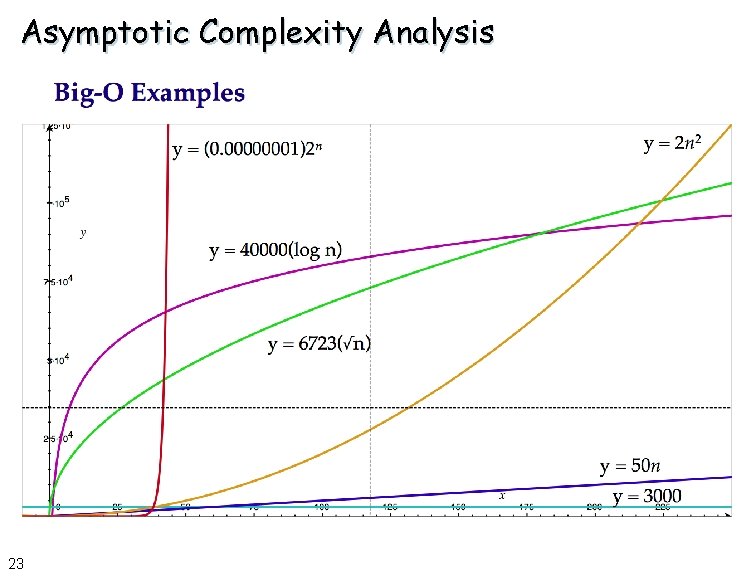
Asymptotic Complexity Analysis 23
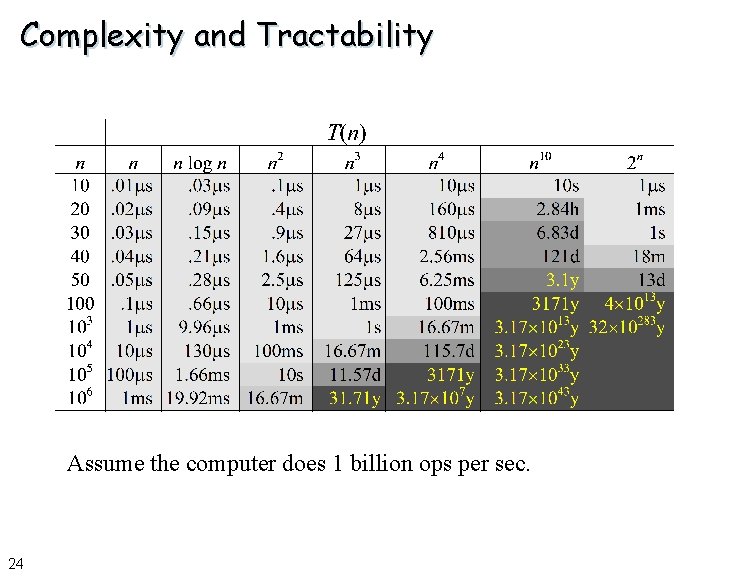
Complexity and Tractability Assume the computer does 1 billion ops per sec. 24
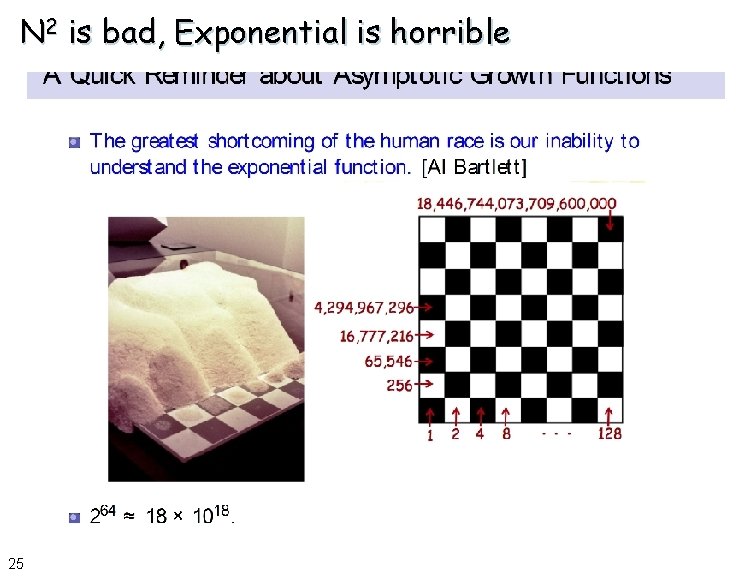
N 2 is bad, Exponential is horrible 25
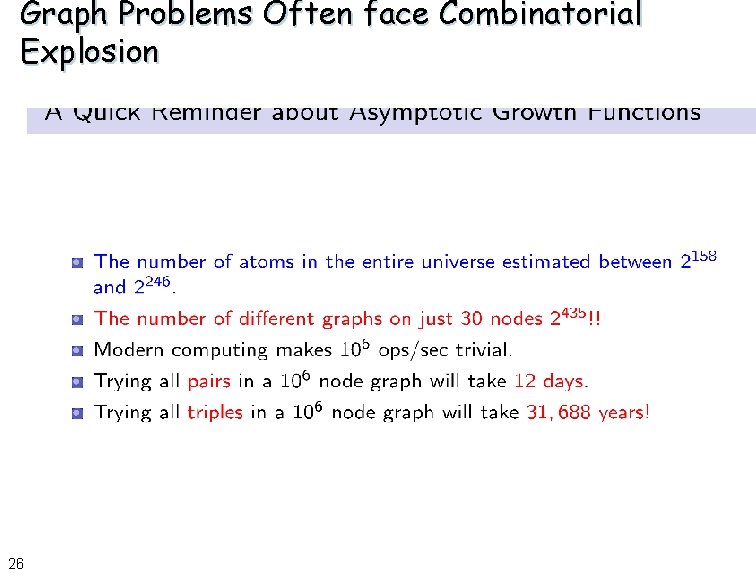
Graph Problems Often face Combinatorial Explosion 26
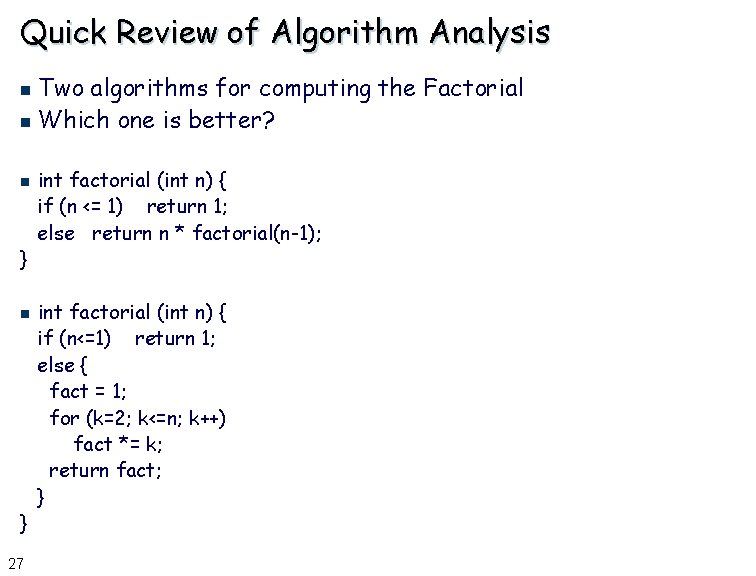
Quick Review of Algorithm Analysis Two algorithms for computing the Factorial n Which one is better? n n } 27 int factorial (int n) { if (n <= 1) return 1; else return n * factorial(n-1); int factorial (int n) { if (n<=1) return 1; else { fact = 1; for (k=2; k<=n; k++) fact *= k; return fact; }
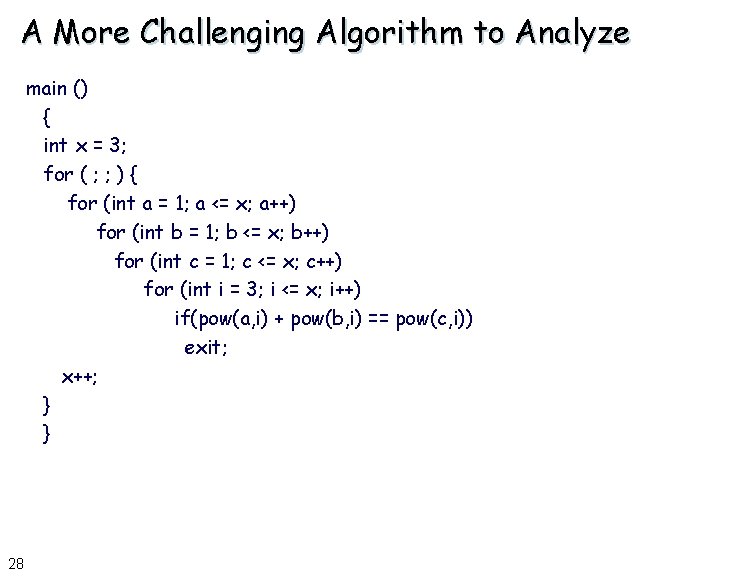
A More Challenging Algorithm to Analyze main () { int x = 3; for ( ; ; ) { for (int a = 1; a <= x; a++) for (int b = 1; b <= x; b++) for (int c = 1; c <= x; c++) for (int i = 3; i <= x; i++) if(pow(a, i) + pow(b, i) == pow(c, i)) exit; x++; } } 28
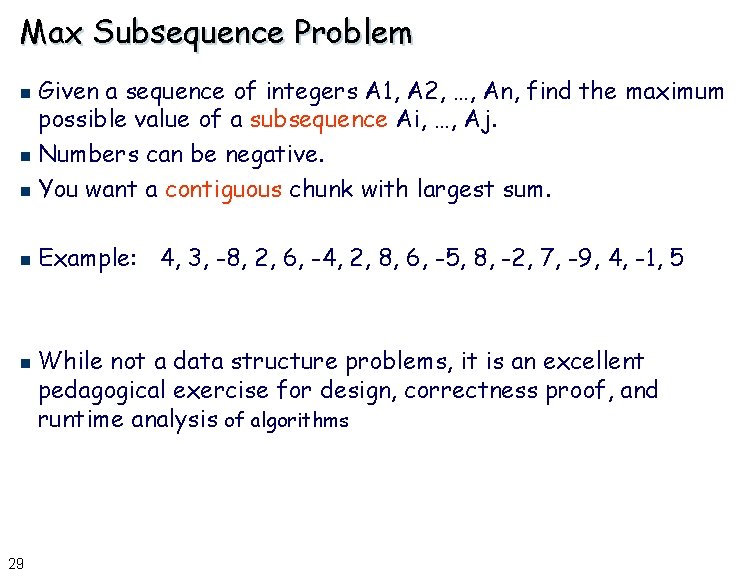
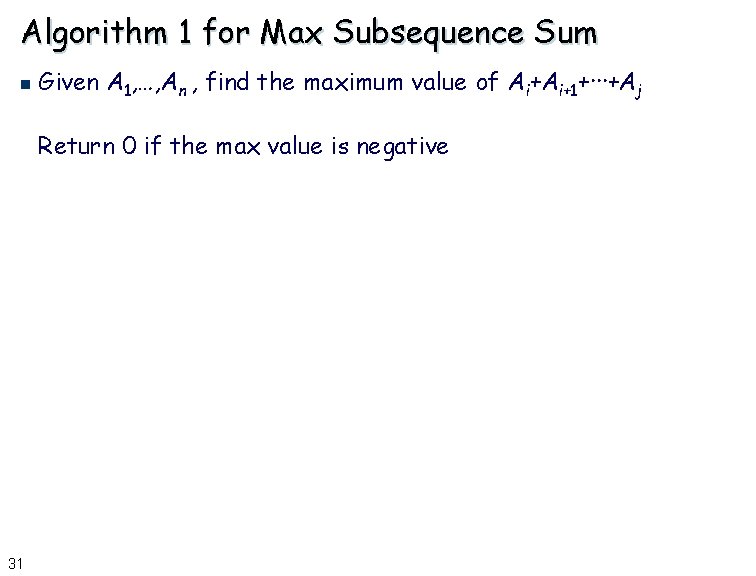
Max Subsequence Problem Given a sequence of integers A 1, A 2, …, An, find the maximum possible value of a subsequence Ai, …, Aj. n Numbers can be negative. n You want a contiguous chunk with largest sum. n n n 29 Example: 4, 3, -8, 2, 6, -4, 2, 8, 6, -5, 8, -2, 7, -9, 4, -1, 5 While not a data structure problems, it is an excellent pedagogical exercise for design, correctness proof, and runtime analysis of algorithms
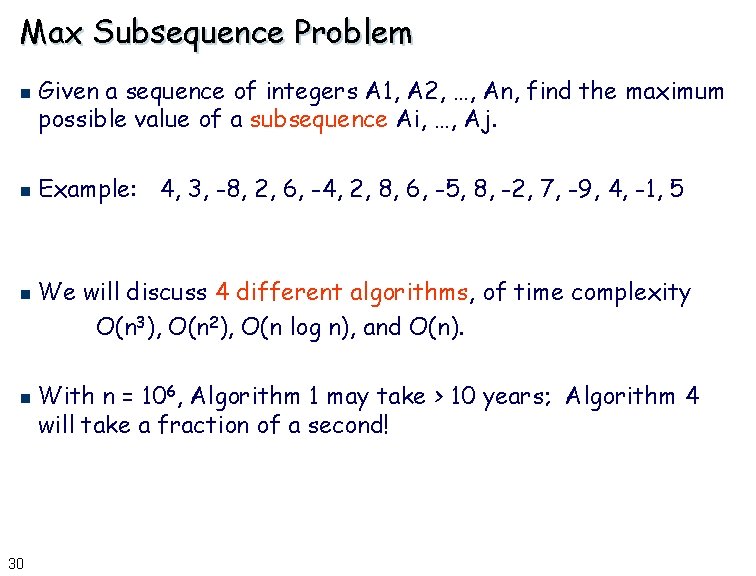
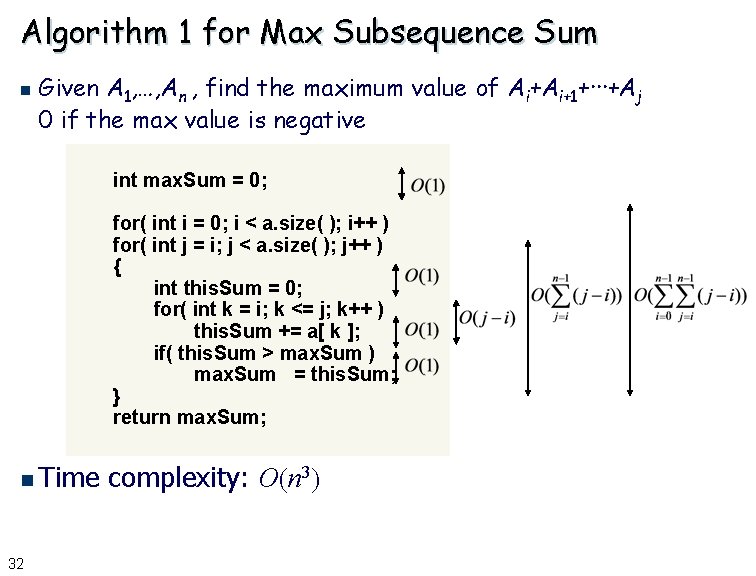
Max Subsequence Problem n n 30 Given a sequence of integers A 1, A 2, …, An, find the maximum possible value of a subsequence Ai, …, Aj. Example: 4, 3, -8, 2, 6, -4, 2, 8, 6, -5, 8, -2, 7, -9, 4, -1, 5 We will discuss 4 different algorithms, of time complexity O(n 3), O(n 2), O(n log n), and O(n). With n = 106, Algorithm 1 may take > 10 years; Algorithm 4 will take a fraction of a second!
Algorithm 1 for Max Subsequence Sum n Given A 1, …, An , find the maximum value of Ai+Ai+1+···+Aj Return 0 if the max value is negative 31
Algorithm 1 for Max Subsequence Sum n Given A 1, …, An , find the maximum value of Ai+Ai+1+···+Aj 0 if the max value is negative int max. Sum = 0; for( int i = 0; i < a. size( ); i++ ) for( int j = i; j < a. size( ); j++ ) { int this. Sum = 0; for( int k = i; k <= j; k++ ) this. Sum += a[ k ]; if( this. Sum > max. Sum ) max. Sum = this. Sum; } return max. Sum; n Time 32 complexity: O(n 3)
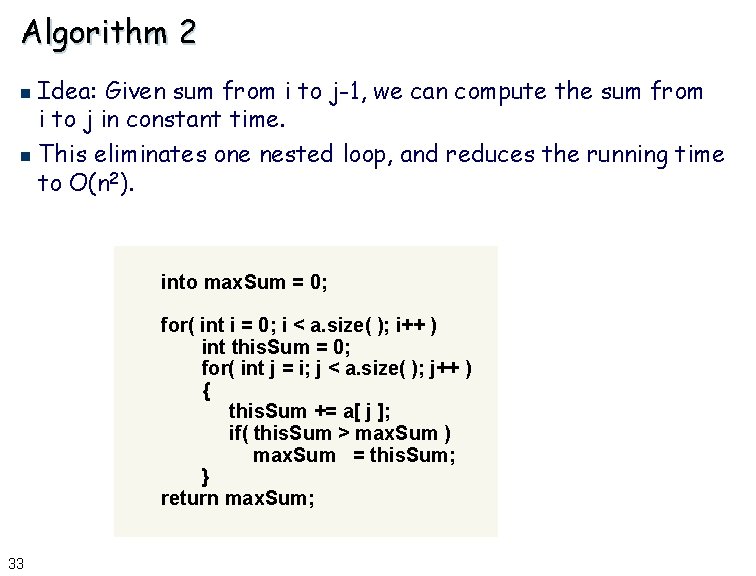
Algorithm 2 Idea: Given sum from i to j-1, we can compute the sum from i to j in constant time. n This eliminates one nested loop, and reduces the running time to O(n 2). n into max. Sum = 0; for( int i = 0; i < a. size( ); i++ ) int this. Sum = 0; for( int j = i; j < a. size( ); j++ ) { this. Sum += a[ j ]; if( this. Sum > max. Sum ) max. Sum = this. Sum; } return max. Sum; 33
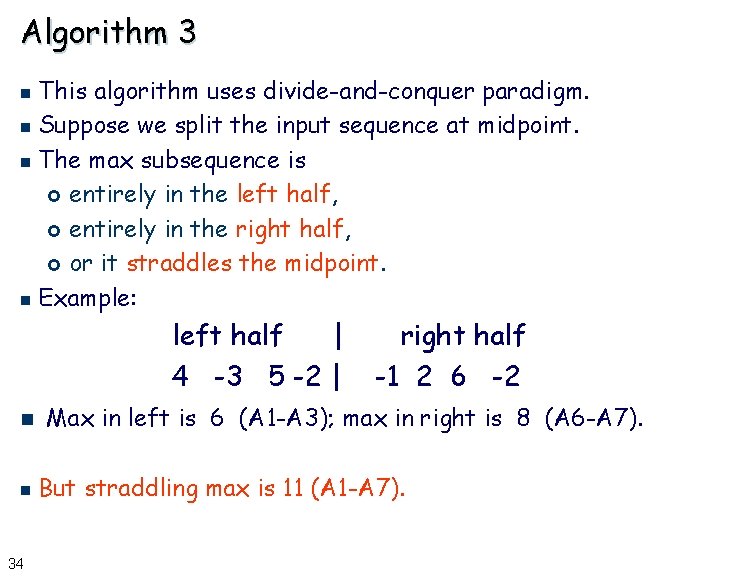
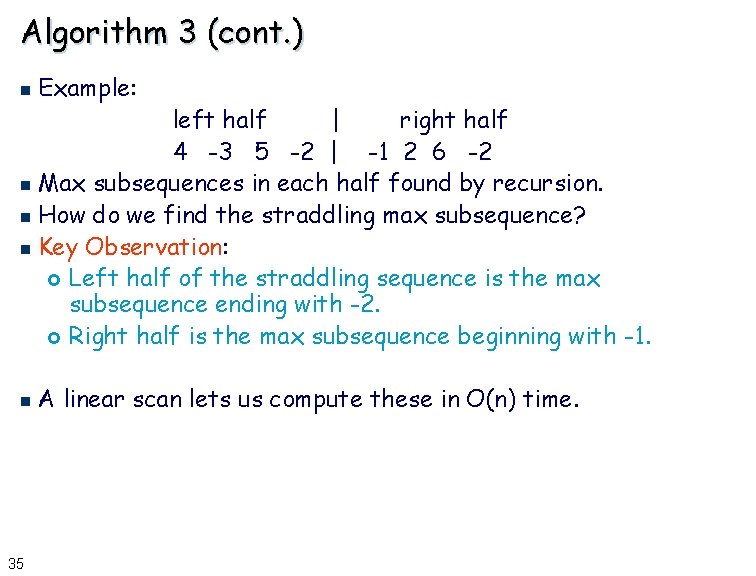
Algorithm 3 This algorithm uses divide-and-conquer paradigm. n Suppose we split the input sequence at midpoint. n The max subsequence is £ entirely in the left half, £ entirely in the right half, £ or it straddles the midpoint. n Example: n left half | 4 -3 5 -2 | n n 34 right half -1 2 6 -2 Max in left is 6 (A 1 -A 3); max in right is 8 (A 6 -A 7). But straddling max is 11 (A 1 -A 7).
Algorithm 3 (cont. ) n Example: left half | right half 4 -3 5 -2 | -1 2 6 -2 n Max subsequences in each half found by recursion. n How do we find the straddling max subsequence? n Key Observation: £ Left half of the straddling sequence is the max subsequence ending with -2. £ Right half is the max subsequence beginning with -1. n 35 A linear scan lets us compute these in O(n) time.
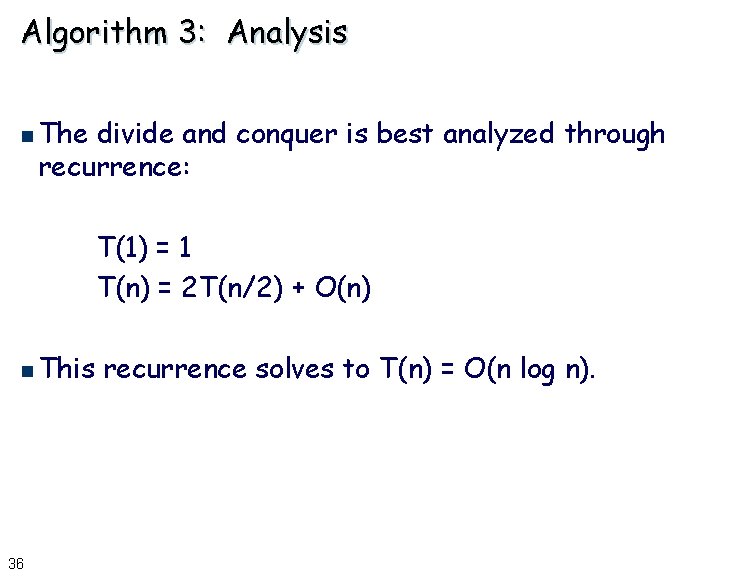
Algorithm 3: Analysis n The divide and conquer is best analyzed through recurrence: T(1) = 1 T(n) = 2 T(n/2) + O(n) n This 36 recurrence solves to T(n) = O(n log n).
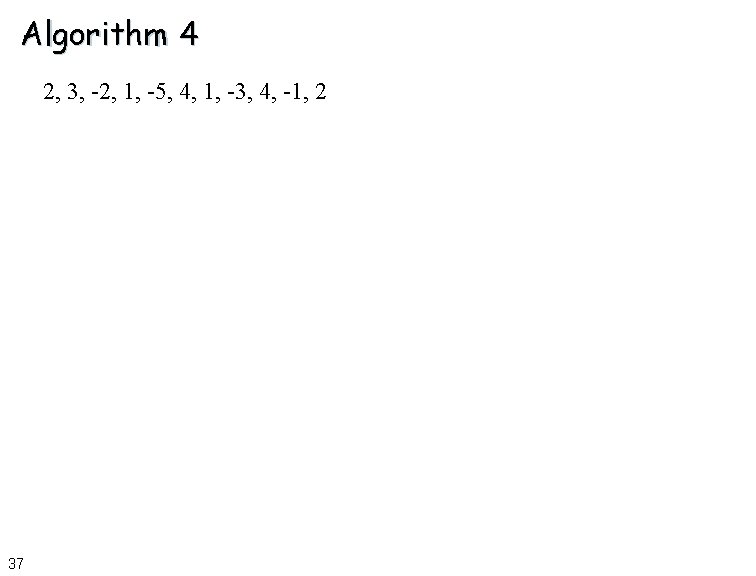
Algorithm 4 2, 3, -2, 1, -5, 4, 1, -3, 4, -1, 2 37
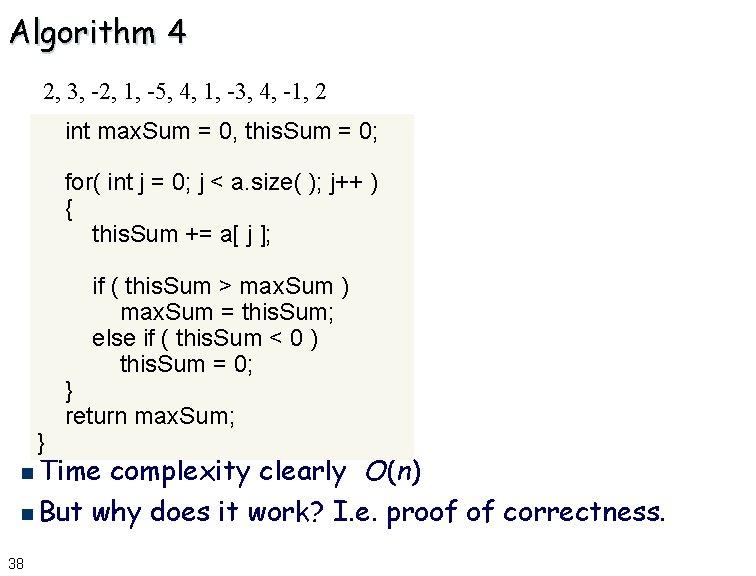
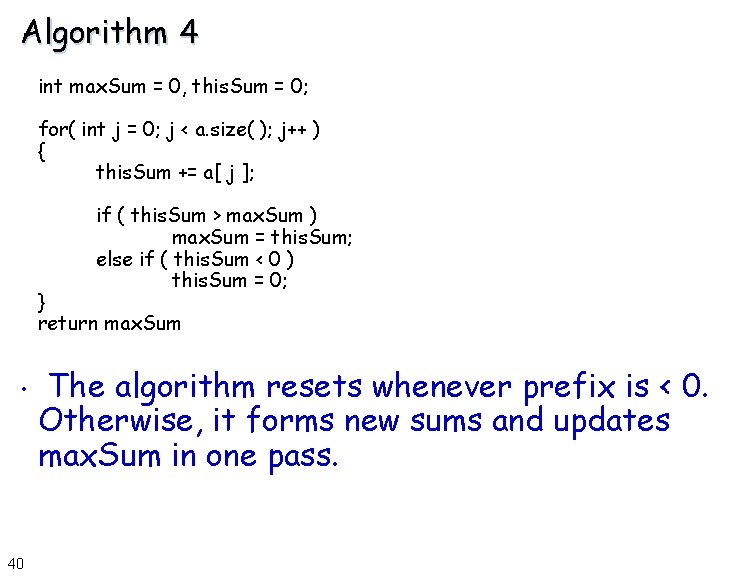
Algorithm 4 2, 3, -2, 1, -5, 4, 1, -3, 4, -1, 2 int max. Sum = 0, this. Sum = 0; for( int j = 0; j < a. size( ); j++ ) { this. Sum += a[ j ]; if ( this. Sum > max. Sum ) max. Sum = this. Sum; else if ( this. Sum < 0 ) this. Sum = 0; } } return max. Sum; n Time complexity clearly O(n) n But why does it work? I. e. proof of correctness. 38
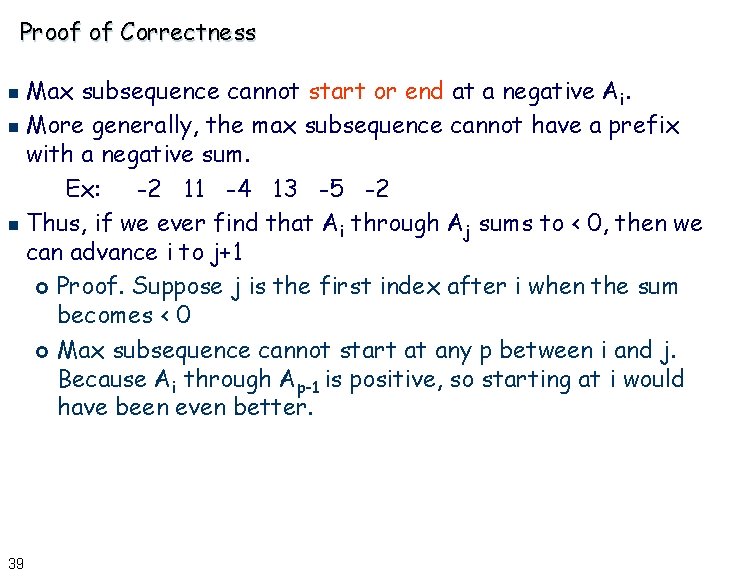
Proof of Correctness Max subsequence cannot start or end at a negative Ai. n More generally, the max subsequence cannot have a prefix with a negative sum. Ex: -2 11 -4 13 -5 -2 n Thus, if we ever find that Ai through Aj sums to < 0, then we can advance i to j+1 £ Proof. Suppose j is the first index after i when the sum becomes < 0 £ Max subsequence cannot start at any p between i and j. Because Ai through Ap-1 is positive, so starting at i would have been even better. n 39
Algorithm 4 int max. Sum = 0, this. Sum = 0; for( int j = 0; j < a. size( ); j++ ) { this. Sum += a[ j ]; if ( this. Sum > max. Sum ) max. Sum = this. Sum; else if ( this. Sum < 0 ) this. Sum = 0; } return max. Sum • 40 The algorithm resets whenever prefix is < 0. Otherwise, it forms new sums and updates max. Sum in one pass.
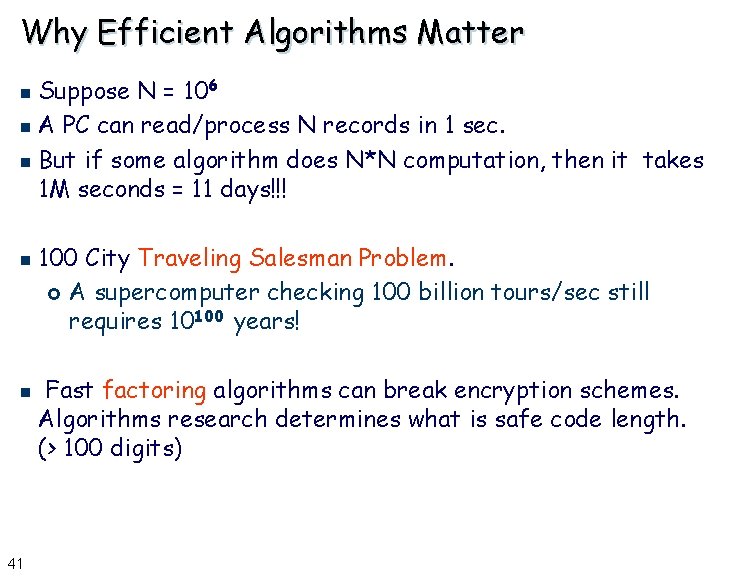
Why Efficient Algorithms Matter Suppose N = 106 n A PC can read/process N records in 1 sec. n But if some algorithm does N*N computation, then it takes 1 M seconds = 11 days!!! n n n 41 100 City Traveling Salesman Problem. £ A supercomputer checking 100 billion tours/sec still requires 10100 years! Fast factoring algorithms can break encryption schemes. Algorithms research determines what is safe code length. (> 100 digits)
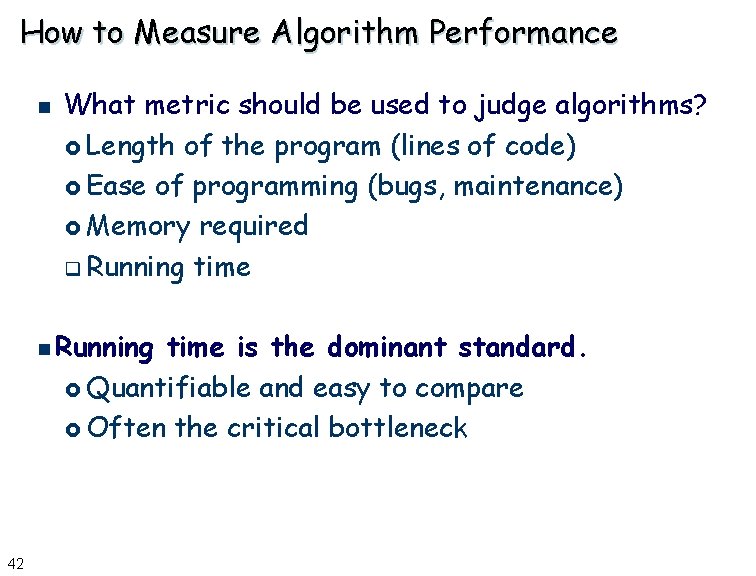
How to Measure Algorithm Performance n What metric should be used to judge algorithms? £ Length of the program (lines of code) £ Ease of programming (bugs, maintenance) £ Memory required q Running time n Running time is the dominant standard. £ Quantifiable and easy to compare £ Often the critical bottleneck 42
Abstraction n n 43 An algorithm may run differently depending on: £ the hardware platform (PC, Cray, Sun) £ the programming language (C, Java, C++) £ the programmer (you, me, Bill Joy) While different in detail, all hardware and prog models are equivalent in some sense: Turing machines. It suffices to count basic operations. Crude but valuable measure of algorithm’s performance as a function of input size.
Average, Best, and Worst-Case n On which input instances should the algorithm’s performance be judged? Average case: £ Real world distributions difficult to predict n Best case: £ Seems unrealistic n Worst case: £ Gives an absolute guarantee £ We will use the worst-case measure. n 44
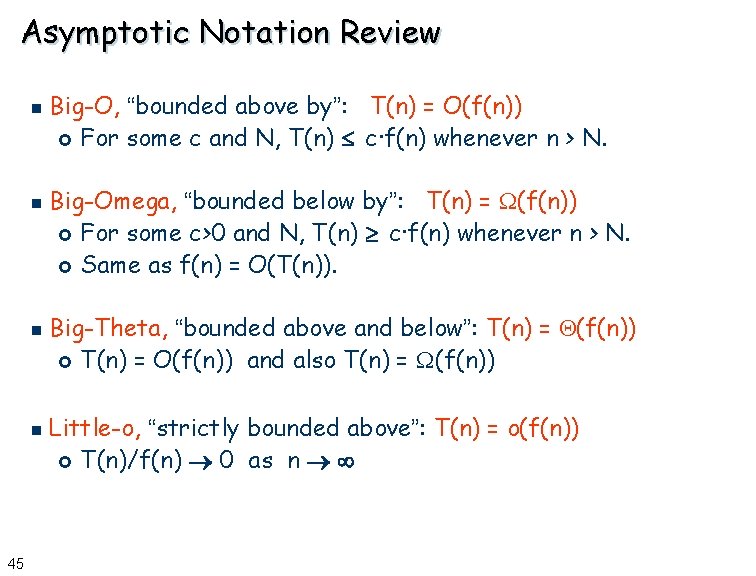
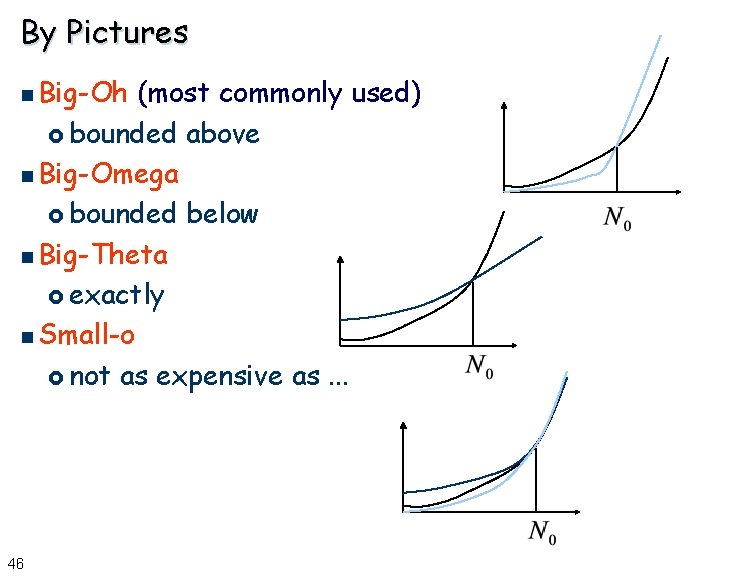
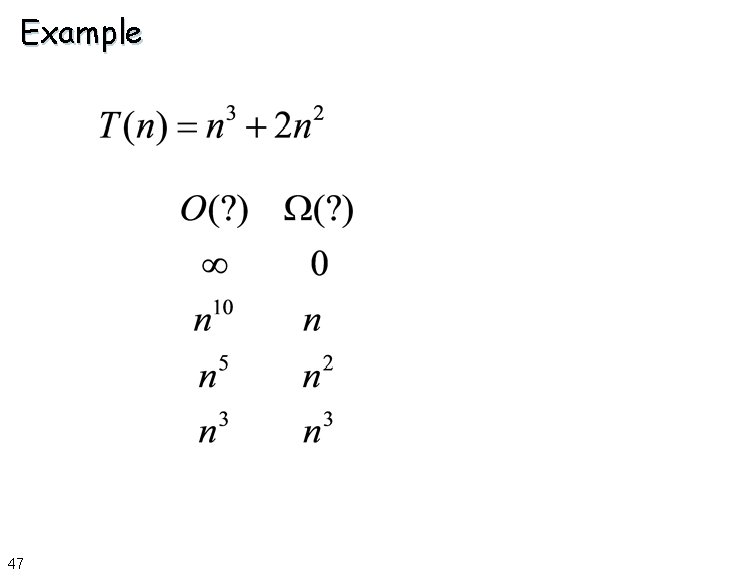
Asymptotic Notation Review n n 45 Big-O, “bounded above by”: T(n) = O(f(n)) £ For some c and N, T(n) c·f(n) whenever n > N. Big-Omega, “bounded below by”: T(n) = W(f(n)) £ For some c>0 and N, T(n) c·f(n) whenever n > N. £ Same as f(n) = O(T(n)). Big-Theta, “bounded above and below”: T(n) = Q(f(n)) £ T(n) = O(f(n)) and also T(n) = W(f(n)) Little-o, “strictly bounded above”: T(n) = o(f(n)) £ T(n)/f(n) 0 as n
By Pictures n Big-Oh (most commonly used) £ bounded above n Big-Omega £ bounded below n Big-Theta £ exactly n Small-o £ not as expensive as. . . 46
Example 47
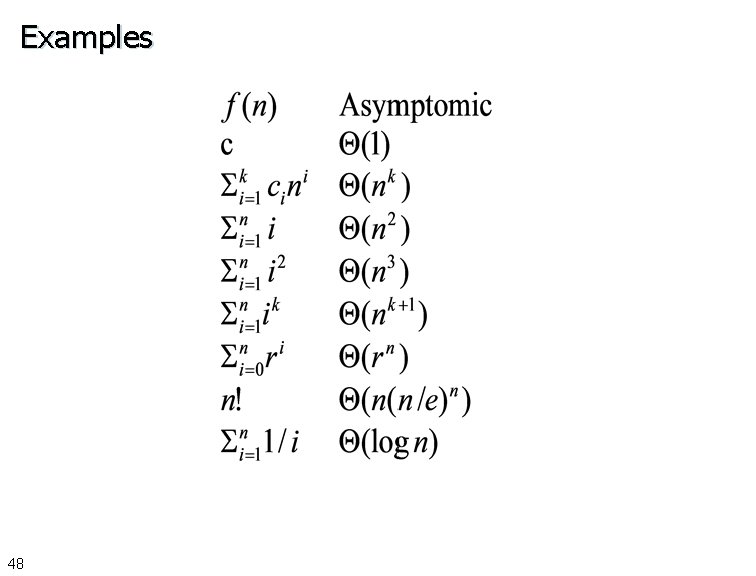
Examples 48
End of Introduction and Analysis £ Next 49 Topic: Hash Tables
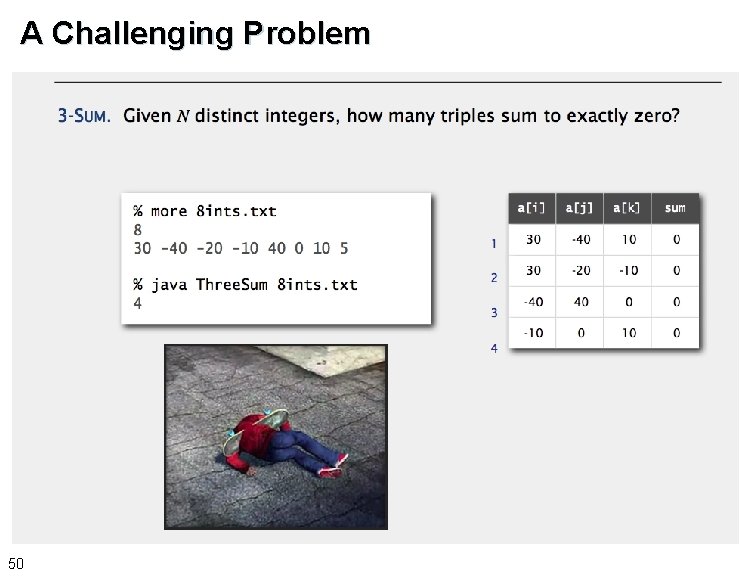
A Challenging Problem 50
51