
Course Outline Introduction and Algorithm Analysis Ch 2
- Slides: 31
Course Outline Introduction and Algorithm Analysis (Ch. 2) n Hash Tables: dictionary data structure (Ch. 5) n Heaps: priority queue data structures (Ch. 6) n Balanced Search Trees: general search structures (Ch. 4. 1 -4. 5) n Union-Find data structure (Ch. 8. 1– 8. 5) n Graphs: Representations and basic algorithms £ Topological Sort (Ch. 9. 1 -9. 2) £ Minimum spanning trees (Ch. 9. 5) £ Shortest-path algorithms (Ch. 9. 3. 2) n B-Trees: External-Memory data structures (Ch. 4. 7) n k. D-Trees: Multi-Dimensional data structures (Ch. 12. 6) n Misc. : Streaming data, randomization n 0
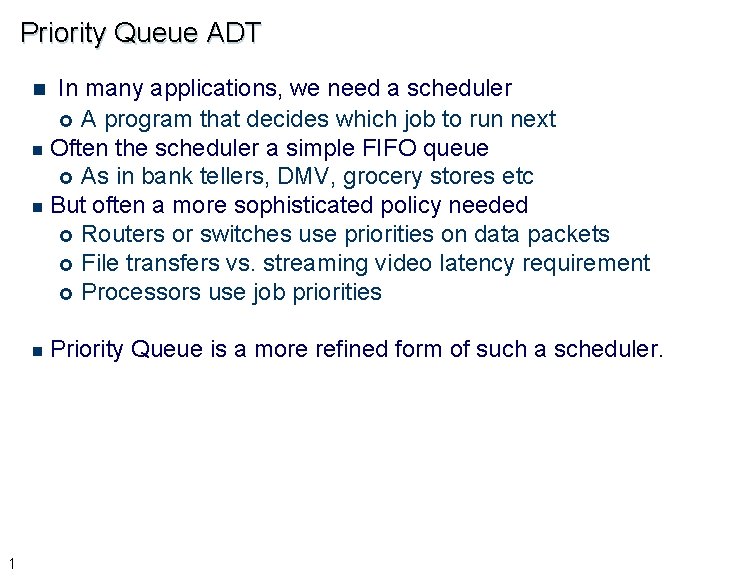
Priority Queue ADT In many applications, we need a scheduler £ A program that decides which job to run next n Often the scheduler a simple FIFO queue £ As in bank tellers, DMV, grocery stores etc n But often a more sophisticated policy needed £ Routers or switches use priorities on data packets £ File transfers vs. streaming video latency requirement £ Processors use job priorities n n 1 Priority Queue is a more refined form of such a scheduler.
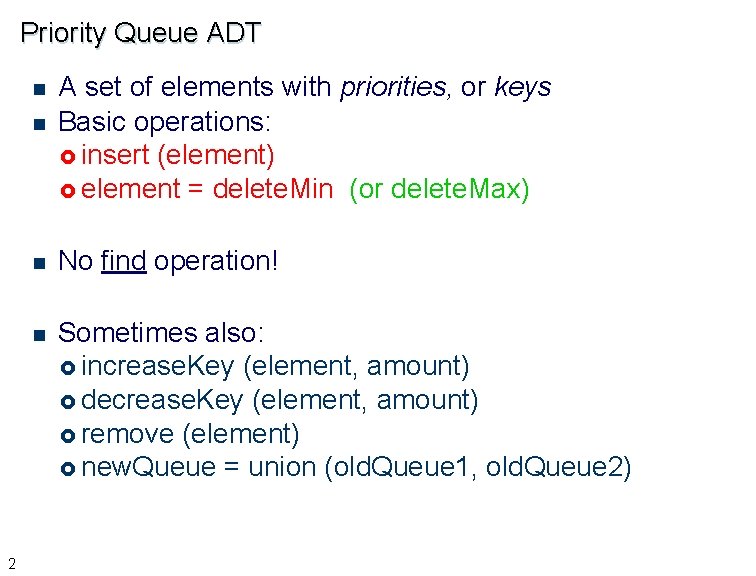
Priority Queue ADT n n 2 A set of elements with priorities, or keys Basic operations: £ insert (element) £ element = delete. Min (or delete. Max) n No find operation! n Sometimes also: £ increase. Key (element, amount) £ decrease. Key (element, amount) £ remove (element) £ new. Queue = union (old. Queue 1, old. Queue 2)
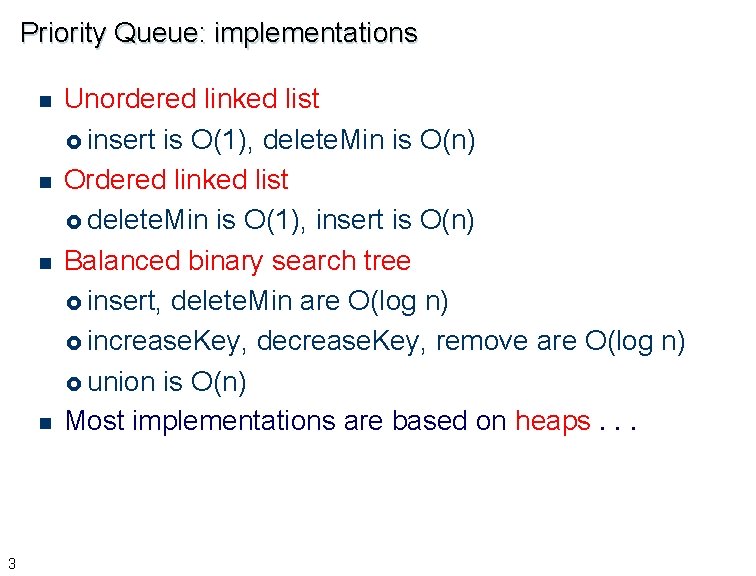
Priority Queue: implementations n n 3 Unordered linked list £ insert is O(1), delete. Min is O(n) Ordered linked list £ delete. Min is O(1), insert is O(n) Balanced binary search tree £ insert, delete. Min are O(log n) £ increase. Key, decrease. Key, remove are O(log n) £ union is O(n) Most implementations are based on heaps. . .
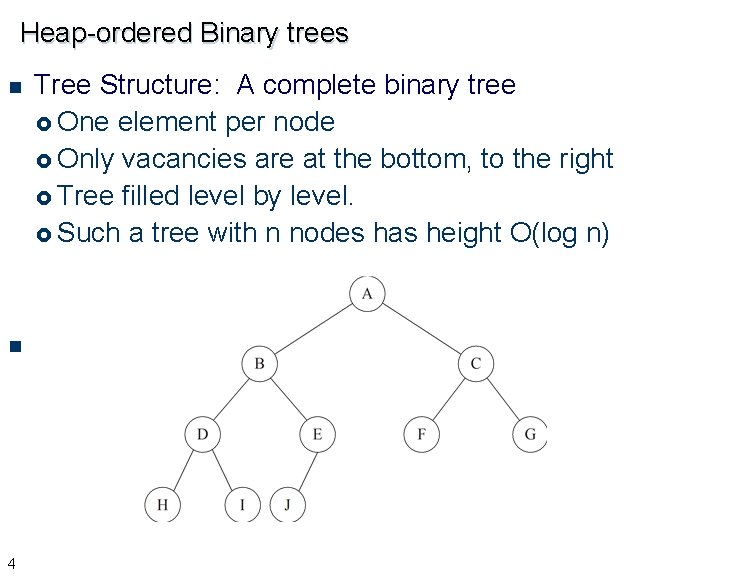
Heap-ordered Binary trees n n 4 Tree Structure: A complete binary tree £ One element per node £ Only vacancies are at the bottom, to the right £ Tree filled level by level. £ Such a tree with n nodes has height O(log n)
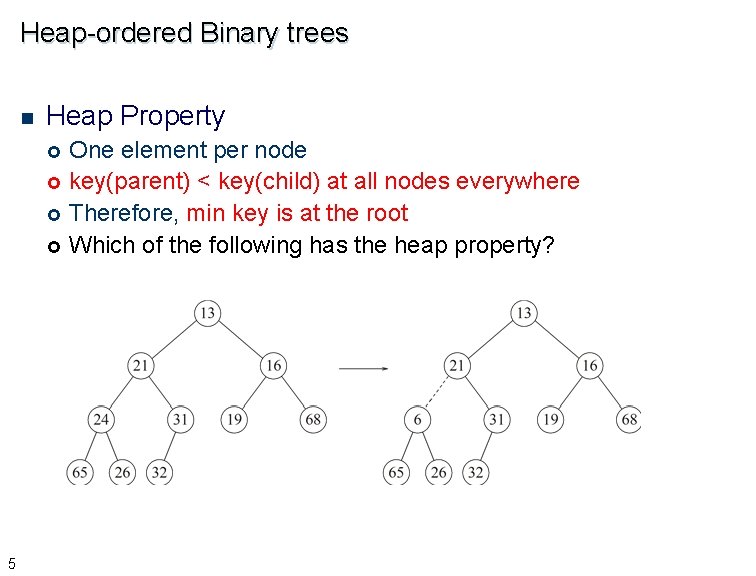
Heap-ordered Binary trees n Heap Property £ £ 5 One element per node key(parent) < key(child) at all nodes everywhere Therefore, min key is at the root Which of the following has the heap property?
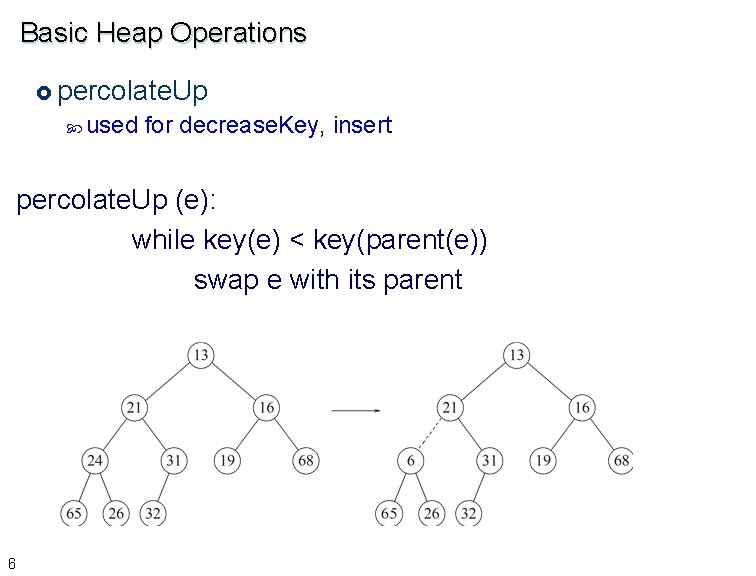
Basic Heap Operations £ percolate. Up used for decrease. Key, insert percolate. Up (e): while key(e) < key(parent(e)) swap e with its parent 6
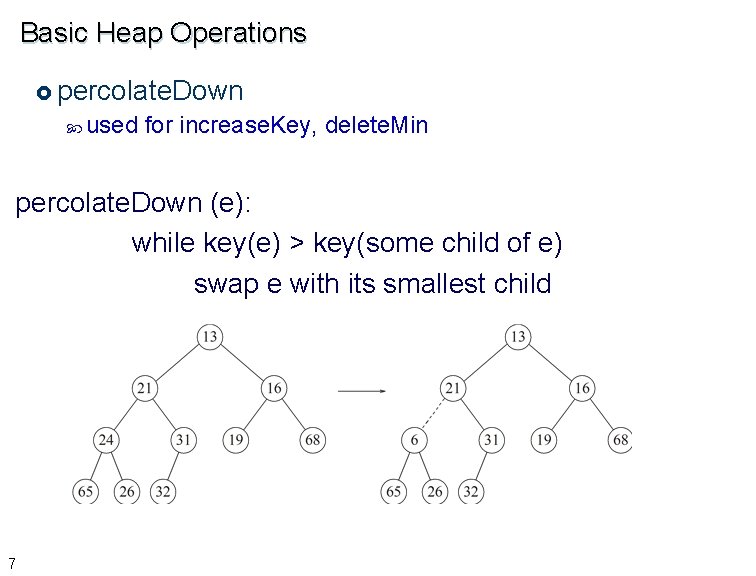
Basic Heap Operations £ percolate. Down used for increase. Key, delete. Min percolate. Down (e): while key(e) > key(some child of e) swap e with its smallest child 7
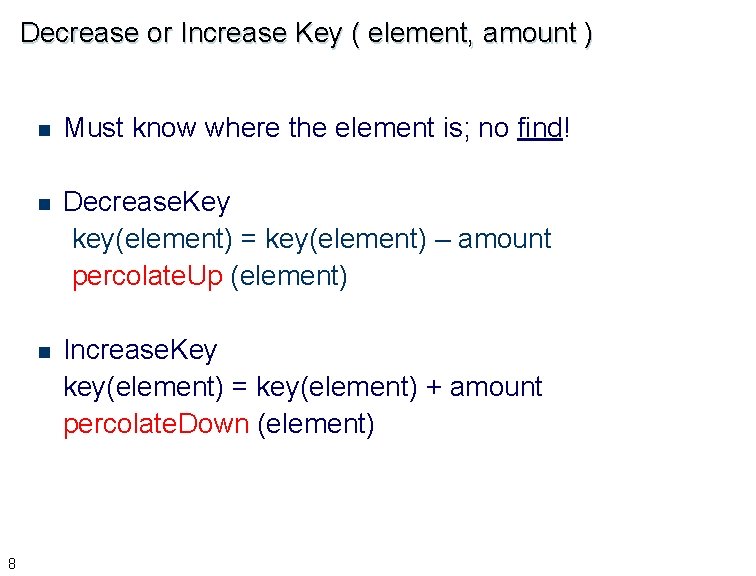
Decrease or Increase Key ( element, amount ) 8 n Must know where the element is; no find! n Decrease. Key key(element) = key(element) – amount percolate. Up (element) n Increase. Key key(element) = key(element) + amount percolate. Down (element)
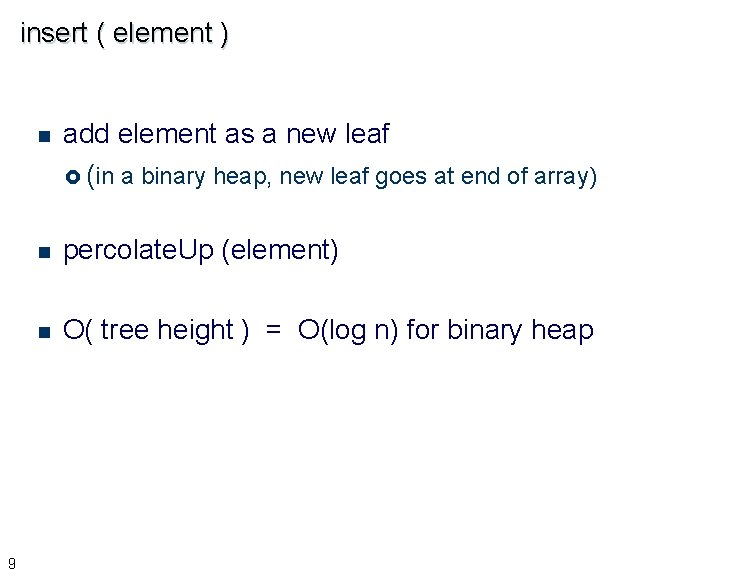
insert ( element ) 9 n add element as a new leaf £ (in a binary heap, new leaf goes at end of array) n percolate. Up (element) n O( tree height ) = O(log n) for binary heap
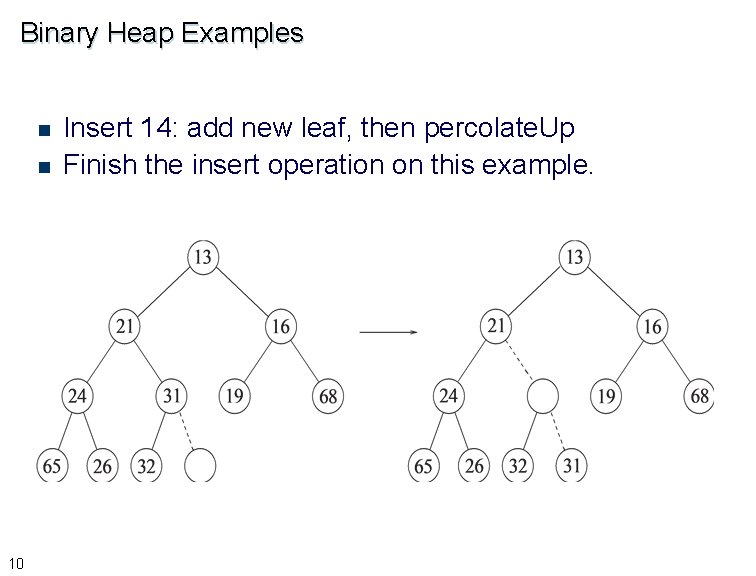
Binary Heap Examples n n 10 Insert 14: add new leaf, then percolate. Up Finish the insert operation on this example.
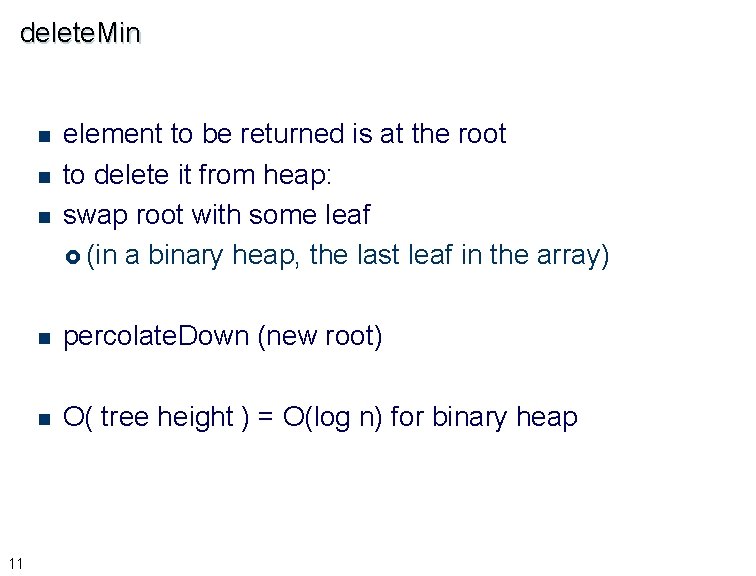
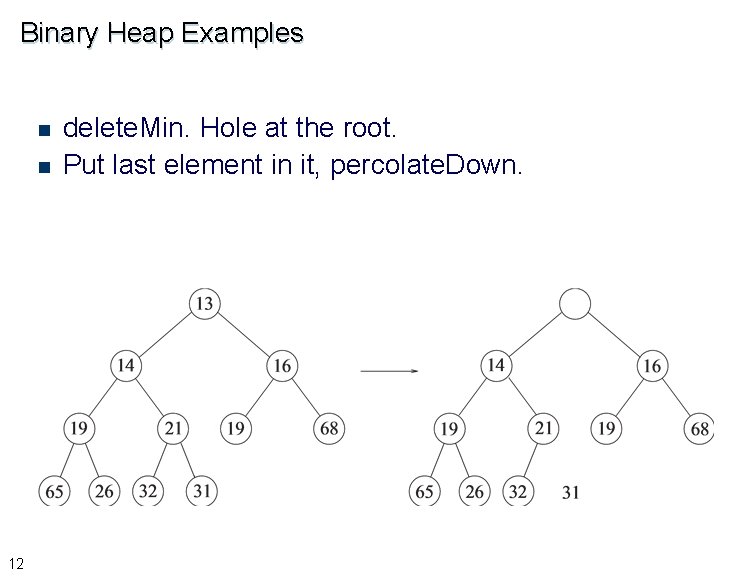
delete. Min n 11 element to be returned is at the root to delete it from heap: swap root with some leaf £ (in a binary heap, the last leaf in the array) n percolate. Down (new root) n O( tree height ) = O(log n) for binary heap
Binary Heap Examples n n 12 delete. Min. Hole at the root. Put last element in it, percolate. Down.
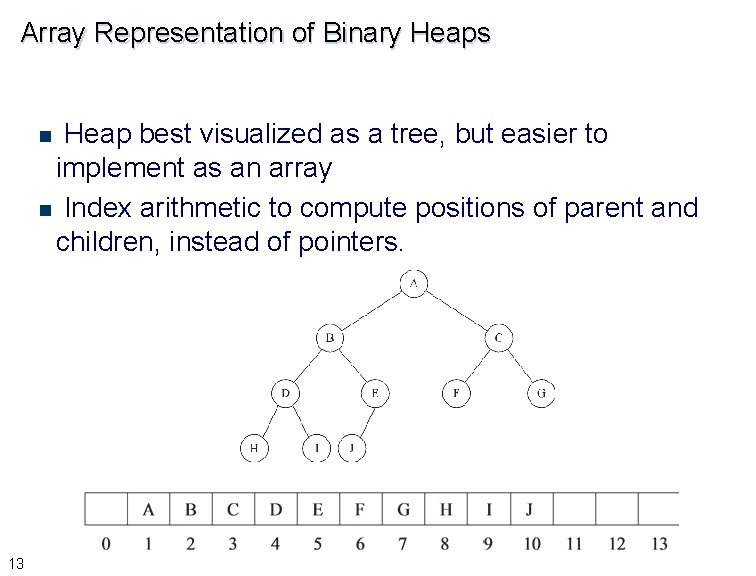
Array Representation of Binary Heaps Heap best visualized as a tree, but easier to implement as an array n Index arithmetic to compute positions of parent and children, instead of pointers. n 13
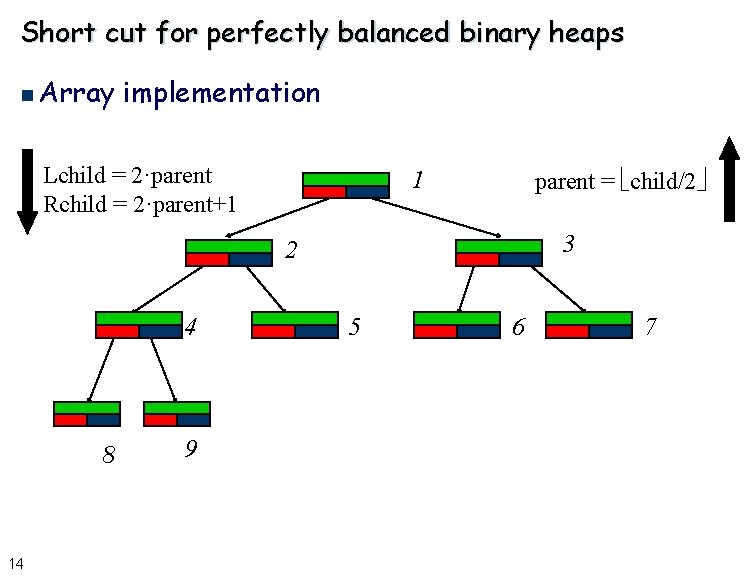
Short cut for perfectly balanced binary heaps n Array implementation Lchild = 2·parent Rchild = 2·parent+1 parent = child/2 1 3 2 4 8 14 9 5 6 7
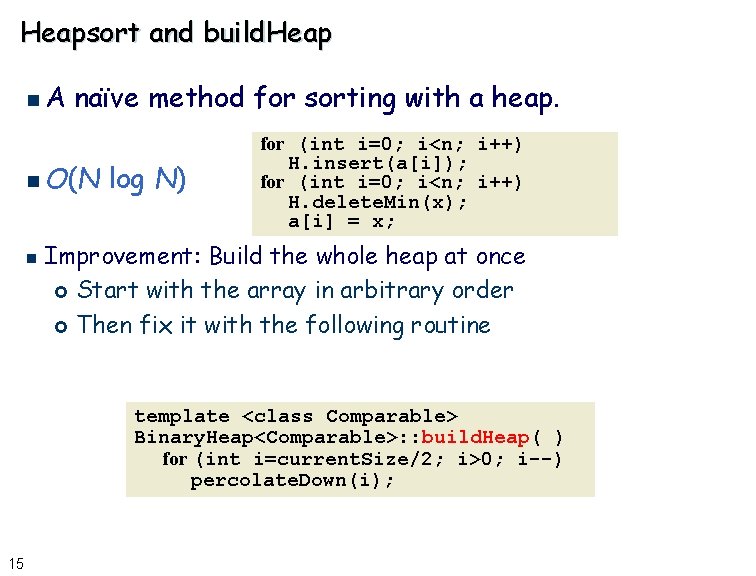
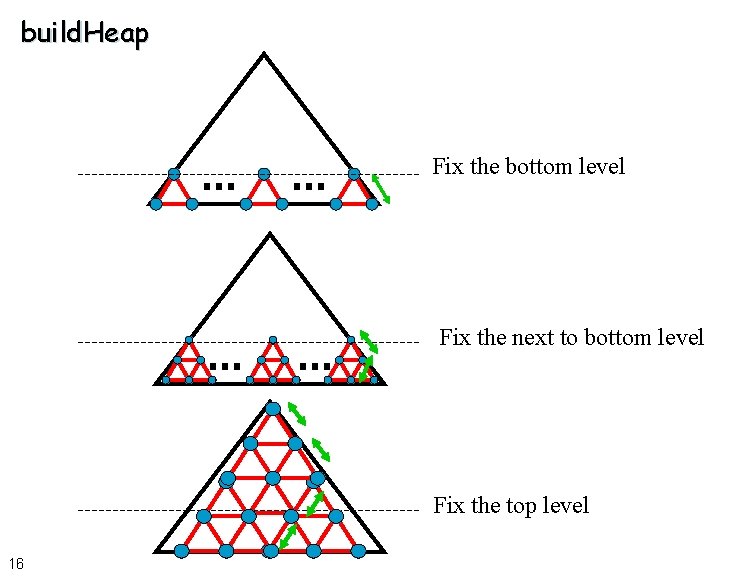
Heapsort and build. Heap n. A naïve method for sorting with a heap. n O(N n log N) for (int i=0; i<n; i++) H. insert(a[i]); for (int i=0; i<n; i++) H. delete. Min(x); a[i] = x; Improvement: Build the whole heap at once £ Start with the array in arbitrary order £ Then fix it with the following routine template <class Comparable> Binary. Heap<Comparable>: : build. Heap( ) for (int i=current. Size/2; i>0; i--) percolate. Down(i); 15
build. Heap Fix the bottom level Fix the next to bottom level Fix the top level 16
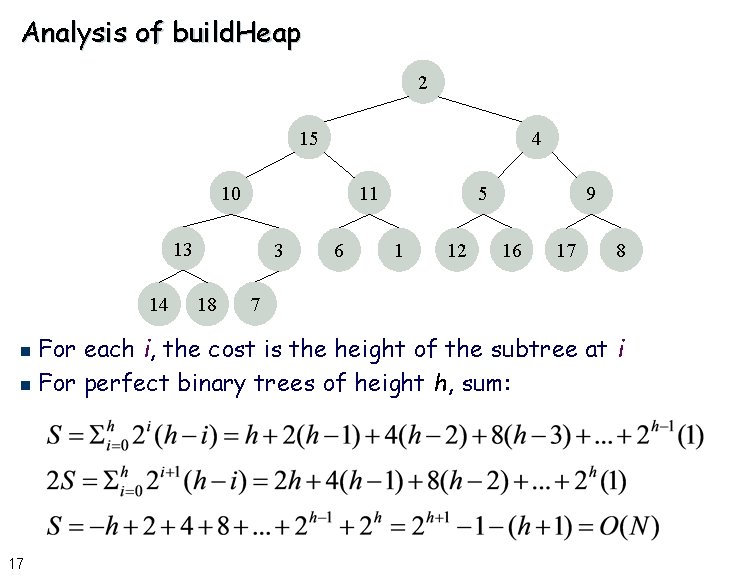
Analysis of build. Heap 2 15 4 10 11 13 14 3 18 6 5 1 12 9 16 17 8 7 For each i, the cost is the height of the subtree at i n For perfect binary trees of height h, sum: n 17
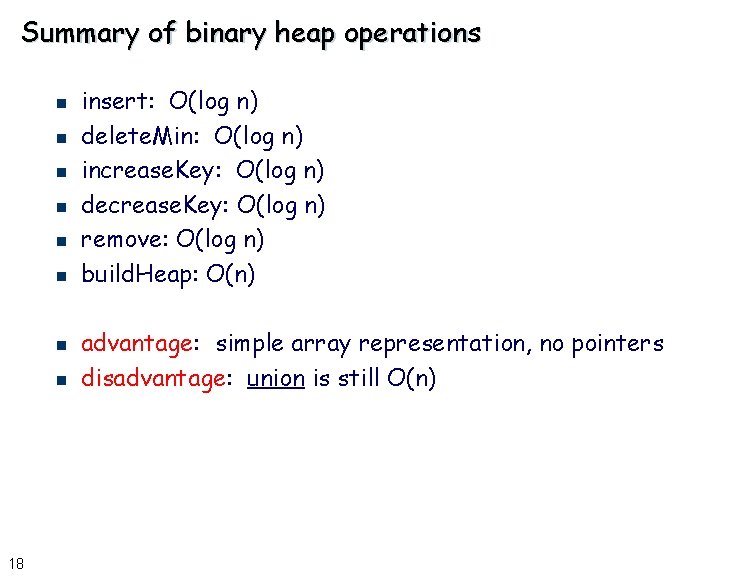
Summary of binary heap operations n n n n 18 insert: O(log n) delete. Min: O(log n) increase. Key: O(log n) decrease. Key: O(log n) remove: O(log n) build. Heap: O(n) advantage: simple array representation, no pointers disadvantage: union is still O(n)
Some Applications and Extensions of Binary Heap n n n Heap Sort Graph algorithms (Shortest Paths, MST) Event driven simulation Tracking top K items in a stream of data d-ary Heaps: £ Insert O(logd n) £ delete. Min O(d logd n) £ Optimize value of d for insert/delete. Min 19
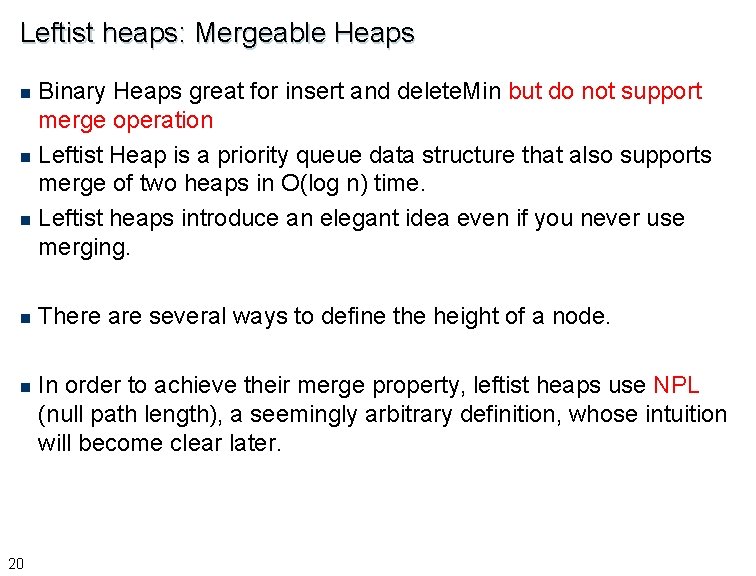
Leftist heaps: Mergeable Heaps Binary Heaps great for insert and delete. Min but do not support merge operation n Leftist Heap is a priority queue data structure that also supports merge of two heaps in O(log n) time. n Leftist heaps introduce an elegant idea even if you never use merging. n n There are several ways to define the height of a node. n In order to achieve their merge property, leftist heaps use NPL (null path length), a seemingly arbitrary definition, whose intuition will become clear later. 20
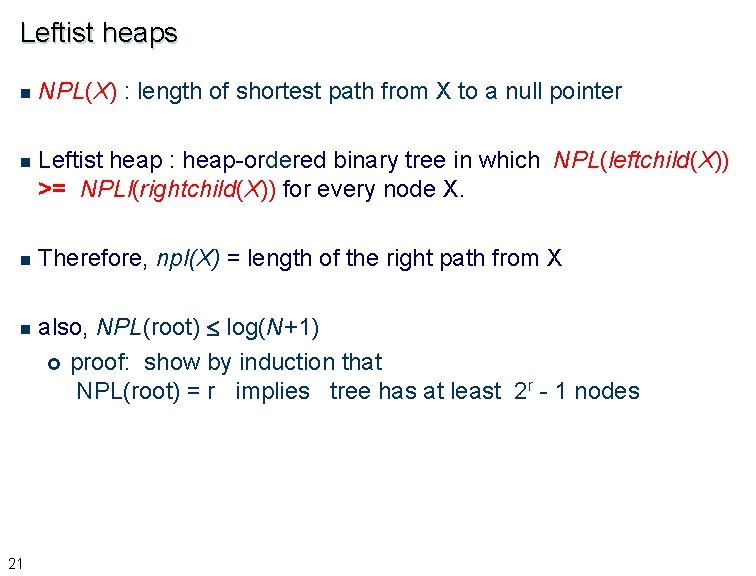
Leftist heaps n NPL(X) : length of shortest path from X to a null pointer n Leftist heap : heap-ordered binary tree in which NPL(leftchild(X)) >= NPLl(rightchild(X)) for every node X. n Therefore, npl(X) = length of the right path from X n 21 also, NPL(root) log(N+1) £ proof: show by induction that NPL(root) = r implies tree has at least 2 r - 1 nodes
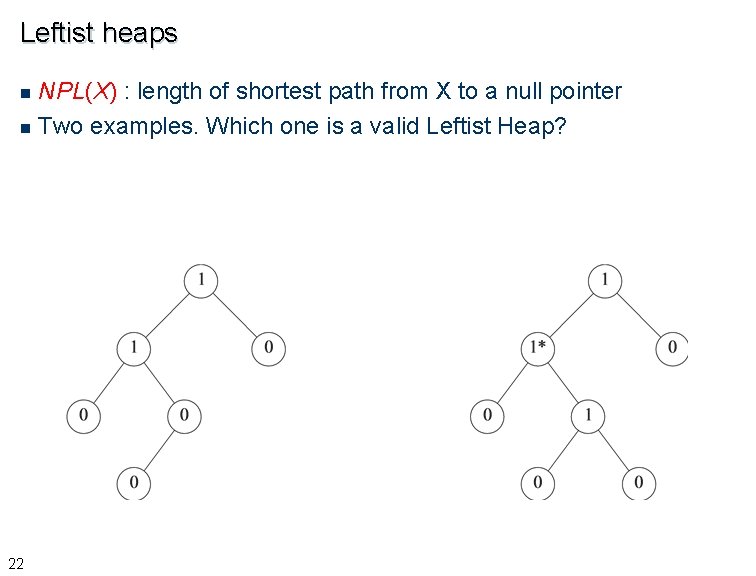
Leftist heaps NPL(X) : length of shortest path from X to a null pointer n Two examples. Which one is a valid Leftist Heap? n 22
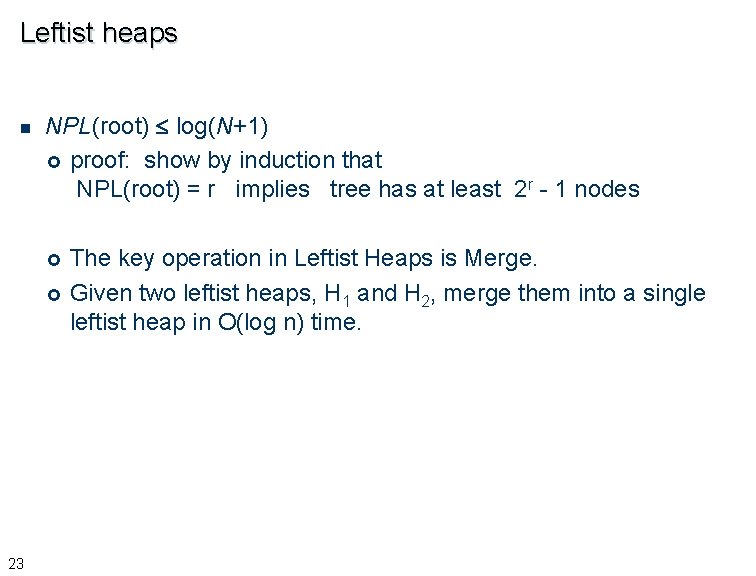
Leftist heaps n NPL(root) log(N+1) £ proof: show by induction that NPL(root) = r implies tree has at least 2 r - 1 nodes £ £ 23 The key operation in Leftist Heaps is Merge. Given two leftist heaps, H 1 and H 2, merge them into a single leftist heap in O(log n) time.
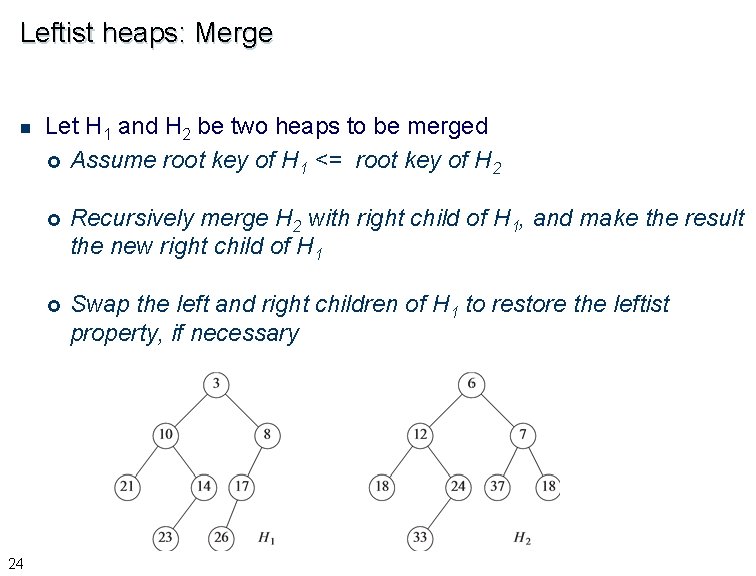
Leftist heaps: Merge n 24 Let H 1 and H 2 be two heaps to be merged £ Assume root key of H 1 <= root key of H 2 £ Recursively merge H 2 with right child of H 1, and make the result the new right child of H 1 £ Swap the left and right children of H 1 to restore the leftist property, if necessary
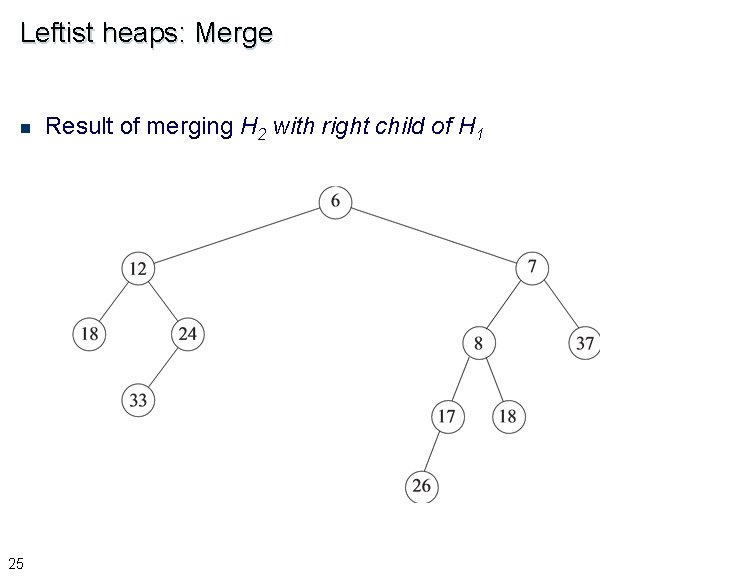
Leftist heaps: Merge n 25 Result of merging H 2 with right child of H 1
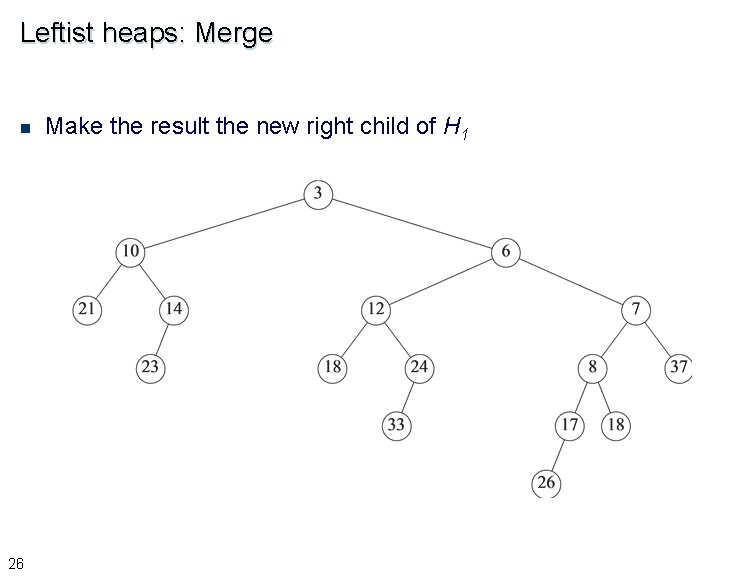
Leftist heaps: Merge n 26 Make the result the new right child of H 1
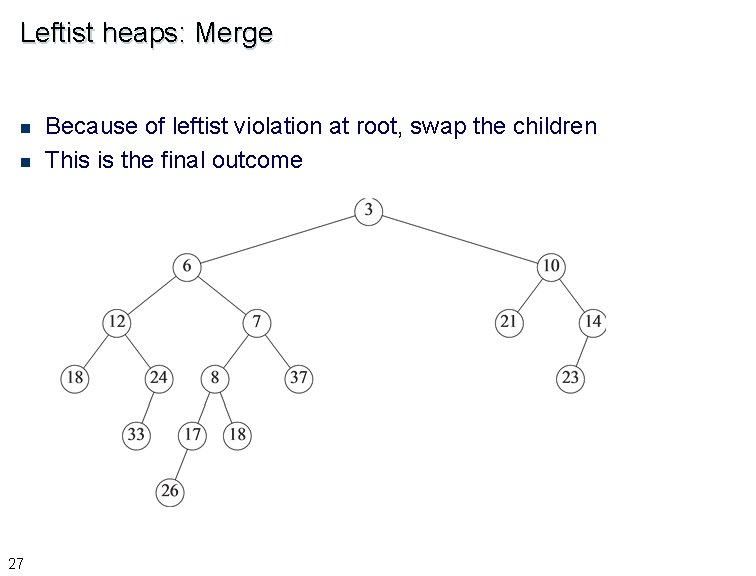
Leftist heaps: Merge n n 27 Because of leftist violation at root, swap the children This is the final outcome
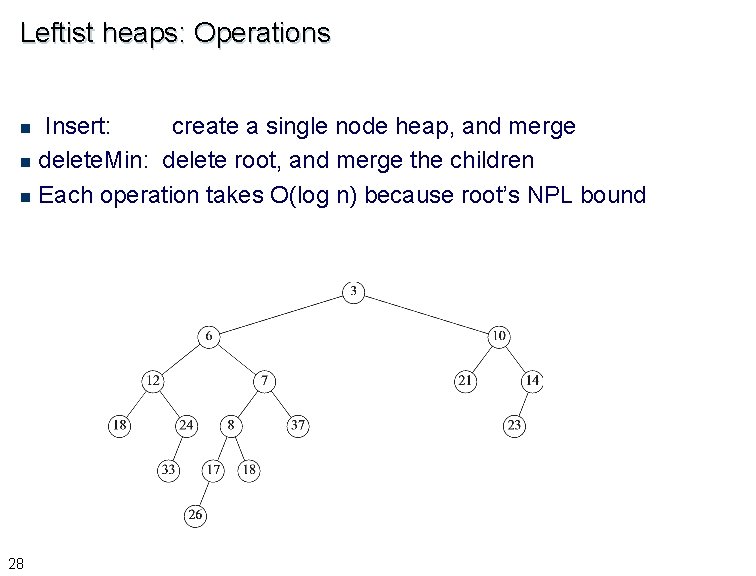
Leftist heaps: Operations Insert: create a single node heap, and merge n delete. Min: delete root, and merge the children n Each operation takes O(log n) because root’s NPL bound n 28
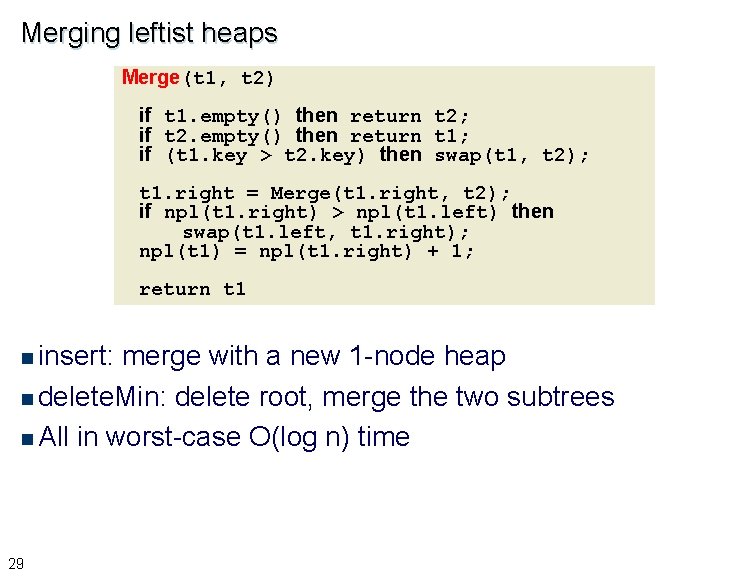
Merging leftist heaps Merge(t 1, t 2) if t 1. empty() then return t 2; if t 2. empty() then return t 1; if (t 1. key > t 2. key) then swap(t 1, t 2); t 1. right = Merge(t 1. right, t 2); if npl(t 1. right) > npl(t 1. left) then swap(t 1. left, t 1. right); npl(t 1) = npl(t 1. right) + 1; return t 1 n insert: merge with a new 1 -node heap n delete. Min: delete root, merge the two subtrees n All in worst-case O(log n) time 29
Other priority queue implementations n n n 30 skew heaps £ like leftist heaps, but no balance condition £ always swap children of root after merge £ amortized (not per-operation) time bounds binomial queues £ binomial queue = collection of heap-ordered “binomial trees”, each with size a power of 2 £ merge looks just like adding integers in base 2 £ very flexible set of operations Fibonacci heaps £ variation of binomial queues £ decrease. Key runs in O(1) amortized time, other operations in O(log n) amortized time