
Course Outline Course 1 MATLAB tutorial 2 Motion
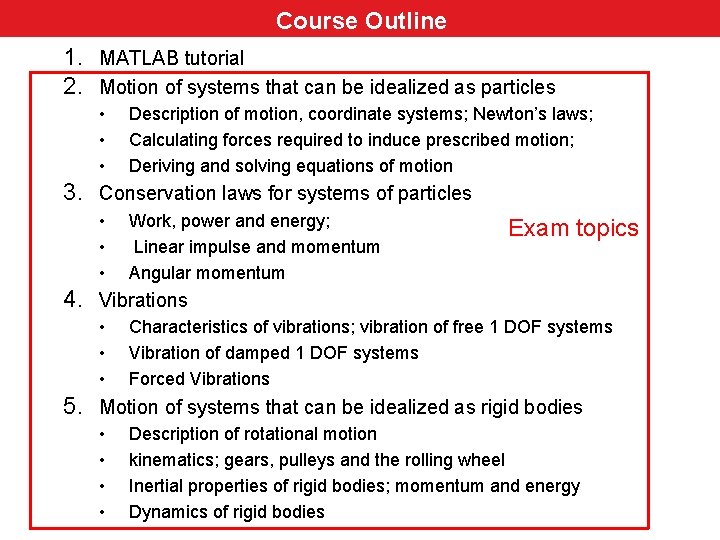
Course Outline Course 1. MATLAB tutorial 2. Motion of systems that can be idealized as particles • • • Description of motion, coordinate systems; Newton’s laws; Calculating forces required to induce prescribed motion; Deriving and solving equations of motion 3. Conservation laws for systems of particles • • • Work, power and energy; Linear impulse and momentum Angular momentum Exam topics 4. Vibrations • • • Characteristics of vibrations; vibration of free 1 DOF systems Vibration of damped 1 DOF systems Forced Vibrations 5. Motion of systems that can be idealized as rigid bodies • • Description of rotational motion kinematics; gears, pulleys and the rolling wheel Inertial properties of rigid bodies; momentum and energy Dynamics of rigid bodies
Course Outline Course 1. MATLAB tutorial 2. Motion of systems that can be idealized as particles • • • Description of motion, coordinate systems; Newton’s laws; Calculating forces required to induce prescribed motion; Deriving and solving equations of motion 3. Conservation laws for systems of particles • • • Work, power and energy; Linear impulse and momentum Angular momentum 4. Vibrations • • • Characteristics of vibrations; vibration of free 1 DOF systems Vibration of damped 1 DOF systems Forced Vibrations 5. Motion of systems that can be idealized as rigid bodies • • Description of rotational motion kinematics; gears, pulleys and the rolling wheel Inertial properties of rigid bodies; momentum and energy Dynamics of rigid bodies
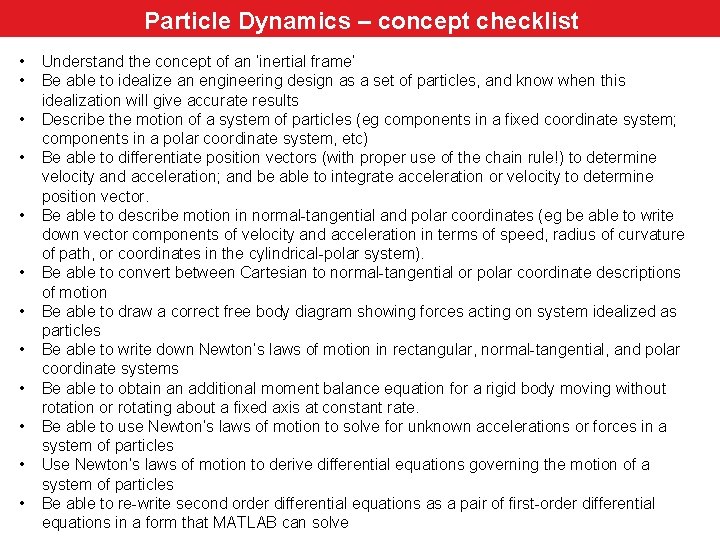
Particle Dynamics – concept checklist • • • Understand the concept of an ‘inertial frame’ Be able to idealize an engineering design as a set of particles, and know when this idealization will give accurate results Describe the motion of a system of particles (eg components in a fixed coordinate system; components in a polar coordinate system, etc) Be able to differentiate position vectors (with proper use of the chain rule!) to determine velocity and acceleration; and be able to integrate acceleration or velocity to determine position vector. Be able to describe motion in normal-tangential and polar coordinates (eg be able to write down vector components of velocity and acceleration in terms of speed, radius of curvature of path, or coordinates in the cylindrical-polar system). Be able to convert between Cartesian to normal-tangential or polar coordinate descriptions of motion Be able to draw a correct free body diagram showing forces acting on system idealized as particles Be able to write down Newton’s laws of motion in rectangular, normal-tangential, and polar coordinate systems Be able to obtain an additional moment balance equation for a rigid body moving without rotation or rotating about a fixed axis at constant rate. Be able to use Newton’s laws of motion to solve for unknown accelerations or forces in a system of particles Use Newton’s laws of motion to derive differential equations governing the motion of a system of particles Be able to re-write second order differential equations as a pair of first-order differential equations in a form that MATLAB can solve
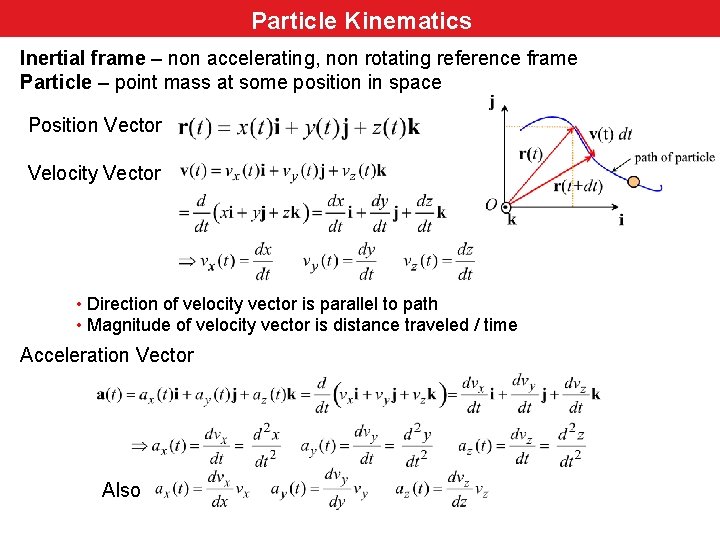
Particle Kinematics Inertial frame – non accelerating, non rotating reference frame Particle – point mass at some position in space Position Vector Velocity Vector • Direction of velocity vector is parallel to path • Magnitude of velocity vector is distance traveled / time Acceleration Vector Also
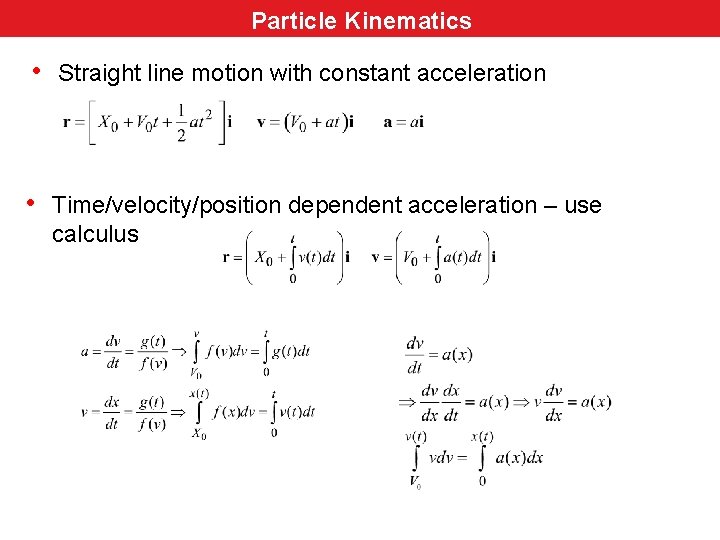
Particle Kinematics Particle • Straight line motion with constant acceleration • Time/velocity/position dependent acceleration – use calculus
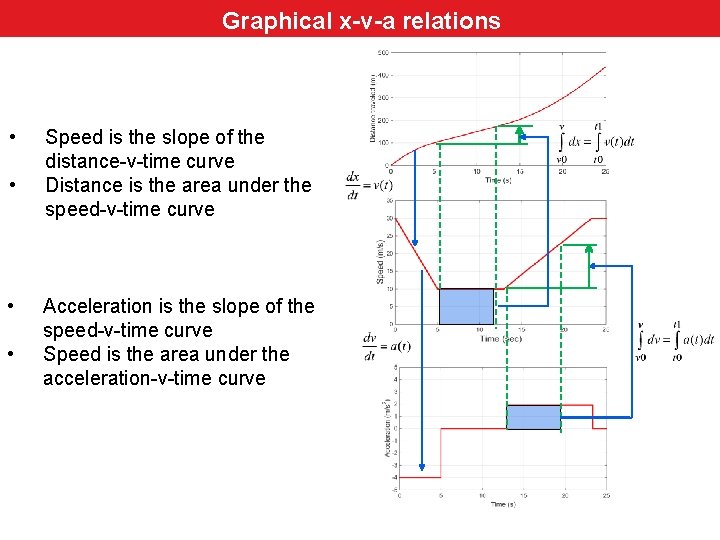
Math Review: Graphical position-velocity-acceleration relations Graphical x-v-a relations • • Speed is the slope of the distance-v-time curve Distance is the area under the speed-v-time curve Acceleration is the slope of the speed-v-time curve Speed is the area under the acceleration-v-time curve
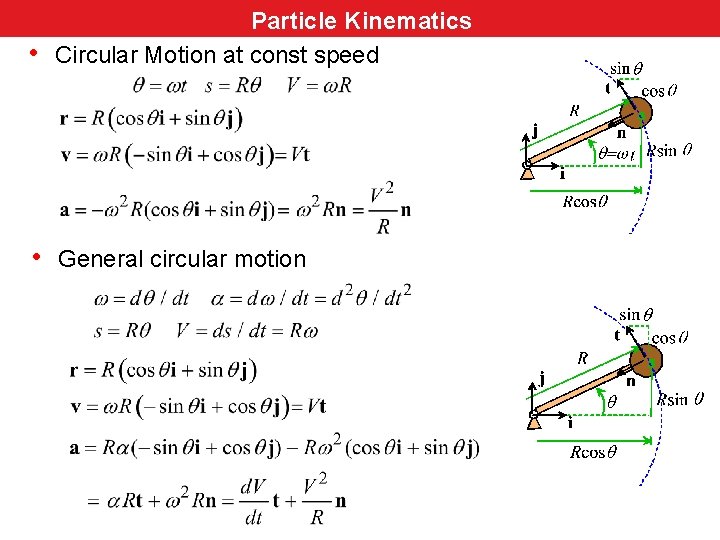
• Particle Kinematics Circular Motion at const speed • General circular motion
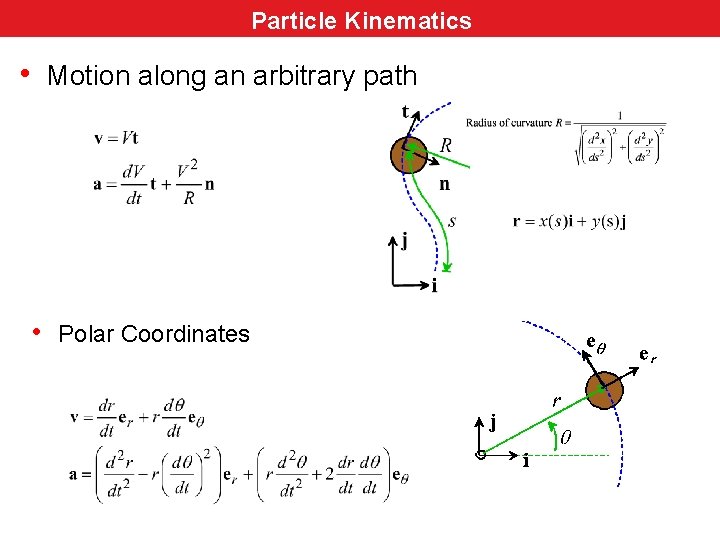
Particle Kinematics • Motion along an arbitrary path • Polar Coordinates
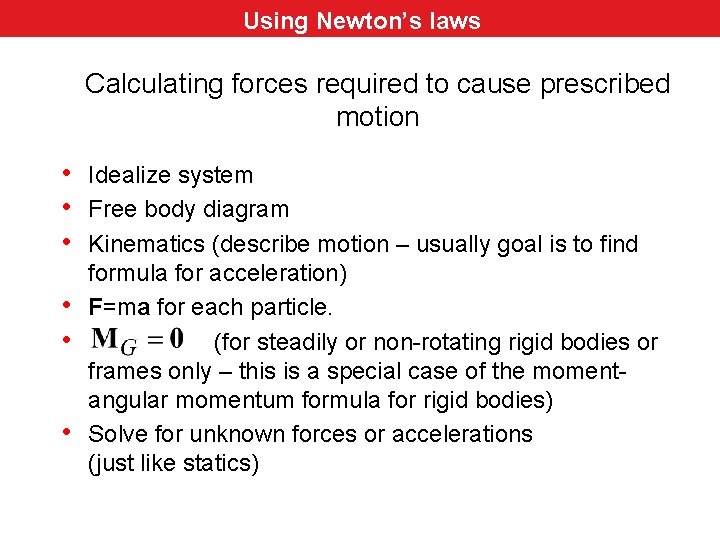
Using Newton’s laws Calculating forces required to cause prescribed motion • Idealize system • Free body diagram • Kinematics (describe motion – usually goal is to find • • • formula for acceleration) F=ma for each particle. (for steadily or non-rotating rigid bodies or frames only – this is a special case of the momentangular momentum formula for rigid bodies) Solve for unknown forces or accelerations (just like statics)
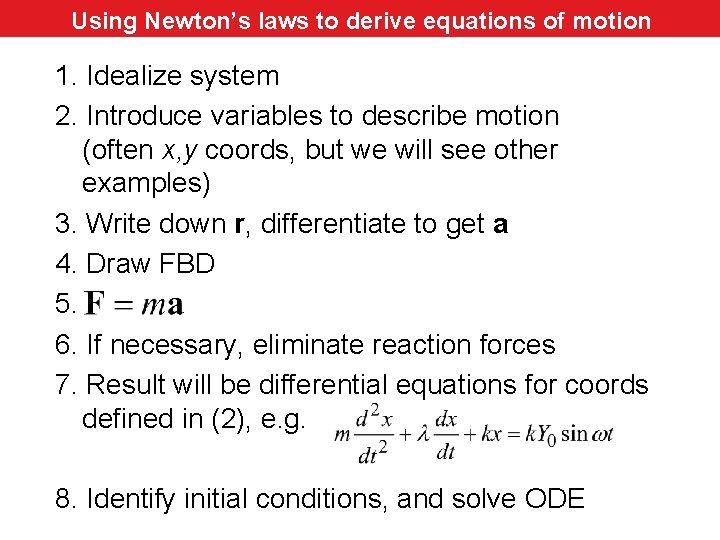
Using Newton’s laws to derive equations of motion 1. Idealize system 2. Introduce variables to describe motion (often x, y coords, but we will see other examples) 3. Write down r, differentiate to get a 4. Draw FBD 5. 6. If necessary, eliminate reaction forces 7. Result will be differential equations for coords defined in (2), e. g. 8. Identify initial conditions, and solve ODE
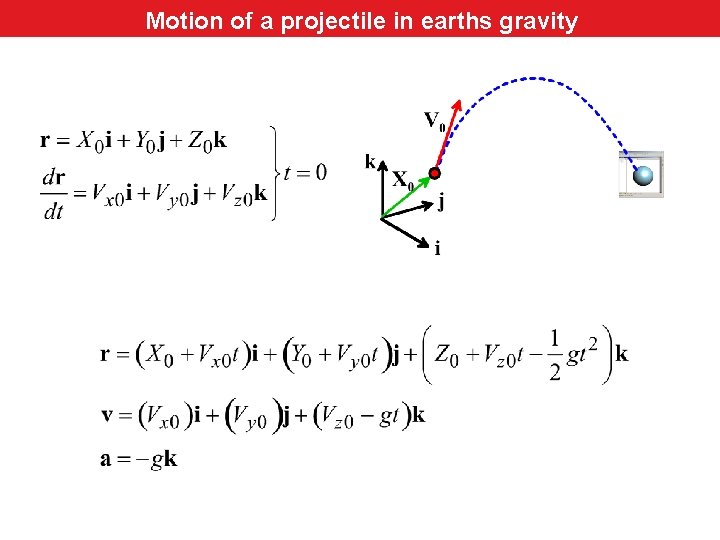
Motion of a projectile in earths gravity
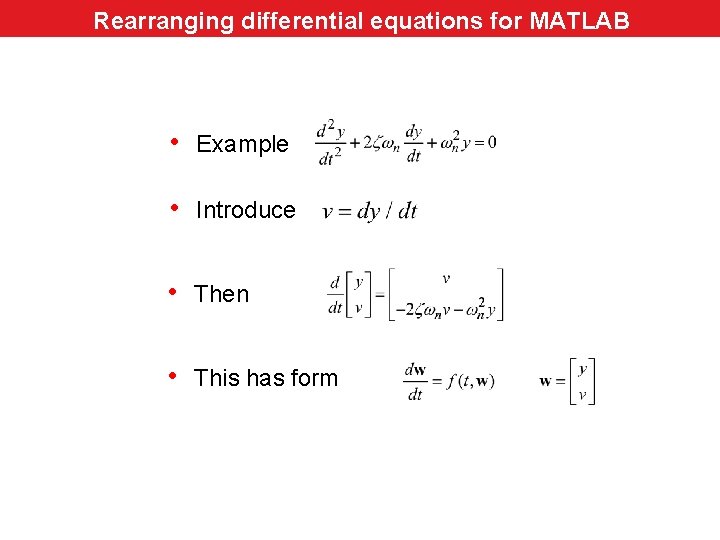
Rearranging differential equations for MATLAB • Example • Introduce • Then • This has form
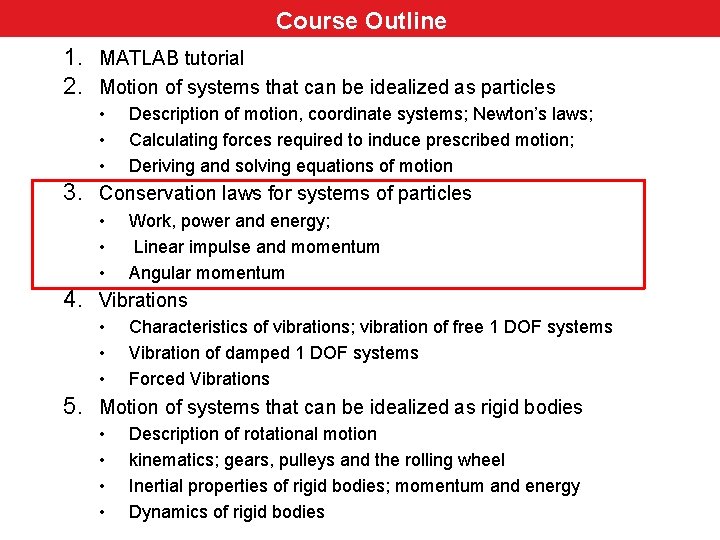
Course Outline Course 1. MATLAB tutorial 2. Motion of systems that can be idealized as particles • • • Description of motion, coordinate systems; Newton’s laws; Calculating forces required to induce prescribed motion; Deriving and solving equations of motion 3. Conservation laws for systems of particles • • • Work, power and energy; Linear impulse and momentum Angular momentum 4. Vibrations • • • Characteristics of vibrations; vibration of free 1 DOF systems Vibration of damped 1 DOF systems Forced Vibrations 5. Motion of systems that can be idealized as rigid bodies • • Description of rotational motion kinematics; gears, pulleys and the rolling wheel Inertial properties of rigid bodies; momentum and energy Dynamics of rigid bodies
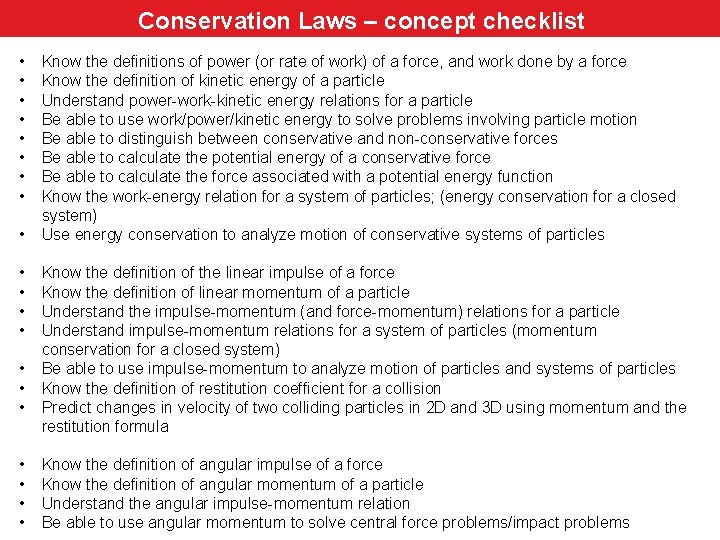
Conservation Laws – concept checklist. Checklist Conservation laws for particles: Concept • • • • • Know the definitions of power (or rate of work) of a force, and work done by a force Know the definition of kinetic energy of a particle Understand power-work-kinetic energy relations for a particle Be able to use work/power/kinetic energy to solve problems involving particle motion Be able to distinguish between conservative and non-conservative forces Be able to calculate the potential energy of a conservative force Be able to calculate the force associated with a potential energy function Know the work-energy relation for a system of particles; (energy conservation for a closed system) Use energy conservation to analyze motion of conservative systems of particles Know the definition of the linear impulse of a force Know the definition of linear momentum of a particle Understand the impulse-momentum (and force-momentum) relations for a particle Understand impulse-momentum relations for a system of particles (momentum conservation for a closed system) Be able to use impulse-momentum to analyze motion of particles and systems of particles Know the definition of restitution coefficient for a collision Predict changes in velocity of two colliding particles in 2 D and 3 D using momentum and the restitution formula Know the definition of angular impulse of a force Know the definition of angular momentum of a particle Understand the angular impulse-momentum relation Be able to use angular momentum to solve central force problems/impact problems
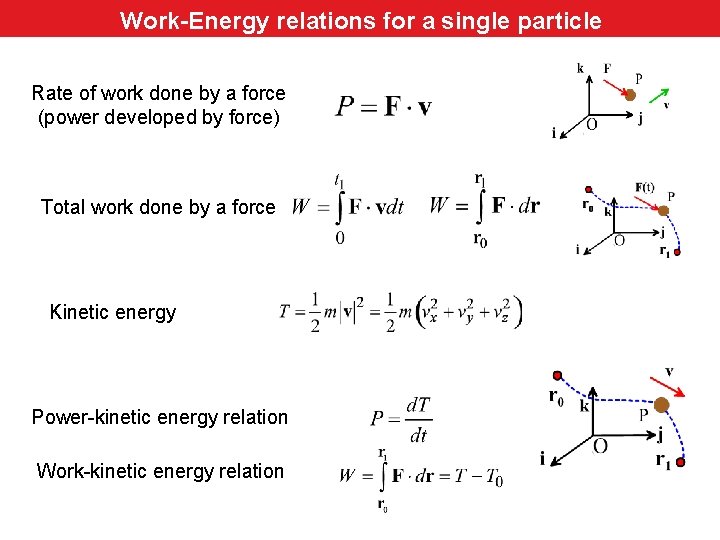
Work-Energy relations for a single particle Rate of work done by a force (power developed by force) Total work done by a force Kinetic energy Power-kinetic energy relation Work-kinetic energy relation
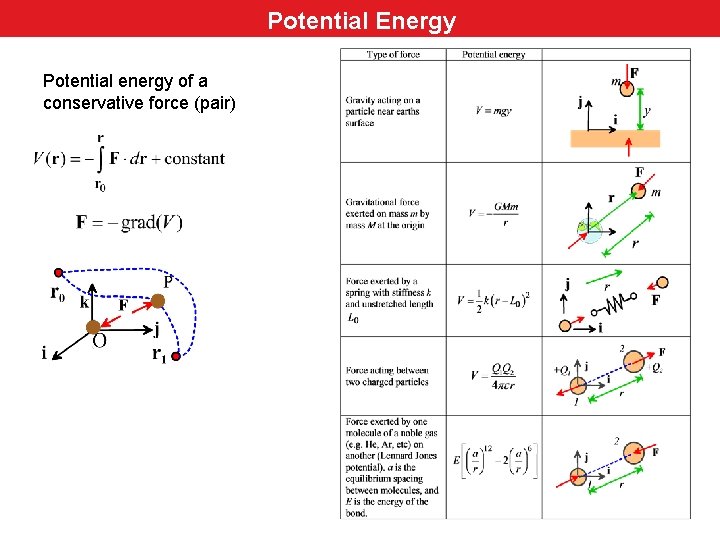
Potential Energy Potential energy of a conservative force (pair)
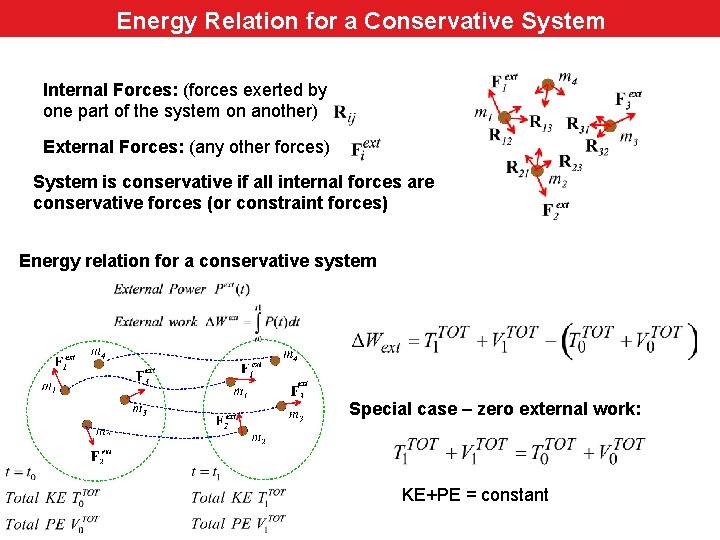
Energy Relation for a Conservative System Internal Forces: (forces exerted by one part of the system on another) External Forces: (any other forces) System is conservative if all internal forces are conservative forces (or constraint forces) Energy relation for a conservative system Special case – zero external work: KE+PE = constant
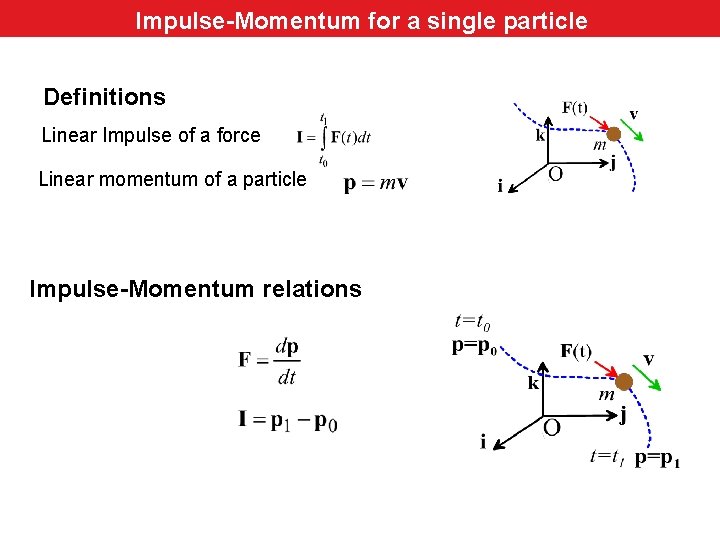
Impulse-Momentum for a single particle Definitions Linear Impulse of a force Linear momentum of a particle Impulse-Momentum relations
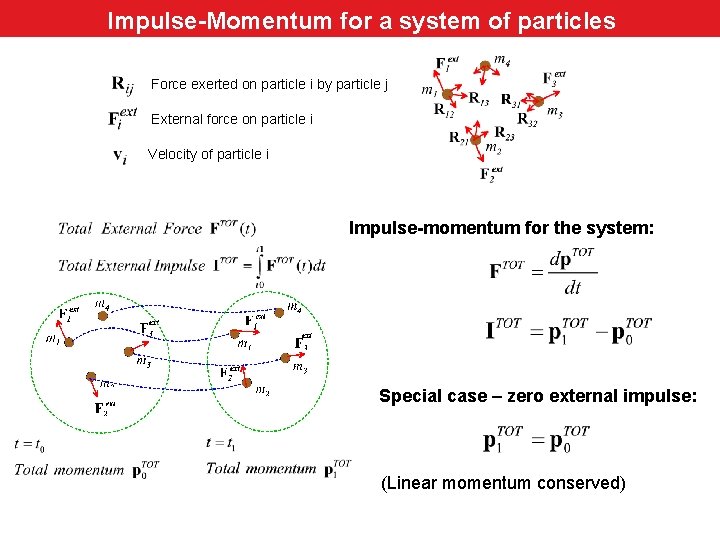
Impulse-momentum for a system of particles Impulse-Momentum for a system of particles Force exerted on particle i by particle j External force on particle i Velocity of particle i Impulse-momentum for the system: Special case – zero external impulse: (Linear momentum conserved)
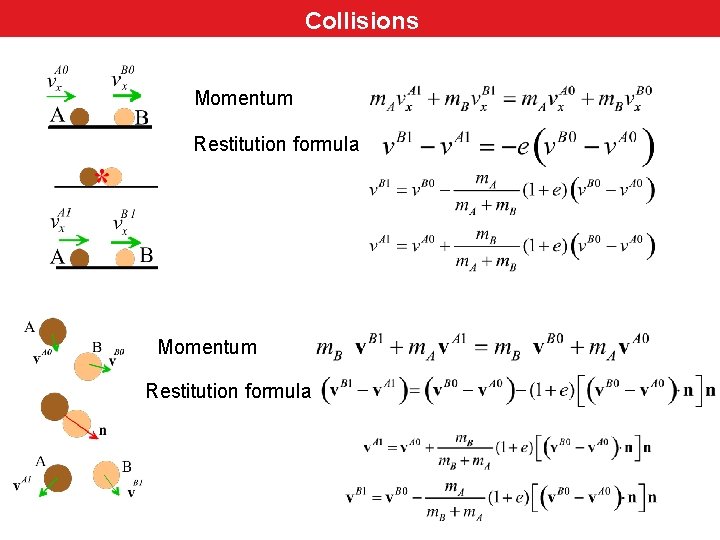
Collisions Momentum Restitution formula
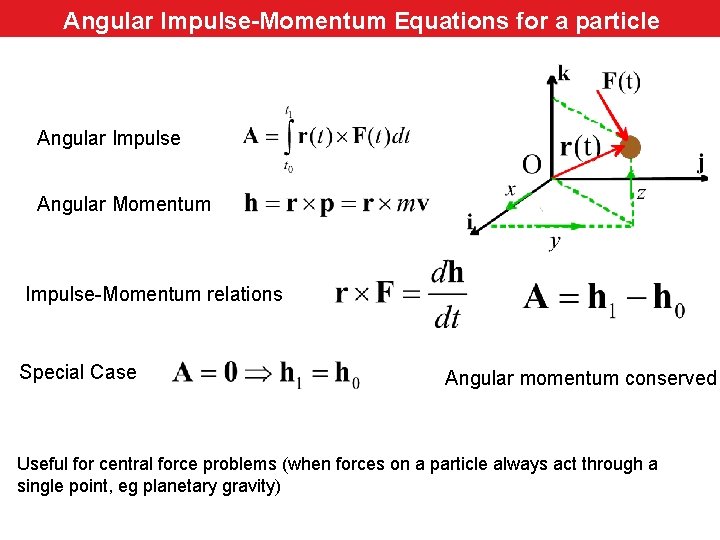
Angular Impulse-Momentum Equations for aa Particle particle Angular Impulse Angular Momentum Impulse-Momentum relations Special Case Angular momentum conserved Useful for central force problems (when forces on a particle always act through a single point, eg planetary gravity)
Course Outline Course 1. MATLAB tutorial 2. Motion of systems that can be idealized as particles • • • Description of motion, coordinate systems; Newton’s laws; Calculating forces required to induce prescribed motion; Deriving and solving equations of motion 3. Conservation laws for systems of particles • • • Work, power and energy; Linear impulse and momentum Angular momentum 4. Vibrations • • • Characteristics of vibrations; vibration of free 1 DOF systems Vibration of damped 1 DOF systems Forced Vibrations 5. Motion of systems that can be idealized as rigid bodies • • Description of rotational motion kinematics; gears, pulleys and the rolling wheel Inertial properties of rigid bodies; momentum and energy Dynamics of rigid bodies
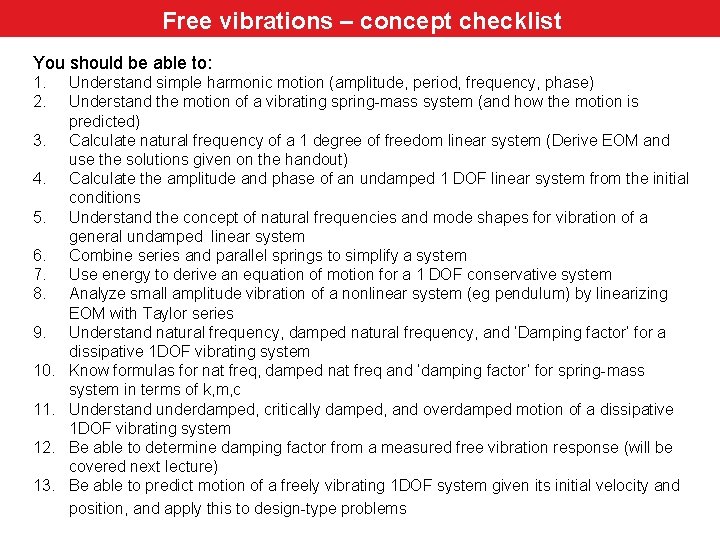
Free. Vibrations vibrations – concept Free conceptchecklist You should be able to: 1. 2. 3. 4. 5. 6. 7. 8. 9. 10. 11. 12. 13. Understand simple harmonic motion (amplitude, period, frequency, phase) Understand the motion of a vibrating spring-mass system (and how the motion is predicted) Calculate natural frequency of a 1 degree of freedom linear system (Derive EOM and use the solutions given on the handout) Calculate the amplitude and phase of an undamped 1 DOF linear system from the initial conditions Understand the concept of natural frequencies and mode shapes for vibration of a general undamped linear system Combine series and parallel springs to simplify a system Use energy to derive an equation of motion for a 1 DOF conservative system Analyze small amplitude vibration of a nonlinear system (eg pendulum) by linearizing EOM with Taylor series Understand natural frequency, damped natural frequency, and ‘Damping factor’ for a dissipative 1 DOF vibrating system Know formulas for nat freq, damped nat freq and ‘damping factor’ for spring-mass system in terms of k, m, c Understand underdamped, critically damped, and overdamped motion of a dissipative 1 DOF vibrating system Be able to determine damping factor from a measured free vibration response (will be covered next lecture) Be able to predict motion of a freely vibrating 1 DOF system given its initial velocity and position, and apply this to design-type problems
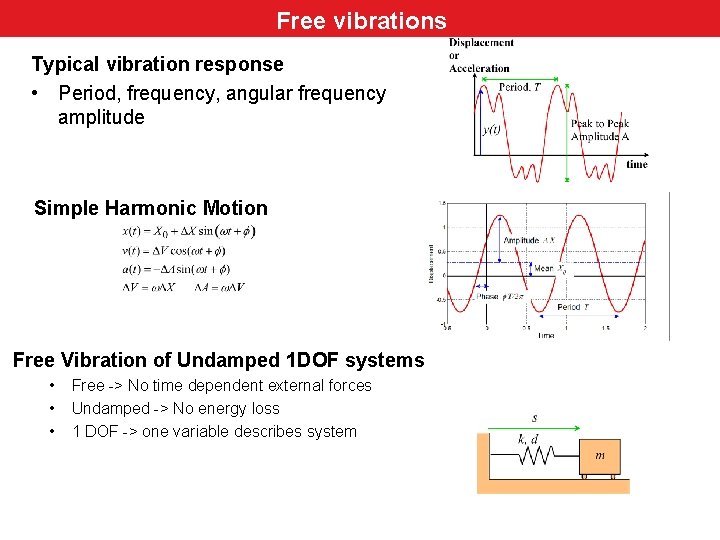
Free. Review vibrations Typical vibration response • Period, frequency, angular frequency amplitude Simple Harmonic Motion Free Vibration of Undamped 1 DOF systems • • • Free -> No time dependent external forces Undamped -> No energy loss 1 DOF -> one variable describes system
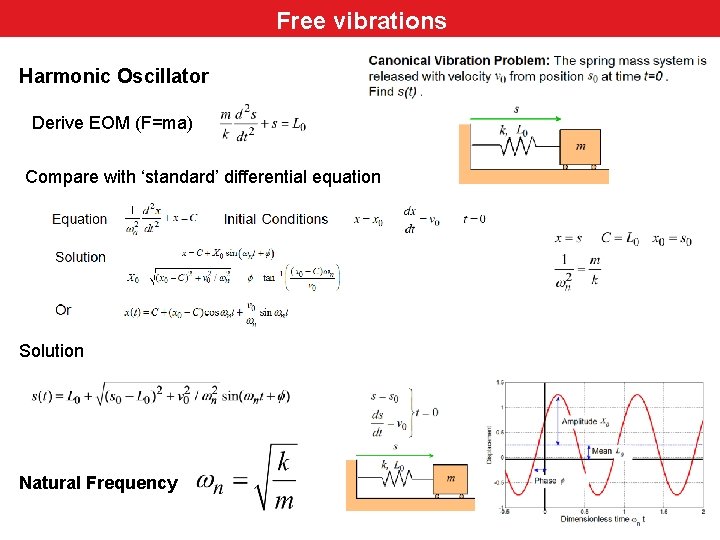
Free. Review vibrations Harmonic Oscillator Derive EOM (F=ma) Compare with ‘standard’ differential equation Solution Natural Frequency
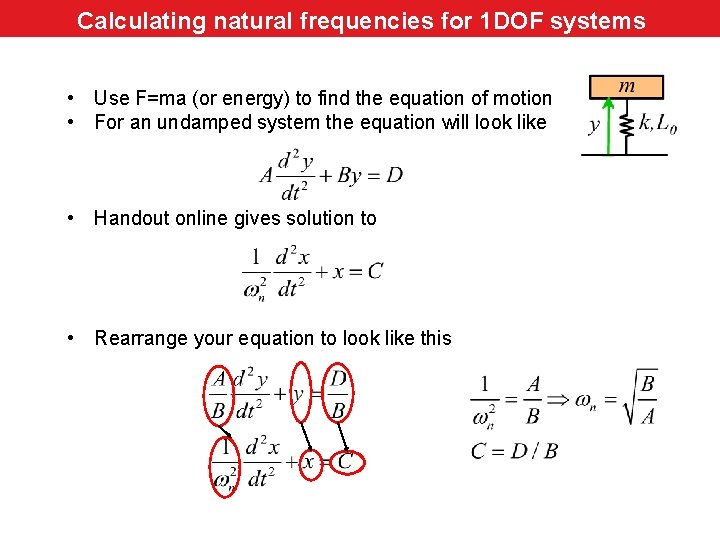
Calculating natural frequencies for 1 DOF systems • Use F=ma (or energy) to find the equation of motion • For an undamped system the equation will look like • Handout online gives solution to • Rearrange your equation to look like this
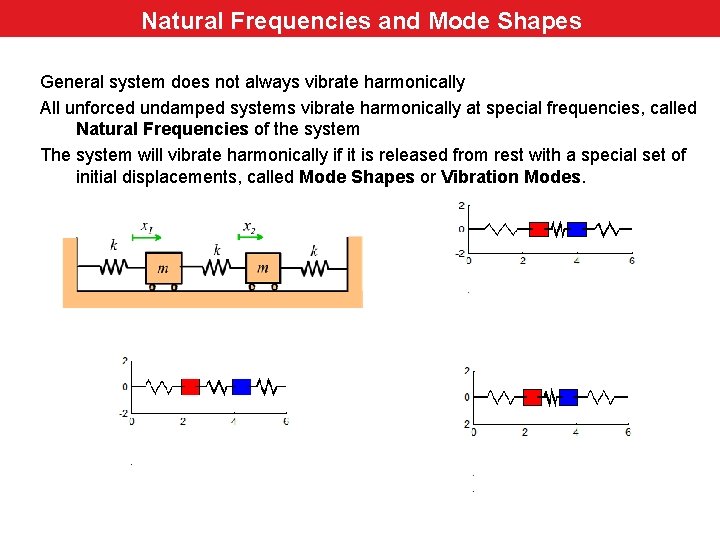
Natural Frequencies and Mode Shapes Review General system does not always vibrate harmonically All unforced undamped systems vibrate harmonically at special frequencies, called Natural Frequencies of the system The system will vibrate harmonically if it is released from rest with a special set of initial displacements, called Mode Shapes or Vibration Modes.
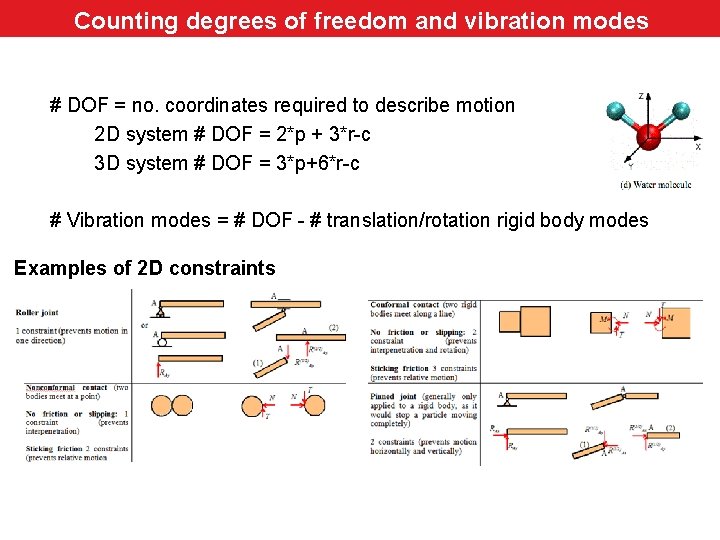
Counting degrees of freedom and vibration modes # DOF = no. coordinates required to describe motion 2 D system # DOF = 2*p + 3*r-c 3 D system # DOF = 3*p+6*r-c # Vibration modes = # DOF - # translation/rotation rigid body modes Examples of 2 D constraints
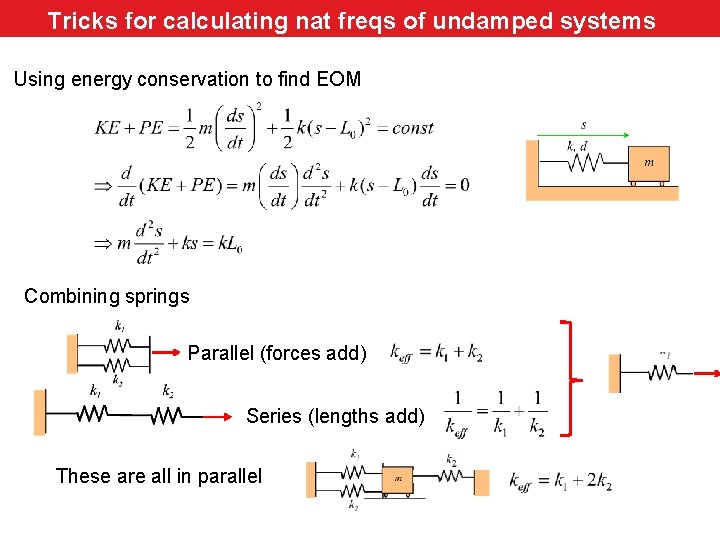
Tricks for calculating nat freqs of undamped systems Review Using energy conservation to find EOM Combining springs Parallel (forces add) Series (lengths add) These are all in parallel
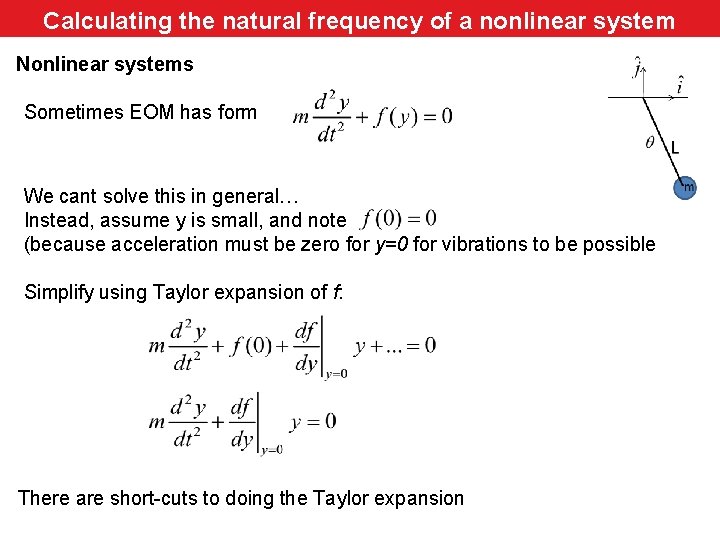
Calculating the natural frequency of a nonlinear system Nonlinear systems Sometimes EOM has form We cant solve this in general… Instead, assume y is small, and note (because acceleration must be zero for y=0 for vibrations to be possible Simplify using Taylor expansion of f: There are short-cuts to doing the Taylor expansion
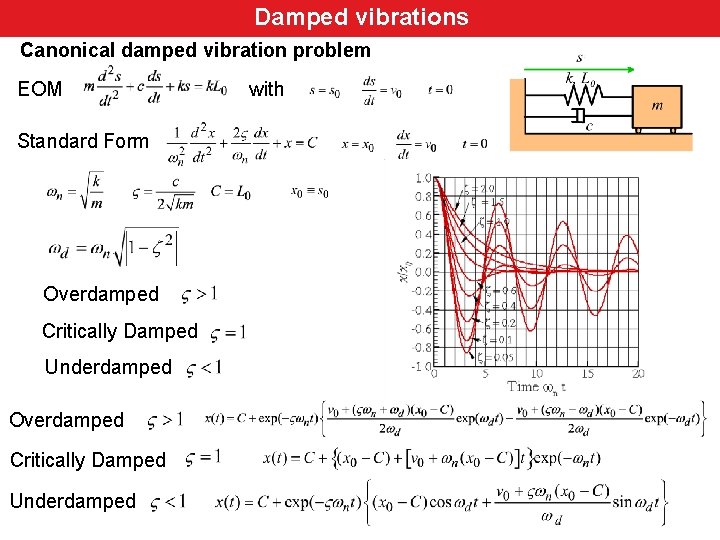
Damped vibrations Canonical damped vibration problem EOM Standard Form Overdamped Critically Damped Underdamped with
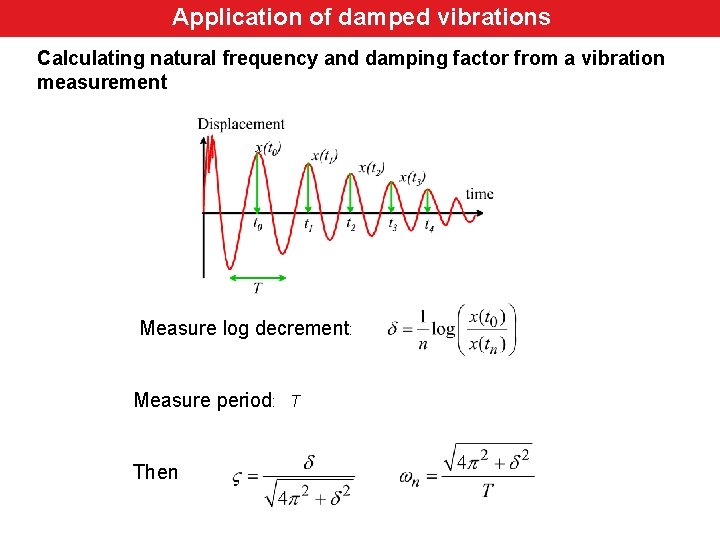
Application of damped vibrations Calculating natural frequency and damping factor from a vibration measurement Measure log decrement: Measure period: Then T
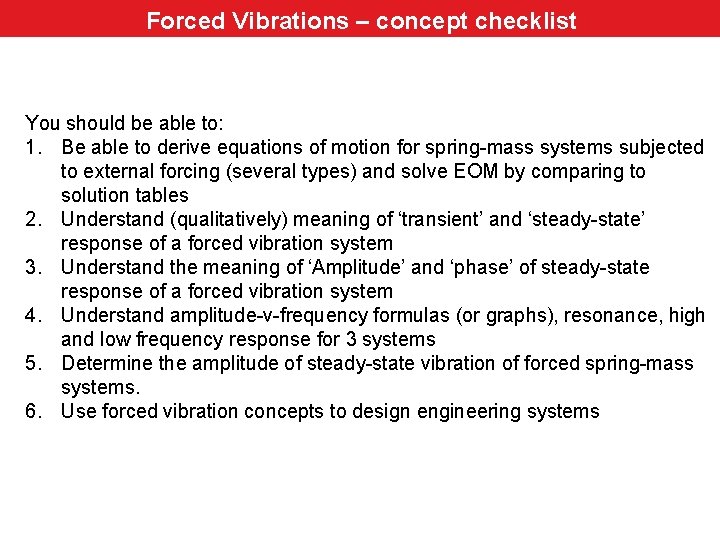
Forced. Vibrations – concept Forced conceptchecklist You should be able to: 1. Be able to derive equations of motion for spring-mass systems subjected to external forcing (several types) and solve EOM by comparing to solution tables 2. Understand (qualitatively) meaning of ‘transient’ and ‘steady-state’ response of a forced vibration system 3. Understand the meaning of ‘Amplitude’ and ‘phase’ of steady-state response of a forced vibration system 4. Understand amplitude-v-frequency formulas (or graphs), resonance, high and low frequency response for 3 systems 5. Determine the amplitude of steady-state vibration of forced spring-mass systems. 6. Use forced vibration concepts to design engineering systems
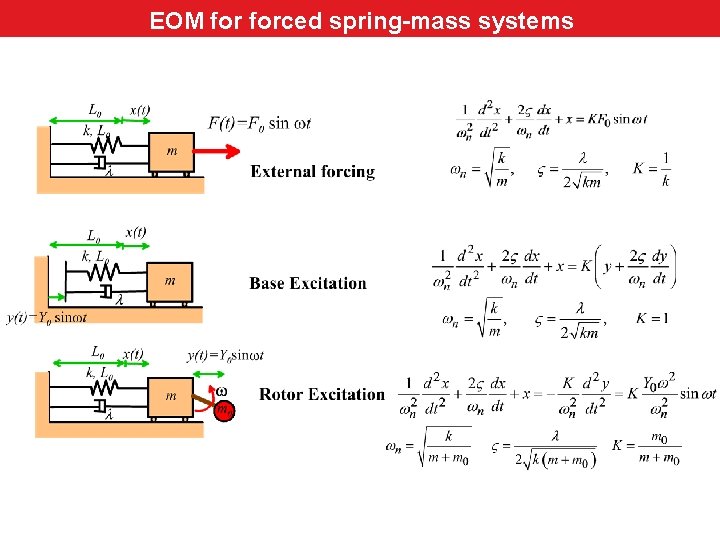
for forced vibrating systems EOMEOM forced spring-mass systems
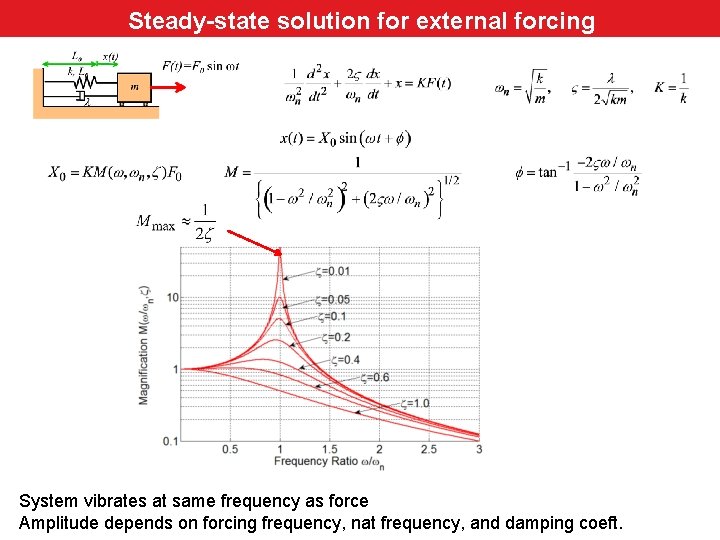
Steady-state solution external forcing force Steady-state solution for–external System vibrates at same frequency as force Amplitude depends on forcing frequency, nat frequency, and damping coeft.
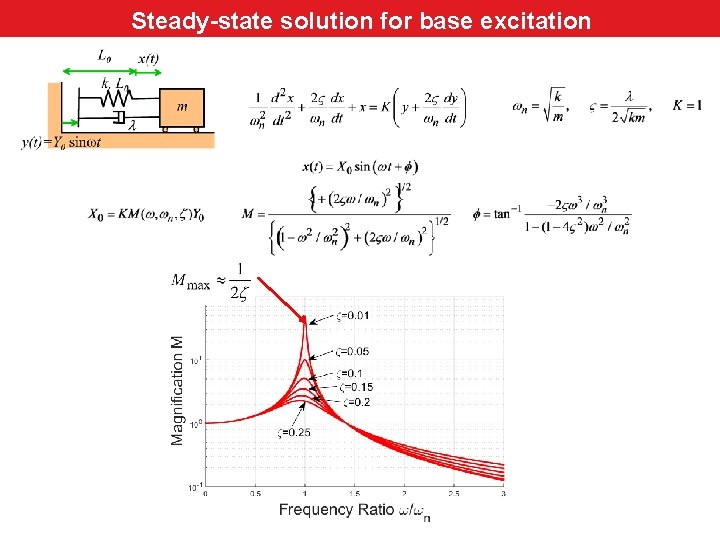
Steady-state solutionfor – Base Steady-state solution base excitation
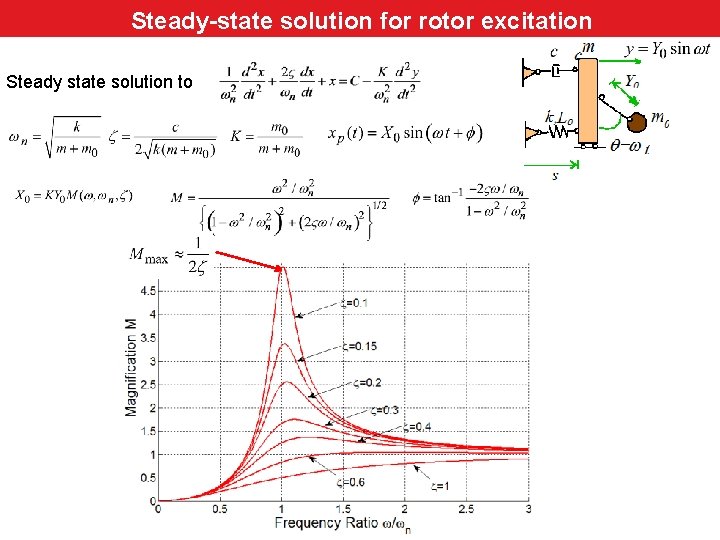
Canonical rotor excited system for (steady state solution) Steady-state solution rotor excitation Steady state solution to
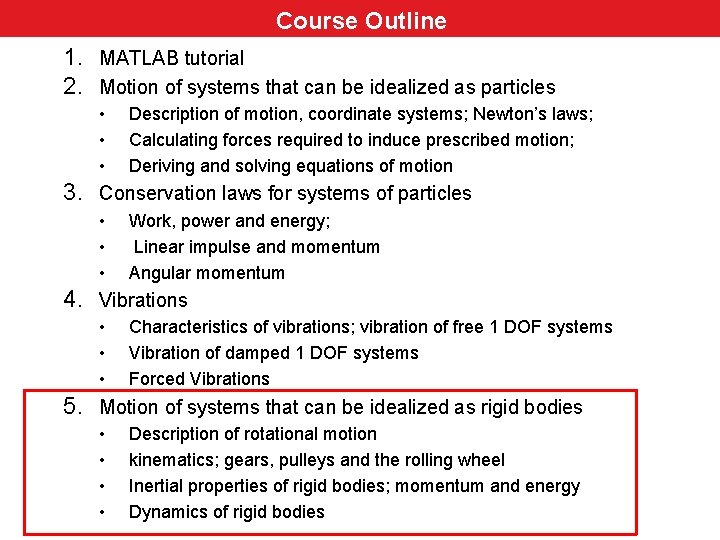
Course Outline Course 1. MATLAB tutorial 2. Motion of systems that can be idealized as particles • • • Description of motion, coordinate systems; Newton’s laws; Calculating forces required to induce prescribed motion; Deriving and solving equations of motion 3. Conservation laws for systems of particles • • • Work, power and energy; Linear impulse and momentum Angular momentum 4. Vibrations • • • Characteristics of vibrations; vibration of free 1 DOF systems Vibration of damped 1 DOF systems Forced Vibrations 5. Motion of systems that can be idealized as rigid bodies • • Description of rotational motion kinematics; gears, pulleys and the rolling wheel Inertial properties of rigid bodies; momentum and energy Dynamics of rigid bodies
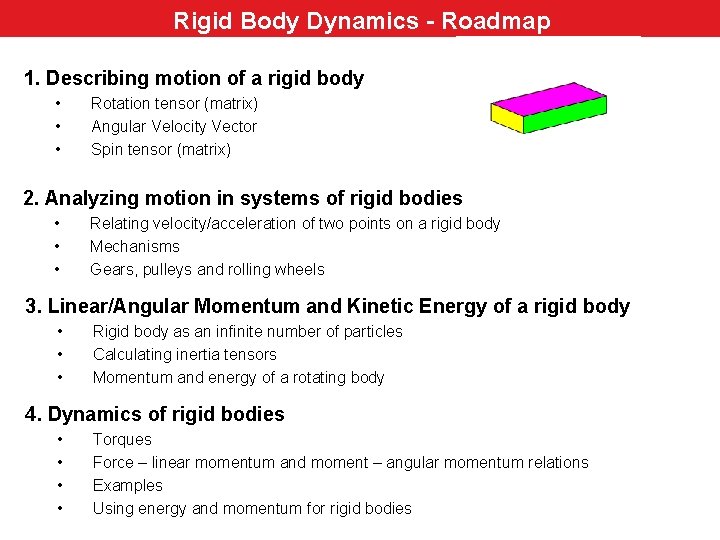
Rigid Body Dynamics - Roadmap 1. Describing motion of a rigid body • • • Rotation tensor (matrix) Angular Velocity Vector Spin tensor (matrix) 2. Analyzing motion in systems of rigid bodies • • • Relating velocity/acceleration of two points on a rigid body Mechanisms Gears, pulleys and rolling wheels 3. Linear/Angular Momentum and Kinetic Energy of a rigid body • • • Rigid body as an infinite number of particles Calculating inertia tensors Momentum and energy of a rotating body 4. Dynamics of rigid bodies • • Torques Force – linear momentum and moment – angular momentum relations Examples Using energy and momentum for rigid bodies
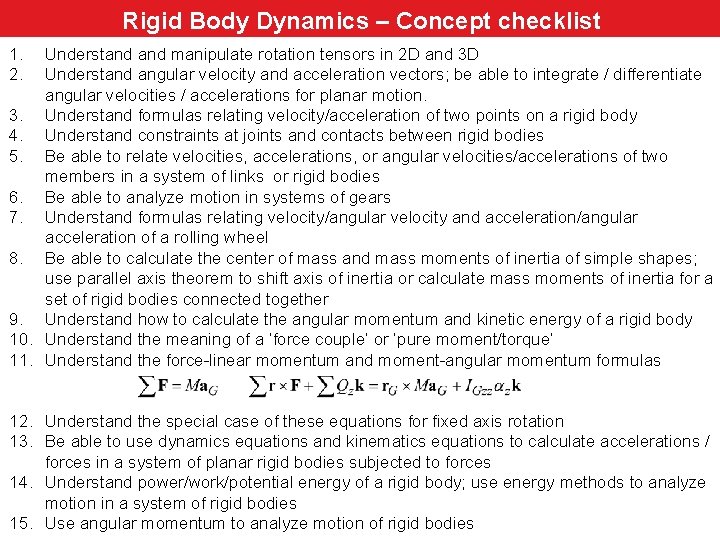
Dynamics of Rigid Bodies– conceptchecklist Rigid Body Dynamics – Concept 1. 2. Understand manipulate rotation tensors in 2 D and 3 D Understand angular velocity and acceleration vectors; be able to integrate / differentiate angular velocities / accelerations for planar motion. 3. Understand formulas relating velocity/acceleration of two points on a rigid body 4. Understand constraints at joints and contacts between rigid bodies 5. Be able to relate velocities, accelerations, or angular velocities/accelerations of two members in a system of links or rigid bodies 6. Be able to analyze motion in systems of gears 7. Understand formulas relating velocity/angular velocity and acceleration/angular acceleration of a rolling wheel 8. Be able to calculate the center of mass and mass moments of inertia of simple shapes; use parallel axis theorem to shift axis of inertia or calculate mass moments of inertia for a set of rigid bodies connected together 9. Understand how to calculate the angular momentum and kinetic energy of a rigid body 10. Understand the meaning of a ‘force couple’ or ‘pure moment/torque’ 11. Understand the force-linear momentum and moment-angular momentum formulas 12. Understand the special case of these equations for fixed axis rotation 13. Be able to use dynamics equations and kinematics equations to calculate accelerations / forces in a system of planar rigid bodies subjected to forces 14. Understand power/work/potential energy of a rigid body; use energy methods to analyze motion in a system of rigid bodies 15. Use angular momentum to analyze motion of rigid bodies
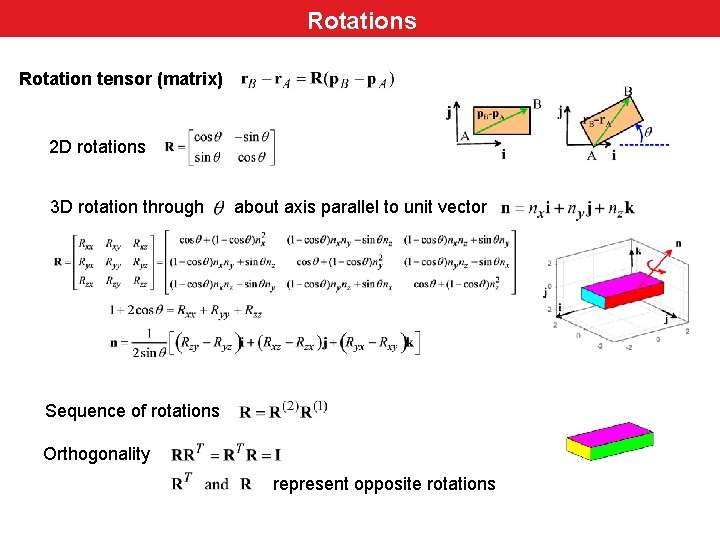
Rotations Rotation tensor (matrix) 2 D rotations 3 D rotation through about axis parallel to unit vector Sequence of rotations Orthogonality represent opposite rotations
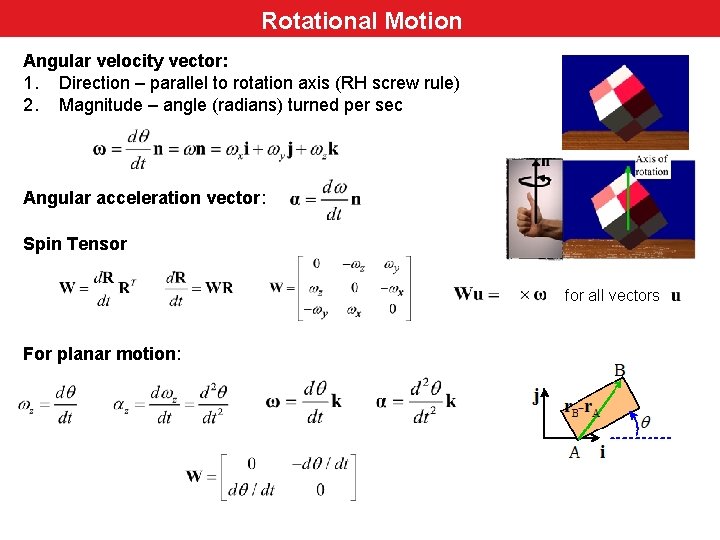
Rotational Motion Angular velocity vector: 1. Direction – parallel to rotation axis (RH screw rule) 2. Magnitude – angle (radians) turned per sec Angular acceleration vector: Spin Tensor for all vectors For planar motion:
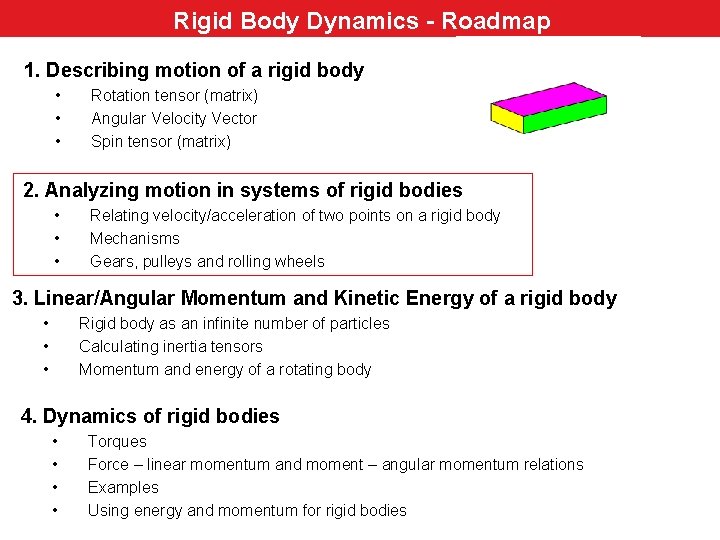
Rigid Body Dynamics - Roadmap 1. Describing motion of a rigid body • • • Rotation tensor (matrix) Angular Velocity Vector Spin tensor (matrix) 2. Analyzing motion in systems of rigid bodies • • • Relating velocity/acceleration of two points on a rigid body Mechanisms Gears, pulleys and rolling wheels 3. Linear/Angular Momentum and Kinetic Energy of a rigid body • • • Rigid body as an infinite number of particles Calculating inertia tensors Momentum and energy of a rotating body 4. Dynamics of rigid bodies • • Torques Force – linear momentum and moment – angular momentum relations Examples Using energy and momentum for rigid bodies
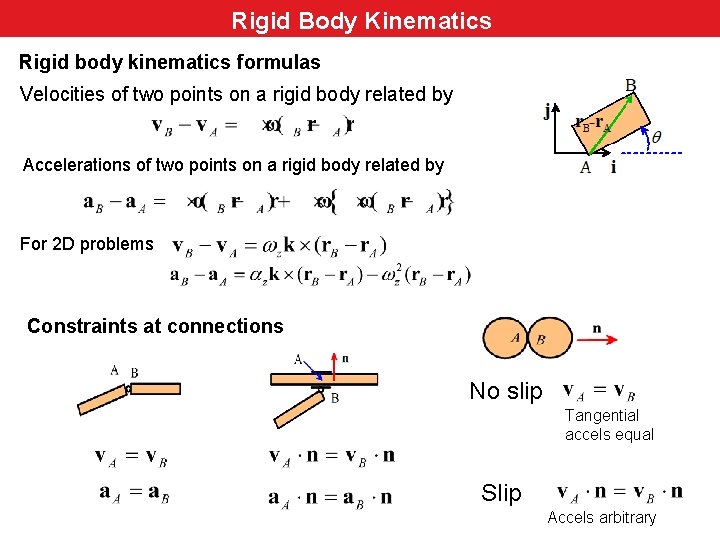
Rigid Body Kinematics Rigid body kinematics main concepts Rigid body kinematics formulas Velocities of two points on a rigid body related by Accelerations of two points on a rigid body related by For 2 D problems Constraints at connections No slip Tangential accels equal Slip Accels arbitrary
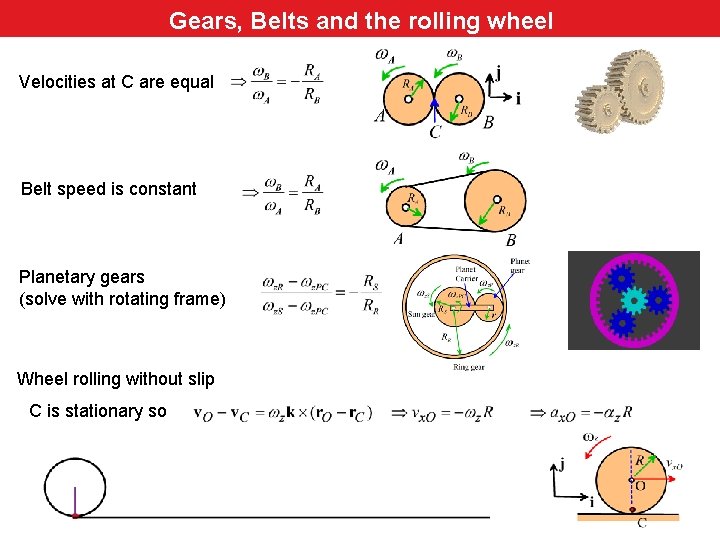
Gears, Belts and the rolling wheel Velocities at C are equal Belt speed is constant Planetary gears (solve with rotating frame) Wheel rolling without slip C is stationary so
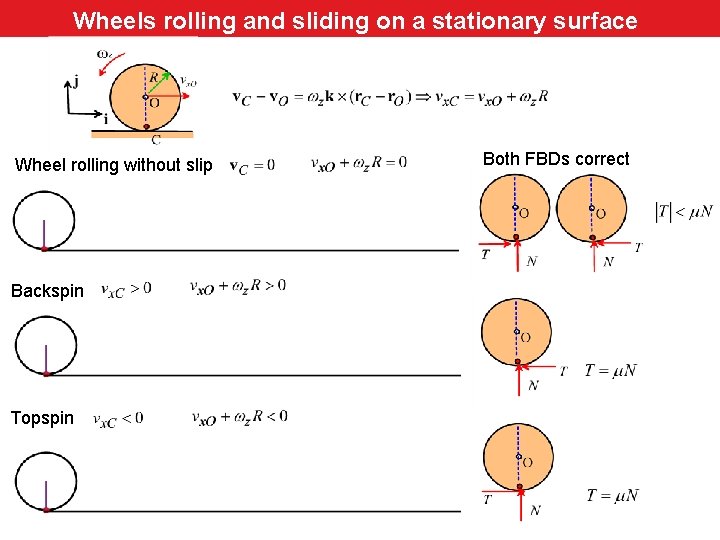
Wheels rolling and sliding on a stationary surface Wheel rolling without slip Backspin Topspin Both FBDs correct
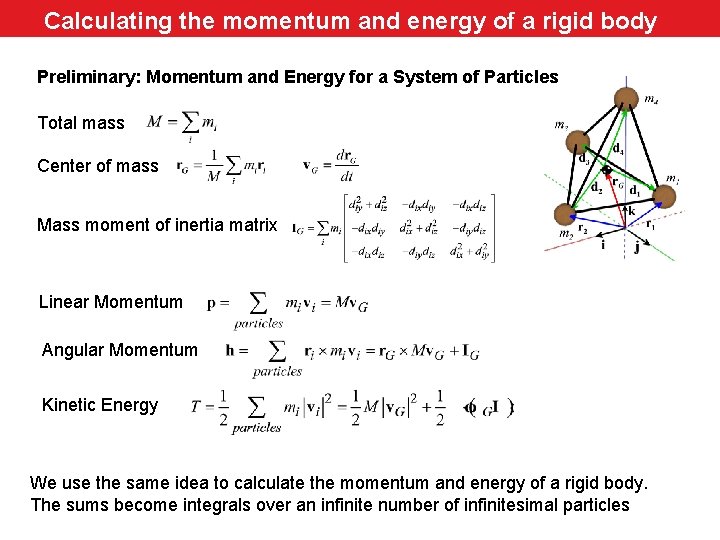
Calculating the momentum and energy of a rigid body Preliminary: Momentum and Energy for a System of Particles Total mass Center of mass Mass moment of inertia matrix Linear Momentum Angular Momentum Kinetic Energy We use the same idea to calculate the momentum and energy of a rigid body. The sums become integrals over an infinite number of infinitesimal particles
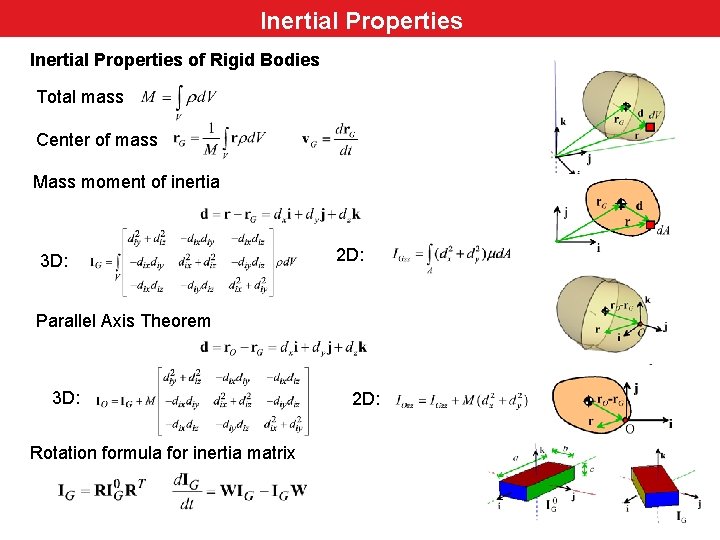
Inertial Properties of Rigid Bodies Total mass Center of mass Mass moment of inertia 3 D: 2 D: Parallel Axis Theorem 3 D: Rotation formula for inertia matrix 2 D:
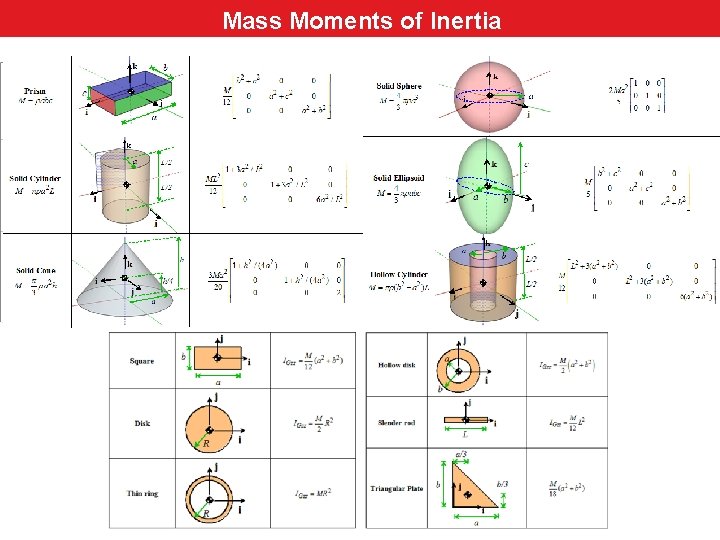
Mass Moments of Inertia
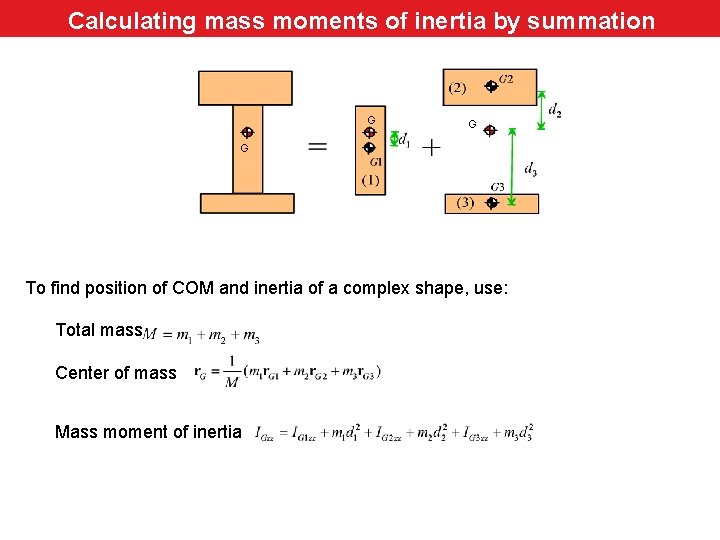
Calculating mass moments of inertia by summation G G G To find position of COM and inertia of a complex shape, use: Total mass Center of mass Mass moment of inertia
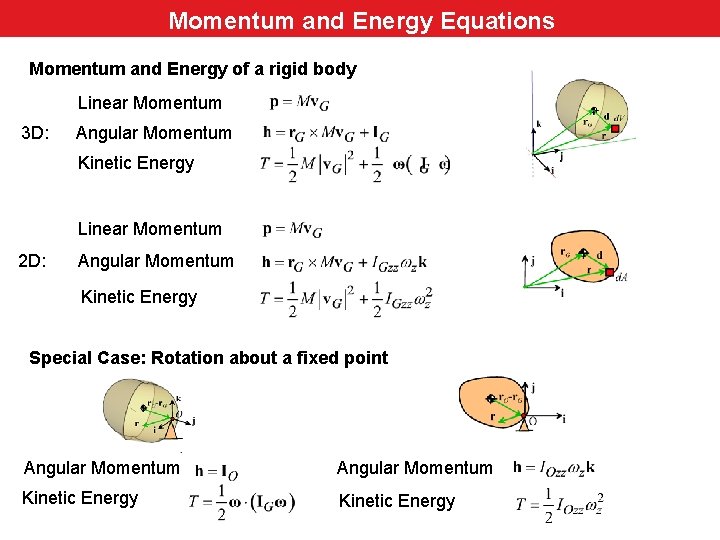
Momentum and Energy Equations Momentum and Energy of a rigid body Linear Momentum 3 D: Angular Momentum Kinetic Energy Linear Momentum 2 D: Angular Momentum Kinetic Energy Special Case: Rotation about a fixed point Angular Momentum Kinetic Energy
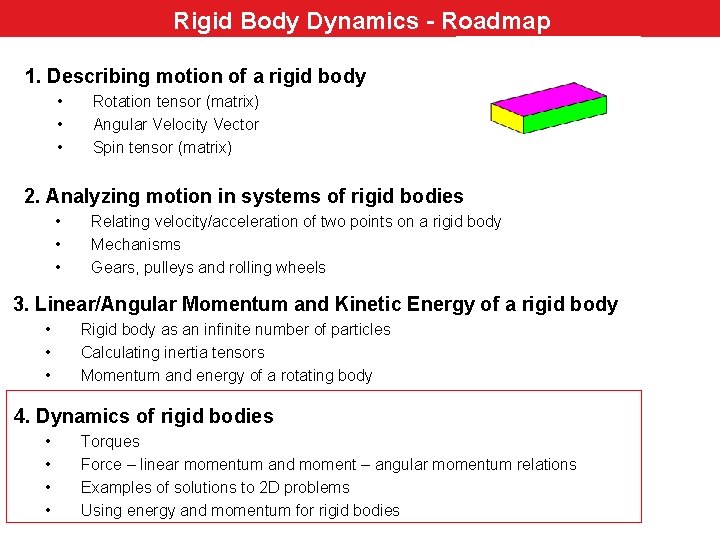
Rigid Body Dynamics - Roadmap 1. Describing motion of a rigid body • • • Rotation tensor (matrix) Angular Velocity Vector Spin tensor (matrix) 2. Analyzing motion in systems of rigid bodies • • • Relating velocity/acceleration of two points on a rigid body Mechanisms Gears, pulleys and rolling wheels 3. Linear/Angular Momentum and Kinetic Energy of a rigid body • • • Rigid body as an infinite number of particles Calculating inertia tensors Momentum and energy of a rotating body 4. Dynamics of rigid bodies • • Torques Force – linear momentum and moment – angular momentum relations Examples of solutions to 2 D problems Using energy and momentum for rigid bodies
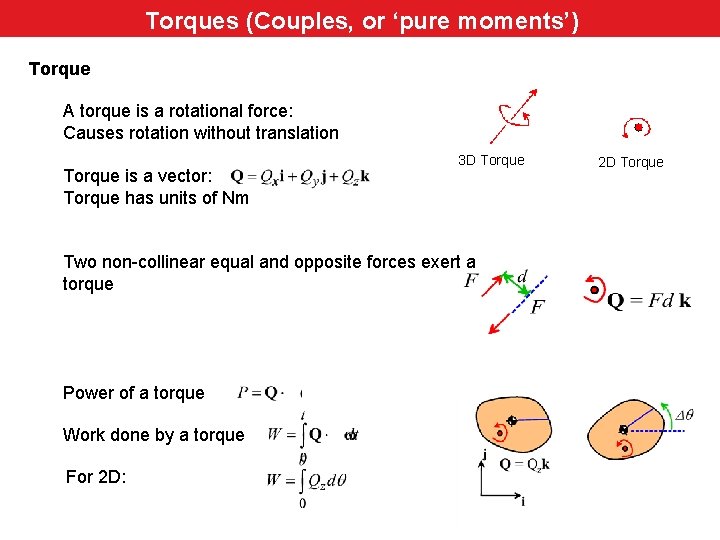
Torques (Couples, or ‘pure moments’) Torque A torque is a rotational force: Causes rotation without translation Torque is a vector: Torque has units of Nm 3 D Torque Two non-collinear equal and opposite forces exert a torque Power of a torque Work done by a torque For 2 D: 2 D Torque
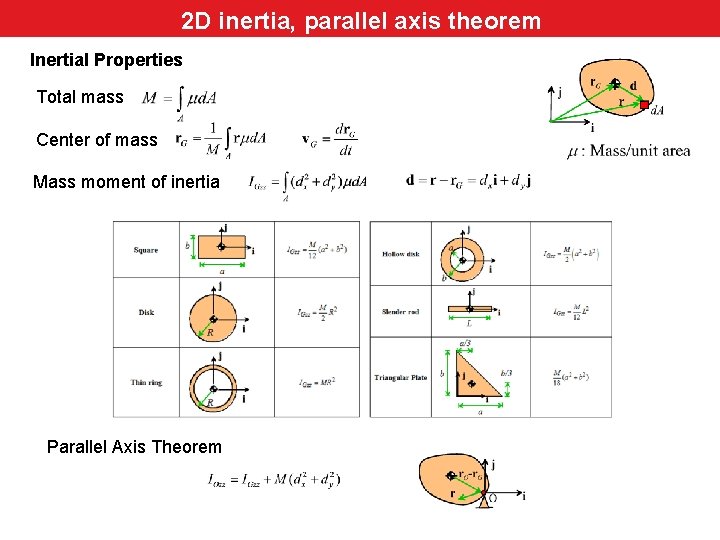
2 D inertia, parallel axis theorem Inertial Properties Total mass Center of mass Mass moment of inertia Parallel Axis Theorem
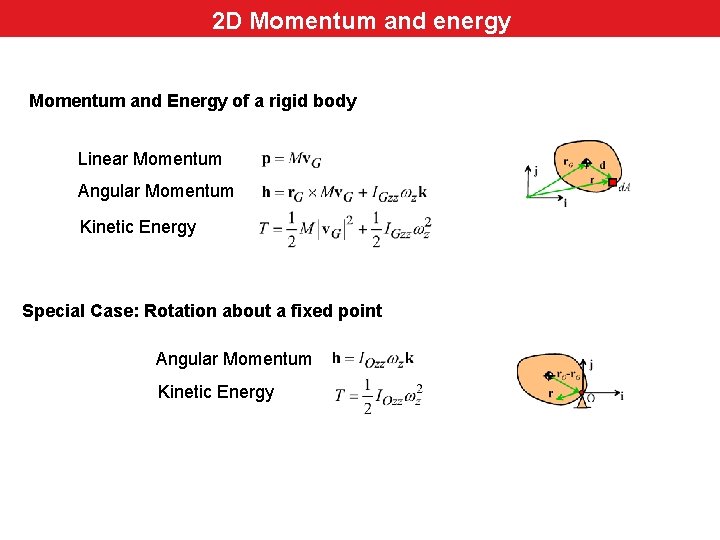
2 D Momentum and energy Momentum and Energy of a rigid body Linear Momentum Angular Momentum Kinetic Energy Special Case: Rotation about a fixed point Angular Momentum Kinetic Energy
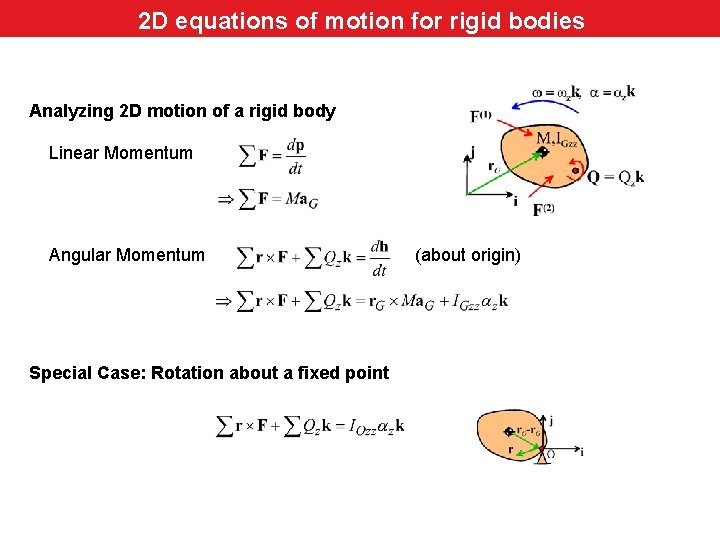
2 D equations of motion for rigid bodies Analyzing 2 D motion of a rigid body Linear Momentum Angular Momentum Special Case: Rotation about a fixed point (about origin)
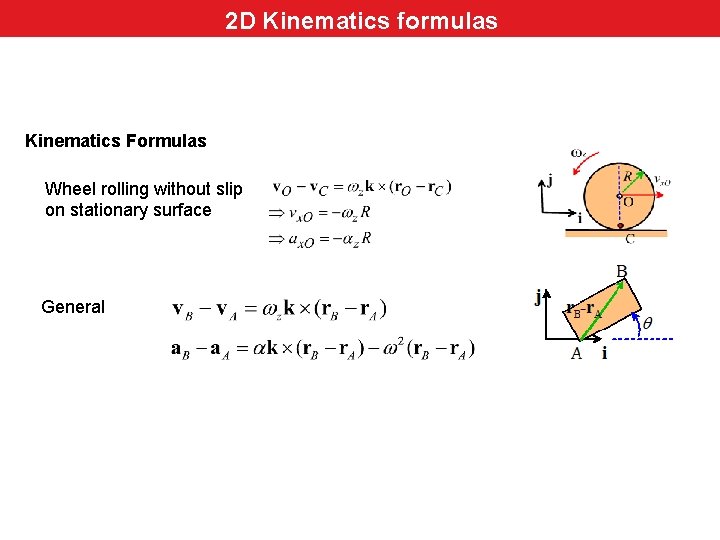
2 D Kinematics formulas Kinematics Formulas Wheel rolling without slip on stationary surface General
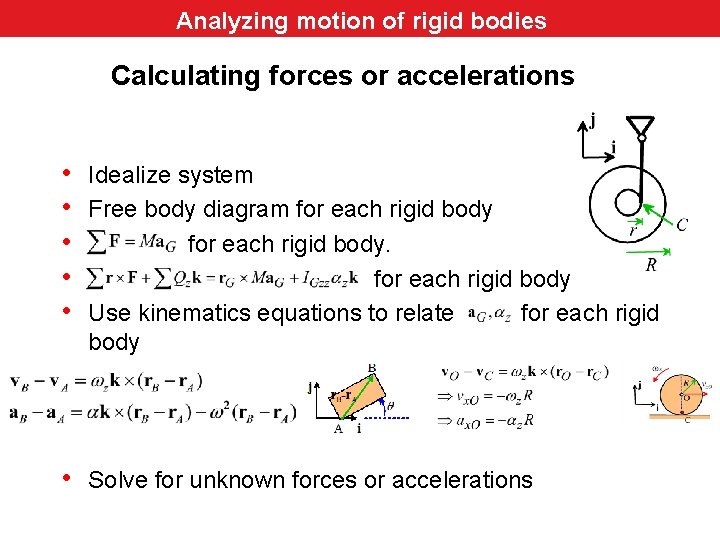
Analyzing motion of rigid bodies Calculating forces or accelerations • Idealize system • Free body diagram for each rigid body • Use kinematics equations to relate for each rigid body • Solve for unknown forces or accelerations
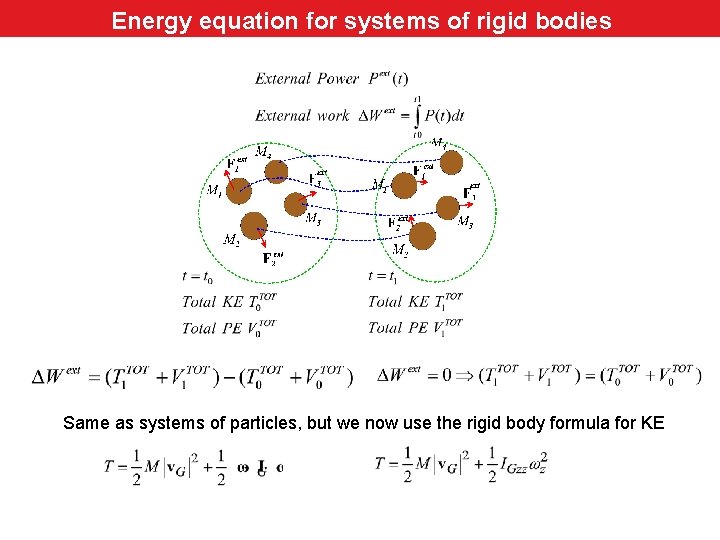
Energy equation for systems of rigid bodies Same as systems of particles, but we now use the rigid body formula for KE
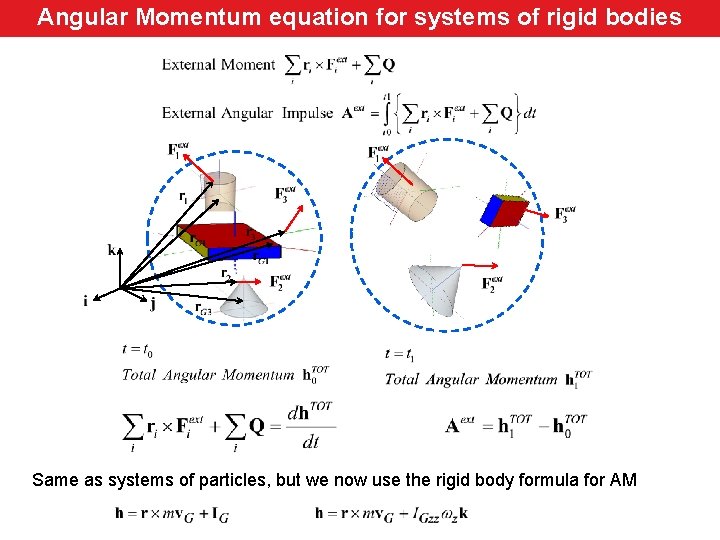
Angular Momentum equation for systems of rigid bodies Same as systems of particles, but we now use the rigid body formula for AM
- Slides: 60