
Course Outline 1 Introduction to the Climate System


- Slides: 35
Course Outline 1. Introduction to the Climate System 2. Natural Climate Variability 3. Climate Change 4. Future Perspectives
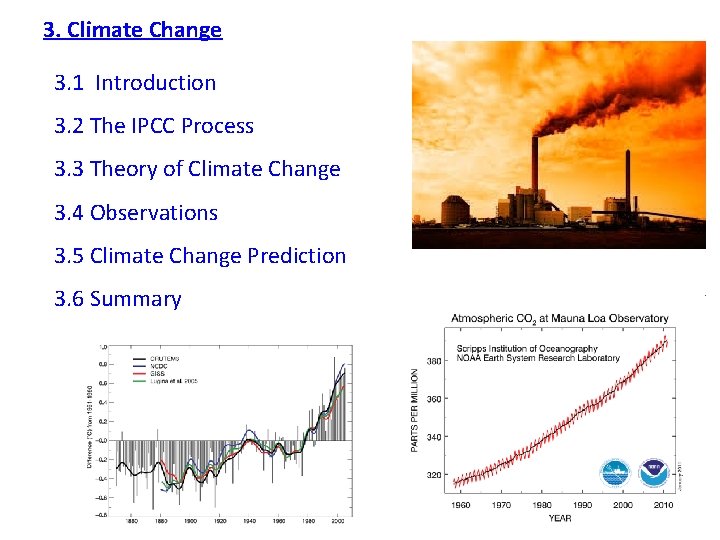
3. Climate Change 3. 1 Introduction 3. 2 The IPCC Process 3. 3 Theory of Climate Change 3. 4 Observations 3. 5 Climate Change Prediction 3. 6 Summary
3. 1 Introduction
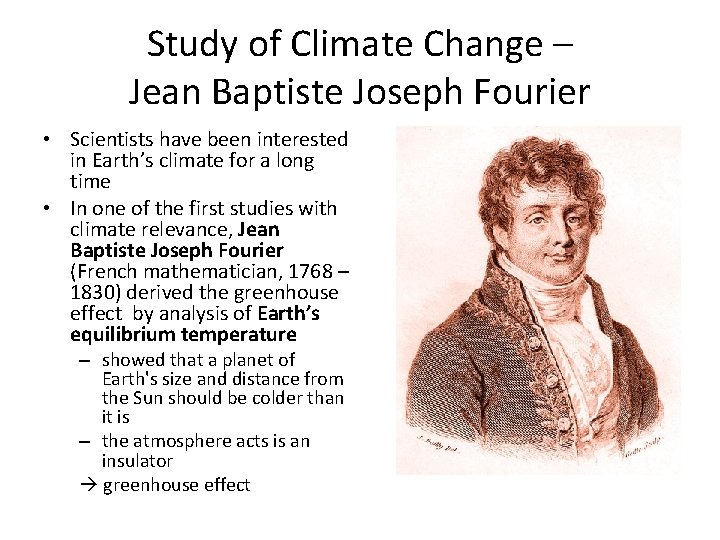
Study of Climate Change – Jean Baptiste Joseph Fourier • Scientists have been interested in Earth’s climate for a long time • In one of the first studies with climate relevance, Jean Baptiste Joseph Fourier (French mathematician, 1768 – 1830) derived the greenhouse effect by analysis of Earth’s equilibrium temperature – showed that a planet of Earth's size and distance from the Sun should be colder than it is – the atmosphere acts is an insulator greenhouse effect
Study of Climate Change – John Tyndall • In 1864, John Tyndall (1820 -1893, an Irish physicist) showed that water vapor, carbon dioxide, methane, and other hydrocarbons were effective at absorbing infrared radiation
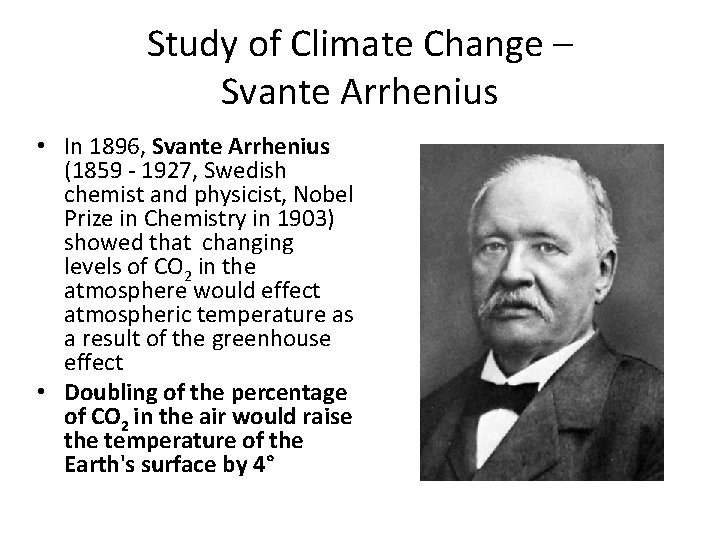
Study of Climate Change – Svante Arrhenius • In 1896, Svante Arrhenius (1859 - 1927, Swedish chemist and physicist, Nobel Prize in Chemistry in 1903) showed that changing levels of CO 2 in the atmosphere would effect atmospheric temperature as a result of the greenhouse effect • Doubling of the percentage of CO 2 in the air would raise the temperature of the Earth's surface by 4°
Study of Climate Change – E. O. Hulbert and Guy Stewart Callendar • In 1931, American physicist E. O. Hulbert confirmed Arrhenius's estimate and showed that – "doubling or tripling the amount of the carbon dioxide of the atmosphere increases the average sea level temperature by about 4° and 7°K, respectively; halving or reducing to zero the carbon dioxide decreases the temperature by similar amounts. “ • In 1938, English Steam Engineer Guy Stewart Callendar showed – that temperature and CO 2 levels in the atmosphere had risen over the preceding 50 years – that CO 2 is an effective absorber of infrared radiation – this would lead to atmospheric warming in the future
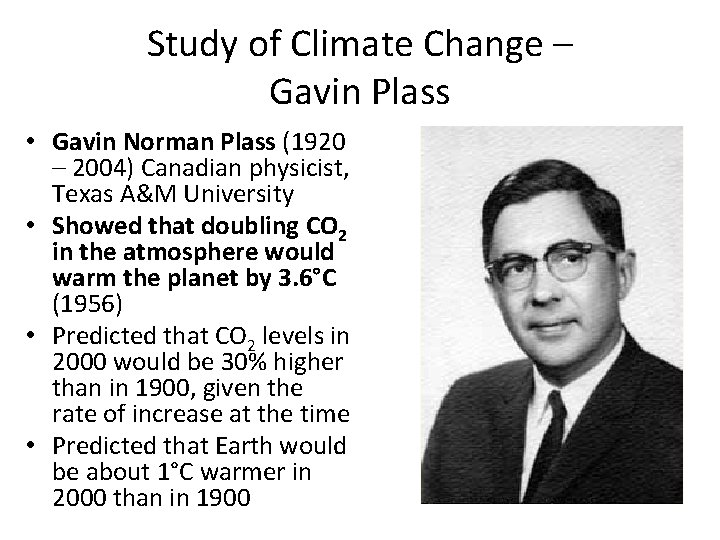
Study of Climate Change – Gavin Plass • Gavin Norman Plass (1920 – 2004) Canadian physicist, Texas A&M University • Showed that doubling CO 2 in the atmosphere would warm the planet by 3. 6°C (1956) • Predicted that CO 2 levels in 2000 would be 30% higher than in 1900, given the rate of increase at the time • Predicted that Earth would be about 1°C warmer in 2000 than in 1900
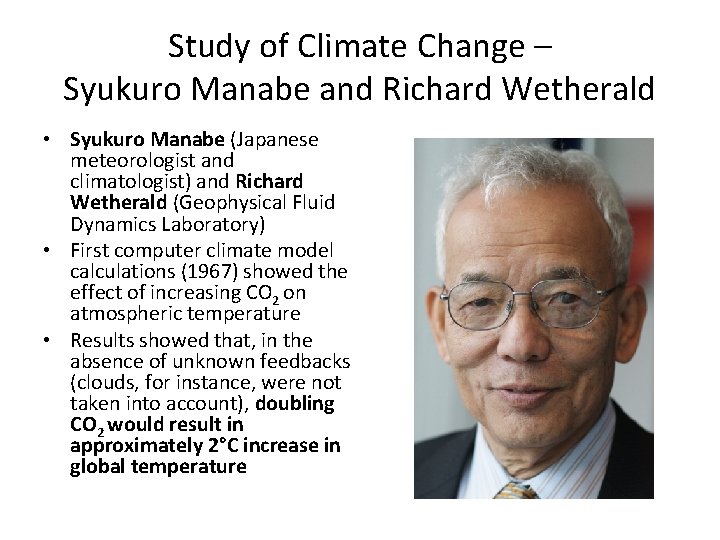
Study of Climate Change – Syukuro Manabe and Richard Wetherald • Syukuro Manabe (Japanese meteorologist and climatologist) and Richard Wetherald (Geophysical Fluid Dynamics Laboratory) • First computer climate model calculations (1967) showed the effect of increasing CO 2 on atmospheric temperature • Results showed that, in the absence of unknown feedbacks (clouds, for instance, were not taken into account), doubling CO 2 would result in approximately 2°C increase in global temperature
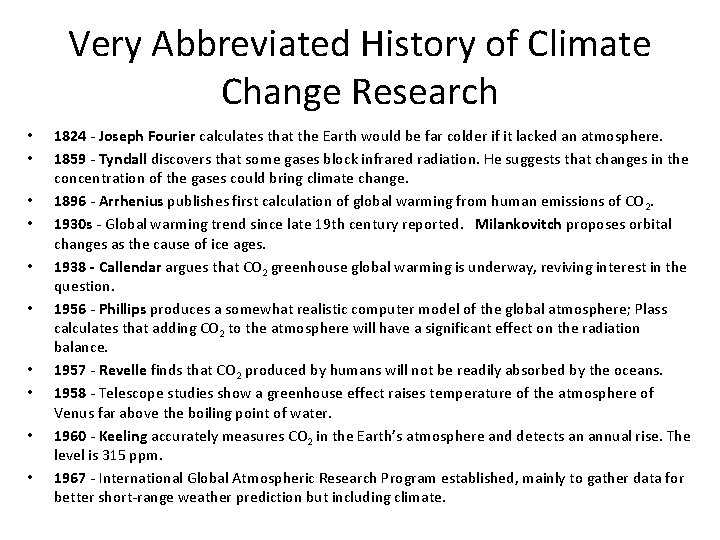
Very Abbreviated History of Climate Change Research • • • 1824 - Joseph Fourier calculates that the Earth would be far colder if it lacked an atmosphere. 1859 - Tyndall discovers that some gases block infrared radiation. He suggests that changes in the concentration of the gases could bring climate change. 1896 - Arrhenius publishes first calculation of global warming from human emissions of CO 2. 1930 s - Global warming trend since late 19 th century reported. Milankovitch proposes orbital changes as the cause of ice ages. 1938 - Callendar argues that CO 2 greenhouse global warming is underway, reviving interest in the question. 1956 - Phillips produces a somewhat realistic computer model of the global atmosphere; Plass calculates that adding CO 2 to the atmosphere will have a significant effect on the radiation balance. 1957 - Revelle finds that CO 2 produced by humans will not be readily absorbed by the oceans. 1958 - Telescope studies show a greenhouse effect raises temperature of the atmosphere of Venus far above the boiling point of water. 1960 - Keeling accurately measures CO 2 in the Earth’s atmosphere and detects an annual rise. The level is 315 ppm. 1967 - International Global Atmospheric Research Program established, mainly to gather data for better short-range weather prediction but including climate.
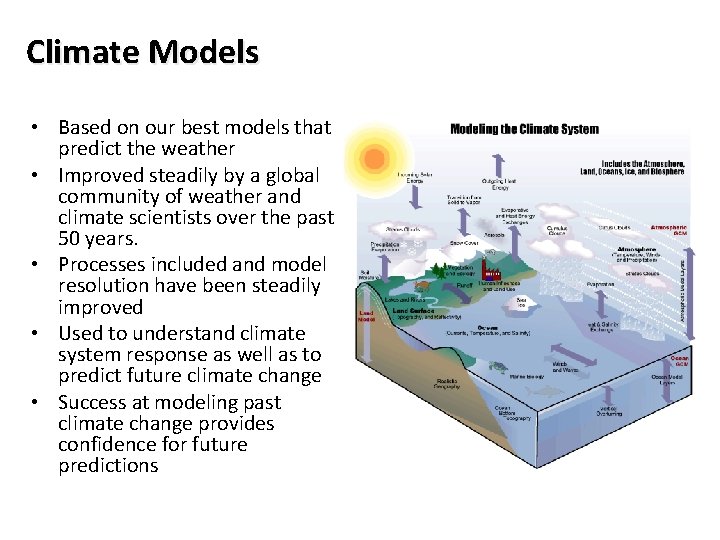
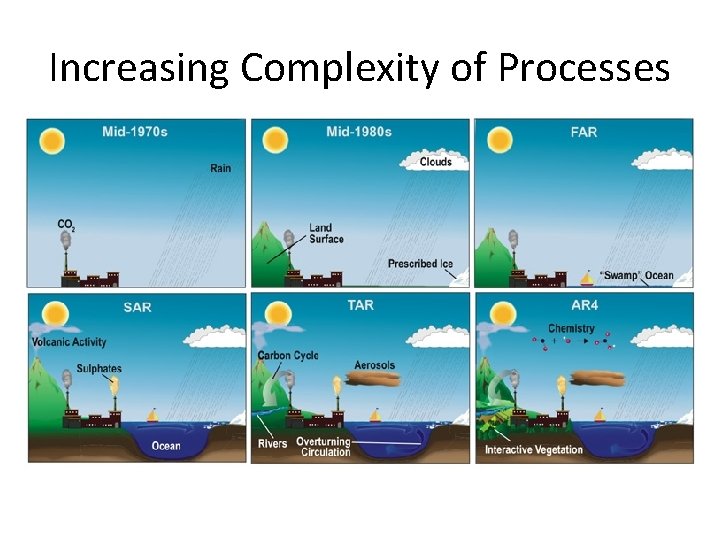
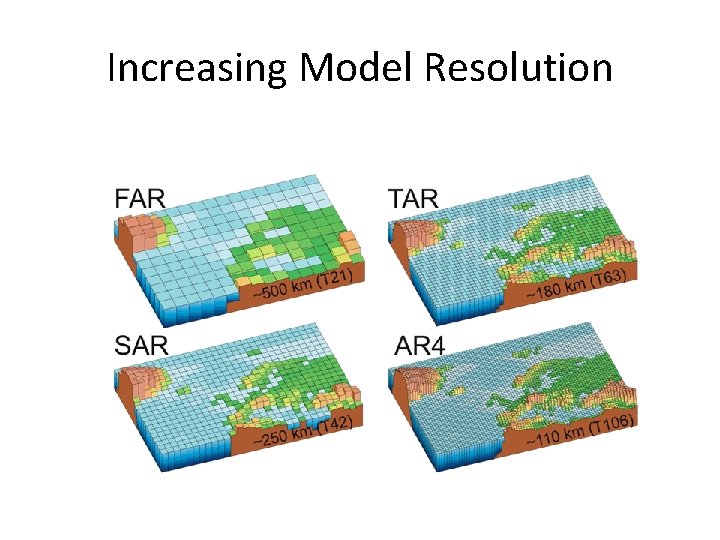
Climate Models • Based on our best models that predict the weather • Improved steadily by a global community of weather and climate scientists over the past 50 years. • Processes included and model resolution have been steadily improved • Used to understand climate system response as well as to predict future climate change • Success at modeling past climate change provides confidence for future predictions
Increasing Complexity of Processes
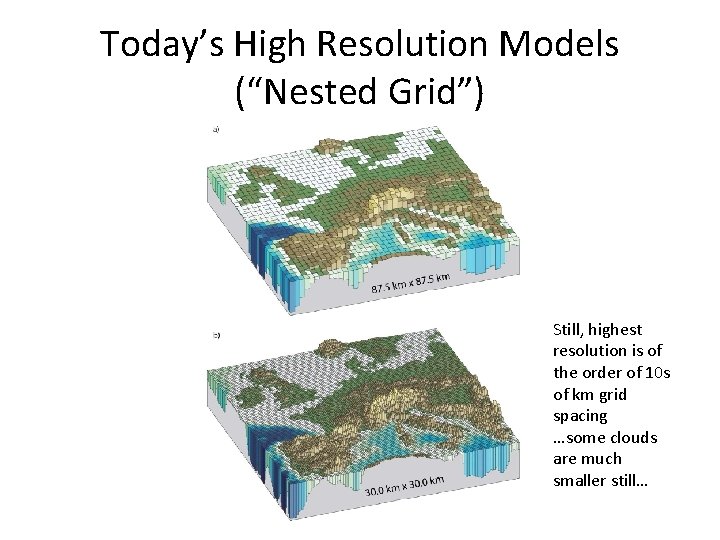
Increasing Model Resolution
Today’s High Resolution Models (“Nested Grid”) Still, highest resolution is of the order of 10 s of km grid spacing …some clouds are much smaller still…
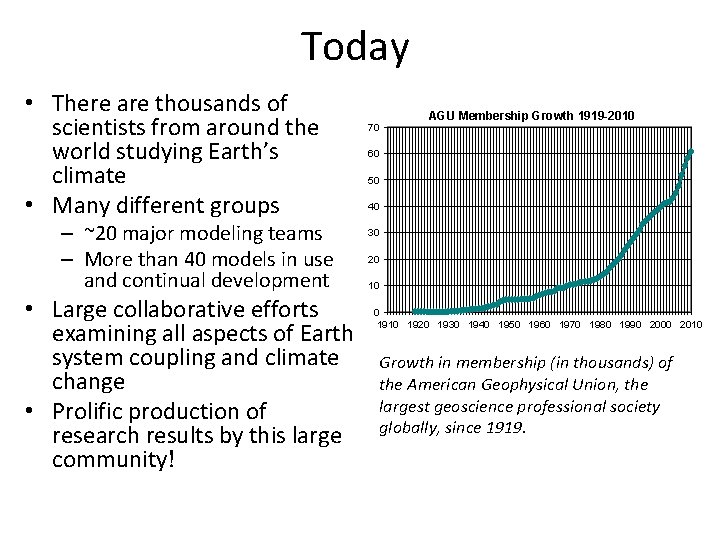
Today • There are thousands of scientists from around the world studying Earth’s climate • Many different groups – ~20 major modeling teams – More than 40 models in use and continual development • Large collaborative efforts examining all aspects of Earth system coupling and climate change • Prolific production of research results by this large community! 70 AGU Membership Growth 1919 -2010 60 50 40 30 20 10 0 1910 1920 1930 1940 1950 1960 1970 1980 1990 2000 2010 Growth in membership (in thousands) of the American Geophysical Union, the largest geoscience professional society globally, since 1919.
3. 2 The IPCC Process
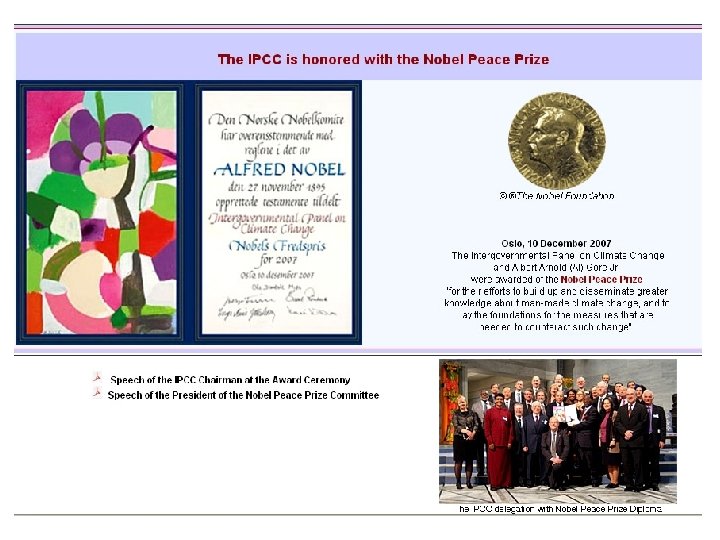
The IPCC • The Intergovernmental Panel on Climate Change was created in 1988 by the World Meteorological Organization (WMO) and the United Nations Environment Program (UNEP) – Mission – “to provide the world with a clear scientific view on the current state of knowledge in climate change and its potential environmental and socioeconomic impacts” – Involves thousands of scientists and other experts from around the world (voluntary, unpaid) – Involves representatives from ~120 countries
What does the IPCC do? • Community works iteratively examining research every ~5 -7 years, synthesizing the results, identifying implications, and issuing reports that address consequences of climate change – does not carry out its own original research – does no monitoring of climate or related phenomena – assessments based mainly on peer reviewed and published scientific literature • The IPCC is the internationally accepted authority on climate change, producing reports which have the agreement of leading climate scientists and the consensus of participating governments • Has published 5 comprehensive reports to date, and numerous supplementary reports • www. ipcc. ch
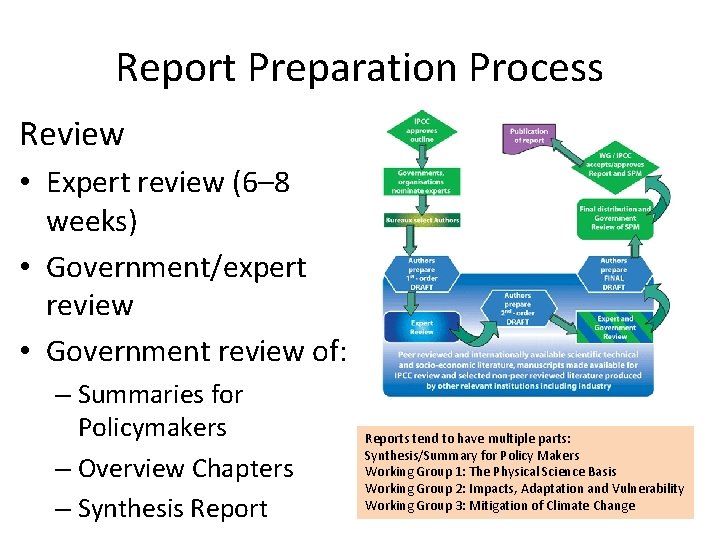
Report Preparation Process Review • Expert review (6– 8 weeks) • Government/expert review • Government review of: – Summaries for Policymakers – Overview Chapters – Synthesis Reports tend to have multiple parts: Synthesis/Summary for Policy Makers Working Group 1: The Physical Science Basis Working Group 2: Impacts, Adaptation and Vulnerability Working Group 3: Mitigation of Climate Change
Authors • Each chapter has a number of authors who are responsible for writing and editing – A chapter typically has two "coordinating lead authors", ten to fifteen "lead authors", and a somewhat larger number of "contributing authors" – Coordinating lead authors responsible for assembling contributions of the other authors, ensuring that they meet stylistic and formatting requirements, and reporting to the Working Group chairs – Lead authors are responsible for writing sections of chapters – Contributing authors prepare text, graphs or data for inclusion by the lead authors • Authors for the IPCC reports are chosen from a list of researchers prepared by governments and participating organizations, by the Working Group/Task Force Office, as well as other experts known through their published work • IPCC aims for a range of views, expertise and geographical representation, ensuring representation of experts from developing and developed countries and countries with economies in transition
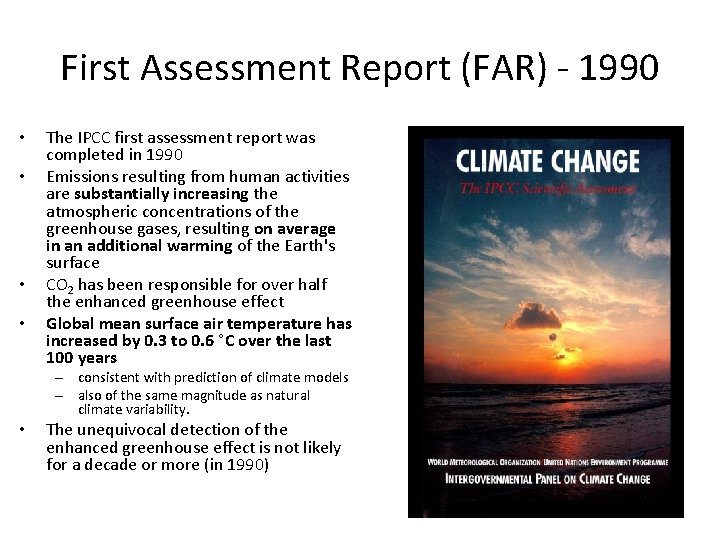
First Assessment Report (FAR) - 1990 • • The IPCC first assessment report was completed in 1990 Emissions resulting from human activities are substantially increasing the atmospheric concentrations of the greenhouse gases, resulting on average in an additional warming of the Earth's surface CO 2 has been responsible for over half the enhanced greenhouse effect Global mean surface air temperature has increased by 0. 3 to 0. 6 °C over the last 100 years – consistent with prediction of climate models – also of the same magnitude as natural climate variability. • The unequivocal detection of the enhanced greenhouse effect is not likely for a decade or more (in 1990)
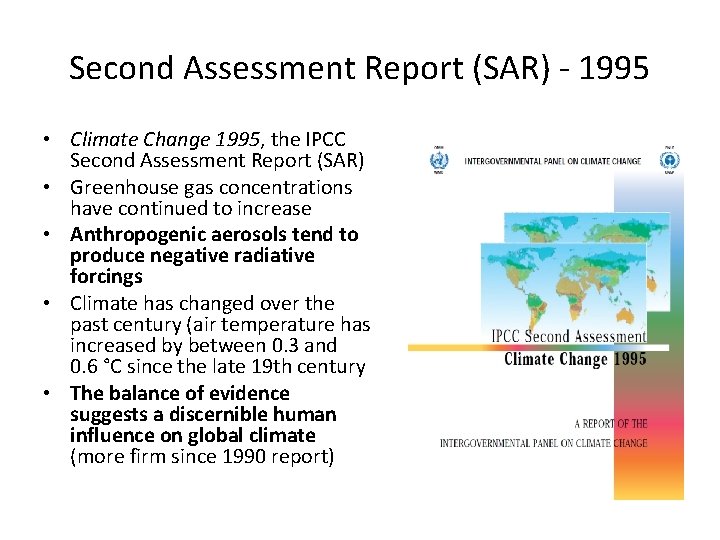
Second Assessment Report (SAR) - 1995 • Climate Change 1995, the IPCC Second Assessment Report (SAR) • Greenhouse gas concentrations have continued to increase • Anthropogenic aerosols tend to produce negative radiative forcings • Climate has changed over the past century (air temperature has increased by between 0. 3 and 0. 6 °C since the late 19 th century • The balance of evidence suggests a discernible human influence on global climate (more firm since 1990 report)
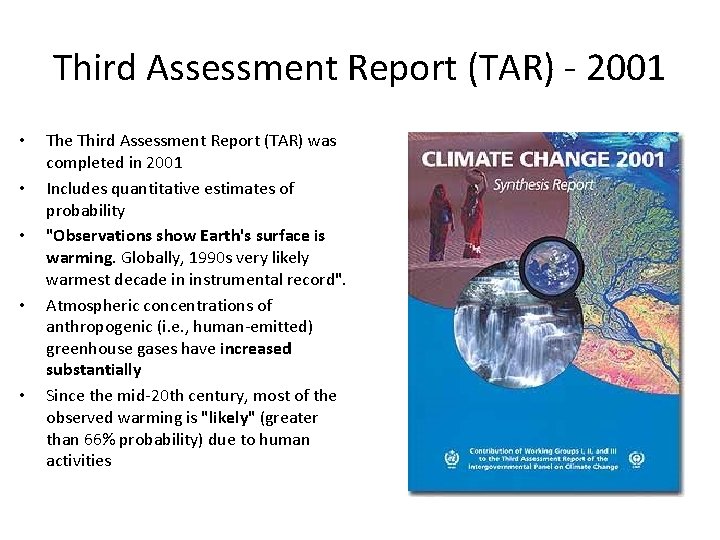
Third Assessment Report (TAR) - 2001 • • • The Third Assessment Report (TAR) was completed in 2001 Includes quantitative estimates of probability "Observations show Earth's surface is warming. Globally, 1990 s very likely warmest decade in instrumental record". Atmospheric concentrations of anthropogenic (i. e. , human-emitted) greenhouse gases have increased substantially Since the mid-20 th century, most of the observed warming is "likely" (greater than 66% probability) due to human activities
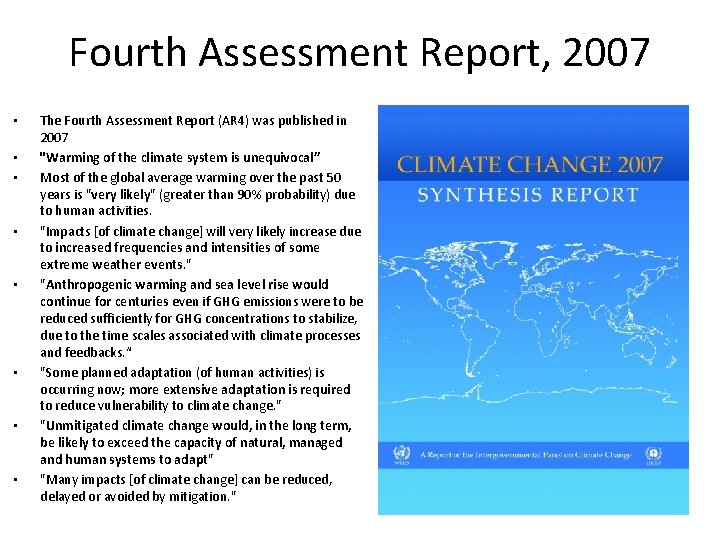
Fourth Assessment Report, 2007 • • The Fourth Assessment Report (AR 4) was published in 2007 "Warming of the climate system is unequivocal” Most of the global average warming over the past 50 years is "very likely" (greater than 90% probability) due to human activities. "Impacts [of climate change] will very likely increase due to increased frequencies and intensities of some extreme weather events. " "Anthropogenic warming and sea level rise would continue for centuries even if GHG emissions were to be reduced sufficiently for GHG concentrations to stabilize, due to the time scales associated with climate processes and feedbacks. “ "Some planned adaptation (of human activities) is occurring now; more extensive adaptation is required to reduce vulnerability to climate change. " "Unmitigated climate change would, in the long term, be likely to exceed the capacity of natural, managed and human systems to adapt" "Many impacts [of climate change] can be reduced, delayed or avoided by mitigation. "
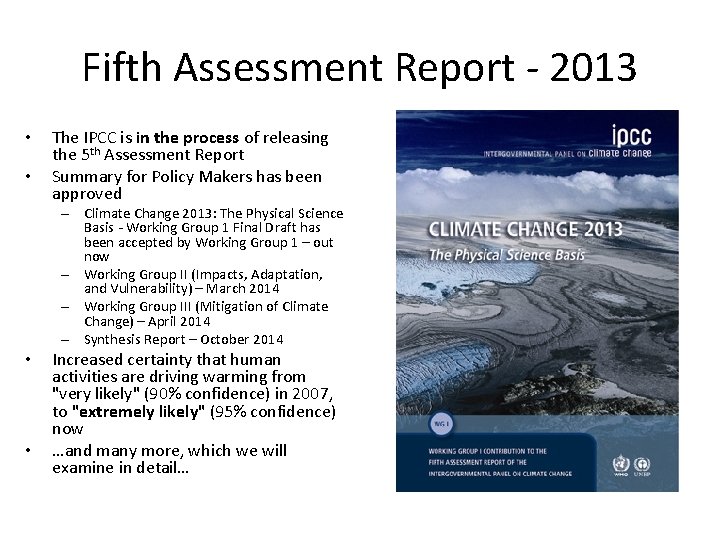
Fifth Assessment Report - 2013 • • The IPCC is in the process of releasing the 5 th Assessment Report Summary for Policy Makers has been approved – Climate Change 2013: The Physical Science Basis - Working Group 1 Final Draft has been accepted by Working Group 1 – out now – Working Group II (Impacts, Adaptation, and Vulnerability) – March 2014 – Working Group III (Mitigation of Climate Change) – April 2014 – Synthesis Report – October 2014 • • Increased certainty that human activities are driving warming from "very likely" (90% confidence) in 2007, to "extremely likely" (95% confidence) now …and many more, which we will examine in detail…
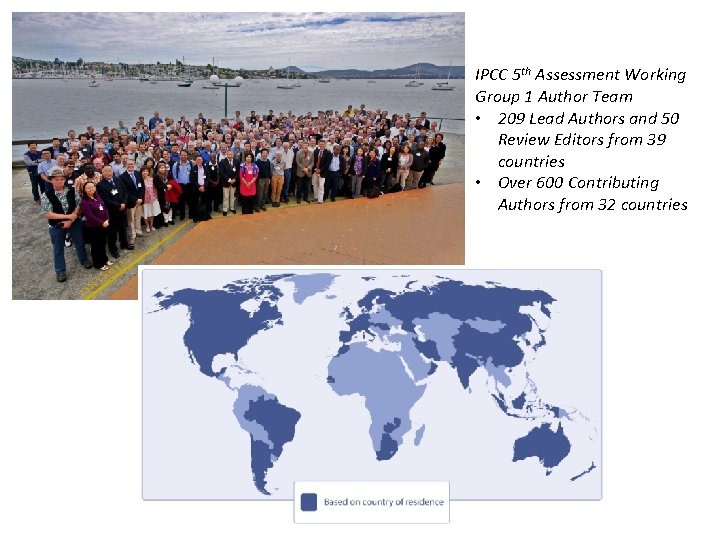
IPCC 5 th Assessment Working Group 1 Author Team • 209 Lead Authors and 50 Review Editors from 39 countries • Over 600 Contributing Authors from 32 countries
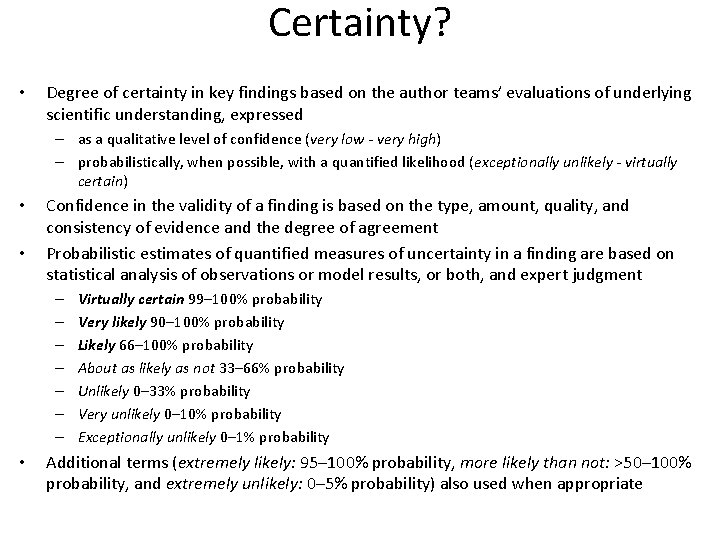
Certainty? • Degree of certainty in key findings based on the author teams’ evaluations of underlying scientific understanding, expressed – as a qualitative level of confidence (very low - very high) – probabilistically, when possible, with a quantified likelihood (exceptionally unlikely - virtually certain) • • Confidence in the validity of a finding is based on the type, amount, quality, and consistency of evidence and the degree of agreement Probabilistic estimates of quantified measures of uncertainty in a finding are based on statistical analysis of observations or model results, or both, and expert judgment – – – – • Virtually certain 99– 100% probability Very likely 90– 100% probability Likely 66– 100% probability About as likely as not 33– 66% probability Unlikely 0– 33% probability Very unlikely 0– 10% probability Exceptionally unlikely 0– 1% probability Additional terms (extremely likely: 95– 100% probability, more likely than not: >50– 100% probability, and extremely unlikely: 0– 5% probability) also used when appropriate
Observing Changes in the Climate System • • Observations of the climate system are based on direct measurements and remote sensing from satellites and other platforms Global-scale observations from the instrumental era began in the mid 19 th century for temperature and other variables, with more comprehensive and diverse sets of observations available for the period 1950 onwards Paleoclimate reconstructions extend some records back hundreds to millions of years Together, they provide a comprehensive view of the variability and long-term changes in the atmosphere, the ocean, the cryosphere, and the land surface NASA Earth Observatories have been key to making progress understanding climate
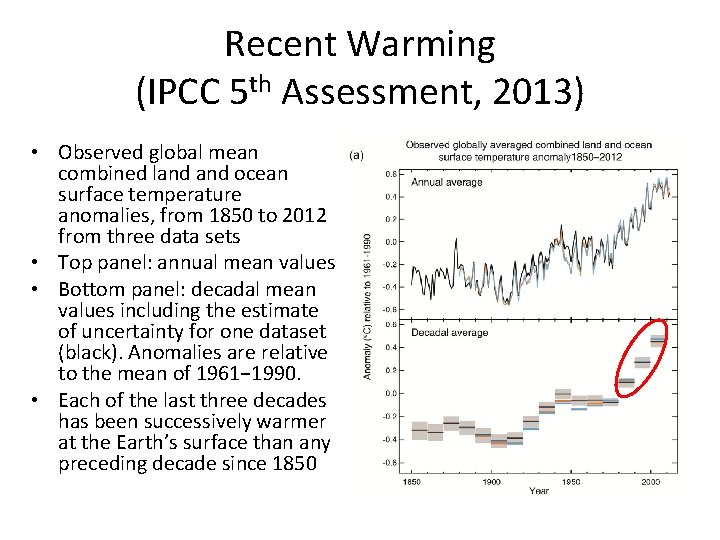
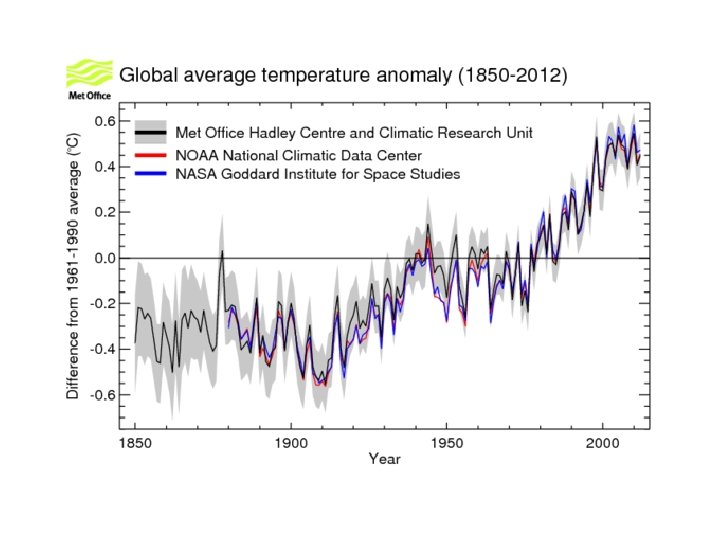
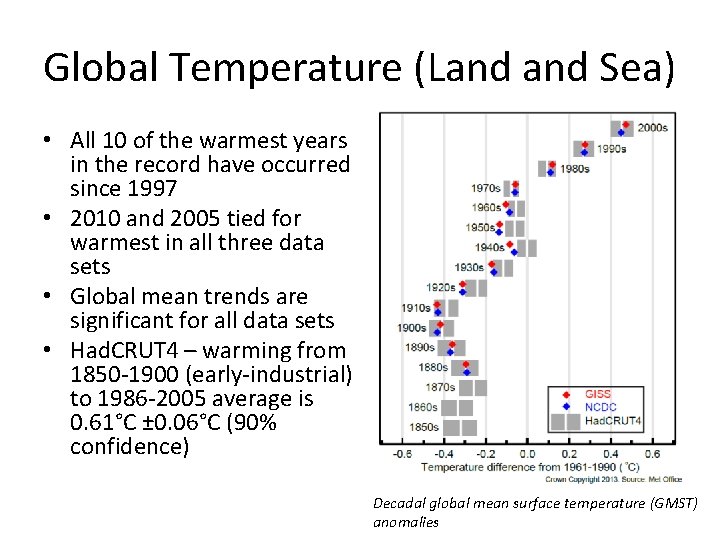
Recent Warming (IPCC 5 th Assessment, 2013) • Observed global mean combined land ocean surface temperature anomalies, from 1850 to 2012 from three data sets • Top panel: annual mean values • Bottom panel: decadal mean values including the estimate of uncertainty for one dataset (black). Anomalies are relative to the mean of 1961− 1990. • Each of the last three decades has been successively warmer at the Earth’s surface than any preceding decade since 1850
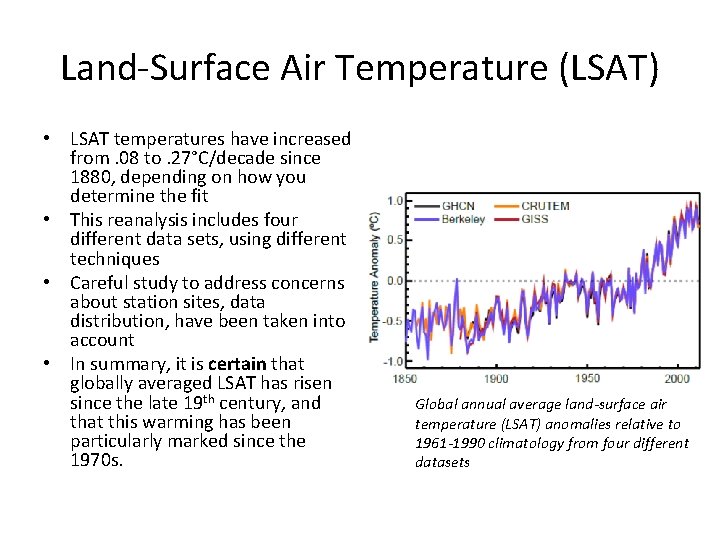
Land-Surface Air Temperature (LSAT) • LSAT temperatures have increased from. 08 to. 27°C/decade since 1880, depending on how you determine the fit • This reanalysis includes four different data sets, using different techniques • Careful study to address concerns about station sites, data distribution, have been taken into account • In summary, it is certain that globally averaged LSAT has risen since the late 19 th century, and that this warming has been particularly marked since the 1970 s. Global annual average land-surface air temperature (LSAT) anomalies relative to 1961 -1990 climatology from four different datasets
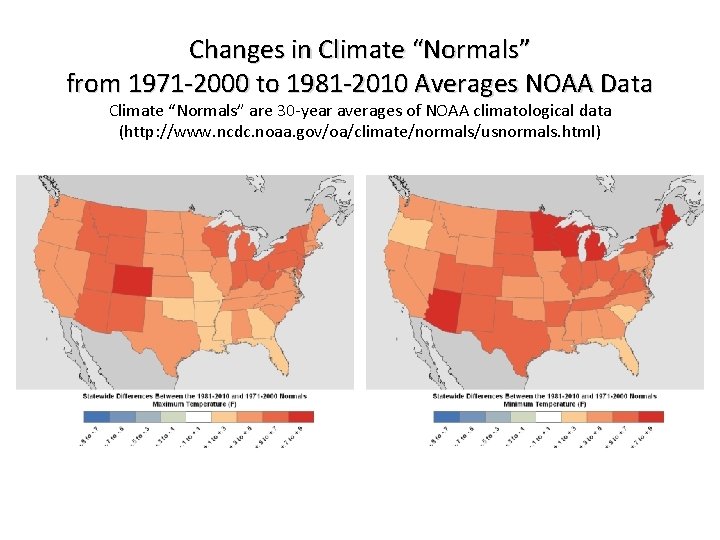
Changes in Climate “Normals” from 1971 -2000 to 1981 -2010 Averages NOAA Data Climate “Normals” are 30 -year averages of NOAA climatological data (http: //www. ncdc. noaa. gov/oa/climate/normals/usnormals. html)
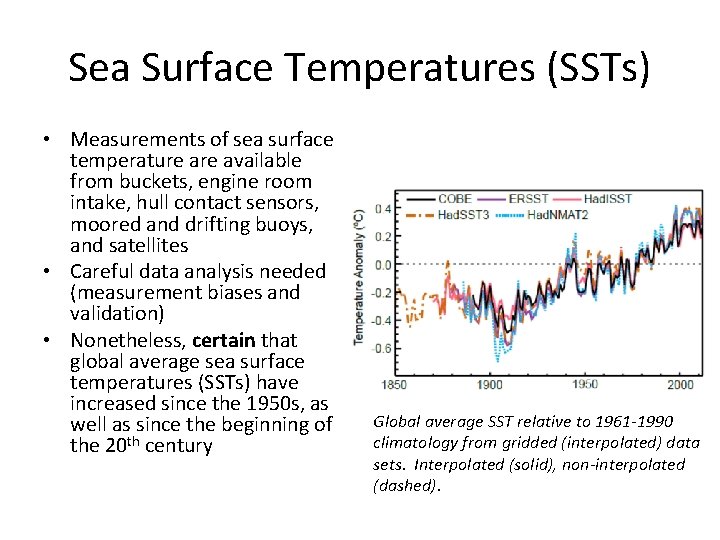
Sea Surface Temperatures (SSTs) • Measurements of sea surface temperature available from buckets, engine room intake, hull contact sensors, moored and drifting buoys, and satellites • Careful data analysis needed (measurement biases and validation) • Nonetheless, certain that global average sea surface temperatures (SSTs) have increased since the 1950 s, as well as since the beginning of the 20 th century Global average SST relative to 1961 -1990 climatology from gridded (interpolated) data sets. Interpolated (solid), non-interpolated (dashed).
Global Temperature (Land Sea) • All 10 of the warmest years in the record have occurred since 1997 • 2010 and 2005 tied for warmest in all three data sets • Global mean trends are significant for all data sets • Had. CRUT 4 – warming from 1850 -1900 (early-industrial) to 1986 -2005 average is 0. 61°C ± 0. 06°C (90% confidence) Decadal global mean surface temperature (GMST) anomalies