
Course objectives Set out the roles and responsibilities
Course objectives Ø Set out the roles and responsibilities of the Board and Directors and explore some practical difficulties that can arise Ø Examine the key relationships within and outwith the Board and how they can operate most productively Ø Allow you to benchmark your own Board against best practice in corporate governance and identify areas for development
Session 1 Roles and relationships

An effective Board
Provides leadership and direction Ø “Keeps its eye on the ball” • Ensures clarity of purpose and a focus on delivering outcomes for citizens and users Ø Provides strategic direction to the organisation • Oversees development of the Corporate Plan and approves an annual Business Plan • Ensures that the Corporate Plan is robust, achievable and financially sound • Considers and understands the key business risks facing the organisation (develops alternative scenarios)
Monitors performance Ø Monitors performance and results • Sets a few high level targets and indicators against which success can be measured • Receives comprehensive and accurate information to enable the Board to monitor performance • Focuses its scrutiny on the critical not the merely interesting • Gets assurance from internal and external sources including ‘service users’ and staff • Takes appropriate corrective action to address areas of concern (is prepared to take difficult, unpopular decisions) • Ensures good financial stewardship
Delegates within a culture of control Ø Appoints the Chief Executive and ensures that an effective management team is in place • Holds managers to account for performance but generally avoids getting involved in operational detail Ø Delegates: clarifies which decisions are reserved for the Board and clearly delegates the rest • Approves a formal scheme of delegation and a schedule of matters reserved for the decision of the Board • Reviews/approves significant corporate actions - matters of significant financial or reputational risk or issues of principle
Is open and accountable Ø Develops and maintains relationships with stakeholders and ensures effective dialogue • The Highland Council, regulators • Service users and the public: satisfaction surveys, complaints and how they have been handled etc. • Staff: independent staff survey, grievances etc. • Local communities, public, media: how are you perceived? • Stakeholder engagement is central to the management of reputational risk (on the Board agenda regularly) Ø Acts promptly to address problems/concerns
Ensures good governance and Demonstrates the value of good governance through behaviours (sets the tone from the top) Ø Leads by example (protects company’s reputation) Ø Effective financial systems/internal controls in place Ø Regularly reviews the risks faced by the company and plans for the management of those risks Ø Operates within the law, constitution and corporate governance framework (role of Company Secretary) Ø Meets its responsibilities to staff as a good employer (health and safety, HR etc. ) Ø All vulnerable users are protected from abuse
Legal duties of a Director
Legal duties of a Director Ø Duty to promote the success of the company Ø Duty to exercise reasonable care, skill and diligence Ø Duty to act within powers Ø Duty to exercise independent judgement Ø Duty to avoid conflicts of interests and duty to disclose relevant interests Ø Duty not to accept benefits from third parties
An effective Director
An effective Director Ø Brings “an independent judgement to bear on strategy, performance, key appointments and accountability” • Brings insight and original thinking to Board discussions Ø Operates strategically (concentrates on big picture) • Does not micro-manage • Does not operate as a single issue ‘Member’ or a lobbyist Ø Places his/her skills, contacts, expertise at the disposal of the Board and the management team
An effective Director Ø Contributes fully to Board discussions and shares responsibility for decisions • Questions intelligently, debates constructively, challenges rigorously and decides dispassionately • Listens sensitively to the views of others inside and outside the Board (works for consensus) Ø Acts as an effective ambassador and advocate • Is loyal to the Board/organisation at all times – accepts, supports and promotes Board decisions and policies
An effective Director Ø Operates as a team player • Takes decisions in the corporate interest and not for selfish reasons or to benefit factional interests • Respects the differing roles of Directors and executives (Directors who are/were executives in their day jobs should be careful not to continue to think as executives) Ø Undertakes specific functions (as agreed by the Board) • Represents Board/company at events, with media/public etc. • Serves on Committees, acts as an authorised signatory in financial/contractual matters
An effective Director Ø Attends Board meetings and is well prepared • “Approaches the task with seriousness of purpose and applies care, diligence and skill to all that they do” (3. 1) • Reads - studies - relevant papers in advance • Full attendance is the norm and for the whole meeting • Provides a view on major issues even if cannot attend • Clarifies issues with the Chief Executive in advance • Gets sufficient, high quality information to be assured that the company is operating effectively
An effective Director Ø Does not bring the company or the Board into disrepute by his/her conduct (including social media) • Is not aggressive or discourteous within the Boardroom or disloyal to the company or Board outside the Boardroom • Handles conflicts of interest properly - openness • Does not leak information that is confidential or obtained through privileged access • Is scrupulous in claiming expenses according to the rules • Treats staff with respect and avoids bullying • Conduct at Board meetings is exemplary
Personal liability of Directors Ø Directors should be indemnified against liability for negligence, default, breach of duty etc. Ø Possibility of removal (check your own position) • Bankrupt or disqualified from acting as a Director • Incapable by reason of mental disorder or illness or injury of administering your property and affairs • Absent from meetings? Ø When in doubt - take legal advice
Role of the Chair
Role of the Chair Ø Leadership • Effective leadership of the Board and ensures that the Board fulfils its duties, roles and responsibilities • The organisation is well connected with its ‘stakeholders’ • Directors work together effectively as a team Ø Development • Reviews the composition of the Board periodically and assesses experience and skills mix (succession planning) • Ensures timely induction and ongoing training for Directors • Monitors attendance and performance of Directors • Arranges for an annual review of Board effectiveness
Role of the Chair Ø Direction • Ensures that the Board concentrates on directing the organisation and not on managing it! Ø Monitoring • Ensures that the Board monitors progress effectively and holds the Chief Executive to account • Ensures the Board has arrangements in place to ensure compliance with constitution and framework of control Ø Represents the organisation at events and with key stakeholders
Role of the Chair Ø Board business – makes sure the Board carries out its essential functions efficiently and effectively: • Ensures that the Board takes proper account of legal and other requirements in reaching decisions • Promotes high standard of probity and corporate governance within the organisation • Ensures that the Board meets regularly and the Board’s record of meetings accurately records the decisions and, where necessary, the views of individual Directors • Obtains professional advice for the Board when needed • Leads Directors in appointment of the Chief Executive
Efficient conduct of Board business Ø Review the corporate governance framework (including Standing Orders) annually Ø Meetings • Directors should contribute to the agenda which should focus on strategic and performance issues • Papers should be fit for purpose and issued to Directors at least 5 working days before the meeting • Minutes should be issued within [10] working days of the meeting and be a record of decisions made as well as significant aspects of the discussion • Brief report from Committee Chairs not just the papers
Role of the Chief Executive
Role of the Chief Executive Ø “A good or bad CEO makes or breaks a organisation” Ø Leads and inspires the organisation to fully implement agreed plans (and delegated matters) Ø Develops plans that reflect the longer-term corporate objectives and priorities established by the Board Ø Establishes a performance management framework Ø Cultivates relationships with key stakeholders etc. and communicates plans and achievements
Role of the Chief Executive Ø Closely monitors operating and financial performance against plans and budgets, taking corrective action as necessary, informing the Board of significant changes Ø Ensures that the Board is kept adequately informed for it to be able to discharge its duty to monitor the performance of the company Ø Draws the Board’s attention to matters it should consider and decide and ensures that the Board is fully informed of reputational and other key issues

Role of the Company Secretary
Role of the Company Secretary Ø Not a legal requirement for charities and companies to have a Company Secretary but …. Ø Appointment and removal of the Company Secretary is normally a matter for the Board Ø Should be a person with considerable personal integrity - “Sides with the angels”
Board Ø Convenes Board meetings Ø Takes minutes of meetings Ø Writes up register of Director interests, minute book of general and Board meetings, company’s statutory books, OSCR information returns etc. Ø Acts as secretary to all Board committees Ø Ensures Board procedures are followed and reviewed Ø Source of impartial advice on legal requirements, corporate governance and related best practice Ø Facilitates induction and development for Directors
Board Ø Provision of information to Directors and Committee Members so that they can maximise their ability to contribute to Board meetings, discussions etc. Ø Provides comprehensive practical support/guidance to Directors as individuals and as a collective Ø Assists in compilation of Board papers and filters them to ensure compliance with good governance Ø Raises matters which warrant attention of the Board
Organisation Ø Central source of guidance and advice within the company on matters of business ethics and good governance Ø Monitors incidents of non-compliance and reports to the Board Ø Complies with the fiduciary and other duties of Directors Ø Administers alterations to constitution
Organisation Ø Maintains statutory registers Ø Completes and files statutory forms Ø Reports and accounts Ø Meetings and resolutions Ø Miscellaneous • Company seal: safe custody and proper use of any company seals
Managing key relationships
Chair and Directors Ø Ensures that Directors contribute fully at Board meetings and Committees • . . . but allows new Directors time for familiarisation • Informal feedback and encouragement • Doesn’t dominate/allow individual Directors to dominate Ø Fosters a team approach • Councillors and independents • Executives and Non-Executives
Directors and other Directors Ø There is only one category of Director – appointed or elected, professional or not Ø Directors should not operate in cliques inside or outside meetings or take direction on what to say or how to vote Ø Directors should show respect to fellow Directors and the role they play, treating them with courtesy Ø Remain loyal to fellow Directors and the Board when meeting staff, users, stakeholders etc.
Chair and Chief Executive Ø Chair should develop an effective working relationship with the Chief Executive • Nature of the relationship is as important as definition of roles - characterised by openness and integrity • The Chair should support, advise, act as confidant(e) …but • The relationship should not become too cosy • Chair must lead the Board in challenge and scrutiny – holding the Chief Executive to account for performance
Directors and staff Ø Individual Directors should not instruct the Chief Executive or members of staff. Board should protect Chief Executive and staff from individual Directors Ø Directors should ‘constructively’ challenge the Chief Executive and managers but not be confrontational (catch them out!) Ø Manage relationship with staff carefully – not too distant or too approachable. Directors should not lobby, or be lobbied by, staff and/or become seen as a way around the Chief Executive
Organisation and the Council Ø Board should ensure this relationship is working well • Full and open communication both ways • The Council has confidence in you! o Good news stories/rule of no surprises o Your governance is fit for purpose, compliance with the corporate governance framework and a culture of innovation and delivery o Avoid excessive interference or unrealistic expectations • Use Directors as advocates and ambassadors • Review operation of the relationship periodically and address any issues
Session 2 Scandal and how to avoid it! Ethical standards in practice
Key principles Ø Selflessness Take decisions solely in terms of the public interest. You must not act in order to gain financial or other material benefit for yourself, family or friends Ø Integrity Do not place yourself under any financial or other obligation to any individual or organisation that might reasonably be thought to influence you in the performance of your duties Ø Objectivity Make decisions solely on merit when carrying out public business (awarding of contracts, making appointments, recommending people for benefits)
Key principles Ø Accountability and stewardship Be accountable for your decisions and actions to the public. Consider issues on their merits, taking account of the views of others and ensure that the company uses its resources prudently and in accordance with the law Ø Openness Be as open as possible about all decisions and actions, giving reasons for your decisions and restricting information only when the wider public interest clearly demands Ø Honesty Act honestly. Declare private interests relating to public duties and resolve conflicts in a way that protects the public interest
Key principles Ø Leadership Promote and support these principles by leadership and example to maintain and strengthen the public’s trust and confidence in the integrity of the company and its Directors Ø Duty Uphold the law and act in accordance with the law and the public trust placed in you. Always act in the interests of the company and in accordance with its core functions and duties Ø Respect fellow Directors and employees and the role they play, treating them with courtesy at all times. Respect members of the public when discharging your role

Conflicts of interest

Registration of interests Ø Maintain and allow the public access to a register of Director interests • Register of staff interests Ø Seven categories of interests have to be registered • Remuneration • Related undertakings • Contracts with the company • Houses, land buildings (relevant) • Shares and securities (1% or £ 25, 000) • Gifts and hospitality • Non financial interests (clubs, societies, unions etc. )
Registration of interests Ø Maintaining the register • Directors should register their interests upon appointment and complete an annual update • When changes to existing interests occur or a new interest is acquired, update register within one month (4. 1) • Information should be electronically registered (dated) • Err on the side of registering more rather than less! Ø The register should be held centrally and it is vital that the Chair, Chief Executive and/or other key personnel are made aware of relevant interests (particularly in advance of meetings etc. )
Declaration of interests Ø Is there an interest? • Includes interests of spouses, relatives and friends etc. Ø Is that interest material? • What would a reasonable and objective observer with knowledge of all the relevant facts think? • Would it harm your ability to judge the company’s interest? • In cases of doubt, obtain clarification in advance of meeting Ø Take advice but you are responsible for your own decisions and must accept the consequences
Declaration of interests Ø If it is a material interest, declare and withdraw • If not, the Chair must intervene • All financial interests are material unless the interest is so remote or insignificant that a reasonable person would not see it as likely to effect any influence • Section 5. 8. 1 states “being a Councillor on a nominating body does not raise any issue of declaration of interest” Ø Making a declaration • Declarations (written or verbal) - “I declare an interest” • Declare at outset or as soon as reasonably practical • Declaration and resulting action should be minuted
Handling conflicts of interest Ø Director with a financial/material interest • Should not be on a Committee if, or likely to be, a significant or habitual recipient • Should not be bidding at all for work with the company as a supplier during Board tenure • Should not receive papers relating to their application in advance of the meeting, be copied in on e-mails, correspondence etc. , or receive [full] minutes afterwards • Should be absent for the discussion and decision • Should not use their position to try and improperly influence the decision in their absence
Handling conflicts of interest Ø Material transactions with related parties should be disclosed in financial statements (FRS 8) Ø Principles apply to appointments, discipline, promotion, pay adjustments Ø If conflicts of interest are a big risk, develop a specific policy and provide training Ø Cultural issues • A culture where staff are prepared to challenge bad practice? • Openness and transparency is key
![Ten guiding principles Ø Take personal responsibility Ø Put [the organisation] first Ø Be](http://slidetodoc.com/presentation_image_h2/bfb2d3ea2dc31cccf2273b03efca1120/image-49.jpg "Ten guiding principles Ø Take personal responsibility Ø Put [the organisation] first Ø Be")
Ten guiding principles Ø Take personal responsibility Ø Put [the organisation] first Ø Be open and transparent Ø Be aware of public perception Ø If conflicted, play no part Ø Declare and refer every time Ø Escalate Ø Document everything Ø Take advice Ø If in doubt, get out!

Gifts and hospitality
Gifts and hospitality Ø What is a gift? • A gift can be a service provided below normal cost, debt relief etc. (3. 7) • In certain circumstances, it may be given to a family member or company/partnership (3. 7) Ø There is a presumption against accepting gifts (3. 9) Ø Gifts or hospitality should never be sought (3. 8) Ø Covered by the Bribery Act 2010
Gifts and hospitality Ø All offers of gifts or hospitality (accepted or declined) should be recorded in a central gifts and hospitality register (councillors must also include details in the register of interests) Ø Five key considerations • Relationship • Legitimate interest • Value • Frequency • Reputation
Relationship Ø Consider whether the acceptance of a gift or hospitality might influence or appear to influence an official decision or action • Supplier/potential supplier, contractor or someone awaiting a decision vs member of public (3. 10) • Site visits – pay your own way (3. 10) • Staff involved in procurement or monitoring of contracts Ø Offers of hospitality are usually acceptable if there is a genuine need to impart information or represent the organisation in the community etc. (3. 11)
Value Ø Seasonal, promotional and trivial gifts are generally acceptable • Seasonal items include diaries, calendars, small items of office equipment • Trivial is defined as less than £ 50 but no cash etc. (3. 9 (i)) • Gift offered to the organisation is more acceptable than one to an individual staff member or Director (3. 9 (iii)) • Reasonable hospitality such as lunch during or as a result of a business meeting (inappropriate to refuse) is more acceptable than more expensive social functions (3. 9 (ii)) • Take care when giver stands to benefit from a decision, grant, contract (present or future) even if less than £ 50
Legitimate interest and frequency Ø What is the reason for the contact on both sides? • Is this contact likely to benefit the organisation? • Are the motives of the other party suspect (e. g. the timing is potentially problematic)? Ø Avoid repeated hospitality and gifts from the same source (3. 12) Ø Legitimate interest may justify isolated acceptance of, for example, an invitation to a public, cultural, sporting or social event
Reputation Ø Is the person or organisation offering the gift or hospitality a potential source of embarrassment? • Under investigation by a regulator or inspector • A track record of trying to gain undue influence through hospitality or inappropriate lobbying • Could acceptance be seen as supporting that person/body? Ø All offers of gifts etc. should be open and transparent Ø Same principles apply to offers of sponsorship • Take care to avoid undue influence or allowing existing suppliers/contractors to reinforce their position
Gifts and hospitality Ø Offers of fees for speaking engagements should be declined or surrendered to the organisation Ø Benefits gained from publicly-funded activity (air miles, hotel vouchers) to be used on business or lost Ø Ensure guidance on the offering/acceptance of gifts and hospitality is kept up-to-date and complied with Ø If in doubt, talk to Chair/Standards Officer. If still in doubt, decline but if you reject a gift etc. , be sensitive
General rule on hospitality Ø Directors may accept the occasional offer of modest, proportionate hospitality but must consider whether: • Acceptance will further the aims of the organisation • The level is reasonable in the circumstances (and would be considered reasonable by an objective observer) • It has been openly offered • Other Directors and/or staff will be there (how many)? • It could not be construed as a form of inducement and will not put the person under any obligation to those offering it
Accountability and value for money
Accountability and VFM Ø Avoid lavish or inappropriate use of public monies Ø The watchwords are “modest and appropriate” • Could you stand in front of a journalist or a member of the public and feel comfortable defending the expenditure? • Be conscious of the current economic climate Ø For exceptional cases, produce a sound business case setting out the benefits Ø Ensure full compliance with financial regulations
Accountability and VFM Ø Ensure compliance with the procurement regulations • Tendering (and grant-making) procedures should be robust and comply with best practice • Plan ahead • Follow the rules and take breaches seriously • No splitting contracts to avoid tendering • Special care over EU procurement rules but… • Use a little bit of common sense! Ø Avoid becoming obliged to, or appearing to become obliged to, a supplier
Directors and finance Ø Financial responsibilities • Ensure that the organisation has the appropriate level of financial expertise at Board and executive level • Audit Committee should ensure that the financial systems etc. are sound o Co-opt members with relevant financial experience if not available within the Board • The Board must receive regular reports on financial and non-financial performance and scrutinise o Reports presented in understandable way o Not tabled on the day of meetings
Directors and finance Ø Financial and non-financial information: • Understand it (do not rely on others) • Scrutinise and question it • Is it accurate and timely? • Not too much to confuse and not too little that inhibits decision-making • Materiality (do not micro-manage) • Information should be presented to assist the decisionmaking process – explained in a jargon free way • Do not accept the decision if you have reservations o Do not be afraid to ask for more information
Standards of behaviour
Conduct of Directors Ø Conduct at meetings • Respect for the Chair, fellow Directors, employees and members of the public (3. 2) • Comply with the rulings of the Chair Ø Directors must treat employees with respect (3. 3) • Avoid undue interference in direct operational management (Protocol) (3. 4 and 3. 5) Ø Directors must not misuse facilities, equipment, stationery, telephony and services or use for party political or campaigning purposes (3. 16)
General conduct Ø Interest groups and lobbying • Guard against undue influence/ensure a fair hearing for all Ø Compliance with equality and diversity policies • Provision of services (and take up of services) • Staff recruitment, selection, training, conditions of service Ø Observe rules concerning confidentiality and do not leak information that is confidential or obtained through privileged access (3. 15) Ø Take particular care over expense claims (3. 6)
Session 3 Principles of effective governance
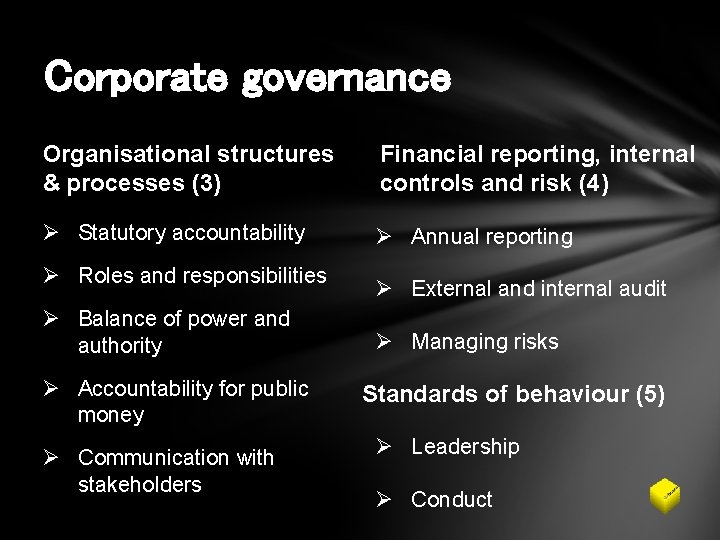
Corporate governance Organisational structures & processes (3) Financial reporting, internal controls and risk (4) Ø Statutory accountability Ø Annual reporting Ø Roles and responsibilities Ø Balance of power and authority Ø Accountability for public money Ø Communication with stakeholders Ø External and internal audit Ø Managing risks Standards of behaviour (5) Ø Leadership Ø Conduct

How good is your Governance?

and finally
Some final points Ø Ensure clarity of purpose and a focus on outcomes Ø Set clear corporate goals underpinned by effective performance management Ø High level focus with clear schemes of delegation Ø Identify key business risks and monitor regularly Ø Ensure regular Board and Director development including an annual review of Board effectiveness and individual Director development
Some final points Ø Ensure clear lines of reporting and accountability between Board and committees; company and council • Delegate but do not abdicate! Ø Put in place a strong Audit Committee with expertise and a robust challenge function Ø All Directors must take their financial and compliance responsibilities seriously Ø Ask and do not be satisfied until you see evidence. How much will this cost? What if not?
- Slides: 72