
Course name An Outline of Earth Sciences Introduction







- Slides: 47
Course name: An Outline of Earth Sciences 地球科学概论 (Introduction to Earth Sciences) Textbook (教材):吕洪波,2006,《An Outline of Earth Sciences》( 地球科学概论),中国石油大学出版社, 367 pp. References or bibliography 参考书目: 1. 夏邦栋主编:《普通地质学》,1995年,地质出版社 2. www. http: //google. com,输入地学关键词汇查询 3. 其他网络资源(见教材每章末尾网址链接) Teacher (教师):吕洪波教授 (Professor Hongbo Lu) Requirement in class 课堂要求:记录课堂笔记 Make notes Requirement after school课余要求: 预习和复习 preview and review Time table and places 时间与地点:见课程表(curriculum schedule) Tests and scores 考核与成绩: 平时参加、实验室成绩(矿物岩石标本鉴定) (30%) 笔试成绩(英文试卷,重点词汇附汉语标注,开卷考试)(70%)
Key words of Chapter 1 Earth Sciences, geology, geography, biology, meteorology, environmental sciences, astronomy; lithosphere, biosphere, atmosphere, hydrosphere… Geology: marine geology, geochemistry, geophysics, geology of ore deposits, petrology, petroleum geology… The method of geology: natural laboratory, time scale and space scale, principle of actualism… Geologic process: endogenic process, exogenic process, sites and major energies (internal heat, radioactive heat, Sun’s heat), auxiliary energies (gravity, rotation force, gravitation etc. ).
The Scientific Method • The scientific method, on which all scientists rely, is a general research strategy based on experimentation and on the principle that every physical event has a physical explanation, even if may be beyond our present ability to discover. • Hypothesis—a tentative(尝试的)explanation based on data collected through observations and experiments—they present it to the community of scientists for criticism and repeated testing against new data. A hypothesis that is confirmed by other scientists gains credibility(可信度), particularly if it predicts the outcome of new experiments. • Theory: A hypothesis that has survived repeated challenges and accumulated a substantial body of experimental support is elevated to the status of a theory. Although its explanatory and predictive powers have been demonstrated, a theory can never be considered finally proved. The essence (本质) of science is that no explanation, no matter how believable or appealing, is immune(免疫的) to question. If convincing new evidence indicates that a theory is wrong, scientists may modify or discard it. The longer a theory holds up to all scientific challenges, however, the more confidently(信赖地)it is held.
To encourage the atmosphere of challenge, scientists share their ideas and data by presenting them at professional meetings, publishing them in professional journals, and discussing them in informal conversation with colleagues. Scientists learn from one another’s work as well as from the discoveries of the past. Because such free intellectual exchange is subject to abuses, a code of ethics(道德规范)has evolved among scientists. Scientists must acknowledge the contributions of all others on whose work they have drawn(吸取). They must not fabricate(虚构)or falsify(窜改)data, and they must accept responsibility for training the next generation of researchers and teachers. The most basic to science—honesty(诚实), generosity(宽宏), a respect for evidence, openness(坦率)to all ideas and opinions! The above words cited from: Press and Siever, 2001, Understanding Earth, third edition. p 4.
Chapter 1 Preface—Introduction to Earth Sciences 1. 1 Earth Sciences and Some Related Concepts Earth Sciences (地球科学)are the sciences related to the Earth, including many branches, such as Geology (地质学)and its branches—mainly study the solid Earth—lithosphere Geography(地理学)—mainly studies the surface of the Earth Biology(生物学)—mainly studies the biosphere of the Earth Meteorology(气象学)—mainly studies the atmosphere of the Earth Environmental sciences(环境科学)—natural conditions for all the living things Astronomy(天文学)—Universe—Solar System—planets and so on. Marine geology(海洋地质学) is a branch of geology, mainly researching oceans and their processes. Petroleum geology(石油地质学), Structural geology(构造地质学)… …
1. 1. 1 What is Geology? Geology is the study of the planet Earth. It is concerned with the origin of the planet, the material and morphology of the Earth, and its history as well as the processes acted/acting on it. (地球的起源、物质、 形态、历史、作用) 地质学是一门综合的自然科学!不简单!!! The word “geology” was first used by a Swiss scholar—H. B. De Saussure (17401799) in 1779. The prefix “geo-” means “Earth or land”, while the suffix “-logy” means “subject—a course or area of study”. ====================== Note: prefix前缀 suffix后缀
1. 1. 2 The objective (aim, purpose, goal) of geology(地质学的目的----To get something good and to prevent something bad索宝与防害. ) The knowledge obtained through the study of the planet is aimed at the service of mankind. a. To discover useful materials within the Earth (maybe outside the Earth in the future) such as, metals (e. g. , Fe, Al, Cu, Pb, Zn, Au, Ag, etc. ) and nonmetals (rocks), energy resources (coal, oil and gas, gas hydrates, nuclear fuels, solar energies: wind and water power etc. ) and other materials. b. To provide a foreknowledge of dangers associated with the mobile forces of a dynamic Earth (to avoid dangers related to the Earth), such as earthquake, volcanic eruption, flood, slide and mudflow, subsidence of land surface etc. (地 震、火山喷发、洪水、滑坡和泥石流、地面沉陷等). c. To protect environments and improve our living conditions (such as to prevent and diminish the pollution of air and water). 人类仅仅是地球系统的一小部分,但人为的危害却越来越大。防止人 为的灾害(谁为人的无知、狂妄、盲目和贪婪负责?)是重要的内容之一。 ======== Note: Fe (iron, ferrum), Al (aluminum), Cu (copper), Pb (lead, plumbum), Zn (zinc), Au (gold), Ag (silver).
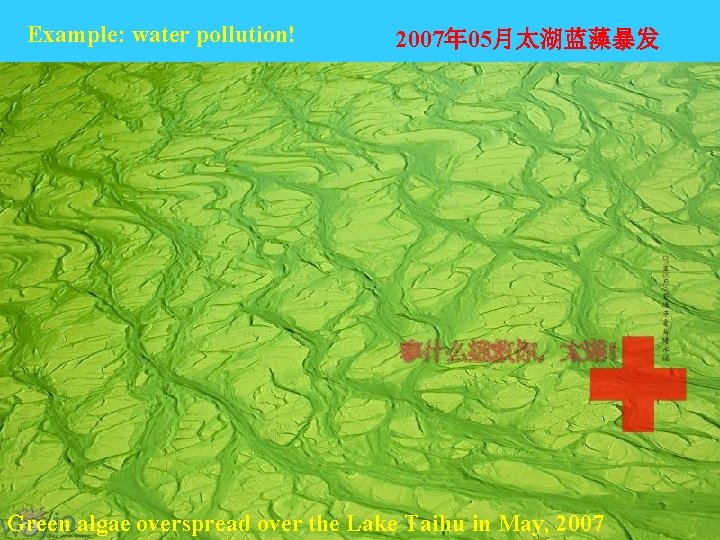
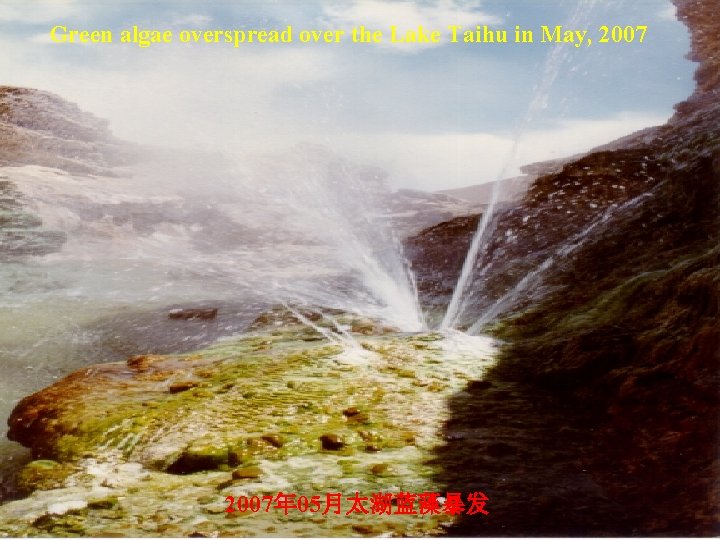
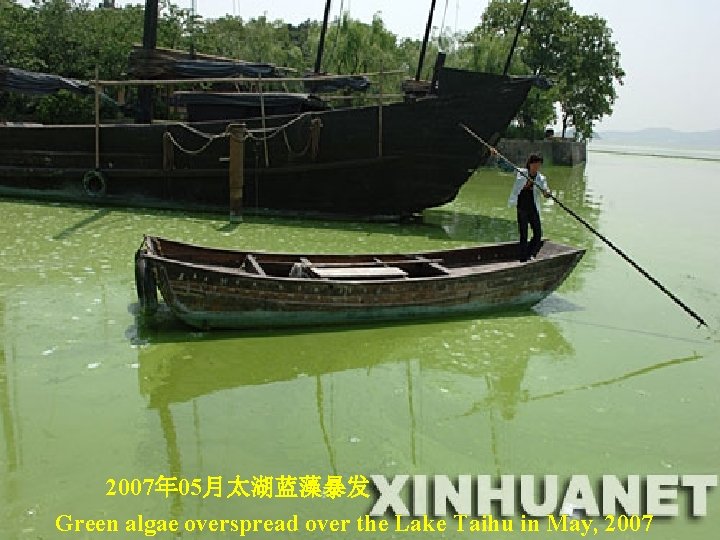
Example: water pollution! 2007年 05月太湖蓝藻暴发 Green algae overspread over the Lake Taihu in May, 2007
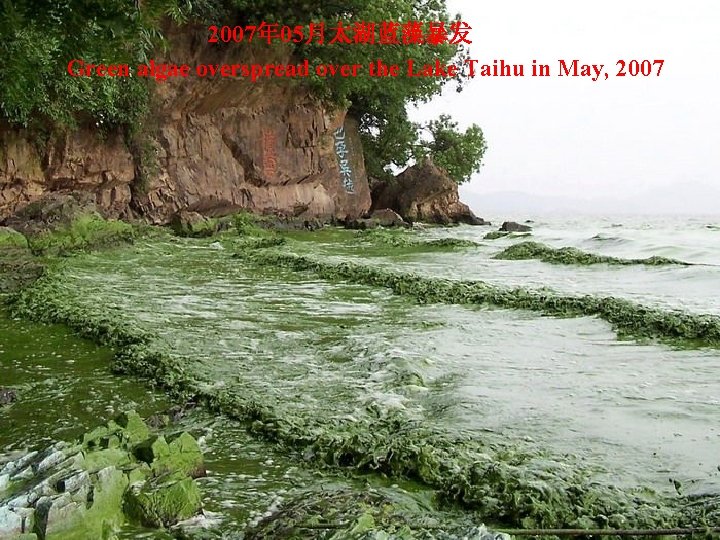
Green algae overspread over the Lake Taihu in May, 2007年 05月太湖蓝藻暴发
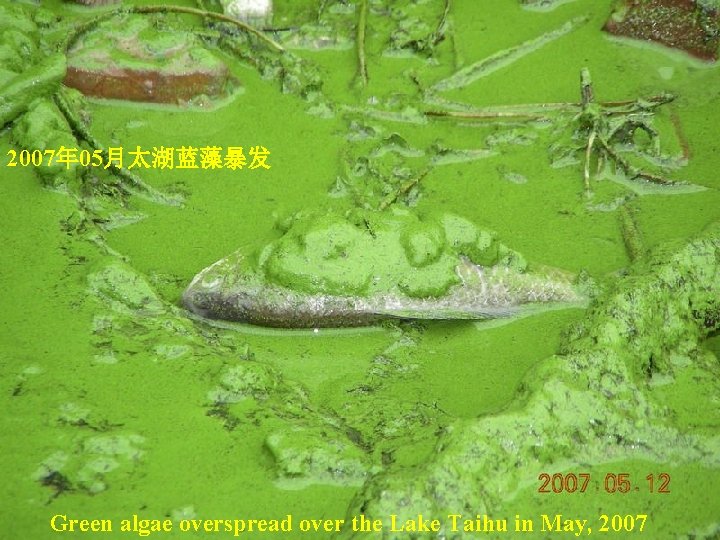
2007年 05月太湖蓝藻暴发 Green algae overspread over the Lake Taihu in May, 2007
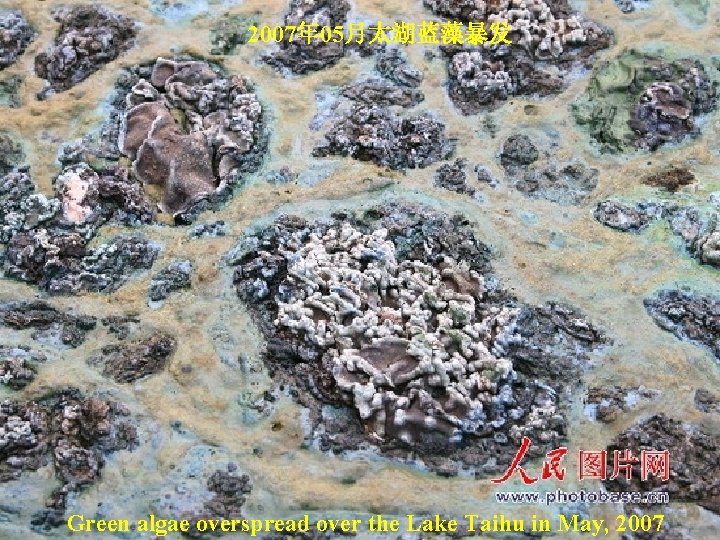
2007年 05月太湖蓝藻暴发 Green algae overspread over the Lake Taihu in May, 2007
2007年 05月太湖蓝藻暴发 Green algae overspread over the Lake Taihu in May, 2007
2007年 05月太湖蓝藻暴发 Green algae overspread over the Lake Taihu in May, 2007
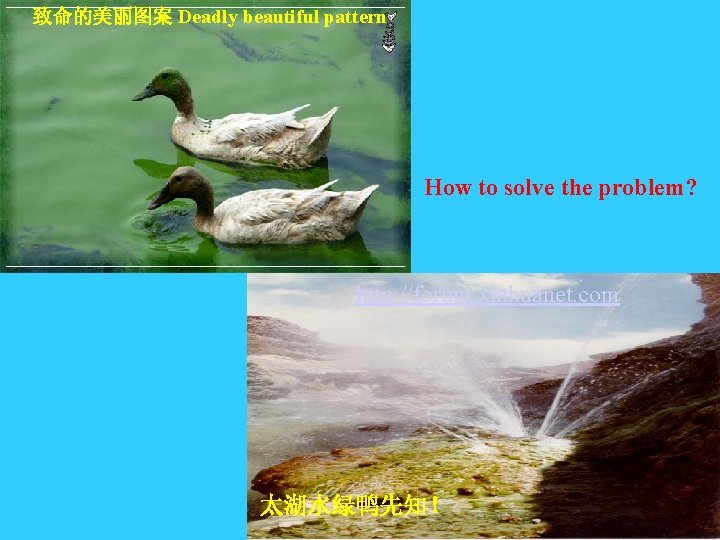
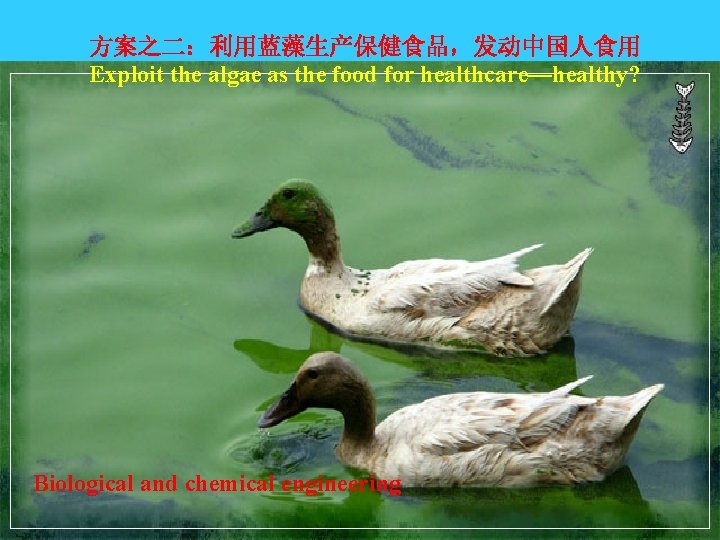
致命的美丽图案 Deadly beautiful pattern How to solve the problem? http: //forum. xinhuanet. com 太湖水绿鸭先知!
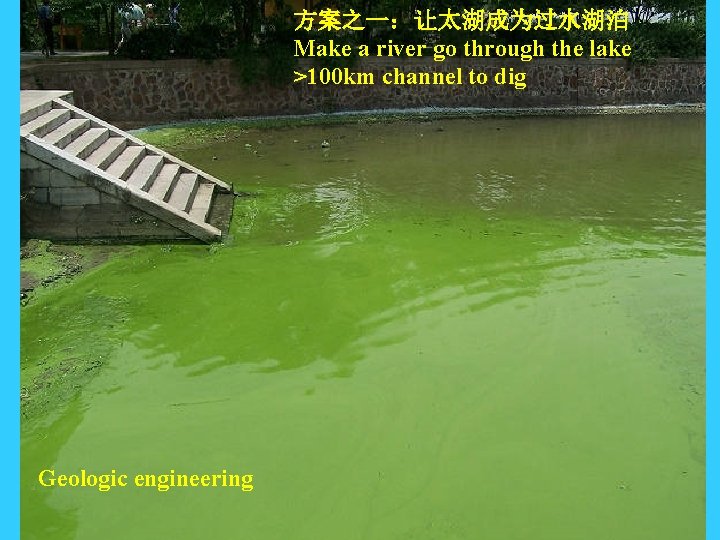
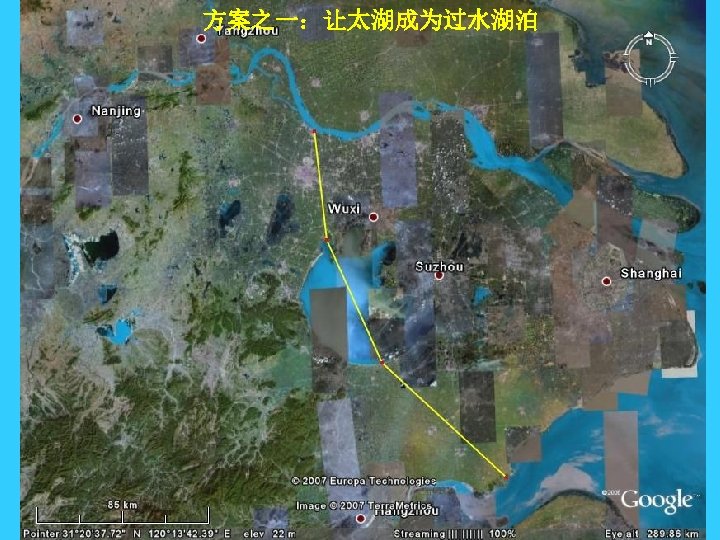
方案之一:让太湖成为过水湖泊 Make a river go through the lake >100 km channel to dig Geologic engineering
方案之二:利用蓝藻生产保健食品,发动中国人食用 Exploit the algae as the food for healthcare—healthy? Biological and chemical engineering
Firework factory explosion in Guangdong (2008. 02. 15)
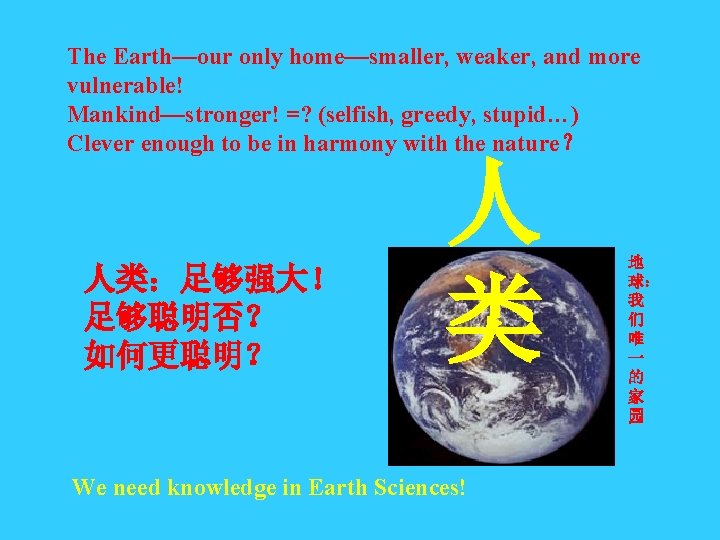
The Earth—our only home—smaller, weaker, and more vulnerable! Mankind—stronger! =? (selfish, greedy, stupid…) Clever enough to be in harmony with the nature? 人类:足够强大! 足够聪明否? 如何更聪明? 人 类 We need knowledge in Earth Sciences! 地 球: 我 们 唯 一 的 家 园
1. 1. 3 The method of geology (methodology)(地质学的研究 方法) The Earth was formed about 4. 6 billion (4, 600 million) years ago. It has been changed greatly (from the beginning) and is still changing. According to the result from the change, geologists want to know the events happened in the Earth’s history. This is very difficult. Like detectives and historians, geologists use the result to analyze its origin, or collect the relic or even traces to reveal the past events. Thus, geology is a special science, because: a. The world in which we live is the best laboratory. Either the scale of space and time needed for the experiments are too large, or the experiments would cause the environment to change in some unfortunate way. We must treat nature as the best laboratory and museum. (大自然是 地质学最好的实验室和博物馆:我们所知道的自然奥秘仅是微小的部 分,因此地质学是我们一生的学科,实践越多,知识就越多。 Geologists = fieldwork + laboratory + reasoning) b. Geologic theories strongly depend on the basic scientific disciplines of physics and chemistry, biology and others, depending on technology advances (progress). 对科技的依赖与促进(如:测年)
c. The principle of actualism. 现实主义原则、 将今论古原理 “The present is the key to the past. ” 现在是认识过去的钥匙 The doctrine is that: geologic processes and natural laws now operating to modify the Earth’s crust have acted in the same regular manner and with essentially the same intensity throughout geologic time, and that past geologic events can be explained by phenomena and forces observable today. The doctrine does not imply that any change has a uniform rate, and does not include minor local catastrophes. The doctrine is called Uniformitarianism(均变论), originated by C. Lyell (1797— 1875) in his book <The principles of Geology> in 1830. (大自然不是简单的重 复,而是演化的,人类可以从过去的历史中学到某些有用的东西,在 将今论古的同时,也要以古鉴今。如:动物演化问题) Geology is a young science (only 200 years). It was born under the demand of industry and military usage for raw materials in the 18 th century. So we have a lot to do in the future.
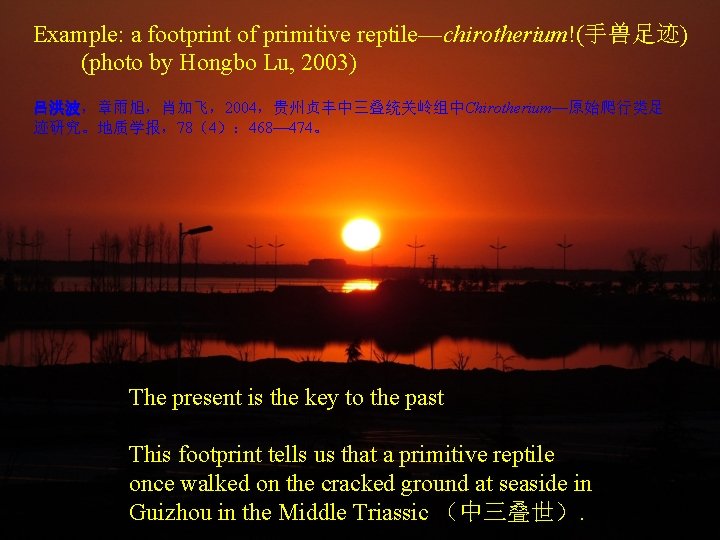
Example: a footprint of primitive reptile—chirotherium!(手兽足迹) (photo by Hongbo Lu, 2003) 吕洪波,章雨旭,肖加飞,2004,贵州贞丰中三叠统关岭组中Chirotherium—原始爬行类足 迹研究。地质学报,78(4): 468— 474。 The present is the key to the past This footprint tells us that a primitive reptile once walked on the cracked ground at seaside in Guizhou in the Middle Triassic (中三叠世).
A imagined primitive body of “Chirotherium” Downloaded from the Internet
+ The past is the sample to the present • • • 将今论古 + 以古鉴今 Evolution of dinosaurs: small to large Large to distinction Yao + Ye => taller basketball player! Mankind: short longer distinction!
1. 1. 4 Geologic process and its energy(地质作用及其能) Geologic process is any natural process that causes the change in composition, morphology and other aspects of the Earth. 地质作用包罗万象,大到火山喷发(内力),小到细菌繁殖、蚂蚁掘洞,当然 还有人类活动(外力)。 Geologic process can be divided into a. Endogenic geologic processes (internal processes) (内力地质作用): Mainly happen inside the solid Earth. Major Energy that drives the processes comes from the Earth’s internal heat. For example, volcanic eruption, earthquake, metamorphism are all endogenic processes. b. Exogenic geologic processes (external processes) (外力地质作用): Happen outside the solid Earth, mainly at the Earth’s surface. The main energy comes from the Sun’s heat. The examples are: weathering, erosion, transportation, sedimentation etc. There are some auxiliary energies(辅助能): gravity, rotation force, gravitation from the Sun and the Moon etc. (重力、自转力、日月引力等)
Key points for Chapter 1 本章要点 • • • Earth Sciences and some branches. (geology, geography, biology, and meteorology etc. ) Definition of geology. (Geo-, -logy) Objectives of geology. (Get something good, prevent something bad. Material, foreknowledge of danger, protect environment…) Methods of geology. (Nature—best laboratory, depending on basic scientific discipline, principle of actualism) Geologic process and its energy (any process, endogenic: inside the solid Earth, internal heat; exogenic: outside the solid Earth, Sun’s heat: Auxiliary energies: gravity, rotation force, and gravitation etc. )
Homework • Read the material in Chapter one and understand the new terms. • Translate the questions into Chinese and try to answer them in both English and Chinese.
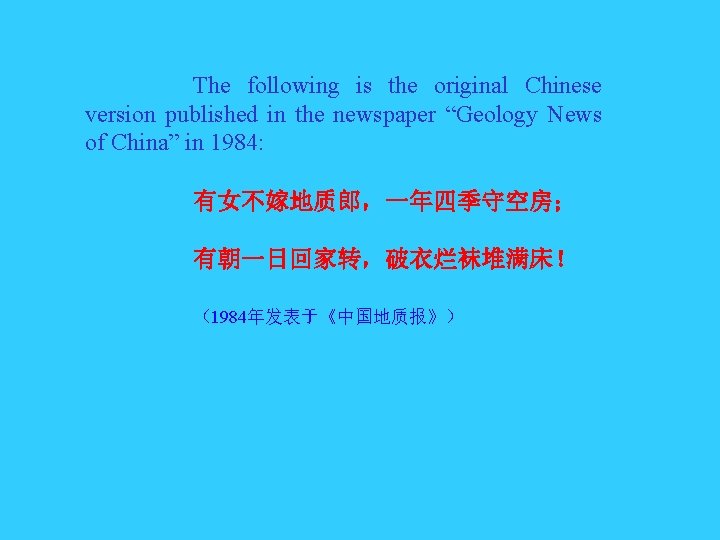
1. 2 The hardship and the pleasures of geologists (地质学家的苦与乐) My students, the prospective geologists, often ask me what hardship I have endured and what pleasure I have experienced. Different geologists have different answers, but as for me, I would rather say: the hardship is that I have to leave home to work in the field and the pleasure is that I can work in the field. Is this self-contradictory? No. A real geologist is always related to fieldwork. No fieldwork, no geologist. Only working in the field can a geologist really understand the secrets of nature! As geologists, we have to bear the extreme hardship and, at the same time, we can enjoy the special pleasure from mother nature. Here I would love to show you two examples related to geologists. There is a very sad poem published in 1984 in the newspaper to describe the geologists’ life of that time. If you have a daughter, Don’t marry her to a geologist; She will be lonely at home all the year round. When the husband comes back occasionally from the field, All belongings to her are the tattered clothes and dirty socks in the bed. (translated by Hongbo Lu)
The following is the original Chinese version published in the newspaper “Geology News of China” in 1984: 有女不嫁地质郎,一年四季守空房; 有朝一日回家转,破衣烂袜堆满床! (1984年发表于《中国地质报》)
Don’t worry! Don’t have to be so sad! As geologists, we have a lot of pleasures from nature!!! When you visit a place in a remote area where only a few people on Earth can reach, you are lucky to be the one among the few. When you are surrounded with the extraordinarily beautiful sceneries of nature, what would you think about? You will forget all the hardship you have endured in your life and be proud of yourself as a geologist. 强身健体,陶冶情操,激发灵感,感悟人生。 Geologists Scientists + artists + thinkers (scientist + vocalist + photographer + writer + philosopher + …)
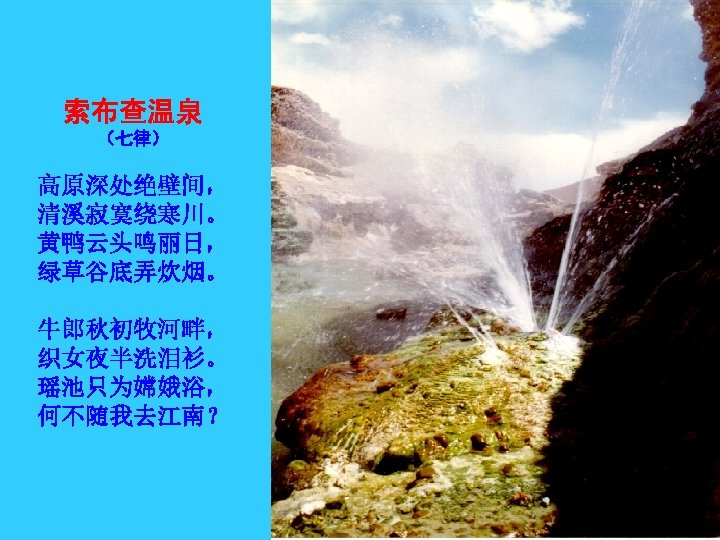
Talk to Suobucha Hot Spring In the remote paradise on the Tibetan Plateau, A clean stream is running quietly down the deep valley around the snow peaks. Who is singing under the sunshine? The yellow ducks flying over the white clouds! Who is cooking at the bottom and making the vapor rising over the banks? The grass with light-green blades enjoying the warmth of the immortal fountains… Who is lucky to come and see the beautiful scenery? Only Altair (Alpha—Shepherd Star) might graze here during early autumns. Who can use the resort? Only the Girl Weaver could wash her blouse stained with her endless tears at mid-night moments. Who built the fountains on the highest cold land of the Earth? The Gods! For whom did they make the abode? The Goddess from the Moon taking shower at the cloudy nights! I would dare to ask: “Are you lonely? ” “Yes. You must be!” “Are you tired of waiting for the goddess during the dark nights? ” “Yes. You must be!” Then why don’t you go with me to the southeast of the country, where you will not be lonely again and you can enjoy the cheering from serving the people…”
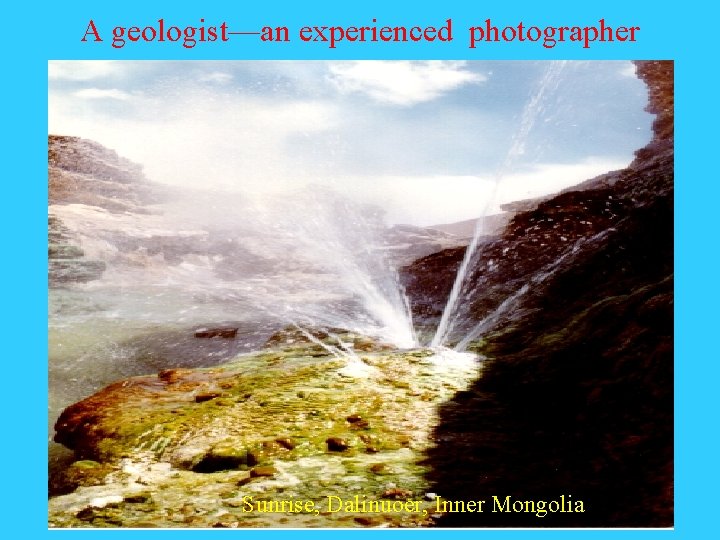
A geologist—an experienced photographer Sunrise, Dalinuoer, Inner Mongolia