
Course MapCheck for Understanding Refer to Handout 01
- Slides: 41
Course Map/Check for Understanding Refer to Handout #01 – Course Map/Checking for Understanding On the first page, review the learning targets from the Introductory Activities. In each box to the right, identify: 1. What I know and am able to do 2. What I still need to know and be able to do 3. What will help me get there
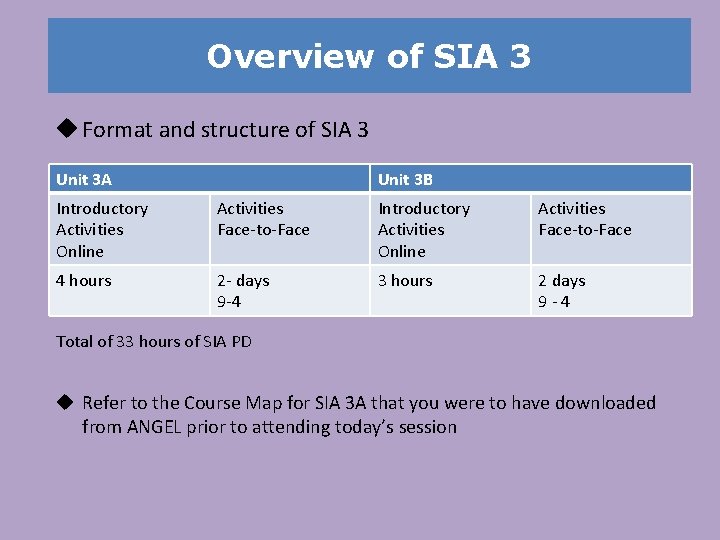
Overview of SIA 3 u Format and structure of SIA 3 Unit 3 A Unit 3 B Introductory Activities Online Activities Face-to-Face 4 hours 2 - days 9 -4 3 hours 2 days 9 - 4 Total of 33 hours of SIA PD u Refer to the Course Map for SIA 3 A that you were to have downloaded from ANGEL prior to attending today’s session
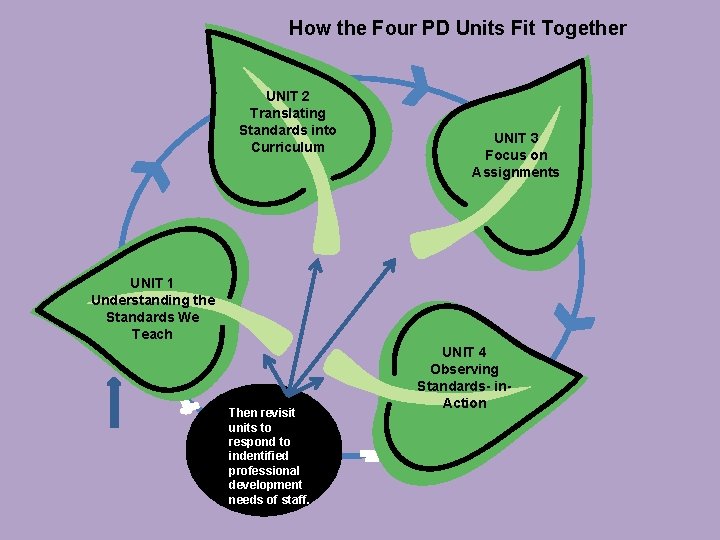
How the Four PD Units Fit Together UNIT 2 Translating Standards into Curriculum UNIT 3 Focus on Assignments UNIT 1 Understanding the Standards We Teach Then revisit units to respond to indentified professional development needs of staff. UNIT 4 Observing Standards- in. Action
Give One, Get One • Take a ½ sheet of card stock or one 5 X 7 blank card from the center of the table. • On the card or paper, write a response to the question prompt, ‘Identify one return on investment in creating units of instruction. ’ • Meet with as many other participants as you can in five minutes and exchange and gather ideas. • Write down as many ideas from other participants on your card as you can in the five minutes.
Evidence and Arguments In the middle of the table is an envelope that is titled “’Evidence and Arguments’ Video Questions. ” In the envelope are laminated strips of paper with a question. Choose a question. As you view the video, look for the answer to your question. https: //www. teachingchannel. org/videos/literacy-analysis-lesson
Creating Coherent Units of Instruction Refer to HO #03 – Creating Coherent Units of Instruction – 8 Steps and HO #04 – Unit of Instruction- ELA Example for Modeling 1. Place lead standard in the first column. 2. Identify connecting standards that support and reinforce the teaching and learning of that lead standard and place these in the second column. These should form a cluster of standards consisting of a lead standard and connecting standards. 3. Provide a rationale for the cluster—reasons why the standards connect and support one another—and place in third column. 4. Determine whether or not to build another cluster of standards—lead standard and connecting standards—to complete the unit.
Creating Coherent Units of Instruction 5. Give the unit a name that summarizes its direction and intent, to provide a quick sense of the unit’s broader objective or instructional goal. 6. Determine an approximate timeframe for the unit (e. g. , number of class periods needed to complete it). 7. Identify where (e. g. , chapters and page numbers) in the primary textbook or other resources an instructor can find content for the unit and place in the fourth column. Review your program’s completed chart for Aligning Resources to Standards. 8. Offer an idea or two about how the standards might come to life within a meaningful task or assignment in the fifth column. Consult the sample activities developed during Unpacking the Components of Standards to find those that are a good match or could be a good match with some refinement.
Creating Coherent Units of Instruction • Refer to HO #05 – Unit of Instruction – Math Example for Revision • With your group or with a partner, review the mathematics unit and identify strengths and areas of improvement
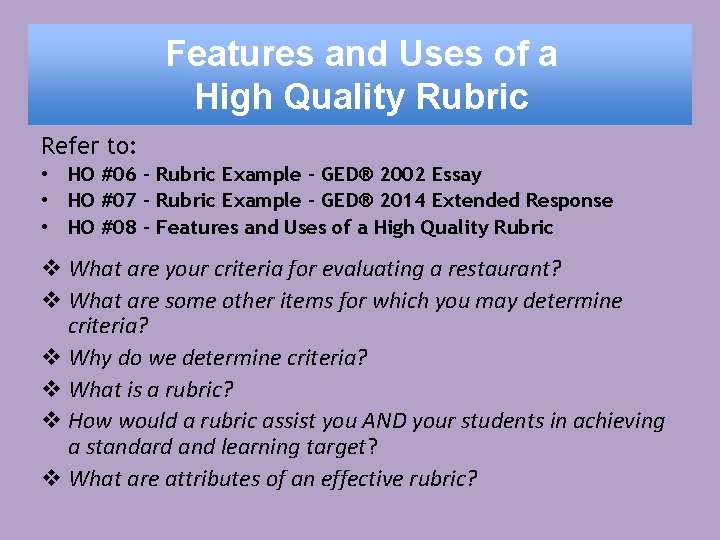
Features and Uses of a High Quality Rubric Refer to: • HO #06 – Rubric Example – GED® 2002 Essay • HO #07 – Rubric Example – GED® 2014 Extended Response • HO #08 – Features and Uses of a High Quality Rubric v What are your criteria for evaluating a restaurant? v What are some other items for which you may determine criteria? v Why do we determine criteria? v What is a rubric? v How would a rubric assist you AND your students in achieving a standard and learning target? v What are attributes of an effective rubric?
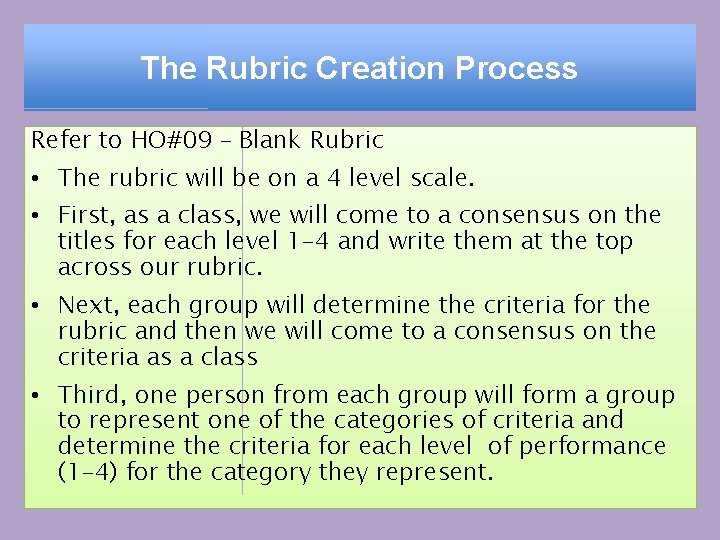
The Rubric Creation Process Refer to HO#09 – Blank Rubric • The rubric will be on a 4 level scale. • First, as a class, we will come to a consensus on the titles for each level 1 -4 and write them at the top across our rubric. • Next, each group will determine the criteria for the rubric and then we will come to a consensus on the criteria as a class • Third, one person from each group will form a group to represent one of the categories of criteria and determine the criteria for each level of performance (1 -4) for the category they represent.
The Rubric Creation Process • In your groups, determine the headings or titles for the levels of criteria for your rubric • Refer to HO #06 – Rubric Example – GED® 2002 Essay as an example, however, feel free to be creative.
Instructions for Determining Category of Criteria Titles • Brainstorm four category titles • Write the titles on flipchart paper on the wall • After each group has posted their flipcharts, each person will vote on the four titles they like best using the dots on the tables
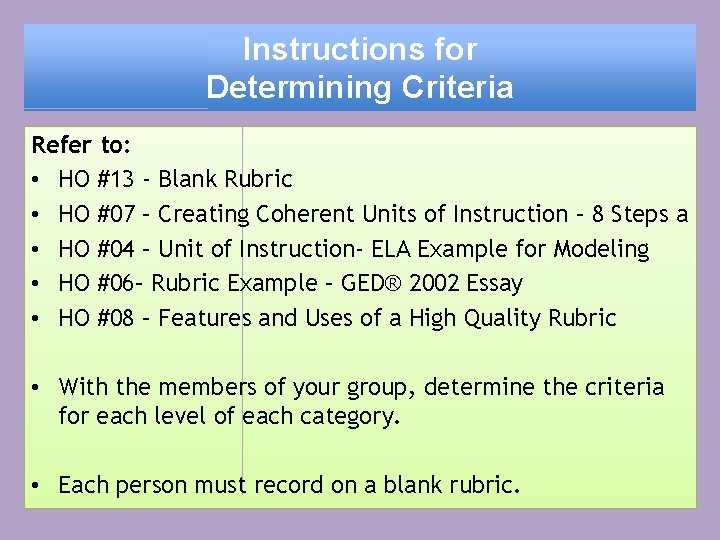
Instructions for Determining Criteria Refer to: • HO #13 - Blank Rubric • HO #07 – Creating Coherent Units of Instruction – 8 Steps a • HO #04 – Unit of Instruction- ELA Example for Modeling • HO #06– Rubric Example – GED® 2002 Essay • HO #08 – Features and Uses of a High Quality Rubric • With the members of your group, determine the criteria for each level of each category. • Each person must record on a blank rubric.
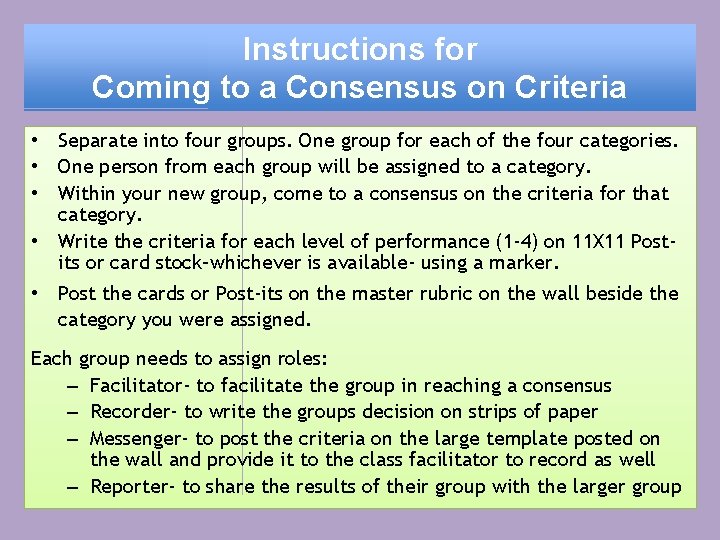
Instructions for Coming to a Consensus on Criteria • Separate into four groups. One group for each of the four categories. • One person from each group will be assigned to a category. • Within your new group, come to a consensus on the criteria for that category. • Write the criteria for each level of performance (1 -4) on 11 X 11 Postits or card stock–whichever is available- using a marker. • Post the cards or Post-its on the master rubric on the wall beside the category you were assigned. Each group needs to assign roles: – Facilitator- to facilitate the group in reaching a consensus – Recorder- to write the groups decision on strips of paper – Messenger- to post the criteria on the large template posted on the wall and provide it to the class facilitator to record as well – Reporter- to share the results of their group with the larger group
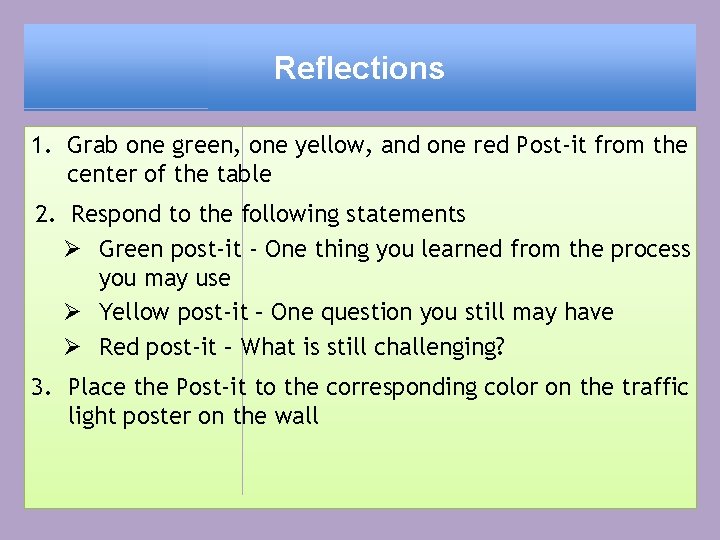
Reflections 1. Grab one green, one yellow, and one red Post-it from the center of the table 2. Respond to the following statements Ø Green post-it - One thing you learned from the process you may use Ø Yellow post-it – One question you still may have Ø Red post-it – What is still challenging? 3. Place the Post-it to the corresponding color on the traffic light poster on the wall
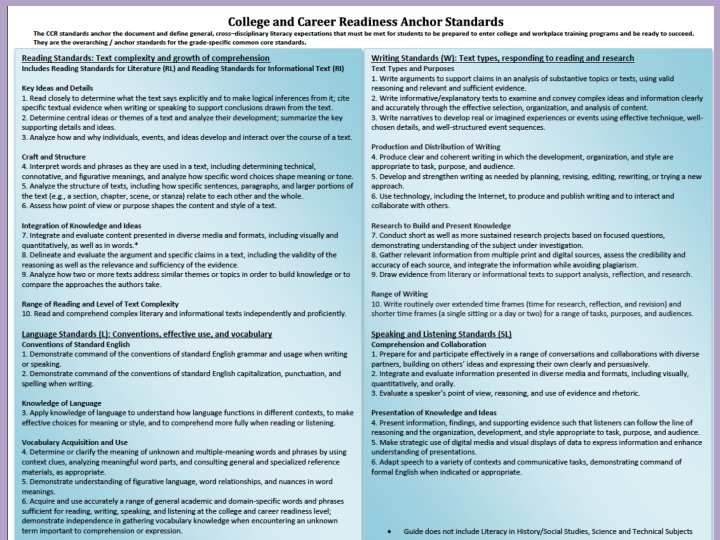
From Common Core State Standards to College and Career Readiness Standards for Adult Education College and Career Readiness Standards for ELA and Math do not replace the KYAE Common Core State Standards. What content of the Common Core State Standards is most relevant to adult education students? Which standards will provide adult students with the critical knowledge and skills necessary for success in college, technical training programs, and employment in the 21 st century?
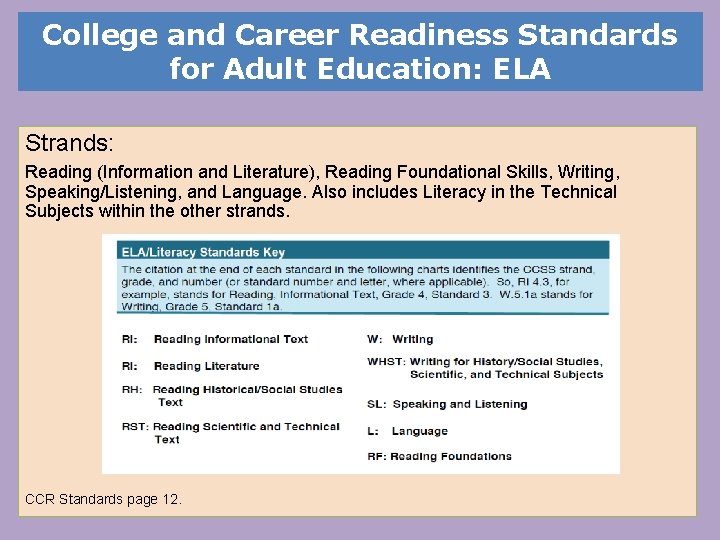
College and Career Readiness Standards for Adult Education: ELA Strands: Reading (Information and Literature), Reading Foundational Skills, Writing, Speaking/Listening, and Language. Also includes Literacy in the Technical Subjects within the other strands. CCR Standards page 12.
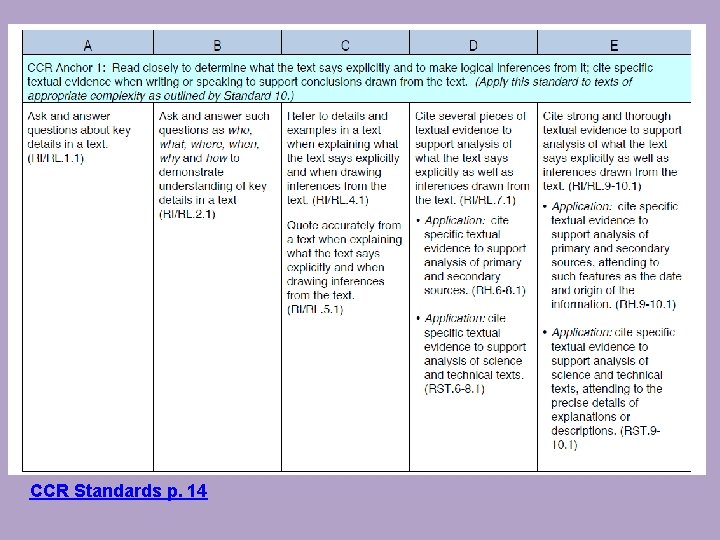
CCR Standards p. 14
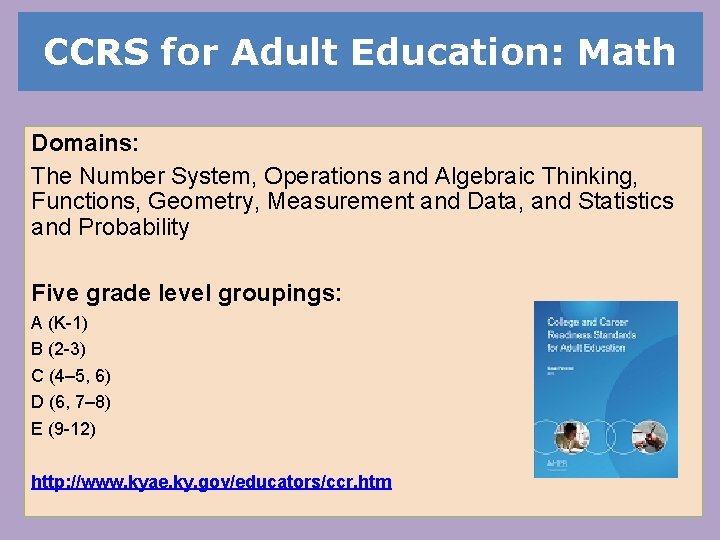
CCRS for Adult Education: Math Domains: The Number System, Operations and Algebraic Thinking, Functions, Geometry, Measurement and Data, and Statistics and Probability Five grade level groupings: A (K-1) B (2 -3) C (4– 5, 6) D (6, 7– 8) E (9 -12) http: //www. kyae. ky. gov/educators/ccr. htm
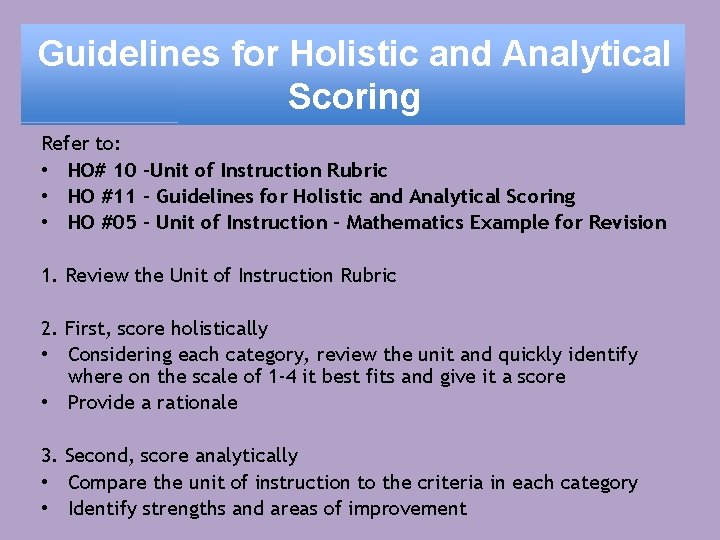
Guidelines for Holistic and Analytical Scoring Refer to: • HO# 10 –Unit of Instruction Rubric • HO #11 – Guidelines for Holistic and Analytical Scoring • HO #05 – Unit of Instruction – Mathematics Example for Revision 1. Review the Unit of Instruction Rubric 2. First, score holistically • Considering each category, review the unit and quickly identify where on the scale of 1 -4 it best fits and give it a score • Provide a rationale 3. Second, score analytically • Compare the unit of instruction to the criteria in each category • Identify strengths and areas of improvement
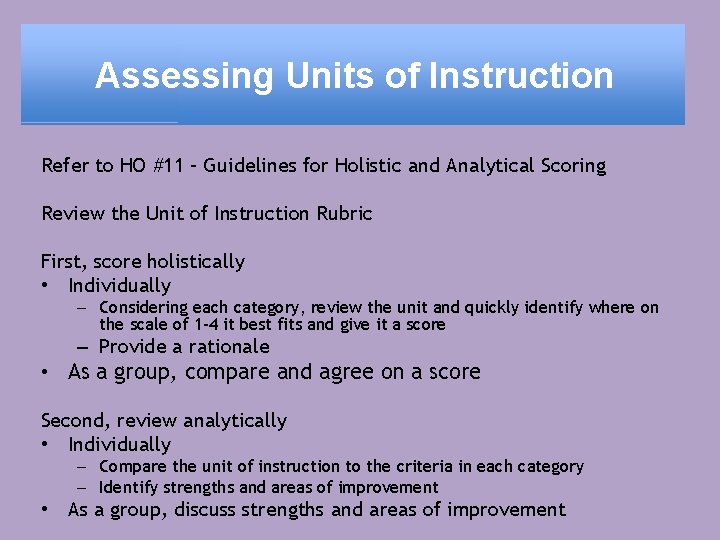
Assessing Units of Instruction Refer to HO #11 – Guidelines for Holistic and Analytical Scoring Review the Unit of Instruction Rubric First, score holistically • Individually – Considering each category, review the unit and quickly identify where on the scale of 1 -4 it best fits and give it a score – Provide a rationale • As a group, compare and agree on a score Second, review analytically • Individually – Compare the unit of instruction to the criteria in each category – Identify strengths and areas of improvement • As a group, discuss strengths and areas of improvement
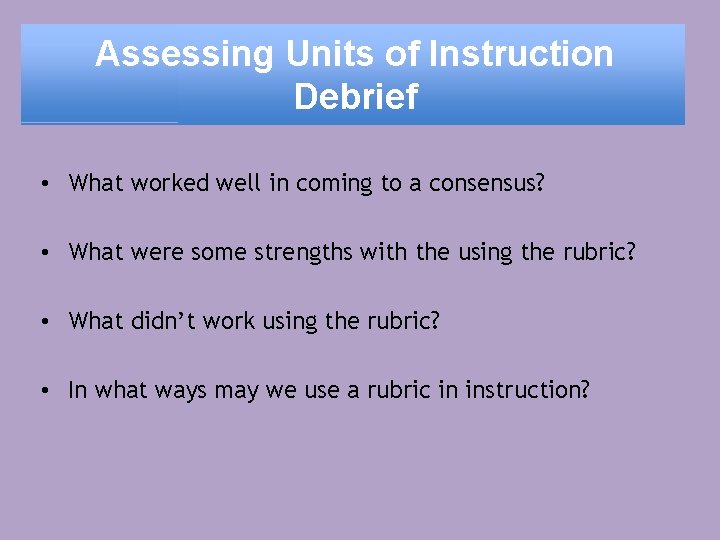
Assessing Units of Instruction Debrief • What worked well in coming to a consensus? • What were some strengths with the using the rubric? • What didn’t work using the rubric? • In what ways may we use a rubric in instruction?
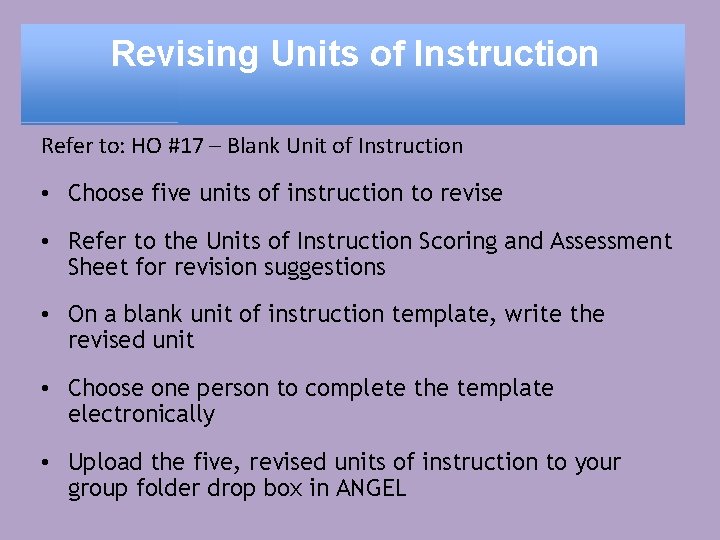
Revising Units of Instruction Refer to: HO #17 – Blank Unit of Instruction • Choose five units of instruction to revise • Refer to the Units of Instruction Scoring and Assessment Sheet for revision suggestions • On a blank unit of instruction template, write the revised unit • Choose one person to complete the template electronically • Upload the five, revised units of instruction to your group folder drop box in ANGEL
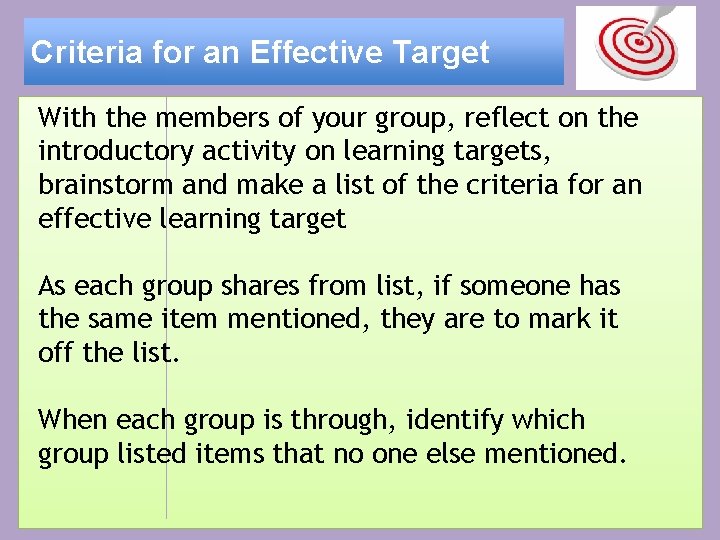
Criteria for an Effective Target With the members of your group, reflect on the introductory activity on learning targets, brainstorm and make a list of the criteria for an effective learning target As each group shares from list, if someone has the same item mentioned, they are to mark it off the list. When each group is through, identify which group listed items that no one else mentioned.
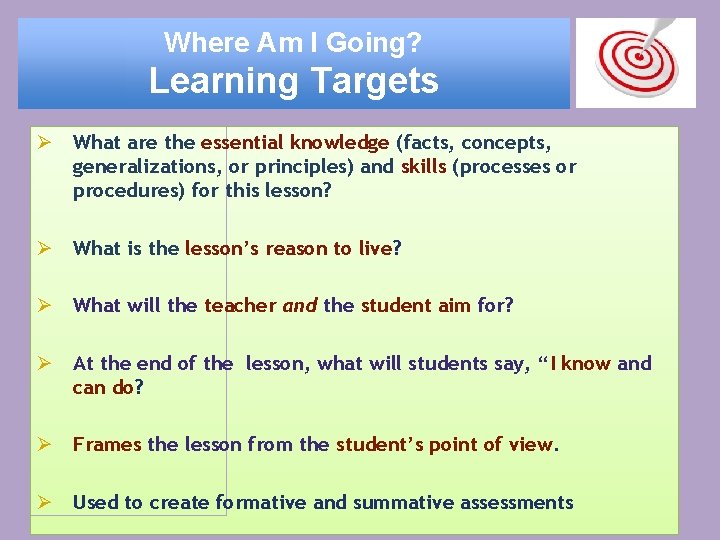
Where Am I Going? Learning Targets Ø What are the essential knowledge (facts, concepts, generalizations, or principles) and skills (processes or procedures) for this lesson? Ø What is the lesson’s reason to live? Ø What will the teacher and the student aim for? Ø At the end of the lesson, what will students say, “I know and can do? Ø Frames the lesson from the student’s point of view. Ø Used to create formative and summative assessments
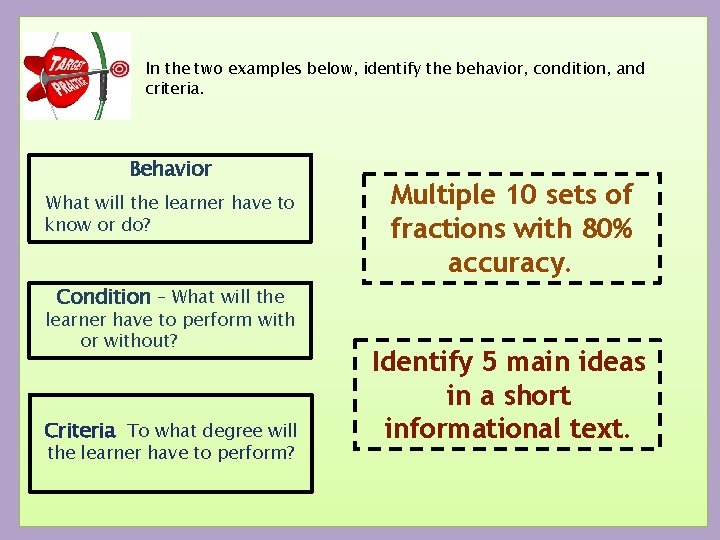
In the two examples below, identify the behavior, condition, and criteria. Behavior What will the learner have to know or do? Multiple 10 sets of fractions with 80% accuracy. Condition – What will the learner have to perform with or without? Criteria To what degree will the learner have to perform? Identify 5 main ideas in a short informational text.
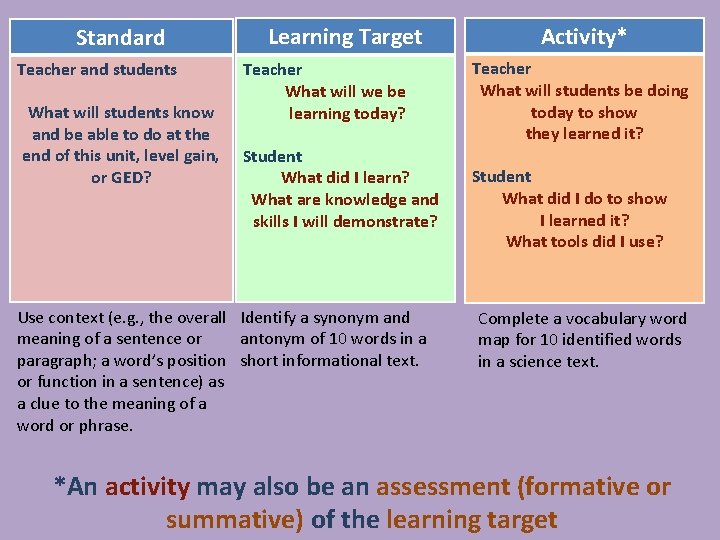
Standard Teacher and students What will students know and be able to do at the end of this unit, level gain, or GED? Learning Target Teacher What will we be learning today? Student What did I learn? What are knowledge and skills I will demonstrate? Use context (e. g. , the overall Identify a synonym and meaning of a sentence or antonym of 10 words in a paragraph; a word’s position short informational text. or function in a sentence) as a clue to the meaning of a word or phrase. Activity* Teacher What will students be doing today to show they learned it? Student What did I do to show I learned it? What tools did I use? Complete a vocabulary word map for 10 identified words in a science text. *An activity may also be an assessment (formative or summative) of the learning target
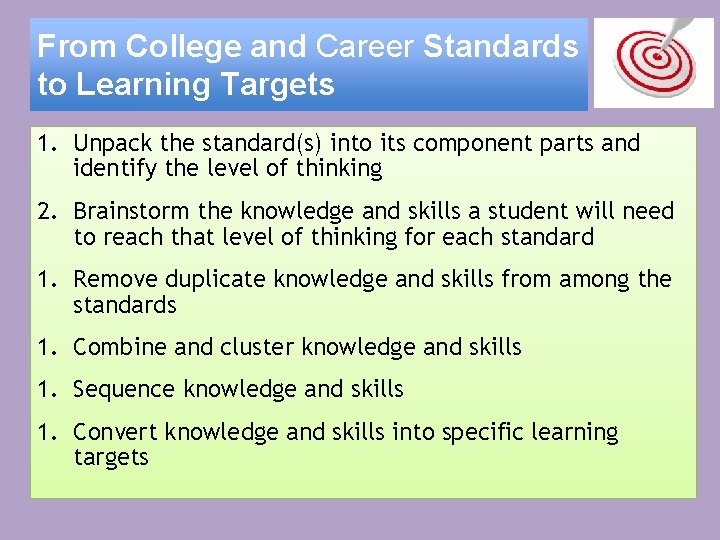
From College and Career Standards to Learning Targets 1. Unpack the standard(s) into its component parts and identify the level of thinking 2. Brainstorm the knowledge and skills a student will need to reach that level of thinking for each standard 1. Remove duplicate knowledge and skills from among the standards 1. Combine and cluster knowledge and skills 1. Sequence knowledge and skills 1. Convert knowledge and skills into specific learning targets
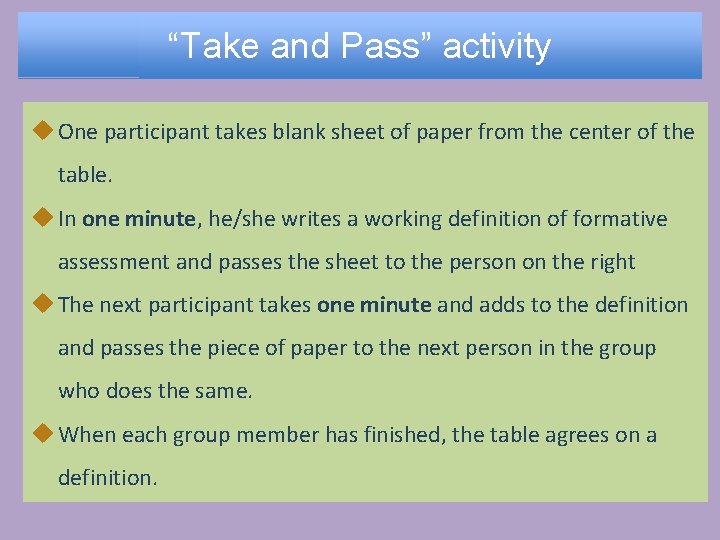
“Take and Pass” activity u One participant takes blank sheet of paper from the center of the table. u In one minute, he/she writes a working definition of formative assessment and passes the sheet to the person on the right u The next participant takes one minute and adds to the definition and passes the piece of paper to the next person in the group who does the same. u When each group member has finished, the table agrees on a definition.
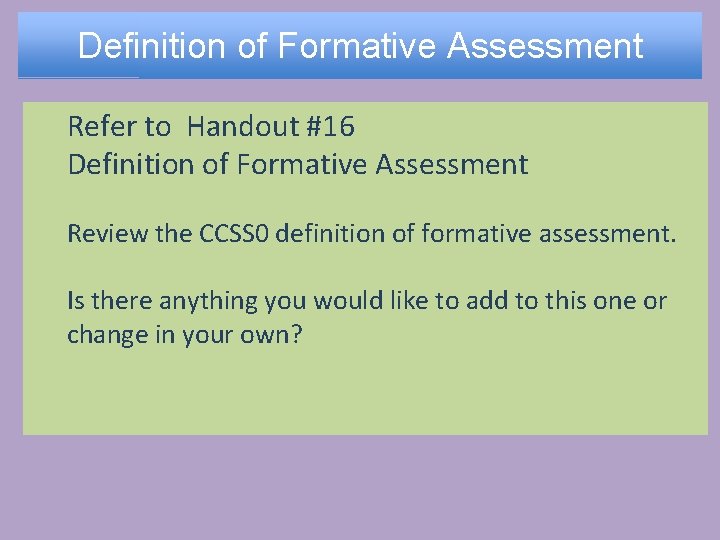
Definition of Formative Assessment Refer to Handout #16 Definition of Formative Assessment Review the CCSS 0 definition of formative assessment. Is there anything you would like to add to this one or change in your own?
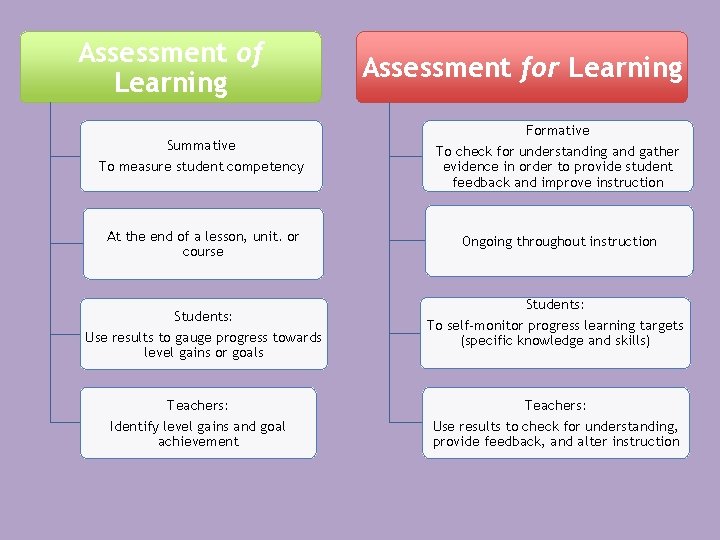
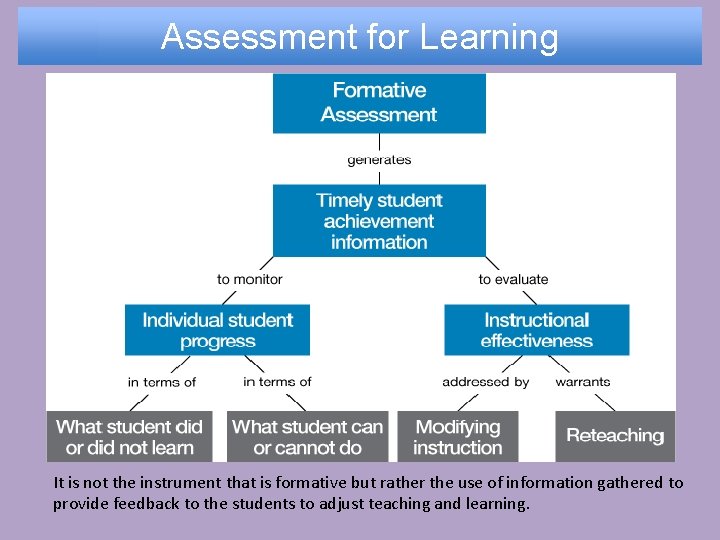
Assessment of Learning Assessment for Learning Formative Summative To measure student competency To check for understanding and gather evidence in order to provide student feedback and improve instruction At the end of a lesson, unit. or course Ongoing throughout instruction Students: Use results to gauge progress towards level gains or goals Teachers: Identify level gains and goal achievement Students: To self-monitor progress learning targets (specific knowledge and skills) Teachers: Use results to check for understanding, provide feedback, and alter instruction
Assessment for Learning Assessment of Learning It is not the instrument that is formative but rather the use of information gathered to provide feedback to the students to adjust teaching and learning.
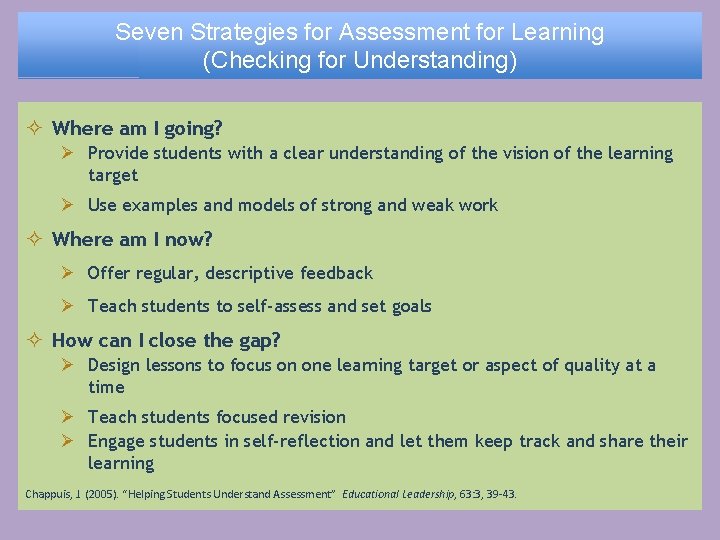
Seven Strategies for Assessment for Learning (Checking for Understanding) ² Where am I going? Ø Provide students with a clear understanding of the vision of the learning target Ø Use examples and models of strong and weak work ² Where am I now? Ø Offer regular, descriptive feedback Ø Teach students to self-assess and set goals ² How can I close the gap? Ø Design lessons to focus on one learning target or aspect of quality at a time Ø Teach students focused revision Ø Engage students in self-reflection and let them keep track and share their learning Chappuis, J. (2005). “Helping Students Understand Assessment” Educational Leadership, 63: 3, 39 -43.
Refer back to the introductory activity blog question. What are some activities you are all ready doing in the classroom to check for understanding? Share with the participants at your table.
What are a few benefits and challenges in checking for understanding throughout a lesson?
Checking for Understanding in an ELA Lesson • Refer to HO #17 ELA Lesson Plan Resources • Please close binders and do not refer to any other handouts • You will be participating in the lesson as a student
Checking for Understanding in an ELA Lesson • Refer to HO #18 - ELA Lesson Plan – Comparing and Contrasting • Refer to HO #19 – Engagement/Instructional/Checking for Understanding Activities With a partner, review the ELA Lesson that was taught and determine at least 2 other ways to check for understanding in the lesson. • Use HO#19 if necessary. Is there anything you may do differently to teach the lesson?
My Favorite No: Learning From Mistakes As you view the video, ask and answer: • What was the formative assessment strategy used? • How did the teacher use the evidence from the assessment? https: //www. teachingchannel. org/videos/class-warm-up-routine
Checking for Understanding in My Lesson • Your target for this session was to identify at least two ways to check for understanding in a lesson. • Take ½ sheet of paper from the center of the table. • In one paragraph, briefly describe a lesson that you teach. • In one paragraph, briefly describe two ways you will check for understanding in that lesson. • You may refer back to HO #19 – Engagement/Instructional/Checking for Understanding Activities
Exit Slip Take a ½ sheet of card stock or 5 X 7 card stock from the center of the table Create a one minute paper to describe: 1. One thing you will start doing 2. One thing you will stop doing 3. One thing you will continue to do OR Return to HO #01 – Course Map/Checking for Understanding and complete the Reflection column for Day Two