
Course Management Systems Past Present a Future Scott

- Slides: 38
Course Management Systems: Past, Present a Future Scott Leslie May 11, 2005
Goals for the Presentation n Discuss the state of CMS from the perspective of maximizing flexibility while preserving/increasing quality and services (and at least maintaining costs)
Outline n History/Context n Enterprise and ‘Standalone’ CMS n Service Oriented Architectures & the ELearning Framework n Sakai, Open Source n Other Alternatives
BUT FIRST… What do I mean when I use the term “Enterprise”
Enterprise Systems…. ¨ too often has meant “large monolithic systems” ¨ should mean “systems that are core to your business” ¨ in CMS world, is under pressure to transform Enterprise Services…. ¨ system level services which provide a coherent level of functionality across all applications and tie in with core administrative systems Enterprise Service….
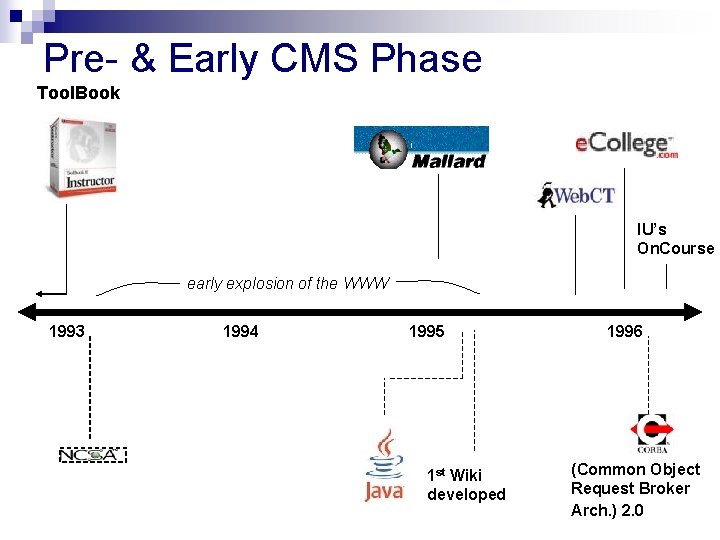
Pre- & Early CMS Phase Tool. Book IU’s On. Course early explosion of the WWW 1993 1994 1995 1 st Wiki developed 1996 (Common Object Request Broker Arch. ) 2. 0
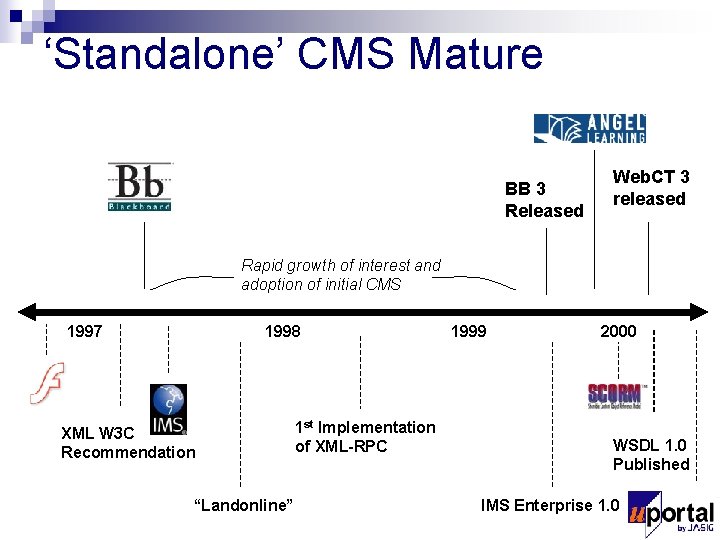
‘Standalone’ CMS Mature BB 3 Released Web. CT 3 released Rapid growth of interest and adoption of initial CMS 1997 1998 XML W 3 C Recommendation “Landonline” 1 st Implementation of XML-RPC 1999 2000 WSDL 1. 0 Published IMS Enterprise 1. 0
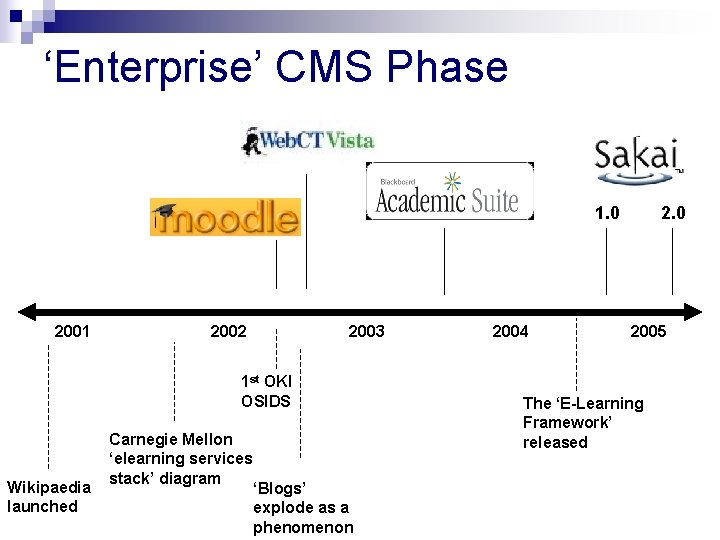
‘Enterprise’ CMS Phase 1. 0 2001 2002 2003 1 st OKI OSIDS Wikipaedia launched Carnegie Mellon ‘elearning services stack’ diagram ‘Blogs’ explode as a phenomenon 2004 2. 0 2005 The ‘E-Learning Framework’ released
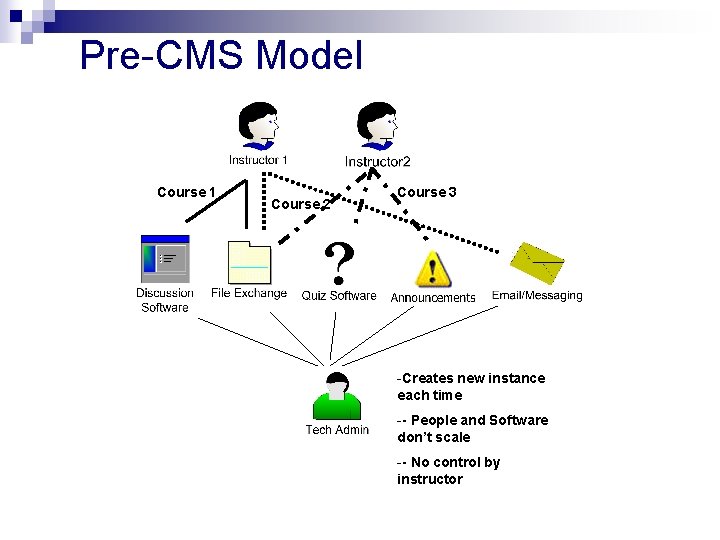
Pre-CMS Model Course 1 Course 2 Course 3 -Creates new instance each time -- People and Software don’t scale -- No control by instructor
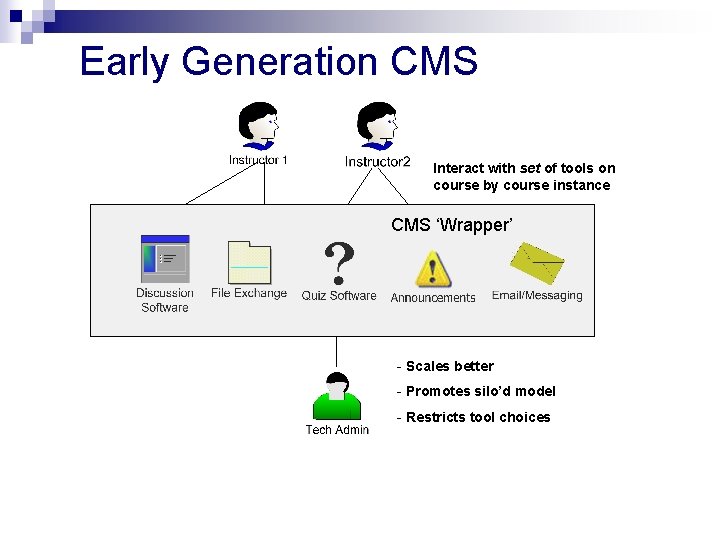
Early Generation CMS Interact with set of tools on course by course instance CMS ‘Wrapper’ - Scales better - Promotes silo’d model - Restricts tool choices
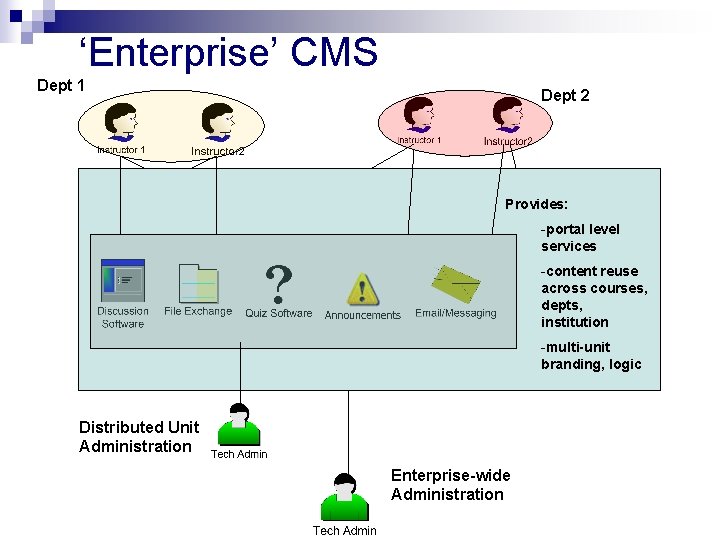
‘Enterprise’ CMS Dept 1 Dept 2 Provides: -portal level services -content reuse across courses, depts, institution -multi-unit branding, logic Distributed Unit Administration Enterprise-wide Administration
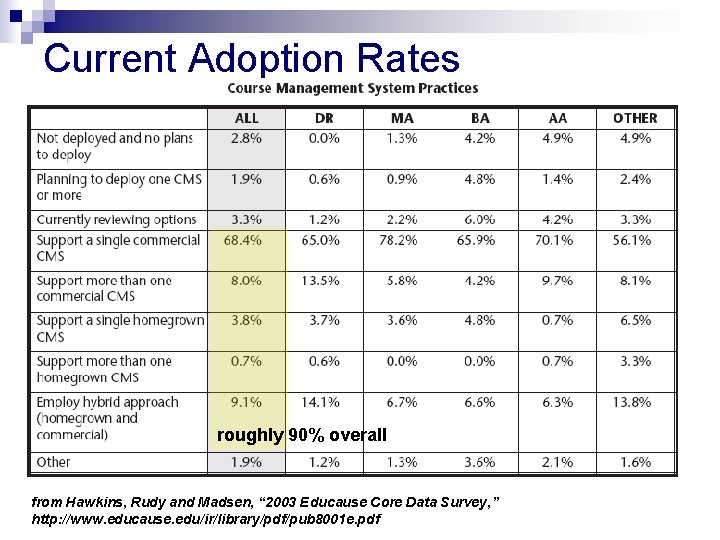
Current Adoption Rates roughly 90% overall from Hawkins, Rudy and Madsen, “ 2003 Educause Core Data Survey, ” http: //www. educause. edu/ir/library/pdf/pub 8001 e. pdf
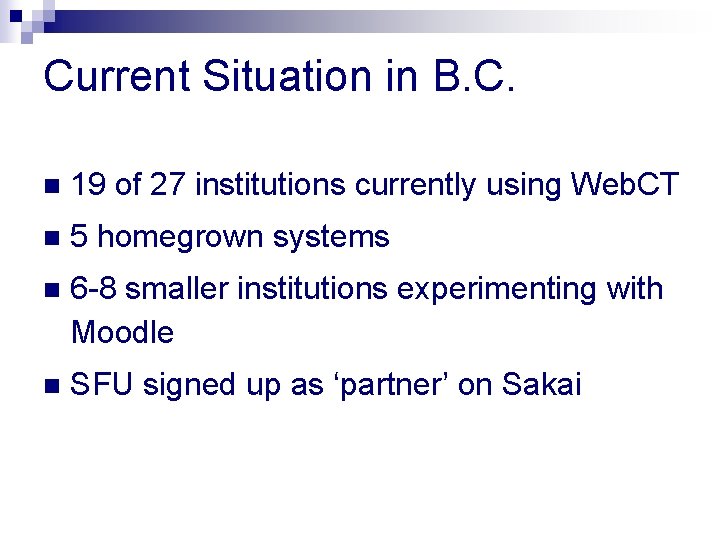
Current Situation in B. C. n 19 of 27 institutions currently using Web. CT n 5 homegrown systems n 6 -8 smaller institutions experimenting with Moodle n SFU signed up as ‘partner’ on Sakai
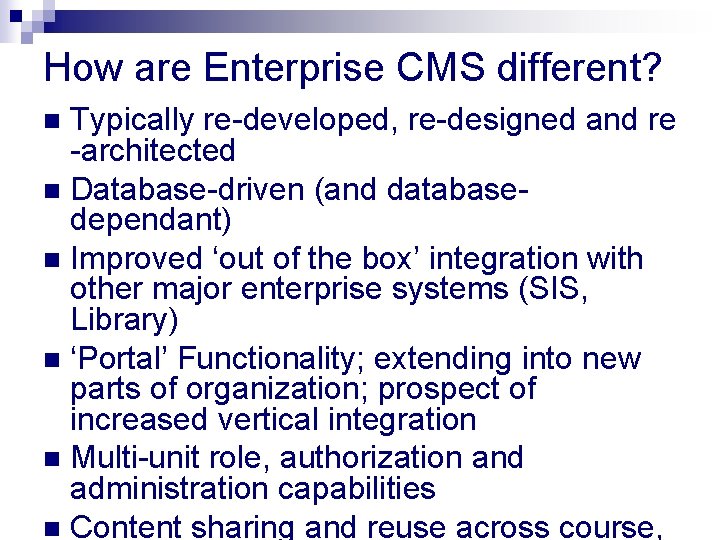
How are Enterprise CMS different? Typically re-developed, re-designed and re -architected n Database-driven (and databasedependant) n Improved ‘out of the box’ integration with other major enterprise systems (SIS, Library) n ‘Portal’ Functionality; extending into new parts of organization; prospect of increased vertical integration n Multi-unit role, authorization and administration capabilities n Content sharing and reuse across course, n
BUT…
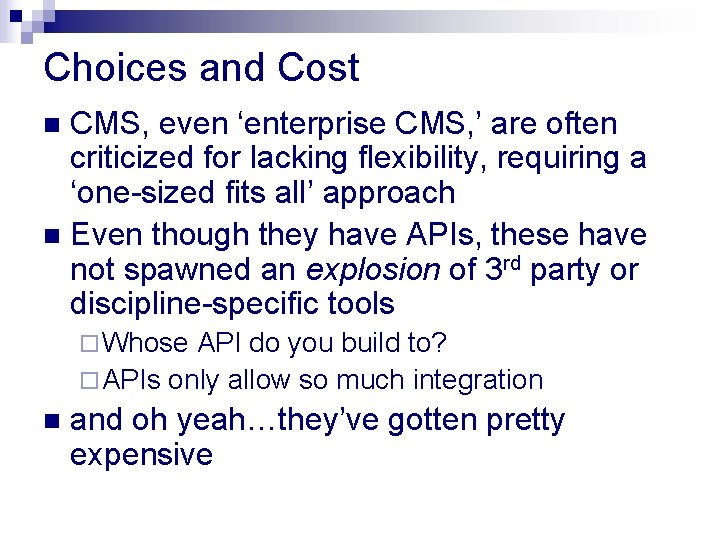
Choices and Cost CMS, even ‘enterprise CMS, ’ are often criticized for lacking flexibility, requiring a ‘one-sized fits all’ approach n Even though they have APIs, these have not spawned an explosion of 3 rd party or discipline-specific tools n ¨ Whose API do you build to? ¨ APIs only allow so much integration n and oh yeah…they’ve gotten pretty expensive
Service-oriented architecture (SOA) definition “A service-oriented architecture is essentially a collection of services. These services communicate with each other. The communication can involve either simple data passing or it could involve two or more services coordinating some activity. Some means of connecting services to each other is needed. “Service-oriented architectures are not a new thing. The first service-oriented architecture for many people in the past was with the use DCOM or Object Request Brokers (ORBs) based on the CORBA [Common Object Request Broker: Architecture] specification. ” from “Web Services and Service-Oriented Architectures, ” http: //www. servicearchitecture. com/web-services/articles/serviceoriented_architecture_soa_definition. html
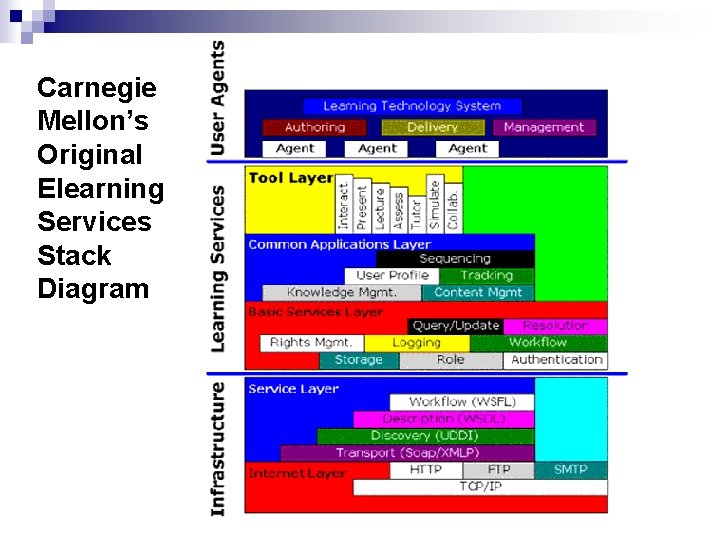
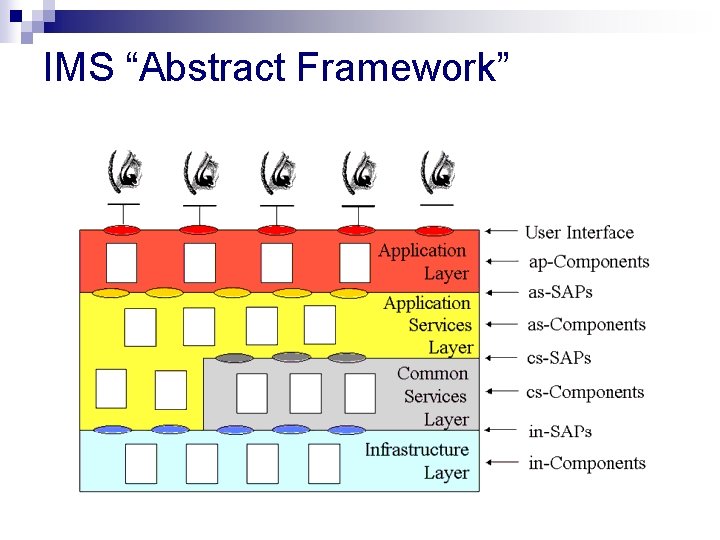
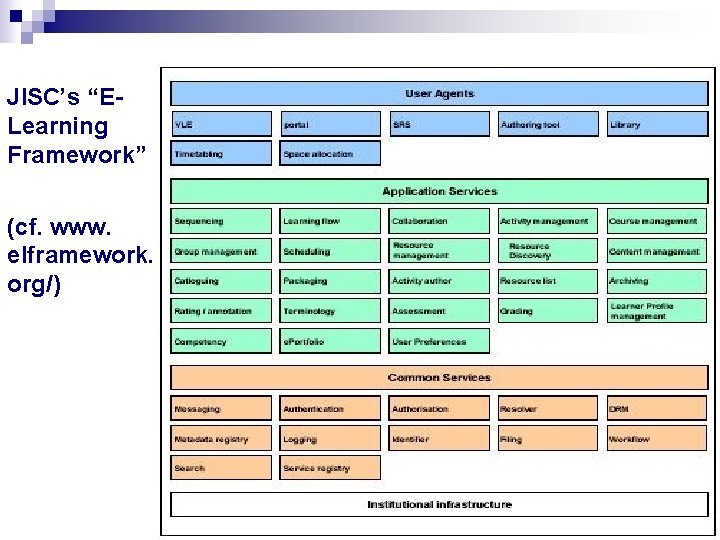
E-learning frameworks n Emerging high level frameworks that outline ‘services’ needed to provide comprehensive e-learning architecture (larger than just CMS) Early instances found in Carnegie Mellon’s ‘E-learning Stack” n Evolved into n ¨ IMS Abstract Framework which inspired ¨ JISC/Industry Canada E-learning Framework (ELF)
Carnegie Mellon’s Original Elearning Services Stack Diagram
IMS “Abstract Framework”
JISC’s “ELearning Framework” (cf. www. elframework. org/)
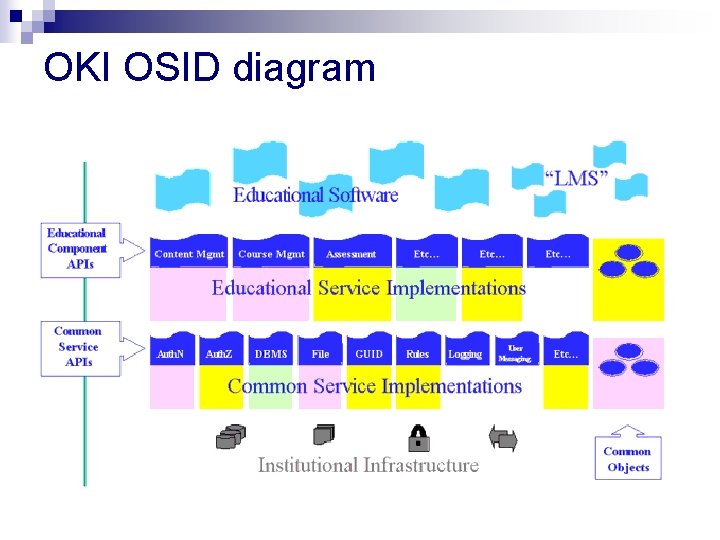
OKI Open Service Interface Definitions (OSIDs) “The OSIDs are an abstraction layer between the programmer and the enterprise infrastructure systems of his or her campus. “This approach offers a number of important benefits to applications designed to the OSIDs: ¨ Simple integration with existing infrastructure ¨ Local innovations can be shared across campuses or universities ¨ Adaptation to new technology without destabilizing the overall environment” from “OKI: About Specifications, ” http: //www. okiproject. org/specs/index. html
OKI OSID diagram
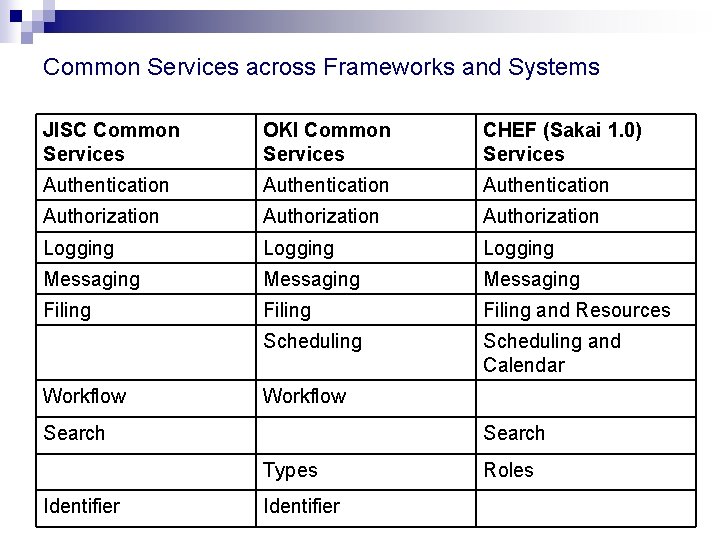
So what are the typical “Common Services? ”
Common Services across Frameworks and Systems JISC Common Services OKI Common Services CHEF (Sakai 1. 0) Services Authentication Authorization Logging Messaging Filing and Resources Scheduling and Calendar Workflow Search Types Identifier Roles
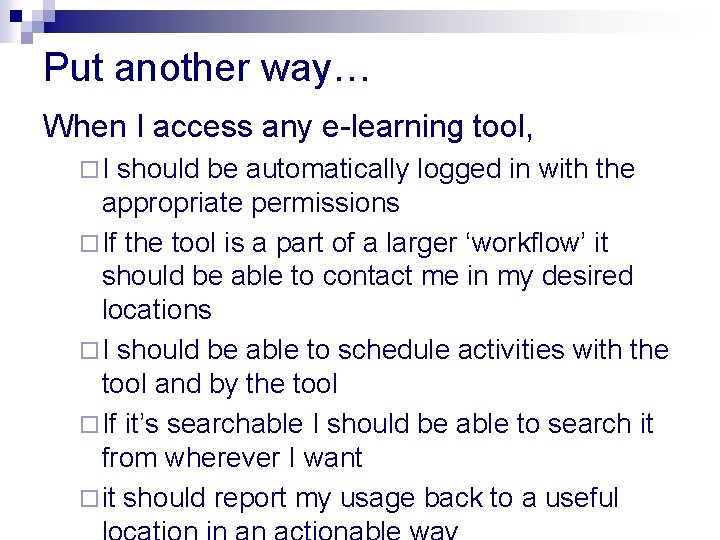
Put another way… When I access any e-learning tool, ¨I should be automatically logged in with the appropriate permissions ¨ If the tool is a part of a larger ‘workflow’ it should be able to contact me in my desired locations ¨ I should be able to schedule activities with the tool and by the tool ¨ If it’s searchable I should be able to search it from wherever I want ¨ it should report my usage back to a useful
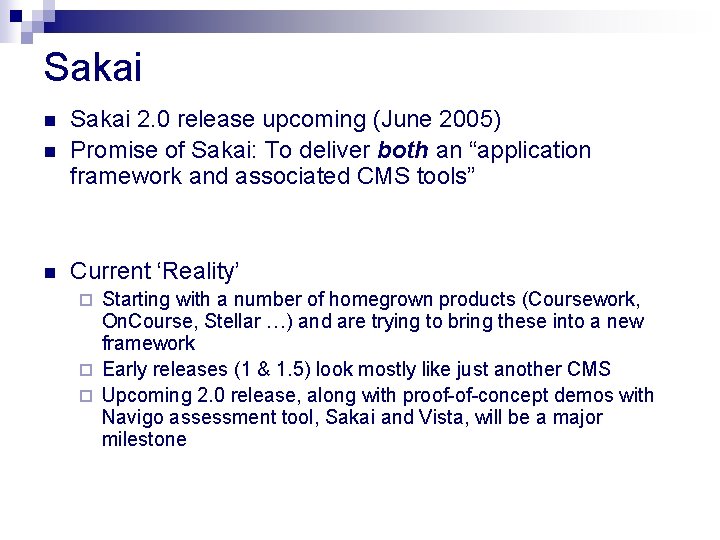
Sakai n Sakai 2. 0 release upcoming (June 2005) Promise of Sakai: To deliver both an “application framework and associated CMS tools” n Current ‘Reality’ n Starting with a number of homegrown products (Coursework, On. Course, Stellar …) and are trying to bring these into a new framework ¨ Early releases (1 & 1. 5) look mostly like just another CMS ¨ Upcoming 2. 0 release, along with proof-of-concept demos with Navigo assessment tool, Sakai and Vista, will be a major milestone ¨
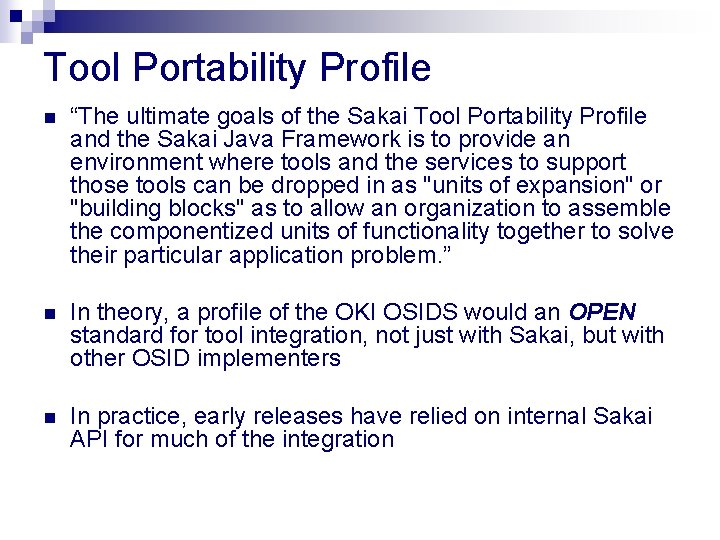
Tool Portability Profile n “The ultimate goals of the Sakai Tool Portability Profile and the Sakai Java Framework is to provide an environment where tools and the services to support those tools can be dropped in as "units of expansion" or "building blocks" as to allow an organization to assemble the componentized units of functionality together to solve their particular application problem. ” n In theory, a profile of the OKI OSIDS would an OPEN standard for tool integration, not just with Sakai, but with other OSID implementers n In practice, early releases have relied on internal Sakai API for much of the integration
Comparing Vista and Sakai extensibility/integration ?
Other Open Source n http: //www. edtechpost. ca/pmwiki. p hp/Ed. Tech. Post/Open. Source. Course. Mana gement. Systems currently lists at least 46 known OS options n ATutor ¨ developed out of U of T ¨ over 2000 registered installations ¨ SCORM and IMS CP support; integration with TILE repository ¨ PHP-based ¨ currently “watching” OKI but hesitant about adopting before benefits are clear
Other Open Source II n Moodle ¨ ¨ ¨ n originated as Ph. D project by Australian aimed at a CMS to support more constructivist style education currently “many thousands” of adoptions SCORM and IMS CP support; repository in development; supports Shibboleth and CAS authentication PHP-based currently “watching” OKI but hesitant about adopting before benefits are clear . LRN ¨ ¨ developed at MIT on top of existing Open. ACS Portal technology recently acknowledged by ADL as SCORM capable supports Unix PAM and LDAP authentication written in TCL
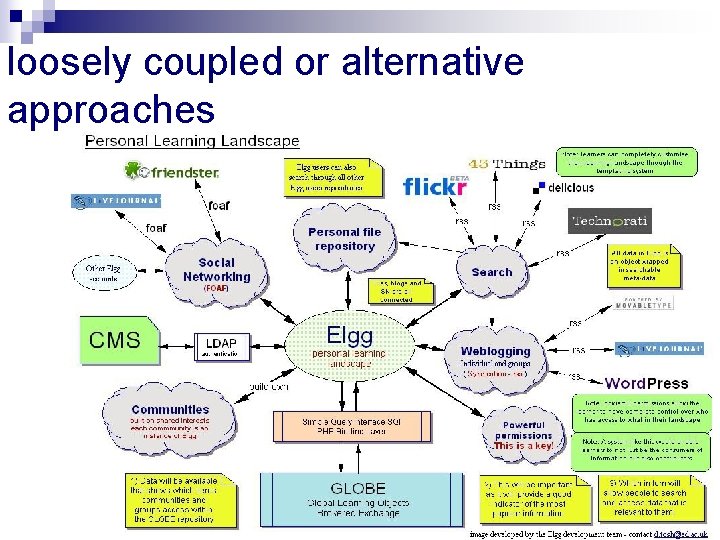
loosely coupled or alternative approaches
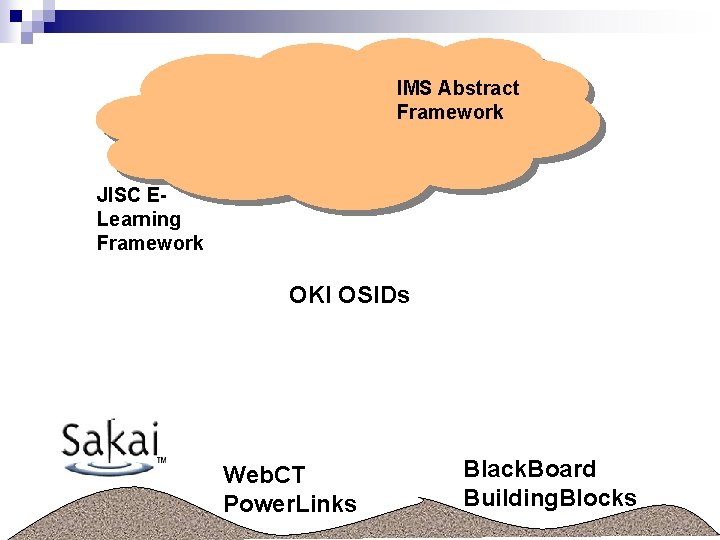
IMS Abstract Framework JISC ELearning Framework OKI OSIDs Web. CT Power. Links Black. Board Building. Blocks
Important Recent Announcements n Web. CT chairing IMS Tools Interop group (http: //www. webct. com/service/viewcontentframe? conten t. ID=25561480) n IMS to partner with OKI on next OSIDS (http: //www. imsglobal. org/pressreleases/pr 050413. cfm) n IBM partners on Sakai project (http: //www. umich. edu/news/? Releases/2005/Apr 05/r 042 605 a) n Web. CT Campus Edition 6 Public Beta Commences (http: //home. businesswire. com/portal/site/google/index. js p? ndm. View. Id=news_view&news. Id=20050425005245&n ews. Lang=en)
Important Upcoming Milestones n Sakai 2. 0 release ¨ Mid-June n Alt-i Lab 2005 Tools Interop Demo between Web. Ct and Sakai ¨ June n 2005 20 -22 in Sheffield, UK Sakai 3. 0 release ¨ end of 2005
Recent ‘Relevant Read’ Rebecca Sausner, “Course Management: Ready for Prime Time, ” in University Buisness, May, 2005. http: //www. universitybusiness. com/page. cf m? p=791 Compares 4 large institutions with 4 different CMS implementations ¨ Marshall U. – Web. CT Vista ¨ U of Cincinnati – Blackboard ¨ U Michigan – Sakai ¨ Berry College - Jenzabar Enterprise
Food for Thought n Is it possible to achieve “enterprise quality service” without imposing or assuming a well-defined, hierarchical structure? n What are the other pieces of the envisioned learning environment, in addition to a CMS, and how should these interact with the CMS? n What level is the appropriate level to standardize at? ¨ Course? ¨ Instructor? ¨ Program? ¨ Department or Faculty? ¨ Institution? And WHAT, specifically, is it important to standardize on? n