
COURSE DESIGN and TEACHING Common European MATERIALS Framework
- Slides: 27
COURSE DESIGN and TEACHING Common European MATERIALS Framework of Reference (CEFR)
Background to the CEFR § The Council of Europe (Co. E) founded in 1949 serves 800 million people in 47 member states. § § § The purposes of the Council of Europe; defend human rights develop continent wide agreements to standardize member countries` social and legal practices § promote awareness of a European identity based on shared values and cutting across different cultures (Morrow, 2008)
Background to the CEFR § In 1970 s, The Threshold Level was developed by John Trim and Jan van Ek on the basis of preliminary studies by a group of experts convened by the Council of Europe to investigate the feasibility of a European unit-credit scheme for adult language learning § Threshold Level was produced as an attempt to define in considerable detail the minimum level of language proficiency which would enable a language learner to act as an independent agent in transacting the business of everyday living as well as exchanging information and ideas with other people § It is the first systematic specification of learning objectives for the English language
Background to the CEFR § It initiated the functional-notional approach, setting out first what the learner had to do with the language and secondarily what language was necessary § Threshold specified objectives for a broadly intermediate level: a lower and an upper level were subsequently described, known as Waystage and Vantage § In 1990, both Threshold Level and Waystage were revised in the light of CEFR (Trim, 2001)
Why is CEFR needed? § In the Intergovernmental Symposium held in Rüschlikon, Switzerland November 1991, Common European Framework of reference was developed for language learning at all levels, in order to (Council of Europe , 2001) : § promote and facilitate co-operation among educational institutions in different countries § provide a sound basis for the mutual recognition of language qualifications § assist learners, teachers, course designers, examining bodies and educational administrators to situate and co-ordinate their efforts
Why is CEF needed? § CEF is a document published by the Council of Europe`s Language Policy Division in 2001 § Council of Europe (2001; p. 1) describes that the Common European Framework provides a common basis for the elaboration of language syllabuses, curriculum guidelines, examinations, textbooks, etc. across Europe. § It describes in a comprehensive way what language learners have to learn to do in order to use a language for communication and what knowledge and skills they have to develop so as to be able to act effectively § Council of Europe (2009; p. 3) expresses that the aim of the CEFR is to facilitate reflection, communication and networking in language education
Oblectives and Principles of the CEFR § § § § OBJECTIVES Promoting plurilingualism Developing plurilingual profile Defining positive ‘can-do’ descriptors Developing textbooks and teaching materials Supporting teacher education and cooperation Enhancing quality in learning, teaching and assessment Facilitating transparency in testing
Plurilingualism § Plurilingualism has grown in importance in the Council of Europe’s approach to language learning § Plurilingualism differs from multilingualism § Multilingualism may be attained by simply diversifying the languages on offer in a particular school or educational system, or by encouraging pupils to learn more than one foreign language, or reducing the dominant position of English in international communication (Council of Europe, 2001)
Plurilingualism § The plurilingual approach emphasises the fact that as an individual person’s experience of language in its cultural contexts expands, from the language of the home to that of society at school or college, he does not keep these languages and cultures in strictly separated mental compartments, but rather builds up a communicative competence to which all knowledge and experience of language contributes and in which languages interrelate and interact (Council of Europe, 2001) § Plurilingualism has itself to be seen in the context of pluriculturalism
Oblectives and Principles of the CEFR § § § § PEDAGOGICAL PRINCIPLES Learner Autonomy Self-assessment Cultural Diversity LANGUAGE LEARNING DOMAINS The public domain The personal domain The occupational domain The educational domain
Oblectives and Principles of the CEFR LANGUAGE ACTIVITIES § § Reception Production Interaction Mediation
CEFR § CEF should be (Council of Europe, 2001); § multi-purpose: usable for the full variety of purposes involved in the planning and provision of facilities for language learning § flexible: adaptable for use in different circumstances § open: capable of further extension and refinement § dynamic: in continuous evolution in response to experience in its use § user-friendly: presented in a form readily understandable and usable by those to whom it is addressed § non-dogmatic: not irrevocably and exclusively attached to any one of a number of competing linguistic or educational theories or practices
CEFR § CEFR provides a comprehensive theoretical approach to modern language learning and teaching to help practitioners (learners, teachers, parents, course designers, administrators, employers etc) to orientate their options and to inform each other in a comprehensive, transparent and coherent way (Co. E, 2001) § Council of Europe (2001; p. 21) states one of the aims of the Framework is to help partners to describe the levels of proficiency required by existing standards, tests and examinations in order to facilitate comparisons between different systems of qualifications. For this purpose, the Council of Europe has developed a European Framework with common reference levels.
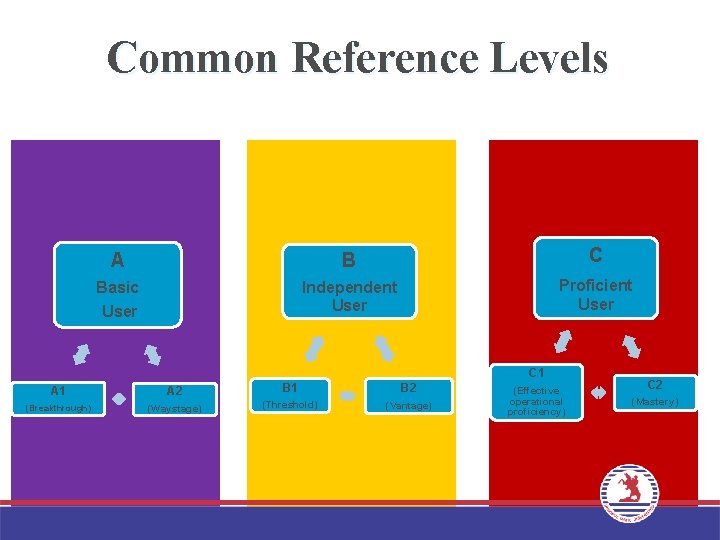
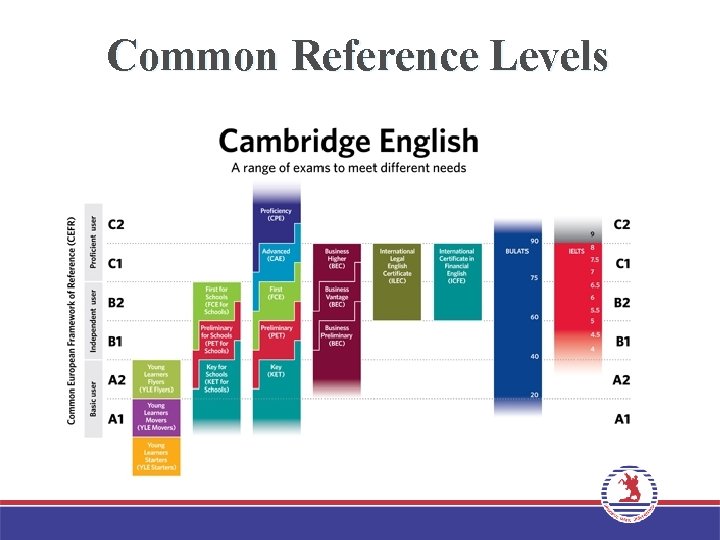
Common Reference Levels A B C Basic User Independent User Proficient User C 1 A 2 B 1 (Breakthrough) (Waystage) (Threshold) B 2 (Vantage) (Effective operational proficiency) C 2 (Mastery)
Common Reference Levels § The basic user has the most elementary expression, however in communication is dependent of the willingness on the converser to adapt to the attain level- conversers assistance is necessary § The independent user can handle the daily language practice, is mostly able to interact without too much effort and generally is able to follow a normal speech tempo- some consideration needs to be taken into account that is not his/her tongue § The proficient user has hardly any or no strains in the use of the target language and no consideration needs to be taken into account that is not his/her native tongue (Council of Europe, 2001; p. 23)
Common Reference Levels § Common Reference Levels are widely used by ministries, examination bodies and providers, curriculum developers, textbook writers and publishers. § One example of this is the objectives set in France by the French Ministry of Education for the academic year 2007/8 onwards: § at the end of primary education, learners should reach Level A 1 of the CEFR in the language studied § at the end of compulsory schooling, learners should reach Level B 1 of the CEFR in the first language studied and A 2 in the second language studied § at the Baccalaureate level, learners should reach Level B 2 of the CEFR in the first language studied and B 1 in the second language studied. (Martyniuk, 2005; p. 14).
Common Reference Levels
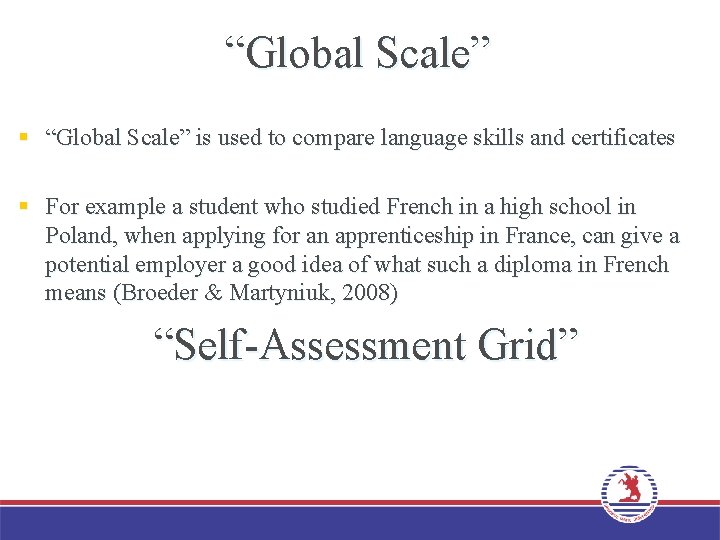
“Global Scale” § “Global Scale” is used to compare language skills and certificates § For example a student who studied French in a high school in Poland, when applying for an apprenticeship in France, can give a potential employer a good idea of what such a diploma in French means (Broeder & Martyniuk, 2008) “Self-Assessment Grid”
“Can Do” Descriptors § “illustrative descriptors” were developed and validated for the CEF. “Can Do” descriptors are provided for reception, interaction and production § “Can Do” statements bring language learning/teaching and assessment into a much closer relation to each other than has often been the case § Each “Can Do” descriptor implies; § A learning target § Teaching/learning activities § Assessment criteria (Little, 2007)
CEFR 2018 COMPANION VOLUME § To produce versions for young learners and sign languages Main Changes § § § § The descriptors Mediation Pluriculturalism Literature Online Usage Sign Language Younf learners
IMPLICATIONS FOR ELT § § § § Reference Level Labels Learning Outcomes Self-evaluation and autonomy Testing Materials Methodology Teacher Training
ELP and CEF Ø CEF is the product of the European Language Portfolio (ELP) developed by the Council of Europe and piloted from 1998 until 2000 for a better learning and teaching process Ø The ELP is an instrument that facilitates the recording, planning, and validation of lifelong language learning Ø The ELP describes; § how and where a learner has studied languages § which proficiency level learner has reached § what plans learner has for developing his language competences
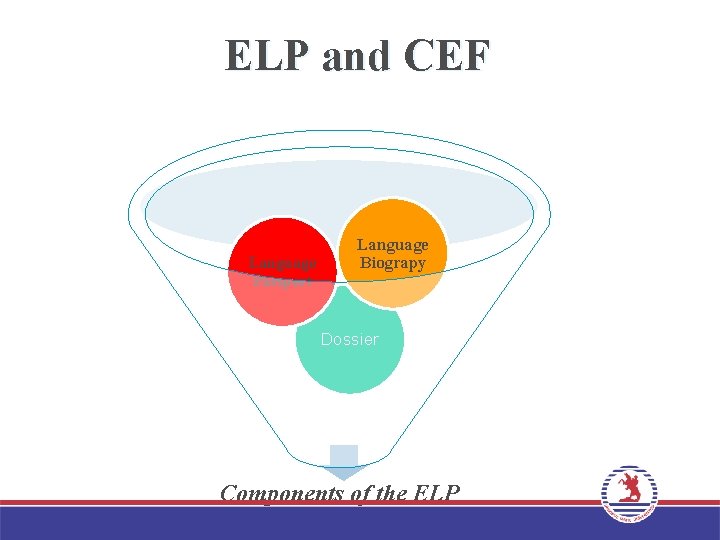
ELP and CEF Language Passport Language Biograpy Dossier Components of the ELP
Components of the ELP Ø Language Passport is learner`s linguistic identity by foreign language learnt, records formal qualifications, describes language competencies as well as significant learning experiences Ø Language Biography, provides language learning target, monitor progress and record specially important language learning and intercultural experiences; learners state what they can do in each language and include information about experiences Ø Dossier collects evidence of foreign language proficiency and intercultural experience, especially supports portfolio learning (Council of Europe, 2001)
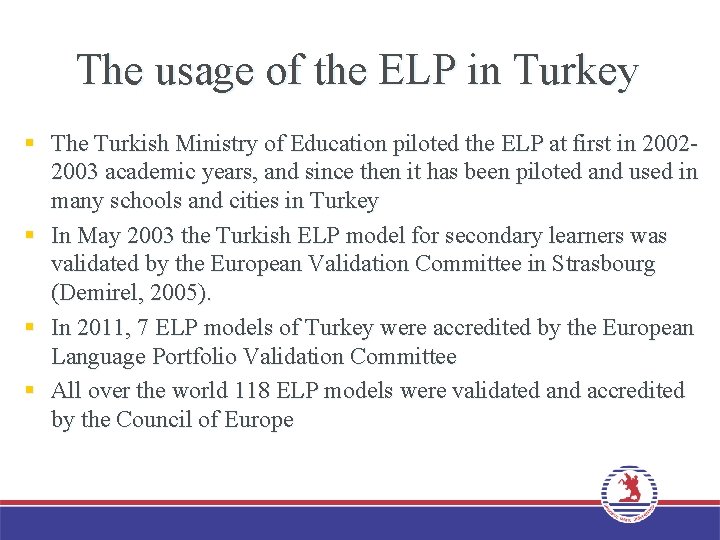
The usage of the ELP in Turkey § The Turkish Ministry of Education piloted the ELP at first in 20022003 academic years, and since then it has been piloted and used in many schools and cities in Turkey § In May 2003 the Turkish ELP model for secondary learners was validated by the European Validation Committee in Strasbourg (Demirel, 2005). § In 2011, 7 ELP models of Turkey were accredited by the European Language Portfolio Validation Committee § All over the world 118 ELP models were validated and accredited by the Council of Europe
References § Broeder, P. , & Martyniuk, W. (2008). Language Education in Europe: The Common European Framework of Reference. In N. Van Deusen-Scholl & N. Hornberger (Eds. ), Encyclopedia of Language and Education (pp. 208 -226). New York: USA. § Council of Europe. (2001). Common European Framework of Reference for Languages: Learning, teaching, assessment. Cambridge, England: Cambridge University Press. § Council of Europe. (2009). Relating Language Examination to the Common European Framework Reference for Languages: Learning, Teaching, Assessment (CEFR)-A Manual, Strasbourg, Council of Europe. § Demirel, Ö. (2005). Avrupa Konseyi dil projesi ve Türkiye uygulaması. MEB Eğitim ve Sosyal Bilimler Dergisi, 167 (33).
References § Little, D. (2007, February 6 -8). From the Common European Framework of Reference to the European Language Portfolio. Paper presented at the CEFR and the development of language policies: challenges and responsibilities Conference, Strasbourg, France: Council of Europe. § Martyniuk, W. (2005). Relating Language Examinations to the Council of Europe`s Common European Framework of Reference for Languages (CEFR). In L. Taylor & C. J. Weir (Eds), Multilingualism and Assessment: Achieving Transparency, Assuring Quality, Sustaining Diversity. Cambridge University Press, 9 -18. § Morrow, K. (2008). Insights from the Common European Framework. Oxford University Press. § Trim, J. L. M. (Ed. ). (2001). Common European Framework of Reference for Languages: learning, teaching and assessment-A Guide for Users. Strasbourg, France: Council of Europe.