
Course contents Basic concepts What is software architecture
Course contents • Basic concepts – What is software architecture ? • Fundamental architectural styles – – Pipes and filters Layers Blackboard Event-driven • Architectural patterns for : – Adaptive systems • The Reflection Pattern – Distributed systems • The Broker Pattern – Data access patterns • Pattern for Object-Relational Mappings • Pattern for decoupling data access
Distributed systems • Outline: – Introduction: • Models for distributed applications • Very short intro in inter-process communication – Patterns used for distributed systems middleware: • • Forwarder-Receiver: [POSA 1], from chap. 3. 6 (pag 307 -322) Client-Dispatcher-Server: [POSA 1], from chap. 3. 6 (pag 323 -336) Remote Proxy: [POSA 1], from chap. 3. 4 (pag 263 -275) Broker: – [POSA 1] chap 2. 3 – Examples: technologies using the Broker pattern: Java RMI, CORBA, . NET Remoting

Distributed Object Computing ? Process 2 (Computer 2) Process 1 (Computer 1) Because Client and Info. Server run in different processes, there is no shared address space/no shared variables ! Inter-process communication mechanisms are needed
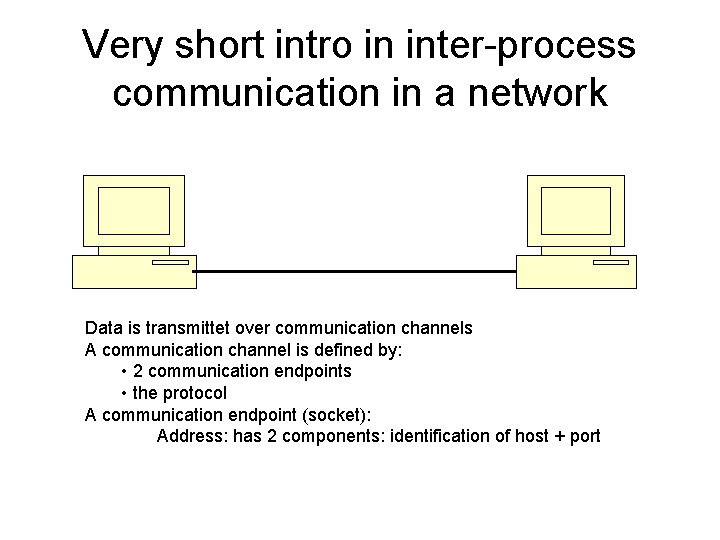
Very short intro in inter-process communication in a network Data is transmittet over communication channels A communication channel is defined by: • 2 communication endpoints • the protocol A communication endpoint (socket): Address: has 2 components: identification of host + port
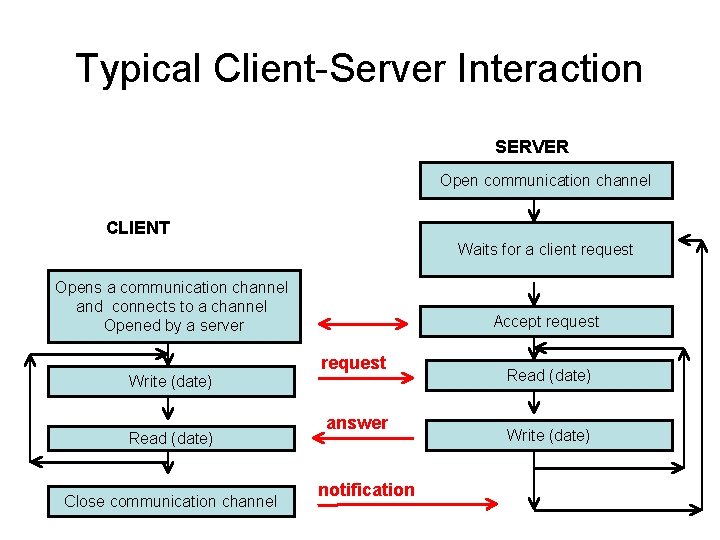
Typical Client-Server Interaction SERVER Open communication channel CLIENT Waits for a client request Opens a communication channel and connects to a channel Opened by a server Write (date) Read (date) Close communication channel Accept request answer notification Read (date) Write (date)
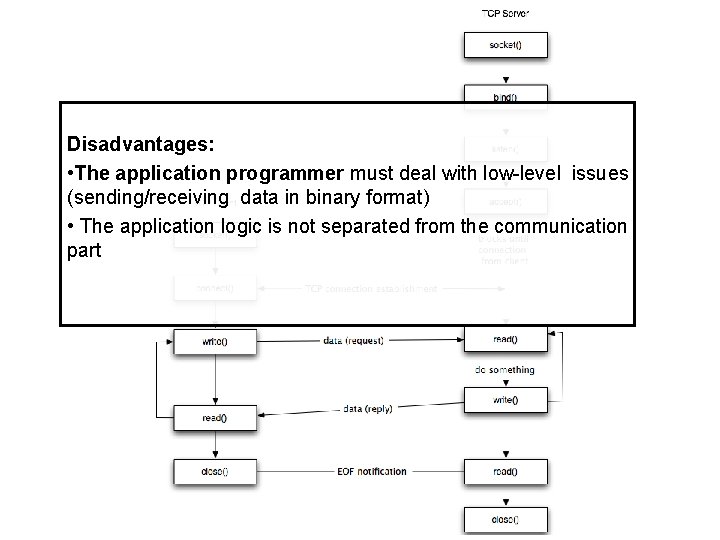
Disadvantages: • The application programmer must deal with low-level issues (sending/receiving data in binary format) • The application logic is not separated from the communication part
We need support for distributed applications: • Distributed applications must present following qualities: – Separation of concerns: application logic must be separate from communication => “somebody” must establish the communication channel and do the messaging over this channel – Location independence: client and server interact in the same way, independent from the location of the server => “somebody” must localize the server – Location transparence: a client should interact wit a remote server in the same way as with a local server => “somebody” must procure a reference to the remote server object • Middleware: – Infrastructure that supports distributed applications – Usually some “off-the-shelf” software – Examples: Java RMI, . NET Remoting, CORBA
Architectural pattern for distributed systems • Broker: – Integrates 3 smaller patterns: : • Forwarder-Receiver: separation of concerns: hides the details of inter-process communication (data formats, transmit/receive messages in a specific protocol) • Client-Dispatcher-Server: location independency: decouples the operation of establishing a connection from later communication • Remote Proxy: location transparency: interaction with a remote server happens via its local proxy (representative).
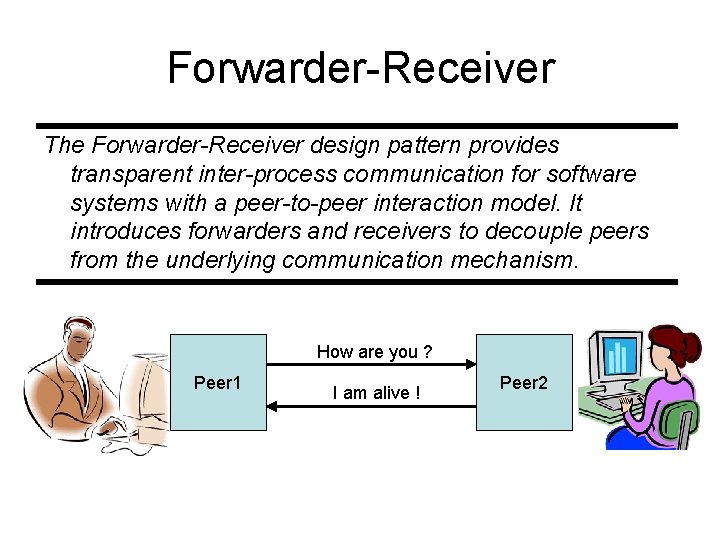
Forwarder-Receiver The Forwarder-Receiver design pattern provides transparent inter-process communication for software systems with a peer-to-peer interaction model. It introduces forwarders and receivers to decouple peers from the underlying communication mechanism. How are you ? Peer 1 I am alive ! Peer 2
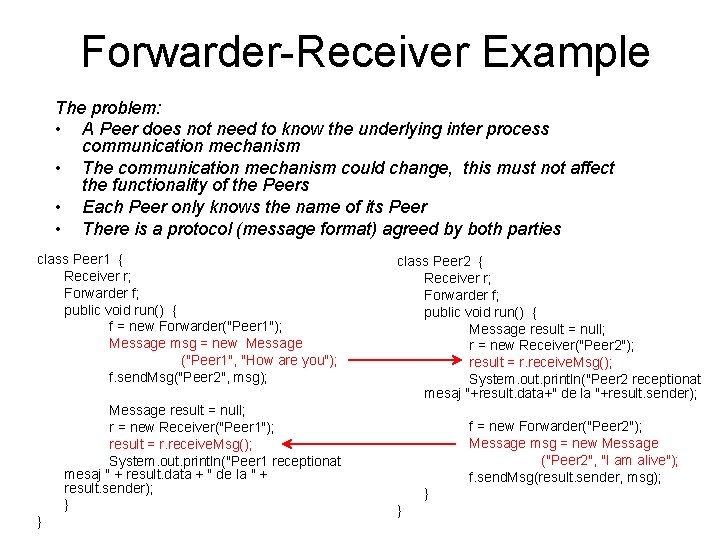
Forwarder-Receiver Example The problem: • A Peer does not need to know the underlying inter process communication mechanism • The communication mechanism could change, this must not affect the functionality of the Peers • Each Peer only knows the name of its Peer • There is a protocol (message format) agreed by both parties class Peer 1 { Receiver r; Forwarder f; public void run() { f = new Forwarder("Peer 1"); Message msg = new Message ("Peer 1", "How are you"); f. send. Msg("Peer 2", msg); Message result = null; r = new Receiver("Peer 1"); result = r. receive. Msg(); System. out. println("Peer 1 receptionat mesaj " + result. data + " de la " + result. sender); } } class Peer 2 { Receiver r; Forwarder f; public void run() { Message result = null; r = new Receiver("Peer 2"); result = r. receive. Msg(); System. out. println("Peer 2 receptionat mesaj "+result. data+" de la "+result. sender); f = new Forwarder("Peer 2"); Message msg = new Message ("Peer 2", "I am alive"); f. send. Msg(result. sender, msg); } }
![Structure of Forwarder Receiver [POSA]-Fig/P. 310](http://slidetodoc.com/presentation_image_h/f75e687d935d151da75d2df7676369c1/image-11.jpg "Structure of Forwarder Receiver [POSA]-Fig/P. 310")
Structure of Forwarder Receiver [POSA]-Fig/P. 310
![Structure of Forwarder-Receiver [POSA]-Fig/P. 311](http://slidetodoc.com/presentation_image_h/f75e687d935d151da75d2df7676369c1/image-12.jpg "Structure of Forwarder-Receiver [POSA]-Fig/P. 311")
Structure of Forwarder-Receiver [POSA]-Fig/P. 311
![Dynamics Forwarder-Receiver [POSA]-Fig/P. 312](http://slidetodoc.com/presentation_image_h/f75e687d935d151da75d2df7676369c1/image-13.jpg "Dynamics Forwarder-Receiver [POSA]-Fig/P. 312")
Dynamics Forwarder-Receiver [POSA]-Fig/P. 312
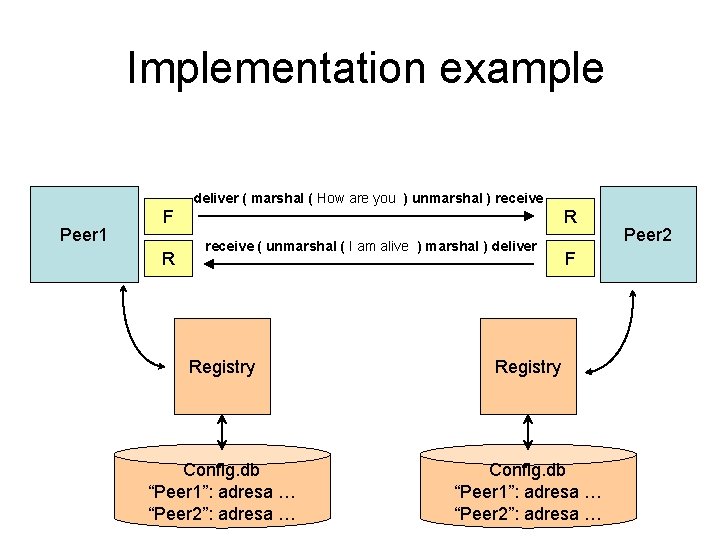
Implementation example deliver ( marshal ( How are you ) unmarshal ) receive Peer 1 F R R receive ( unmarshal ( I am alive ) marshal ) deliver F Registry Config. db “Peer 1”: adresa … “Peer 2”: adresa … Peer 2
Analysis of Forwarder-Receiver • Benefits: – Efficient inter-process communication – Encapsulation of inter-process communication facilities • Liabilities: – No support for flexible re-configuration of components => combination with cu dispatcher as Naming. Service
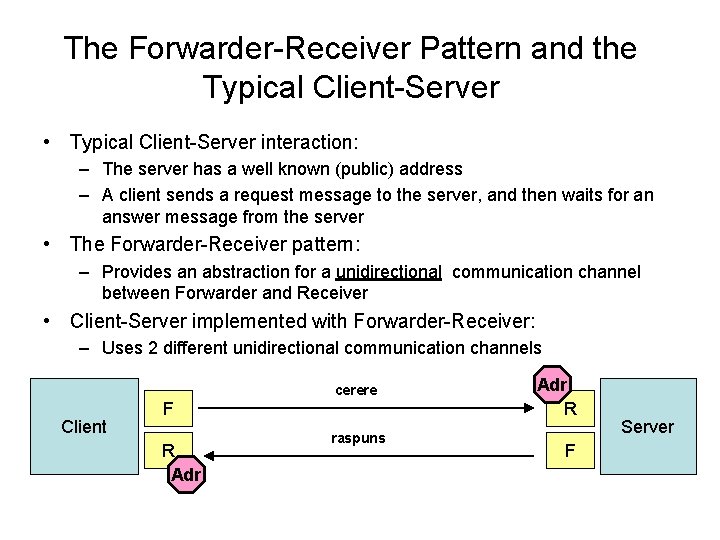
The Forwarder-Receiver Pattern and the Typical Client-Server • Typical Client-Server interaction: – The server has a well known (public) address – A client sends a request message to the server, and then waits for an answer message from the server • The Forwarder-Receiver pattern: – Provides an abstraction for a unidirectional communication channel between Forwarder and Receiver • Client-Server implemented with Forwarder-Receiver: – Uses 2 different unidirectional communication channels cerere Client F R Adr raspuns Adr R F Server
Types of communication channels • A communication channel can be 2 -way (bidirectional) or 1 -way (unidirectional) – 1 -way: Send-Receive (Forward-Receive) – 2 -way: Request-Reply • If the communication protocol supports 2 -way communication channels, we prefer the request-replay pattern for implementing a typical client-server (where the client is a blocking/synchronous client)
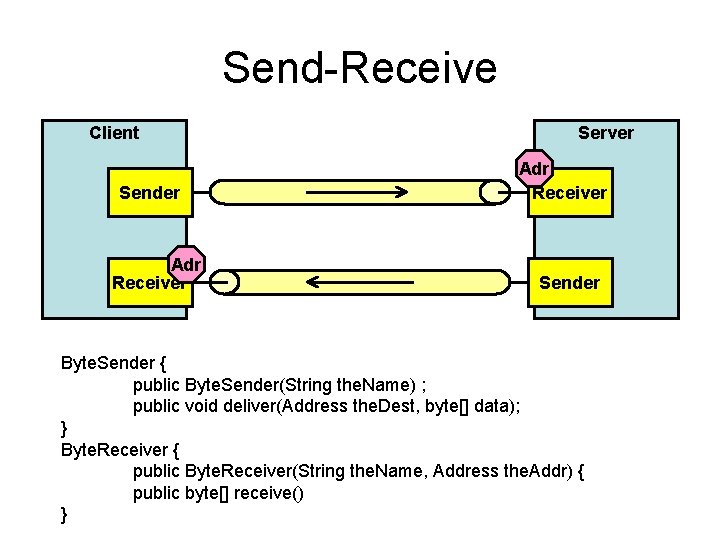
Send-Receive Client Sender Adr Receiver Server Adr Receiver Sender Byte. Sender { public Byte. Sender(String the. Name) ; public void deliver(Address the. Dest, byte[] data); } Byte. Receiver { public Byte. Receiver(String the. Name, Address the. Addr) { public byte[] receive() }
![Client Requestor Request-Reply Server Adr Replyer Requestor{ public Requestor(String the. Name) ; public byte[]](http://slidetodoc.com/presentation_image_h/f75e687d935d151da75d2df7676369c1/image-19.jpg "Client Requestor Request-Reply Server Adr Replyer Requestor{ public Requestor(String the. Name) ; public byte[]")
Client Requestor Request-Reply Server Adr Replyer Requestor{ public Requestor(String the. Name) ; public byte[] deliver_and_wait_feedback(Address the. Dest, byte[] data); } public interface Byte. Stream. Transformer{ public byte[] transform(byte[] in); } Replyer { public Replyer(String the. Name, Address the. Addr); public void receive_transform_and_send_feedback(Byte. Stream. Transformer t); }
Implementations • Example implementations are provided in the course web page: http: //staff. cs. utt. ro/~ioana/arhit-engl/curs. html – Byte. Sender-Byte. Receiver – Requestor-Replyer • The code can be used as-is: the details of their implementation are outside the scope of this course (will be studied in a course for distributed applications and network programming) • Examples of client-server applications: – Client-Server with Send-Receive (SR) – Client-Server with Requestor-Replyer (RR)
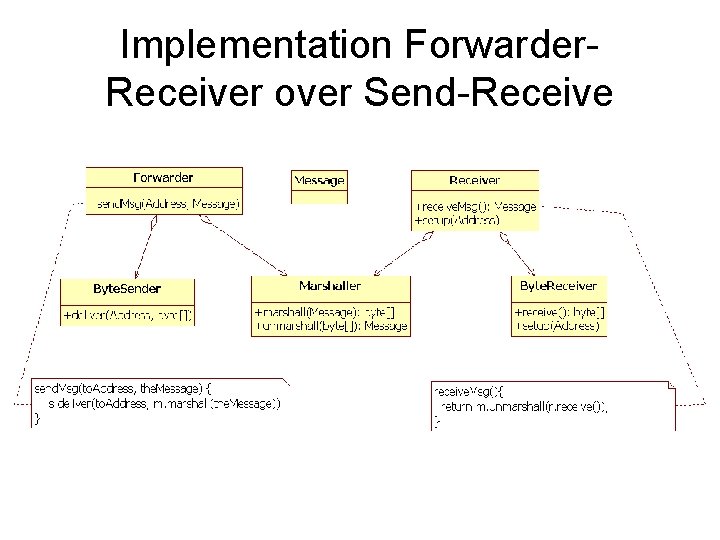
Implementation Forwarder. Receiver over Send-Receive
Client-Dispatcher-Server The Client-Dispatcher-Server design pattern introduces an intermediate layer between clients and servers, the dispatcher component. It provides location transparency by means of a name service, and hides the details of the establishment of the communication connection between clients and servers.
![Structure of Client-Dispatcher-Server [POSA]-Fig/P. 325](http://slidetodoc.com/presentation_image_h/f75e687d935d151da75d2df7676369c1/image-23.jpg "Structure of Client-Dispatcher-Server [POSA]-Fig/P. 325")
Structure of Client-Dispatcher-Server [POSA]-Fig/P. 325
![Structure of Client-Dispatcher-Server [POSA]-Fig/P. 326](http://slidetodoc.com/presentation_image_h/f75e687d935d151da75d2df7676369c1/image-24.jpg "Structure of Client-Dispatcher-Server [POSA]-Fig/P. 326")
Structure of Client-Dispatcher-Server [POSA]-Fig/P. 326
Variant: Client-Dispatcher-Service • Clients address Services, not Servers • The Dispatcher searches its repository to find a server that provides the service (There could be several servers providing the same service)
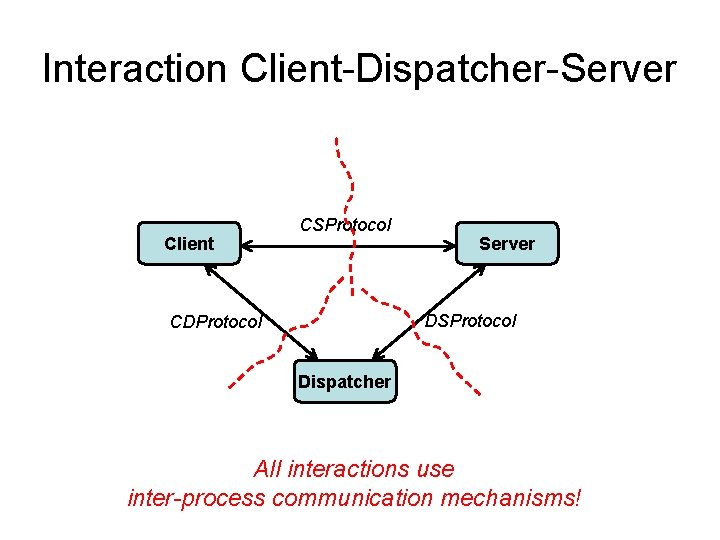
Interaction Client-Dispatcher-Server Client CSProtocol Server DSProtocol CDProtocol Dispatcher All interactions use inter-process communication mechanisms!
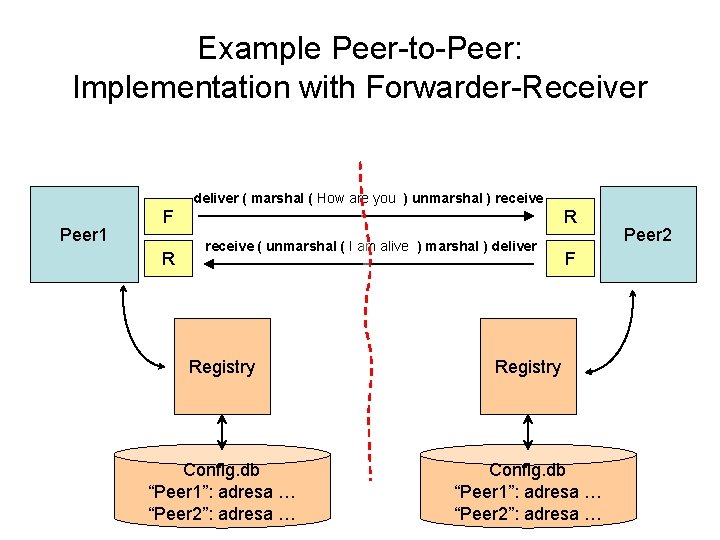
Example Peer-to-Peer: Implementation with Forwarder-Receiver deliver ( marshal ( How are you ) unmarshal ) receive Peer 1 F R R receive ( unmarshal ( I am alive ) marshal ) deliver F Registry Config. db “Peer 1”: adresa … “Peer 2”: adresa … Peer 2
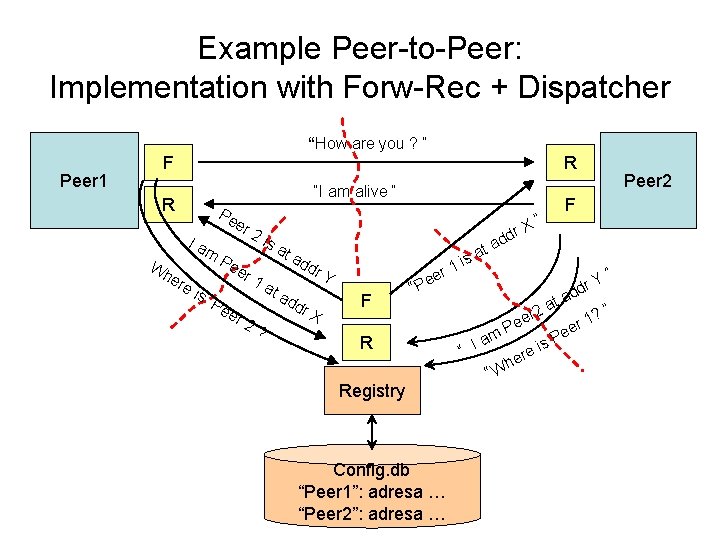
Example Peer-to-Peer: Implementation with Forw-Rec + Dispatcher “How are you ? “ Peer 1 F R “I am alive “ R Pe Ia er m Wh ere Pe er is Pe er 2 i sa 1 a ta 2? dd r ta dd r X r 1 Y F e “Pe R Registry Config. db “Peer 1”: adresa … “Peer 2”: adresa … t is a “ ” X dr Peer 2 F ad m Ia t 2 a r ee P ” ? r 1 ” ad e e s. P i e r he “W Y dr
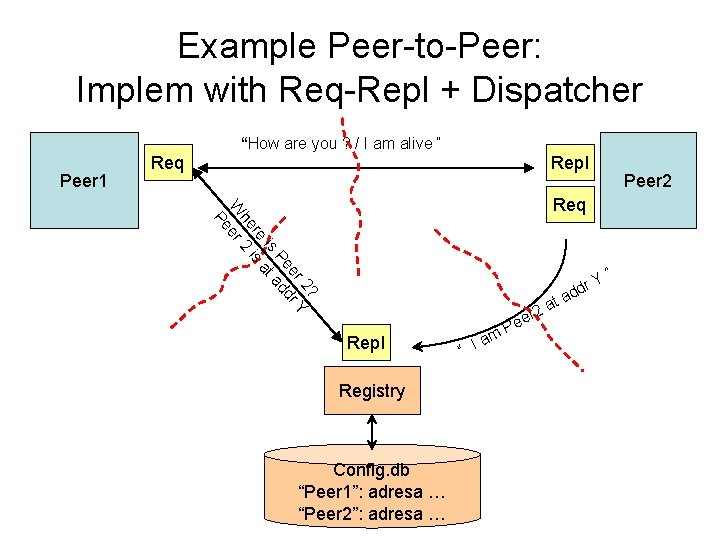
Example Peer-to-Peer: Implem with Req-Repl + Dispatcher “How are you ? / I am alive “ Peer 1 Req Repl Peer 2 2? er dr Y Pe d is t a re is a he 2 W er Pe Req Repl Registry Config. db “Peer 1”: adresa … “Peer 2”: adresa … a “ I m Pe er t 2 a ad Y dr ”
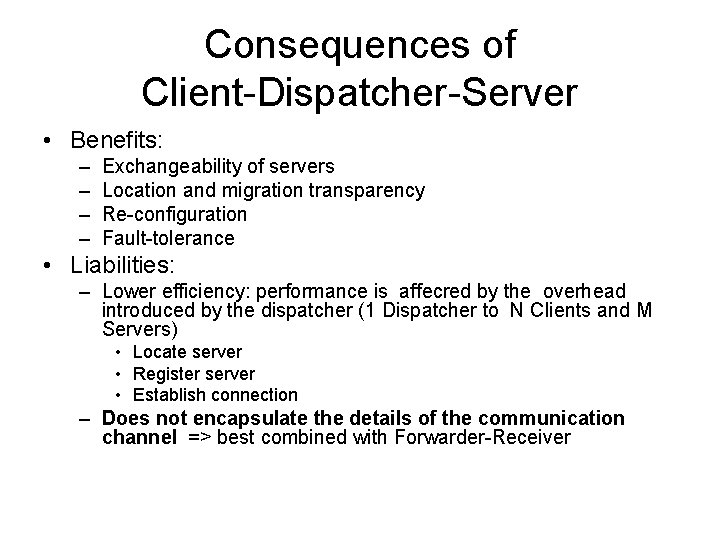
Consequences of Client-Dispatcher-Server • Benefits: – – Exchangeability of servers Location and migration transparency Re-configuration Fault-tolerance • Liabilities: – Lower efficiency: performance is affecred by the overhead introduced by the dispatcher (1 Dispatcher to N Clients and M Servers) • Locate server • Register server • Establish connection – Does not encapsulate the details of the communication channel => best combined with Forwarder-Receiver
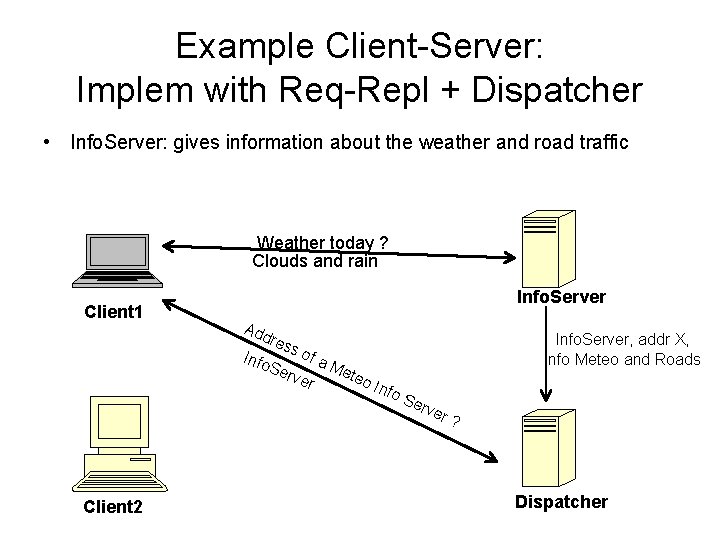
Example Client-Server: Implem with Req-Repl + Dispatcher • Info. Server: gives information about the weather and road traffic Weather today ? Clouds and rain Client 1 Info. Server Add res so Info Ser fa ver Me teo Info. Server, addr X, info Meteo and Roads Info Ser v er ? Client 2 Dispatcher
Example Client-Server: Code implementing Client 1: • Send message to Naming. Service (Dispatcher) – asks for the address of a server providing Meteo information • Receives the answer (containing the address of Info. Server) from Dispatcher • Send message to Info. Server and asks how is the weather today • Receives the answer from Info. Server with today weather We would like to have the code of Client 1 looking like this instead: today. Weather=meteo. Server. Get. Weather. Forecast(“today”);
Proxy and Remote Proxy The Proxy pattern makes the clients of a component communicate with a representative rather than to the component Itself. Introducing such a placeholder can serve many purposes, including enhanced efficiency, easier access and protection from unauthorized access. A Remote Proxy encapsulates and maintains the physical location of the original. It also implements the IPC (inter-process communication) routines that perform the actual communication with the original. For every original, one proxy is instantiated per address space in which the services of the original are needed.
![Proxy – The structure [POSA]-Fig/P.](http://slidetodoc.com/presentation_image_h/f75e687d935d151da75d2df7676369c1/image-34.jpg "Proxy – The structure [POSA]-Fig/P.")
Proxy – The structure [POSA]-Fig/P.
![Proxy – The dynamics [POSA]-Fig/P.](http://slidetodoc.com/presentation_image_h/f75e687d935d151da75d2df7676369c1/image-35.jpg "Proxy – The dynamics [POSA]-Fig/P.")
Proxy – The dynamics [POSA]-Fig/P.
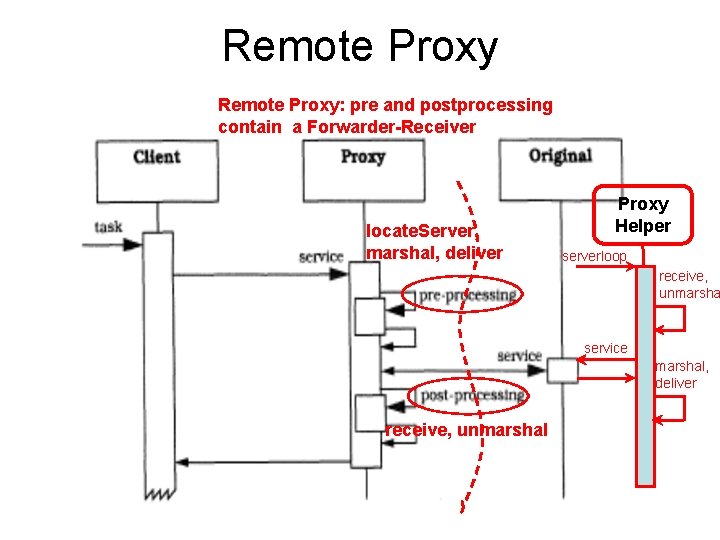
Remote Proxy: pre and postprocessing contain a Forwarder-Receiver locate. Server, marshal, deliver Proxy Helper serverloop receive, unmarsha service marshal, deliver receive, unmarshal
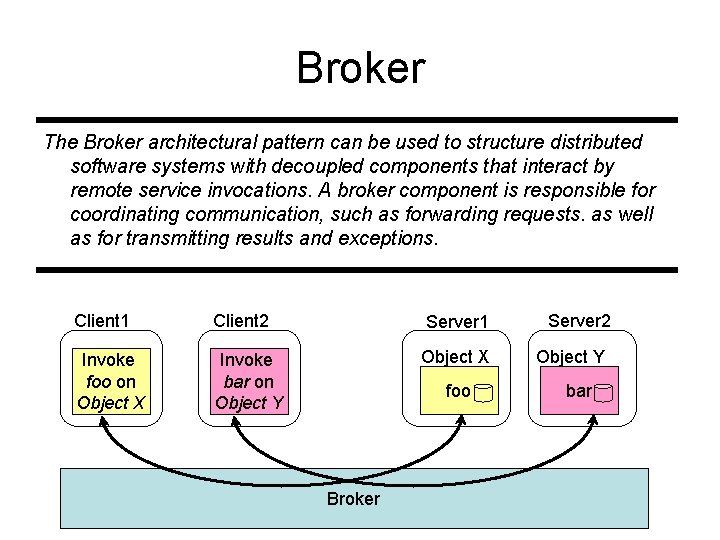
Broker The Broker architectural pattern can be used to structure distributed software systems with decoupled components that interact by remote service invocations. A broker component is responsible for coordinating communication, such as forwarding requests. as well as for transmitting results and exceptions. Client 1 Client 2 Server 1 Invoke foo on Object X Invoke bar on Object Y Object X foo Broker Server 2 Object Y bar
Broker vs Forwarder-Receiver • Both patterns facilitate communication and hide the communication details from the communicating components • Forwarder-Receiver: communication happens via messages having a format known by the participating Peer components • Broker: components interact via remote method invocation, hiding the location of the object whose methods are invoked – The Broker pattern integrates the patterns Remote Proxy with Forwarder-Receiver
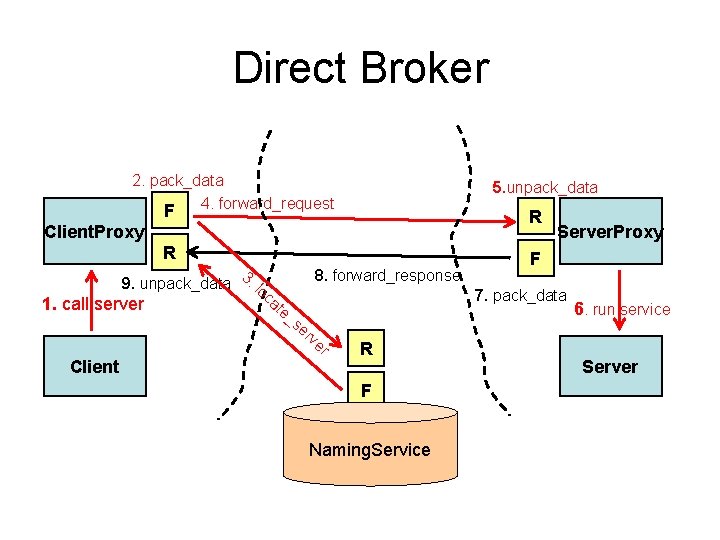
Broker - variants • Indirect Broker: – The Broker facilitates the indirect communication between client and server: any communication between client and server is transmitted via the Broker • Direct Broker: – The Client can communicate directly with the Server, after the connection has been established by the Broker
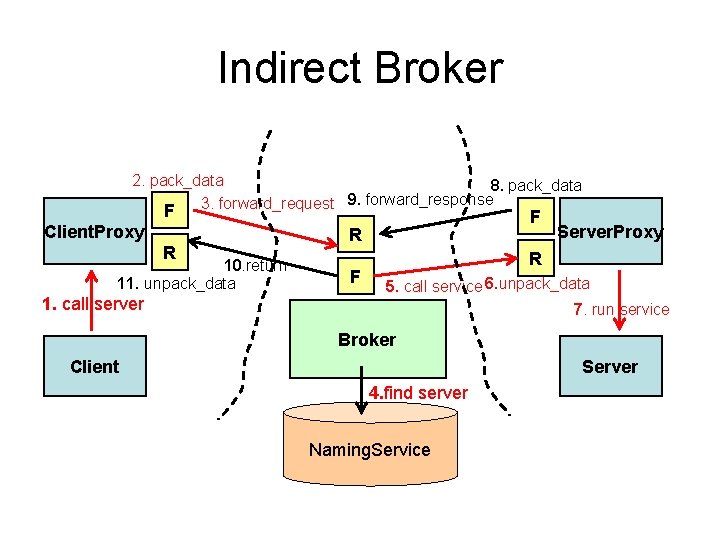
Indirect Broker 2. pack_data 8. pack_data 3. forward_request 9. forward_response F Client. Proxy R 10. return 11. unpack_data 1. call server F R F Server. Proxy R 5. call service 6. unpack_data 7. run service Broker Client Server 4. find server Naming. Service
![Broker [POSA]-Fig/P. 107](http://slidetodoc.com/presentation_image_h/f75e687d935d151da75d2df7676369c1/image-41.jpg "Broker [POSA]-Fig/P. 107")
Broker [POSA]-Fig/P. 107
![[POSA]-Fig/P. 103 -105](http://slidetodoc.com/presentation_image_h/f75e687d935d151da75d2df7676369c1/image-42.jpg "[POSA]-Fig/P. 103 -105")
[POSA]-Fig/P. 103 -105
![Server registers with Broker [POSA]-Fig/P. 108](http://slidetodoc.com/presentation_image_h/f75e687d935d151da75d2df7676369c1/image-43.jpg "Server registers with Broker [POSA]-Fig/P. 108")
Server registers with Broker [POSA]-Fig/P. 108
![The Indirect Broker solves a Client-Server interaction [POSA]-Fig/P. 109](http://slidetodoc.com/presentation_image_h/f75e687d935d151da75d2df7676369c1/image-44.jpg "The Indirect Broker solves a Client-Server interaction [POSA]-Fig/P. 109")
The Indirect Broker solves a Client-Server interaction [POSA]-Fig/P. 109
Broker - Variants • Indirect Broker: – Facilitates indirect communication between client and server: any communication between client and server is transmitted via the Broker – This corresponds with the diagrams presented before – Inefficient as communication solution, but has as advantage the possibility to control/restrict the access to servers • Direct Broker: – The Client can communicate directly with the Server, after the Broker establishes the connection => direct communication is more efficient – The operations described in the diagram presented before are now reallocated between Proxies and Broker: The Proxies will do now forward_request and forward_response instead of the Broker. The Proxy will also interrogate the name. Service-ul (locate_server)
Direct Broker 2. pack_data 4. forward_request 5. unpack_data F R Client. Proxy R 9. unpack_data 1. call server Client 3. 8. forward_response lo ca te Server. Proxy F 7. pack_data _s er ve r R F Naming. Service 6. run service Server
Important remark • The presentation of the Broker pattern used the Forwarder-Receiver pattern (communication Send. Receive on 1 -way communication channels) • If: – The used protocols support 2 -way channels – The semantics of client calls is synchronous calls (client blocks waiting for an answer) => Better to use Request-Reply communication on 2 way channels !
Example: Client-Server: with Direct Broker • Code implementing Client 1: – today. Weather=meteo. Server. Get. Weather. Forecast(“today”); – meteo. Server is an object of type Meteo. Client. Proxy • Code implementing Meteo. Client. Proxy: – When creating the proxy: • Send message to Naming. Service (Dispatcher) – ask for the address of a Meteo server • Receives an answer, containing the address of Info. Server (actually Meteo. Server. Proxy) – In the method Get. Weather. Forecast: • Send message to Info. Server (to the address received when creating the proxy) to ask how is the weather today. The message must include: operation name, parameter values in a specific format (marshall) • Receives answer message from Info. Server • Extracts (unmarshalls) weather forecast from message • Returns result
Example Client-Server: with Direct Broker (cont) • The code implementing Meteo. Server. Proxy: • Creates Receiver (Replyer) and waits for messages • When a message is received, extracts (unmarshalls) information about the requested operation and parameter values • Invokes operation on Info. Server • Marshalls the result into message format, sends message as answer
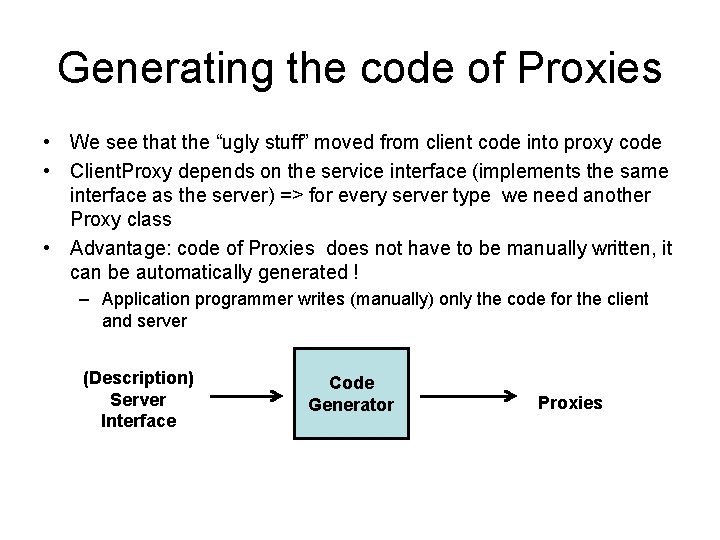
Generating the code of Proxies • We see that the “ugly stuff” moved from client code into proxy code • Client. Proxy depends on the service interface (implements the same interface as the server) => for every server type we need another Proxy class • Advantage: code of Proxies does not have to be manually written, it can be automatically generated ! – Application programmer writes (manually) only the code for the client and server (Description) Server Interface Code Generator Proxies
Broker in practice: Middleware • Middleware: – – – • Infrastructure that supports distributed applications Usually provided by “off-the-shelf” software Examples: Java RMI, . NET Remoting, CORBA What is in an “off-the-shelf” middleware package: 1. 2. 3. Libraries+API for distributed application programmer Executable server/demon to be installed ( Naming. Service) Tools for application developers (example - Generator tool for proxies)
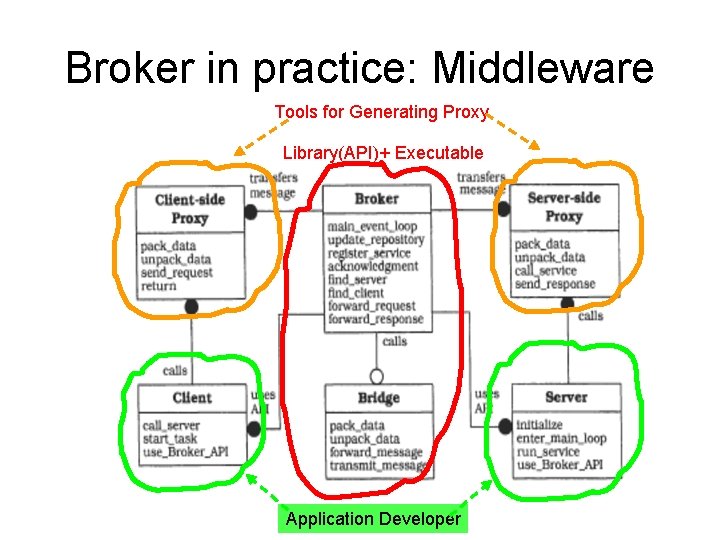
Broker in practice: Middleware Tools for Generating Proxy Library(API)+ Executable Application Developer
- Slides: 52