
Course Competencies Module 1 By Mollie De Hart
Course Competencies Module 1 By Mollie De. Hart Rolando Garcia Greg Sharp
Objectives As a result of this workshop, participants will be able to: 1. 2. 3. 4. 5. Explain how MDC course competencies are identified and developed Access SCNS to browse course competencies Explain how course competencies fit into the curriculum development cycle Differentiate between competencies, instructional activities, and instructional objectives Develop stems/goals for course competencies
Objectives (cont) 6. 7. 8. 9. Develop “Student Performance” statements (“by” statements) for stems/goals Differentiate between cognitive, psychomotor, and affective competencies Use the MDC Course Competency Template – Form 112 to develop competencies at appropriate levels of the cognitive, psychomotor, and affective domains Access and upload competencies to the Course Competency Project Share. Point site
Breakdown of Developing Student Outcomes
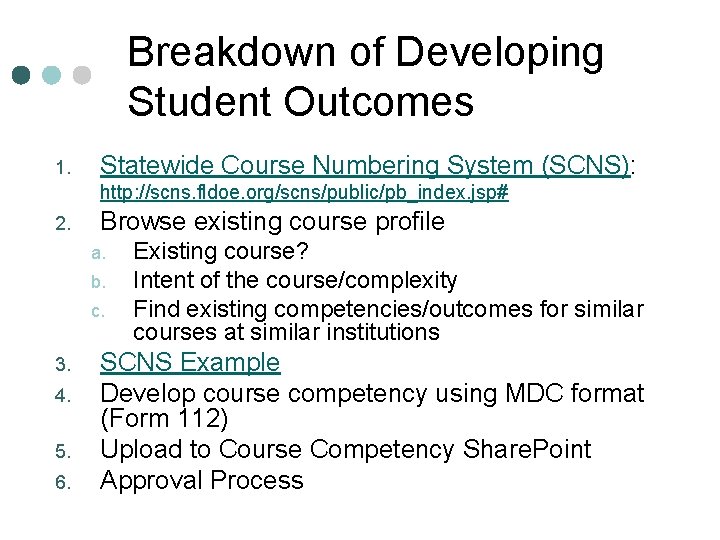
Breakdown of Developing Student Outcomes 1. Statewide Course Numbering System (SCNS): http: //scns. fldoe. org/scns/public/pb_index. jsp# 2. Browse existing course profile a. b. c. 3. 4. 5. 6. Existing course? Intent of the course/complexity Find existing competencies/outcomes for similar courses at similar institutions SCNS Example Develop course competency using MDC format (Form 112) Upload to Course Competency Share. Point Approval Process
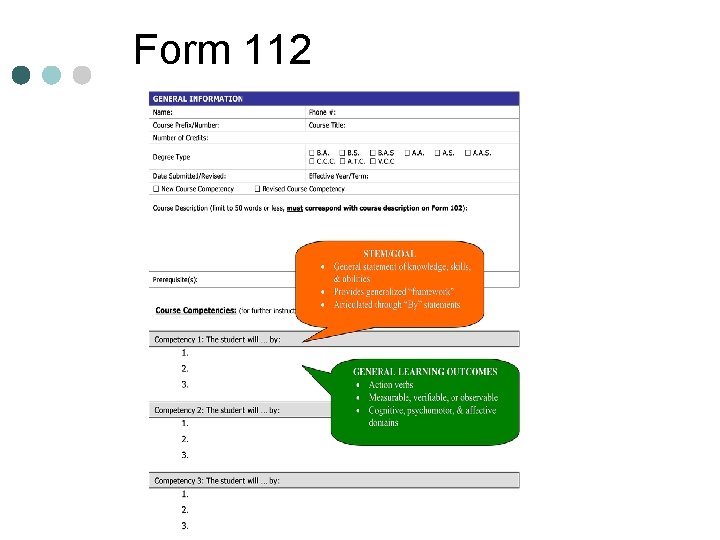
Form 112
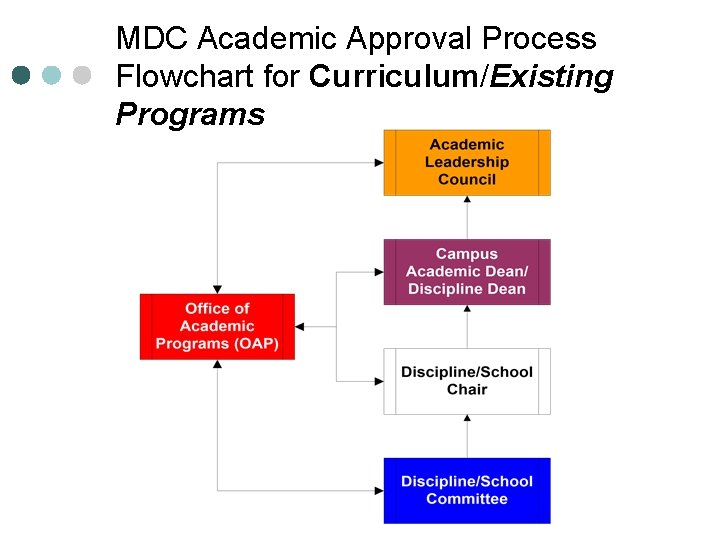
MDC Academic Approval Process Flowchart for Curriculum/Existing Programs
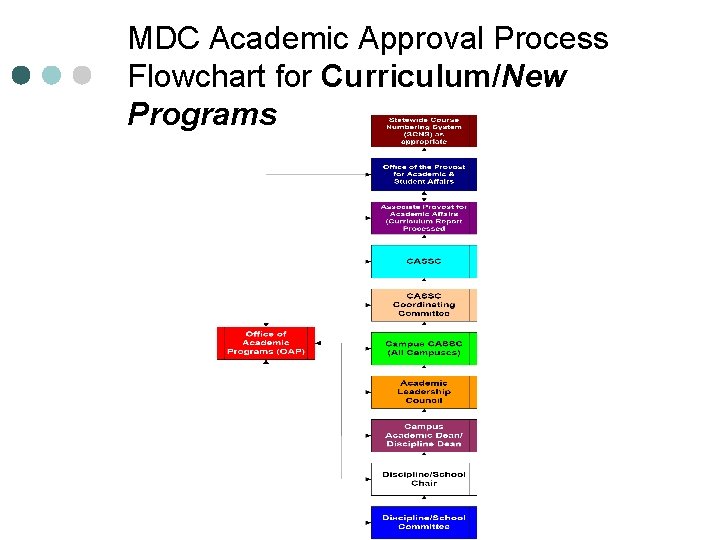
MDC Academic Approval Process Flowchart for Curriculum/New Programs
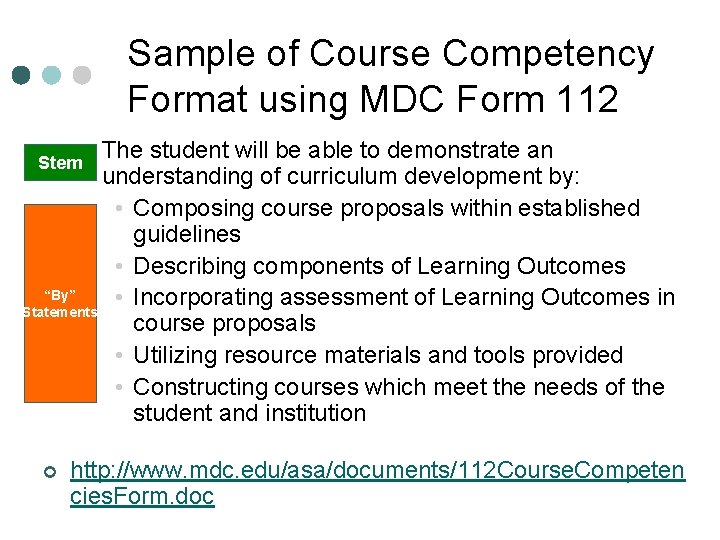
Sample of Course Competency Format using MDC Form 112 The student will be able to demonstrate an understanding of curriculum development by: • Composing course proposals within established guidelines • Describing components of Learning Outcomes “By” • Incorporating assessment of Learning Outcomes in Statements course proposals • Utilizing resource materials and tools provided • Constructing courses which meet the needs of the student and institution l Stem ¢ http: //www. mdc. edu/asa/documents/112 Course. Competen cies. Form. doc
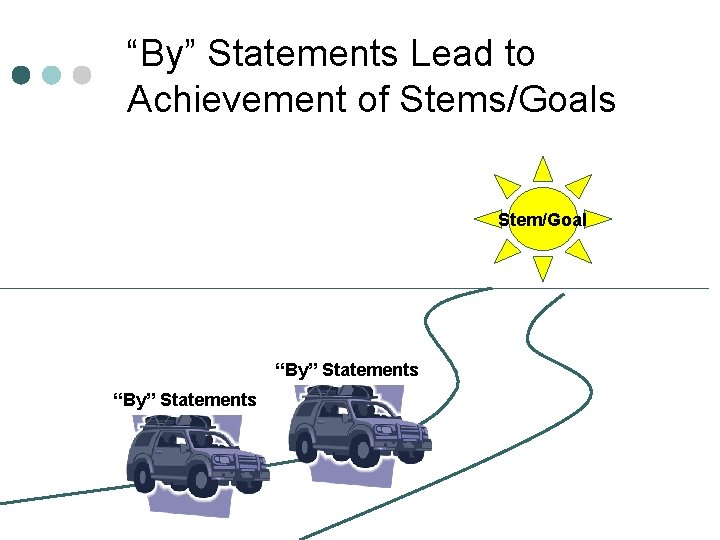
“By” Statements Lead to Achievement of Stems/Goals Stem/Goal “By” Statements
A Course Competency is a… Description of: Competence l Intended result of instruction vs. the process of instruction l Stated in terms of learner performance l
Purpose of Competencies? ¢ Ensure institutional & statewide consistency ¢ Select instructional strategies ¢ Provide framework for learning outcomes assessment ¢ Define discipline and course learning outcomes in relationship to general education outcomes and competencies
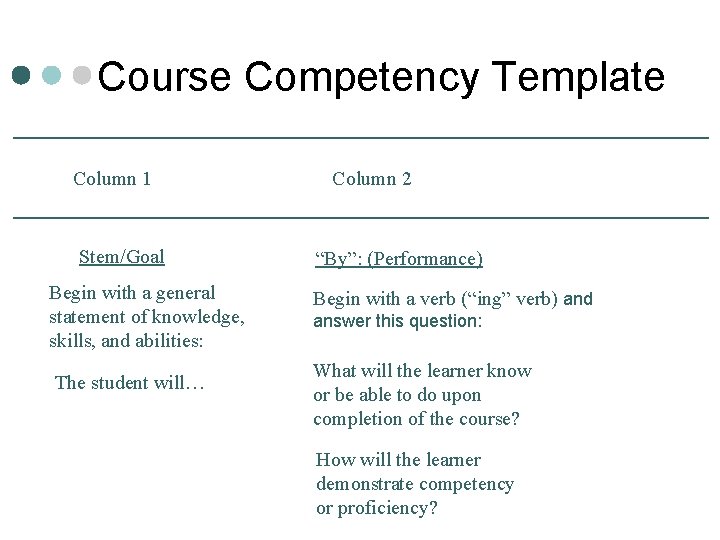
Course Competency Template Column 1 Stem/Goal Begin with a general statement of knowledge, skills, and abilities: The student will… Column 2 “By”: (Performance) Begin with a verb (“ing” verb) and answer this question: What will the learner know or be able to do upon completion of the course? How will the learner demonstrate competency or proficiency?
Course Competency ¢Desired ¢Does results from instruction not precisely clarify what a learner must do or how a learner should perform. (Specific learning outcomes appear in course syllabi)
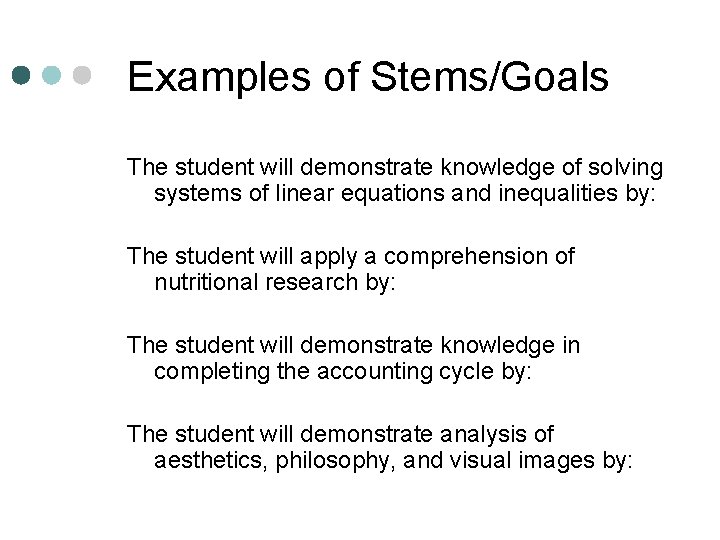
Examples of Stems/Goals The student will demonstrate knowledge of solving systems of linear equations and inequalities by: The student will apply a comprehension of nutritional research by: The student will demonstrate knowledge in completing the accounting cycle by: The student will demonstrate analysis of aesthetics, philosophy, and visual images by:
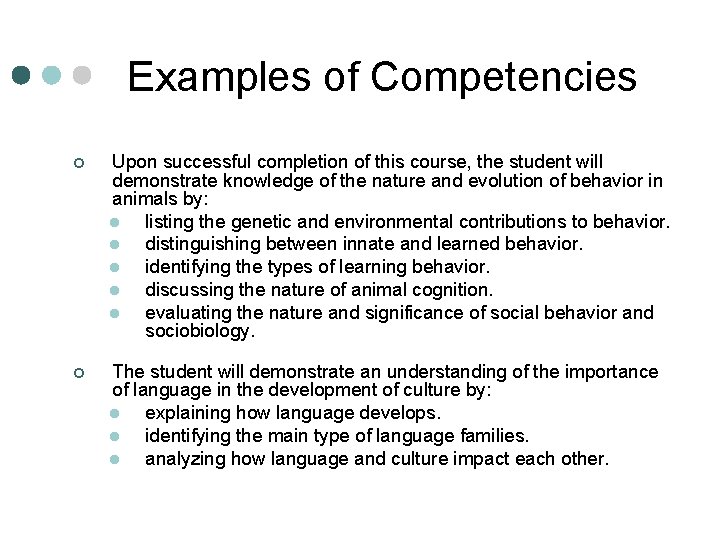
Examples of Competencies ¢ Upon successful completion of this course, the student will demonstrate knowledge of the nature and evolution of behavior in animals by: l listing the genetic and environmental contributions to behavior. l distinguishing between innate and learned behavior. l identifying the types of learning behavior. l discussing the nature of animal cognition. l evaluating the nature and significance of social behavior and sociobiology. ¢ The student will demonstrate an understanding of the importance of language in the development of culture by: l explaining how language develops. l identifying the main type of language families. l analyzing how language and culture impact each other.

Examples of Competencies (cont) ¢ The student will demonstrate an understanding of a visual C++ programming environment by: l creating C++ programs and projects in a visual C++ IDE. l compiling C++ programs and projects in a visual C++ IDE. l testing C++ programs and projects in a visual C++ IDE. l debugging C++ programs and projects in a visual C++ IDE. l executing C++ programs and projects in a visual C++ IDE. ¢ The student will demonstrate knowledge of geometric formulas by: l computing perimeters and areas of plane figures. l computing volumes of solids such as prisms, spheres, right circular cylinders, right circular cones.
Competency vs. Activity A course competency describes student learning outcomes NOT instructor or student activities. Non-examples: ¢ “Viewing specific films and slides on various art movements. ” ¢ “Attending various lectures. ”
Competency vs. Activity Non-examples: ¢ “Studying about the Spanish borderlands and Mexican rule over California, Texas, and New Mexico, and knowing about the revolution in Texas, Manifest Destiny, and the war with Mexico. ” ¢ “Reading relevant media and magazine articles, viewing selected television programs, reading related books and regularly attending class. ”
Course Competency Performance – What should the learner be able to do upon completion of the course? Ask… “What should learners be able to do when demonstrating competency of the task/content? ”
The Performance Component of a Competency (“by” statement) ¢ Select an action verb to describe what learners know or do. ¢ Action verbs must be measurable, verifiable or observable.
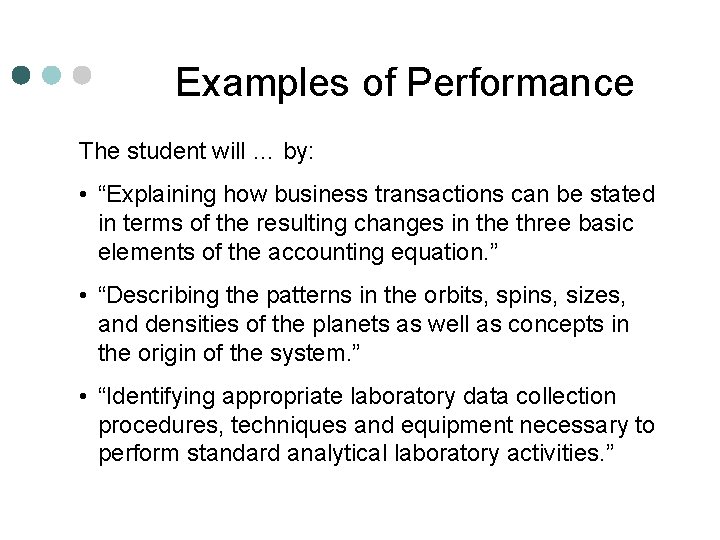
Examples of Performance The student will … by: • “Explaining how business transactions can be stated in terms of the resulting changes in the three basic elements of the accounting equation. ” • “Describing the patterns in the orbits, spins, sizes, and densities of the planets as well as concepts in the origin of the system. ” • “Identifying appropriate laboratory data collection procedures, techniques and equipment necessary to perform standard analytical laboratory activities. ”
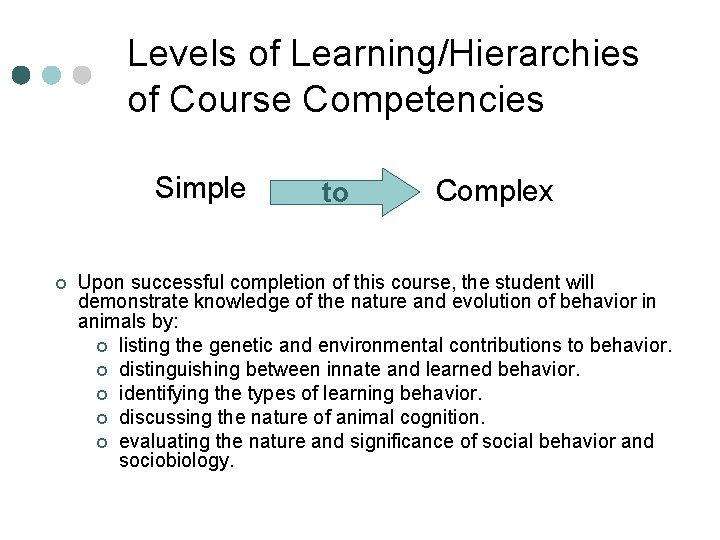
Levels of Learning/Hierarchies of Course Competencies Simple ¢ to Complex Upon successful completion of this course, the student will demonstrate knowledge of the nature and evolution of behavior in animals by: ¢ listing the genetic and environmental contributions to behavior. ¢ distinguishing between innate and learned behavior. ¢ identifying the types of learning behavior. ¢ discussing the nature of animal cognition. ¢ evaluating the nature and significance of social behavior and sociobiology.
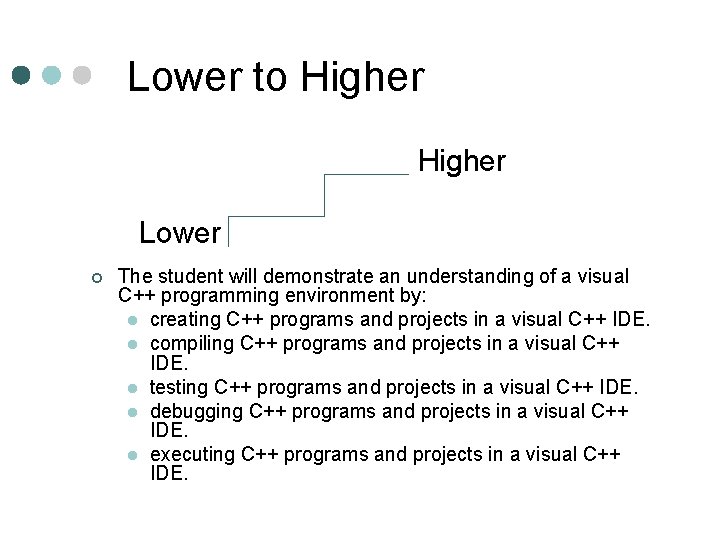
Lower to Higher Lower ¢ The student will demonstrate an understanding of a visual C++ programming environment by: l creating C++ programs and projects in a visual C++ IDE. l compiling C++ programs and projects in a visual C++ IDE. l testing C++ programs and projects in a visual C++ IDE. l debugging C++ programs and projects in a visual C++ IDE. l executing C++ programs and projects in a visual C++ IDE.
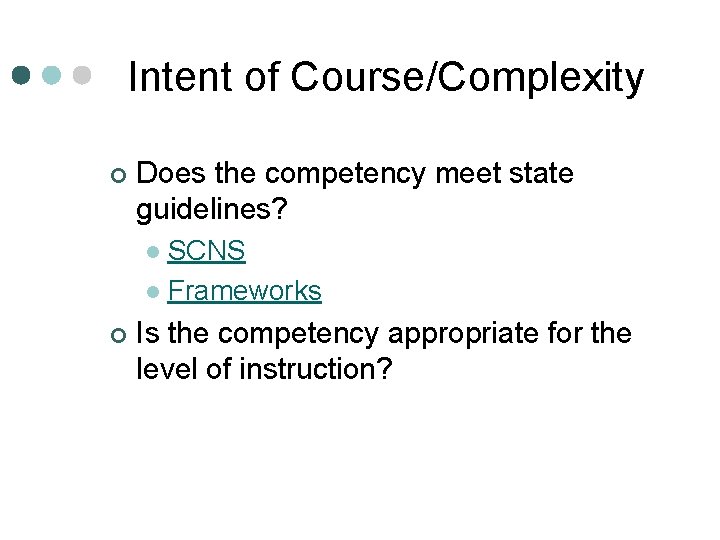
Intent of Course/Complexity ¢ Does the competency meet state guidelines? SCNS l Frameworks l ¢ Is the competency appropriate for the level of instruction?
Cognitive Domains & Taxonomies in Course Competencies
Taxonomy Systematic grouping of outcomes ¢ Share characteristics ¢ Sequential and cumulative order ¢
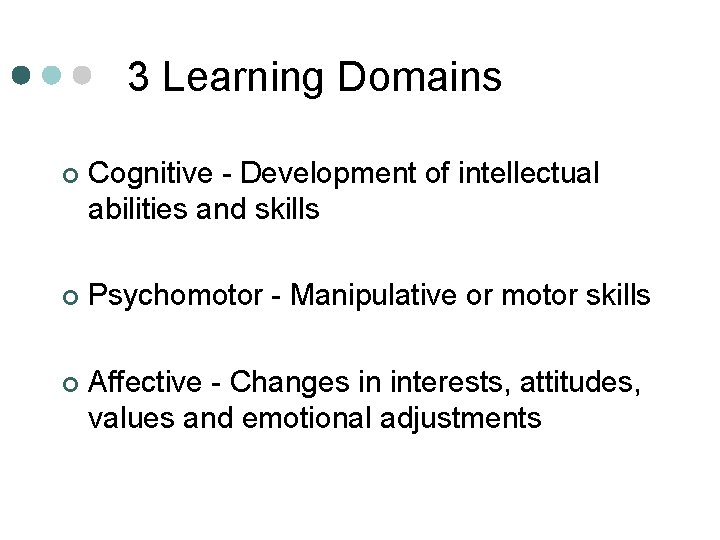
3 Learning Domains ¢ Cognitive - Development of intellectual abilities and skills ¢ Psychomotor - Manipulative or motor skills ¢ Affective - Changes in interests, attitudes, values and emotional adjustments
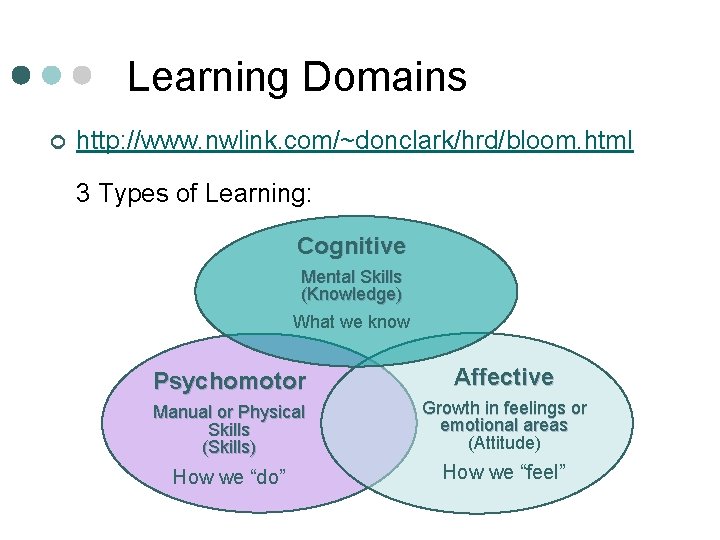
Learning Domains ¢ http: //www. nwlink. com/~donclark/hrd/bloom. html 3 Types of Learning: Cognitive Mental Skills (Knowledge) What we know Psychomotor Affective Manual or Physical Skills (Skills) Growth in feelings or emotional areas (Attitude) How we “do” How we “feel”
Cognitive Domain Bloom (Revised) Includes competencies which deal with remembering information and developing intellectual abilities
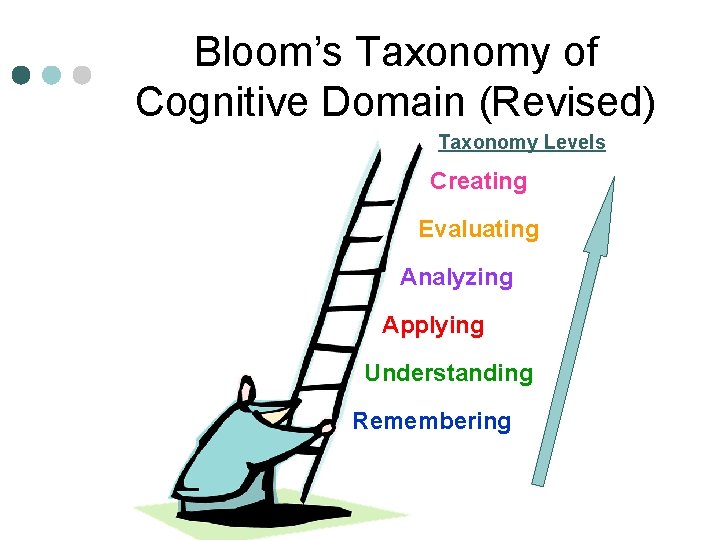
Bloom’s Taxonomy of Cognitive Domain (Revised) Taxonomy Levels Creating Evaluating Analyzing Applying Understanding Remembering
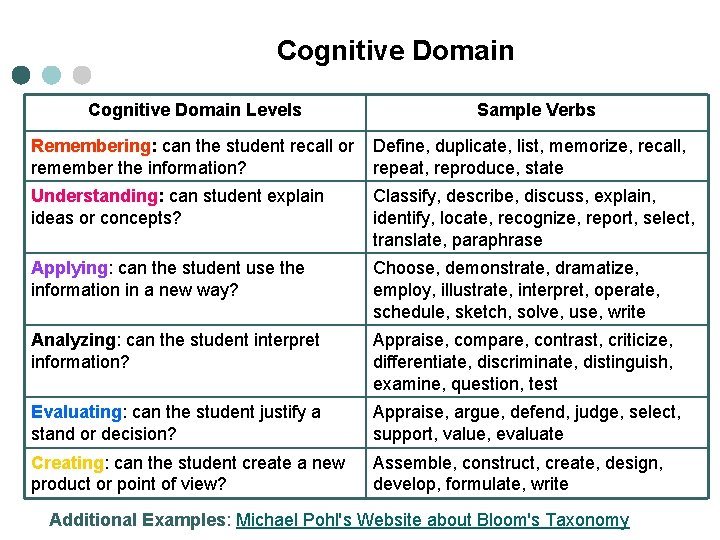
Cognitive Domain Levels Sample Verbs Remembering: can the student recall or remember the information? Define, duplicate, list, memorize, recall, repeat, reproduce, state Understanding: can student explain ideas or concepts? Classify, describe, discuss, explain, identify, locate, recognize, report, select, translate, paraphrase Applying: can the student use the information in a new way? Choose, demonstrate, dramatize, employ, illustrate, interpret, operate, schedule, sketch, solve, use, write Analyzing: can the student interpret information? Appraise, compare, contrast, criticize, differentiate, discriminate, distinguish, examine, question, test Evaluating: can the student justify a stand or decision? Appraise, argue, defend, judge, select, support, value, evaluate Creating: can the student create a new product or point of view? Assemble, construct, create, design, develop, formulate, write Additional Examples: Michael Pohl's Website about Bloom's Taxonomy
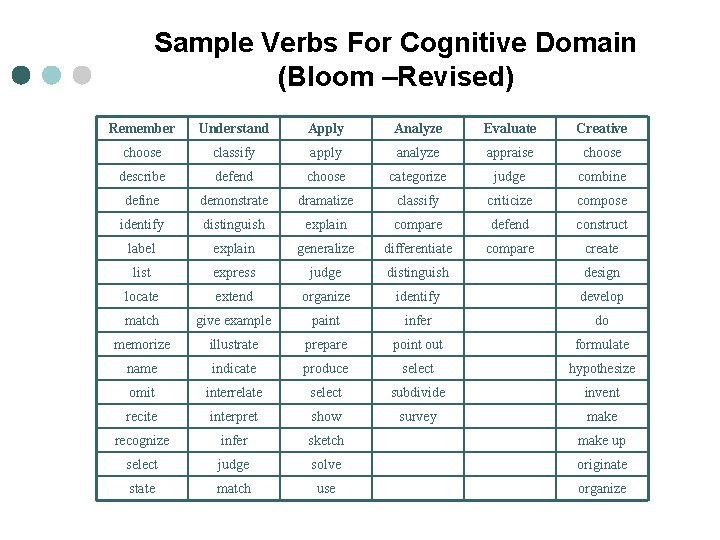
Sample Verbs For Cognitive Domain (Bloom –Revised) Remember Understand Apply Analyze Evaluate Creative choose classify apply analyze appraise choose describe defend choose categorize judge combine define demonstrate dramatize classify criticize compose identify distinguish explain compare defend construct label explain generalize differentiate compare create list express judge distinguish design locate extend organize identify develop match give example paint infer do memorize illustrate prepare point out formulate name indicate produce select hypothesize omit interrelate select subdivide invent recite interpret show survey make recognize infer sketch make up select judge solve originate state match use organize
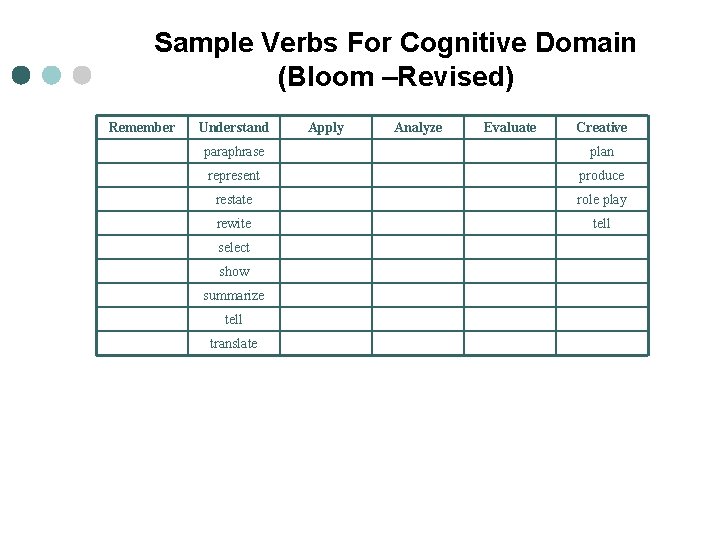
Sample Verbs For Cognitive Domain (Bloom –Revised) Remember Understand Apply Analyze Evaluate Creative paraphrase plan represent produce restate role play rewite tell select show summarize tell translate
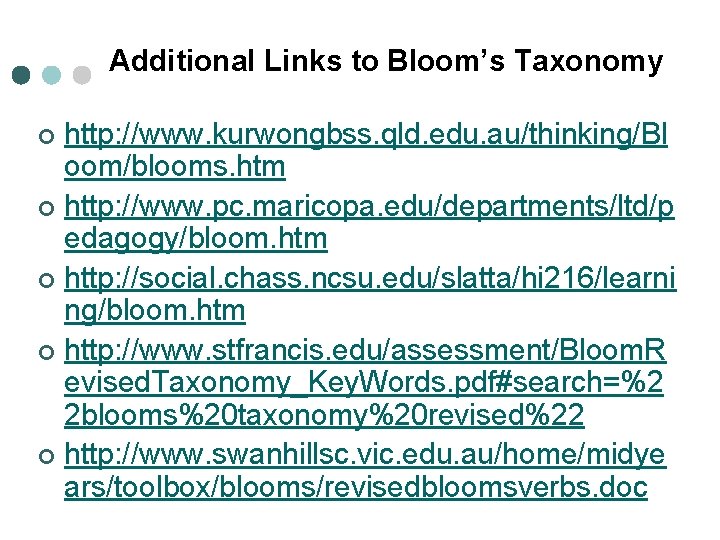
Additional Links to Bloom’s Taxonomy http: //www. kurwongbss. qld. edu. au/thinking/Bl oom/blooms. htm ¢ http: //www. pc. maricopa. edu/departments/ltd/p edagogy/bloom. htm ¢ http: //social. chass. ncsu. edu/slatta/hi 216/learni ng/bloom. htm ¢ http: //www. stfrancis. edu/assessment/Bloom. R evised. Taxonomy_Key. Words. pdf#search=%2 2 blooms%20 taxonomy%20 revised%22 ¢ http: //www. swanhillsc. vic. edu. au/home/midye ars/toolbox/blooms/revisedbloomsverbs. doc ¢
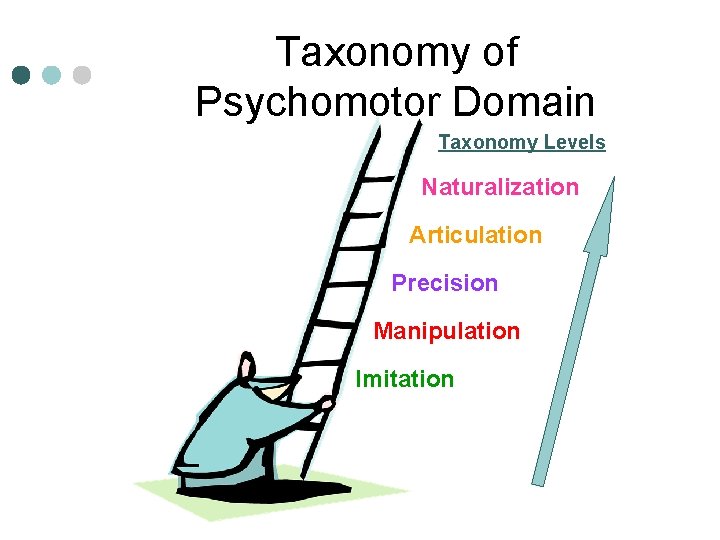
Taxonomy of Psychomotor Domain Taxonomy Levels Naturalization Articulation Precision Manipulation Imitation
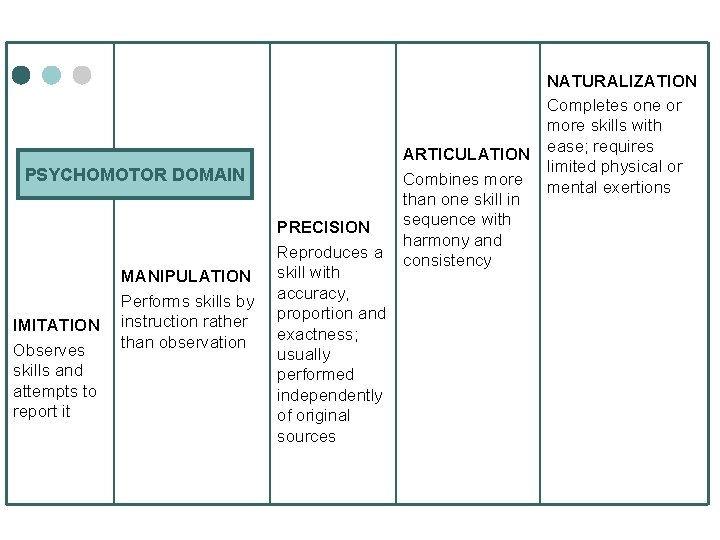
PSYCHOMOTOR DOMAIN IMITATION Observes skills and attempts to report it MANIPULATION Performs skills by instruction rather than observation PRECISION Reproduces a skill with accuracy, proportion and exactness; usually performed independently of original sources NATURALIZATION Completes one or more skills with ARTICULATION ease; requires limited physical or Combines more mental exertions than one skill in sequence with harmony and consistency
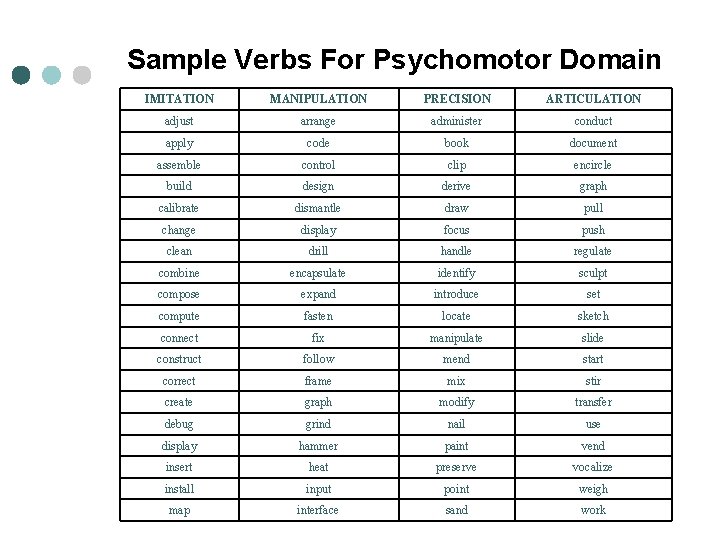
Sample Verbs For Psychomotor Domain IMITATION MANIPULATION PRECISION ARTICULATION adjust arrange administer conduct apply code book document assemble control clip encircle build design derive graph calibrate dismantle draw pull change display focus push clean drill handle regulate combine encapsulate identify sculpt compose expand introduce set compute fasten locate sketch connect fix manipulate slide construct follow mend start correct frame mix stir create graph modify transfer debug grind nail use display hammer paint vend insert heat preserve vocalize install input point weigh map interface sand work
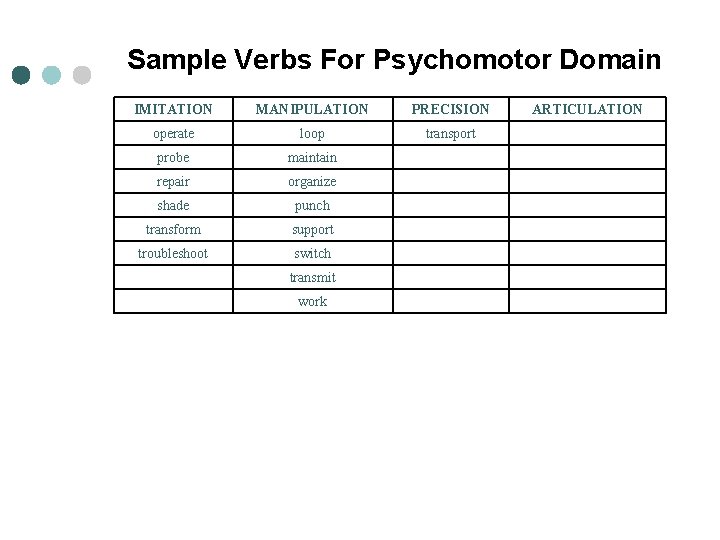
Sample Verbs For Psychomotor Domain IMITATION MANIPULATION PRECISION operate loop transport probe maintain repair organize shade punch transform support troubleshoot switch transmit work ARTICULATION
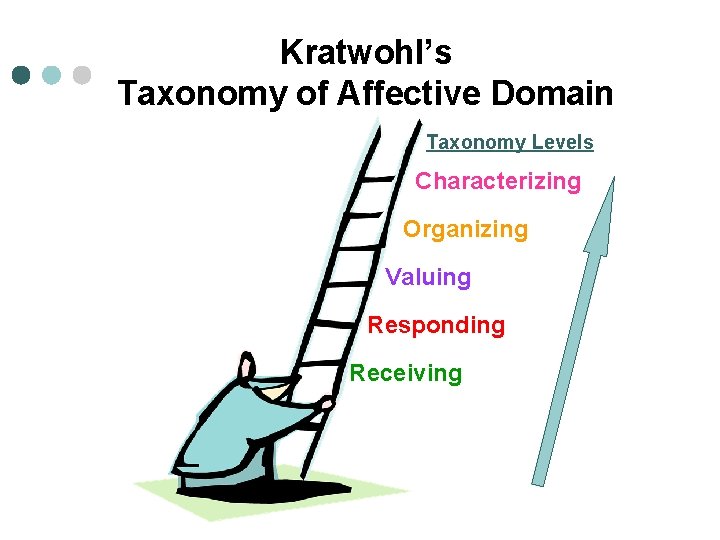
Kratwohl’s Taxonomy of Affective Domain Taxonomy Levels Characterizing Organizing Valuing Responding Receiving
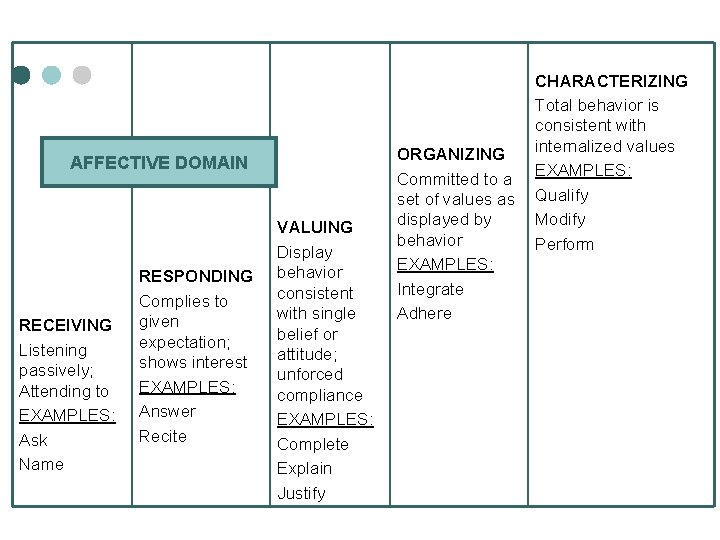
AFFECTIVE DOMAIN RECEIVING Listening passively; Attending to EXAMPLES: Ask Name RESPONDING Complies to given expectation; shows interest EXAMPLES: Answer Recite VALUING Display behavior consistent with single belief or attitude; unforced compliance EXAMPLES: Complete Explain Justify ORGANIZING Committed to a set of values as displayed by behavior EXAMPLES: Integrate Adhere CHARACTERIZING Total behavior is consistent with internalized values EXAMPLES: Qualify Modify Perform
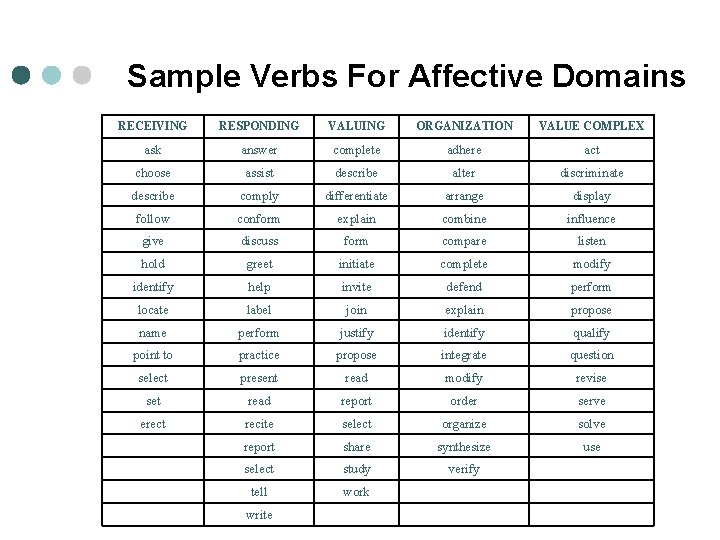
Sample Verbs For Affective Domains RECEIVING RESPONDING VALUING ORGANIZATION VALUE COMPLEX ask answer complete adhere act choose assist describe alter discriminate describe comply differentiate arrange display follow conform explain combine influence give discuss form compare listen hold greet initiate complete modify identify help invite defend perform locate label join explain propose name perform justify identify qualify point to practice propose integrate question select present read modify revise set read report order serve erect recite select organize solve report share synthesize use select study verify tell work write
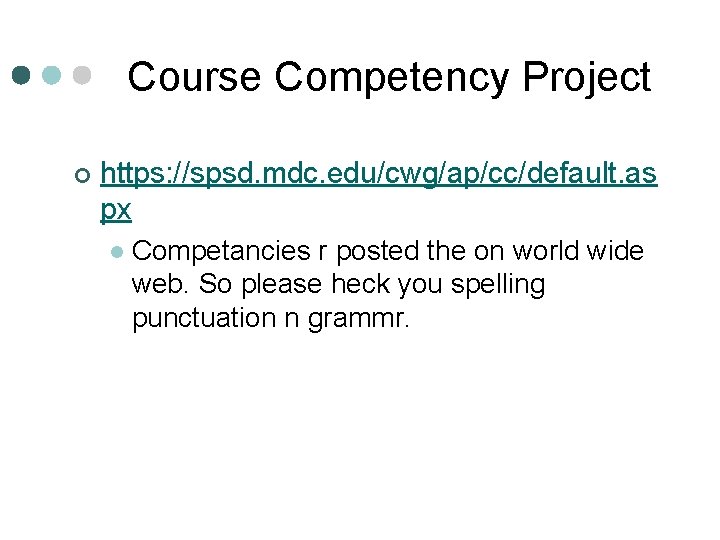
Course Competency Project ¢ https: //spsd. mdc. edu/cwg/ap/cc/default. as px l Competancies r posted the on world wide web. So please heck you spelling punctuation n grammr.
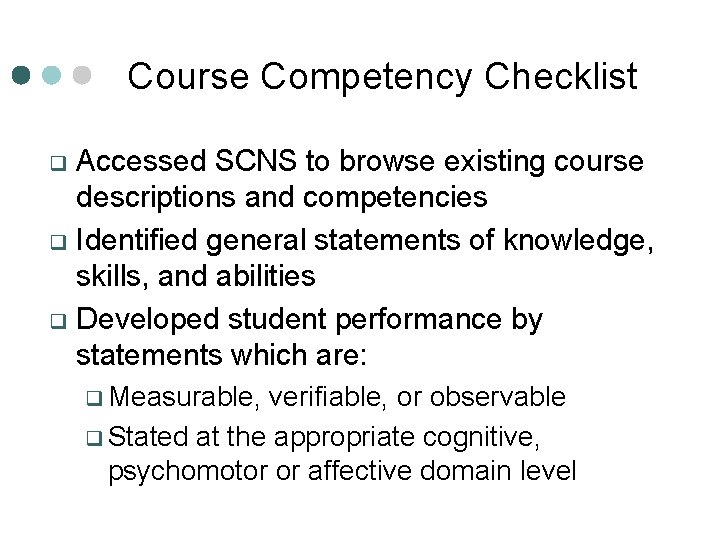
Course Competency Checklist Accessed SCNS to browse existing course descriptions and competencies q Identified general statements of knowledge, skills, and abilities q Developed student performance by statements which are: q q Measurable, verifiable, or observable q Stated at the appropriate cognitive, psychomotor or affective domain level
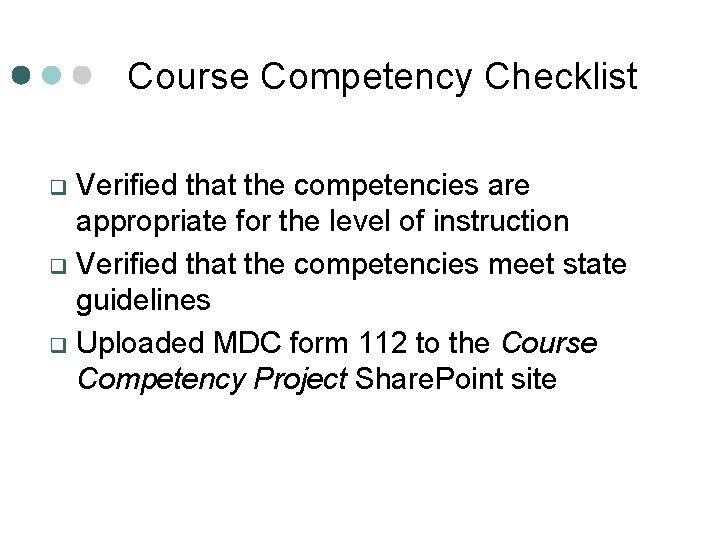
Course Competency Checklist Verified that the competencies are appropriate for the level of instruction q Verified that the competencies meet state guidelines q Uploaded MDC form 112 to the Course Competency Project Share. Point site q
Assessment ¢ Developing Course Competencies Activity ¢ Developing Course Competencies Analysis
- Slides: 46