
Course code 10 CS 74 Advanced Computer Architecture
![Unrolling Loops • • • • • –for (i=1000; i>0; i=i-1) x[i] = x[i]](https://slidetodoc.com/presentation_image_h2/5bb8b01ed6cee3befcc6c7bab879b708/image-4.jpg "Unrolling Loops • • • • • –for (i=1000; i>0; i=i-1) x[i] = x[i]")
![Software pipelined loop • Loop: SD F 4, 16(R 1) #store to v[i] •](https://slidetodoc.com/presentation_image_h2/5bb8b01ed6cee3befcc6c7bab879b708/image-7.jpg "Software pipelined loop • Loop: SD F 4, 16(R 1) #store to v[i] •")
- Slides: 32
Course code: 10 CS 74 Advanced Computer Architecture Chapter-8 HARDWARE AND SOFTWARE FOR VLIW AND EPIC Prepared by : Sandhya Kumari & Dharmalingam. K Department: Computer Science & Engineering
Outline • Exploiting Instruction-Level Parallelism Statically • Detecting and Enhancing Loop-Level Parallelism • Scheduling and Structuring Code for Parallelism • Hardware Support for Exposing Parallelism • Predicated Instructions 07 -01 -2022 2
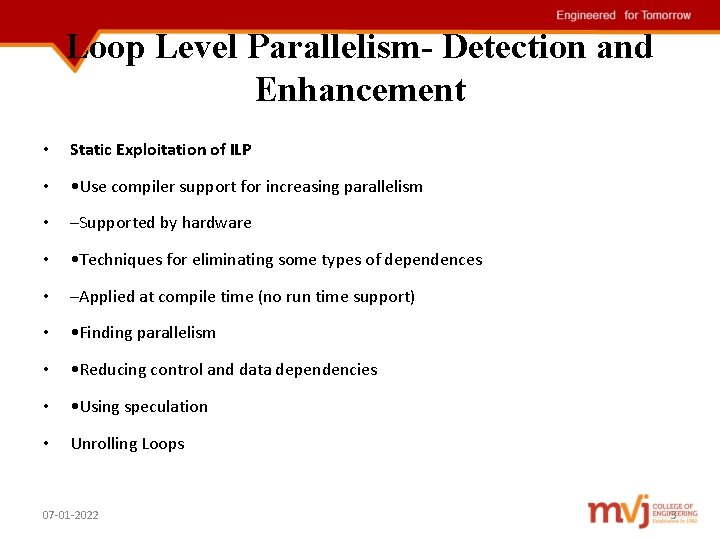
Loop Level Parallelism- Detection and Enhancement • Static Exploitation of ILP • • Use compiler support for increasing parallelism • –Supported by hardware • • Techniques for eliminating some types of dependences • –Applied at compile time (no run time support) • • Finding parallelism • • Reducing control and data dependencies • • Using speculation • Unrolling Loops 07 -01 -2022 3
Unrolling Loops • • • • • –for (i=1000; i>0; i=i-1) x[i] = x[i] + s; –C equivalent of unrolling to block four iterations into one: –for (i=250; i>0; i=i-1) { x[4*i] = x[4*i] + s; x[4*i-1] = x[4*i-1] + s; x[4*i-2] = x[4*i-2] + s; x[4*i-3] = x[4*i-3] + s; } Enhancing Loop-Level Parallelism • Consider the previous running example: –for (i=1000; i>0; i=i-1) x[i] = x[i] + s; –there is no loop-carried dependence – where data used in a later iteration depends on data produced in an earlier one –in other words, all iterations could (conceptually) be executed in parallel • Contrast with the following loop: –for (i=1; i<=100; i=i+1) { A[i+1] = A[i] + C[i]; /* S 1 07 -01 -2022 4
Techniques to increase the amount of ILP • For processor issuing more than one instruction on every clock cycle. • –Loop unrolling, • –software pipelining, • –trace scheduling, and • –superblock scheduling 07 -01 -2022 5
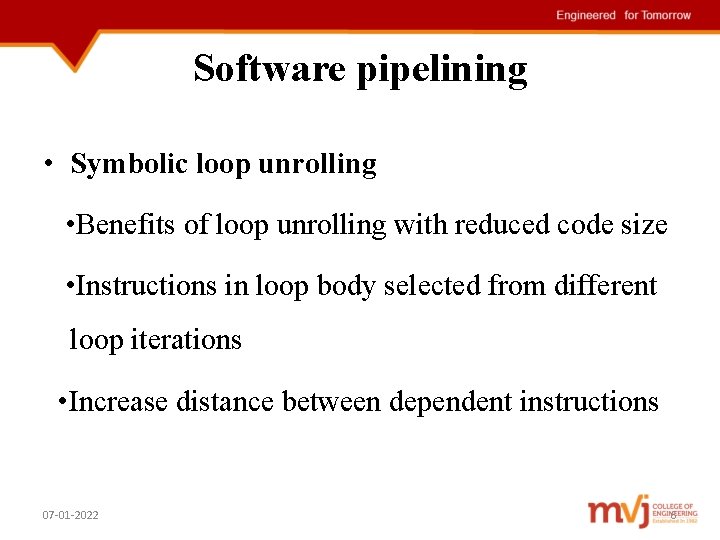
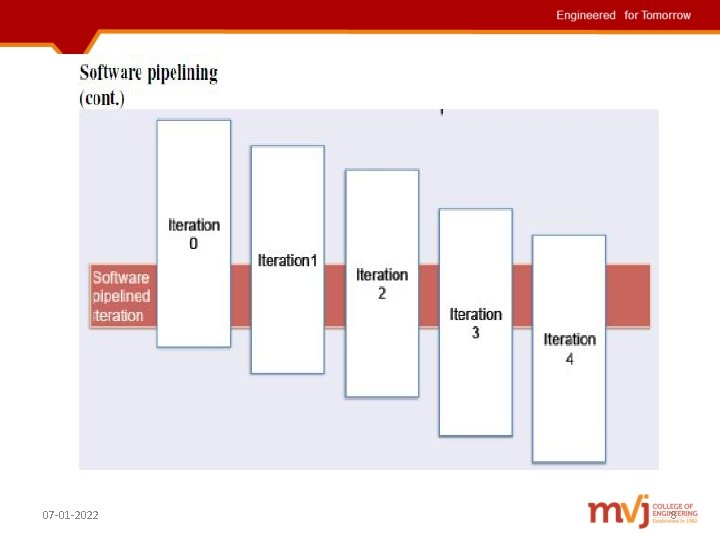
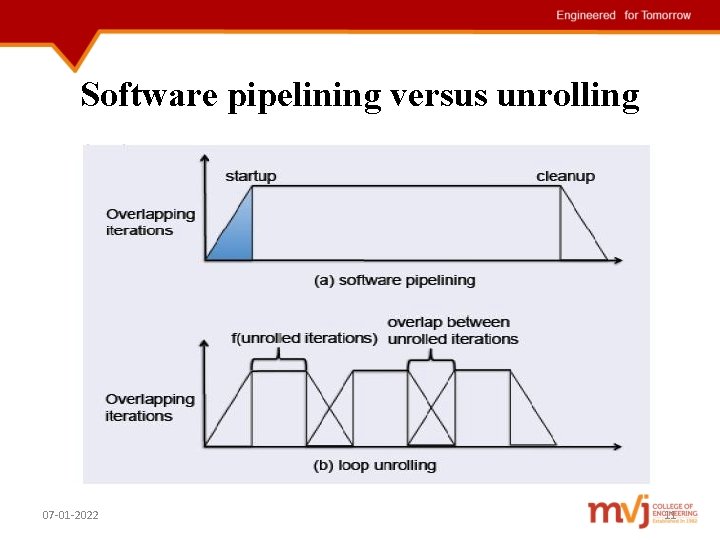
Software pipelining • Symbolic loop unrolling • Benefits of loop unrolling with reduced code size • Instructions in loop body selected from different loop iterations • Increase distance between dependent instructions 07 -01 -2022 6
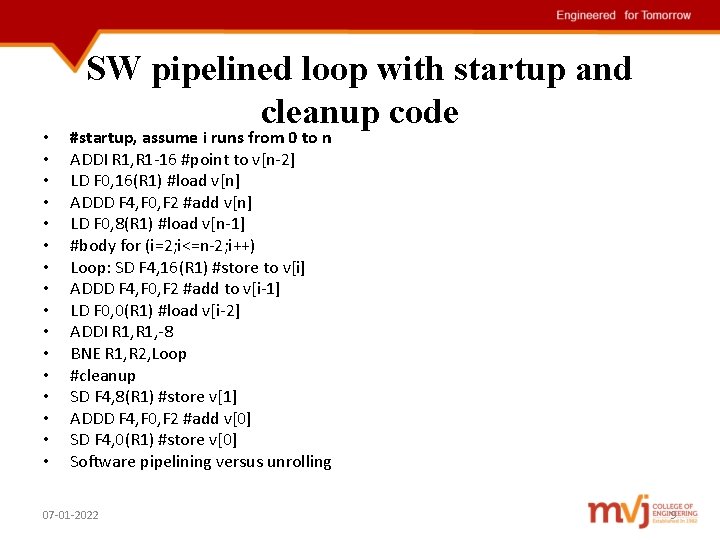
Software pipelined loop • Loop: SD F 4, 16(R 1) #store to v[i] • ADDD F 4, F 0, F 2 #add to v[i-1] • LD F 0, 0(R 1) #load v[i-2] • ADDI R 1, -8 • BNE R 1, R 2, Loop • 5 cycles/iteration (with dynamic scheduling and renaming) • Need startup/cleanup code • SW pipelining 07 -01 -2022 7
07 -01 -2022 8
• • • • SW pipelined loop with startup and cleanup code #startup, assume i runs from 0 to n ADDI R 1, R 1 -16 #point to v[n-2] LD F 0, 16(R 1) #load v[n] ADDD F 4, F 0, F 2 #add v[n] LD F 0, 8(R 1) #load v[n-1] #body for (i=2; i<=n-2; i++) Loop: SD F 4, 16(R 1) #store to v[i] ADDD F 4, F 0, F 2 #add to v[i-1] LD F 0, 0(R 1) #load v[i-2] ADDI R 1, -8 BNE R 1, R 2, Loop #cleanup SD F 4, 8(R 1) #store v[1] ADDD F 4, F 0, F 2 #add v[0] SD F 4, 0(R 1) #store v[0] Software pipelining versus unrolling 07 -01 -2022 9
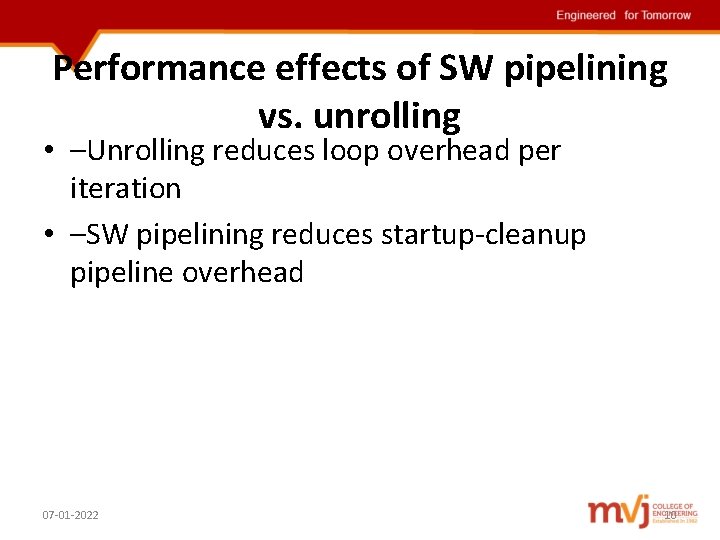
Performance effects of SW pipelining vs. unrolling • –Unrolling reduces loop overhead per iteration • –SW pipelining reduces startup-cleanup pipeline overhead 07 -01 -2022 10
Software pipelining versus unrolling 07 -01 -2022 11
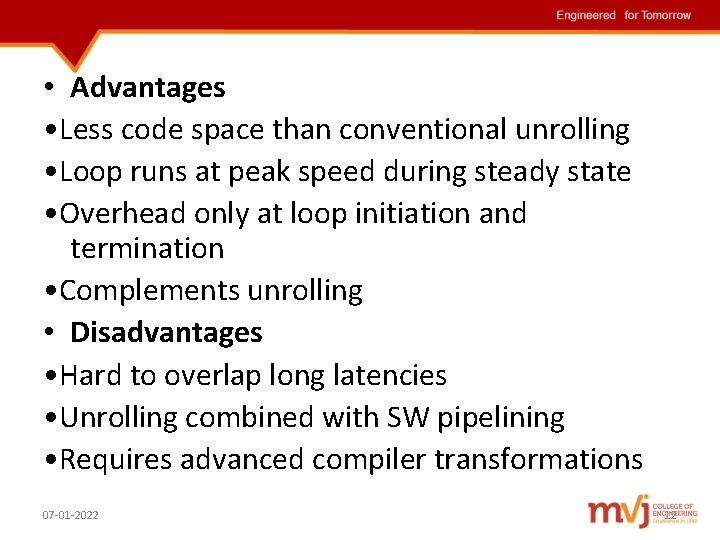
• Advantages • Less code space than conventional unrolling • Loop runs at peak speed during steady state • Overhead only at loop initiation and termination • Complements unrolling • Disadvantages • Hard to overlap long latencies • Unrolling combined with SW pipelining • Requires advanced compiler transformations 07 -01 -2022 12
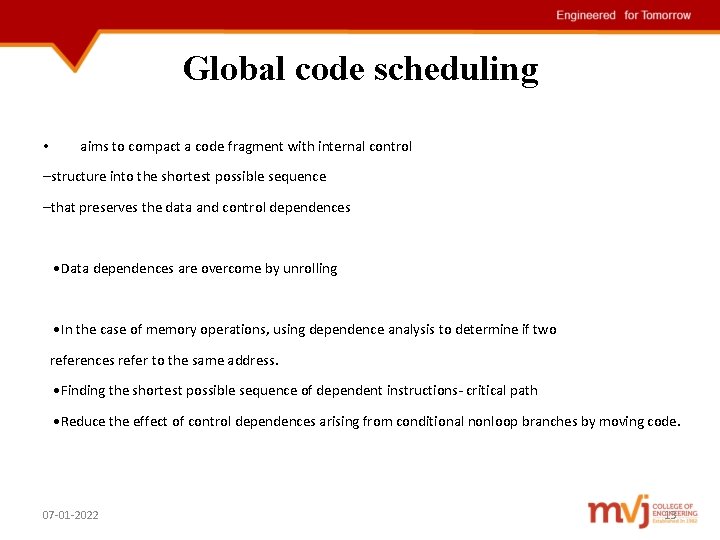
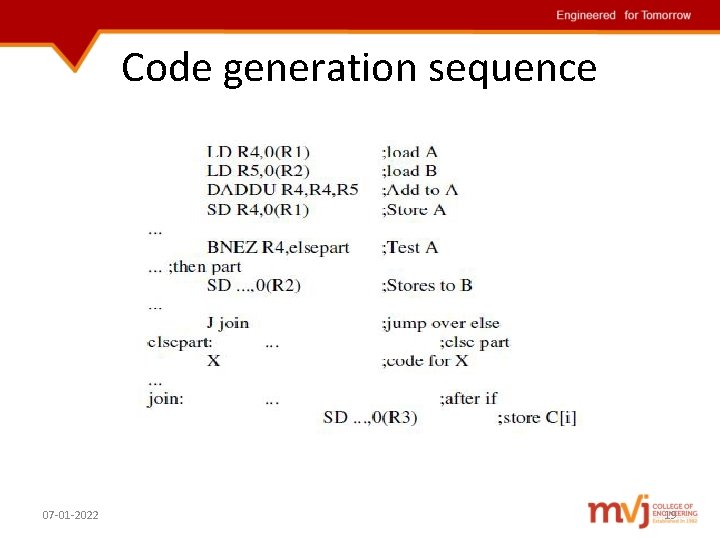
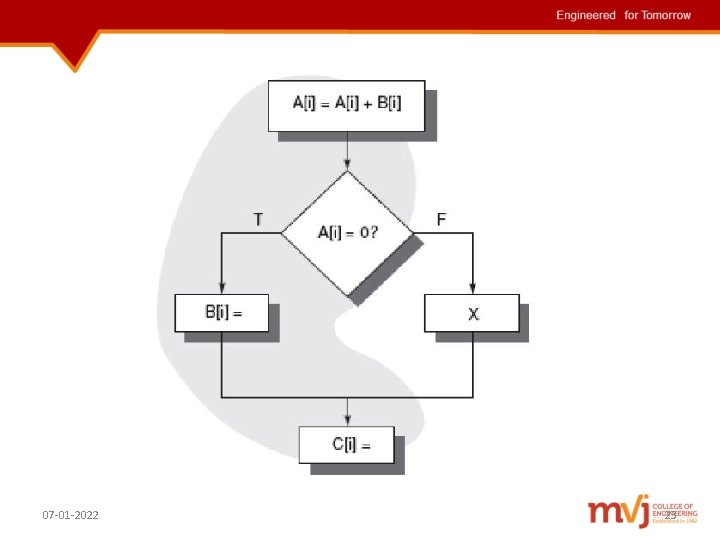
Global code scheduling • aims to compact a code fragment with internal control –structure into the shortest possible sequence –that preserves the data and control dependences • Data dependences are overcome by unrolling • In the case of memory operations, using dependence analysis to determine if two references refer to the same address. • Finding the shortest possible sequence of dependent instructions- critical path • Reduce the effect of control dependences arising from conditional nonloop branches by moving code. 07 -01 -2022 13
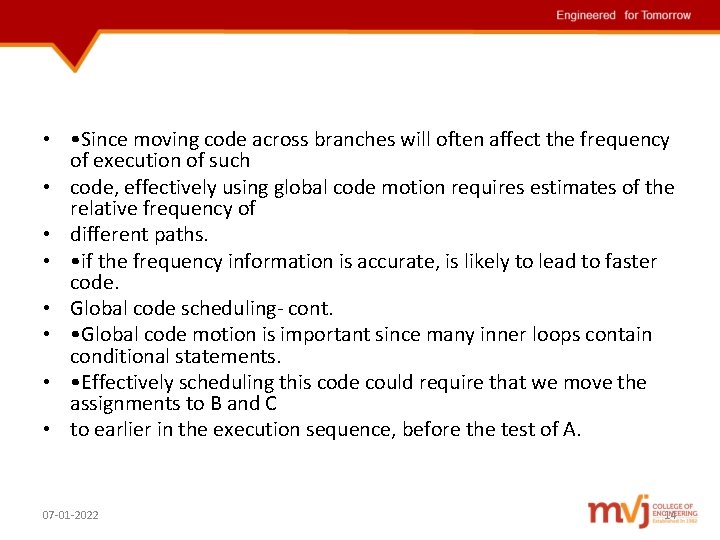
• • Since moving code across branches will often affect the frequency of execution of such • code, effectively using global code motion requires estimates of the relative frequency of • different paths. • • if the frequency information is accurate, is likely to lead to faster code. • Global code scheduling- cont. • • Global code motion is important since many inner loops contain conditional statements. • • Effectively scheduling this code could require that we move the assignments to B and C • to earlier in the execution sequence, before the test of A. 07 -01 -2022 14
• Factors for compiler • • Global code scheduling is an extremely complex problem • –What are the relative execution frequencies • –What is the cost of executing the computation 07 -01 -2022 15
• How will the movement of B change the execution time • –Is B the best code fragment that can be moved • –What is the cost of the compensation code 07 -01 -2022 16
07 -01 -2022 17
07 -01 -2022 18
Code generation sequence 07 -01 -2022 19
Trace Scheduling, Superblocks and Predicated Instructions • For processor issuing more than one instruction on every clock cycle. –Loop unrolling, –software pipelining, –trace scheduling, and –superblock scheduling 07 -01 -2022 20
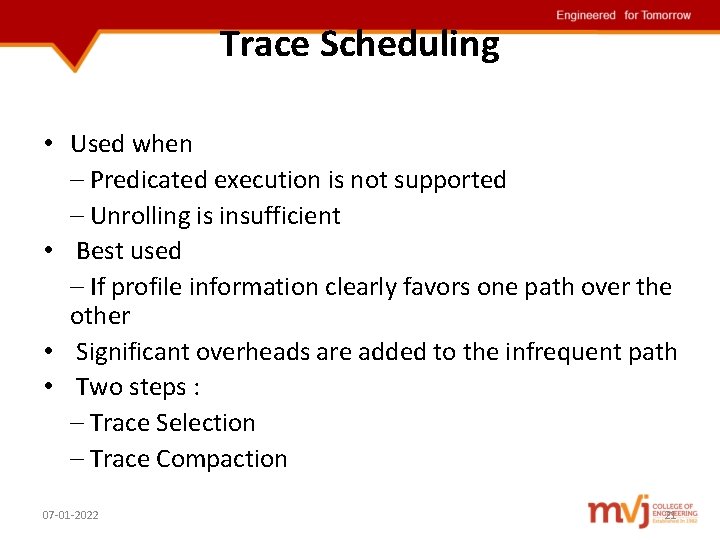
Trace Scheduling • Used when – Predicated execution is not supported – Unrolling is insufficient • Best used – If profile information clearly favors one path over the other • Significant overheads are added to the infrequent path • Two steps : – Trace Selection – Trace Compaction 07 -01 -2022 21
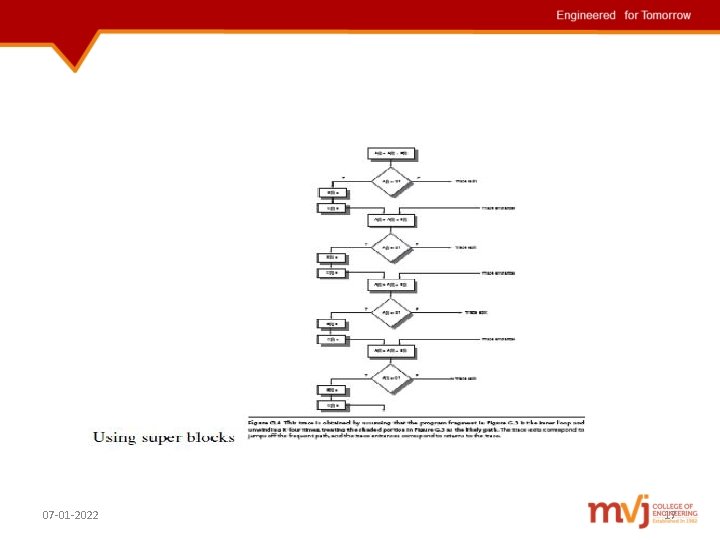
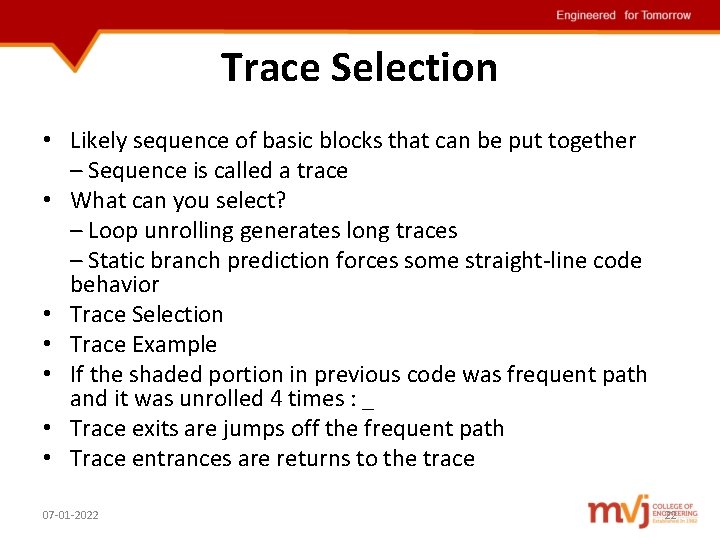
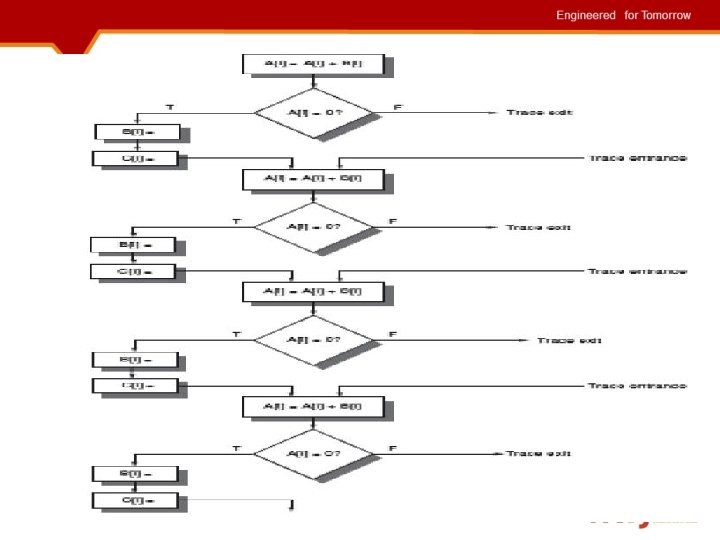
Trace Selection • Likely sequence of basic blocks that can be put together – Sequence is called a trace • What can you select? – Loop unrolling generates long traces – Static branch prediction forces some straight-line code behavior • Trace Selection • Trace Example • If the shaded portion in previous code was frequent path and it was unrolled 4 times : _ • Trace exits are jumps off the frequent path • Trace entrances are returns to the trace 07 -01 -2022 22
07 -01 -2022 23
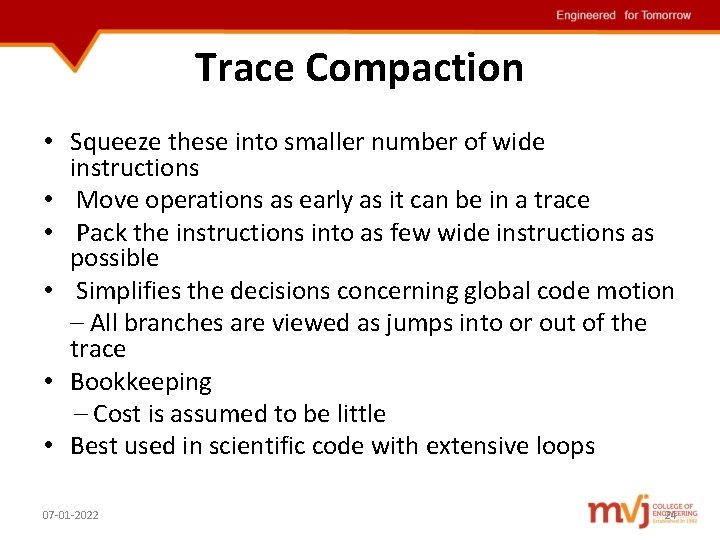
Trace Compaction • Squeeze these into smaller number of wide instructions • Move operations as early as it can be in a trace • Pack the instructions into as few wide instructions as possible • Simplifies the decisions concerning global code motion – All branches are viewed as jumps into or out of the trace • Bookkeeping – Cost is assumed to be little • Best used in scientific code with extensive loops 07 -01 -2022 24
07 -01 -2022 25
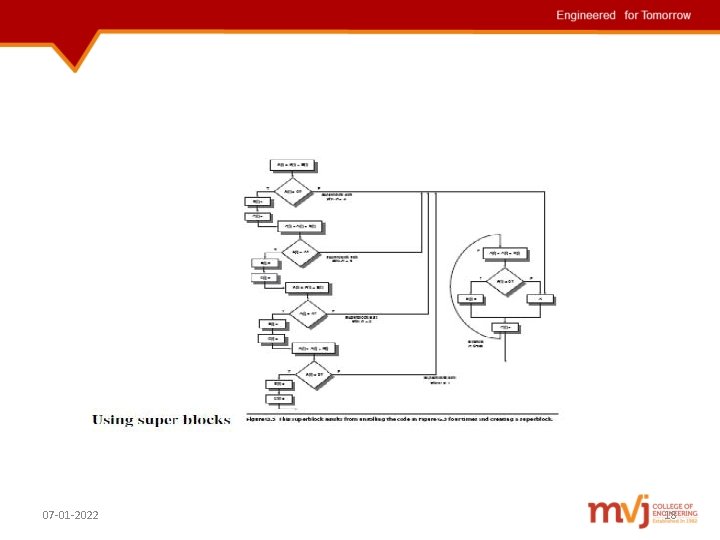
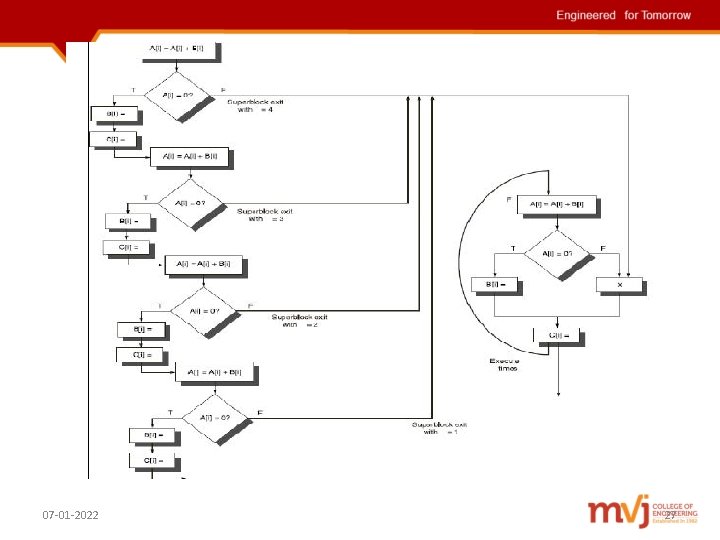
Super Blocks for Global Scheduling • • • Motivation : – Entries and exits into trace schedule code are complicated – Compiler cannot do a good cost analysis about compensation code Superblocks – Are like traces – One entry point Unlike traces – Different exit points – Common in for loops Single entry and exit points Code motion across exit only need be considered 07 -01 -2022 26
07 -01 -2022 27
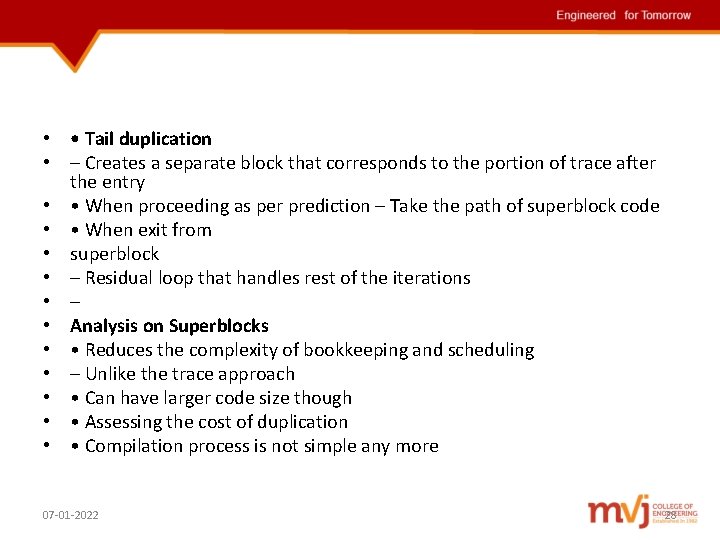
• • Tail duplication • – Creates a separate block that corresponds to the portion of trace after the entry • • When proceeding as per prediction – Take the path of superblock code • • When exit from • superblock • – Residual loop that handles rest of the iterations • – • Analysis on Superblocks • • Reduces the complexity of bookkeeping and scheduling • – Unlike the trace approach • • Can have larger code size though • • Assessing the cost of duplication • • Compilation process is not simple any more 07 -01 -2022 28
H/W Support : Conditional Execution • Also known as Predicated Execution – Enhancement to instruction set – Can be used to eliminate branches – All control dependences are converted to data dependences • Instruction refers to a condition – Evaluated as part of the execution • True? – Executed normally • False? – Execution continues as if the instruction were a no-op • Example : – Conditional move between registers 07 -01 -2022 29
• Example if (A==0) S = T; Straightforward Code BNEZ R 1, L; ADDU R 2, R 3, R 0 L: Conditional Code CMOVZ R 2, R 3, R 1 Annulled if R 1 is not 0 • Conditional Instruction … • Can convert control to data dependence • In vector computing, it’s called if conversion. • Traditionally, in a pipelined system – Dependence has to be resolved closer to front of pipeline • For conditional execution – Dependence is resolved at end of pipeline, closer to the register write 07 -01 -2022 30
Limitations of Conditional Moves • Conditional moves are the simplest form of predicated instructions • Useful for short sequences • For large code, this can be inefficient – Introduces many conditional moves • Some architectures support full predication – All instructions, not just moves • Very useful in global scheduling – Can handle nonloop branches nicely – Eg : The whole if portion can be predicated if the frequent path is not taken 07 -01 -2022 31
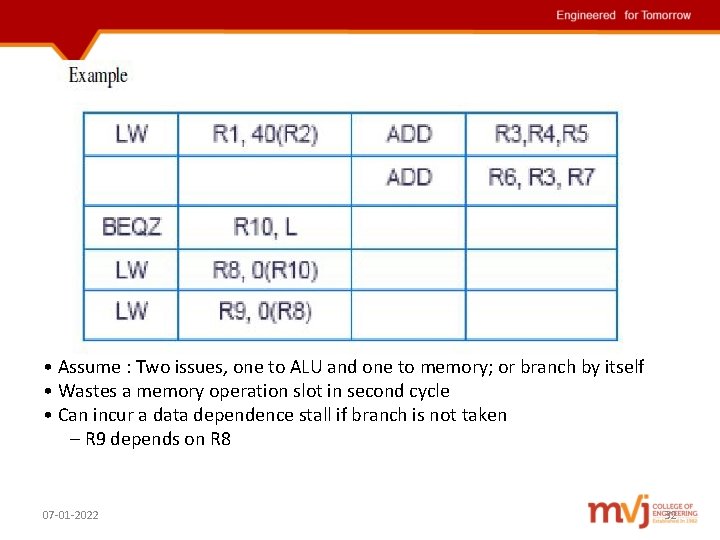
• Assume : Two issues, one to ALU and one to memory; or branch by itself • Wastes a memory operation slot in second cycle • Can incur a data dependence stall if branch is not taken – R 9 depends on R 8 07 -01 -2022 32