
Course code 10 CS 62 Unix Process Engineered
![Engineered for Tomorrow MAIN FUNCTION • PROTOTYPE: int main(int argc, char *argv[ ]); Argc](https://slidetodoc.com/presentation_image_h2/988b535a8d045086069d96bb56abf213/image-4.jpg "Engineered for Tomorrow MAIN FUNCTION • PROTOTYPE: int main(int argc, char *argv[ ]); Argc")
- Slides: 56
Course code: 10 CS 62 Unix Process Engineered for Tomorrow Prepared by : Department of CSE.
Engineered for Tomorrow Contents • • Main function Process Termination Command-Line Arguments Environment List Memory Layout of a C Program Shared Libraries Memory Allocation Environment Variables
Engineered for Tomorrow Continued • setjmp and longjmp Functions • Getrlimit and Setrlimit Functions • UNIX Kernel Support for Processes. …
Engineered for Tomorrow MAIN FUNCTION • PROTOTYPE: int main(int argc, char *argv[ ]); Argc – is the number of command line arguments argv [ ] – is an array of pointers to the arguments
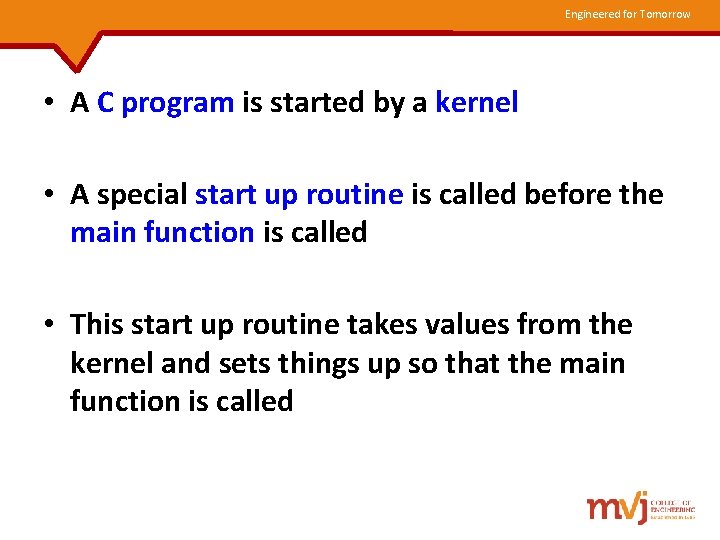
Engineered for Tomorrow • A C program is started by a kernel • A special start up routine is called before the main function is called • This start up routine takes values from the kernel and sets things up so that the main function is called
Engineered for Tomorrow Process termination • Normal termination * return from main * calling exit * calling _exit * Return of the last thread from its start routine. * calling pthread_exit from the last thread.
Engineered for Tomorrow • Abnormal termination * calling abort * terminated by a signal * response of last thread to a cancellation request.
Engineered for Tomorrow exit and _exit functions • _exit returns to kernel immediately • exit performs certain cleanup processing and then returns to kernel • PROTOTYPE #include <unistd. h> void _exit (int status) #include<stdlib. h> void exit (int status) void _Exit(int status);
Engineered for Tomorrow • The exit status is undefined if 1. Any of these function is called without an exit status 2. Main does a return without a return value 3. Main “falls of the end”
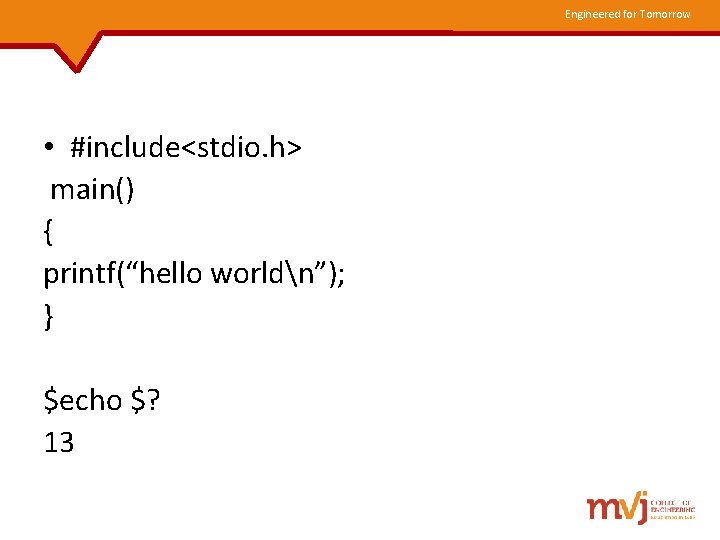
Engineered for Tomorrow • #include<stdio. h> main() { printf(“hello worldn”); } $echo $? 13
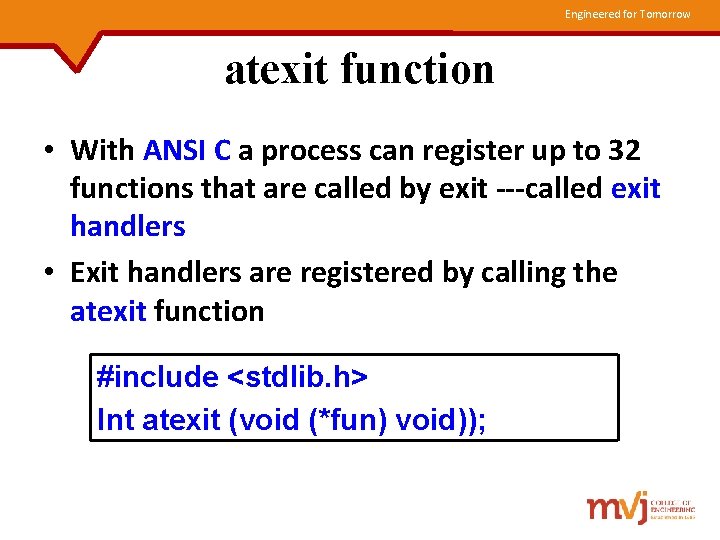
Engineered for Tomorrow atexit function • With ANSI C a process can register up to 32 functions that are called by exit ---called exit handlers • Exit handlers are registered by calling the atexit function #include <stdlib. h> Int atexit (void (*fun) void));
Engineered for Tomorrow • Atexit function calls these functions in reverse order of their registration • Each function is called as many times as it was registered
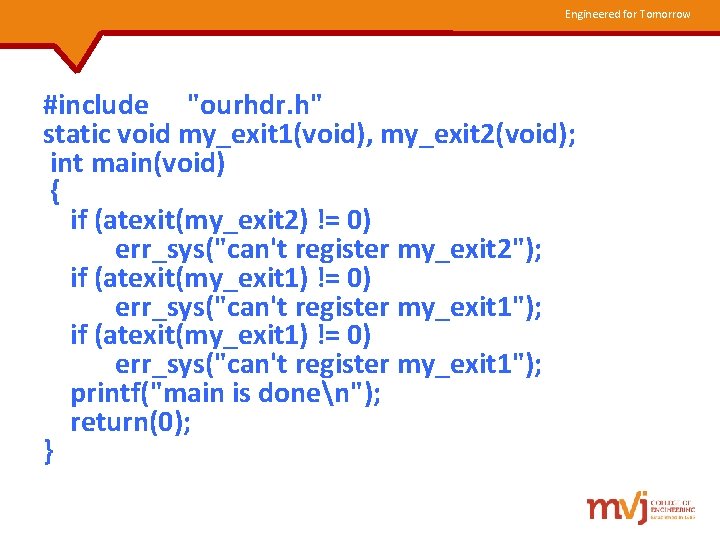
Engineered for Tomorrow #include "ourhdr. h" static void my_exit 1(void), my_exit 2(void); int main(void) { if (atexit(my_exit 2) != 0) err_sys("can't register my_exit 2"); if (atexit(my_exit 1) != 0) err_sys("can't register my_exit 1"); printf("main is donen"); return(0); }
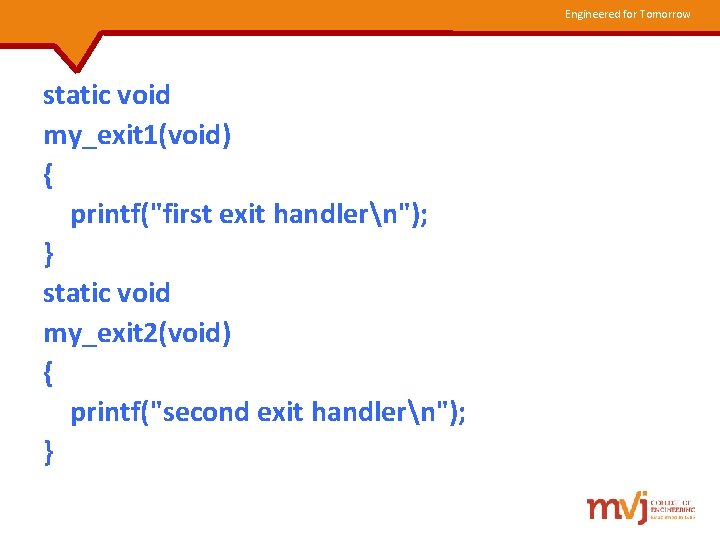
Engineered for Tomorrow static void my_exit 1(void) { printf("first exit handlern"); } static void my_exit 2(void) { printf("second exit handlern"); }
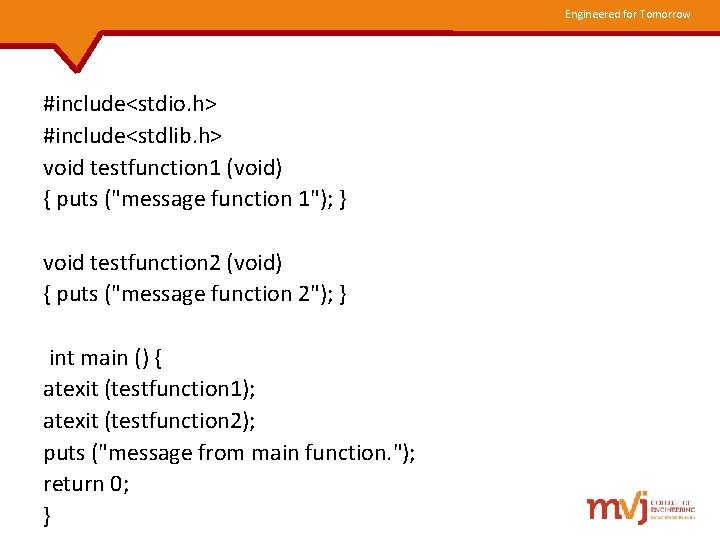
Engineered for Tomorrow #include<stdio. h> #include<stdlib. h> void testfunction 1 (void) { puts ("message function 1"); } void testfunction 2 (void) { puts ("message function 2"); } int main () { atexit (testfunction 1); atexit (testfunction 2); puts ("message from main function. "); return 0; }
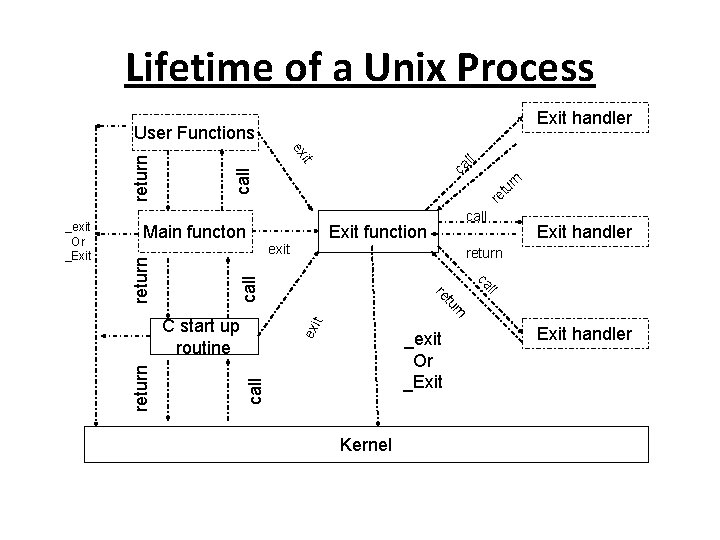
Lifetime of a Unix Process Exit handler call rn tu re call Exit function exit Exit handler ll ca call return rn tu re return Main functon ex it C start up routine _exit Or _Exit call return ll ca it _exit Or _Exit ex return User Functions Kernel Exit handler
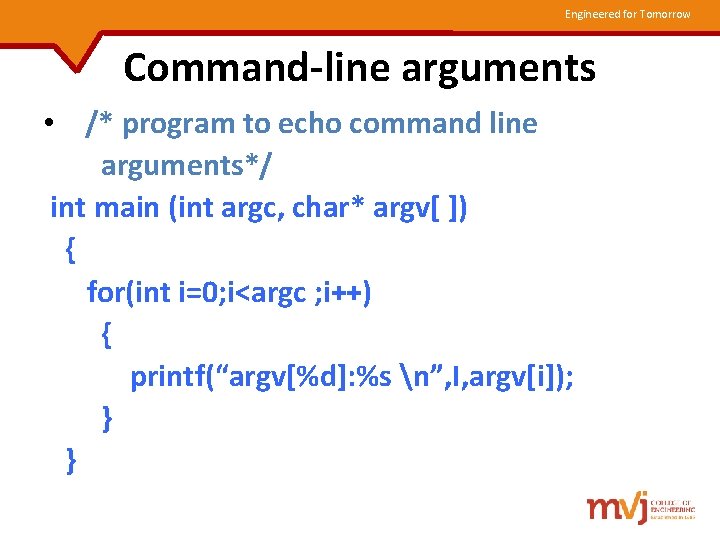
Engineered for Tomorrow Command-line arguments • /* program to echo command line arguments*/ int main (int argc, char* argv[ ]) { for(int i=0; i<argc ; i++) { printf(“argv[%d]: %s n”, I, argv[i]); } }
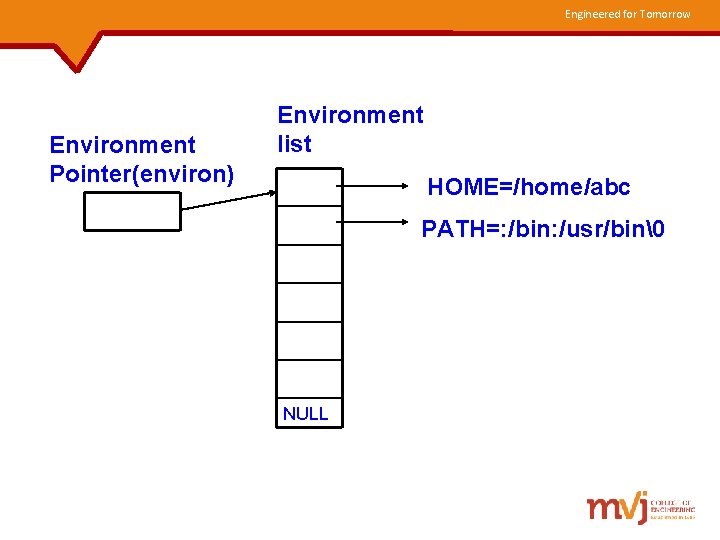
Engineered for Tomorrow Environment list • Environment list – is an array of character pointers , where each pointer contains the address of a null terminated C string • The address of array of pointers is contained in global variable environ • extern char **environ; • each string is of the form name=value
Engineered for Tomorrow Environment Pointer(environ) Environment list HOME=/home/abc PATH=: /bin: /usr/bin NULL
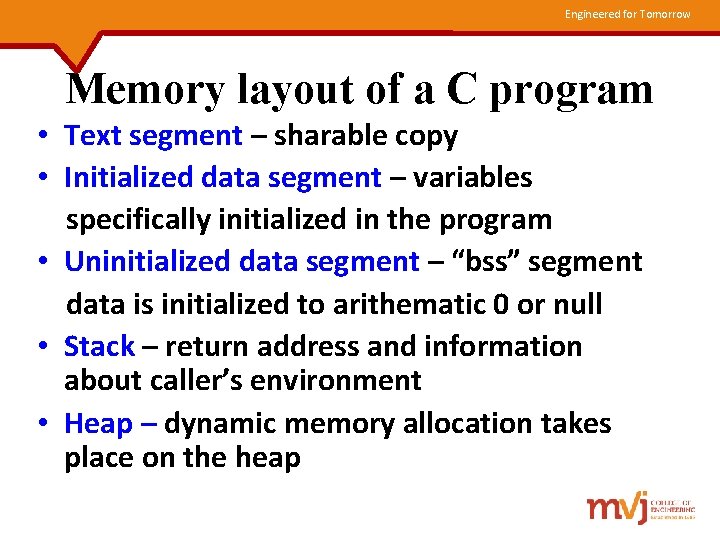
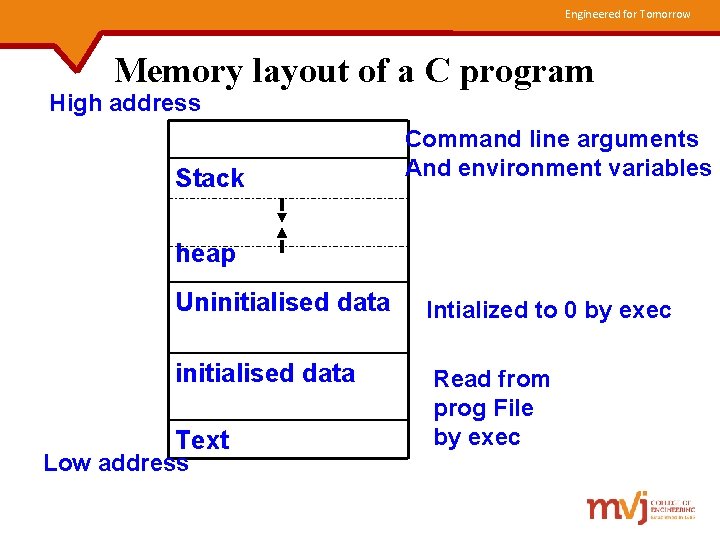
Engineered for Tomorrow Memory layout of a C program • Text segment – sharable copy • Initialized data segment – variables specifically initialized in the program • Uninitialized data segment – “bss” segment data is initialized to arithematic 0 or null • Stack – return address and information about caller’s environment • Heap – dynamic memory allocation takes place on the heap
Engineered for Tomorrow Memory layout of a C program High address Stack Command line arguments And environment variables heap Uninitialised data Text Low address Intialized to 0 by exec Read from prog File by exec
Engineered for Tomorrow • Text segment : also known as a code segment or simply as text, contains only executable instructions. • The text segment is sharable so that only a single copy needs to be in memory for frequently executed programs, such as text editors, the C compiler, the shells, and so on. • Also, the text segment is often read-only, to prevent a program from accidentally modifying its instructions.
Engineered for Tomorrow • Initialized Data Segment: • Initialized data segment, usually called simply the Data Segment. A data segment is a portion of virtual address space of a program, which contains the global variables and static variables that are initialized by the programmer. • Data segment is not read-only, since the values of the variables can be altered at run time.
Engineered for Tomorrow • Uninitialized Data Segment: • Data in this segment is initialized by the kernel to arithmetic 0 before the program starts executing. • uninitialized data starts at the end of the data segment and contains all global variables and static variables that are initialized to zero or do not have explicit initialization in source code.
• Stack: • The stack area traditionally adjoined the heap area and grew the opposite direction; when the stack pointer met the heap pointer, free memory was exhausted. • Each time a function is called, the address of where to return to and certain information about the caller’s environment, such as some of the machine registers, are saved on the stack. The newly called function then allocates room on the stack for its automatic and temporary variables.
• Heap: • Heap is the segment where dynamic memory allocation usually takes place. • The heap area begins at the end of the BSS segment and grows to larger addresses from there. The Heap area is managed by malloc, realloc, and free. • The Heap area is shared by all shared libraries and dynamically loaded modules in a process.
Engineered for Tomorrow Shared libraries • Shared libraries remove the common library routines from the executable file , instead maintaining a single copy of the library routine some where in memory that all processes reference • Advantage: reduces size of executable file easy to replace with a newer version • Disadvantage: some- runtime overhead
Engineered for Tomorrow Memory allocation • malloc : allocates specified number of bytes of memory • calloc : allocates specified number of objects of specified size • realloc : changes size of previous allocated area
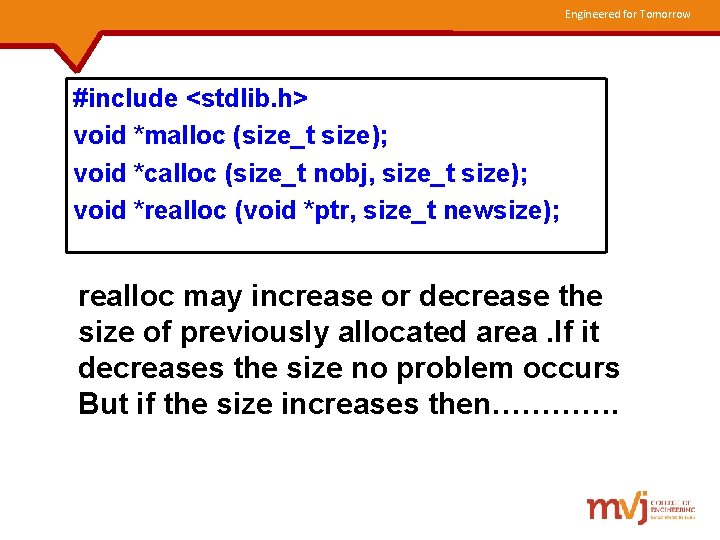
Engineered for Tomorrow #include <stdlib. h> void *malloc (size_t size); void *calloc (size_t nobj, size_t size); void *realloc (void *ptr, size_t newsize); realloc may increase or decrease the size of previously allocated area. If it decreases the size no problem occurs But if the size increases then………….
Engineered for Tomorrow 1. Eithere is enough space then the memory is reallocated and the same pointer is returned 2. If there is no space then it allocates new area copies the contents of old area to new area frees the old area and returns pointer to the new area
Engineered for Tomorrow Alloca function • It is same as malloc but instead of allocating memory from heap, the memory allocated from the stack frame of the current function
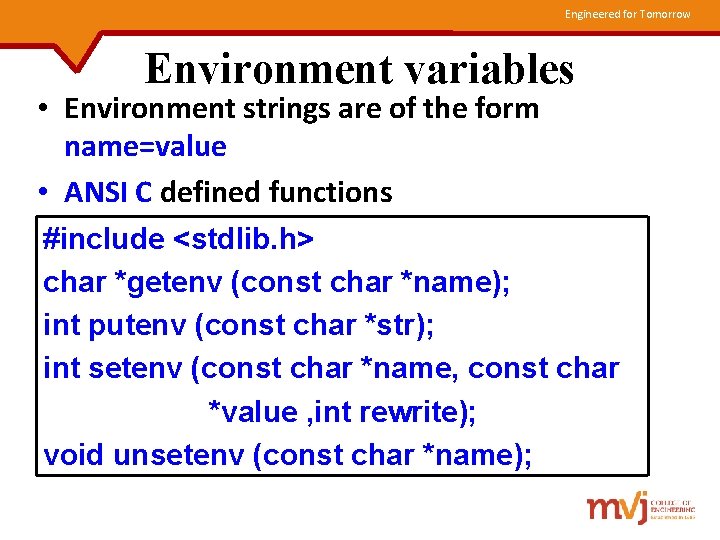
Engineered for Tomorrow Environment variables • Environment strings are of the form name=value • ANSI C defined functions #include <stdlib. h> char *getenv (const char *name); int putenv (const char *str); int setenv (const char *name, const char *value , int rewrite); void unsetenv (const char *name);
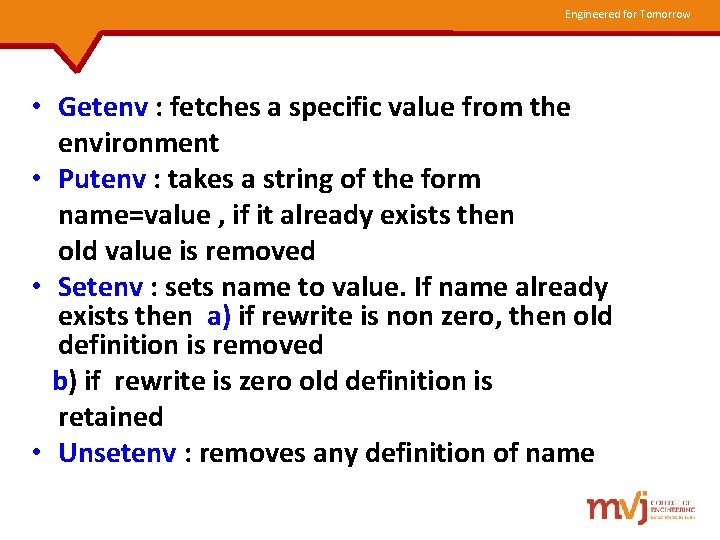
Engineered for Tomorrow • Getenv : fetches a specific value from the environment • Putenv : takes a string of the form name=value , if it already exists then old value is removed • Setenv : sets name to value. If name already exists then a) if rewrite is non zero, then old definition is removed b) if rewrite is zero old definition is retained • Unsetenv : removes any definition of name
Engineered for Tomorrow • Removing an environment variable is simple just find the pointer and move all subsequent pointers down one • But while modifying * if size of new value<=size of existing value just copy new string over the old string * if new value >oldvalue use malloc obtain room for new string, copy the new string to this area and replace the old pointer in environment list for name with pointer to this malloced area
Engineered for Tomorrow • While adding a new name call mallocate room for name=value string and copy the string to this area • If it’s the first time a new name is added , use malloc to obtain area for new list of pointers. Copy the old list of pointers to the malloced area and add the new pointer to its end • If its not the first time a new name was added , then just reallocate area for new pointer since the list is already on the heap
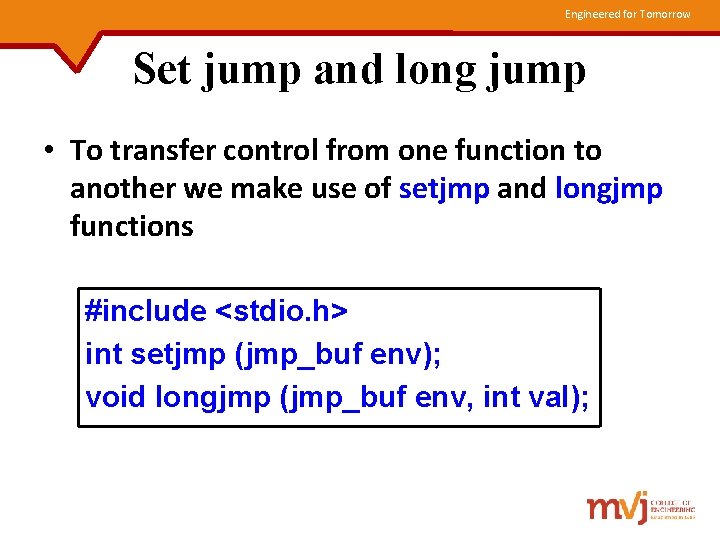
Engineered for Tomorrow Set jump and long jump • To transfer control from one function to another we make use of setjmp and longjmp functions #include <stdio. h> int setjmp (jmp_buf env); void longjmp (jmp_buf env, int val);
Engineered for Tomorrow • env is of type jmp_buf , this data type is form of array that is capable of holding all information required to restore the status of the stack to the state when we call longjmp • Val allows us to have more than one longjmp functions for one setjmp
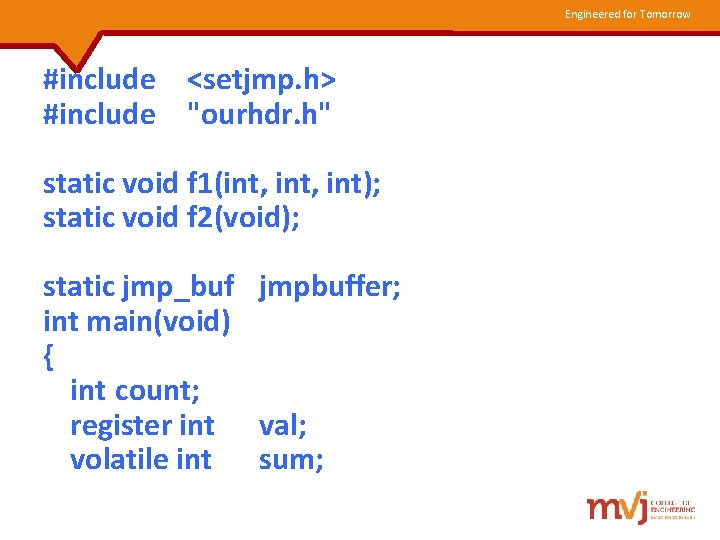
Engineered for Tomorrow #include <setjmp. h> #include "ourhdr. h" static void f 1(int, int); static void f 2(void); static jmp_buf jmpbuffer; int main(void) { int count; register int val; volatile int sum;
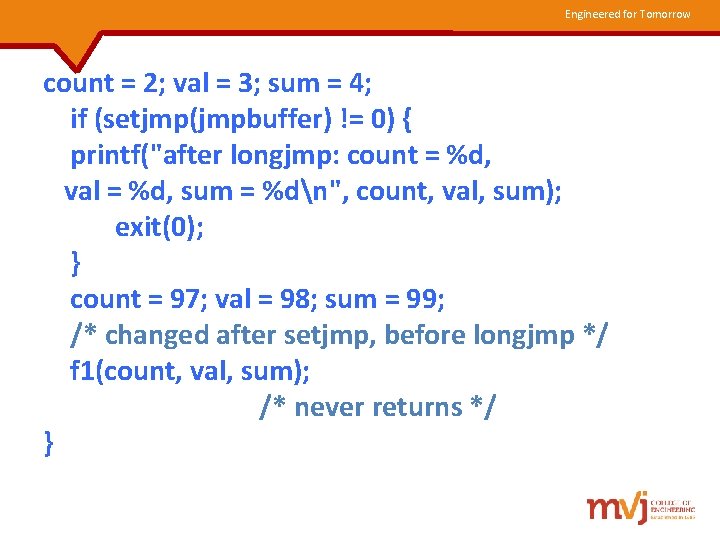
Engineered for Tomorrow count = 2; val = 3; sum = 4; if (setjmp(jmpbuffer) != 0) { printf("after longjmp: count = %d, val = %d, sum = %dn", count, val, sum); exit(0); } count = 97; val = 98; sum = 99; /* changed after setjmp, before longjmp */ f 1(count, val, sum); /* never returns */ }
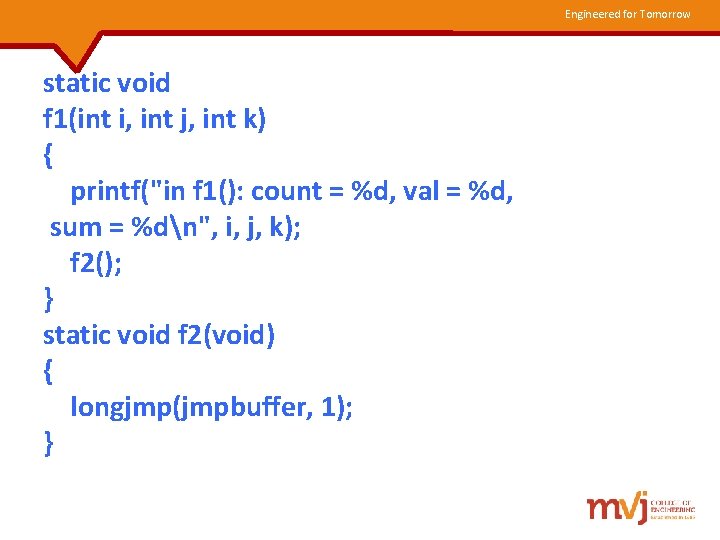
Engineered for Tomorrow static void f 1(int i, int j, int k) { printf("in f 1(): count = %d, val = %d, sum = %dn", i, j, k); f 2(); } static void f 2(void) { longjmp(jmpbuffer, 1); }
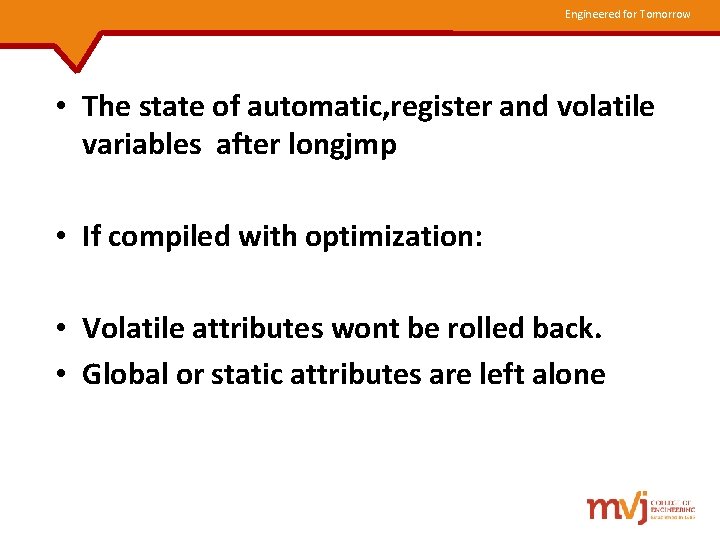
Engineered for Tomorrow • The state of automatic, register and volatile variables after longjmp • If compiled with optimization: • Volatile attributes wont be rolled back. • Global or static attributes are left alone
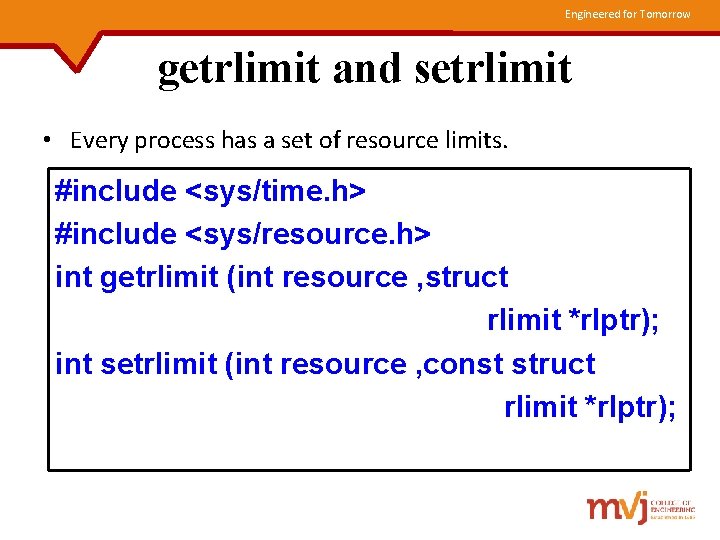
Engineered for Tomorrow getrlimit and setrlimit • Every process has a set of resource limits. #include <sys/time. h> #include <sys/resource. h> int getrlimit (int resource , struct rlimit *rlptr); int setrlimit (int resource , const struct rlimit *rlptr);
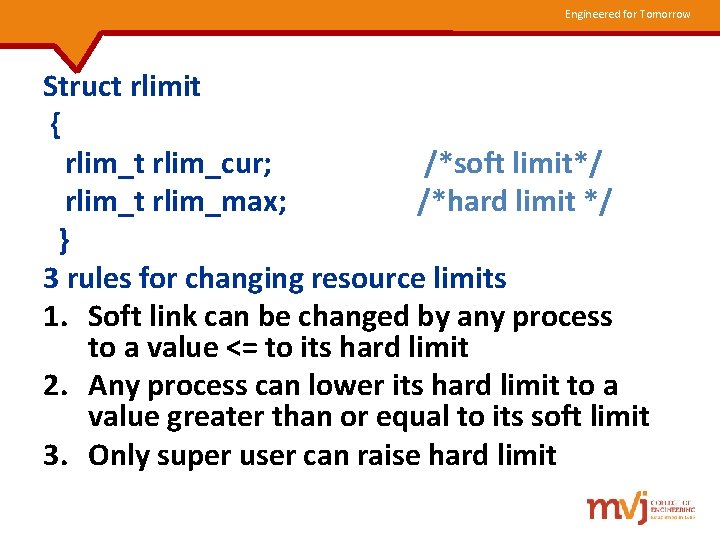
Engineered for Tomorrow Struct rlimit { rlim_t rlim_cur; /*soft limit*/ rlim_t rlim_max; /*hard limit */ } 3 rules for changing resource limits 1. Soft link can be changed by any process to a value <= to its hard limit 2. Any process can lower its hard limit to a value greater than or equal to its soft limit 3. Only super user can raise hard limit
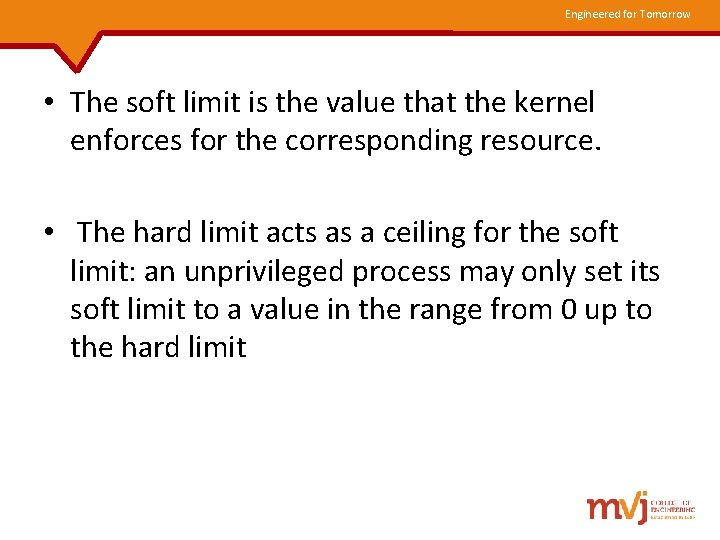
Engineered for Tomorrow • The soft limit is the value that the kernel enforces for the corresponding resource. • The hard limit acts as a ceiling for the soft limit: an unprivileged process may only set its soft limit to a value in the range from 0 up to the hard limit
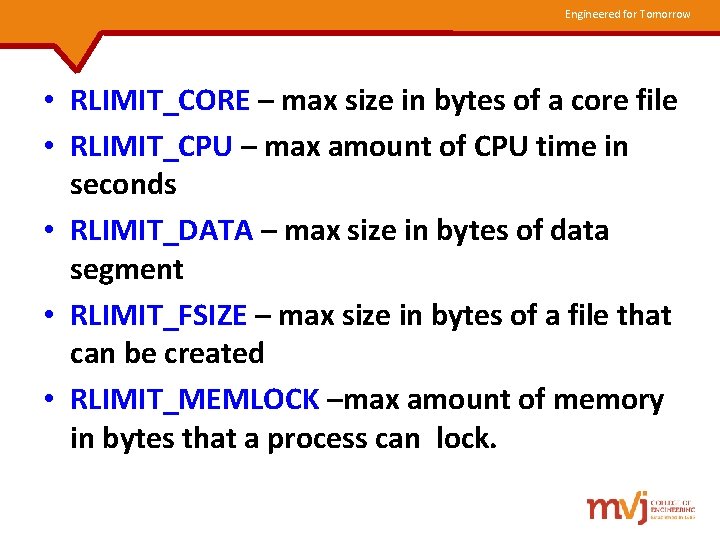
Engineered for Tomorrow • RLIMIT_CORE – max size in bytes of a core file • RLIMIT_CPU – max amount of CPU time in seconds • RLIMIT_DATA – max size in bytes of data segment • RLIMIT_FSIZE – max size in bytes of a file that can be created • RLIMIT_MEMLOCK –max amount of memory in bytes that a process can lock.
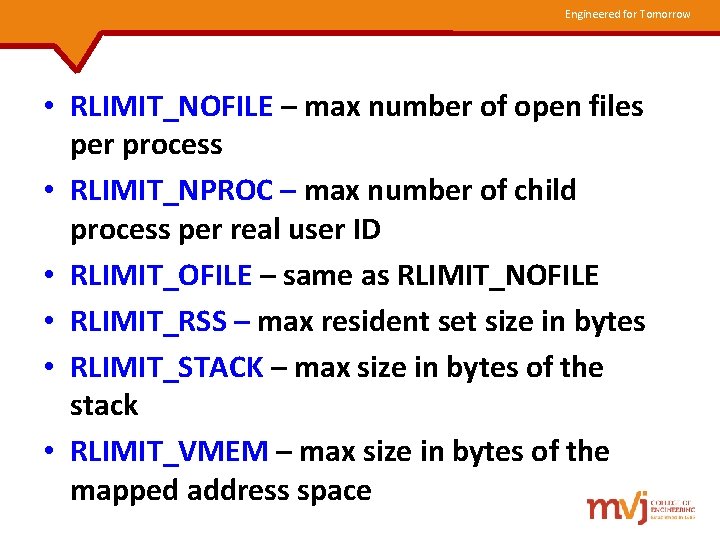
Engineered for Tomorrow • RLIMIT_NOFILE – max number of open files per process • RLIMIT_NPROC – max number of child process per real user ID • RLIMIT_OFILE – same as RLIMIT_NOFILE • RLIMIT_RSS – max resident set size in bytes • RLIMIT_STACK – max size in bytes of the stack • RLIMIT_VMEM – max size in bytes of the mapped address space
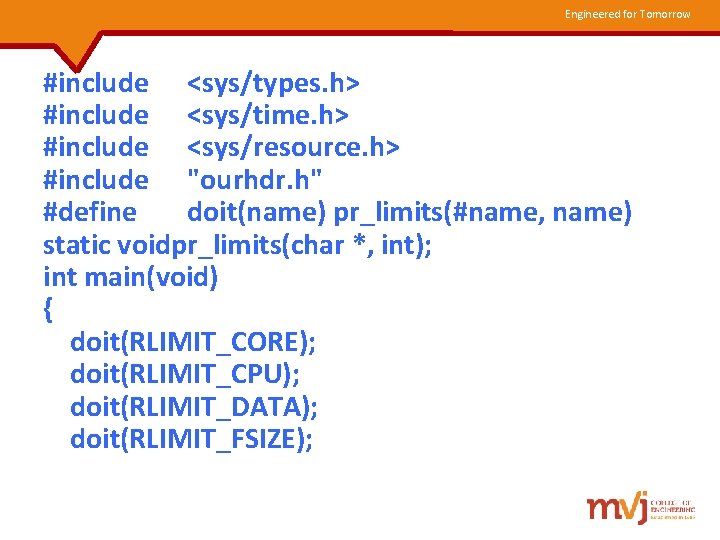
Engineered for Tomorrow #include <sys/types. h> #include <sys/time. h> #include <sys/resource. h> #include "ourhdr. h" #define doit(name) pr_limits(#name, name) static voidpr_limits(char *, int); int main(void) { doit(RLIMIT_CORE); doit(RLIMIT_CPU); doit(RLIMIT_DATA); doit(RLIMIT_FSIZE);
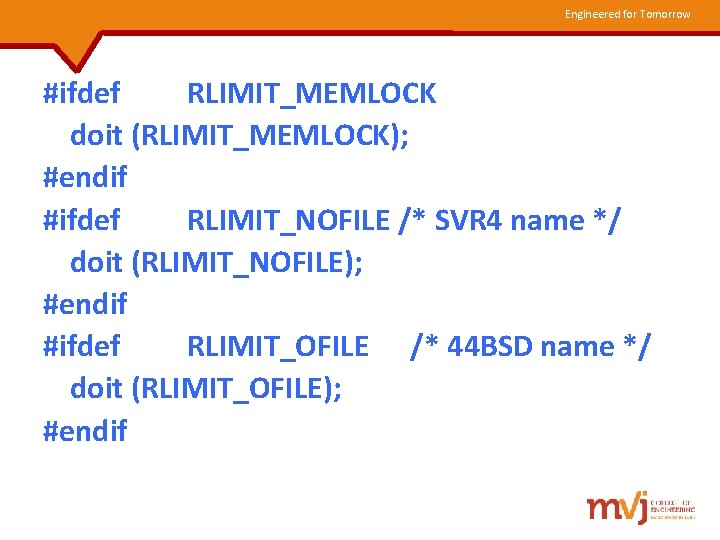
Engineered for Tomorrow #ifdef RLIMIT_MEMLOCK doit (RLIMIT_MEMLOCK); #endif #ifdef RLIMIT_NOFILE /* SVR 4 name */ doit (RLIMIT_NOFILE); #endif #ifdef RLIMIT_OFILE /* 44 BSD name */ doit (RLIMIT_OFILE); #endif
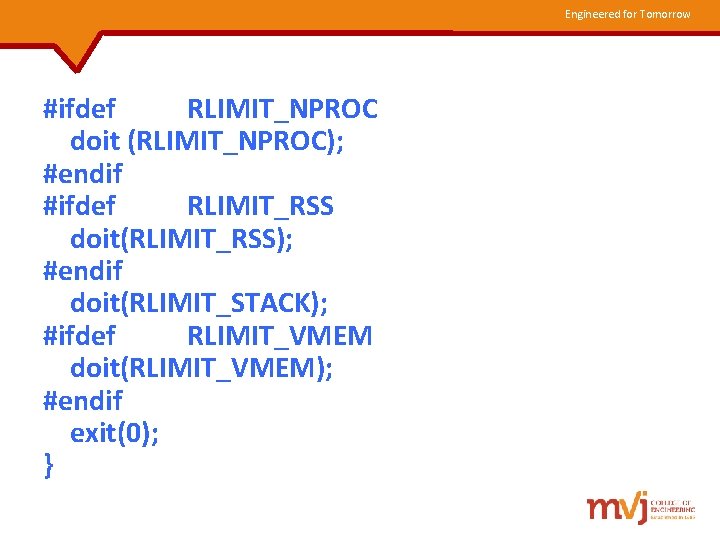
Engineered for Tomorrow #ifdef RLIMIT_NPROC doit (RLIMIT_NPROC); #endif #ifdef RLIMIT_RSS doit(RLIMIT_RSS); #endif doit(RLIMIT_STACK); #ifdef RLIMIT_VMEM doit(RLIMIT_VMEM); #endif exit(0); }
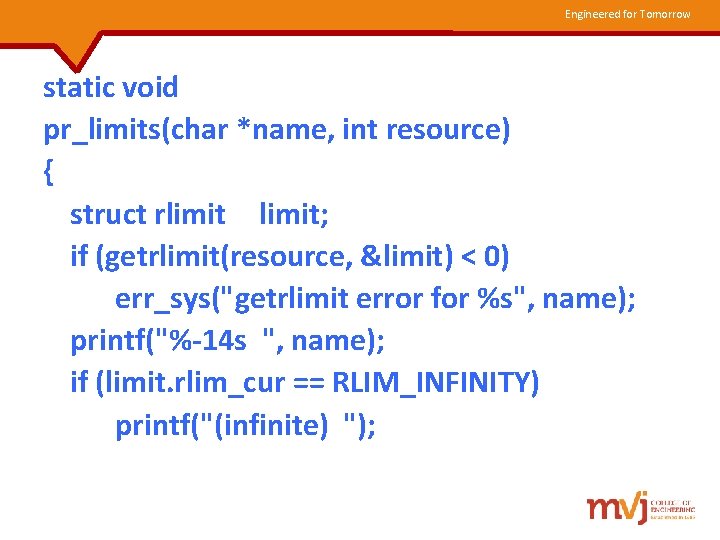
Engineered for Tomorrow static void pr_limits(char *name, int resource) { struct rlimit; if (getrlimit(resource, &limit) < 0) err_sys("getrlimit error for %s", name); printf("%-14 s ", name); if (limit. rlim_cur == RLIM_INFINITY) printf("(infinite) ");
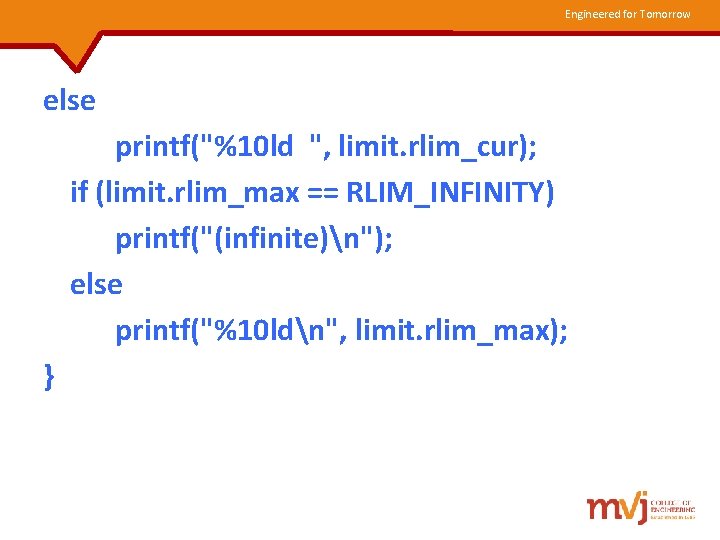
Engineered for Tomorrow else printf("%10 ld ", limit. rlim_cur); if (limit. rlim_max == RLIM_INFINITY) printf("(infinite)n"); else printf("%10 ldn", limit. rlim_max); }
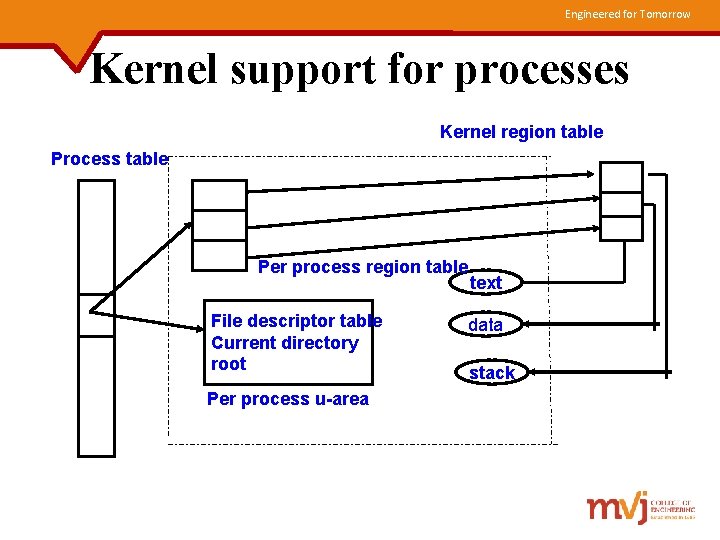
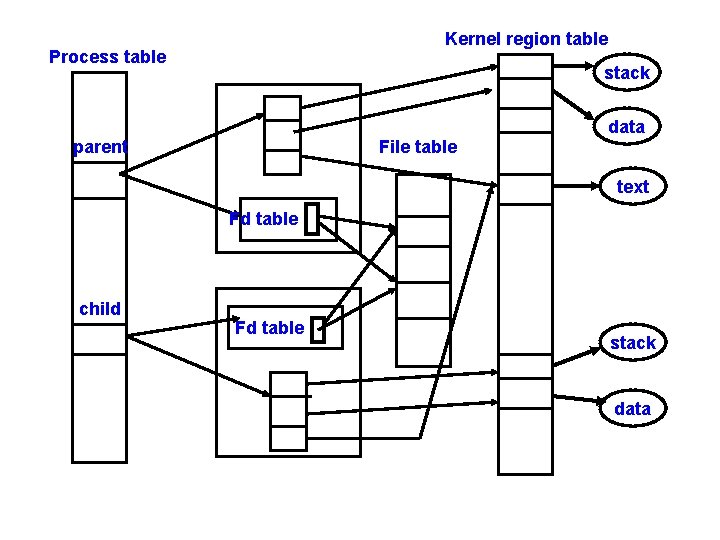
Engineered for Tomorrow Kernel support for processes Kernel region table Process table Per process region table File descriptor table Current directory root Per process u-area text data stack
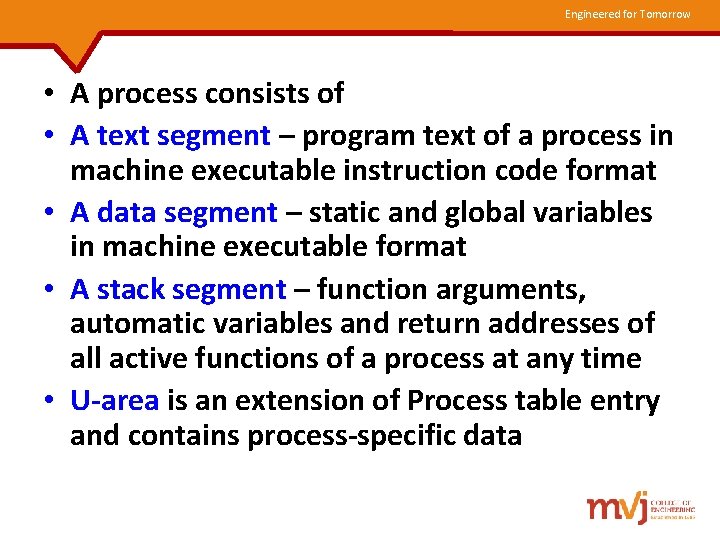
Engineered for Tomorrow • A process consists of • A text segment – program text of a process in machine executable instruction code format • A data segment – static and global variables in machine executable format • A stack segment – function arguments, automatic variables and return addresses of all active functions of a process at any time • U-area is an extension of Process table entry and contains process-specific data
Kernel region table Process table stack data parent File table text Fd table child Fd table stack data
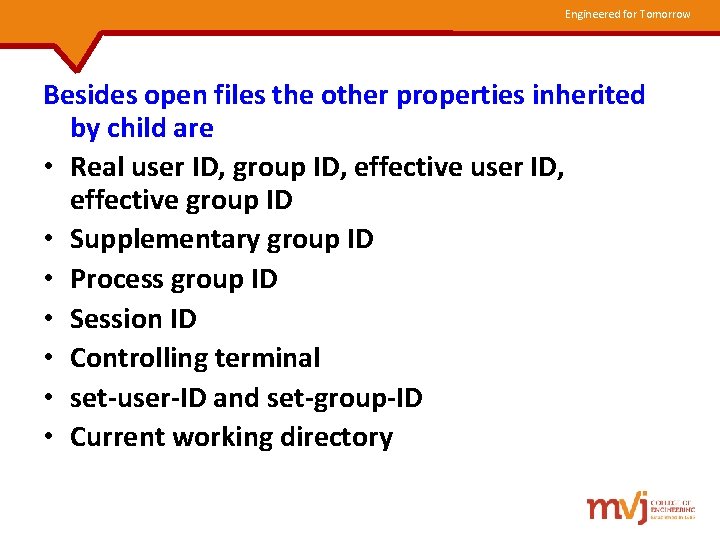
Engineered for Tomorrow Besides open files the other properties inherited by child are • Real user ID, group ID, effective user ID, effective group ID • Supplementary group ID • Process group ID • Session ID • Controlling terminal • set-user-ID and set-group-ID • Current working directory
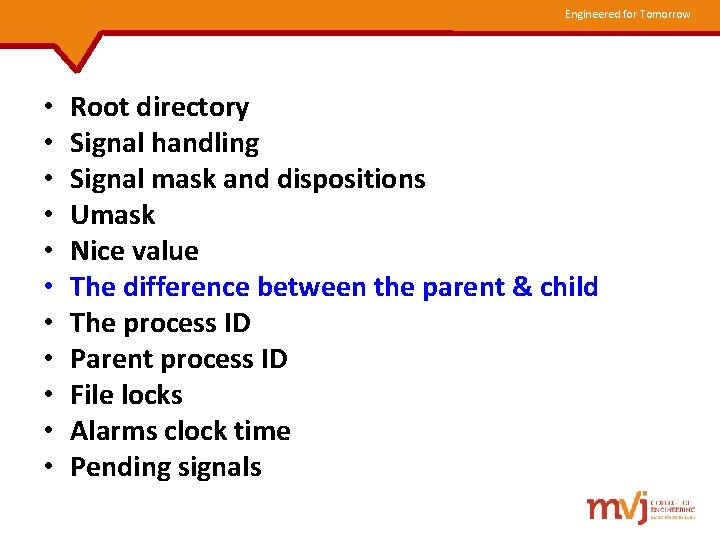
Engineered for Tomorrow • • • Root directory Signal handling Signal mask and dispositions Umask Nice value The difference between the parent & child The process ID Parent process ID File locks Alarms clock time Pending signals