
Course 15 Computational Photography A 3 Understanding Filmlike
- Slides: 22
Course 15: Computational Photography A. 3: Understanding Film-like Photography Tumblin
Computational Photography A 3: Understanding Film-Like Photography or ‘from 2 D Pixels to 4 D Rays’ (10 minutes) Jack Tumblin Northwestern University
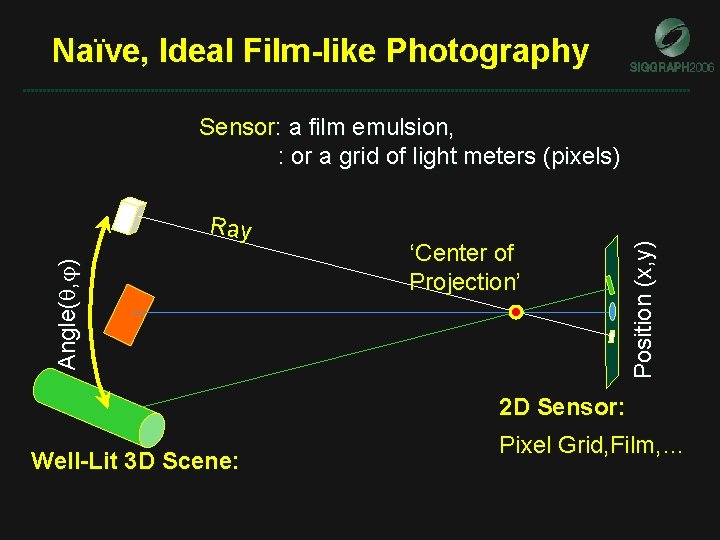
Naïve, Ideal Film-like Photography Angle( , ) Ray ‘Center of Projection’ Position (x, y) Sensor: a film emulsion, : or a grid of light meters (pixels) 2 D Sensor: Well-Lit 3 D Scene: Pixel Grid, Film, …
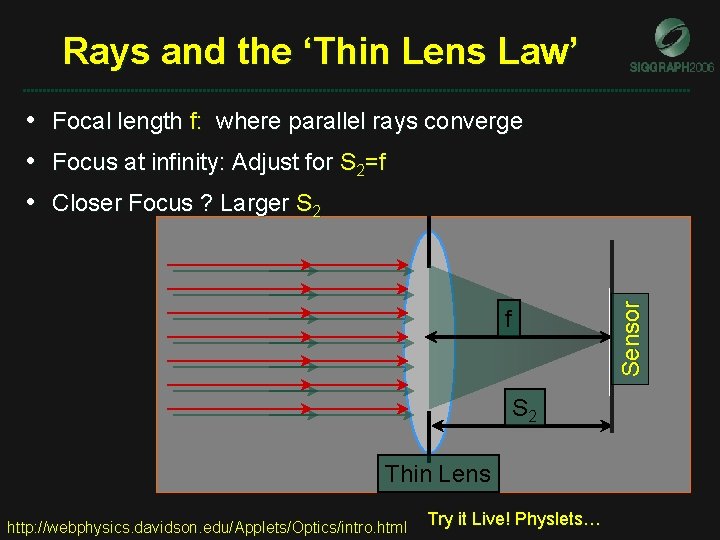
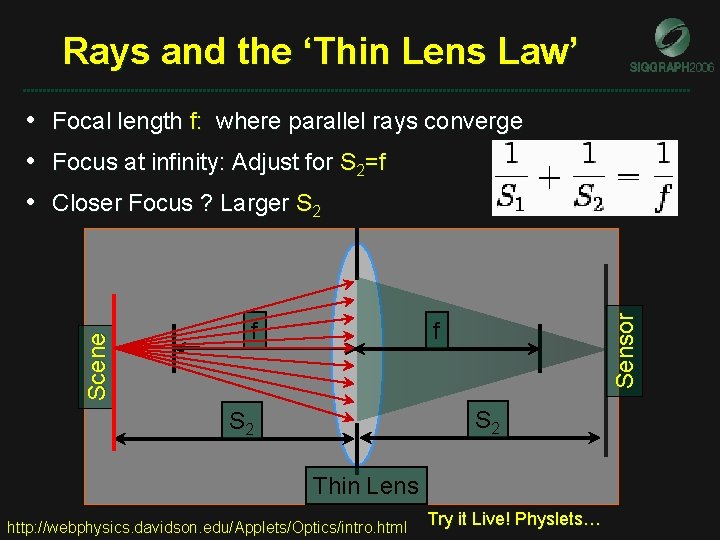
Rays and the ‘Thin Lens Law’ • Focal length f: where parallel rays converge • Focus at infinity: Adjust for S 2=f f S 2 Thin Lens http: //webphysics. davidson. edu/Applets/Optics/intro. html Try it Live! Physlets… Sensor • Closer Focus ? Larger S 2
Rays and the ‘Thin Lens Law’ • Focal length f: where parallel rays converge • Focus at infinity: Adjust for S 2=f f Sensor Scene • Closer Focus ? Larger S 2 f S 2 Thin Lens http: //webphysics. davidson. edu/Applets/Optics/intro. html Try it Live! Physlets…
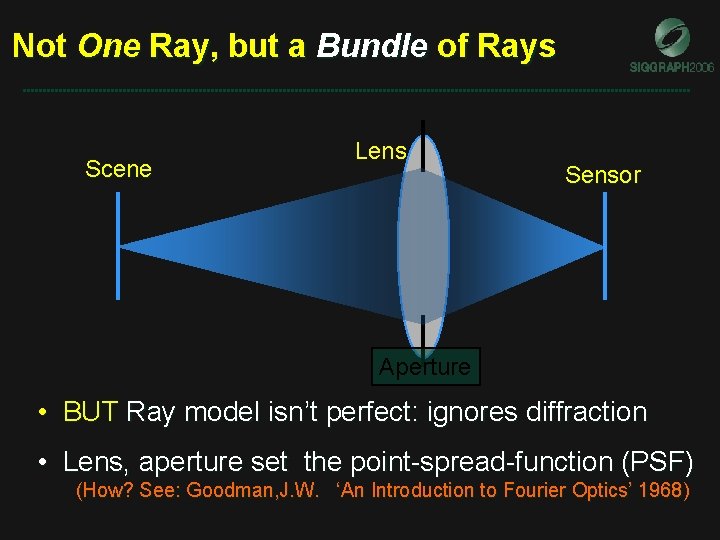
Not One Ray, but a Bundle of Rays Scene Lens Sensor Aperture • BUT Ray model isn’t perfect: ignores diffraction • Lens, aperture set the point-spread-function (PSF) (How? See: Goodman, J. W. ‘An Introduction to Fourier Optics’ 1968)
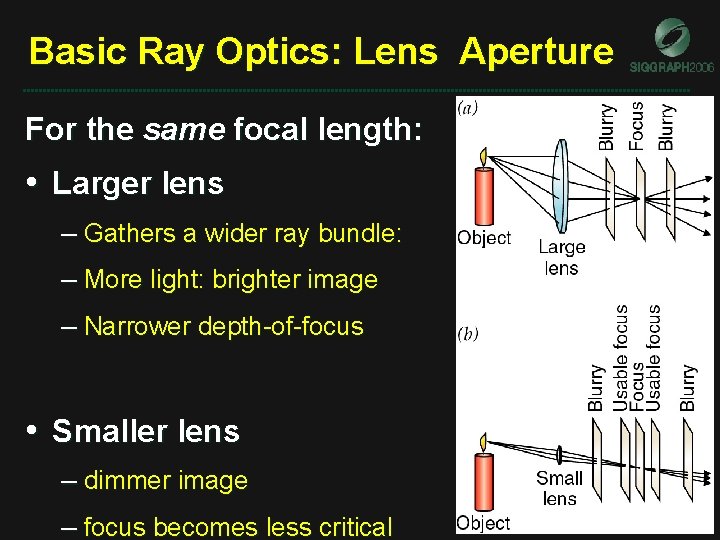
Basic Ray Optics: Lens Aperture For the same focal length: • Larger lens – Gathers a wider ray bundle: – More light: brighter image – Narrower depth-of-focus • Smaller lens – dimmer image – focus becomes less critical
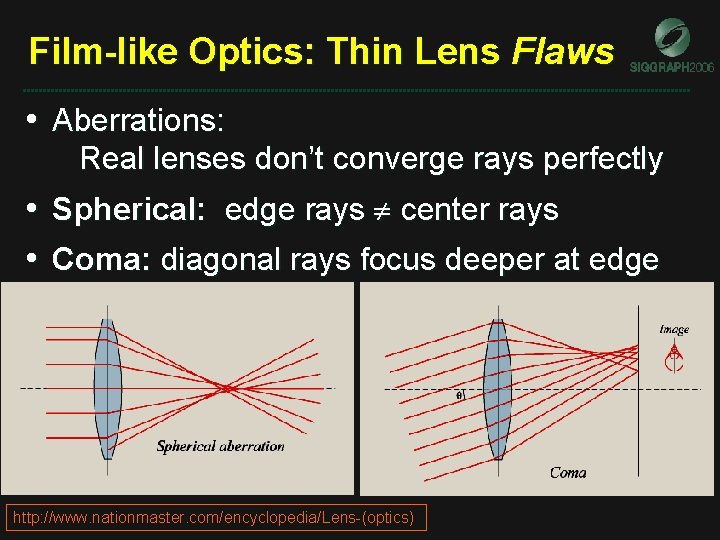
Film-like Optics: Thin Lens Flaws • Aberrations: Real lenses don’t converge rays perfectly • Spherical: edge rays center rays • Coma: diagonal rays focus deeper at edge http: //www. nationmaster. com/encyclopedia/Lens-(optics)
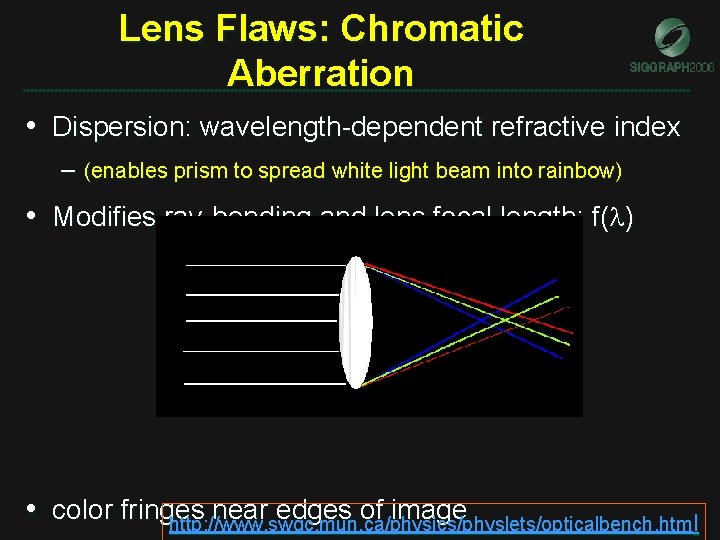
Lens Flaws: Chromatic Aberration • Dispersion: wavelength-dependent refractive index – (enables prism to spread white light beam into rainbow) • Modifies ray-bending and lens focal length: f( ) • color fringes near edges of image http: //www. swgc. mun. ca/physics/physlets/opticalbench. html
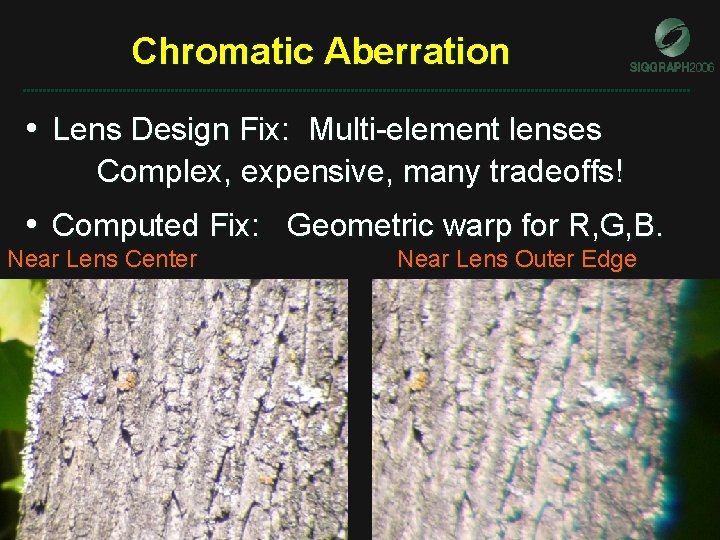
Chromatic Aberration • Lens Design Fix: Multi-element lenses Complex, expensive, many tradeoffs! • Computed Fix: Geometric warp for R, G, B. Near Lens Center Near Lens Outer Edge
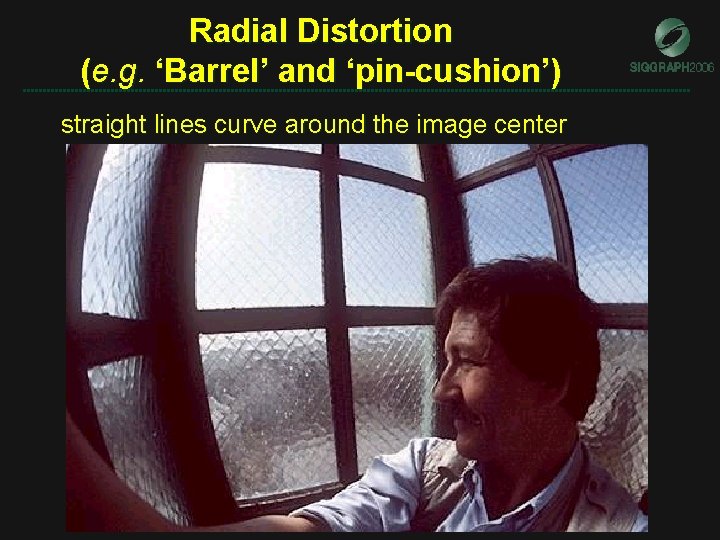
Radial Distortion (e. g. ‘Barrel’ and ‘pin-cushion’) straight lines curve around the image center
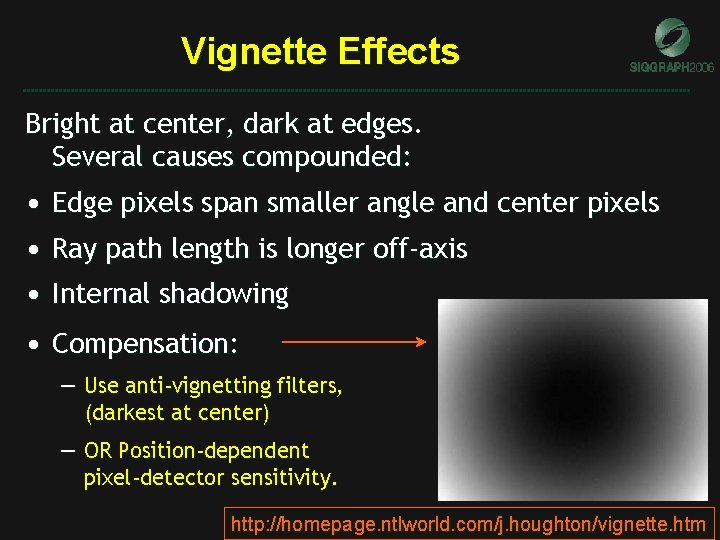
Vignette Effects Bright at center, dark at edges. Several causes compounded: • Edge pixels span smaller angle and center pixels • Ray path length is longer off-axis • Internal shadowing • Compensation: – Use anti-vignetting filters, (darkest at center) – OR Position-dependent pixel-detector sensitivity. http: //homepage. ntlworld. com/j. houghton/vignette. htm
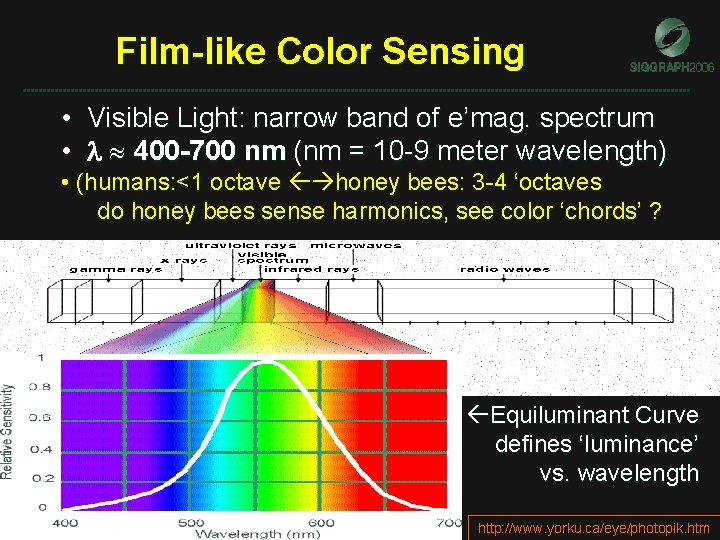
Film-like Color Sensing • Visible Light: narrow band of e’mag. spectrum • 400 -700 nm (nm = 10 -9 meter wavelength) • (humans: <1 octave honey bees: 3 -4 ‘octaves do honey bees sense harmonics, see color ‘chords’ ? Equiluminant Curve defines ‘luminance’ vs. wavelength http: //www. yorku. ca/eye/photopik. htm
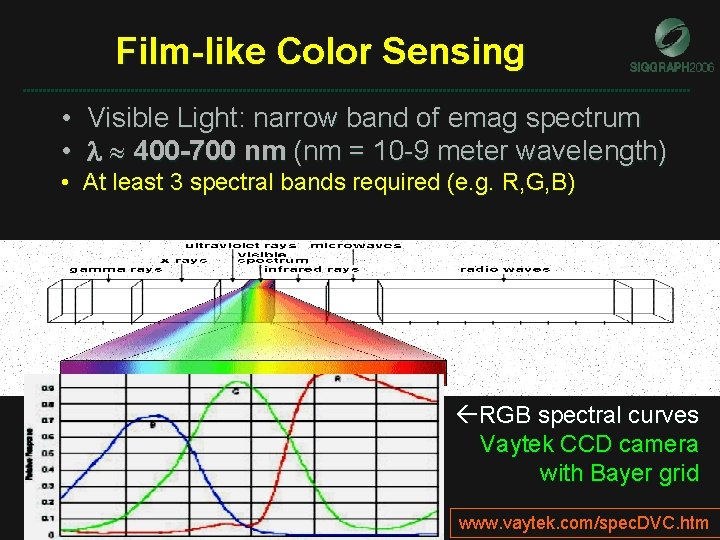
Film-like Color Sensing • Visible Light: narrow band of emag spectrum • 400 -700 nm (nm = 10 -9 meter wavelength) • At least 3 spectral bands required (e. g. R, G, B) RGB spectral curves Vaytek CCD camera with Bayer grid www. vaytek. com/spec. DVC. htm
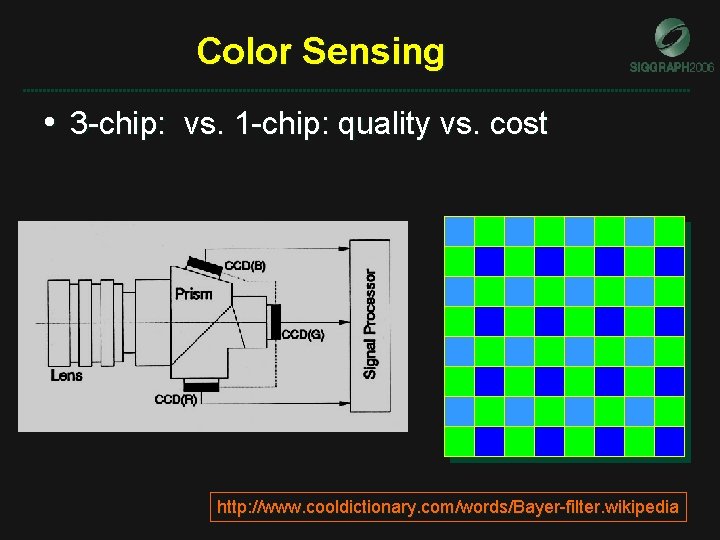
Color Sensing • 3 -chip: vs. 1 -chip: quality vs. cost http: //www. cooldic http: //www. cooldi tionary. com/words/Bayer-filter. wikipedia
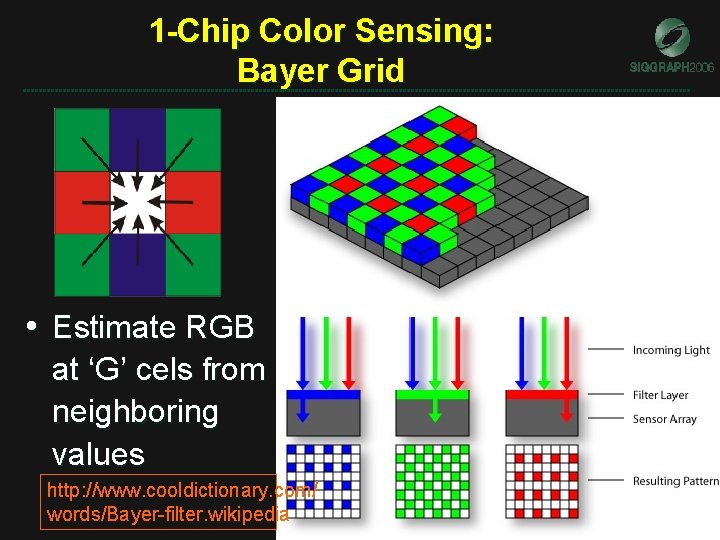
1 -Chip Color Sensing: Bayer Grid • Estimate RGB at ‘G’ cels from neighboring values http: //www. cooldictionary. com/ words/Bayer-filter. wikipedia
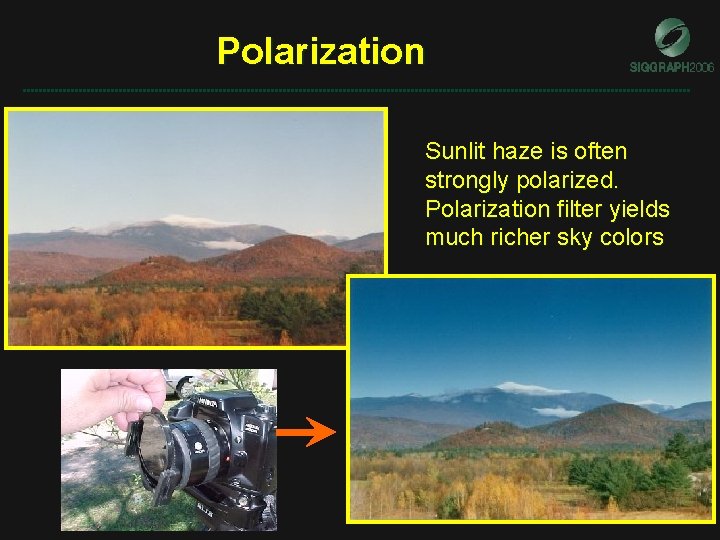
Polarization Sunlit haze is often strongly polarized. Polarization filter yields much richer sky colors
RAYS and PROCESSING • ONE Ray carries doubly infinitesimal power: Ray bundles with finite, measurable power will: • Span a non-zero area • Fill a non-zero solid angle • Everything is Linear: (HUGE win!) Ray reflectance, transmission, absorption, scatter*… • Rays are REVERSIBLE. Helmholtz reciprocity Ray bundles? Not so much: falls quickly with angle, area growth…
Film-like Photography: Many Limitations • Optics: Single focus distance, limited depth-of-field, limited field-of-view, internal reflections/flare/glare • Lighting: Camera has no knowledge of ray source strength, position, direction; little control (e. g. flash) • Sensor: Exposure setting, motion blur, noise, response time, • Processing: – Quantization/color depth, camera shake, scene movement…
Conclusions • Film-like photography methods limit digital photography to film-like results or less. • Broaden, unlock our views of photography: • 4 -D, 8 -D, even 10 -D Ray Space holds the photographic signal. Look for new solutions by creating, gathering, processing RAYS, not focal-plane intensities. • Choose the best, most expressive sets of rays, THEN find the best way to measure them.
Useful links: Interactive Thin Lens Demo (or search ‘physlet optical bench’) www. swgc. mun. ca/physics/physlets/opticalbench. html For more about color: – Prev. SIGGRAPH courses (Stone et al. ) – Good: www. cs. rit. edu/~ncs/color/a_spectr. html – Good: www. colourware. co. uk/cpfaq. htm – Good: www. yorku. ca/eye/toc. htm
Course 15: Computational Photography