
Coupling an Individual Based Model to the Regional
Coupling an Individual Based Model to the Regional Ocean Model System (ROMS): Application on Larval Dispersal Studies Diego Narváez John Klinck Eileen Hofmann Eric Powell John Wilkin Dale Haidvogel ROMS WORKSHOP Honolulu, HI 2010
Background ECOSYSTEM MODELS Population/Concentration. Based Model Diego Narváez Individual. Based Models ROMS 2010
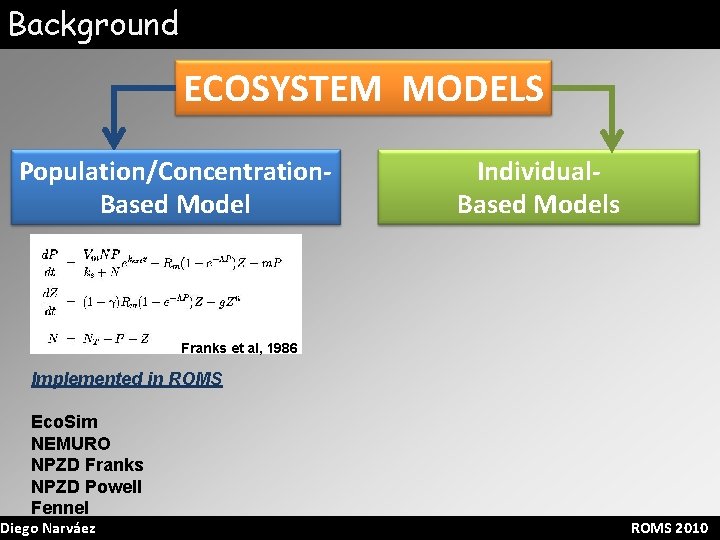
Background ECOSYSTEM MODELS Population/Concentration. Based Model Individual. Based Models Franks et al, 1986 Implemented in ROMS Eco. Sim NEMURO NPZD Franks NPZD Powell Fennel Diego Narváez ROMS 2010
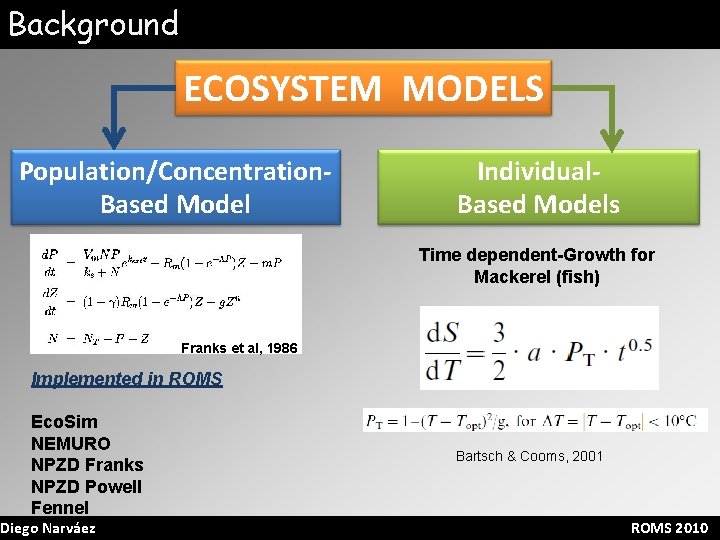
Background ECOSYSTEM MODELS Population/Concentration. Based Model Individual. Based Models Time dependent-Growth for Mackerel (fish) Franks et al, 1986 Implemented in ROMS Eco. Sim NEMURO NPZD Franks NPZD Powell Fennel Diego Narváez Bartsch & Cooms, 2001 ROMS 2010
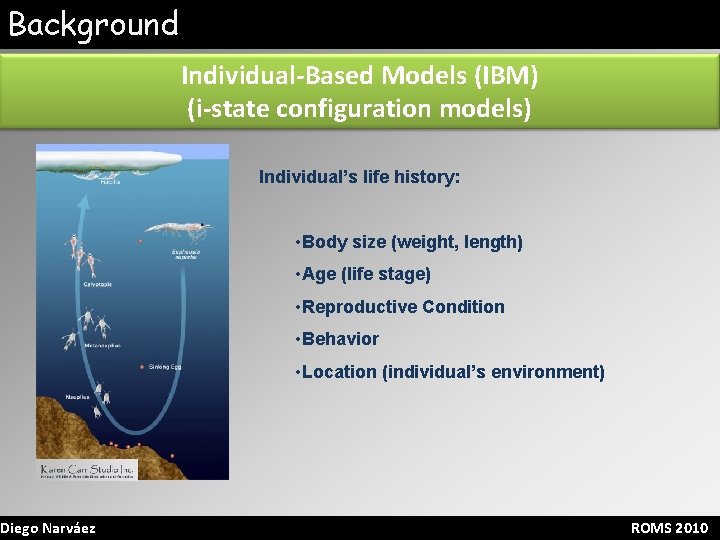
Background Diego Narváez Individual-Based Models (IBM) (i-state configuration models) Individual’s life history: • Body size (weight, length) • Age (life stage) • Reproductive Condition • Behavior • Location (individual’s environment) ROMS 2010
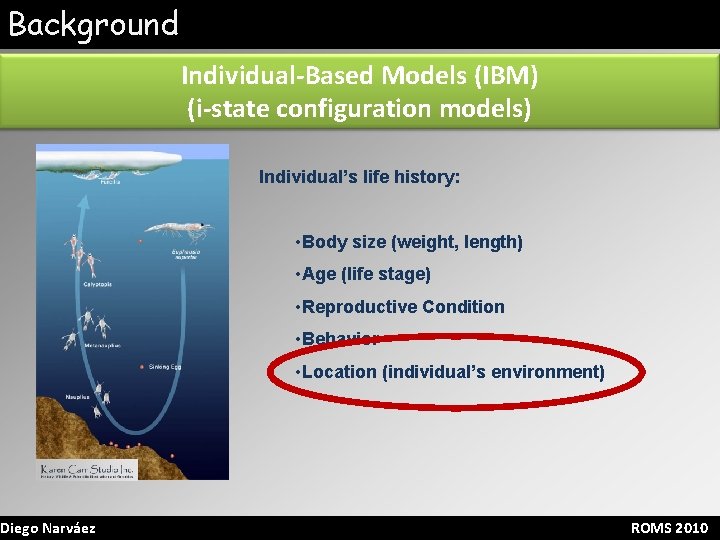
Background Diego Narváez Individual-Based Models (IBM) (i-state configuration models) Individual’s life history: • Body size (weight, length) • Age (life stage) • Reproductive Condition • Behavior • Location (individual’s environment) ROMS 2010
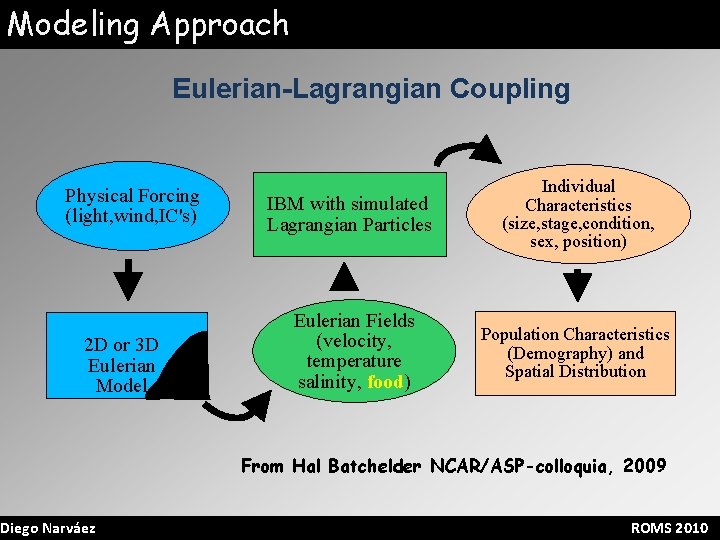
Modeling Approach Eulerian-Lagrangian Coupling Physical Forcing (light, wind, IC's) 2 D or 3 D Eulerian Model Diego Narváez IBM with simulated Lagrangian Particles Individual Characteristics (size, stage, condition, sex, position) Eulerian Fields (velocity, temperature salinity, food) Population Characteristics (Demography) and Spatial Distribution From Hal Batchelder NCAR/ASP-colloquia, 2009 ROMS 2010
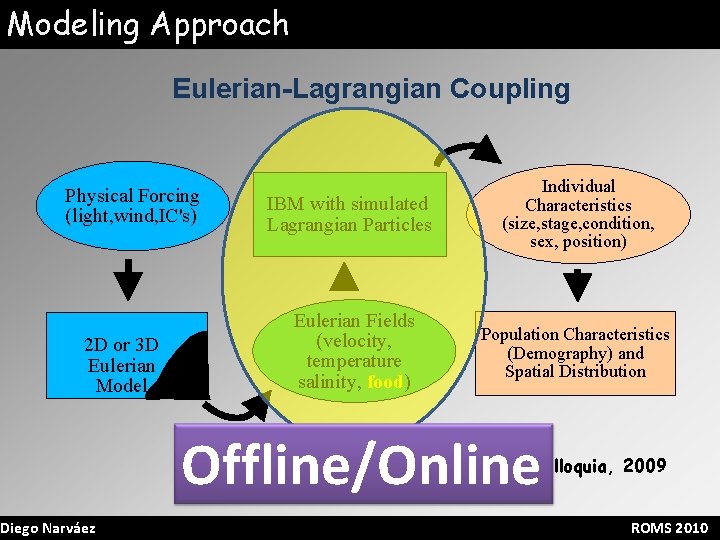
Modeling Approach Eulerian-Lagrangian Coupling Physical Forcing (light, wind, IC's) 2 D or 3 D Eulerian Model Diego Narváez IBM with simulated Lagrangian Particles Individual Characteristics (size, stage, condition, sex, position) Eulerian Fields (velocity, temperature salinity, food) Population Characteristics (Demography) and Spatial Distribution Offline/Online From Hal Batchelder NCAR/ASP-colloquia, 2009 ROMS 2010
Coupling IBM to Eulerian Models Offline Examples: POPCYCLE (Batchelder & Miller, 1989; Batchelder et al. , 2002 Jeffrey Dorman next presentation) LTRANS (North et al, 2008) Online Ongoing research in Gulf of Alaska and Bering Sea Hermann, Dorn, Hinckley, Parada, Moore, Dobbins and many others. Examples : POM – IBM Lobster’s larvae (Xue et al. , 2008) Diego Narváez Kate Hedstrom – previous presentation ROMS 2010
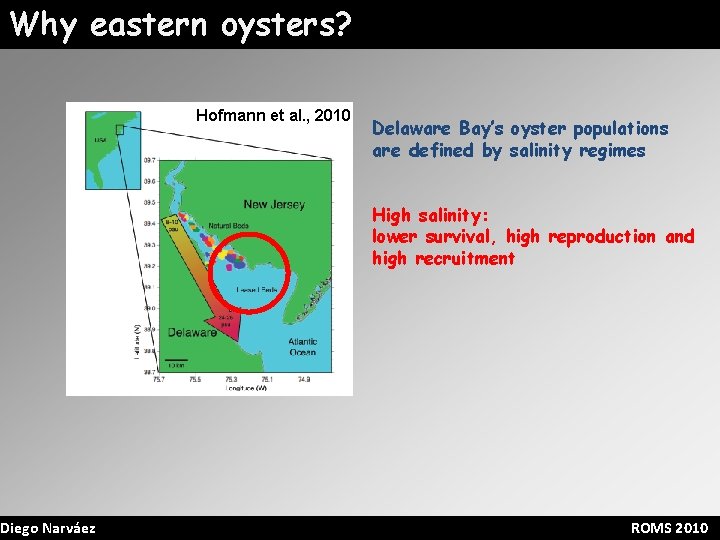
Why eastern oysters? Diego Narváez Hofmann et al. , 2010 Delaware Bay’s oyster populations are defined by salinity regimes High salinity: lower survival, high reproduction and high recruitment ROMS 2010
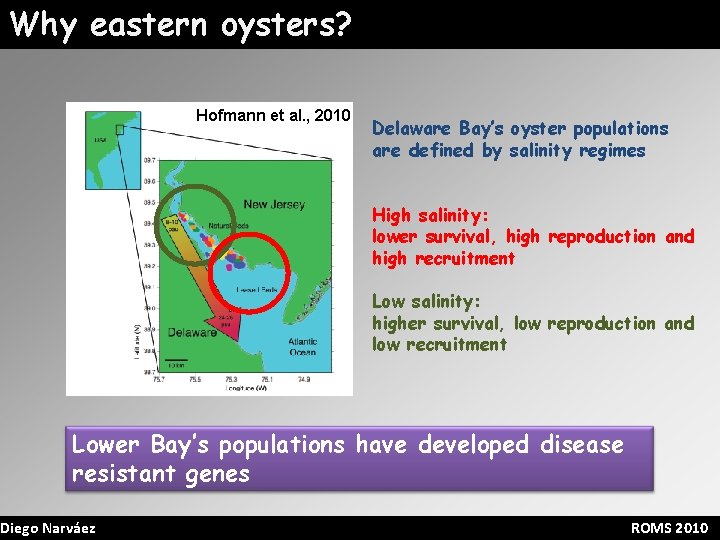
Why eastern oysters? Hofmann et al. , 2010 Delaware Bay’s oyster populations are defined by salinity regimes High salinity: lower survival, high reproduction and high recruitment Low salinity: higher survival, low reproduction and low recruitment Lower Bay’s populations have developed disease resistant genes Diego Narváez ROMS 2010
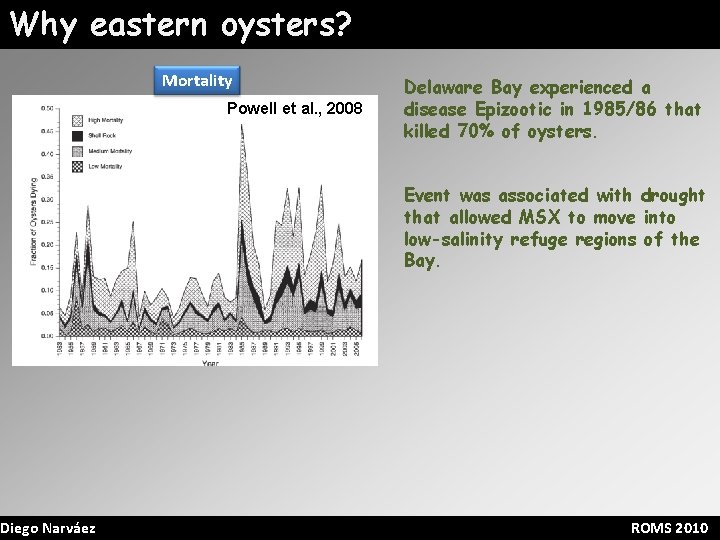
Why eastern oysters? Diego Narváez Mortality Powell et al. , 2008 Delaware Bay experienced a disease Epizootic in 1985/86 that killed 70% of oysters. Event was associated with drought that allowed MSX to move into low-salinity refuge regions of the Bay. ROMS 2010
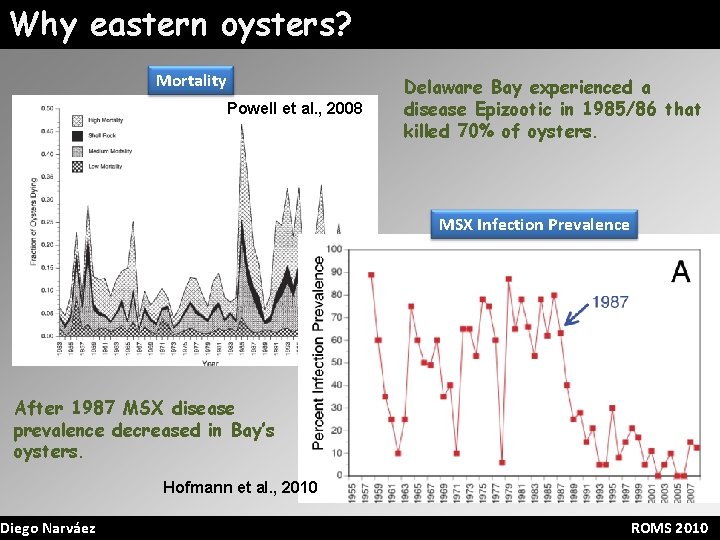
Why eastern oysters? Mortality Powell et al. , 2008 Delaware Bay experienced a disease Epizootic in 1985/86 that killed 70% of oysters. MSX Infection Prevalence After 1987 MSX disease prevalence decreased in Bay’s oysters. Diego Narváez Hofmann et al. , 2010 ROMS 2010
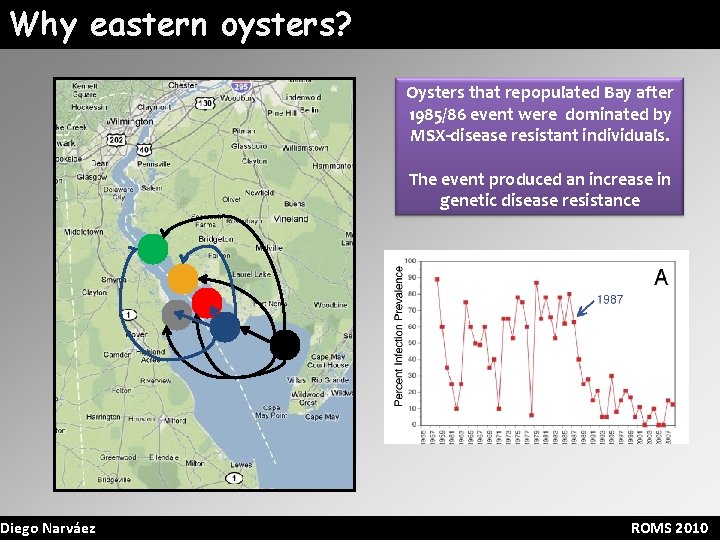
Why eastern oysters? Diego Narváez Oysters that repopulated Bay after 1985/86 event were dominated by MSX-disease resistant individuals. The event produced an increase in genetic disease resistance ROMS 2010
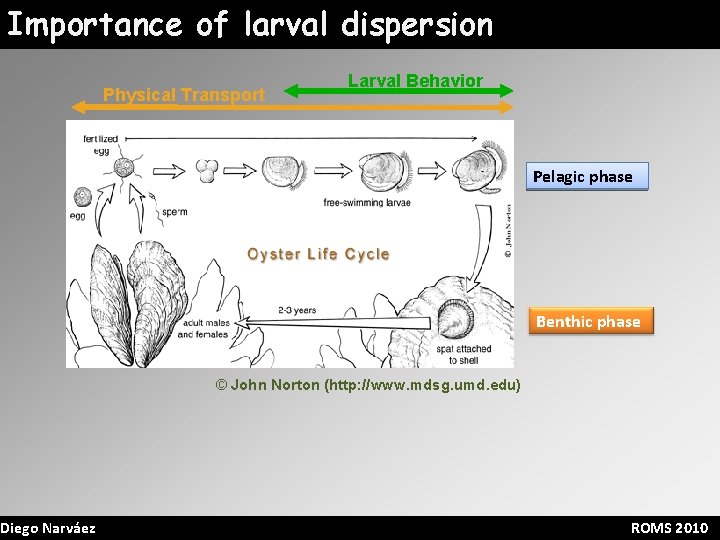
Importance of larval dispersion Diego Narváez Physical Transport Larval Behavior Pelagic phase Benthic phase © John Norton (http: //www. mdsg. umd. edu) ROMS 2010
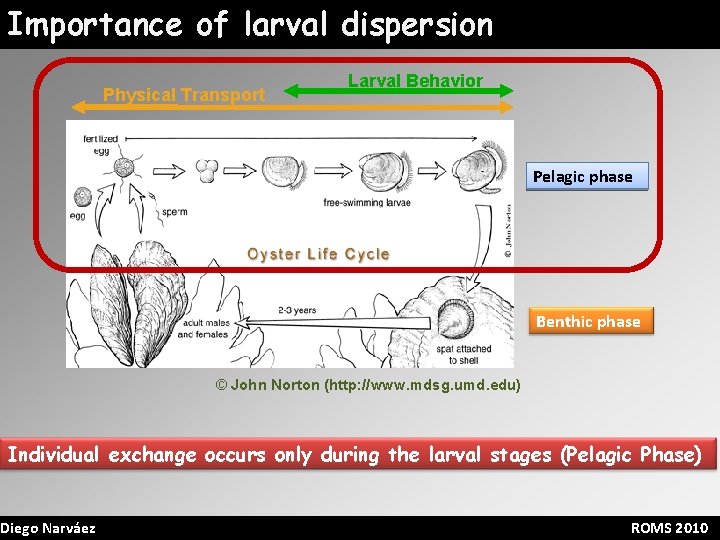
Importance of larval dispersion Physical Transport Larval Behavior Pelagic phase Benthic phase © John Norton (http: //www. mdsg. umd. edu) Individual exchange occurs only during the larval stages (Pelagic Phase) Diego Narváez ROMS 2010
Research Questions ØWhat are the larval dispersal pathways and exchange rates for the oysters in Delaware Bay? ØHow bio-physical processes and environmental variables affect the larval dispersion? Diego Narváez ROMS 2010
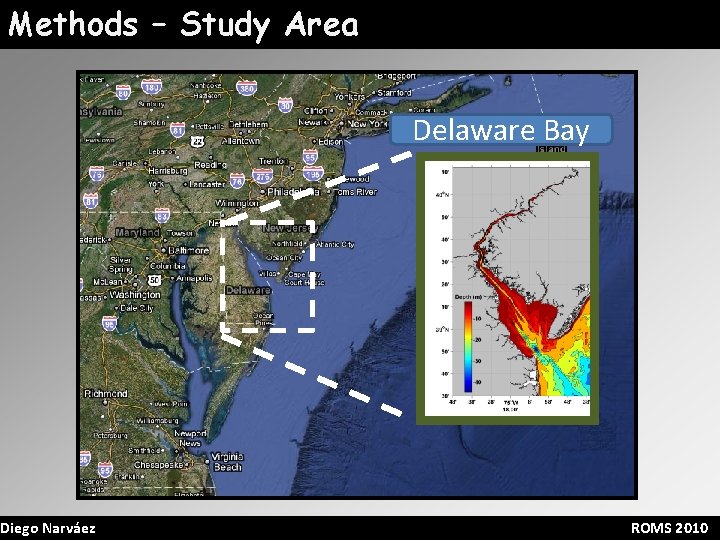
Methods – Study Area Diego Narváez Delaware Bay ROMS 2010
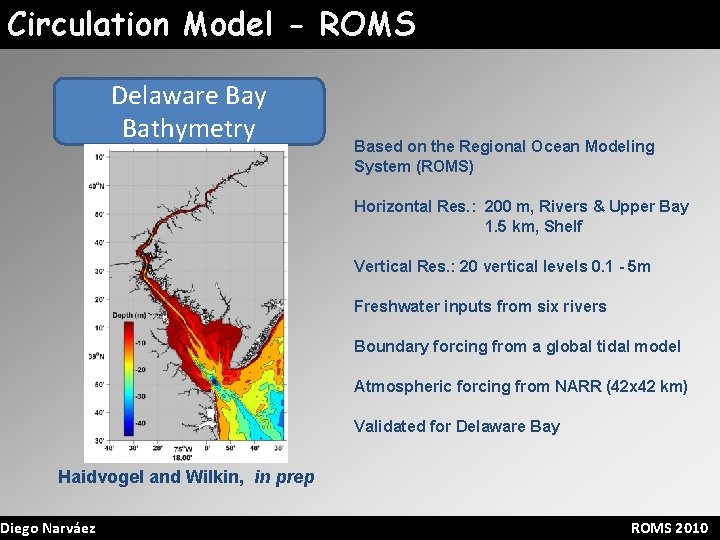
Circulation Model - ROMS Delaware Bay Bathymetry Based on the Regional Ocean Modeling System (ROMS) Horizontal Res. : 200 m, Rivers & Upper Bay 1. 5 km, Shelf Vertical Res. : 20 vertical levels 0. 1 - 5 m Freshwater inputs from six rivers Boundary forcing from a global tidal model Atmospheric forcing from NARR (42 x 42 km) Validated for Delaware Bay Haidvogel and Wilkin, in prep Diego Narváez ROMS 2010
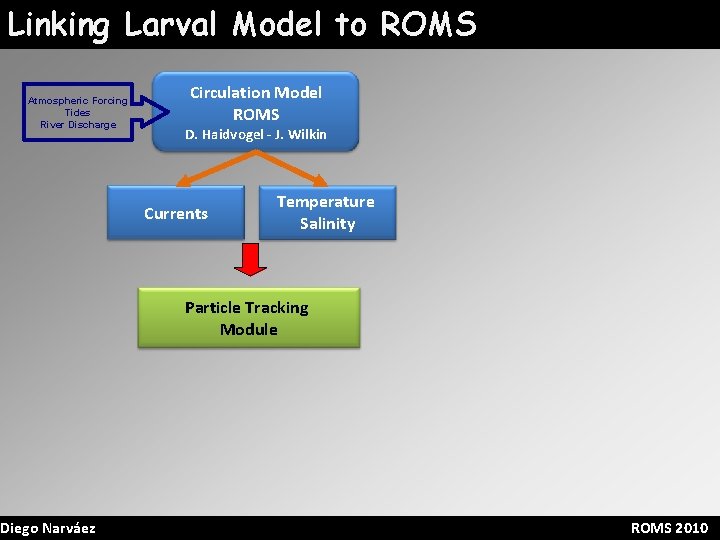
Linking Larval Model to ROMS Atmospheric Forcing Tides River Discharge Diego Narváez Circulation Model ROMS D. Haidvogel - J. Wilkin Currents Temperature Salinity Particle Tracking Module ROMS 2010
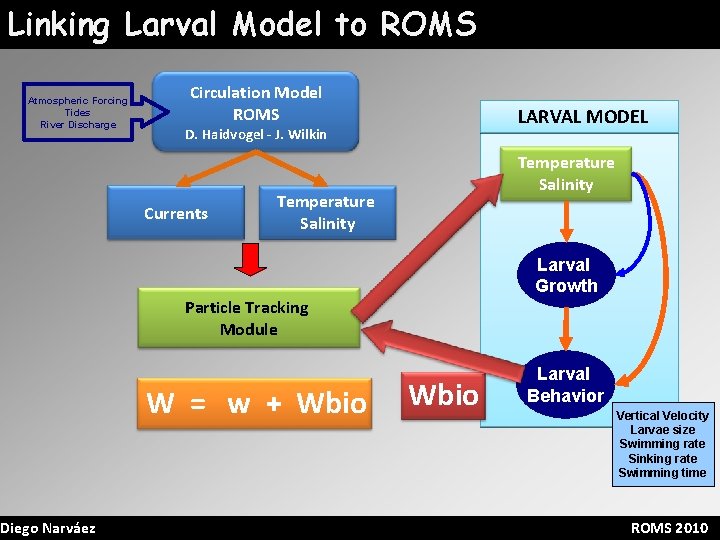
Linking Larval Model to ROMS Atmospheric Forcing Tides River Discharge Diego Narváez Circulation Model ROMS LARVAL MODEL D. Haidvogel - J. Wilkin Currents Temperature Salinity Larval Growth Particle Tracking Module W = w + Wbio Larval Behavior Vertical Velocity Larvae size Swimming rate Sinking rate Swimming time ROMS 2010
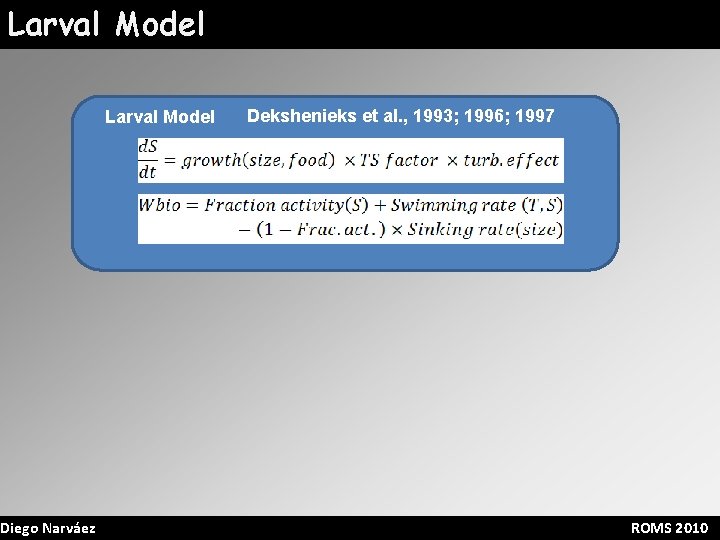
Larval Model Diego Narváez Larval Model Dekshenieks et al. , 1993; 1996; 1997 ROMS 2010
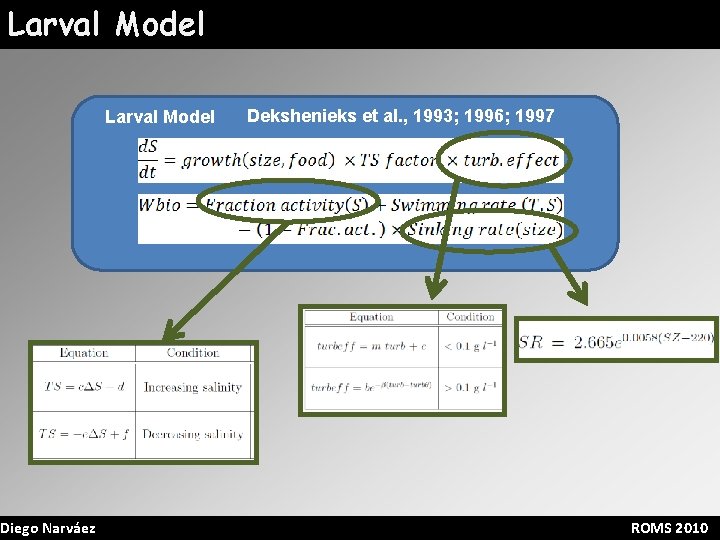
Larval Model Diego Narváez Larval Model Dekshenieks et al. , 1993; 1996; 1997 ROMS 2010
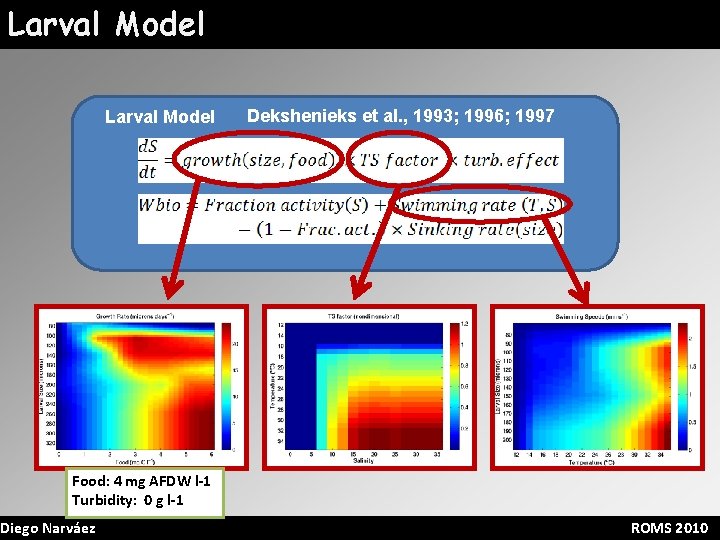
Larval Model Dekshenieks et al. , 1993; 1996; 1997 Food: 4 mg AFDW l-1 Turbidity: 0 g l-1 Diego Narváez ROMS 2010
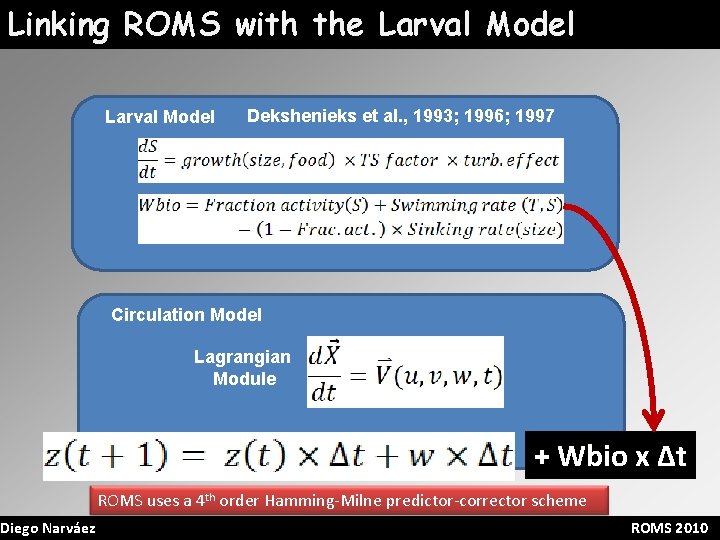
Linking ROMS with the Larval Model Diego Narváez Larval Model Dekshenieks et al. , 1993; 1996; 1997 Circulation Model Lagrangian Module + Wbio x ∆t ROMS uses a 4 th order Hamming-Milne predictor-corrector scheme ROMS 2010
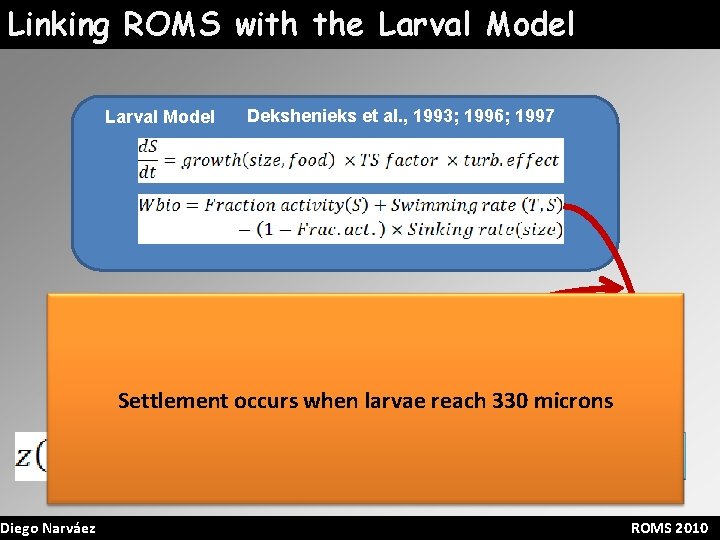
Linking ROMS with the Larval Model Diego Narváez Larval Model Dekshenieks et al. , 1993; 1996; 1997 Circulation Model Lagrangian Module Temperature Settlement occurs when larvae reach Salinity 330 microns + Wbio x ∆t ROMS 2010
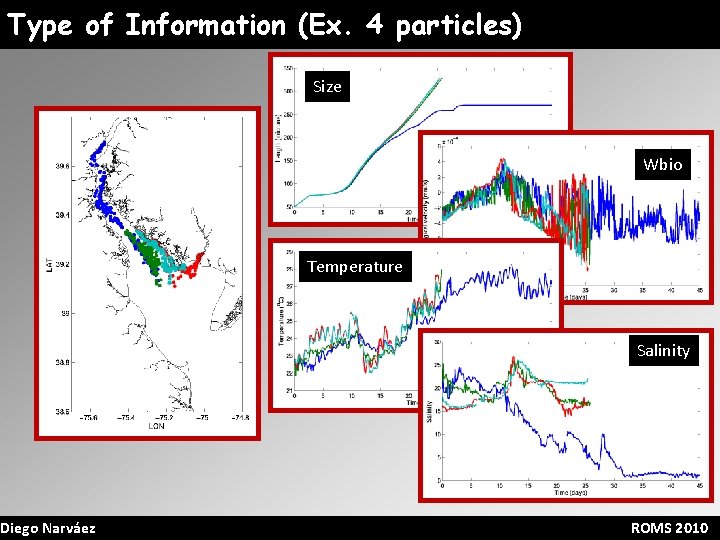
Type of Information (Ex. 4 particles) Diego Narváez Size Wbio Temperature Salinity ROMS 2010
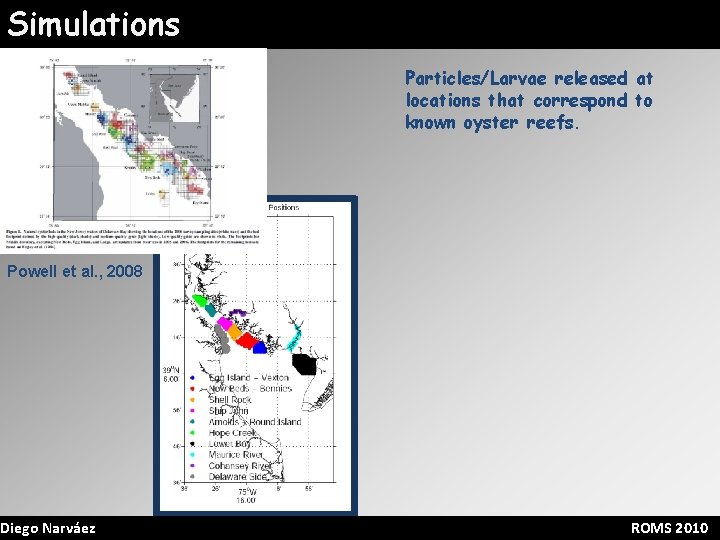
Simulations Particles/Larvae released at locations that correspond to known oyster reefs. Powell et al. , 2008 Diego Narváez ROMS 2010
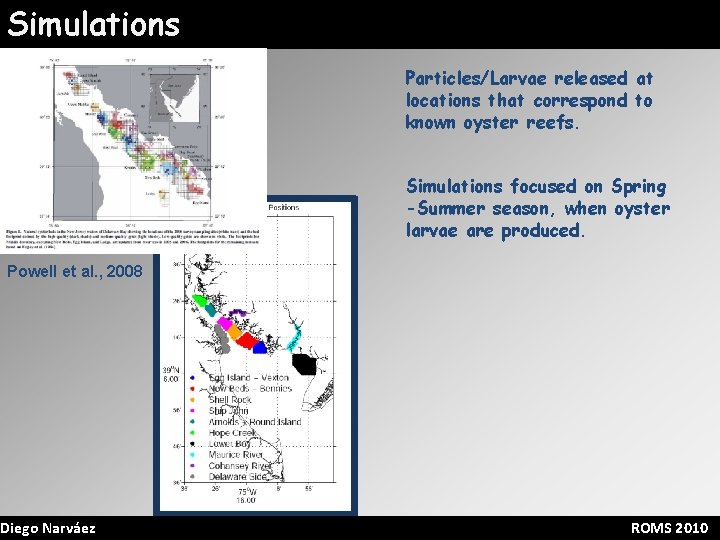
Simulations Particles/Larvae released at locations that correspond to known oyster reefs. Simulations focused on Spring -Summer season, when oyster larvae are produced. Powell et al. , 2008 Diego Narváez ROMS 2010
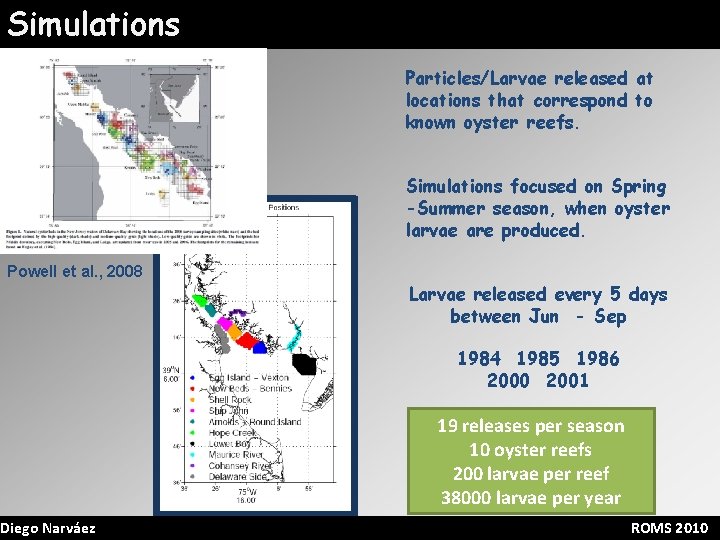
Simulations Particles/Larvae released at locations that correspond to known oyster reefs. Simulations focused on Spring -Summer season, when oyster larvae are produced. Powell et al. , 2008 Diego Narváez Larvae released every 5 days between Jun - Sep 1984 1985 1986 2000 2001 19 releases per season 10 oyster reefs 200 larvae per reef 38000 larvae per year ROMS 2010
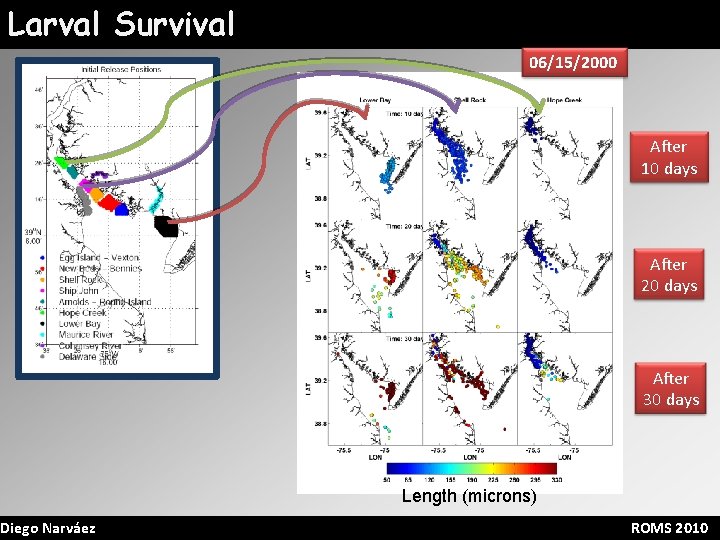
Larval Survival Diego Narváez 06/15/2000 After 10 days After 20 days After 30 days Length (microns) ROMS 2010
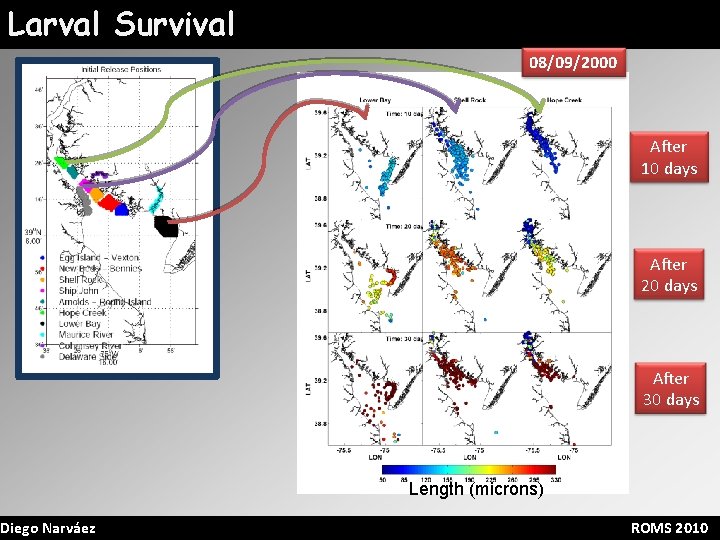
Larval Survival Diego Narváez 08/09/2000 After 10 days After 20 days After 30 days Length (microns) ROMS 2010
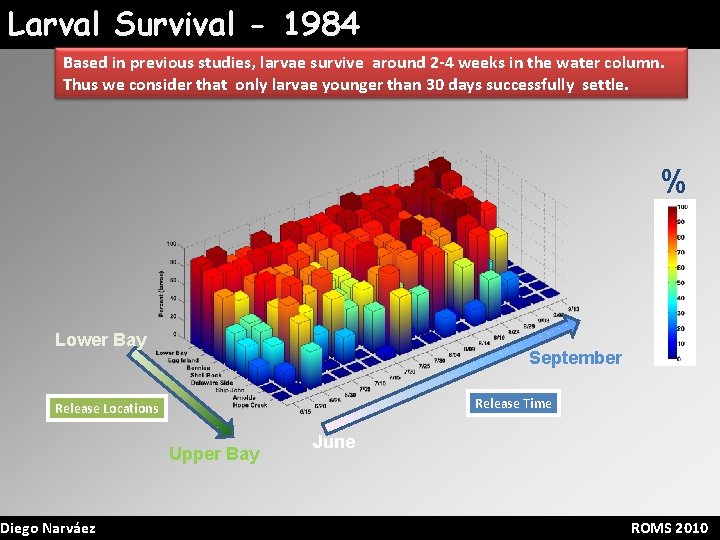
Larval Survival - 1984 Based in previous studies, larvae survive around 2 -4 weeks in the water column. Thus we consider that only larvae younger than 30 days successfully settle. % Lower Bay September Release Time Release Locations Diego Narváez Upper Bay June ROMS 2010
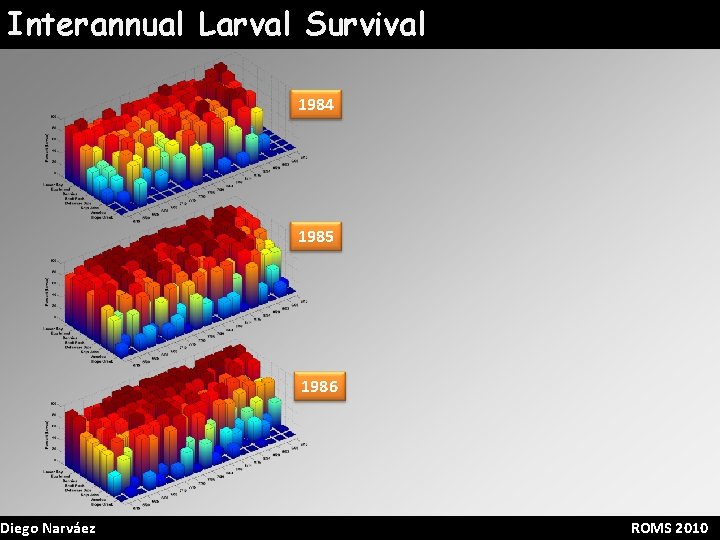
Interannual Larval Survival Diego Narváez 1984 1985 1986 ROMS 2010
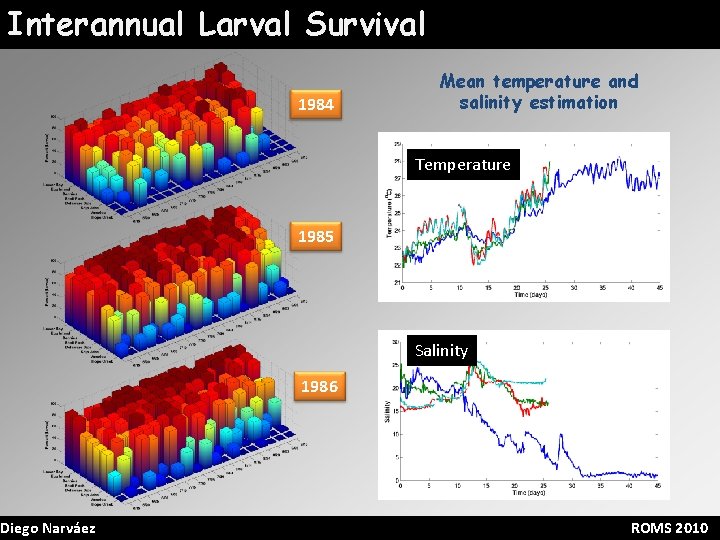
Interannual Larval Survival Diego Narváez 1984 Mean temperature and salinity estimation Temperature 1985 Salinity 1986 ROMS 2010
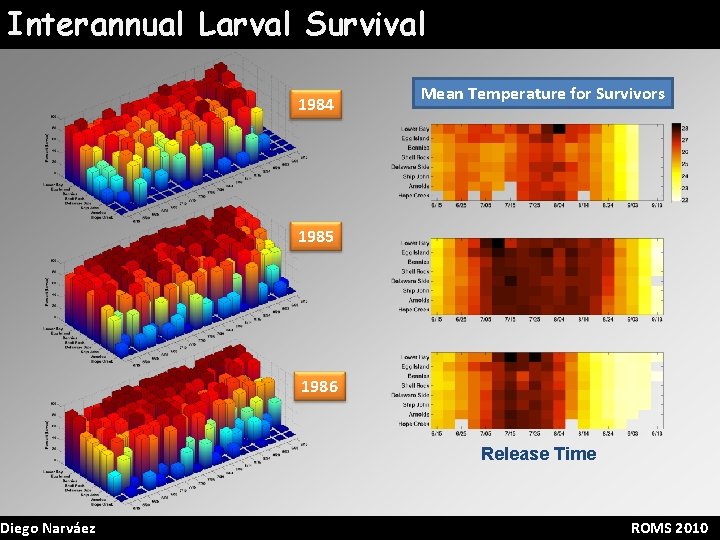
Interannual Larval Survival Diego Narváez 1984 Mean Temperature for Survivors 1985 1986 Release Time ROMS 2010
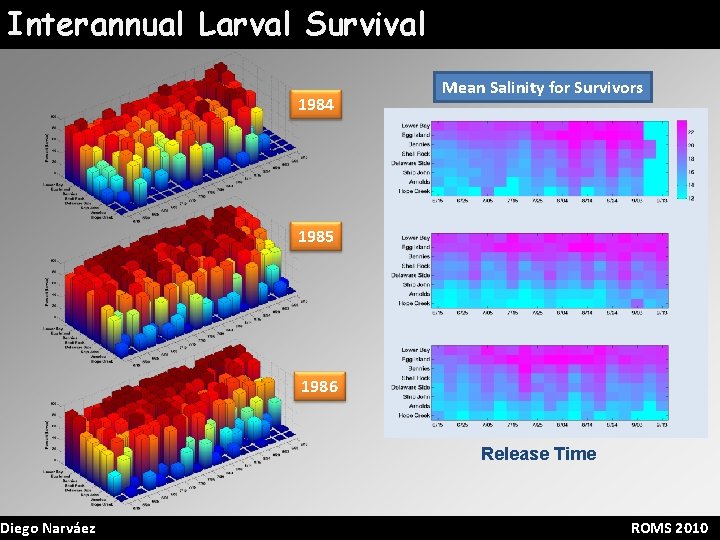
Interannual Larval Survival Diego Narváez 1984 Mean Salinity for Survivors 1985 1986 Release Time ROMS 2010
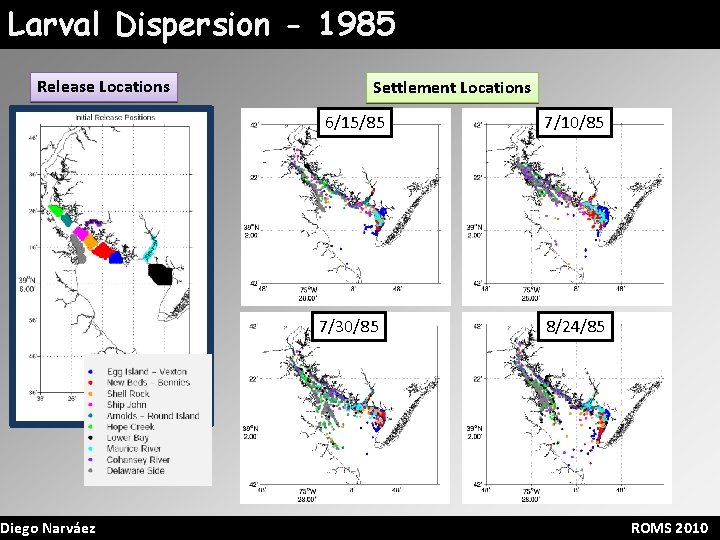
Larval Dispersion - 1985 Release Locations Diego Narváez Settlement Locations 6/15/85 7/30/85 7/10/85 8/24/85 ROMS 2010
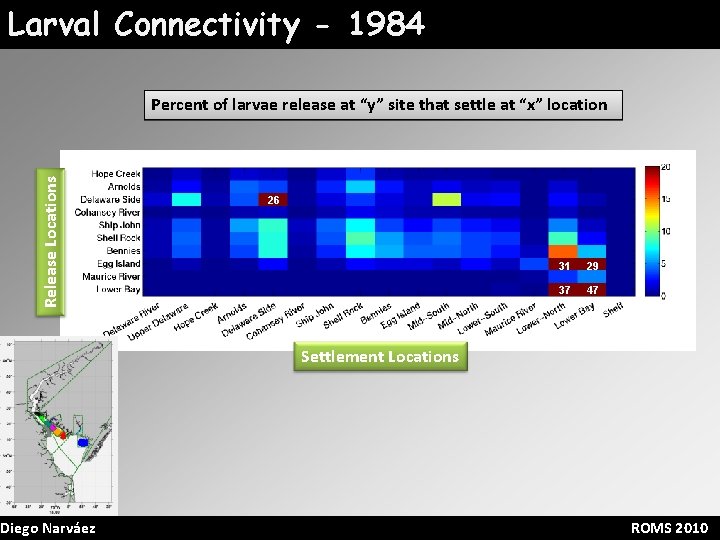
Larval Connectivity - 1984 Release Locations Percent of larvae release at “y” site that settle at “x” location Diego Narváez 26 31 29 37 47 Settlement Locations ROMS 2010
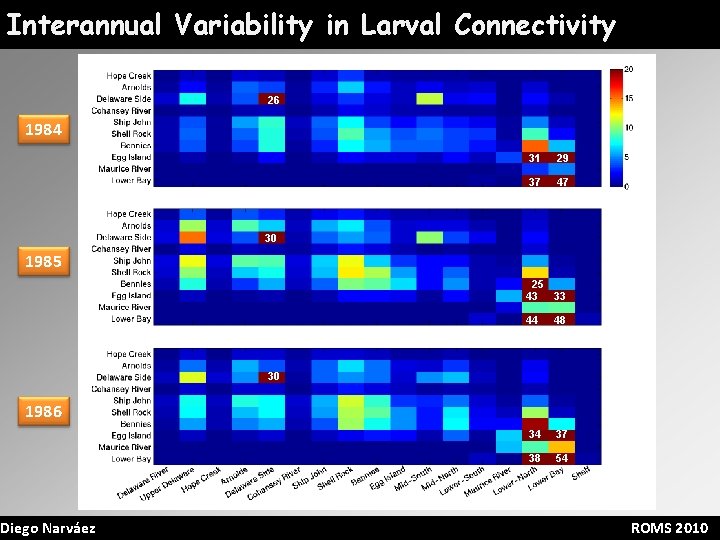
Interannual Variability in Larval Connectivity 26 1984 31 29 37 47 30 1985 25 43 33 44 48 34 37 38 54 30 1986 Diego Narváez ROMS 2010
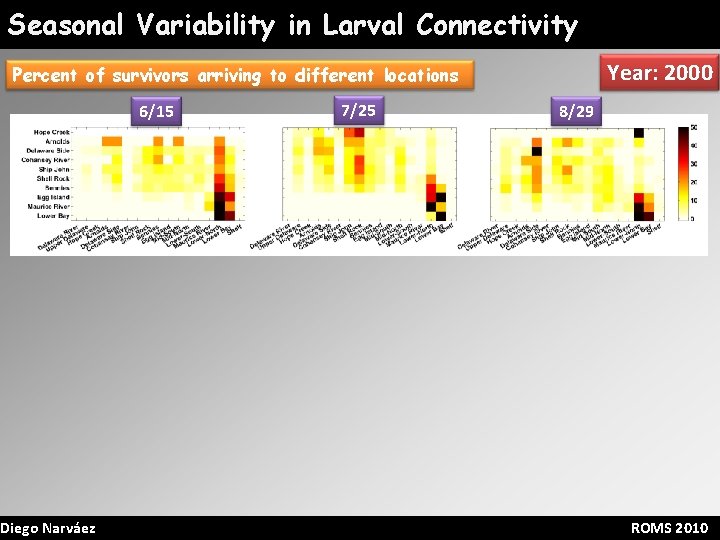
Seasonal Variability in Larval Connectivity Year: 2000 Percent of survivors arriving to different locations Diego Narváez 6/15 7/25 8/29 ROMS 2010
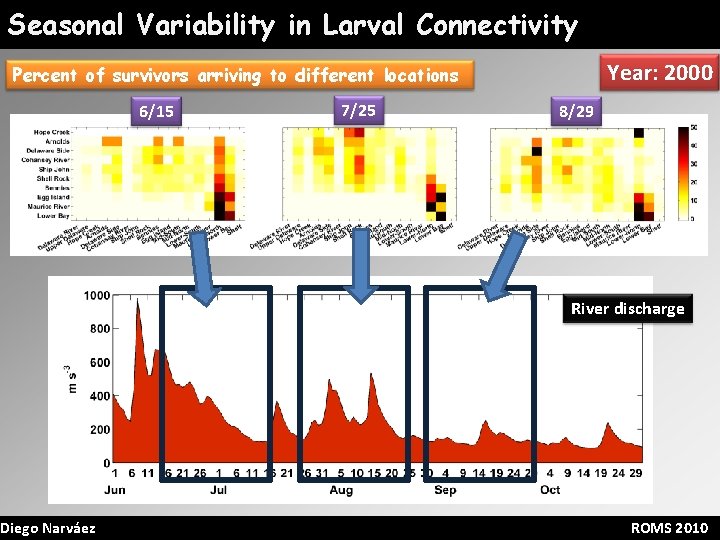
Seasonal Variability in Larval Connectivity Year: 2000 Percent of survivors arriving to different locations Diego Narváez 6/15 7/25 8/29 River discharge ROMS 2010
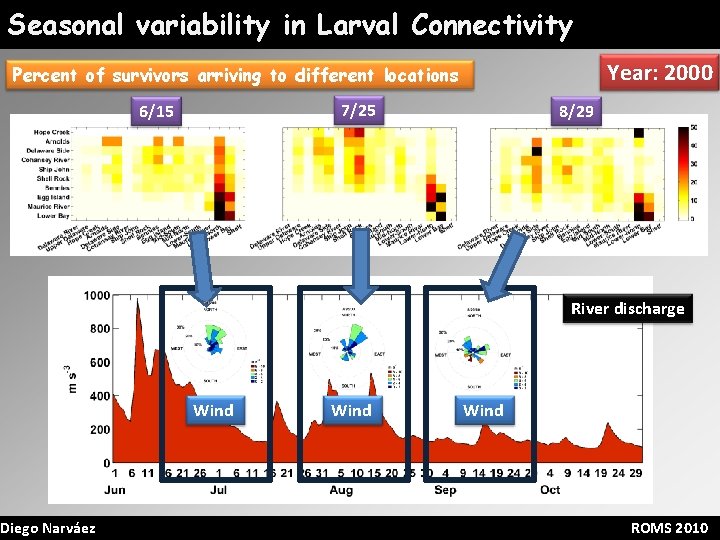
Seasonal variability in Larval Connectivity Year: 2000 Percent of survivors arriving to different locations Diego Narváez 7/25 6/15 8/29 River discharge Wind ROMS 2010
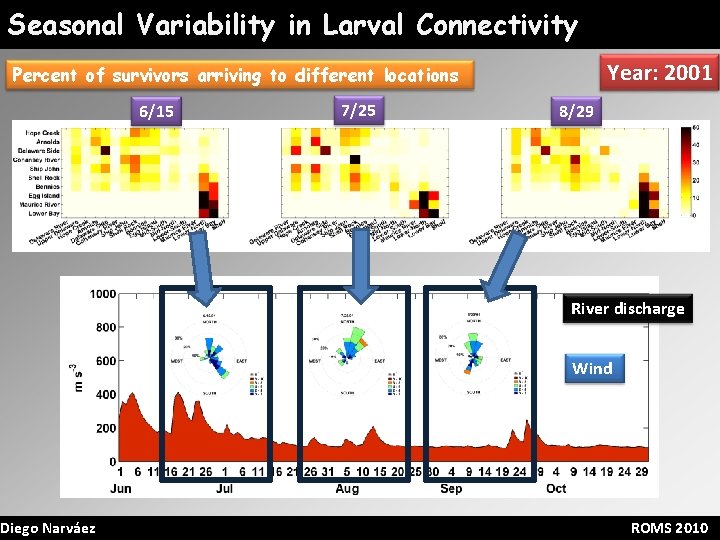
Seasonal Variability in Larval Connectivity Year: 2001 Percent of survivors arriving to different locations Diego Narváez 6/15 7/25 8/29 River discharge Wind ROMS 2010
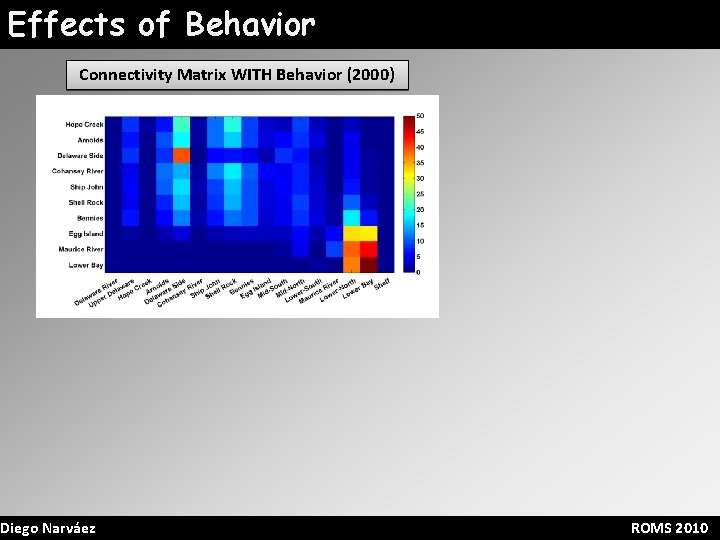
Effects of Behavior Connectivity Matrix WITH Behavior (2000) Diego Narváez ROMS 2010
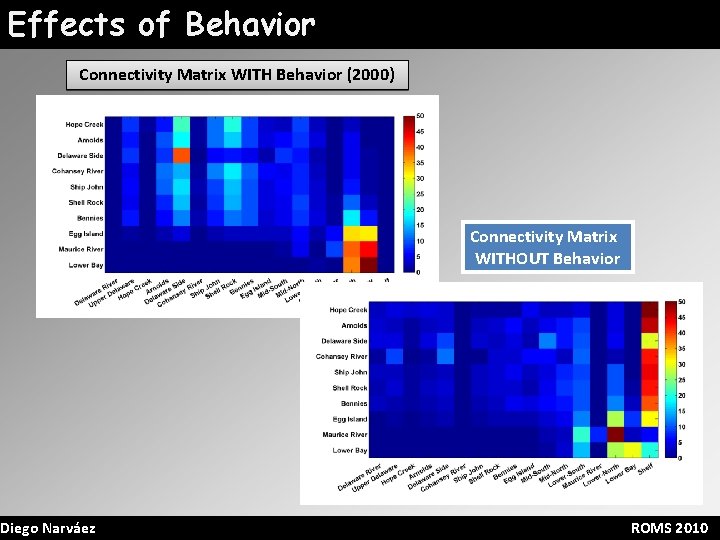
Effects of Behavior Connectivity Matrix WITH Behavior (2000) Diego Narváez Connectivity Matrix WITHOUT Behavior ROMS 2010
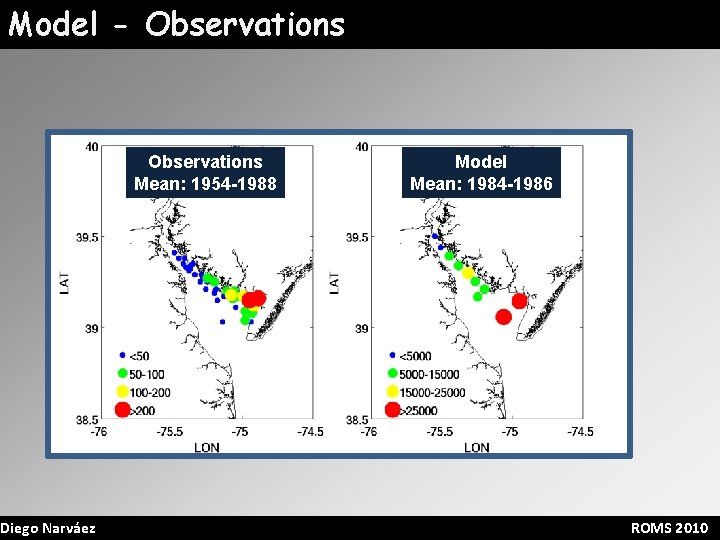
Model - Observations Diego Narváez Observations Mean: 1954 -1988 Model Mean: 1984 -1986 ROMS 2010
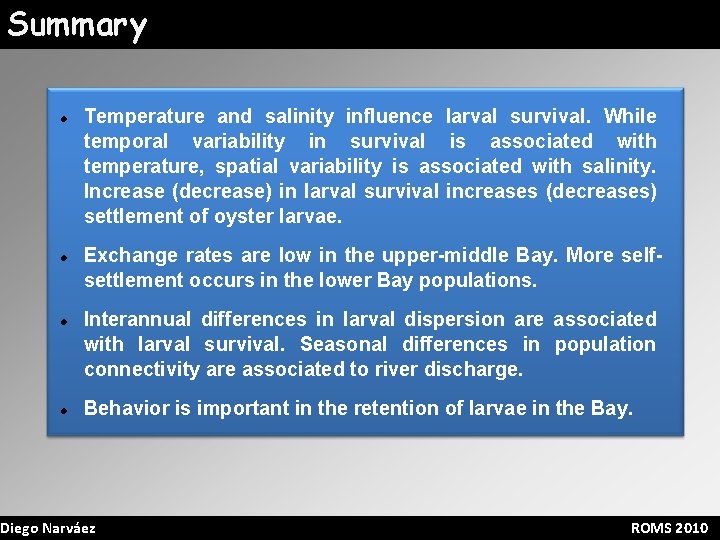
Summary Temperature and salinity influence larval survival. While temporal variability in survival is associated with temperature, spatial variability is associated with salinity. Increase (decrease) in larval survival increases (decreases) settlement of oyster larvae. Exchange rates are low in the upper-middle Bay. More selfsettlement occurs in the lower Bay populations. Interannual differences in larval dispersion are associated with larval survival. Seasonal differences in population connectivity are associated to river discharge. Behavior is important in the retention of larvae in the Bay. Diego Narváez ROMS 2010

Acknowledgments Hernan Arango ROMS developers community Funding by: National Science Foundation

Acknowledgments Dr. Hernan Arango ROMS users community Funds: National Science Foundation Thank you! Questions?
- Slides: 50