
Couples Experiences of Prostate Cancer Distress Communication and
- Slides: 1
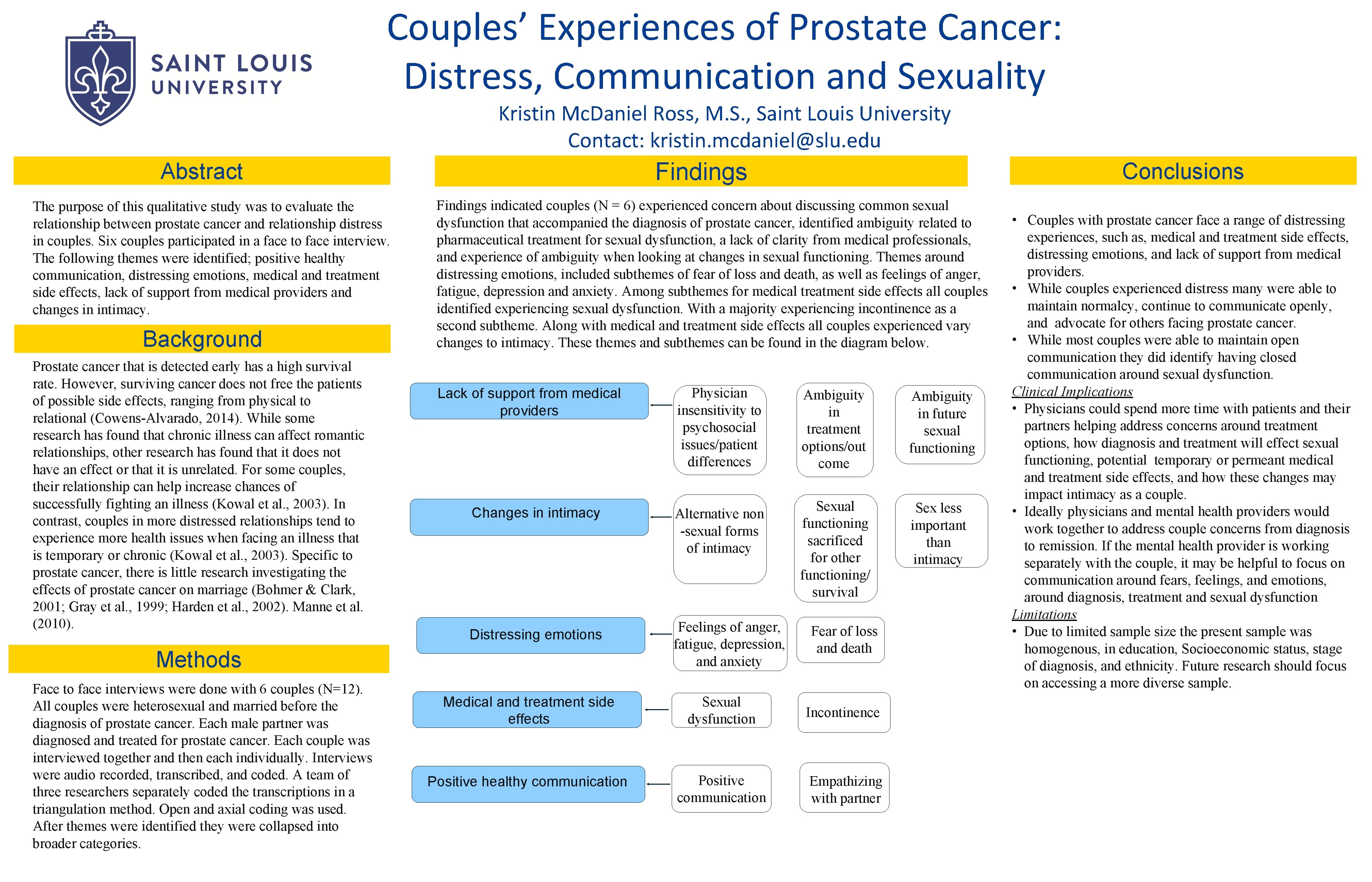
Couples’ Experiences of Prostate Cancer: Distress, Communication and Sexuality Kristin Mc. Daniel Ross, M. S. , Saint Louis University Contact: kristin. mcdaniel@slu. edu Findings Abstract The purpose of this qualitative study was to evaluate the relationship between prostate cancer and relationship distress in couples. Six couples participated in a face to face interview. The following themes were identified; positive healthy communication, distressing emotions, medical and treatment side effects, lack of support from medical providers and changes in intimacy. Background Prostate cancer that is detected early has a high survival rate. However, surviving cancer does not free the patients of possible side effects, ranging from physical to relational (Cowens-Alvarado, 2014). While some research has found that chronic illness can affect romantic relationships, other research has found that it does not have an effect or that it is unrelated. For some couples, their relationship can help increase chances of successfully fighting an illness (Kowal et al. , 2003). In contrast, couples in more distressed relationships tend to experience more health issues when facing an illness that is temporary or chronic (Kowal et al. , 2003). Specific to prostate cancer, there is little research investigating the effects of prostate cancer on marriage (Bohmer & Clark, 2001; Gray et al. , 1999; Harden et al. , 2002). Manne et al. (2010). Findings indicated couples (N = 6) experienced concern about discussing common sexual dysfunction that accompanied the diagnosis of prostate cancer, identified ambiguity related to pharmaceutical treatment for sexual dysfunction, a lack of clarity from medical professionals, and experience of ambiguity when looking at changes in sexual functioning. Themes around distressing emotions, included subthemes of fear of loss and death, as well as feelings of anger, fatigue, depression and anxiety. Among subthemes for medical treatment side effects all couples identified experiencing sexual dysfunction. With a majority experiencing incontinence as a second subtheme. Along with medical and treatment side effects all couples experienced vary changes to intimacy. These themes and subthemes can be found in the diagram below. Lack of support from medical providers Changes in intimacy Distressing emotions Methods Face to face interviews were done with 6 couples (N=12). All couples were heterosexual and married before the diagnosis of prostate cancer. Each male partner was diagnosed and treated for prostate cancer. Each couple was interviewed together and then each individually. Interviews were audio recorded, transcribed, and coded. A team of three researchers separately coded the transcriptions in a triangulation method. Open and axial coding was used. After themes were identified they were collapsed into broader categories. Conclusions Physician insensitivity to psychosocial issues/patient differences Alternative non -sexual forms of intimacy Feelings of anger, fatigue, depression, and anxiety Ambiguity in treatment options/out come Ambiguity in future sexual functioning Sexual functioning sacrificed for other functioning/ survival Sex less important than intimacy Fear of loss and death Medical and treatment side effects Sexual dysfunction Incontinence Positive healthy communication Positive communication Empathizing with partner • Couples with prostate cancer face a range of distressing experiences, such as, medical and treatment side effects, distressing emotions, and lack of support from medical providers. • While couples experienced distress many were able to maintain normalcy, continue to communicate openly, and advocate for others facing prostate cancer. • While most couples were able to maintain open communication they did identify having closed communication around sexual dysfunction. Clinical Implications • Physicians could spend more time with patients and their partners helping address concerns around treatment options, how diagnosis and treatment will effect sexual functioning, potential temporary or permeant medical and treatment side effects, and how these changes may impact intimacy as a couple. • Ideally physicians and mental health providers would work together to address couple concerns from diagnosis to remission. If the mental health provider is working separately with the couple, it may be helpful to focus on communication around fears, feelings, and emotions, around diagnosis, treatment and sexual dysfunction Limitations • Due to limited sample size the present sample was homogenous, in education, Socioeconomic status, stage of diagnosis, and ethnicity. Future research should focus on accessing a more diverse sample.