
Coupled Sequence Labeling on Heterogeneous Annotations POS tagging
Coupled Sequence Labeling on Heterogeneous Annotations (POS tagging) Zhenghua Li, Jiayuan Chao, Min Zhang, Wenliang Chen {zhli 13, minzhang, wlchen}@suda. edu. cn; china_cjy@163. com; Soochow University, China
An interesting problem in our mind �The existence of multiple labeled data, with different annotation guidelines or formulations (heterogeneous annotations) �How to effectively utilize such data? �How to train a model with heterogeneous data?
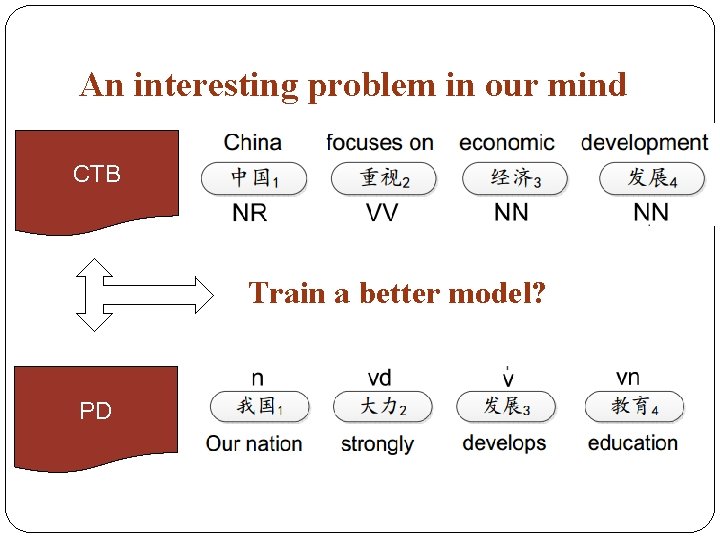
An interesting problem in our mind CTB Train a better model? PD
Challenges �How to capture the structure/tag correspondences between two guidelines? �Usually context-dependent. Hard to represent with rules. �The datasets (PD/CTB) are typically non- overlapping. Thus it is difficult to build a model to automatically learn the correspondences.
Previous work �Guide-feature based methods (stacked learning) �Word segmentation, POS tagging (Jiang+ 09; Sun & Wan 12; Jiang+12; Gao+ 14) �Dependency parsing (Li+ 12) �Constituent treebank conversion (Zhu+ 11; Jiang+ 13) �…
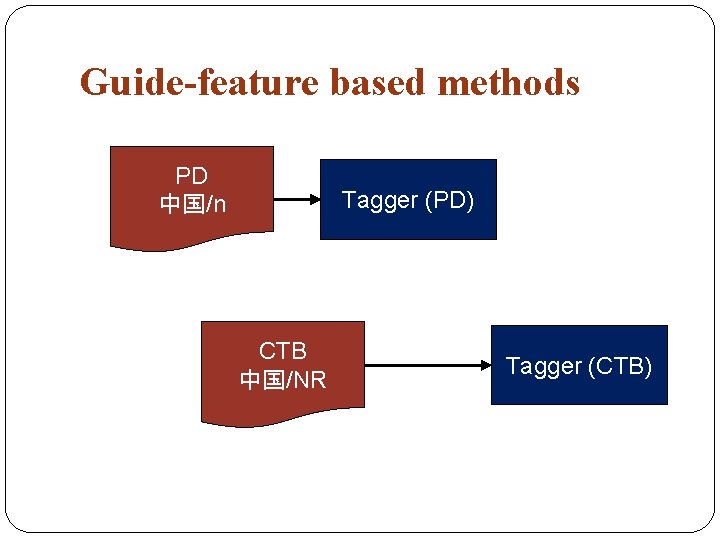
Guide-feature based methods PD 中国/n Tagger (PD) CTB 中国/NR Tagger (CTB)
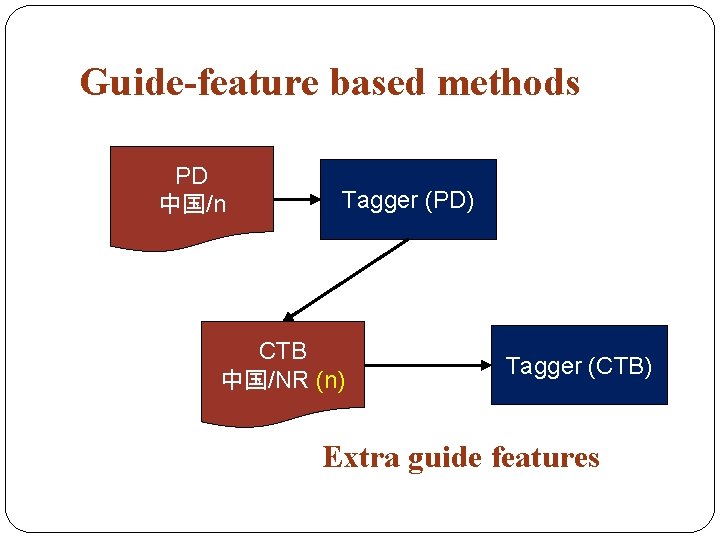
Guide-feature based methods PD 中国/n Tagger (PD) CTB 中国/NR (n) Tagger (CTB) Extra guide features
The problem with guide-feature based methods �The methodology is not simple/elegant: twice training/decoding. Although �very effective and robust for different problems �very simple to implement. �The source data is not fully exploited, and not directly contribute to training. The final target model does not directly learn from the source sentences. (Prof. Haifeng Wang, Baidu)
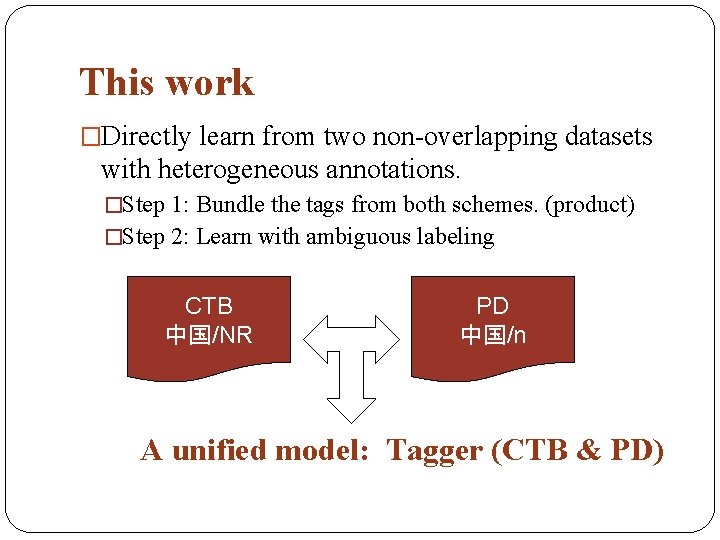
This work �Directly learn from two non-overlapping datasets with heterogeneous annotations. �Step 1: Bundle the tags from both schemes. (product) �Step 2: Learn with ambiguous labeling CTB 中国/NR PD 中国/n A unified model: Tagger (CTB & PD)
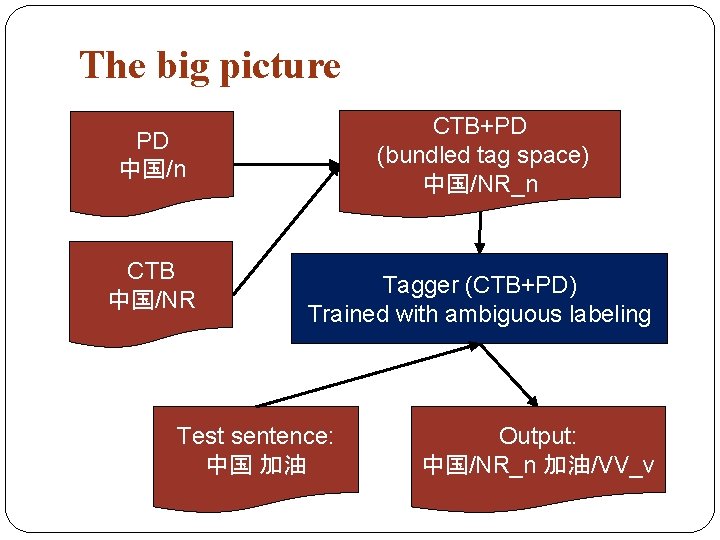
The big picture CTB+PD (bundled tag space) 中国/NR_n PD 中国/n CTB 中国/NR Tagger (CTB+PD) Trained with ambiguous labeling Test sentence: 中国 加油 Output: 中国/NR_n 加油/VV_v
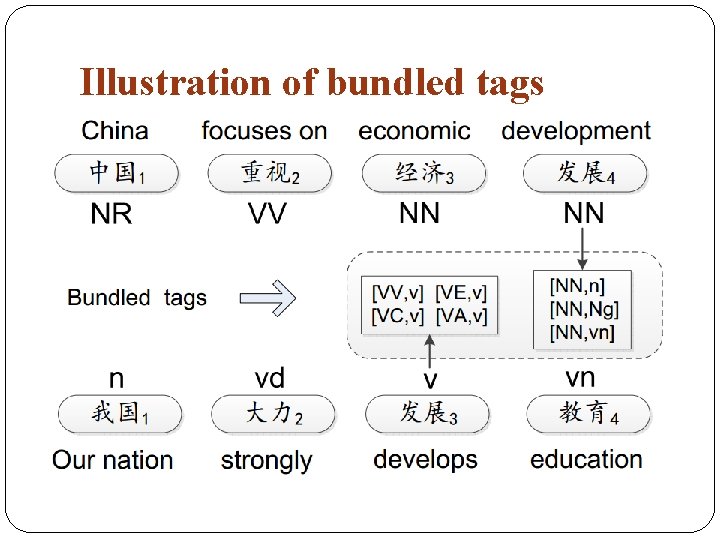
Illustration of bundled tags
How to create bundled tags?
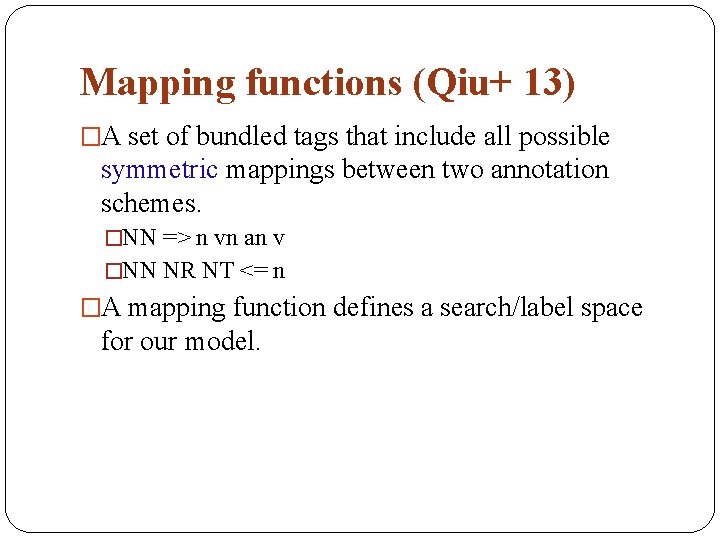
Mapping functions (Qiu+ 13) �A set of bundled tags that include all possible symmetric mappings between two annotation schemes. �NN => n vn an v �NN NR NT <= n �A mapping function defines a search/label space for our model.
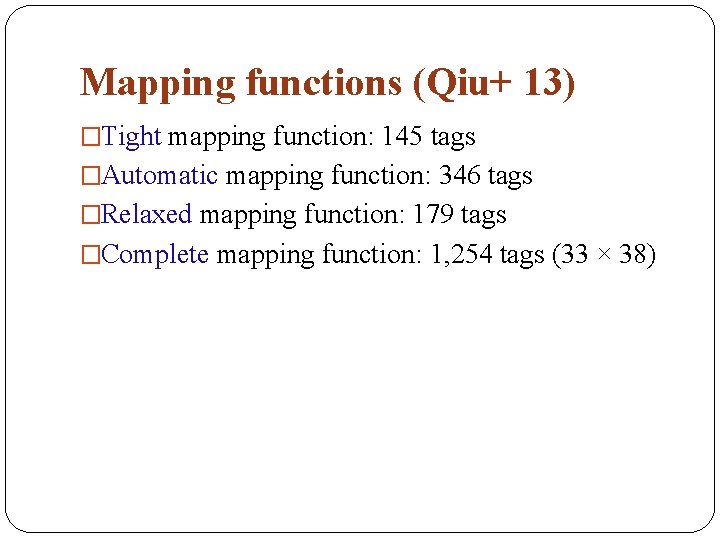
Mapping functions (Qiu+ 13) �Tight mapping function: 145 tags �Automatic mapping function: 346 tags �Relaxed mapping function: 179 tags �Complete mapping function: 1, 254 tags (33 × 38)
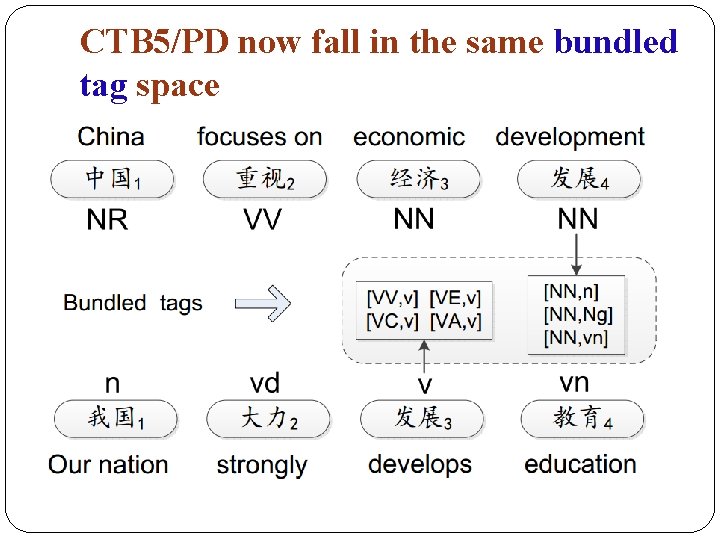
CTB 5/PD now fall in the same bundled tag space
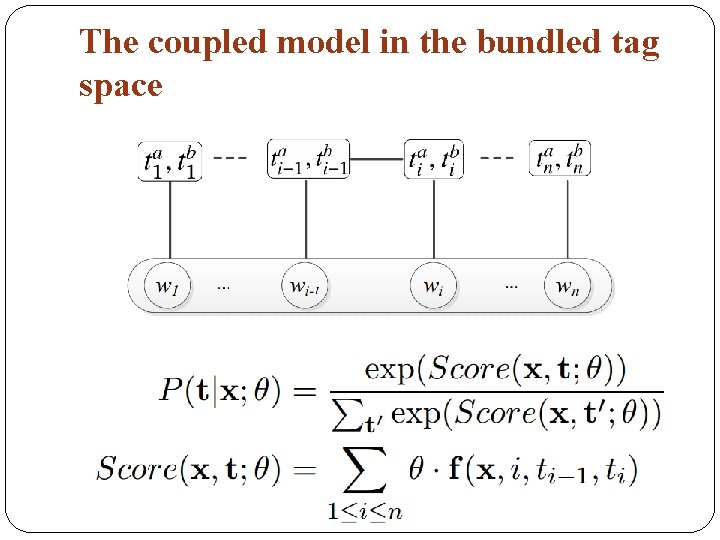
The coupled model in the bundled tag space
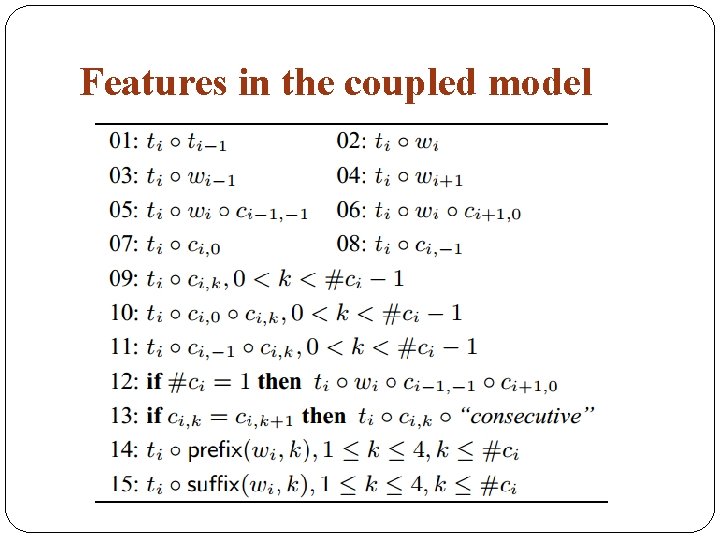
Features in the coupled model
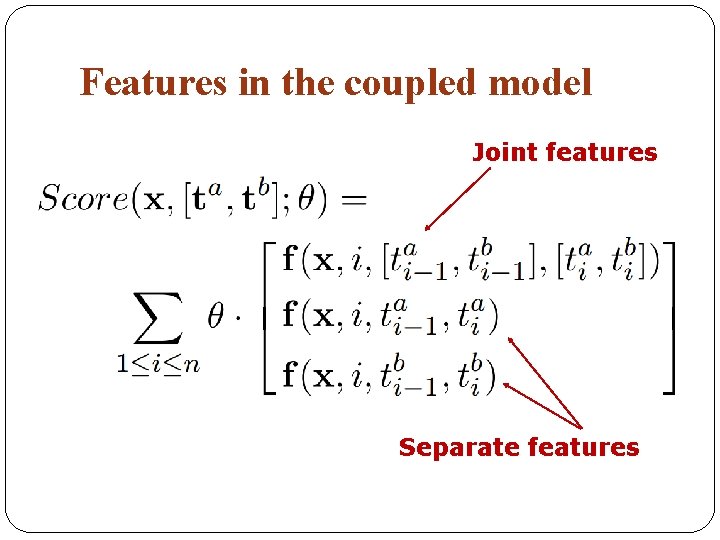
Features in the coupled model Joint features Separate features

Features in the coupled model 外交部 1 Foreign Ministry �言人 2 Spokesman 答 3 answers NN_n^外交部 Joint features NN^外交部 n^外交部 Separate features
What is the benefit of this model? �Both datasets are directly used for training. �Can use both joint and separate features. �Joint features capture the implicit correspondences between annotations. �Separate features function as back-off/base features.
How to train the model?
Ambiguous labeling (partial annotation, natural annotation) �Relaxed/weak supervision �Multilingual transfer on dependency parsing (Tackstrom+ 13) �Semi-supervised dependency parsing (Li+ 14 a, 14 b) �Word segmentation (Jiang+ 13; Liu+14; Yang and Vozila 14)
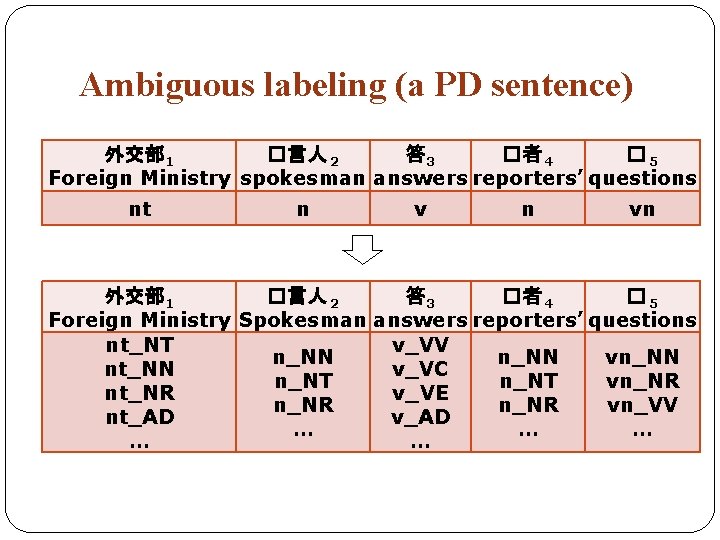
Ambiguous labeling (a PD sentence) 外交部 1 �言人 2 答 3 �者 4 � 5 Foreign Ministry spokesman answers reporters’ questions nt n vn 外交部 1 �言人 2 答 3 �者 4 � 5 Foreign Ministry Spokesman answers reporters’ questions nt_NT v_VV n_NN vn_NN nt_NN v_VC n_NT vn_NR nt_NR v_VE n_NR vn_VV nt_AD v_AD … … …
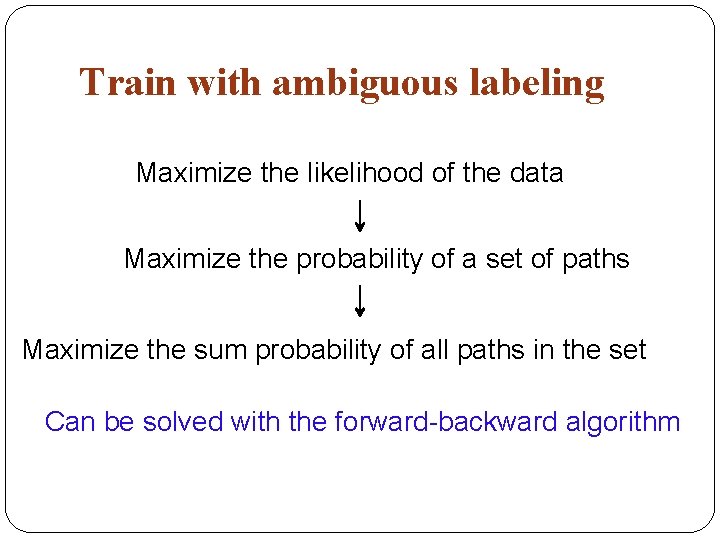
Train with ambiguous labeling Maximize the likelihood of the data Maximize the probability of a set of paths Maximize the sum probability of all paths in the set Can be solved with the forward-backward algorithm
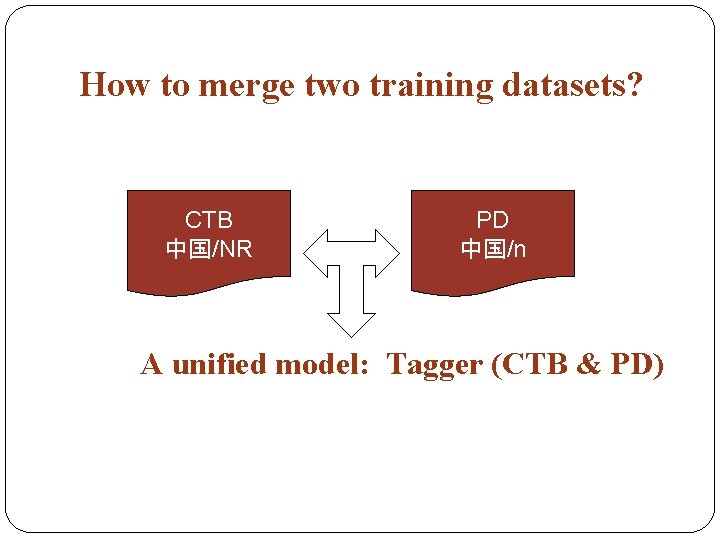
How to merge two training datasets? CTB 中国/NR PD 中国/n A unified model: Tagger (CTB & PD)
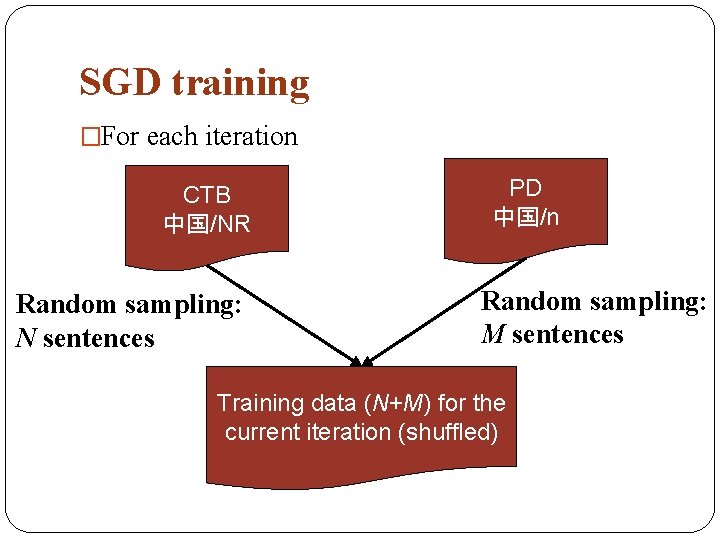
SGD training �For each iteration CTB 中国/NR Random sampling: N sentences PD 中国/n Random sampling: M sentences Training data (N+M) for the current iteration (shuffled)
Previous work (Qiu+ 13) �We are directly inspired by their work. �Differences from our work �Linear model with perceptron-like training �Only explore separate features �Approximate decoding �Rely on manually designed mapping functions

Experiments �Data statistics Newly annotated data for conversion evaluation (partial annotation: 20% most difficult tokens)
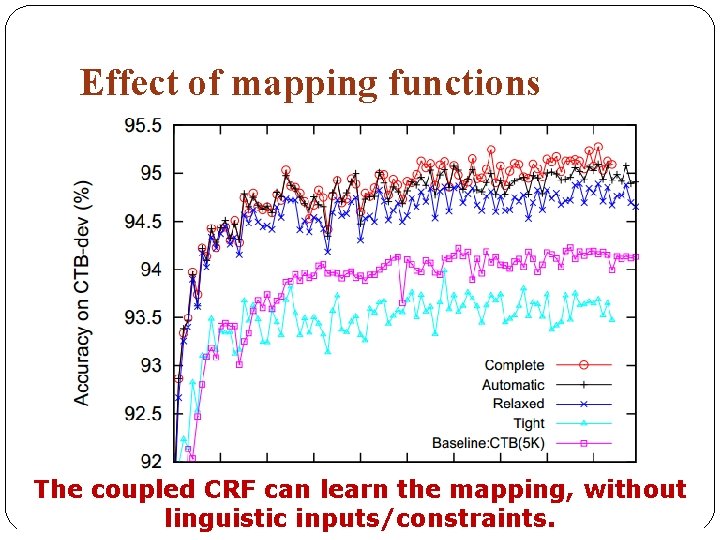
Effect of mapping functions The coupled CRF can learn the mapping, without linguistic inputs/constraints.
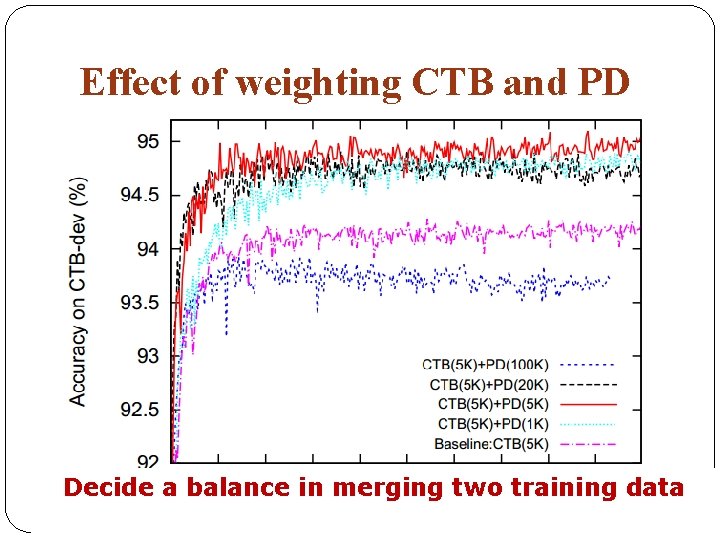
Effect of weighting CTB and PD Decide a balance in merging two training data
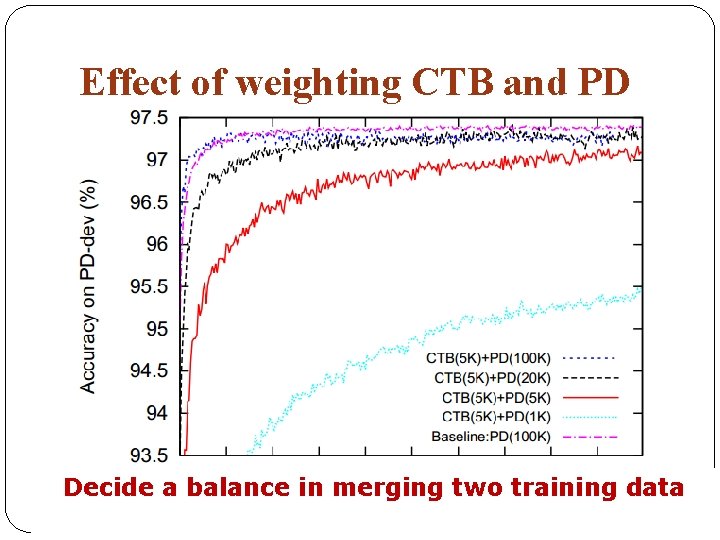
Effect of weighting CTB and PD Decide a balance in merging two training data
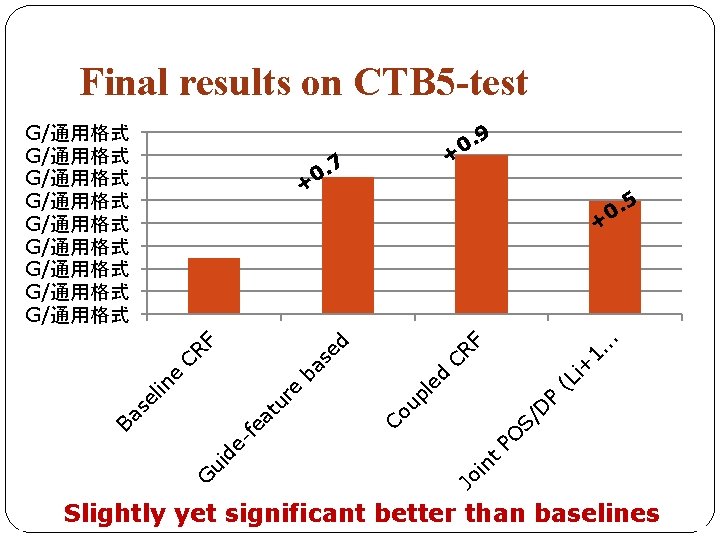
Final results on CTB 5 -test G/通用格式 G/通用格式 G/通用格式 9 . 0 + 7 . . (L i+ 1. CR F D P up l Jo in t PO S/ Co re tu fe a ui de G ed ba s CR e lin se Ba 5 . 0 + ed F . 0 + Slightly yet significant better than baselines
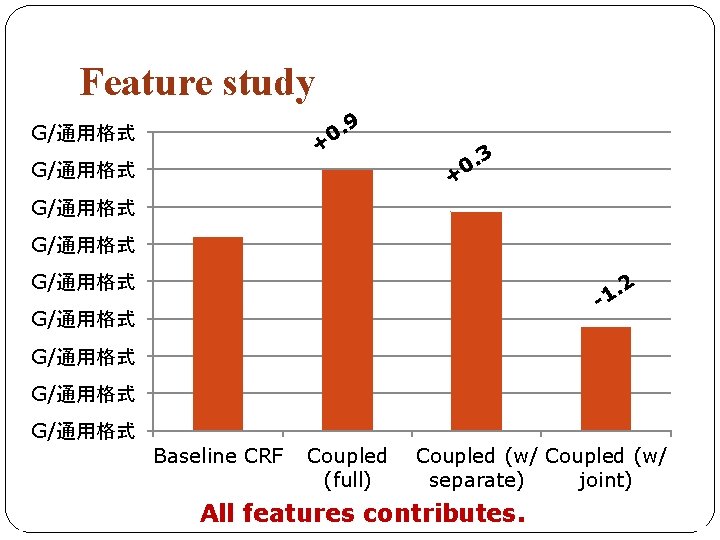
Feature study 9 . 0 + G/通用格式 3 . 0 + G/通用格式 2 . -1 G/通用格式 Baseline CRF Coupled (full) Coupled (w/ separate) joint) All features contributes.
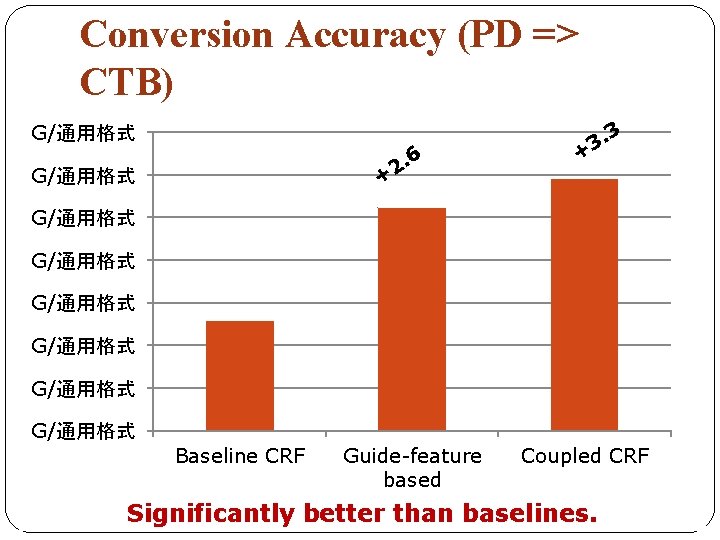
Conversion Accuracy (PD => CTB) G/通用格式 6 . 2 + G/通用格式 3 . 3 + G/通用格式 G/通用格式 Baseline CRF Guide-feature based Coupled CRF Significantly better than baselines.
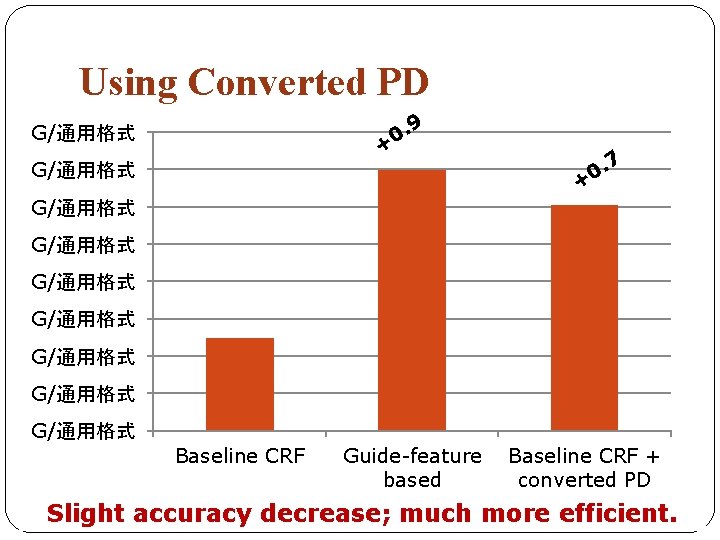
Using Converted PD 9 . 0 + G/通用格式 7 . 0 + G/通用格式 G/通用格式 Baseline CRF Guide-feature based Baseline CRF + converted PD Slight accuracy decrease; much more efficient.
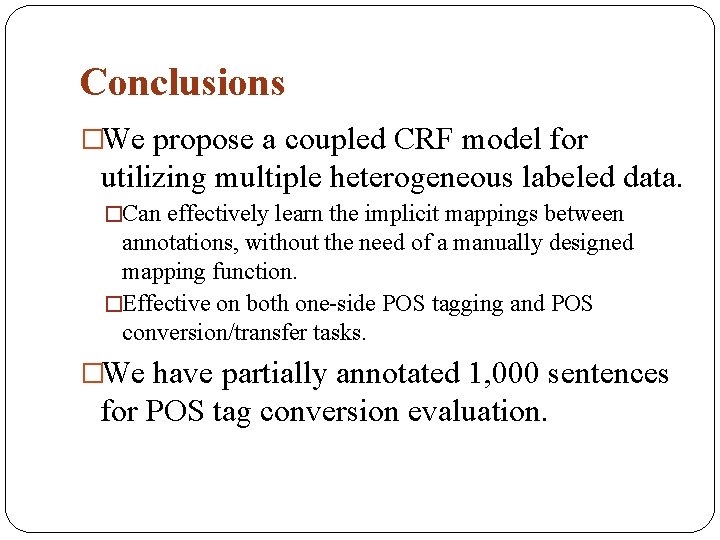
Conclusions �We propose a coupled CRF model for utilizing multiple heterogeneous labeled data. �Can effectively learn the implicit mappings between annotations, without the need of a manually designed mapping function. �Effective on both one-side POS tagging and POS conversion/transfer tasks. �We have partially annotated 1, 000 sentences for POS tag conversion evaluation.

Future directions �Annotate more data with both CTB and PD tags, and investigate the coupled model with small amount of such annotation as extra training data. �Propose a more principled and theoretically sound method to merge multiple training data. �Efficiency issue �Word segmentation guidelines also differ, which is ignored in this work
Thanks for your time! Questions? Codes, newly annotated data, and other resources are released at http: //hlt. suda. edu. cn/~zhli for non-commercial usage.
Work going on �Our approach is also effective on the word segmentation task. �Adapt our approach to dependency parsing.
Coupled model used for conversion �Constrained decoding �PD=>CTB conversion �the search space is constrained by the PD-side tags.
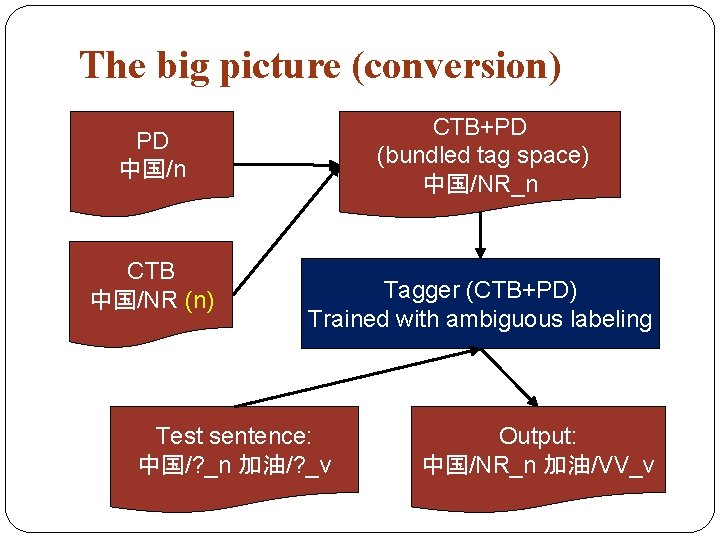
The big picture (conversion) CTB+PD (bundled tag space) 中国/NR_n PD 中国/n CTB 中国/NR (n) Tagger (CTB+PD) Trained with ambiguous labeling Test sentence: 中国/? _n 加油/? _v Output: 中国/NR_n 加油/VV_v
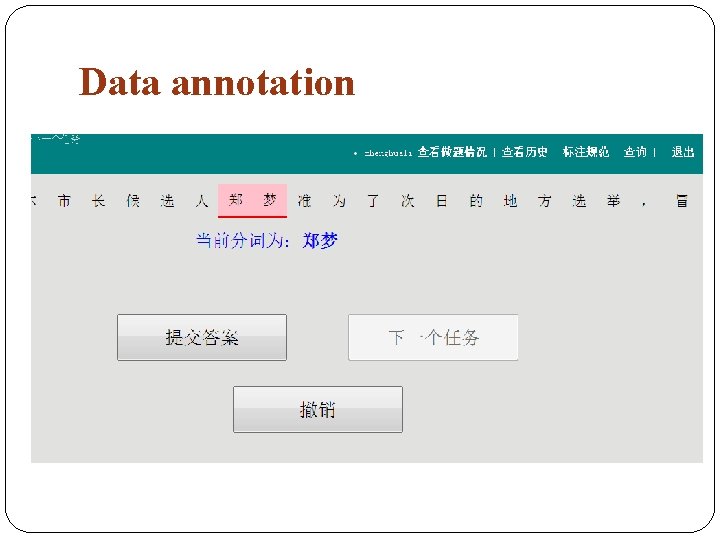
Data annotation
Domain adaptation �Previous studies suggest that directly combining out-domain and in-domain training data does not lead to an optimal model.
- Slides: 43