
Coupled FluidThermalStructural Modeling of Motorized Spindle to Reduce
- Slides: 1
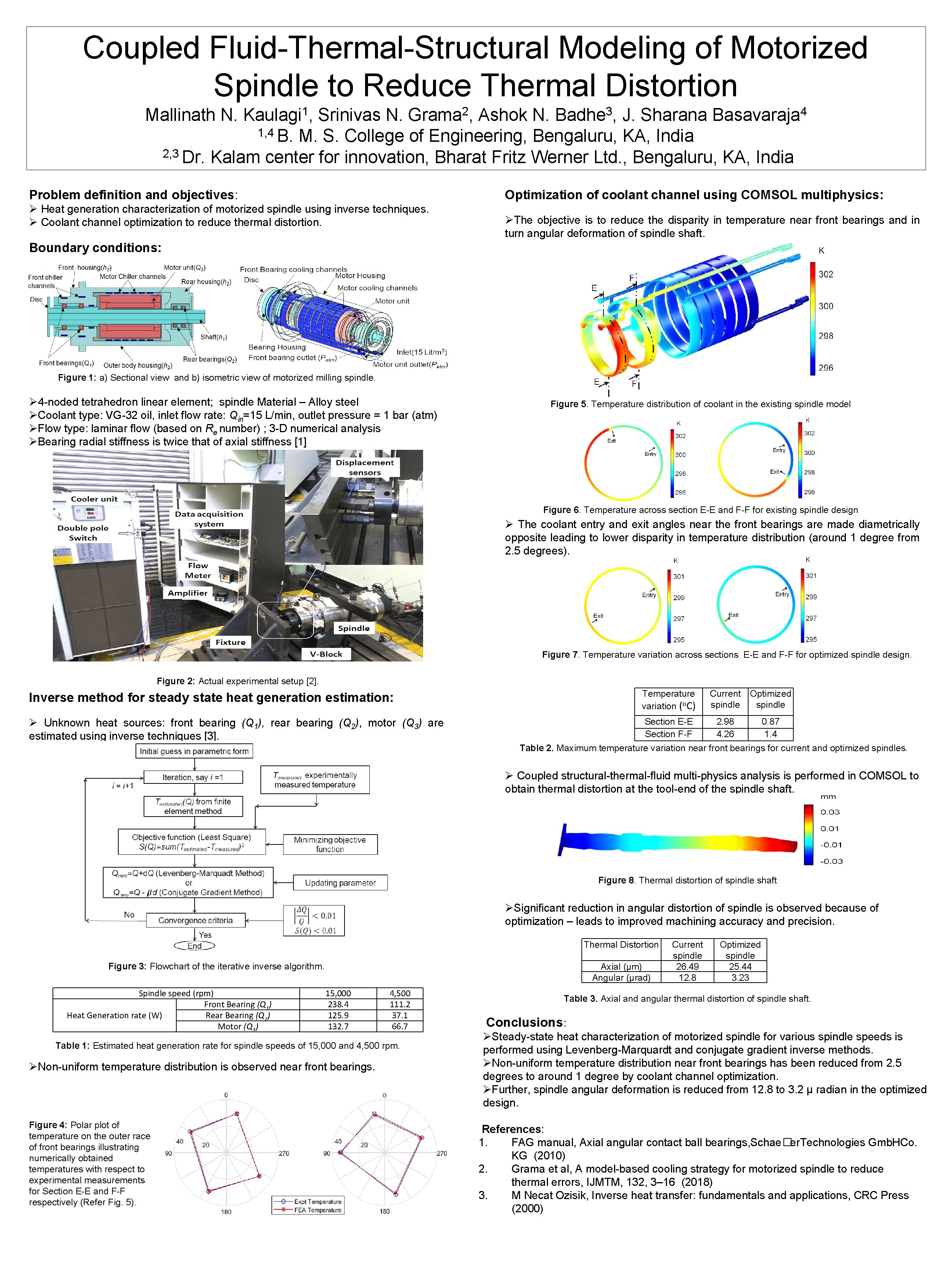
Coupled Fluid-Thermal-Structural Modeling of Motorized Spindle to Reduce Thermal Distortion Mallinath N. 1 Kaulagi , 2 Grama , Srinivas N. Ashok N. J. Sharana 1, 4 B. M. S. College of Engineering, Bengaluru, KA, India 2, 3 Dr. Kalam center for innovation, Bharat Fritz Werner Ltd. , Bengaluru, KA, India Problem definition and objectives: 3 Badhe , 4 Basavaraja Optimization of coolant channel using COMSOL multiphysics: Ø Heat generation characterization of motorized spindle using inverse techniques. Ø Coolant channel optimization to reduce thermal distortion. ØThe objective is to reduce the disparity in temperature near front bearings and in turn angular deformation of spindle shaft. Boundary conditions: Figure 1: a) Sectional view and b) isometric view of motorized milling spindle. Ø 4 -noded tetrahedron linear element; spindle Material – Alloy steel ØCoolant type: VG-32 oil, inlet flow rate: Qin=15 L/min, outlet pressure = 1 bar (atm) ØFlow type: laminar flow (based on Re number) ; 3 -D numerical analysis ØBearing radial stiffness is twice that of axial stiffness [1] Figure 5. Temperature distribution of coolant in the existing spindle model Figure 6. Temperature across section E-E and F-F for existing spindle design Ø The coolant entry and exit angles near the front bearings are made diametrically opposite leading to lower disparity in temperature distribution (around 1 degree from 2. 5 degrees). Figure 7. Temperature variation across sections E-E and F-F for optimized spindle design. Figure 2: Actual experimental setup [2]. Inverse method for steady state heat generation estimation: Temperature variation (o. C) Current spindle Optimized spindle Ø Unknown heat sources: front bearing (Q 1), rear bearing (Q 2), motor (Q 3) are estimated using inverse techniques [3]. Section E-E Section F-F 2. 98 4. 26 0. 87 1. 4 Table 2. Maximum temperature variation near front bearings for current and optimized spindles. Ø Coupled structural-thermal-fluid multi-physics analysis is performed in COMSOL to obtain thermal distortion at the tool-end of the spindle shaft. Figure 8. Thermal distortion of spindle shaft ØSignificant reduction in angular distortion of spindle is observed because of optimization – leads to improved machining accuracy and precision. Thermal Distortion Figure 3: Flowchart of the iterative inverse algorithm. Spindle speed (rpm) Front Bearing (Q 1) Rear Bearing (Q 2) Heat Generation rate (W) Motor (Q 3) Axial (µm) Angular (µrad) 15, 000 238. 4 125. 9 132. 7 4, 500 111. 2 37. 1 66. 7 Table 1: Estimated heat generation rate for spindle speeds of 15, 000 and 4, 500 rpm. ØNon-uniform temperature distribution is observed near front bearings. Figure 4: Polar plot of temperature on the outer race of front bearings illustrating numerically obtained temperatures with respect to experimental measurements for Section E-E and F-F respectively (Refer Fig. 5). Current spindle 26. 49 12. 8 Optimized spindle 25. 44 3. 23 Table 3. Axial and angular thermal distortion of spindle shaft. Conclusions: ØSteady-state heat characterization of motorized spindle for various spindle speeds is performed using Levenberg-Marquardt and conjugate gradient inverse methods. ØNon-uniform temperature distribution near front bearings has been reduced from 2. 5 degrees to around 1 degree by coolant channel optimization. ØFurther, spindle angular deformation is reduced from 12. 8 to 3. 2 µ radian in the optimized design. References: 1. FAG manual, Axial angular contact ball bearings, Schae�er. Technologies Gmb. HCo. KG (2010) 2. Grama et al, A model-based cooling strategy for motorized spindle to reduce thermal errors, IJMTM, 132, 3– 16 (2018) 3. M Necat Ozisik, Inverse heat transfer: fundamentals and applications, CRC Press (2000)