
County Based MediCal Administrative Activities CMAA Participation Requirements
County Based Medi-Cal Administrative Activities (CMAA) Participation Requirements & Process 2016 LGA Consortium Conference
Introduction Dion Andres – Sacramento County LGA David Huey – formerly from Alameda County LGA and currently, one of the LGA Consultants for the LGA Consortium Who is in the room?
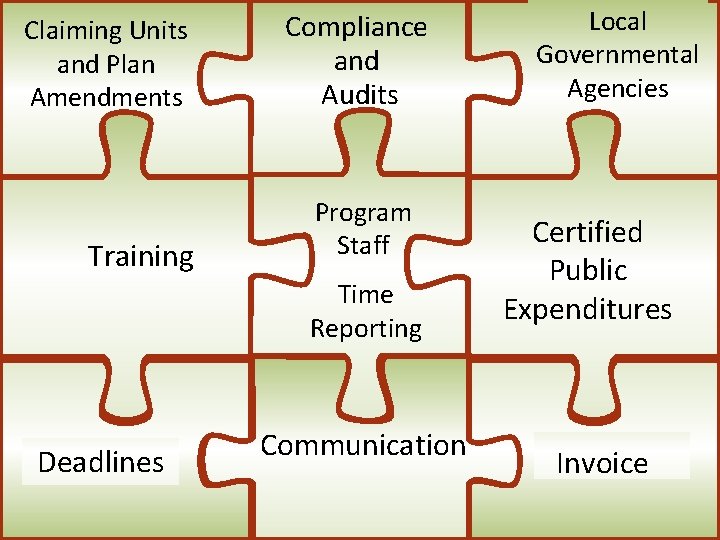
Coordination Claiming Units of Compliance and Plan CMAA Audits Amendments The Puzzle Training Program Staff Time Reporting Communication Deadlines 3 Local Governmental Agencies Certified Public Expenditures Invoice

What is MAA? Under MAA, the federal government reimburses state and local agencies for their costs associated with case management and administrative activities delivered to Medi-Cal eligible individuals. MAA is not a direct service program like our common notions of Medi-Cal that reimburses doctors and hospitals for health care services. Instead, participating agencies are reimbursed for their work in linking, connecting, and coordinating services for the benefit of their clients, rather than being direct providers.

The History of MAA • 1994: federal disallowance of programs • 1995: MAC Agreement Authorizes new programs • County-Based MAA • Targeted Case Management • Mental Health MAA 2003: CMS Issues School-Based MAA (SMAA) Manual • Separates SMAA from CMAA 2009: CMS invalidates Time Survey May 2013: CMS approves ‘County Based Medi-Cal Administrative Activities Program Operational Plan’

Communication LGA (internal) - Program Managers - Fiscal Analysts - IT Staff Agency/CBO (internal & external) - Coordinators - Staff DHCS (external) - Branch Chief - Unit Chief - Analyst LGA Consortium (external) - Executive Committee - Consultants - Coordinators

Basics: Getting Started What are the requirements to participate in MAA? ü Contract with DHCS ü Contract with Host County ü Contract with claiming agencies and vendors - MOU ü Comprehensive Claiming Plan documentation for each claiming agency (CUFG, Duty Statements, and Activity Code worksheets) ü Mandatory annual time survey training for all staff ü Training on on-line TS system (if applicable) ü MAA invoice submission
Basics: Key MAA Codes MAA codes that are 100% allowable under the Medi-Cal program and claimable at the 50% FFP reimbursement Code 4: Medi-Cal Outreach Code 8: Facilitating the Medi-Cal Application Code 12: Code 6: Referral, Coordination, and/or Monitoring Code 12: Contract Administration Codes 15 & 16: PP&PD and SPMP PP&PD Code 19: MAA/TCM Coordination/ Claims Administration • Only one staff can code to this per Claiming Unit— without prior DHCS approval Code 20: MAA/TCM Implementation Training

MAA Codes/Activities MAA codes for which the share of costs must be determined by applying the discounted or proportional Medi-Cal share or Medi-Cal percentage Code 6: Referral, Coordination, and/or Monitoring Code 10: Non-Emergency, Non-Medical Transport Code 13: Contract Administration Codes 17 & 18: PP&PD and SPMP PP&PD

Basics: Medi-Cal % DHCS prefers the use of Actual Client Count (ACC) method ACC = Number of Medi-Cal Beneficiaries / Number of All Clients Served County-wide Average (option) Use for Codes 6, 10, 13, 17, and 18
Best Practice: MC % Complete your Activity Code worksheets to document which codes are using ACC. Explain why you are using and how it is calculated. Provide back-up for calculated %.

Basics: Reallocated Codes Reallocated MAA codes are administrative activities that are reallocated across other activity codes on a proportional basis. • Code 21 – General Administration • Code 22 – Paid Time Off
Best Practice: Time Survey Activity Results Monitor time survey coding for accuracy and appropriateness to work performed. • Time Survey must match your Payroll time sheets. • High allocated time to any one code should be reviewed. Codes 1 and 21: Daily allocation Code 20 for any training except 1 st time or annual. Maximize time allocation to a code by accounting for the time preparing for, traveling to and from an activity, and follow-up work, within the code you are performing.
Best Practice: Electronic Time Surveys Consider an electronic time survey for your time study management. These are the benefits: Streamline workflow Eliminate many paper files Stores surveys online, for safety and redundancy. Ease monitoring participant performance Simplify participant and Supervisor signature Simplify payroll time survey matching compliance. Direct Charge software expenses to recover 50% of system costs.
Basics: Other Time Survey Requirements Signature requirements on time surveys • Participant and supervisor signatures (blue ink) • E-signature for on-line time surveys (PPL 12009) Submission requirements • Only time survey results are reported and used for MAA invoices • Original hard copy surveys maintained in audit files
Basics: CPE (Revenue) 100% certified public expenditures (CPE) CPE: State, County, or local funds • Some federal funds may be allowed • MAA/TCM reimbursements are allowable federal CPE Most federal funds must be offset Refer to p. 5 of CMAA/TCM Implementation Plan dated 11/05/13
Best Practices: COST POOLS Look at the Cost Pools (a part of the invoice process) when forming Claiming Units to designate agency participation. Review under-or-over performing Claiming Units to ensure audit compliance.
Basics: COST POOLS All claiming unit staff costs are categorized into Cost Pools in the MAA invoice for reimbursement. Cost Pool 1 –Skilled Professional Medical Personnel (SPMP): limited to Governmental Agencies Cost Pool 2 – Non–SPMP: time survey staff and support staff to Cost Pool 2 Cost Pool 3 – Non-MAA, Non-Support: Didn’t time survey or direct charge, not in a support classification
Basics: COST POOLS All claiming unit staff costs are categorized into Cost Pools in the MAA invoice for reimbursement. Cost Pool 5 – Direct Charge costs (includes DC staff costs): Specific to the MAA program Cost Pool 6 – Administrative Costs: General Administrative and Support staff
Basic: Direct Charge The following Activity Codes can be direct charged: Code 4: Medi-Cal Outreach Code 10: Transportation Costs Code 15 -18: Program Planning and Policy Development Code 19: MAA Coordination/Claims Administration
Best Practice: Direct Charge Identify on your Claiming Unit Functions Grid: One code to direct charge per time survey participant or subcontractor Documentation/ audit back-up: Time log or calendar Certify your time: DHCS Staff Certification of Direct Charge Time form
Summary Develop program knowledge Regional Oversight and Responsibility Manage Deadlines Policy Guidance and Program Training Collaborate internally and externally w/ all stakeholders • Administration, Claiming Agencies, LGA Consortium, and DHCS Audit Files
Best Practices: Participation Consider being a part of the CMAA GUIDELINES WORKGROUP or an active participant of the LGA Consortium
- Slides: 23