
Country Patterns of Labour Market Entry and Early
Country Patterns of Labour Market Entry and Early Career Péter Róbert TARKI Social Research Institute, Budapest, Hungary Paper prepared for the DECOWE Conference, Ljubljana, 24 -26 September 2009
Outline of the presentation • Research ambition and questions • Conceptual background and hypotheses • Data issues: REFLEX and HEGESCO • Construction of the measurements • Methodology • Results on country patterns • Discussion and policy relevance
Research objective: LM entry and early career • Easiness and fastness of LM entry: - length of job search • Match between education and current job: - over-education, underemployment - performance gap / credential gap - objective / subjective approach • Early career - unemployment experience
Conceptual background: OLM / ILM and EPL • Internal vs. occupational markets; production vs. training approach; organisational vs. qualificational mobility space - tracking in the school system, vocational specificity, signalling function • Employment protection legislation - insider vs. outsider labour market
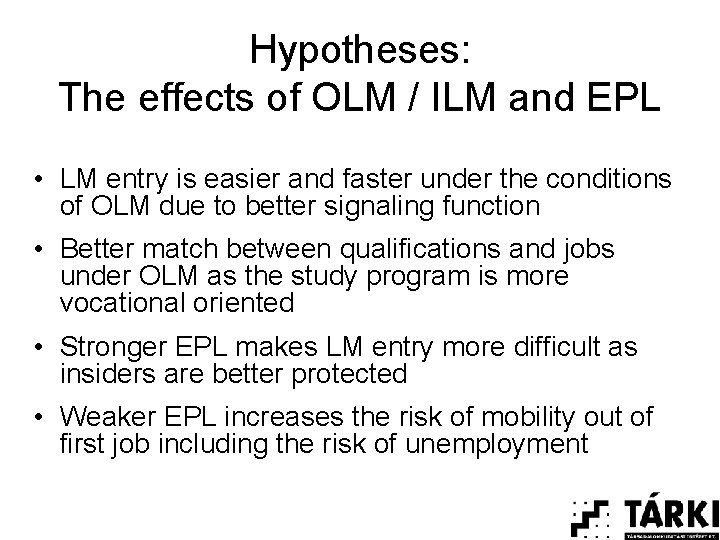
Hypotheses: The effects of OLM / ILM and EPL • LM entry is easier and faster under the conditions of OLM due to better signaling function • Better match between qualifications and jobs under OLM as the study program is more vocational oriented • Stronger EPL makes LM entry more difficult as insiders are better protected • Weaker EPL increases the risk of mobility out of first job including the risk of unemployment
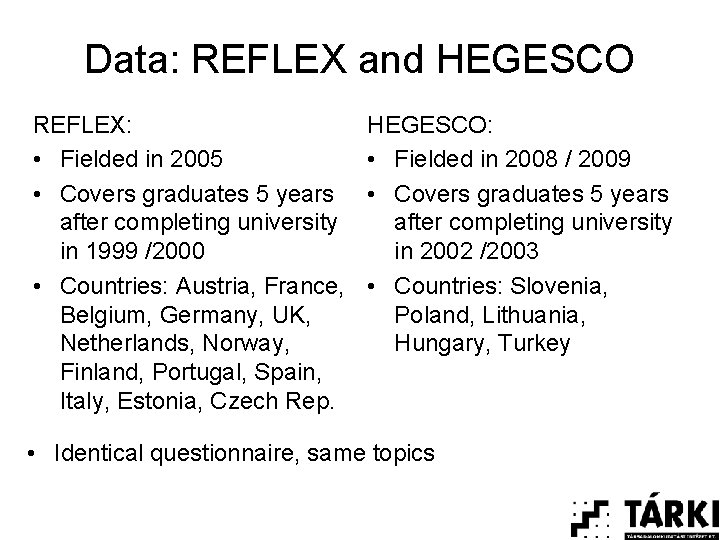
Data: REFLEX and HEGESCO REFLEX: • Fielded in 2005 • Covers graduates 5 years after completing university in 1999 /2000 • Countries: Austria, France, Belgium, Germany, UK, Netherlands, Norway, Finland, Portugal, Spain, Italy, Estonia, Czech Rep. HEGESCO: • Fielded in 2008 / 2009 • Covers graduates 5 years after completing university in 2002 /2003 • Countries: Slovenia, Poland, Lithuania, Hungary, Turkey • Identical questionnaire, same topics
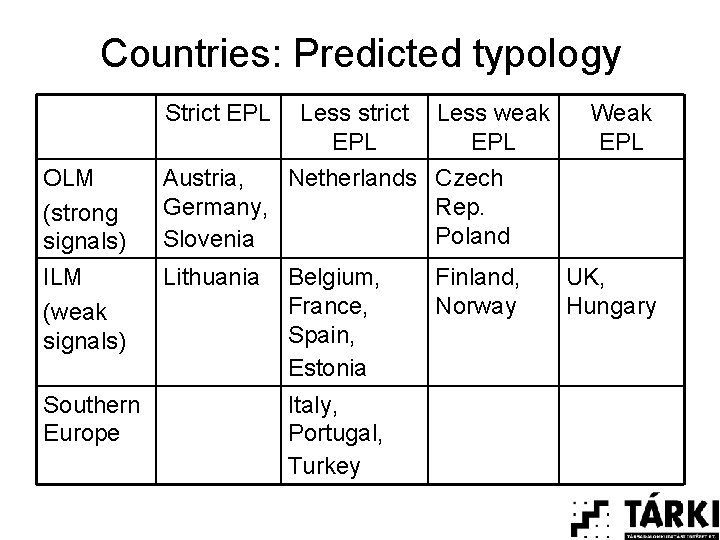
Countries: Predicted typology Strict EPL OLM (strong signals) ILM (weak signals) Southern Europe Less strict Less weak EPL Austria, Netherlands Czech Germany, Rep. Poland Slovenia Lithuania Belgium, France, Spain, Estonia Italy, Portugal, Turkey Finland, Norway Weak EPL UK, Hungary

Dimensions and indicators • Labour market entry - Job search lasted longer than 6 months • Match between qualification and current job - Working in a job that does not require diploma (based on ISCO title) - Feels that working in a job that requires a level of schooling below tertiary education - Feels that his/her skills are underutilized in current job • Early career - Experienced unemployment at least one time
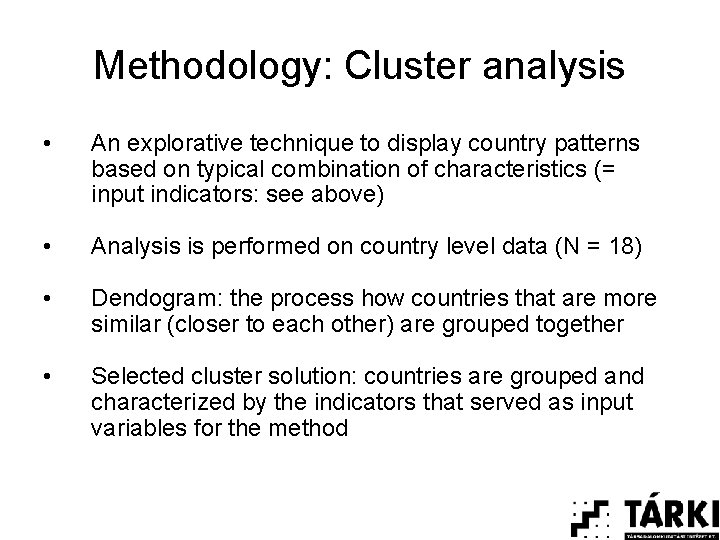
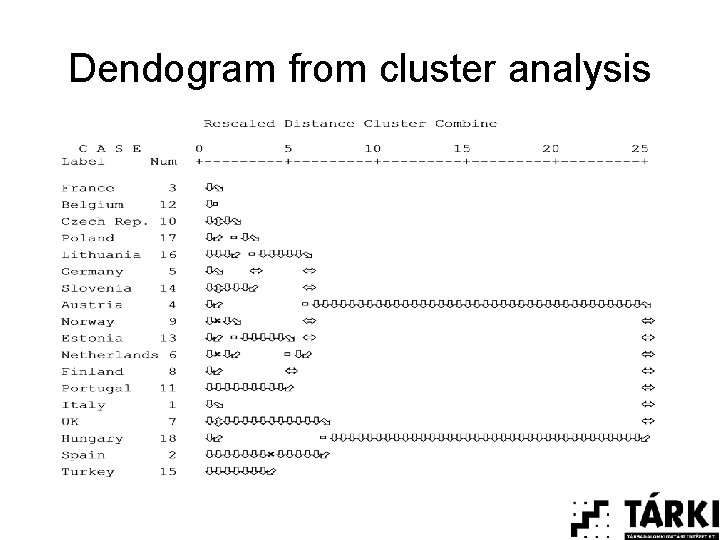
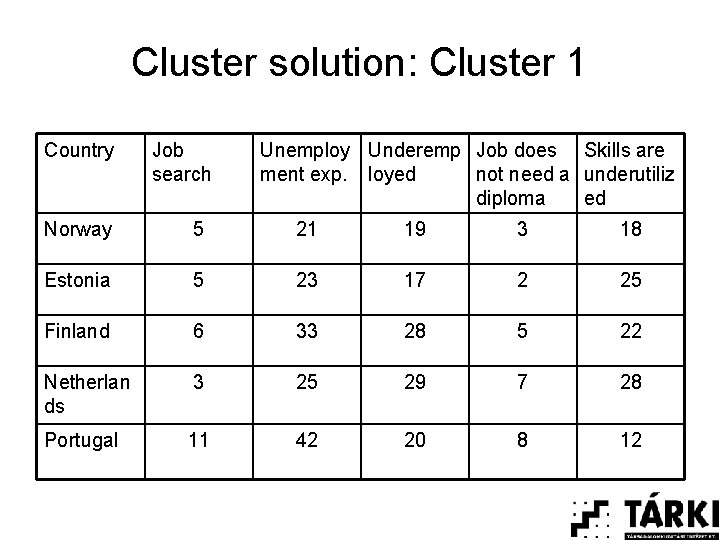
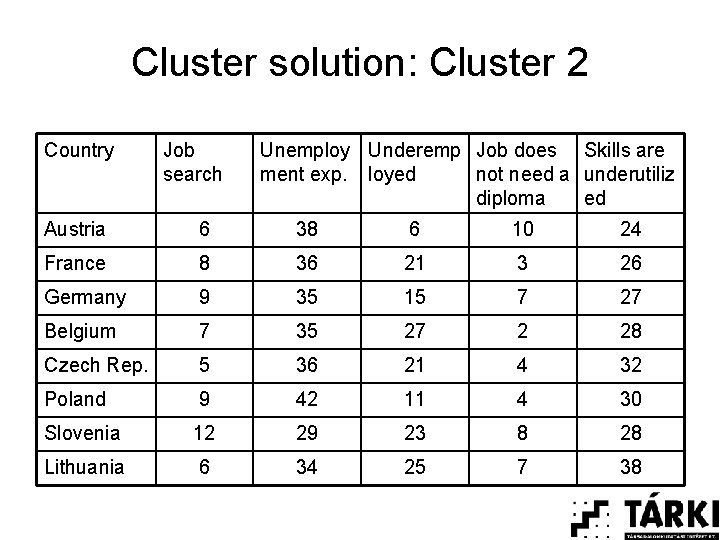
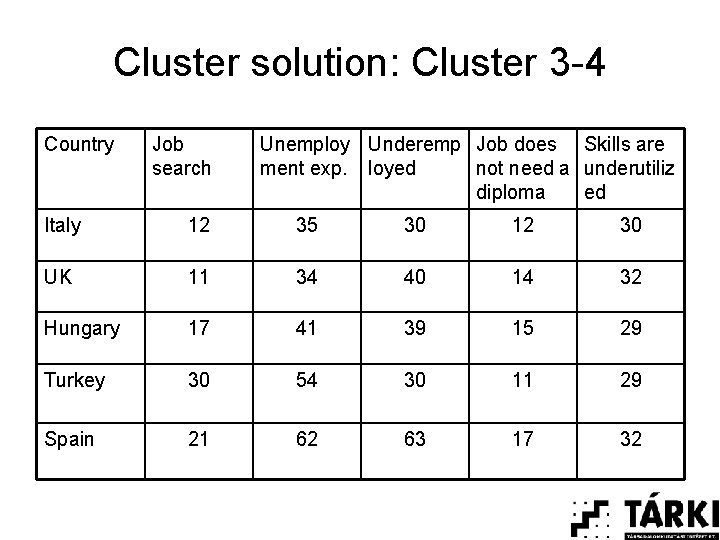
Methodology: Cluster analysis • An explorative technique to display country patterns based on typical combination of characteristics (= input indicators: see above) • Analysis is performed on country level data (N = 18) • Dendogram: the process how countries that are more similar (closer to each other) are grouped together • Selected cluster solution: countries are grouped and characterized by the indicators that served as input variables for the method
Dendogram from cluster analysis
Cluster solution: Cluster 1 Country Job search Unemploy Underemp Job does Skills are ment exp. loyed not need a underutiliz diploma ed Norway 5 21 19 3 18 Estonia 5 23 17 2 25 Finland 6 33 28 5 22 Netherlan ds 3 25 29 7 28 Portugal 11 42 20 8 12
Cluster solution: Cluster 2 Country Job search Unemploy Underemp Job does Skills are ment exp. loyed not need a underutiliz diploma ed Austria 6 38 6 10 24 France 8 36 21 3 26 Germany 9 35 15 7 27 Belgium 7 35 27 2 28 Czech Rep. 5 36 21 4 32 Poland 9 42 11 4 30 Slovenia 12 29 23 8 28 Lithuania 6 34 25 7 38
Cluster solution: Cluster 3 -4 Country Job search Unemploy Underemp Job does Skills are ment exp. loyed not need a underutiliz diploma ed Italy 12 35 30 12 30 UK 11 34 40 14 32 Hungary 17 41 39 15 29 Turkey 30 54 30 11 29 Spain 21 62 63 17 32
Discussion: Limitations • Selection effect: only those analyzed who entered the labour market • Conceptual background has been developed and tested earlier for the entire population of LM entrants and not only for graduates • Indicators were carefully selected but a wider range of them can only be applied if dimensions analyzed separately
Discussion: Lessons • Returns to human capital are not homogeneous in the various societies, institutional differences reshape labour market entry and early career of graduates • OLM / ILM and EPL turned out to be relevant for a large number of countries in the case of several indicators • Country differences are not solely along the lines of former political regimes - the major added value of the HEGESCO project is that including further new EU member states makes clear the existing variation among them - similarly large distance between Estonia and Hungary, and Norway and Spain.
Discussion: Policy implications • Governments: - Further increase of internationalizing the national higher education system in terms of study programs, methods, international contacts is crucial requirement • Employers: - Collecting more information about study programs → Increasing the signaling function of education despite of the expansion at tertiary level → Decrease of underemployment • Universities: - Strengthening professional expertise with practical orientation - Increasing collaboration with employers → better signaling function of education → helping decreasing search costs of employers and making easier the LM entry for the students
Thank you! Péter Róbert TARKI Social Research Institute Budaorsi ut 45 1112. Budapest, Hungary E-mail: robert@tarki. hu
- Slides: 17