
Counting Techniques Permutations of Selected Elements Addition Rule
- Slides: 11
Counting Techniques: Permutations of Selected Elements Addition Rule, Difference Rule, Inclusion/Exclusion Rule 1
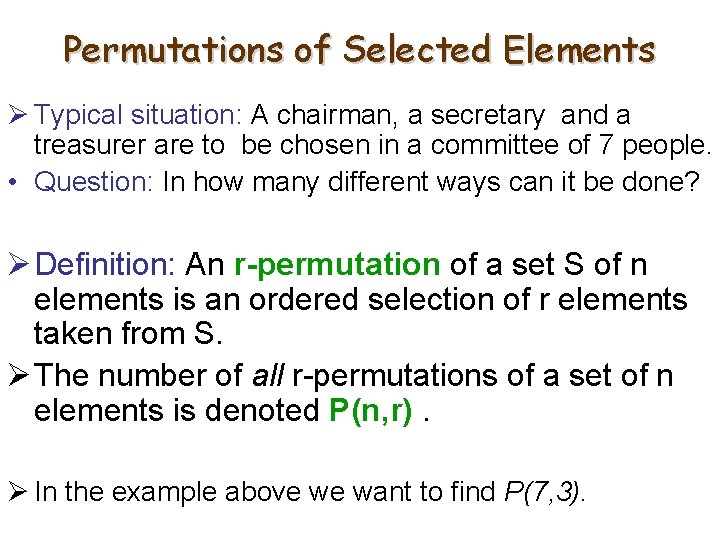
Permutations of Selected Elements Ø Typical situation: A chairman, a secretary and a treasurer are to be chosen in a committee of 7 people. • Question: In how many different ways can it be done? Ø Definition: An r-permutation of a set S of n elements is an ordered selection of r elements taken from S. Ø The number of all r-permutations of a set of n elements is denoted P(n, r). Ø In the example above we want to find P(7, 3).
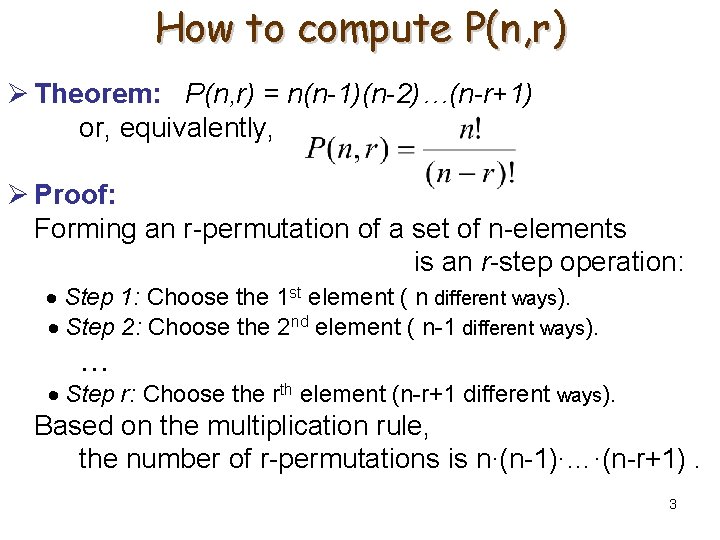
How to compute P(n, r) Ø Theorem: P(n, r) = n(n-1)(n-2)…(n-r+1) or, equivalently, Ø Proof: Forming an r-permutation of a set of n-elements is an r-step operation: Step 1: Choose the 1 st element ( n different ways). Step 2: Choose the 2 nd element ( n-1 different ways). … Step r: Choose the rth element (n-r+1 different ways). Based on the multiplication rule, the number of r-permutations is n∙(n-1)∙…∙(n-r+1). 3
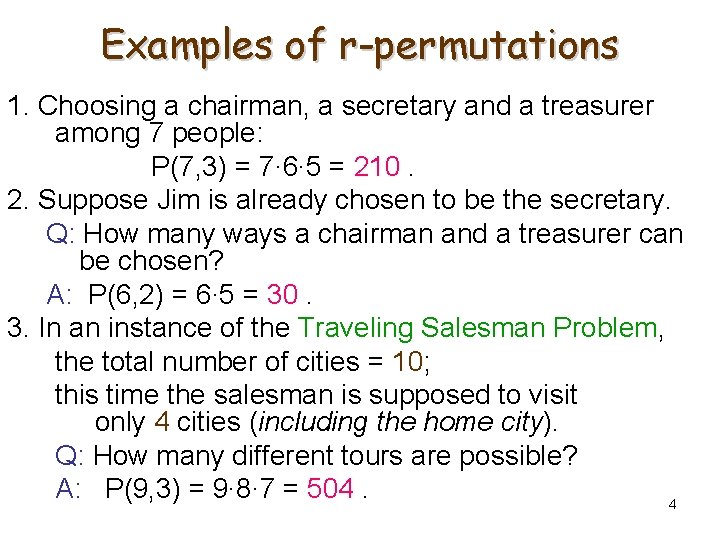
Examples of r-permutations 1. Choosing a chairman, a secretary and a treasurer among 7 people: P(7, 3) = 7∙ 6∙ 5 = 210. 2. Suppose Jim is already chosen to be the secretary. Q: How many ways a chairman and a treasurer can be chosen? A: P(6, 2) = 6∙ 5 = 30. 3. In an instance of the Traveling Salesman Problem, the total number of cities = 10; this time the salesman is supposed to visit only 4 cities (including the home city). Q: How many different tours are possible? A: P(9, 3) = 9∙ 8∙ 7 = 504. 4
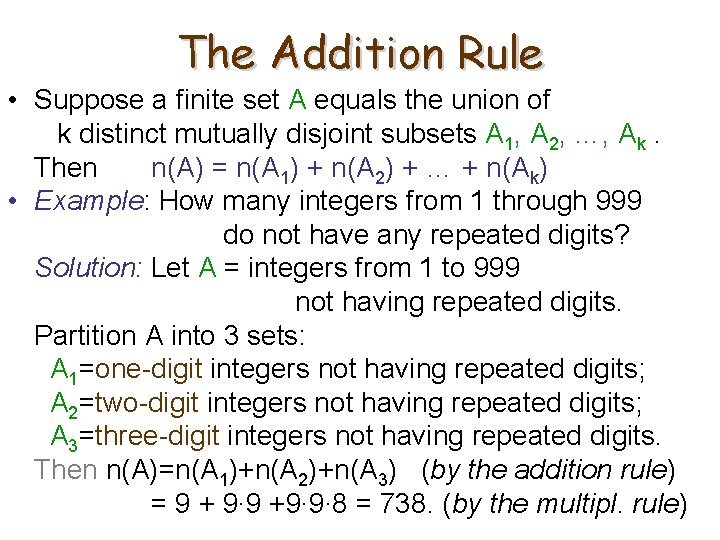
The Addition Rule • Suppose a finite set A equals the union of k distinct mutually disjoint subsets A 1, A 2, …, Ak. Then n(A) = n(A 1) + n(A 2) + … + n(Ak) • Example: How many integers from 1 through 999 do not have any repeated digits? Solution: Let A = integers from 1 to 999 not having repeated digits. Partition A into 3 sets: A 1=one-digit integers not having repeated digits; A 2=two-digit integers not having repeated digits; A 3=three-digit integers not having repeated digits. Then n(A)=n(A 1)+n(A 2)+n(A 3) (by the addition rule) = 9 + 9∙ 9 +9∙ 9∙ 8 = 738. (by the multipl. rule)
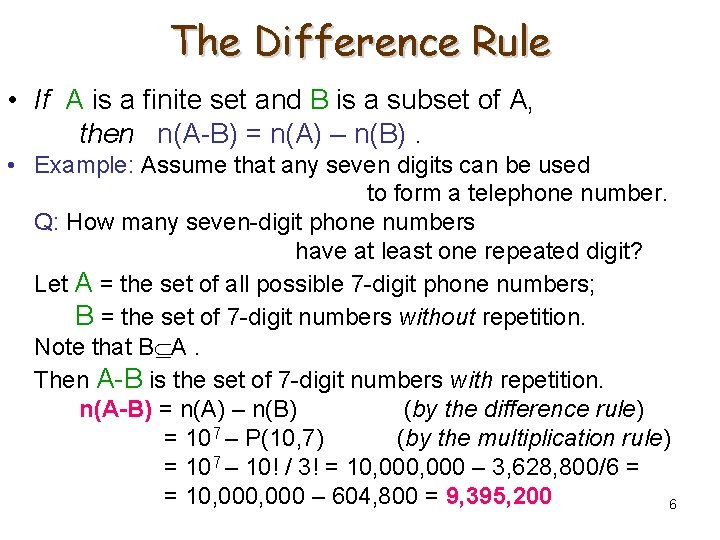
The Difference Rule • If A is a finite set and B is a subset of A, then n(A-B) = n(A) – n(B). • Example: Assume that any seven digits can be used to form a telephone number. Q: How many seven-digit phone numbers have at least one repeated digit? Let A = the set of all possible 7 -digit phone numbers; B = the set of 7 -digit numbers without repetition. Note that B A. Then A-B is the set of 7 -digit numbers with repetition. n(A-B) = n(A) – n(B) (by the difference rule) = 107 – P(10, 7) (by the multiplication rule) = 107 – 10! / 3! = 10, 000 – 3, 628, 800/6 = = 10, 000 – 604, 800 = 9, 395, 200 6
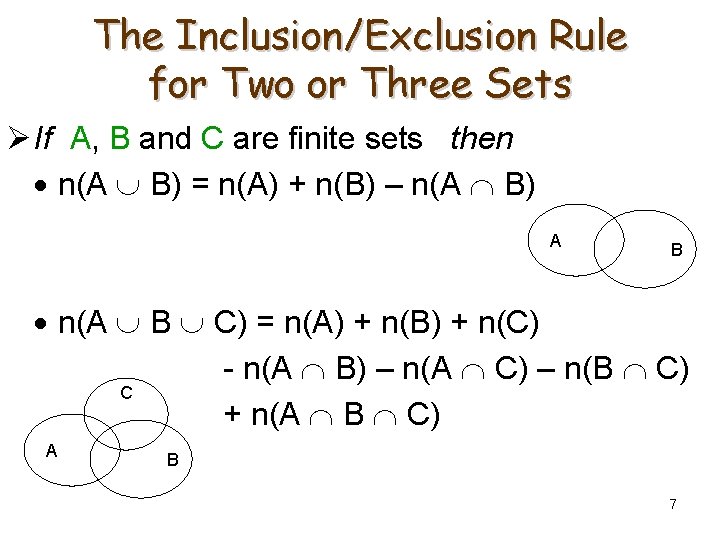
The Inclusion/Exclusion Rule for Two or Three Sets Ø If A, B and C are finite sets then n(A B) = n(A) + n(B) – n(A B) A B n(A B C) = n(A) + n(B) + n(C) - n(A B) – n(A C) – n(B C) C + n(A B C) A B 7
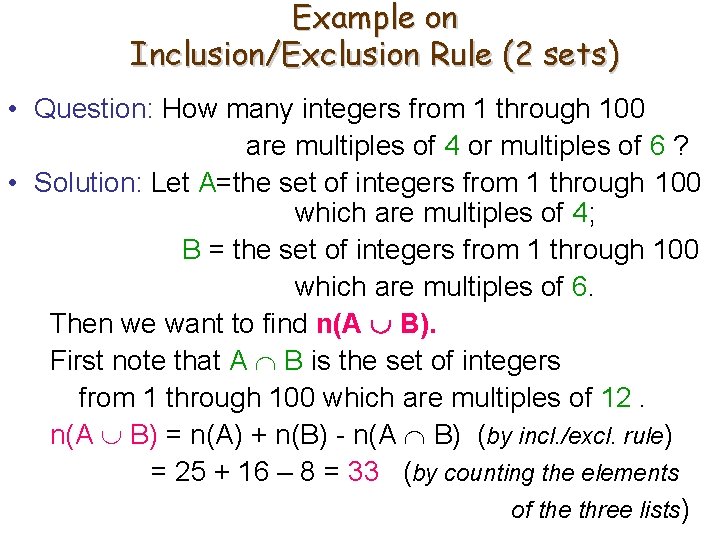
Example on Inclusion/Exclusion Rule (2 sets) • Question: How many integers from 1 through 100 are multiples of 4 or multiples of 6 ? • Solution: Let A=the set of integers from 1 through 100 which are multiples of 4; B = the set of integers from 1 through 100 which are multiples of 6. Then we want to find n(A B). First note that A B is the set of integers from 1 through 100 which are multiples of 12. n(A B) = n(A) + n(B) - n(A B) (by incl. /excl. rule) = 25 + 16 – 8 = 33 (by counting the elements of the three lists)
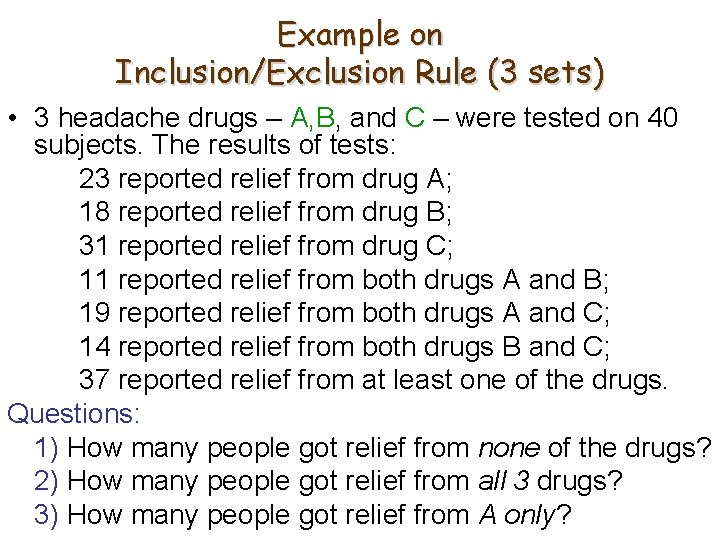
Example on Inclusion/Exclusion Rule (3 sets) • 3 headache drugs – A, B, and C – were tested on 40 subjects. The results of tests: 23 reported relief from drug A; 18 reported relief from drug B; 31 reported relief from drug C; 11 reported relief from both drugs A and B; 19 reported relief from both drugs A and C; 14 reported relief from both drugs B and C; 37 reported relief from at least one of the drugs. Questions: 1) How many people got relief from none of the drugs? 2) How many people got relief from all 3 drugs? 3) How many people got relief from A only?
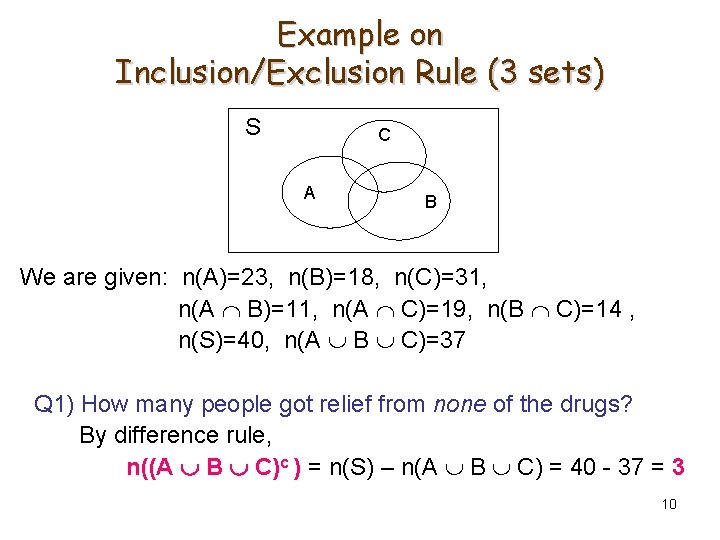
Example on Inclusion/Exclusion Rule (3 sets) S C A B We are given: n(A)=23, n(B)=18, n(C)=31, n(A B)=11, n(A C)=19, n(B C)=14 , n(S)=40, n(A B C)=37 Q 1) How many people got relief from none of the drugs? By difference rule, n((A B C)c ) = n(S) – n(A B C) = 40 - 37 = 3 10
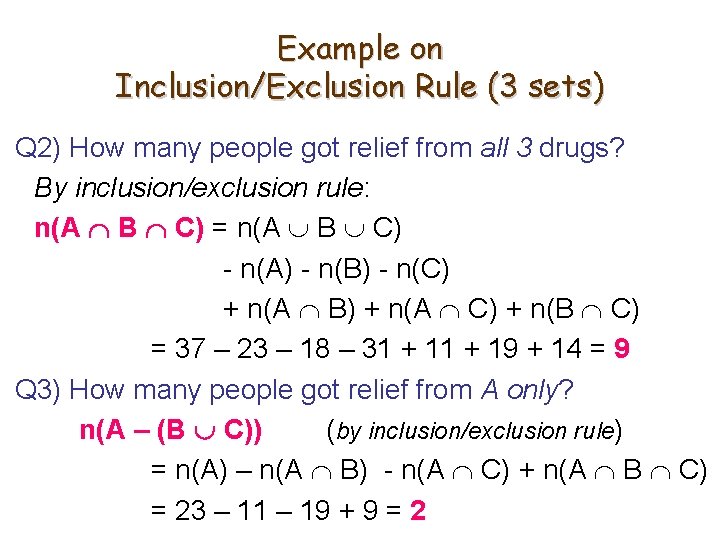
Example on Inclusion/Exclusion Rule (3 sets) Q 2) How many people got relief from all 3 drugs? By inclusion/exclusion rule: n(A B C) = n(A B C) - n(A) - n(B) - n(C) + n(A B) + n(A C) + n(B C) = 37 – 23 – 18 – 31 + 19 + 14 = 9 Q 3) How many people got relief from A only? n(A – (B C)) (by inclusion/exclusion rule) = n(A) – n(A B) - n(A C) + n(A B C) = 23 – 11 – 19 + 9 = 2