
Counting Systems IT 110 Computer Organization Base 10
Counting Systems IT 110: Computer Organization
Base 10 Number System Why do we use base 10? IT 110: Computer Organization
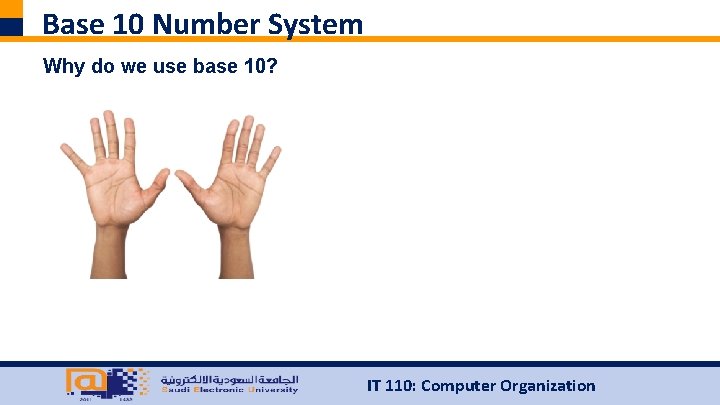
Base 10 Number System Why do we use base 10? IT 110: Computer Organization
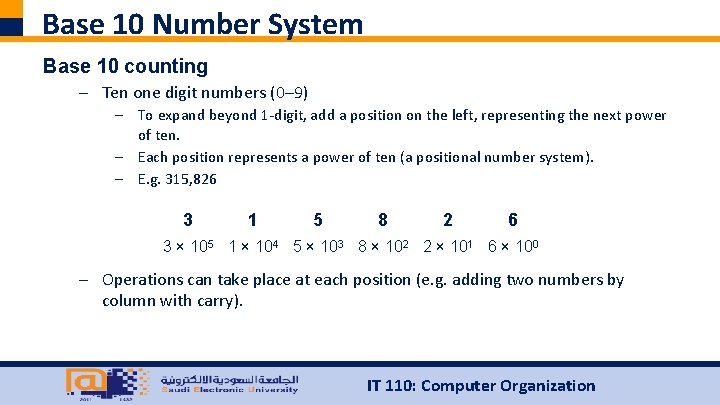
Base 10 Number System Base 10 counting – Ten one digit numbers (0– 9) – To expand beyond 1 -digit, add a position on the left, representing the next power of ten. – Each position represents a power of ten (a positional number system). – E. g. 315, 826 3 1 5 8 2 6 3 × 10⁵ 1 × 10⁴ 5 × 10³ 8 × 10² 2 × 101 6 × 100 – Operations can take place at each position (e. g. adding two numbers by column with carry). IT 110: Computer Organization
Base 2 Number System Base 2 counting – Two one digit numbers (0– 1) – To expand beyond 1 -digit, add a position on the left, representing the next power of two. IT 110: Computer Organization
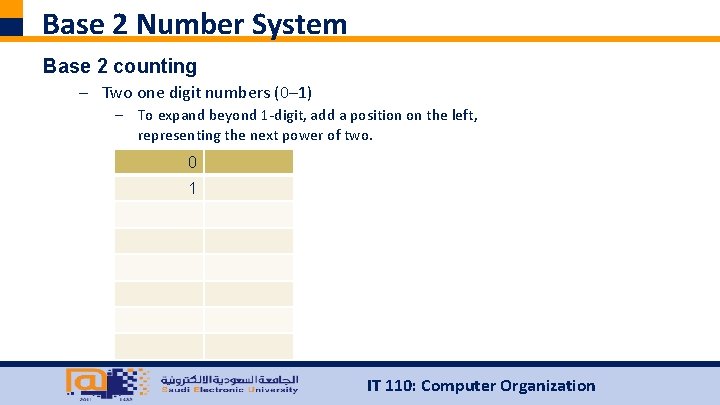
Base 2 Number System Base 2 counting – Two one digit numbers (0– 1) – To expand beyond 1 -digit, add a position on the left, representing the next power of two. 0 1 IT 110: Computer Organization
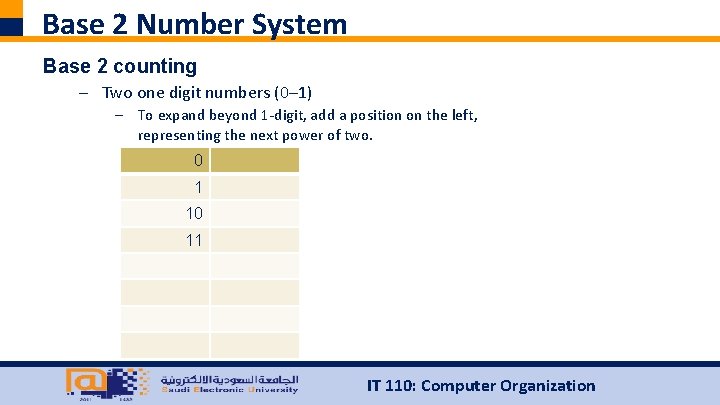
Base 2 Number System Base 2 counting – Two one digit numbers (0– 1) – To expand beyond 1 -digit, add a position on the left, representing the next power of two. 0 1 10 11 IT 110: Computer Organization
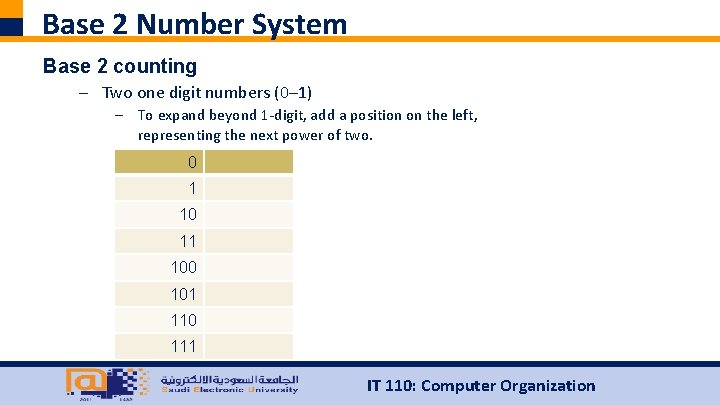
Base 2 Number System Base 2 counting – Two one digit numbers (0– 1) – To expand beyond 1 -digit, add a position on the left, representing the next power of two. 0 1 10 11 100 101 110 111 IT 110: Computer Organization
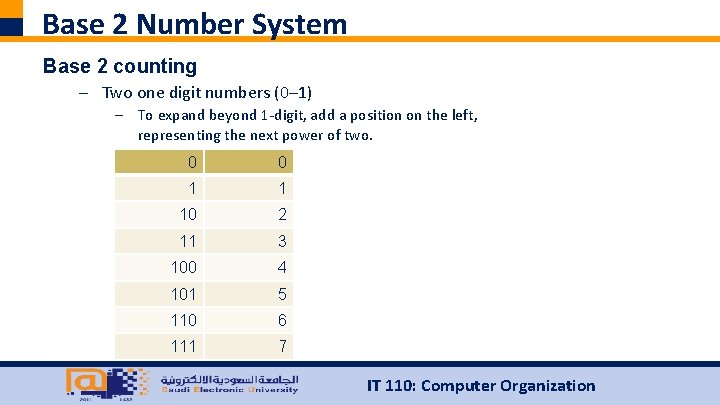
Base 2 Number System Base 2 counting – Two one digit numbers (0– 1) – To expand beyond 1 -digit, add a position on the left, representing the next power of two. 0 0 1 1 10 2 11 3 100 4 101 5 110 6 111 7 IT 110: Computer Organization
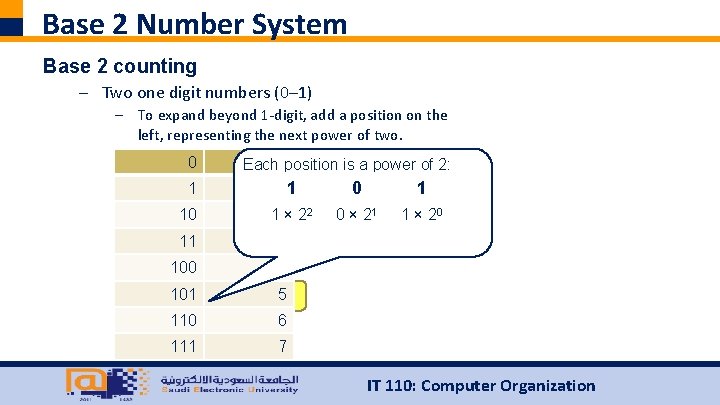
Base 2 Number System Base 2 counting – Two one digit numbers (0– 1) – To expand beyond 1 -digit, add a position on the left, representing the next power of two. 0 Each 0 position is a power of 2: 1 11 0 1 10 12× 22 0 × 21 1 × 20 11 3 100 4 101 5 110 6 111 7 IT 110: Computer Organization
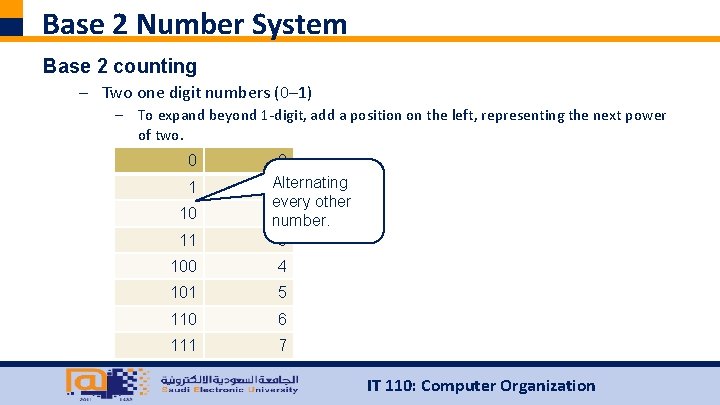
Base 2 Number System Base 2 counting – Two one digit numbers (0– 1) – To expand beyond 1 -digit, add a position on the left, representing the next power of two. 0 1 10 11 0 Alternating 1 every other 2 number. 3 100 4 101 5 110 6 111 7 IT 110: Computer Organization
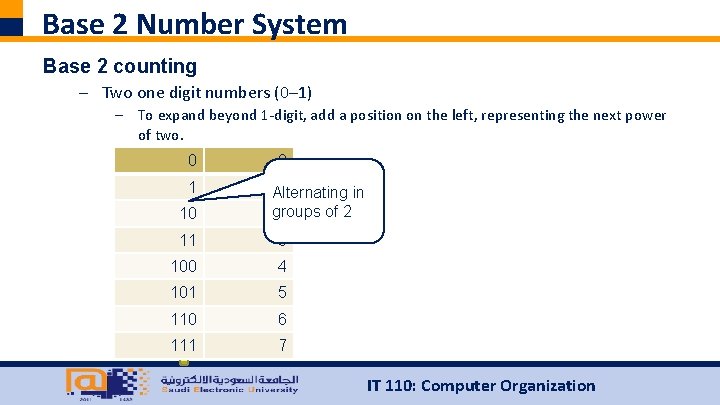
Base 2 Number System Base 2 counting – Two one digit numbers (0– 1) – To expand beyond 1 -digit, add a position on the left, representing the next power of two. 0 1 10 0 1 Alternating in groups of 2 2 11 3 100 4 101 5 110 6 111 7 IT 110: Computer Organization
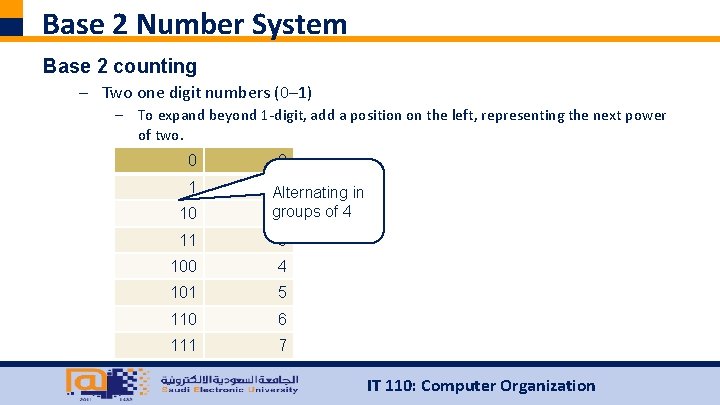
Base 2 Number System Base 2 counting – Two one digit numbers (0– 1) – To expand beyond 1 -digit, add a position on the left, representing the next power of two. 0 1 10 0 1 Alternating in groups of 4 2 11 3 100 4 101 5 110 6 111 7 IT 110: Computer Organization
Base 2 Number System Base 2 counting – Leading zeros – Are insignificant, but often written to indicate the number of bits in a quantity. – e. g. , 0110 = 110. IT 110: Computer Organization
Base 2 Number System Converting to and from binary – Base 10 to base 2 conversion: repeated division with remainders – Example: Convert 9210 to binary. IT 110: Computer Organization
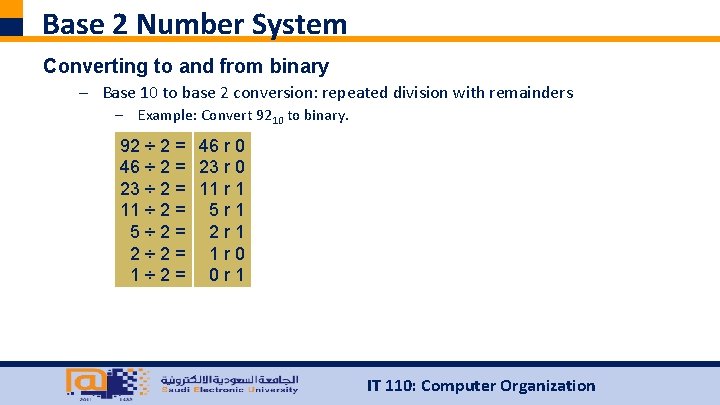
Base 2 Number System Converting to and from binary – Base 10 to base 2 conversion: repeated division with remainders – Example: Convert 9210 to binary. 92 ÷ 2 = 46 r 0 46 ÷ 2 = 23 r 0 23 ÷ 2 = 11 r 1 11 ÷ 2 = 5 r 1 5÷ 2= 2 r 1 2÷ 2= 1 r 0 1÷ 2= 0 r 1 IT 110: Computer Organization
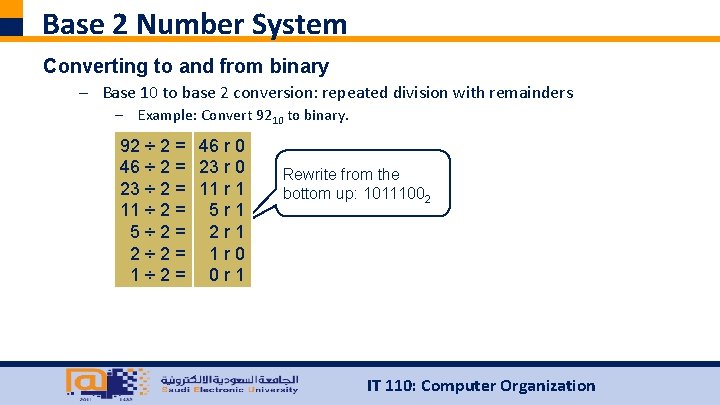
Base 2 Number System Converting to and from binary – Base 10 to base 2 conversion: repeated division with remainders – Example: Convert 9210 to binary. 92 ÷ 2 = 46 r 0 46 ÷ 2 = 23 r 0 23 ÷ 2 = 11 r 1 11 ÷ 2 = 5 r 1 5÷ 2= 2 r 1 2÷ 2= 1 r 0 1÷ 2= 0 r 1 Rewrite from the bottom up: 10111002 IT 110: Computer Organization
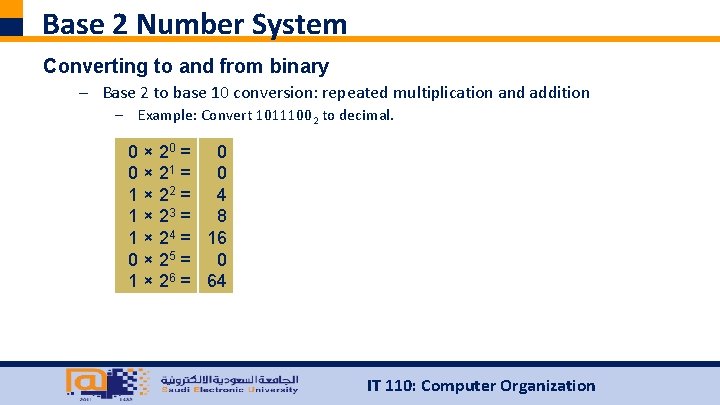
Base 2 Number System Converting to and from binary – Base 2 to base 10 conversion: repeated multiplication and addition – Example: Convert 10111002 to decimal. 0 × 20 = 0 0 × 21 = 0 1 × 22 = 4 1 × 23 = 8 1 × 24 = 16 0 × 25 = 0 1 × 26 = 64 IT 110: Computer Organization
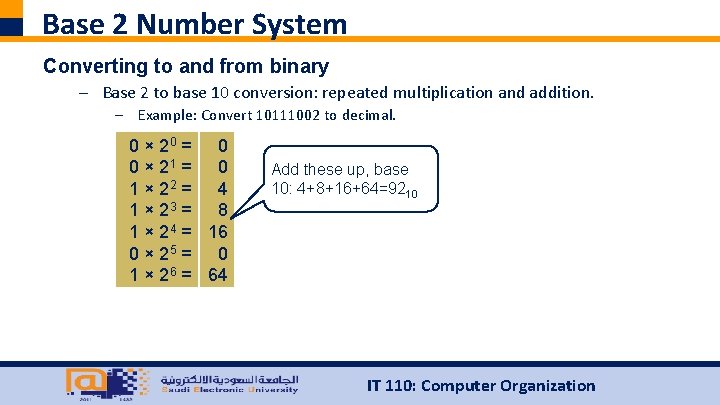
Base 2 Number System Converting to and from binary – Base 2 to base 10 conversion: repeated multiplication and addition. – Example: Convert 10111002 to decimal. 0 × 20 = 0 0 × 21 = 0 1 × 22 = 4 1 × 23 = 8 1 × 24 = 16 0 × 25 = 0 1 × 26 = 64 Add these up, base 10: 4+8+16+64=9210 IT 110: Computer Organization
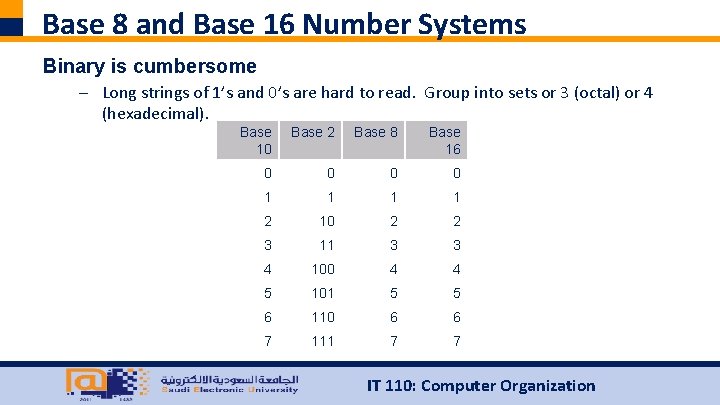
Base 8 and Base 16 Number Systems Binary is cumbersome – Long strings of 1’s and 0’s are hard to read. Group into sets or 3 (octal) or 4 (hexadecimal). Base 10 Base 2 Base 8 Base 16 0 0 1 1 2 10 2 2 3 11 3 3 4 100 4 4 5 101 5 5 6 110 6 6 7 111 7 7 IT 110: Computer Organization
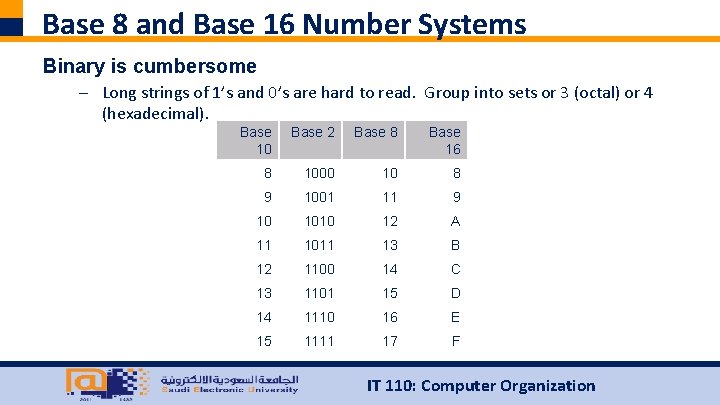
Base 8 and Base 16 Number Systems Binary is cumbersome – Long strings of 1’s and 0’s are hard to read. Group into sets or 3 (octal) or 4 (hexadecimal). Base 10 Base 2 Base 8 Base 16 8 1000 10 8 9 1001 11 9 10 1010 12 A 11 1011 13 B 12 1100 14 C 13 1101 15 D 14 1110 16 E 15 1111 17 F IT 110: Computer Organization
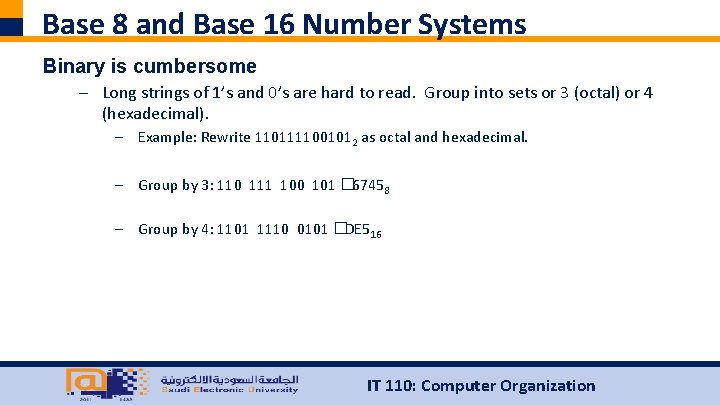
Base 8 and Base 16 Number Systems Binary is cumbersome – Long strings of 1’s and 0’s are hard to read. Group into sets or 3 (octal) or 4 (hexadecimal). – Example: Rewrite 1101111001012 as octal and hexadecimal. – Group by 3: 110 111 100 101 � 67458 – Group by 4: 1101 1110 0101 �DE 516 IT 110: Computer Organization
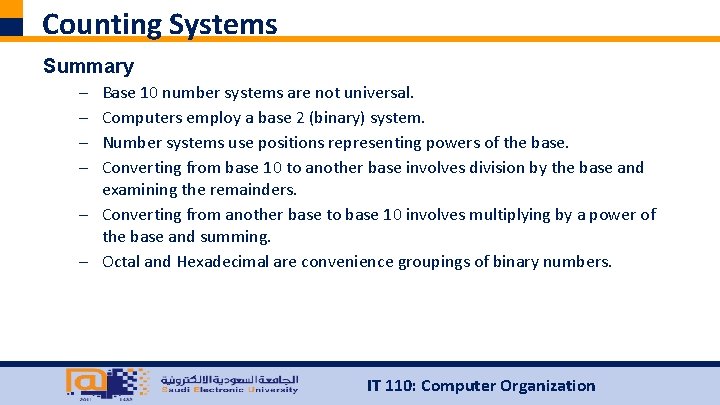
Counting Systems Summary – – Base 10 number systems are not universal. Computers employ a base 2 (binary) system. Number systems use positions representing powers of the base. Converting from base 10 to another base involves division by the base and examining the remainders. – Converting from another base to base 10 involves multiplying by a power of the base and summing. – Octal and Hexadecimal are convenience groupings of binary numbers. IT 110: Computer Organization
- Slides: 23