
Counting Relations Example How many different reflexive relations
- Slides: 25
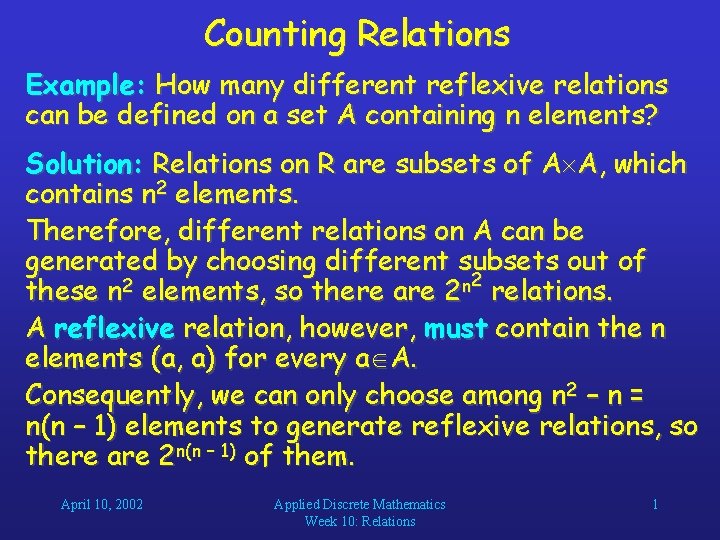
Counting Relations Example: How many different reflexive relations can be defined on a set A containing n elements? Solution: Relations on R are subsets of A A, which contains n 2 elements. Therefore, different relations on A can be generated by choosing different subsets out of 2 2 n these n elements, so there are 2 relations. A reflexive relation, however, must contain the n elements (a, a) for every a A. Consequently, we can only choose among n 2 – n = n(n – 1) elements to generate reflexive relations, so there are 2 n(n – 1) of them. April 10, 2002 Applied Discrete Mathematics Week 10: Relations 1
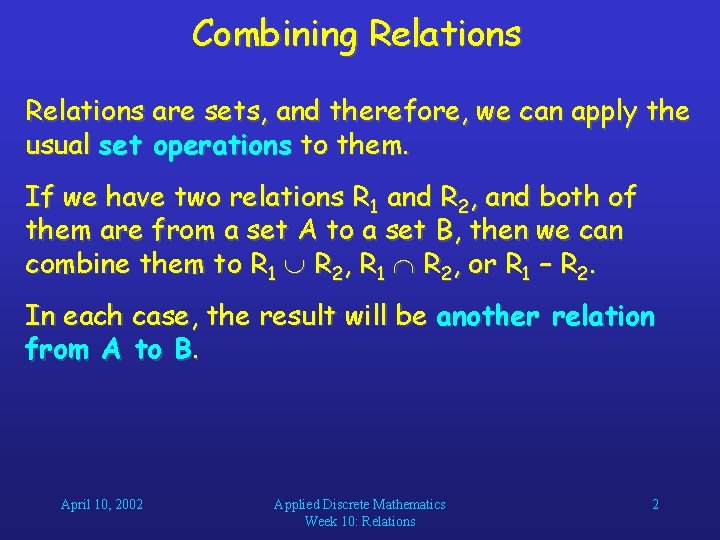
Combining Relations are sets, and therefore, we can apply the usual set operations to them. If we have two relations R 1 and R 2, and both of them are from a set A to a set B, then we can combine them to R 1 R 2, or R 1 – R 2. In each case, the result will be another relation from A to B. April 10, 2002 Applied Discrete Mathematics Week 10: Relations 2
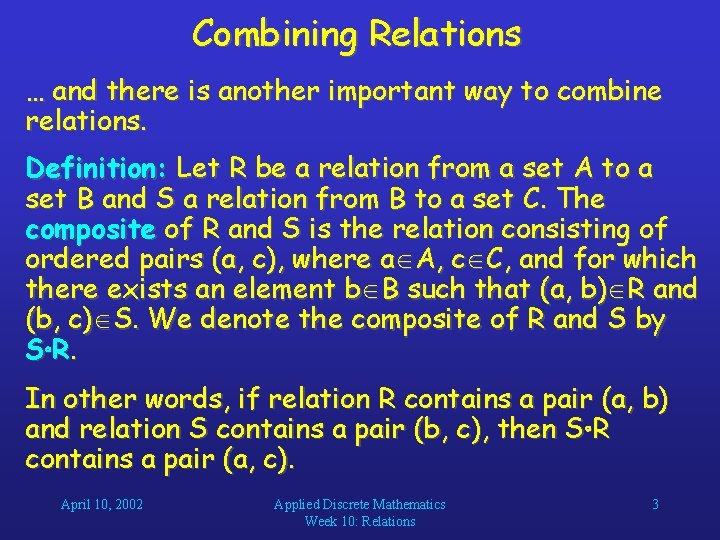
Combining Relations … and there is another important way to combine relations. Definition: Let R be a relation from a set A to a set B and S a relation from B to a set C. The composite of R and S is the relation consisting of ordered pairs (a, c), where a A, c C, and for which there exists an element b B such that (a, b) R and (b, c) S. We denote the composite of R and S by S R. In other words, if relation R contains a pair (a, b) and relation S contains a pair (b, c), then S R contains a pair (a, c). April 10, 2002 Applied Discrete Mathematics Week 10: Relations 3
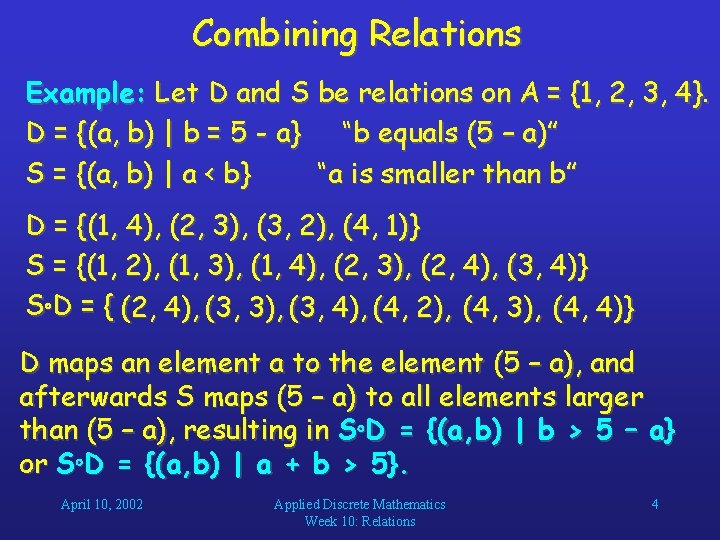
Combining Relations Example: Let D and S be relations on A = {1, 2, 3, 4}. D = {(a, b) | b = 5 - a} “b equals (5 – a)” S = {(a, b) | a < b} “a is smaller than b” D = {(1, 4), (2, 3), (3, 2), (4, 1)} S = {(1, 2), (1, 3), (1, 4), (2, 3), (2, 4), (3, 4)} S D = { (2, 4), (3, 3), (3, 4), (4, 2), (4, 3), (4, 4)} D maps an element a to the element (5 – a), and afterwards S maps (5 – a) to all elements larger than (5 – a), resulting in S D = {(a, b) | b > 5 – a} or S D = {(a, b) | a + b > 5}. April 10, 2002 Applied Discrete Mathematics Week 10: Relations 4
Combining Relations We already know that functions are just special cases of relations (namely those that map each element in the domain onto exactly one element in the codomain). If we formally convert two functions into relations, that is, write them down as sets of ordered pairs, the composite of these relations will be exactly the same as the composite of the functions (as defined earlier). April 10, 2002 Applied Discrete Mathematics Week 10: Relations 5
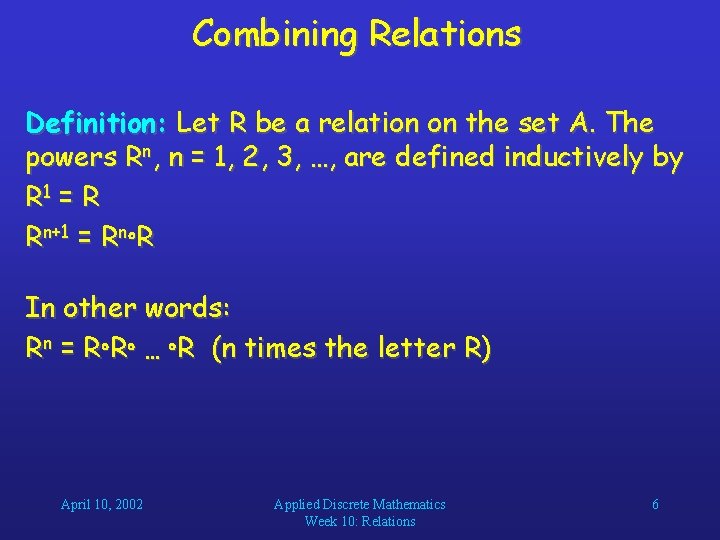
Combining Relations Definition: Let R be a relation on the set A. The powers Rn, n = 1, 2, 3, …, are defined inductively by R 1 = R Rn+1 = Rn R In other words: Rn = R R … R (n times the letter R) April 10, 2002 Applied Discrete Mathematics Week 10: Relations 6
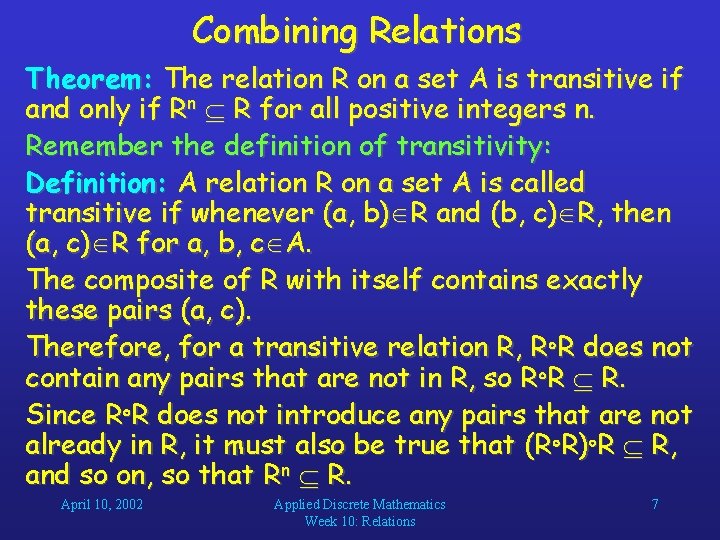
Combining Relations Theorem: The relation R on a set A is transitive if and only if Rn R for all positive integers n. Remember the definition of transitivity: Definition: A relation R on a set A is called transitive if whenever (a, b) R and (b, c) R, then (a, c) R for a, b, c A. The composite of R with itself contains exactly these pairs (a, c). Therefore, for a transitive relation R, R R does not contain any pairs that are not in R, so R R R. Since R R does not introduce any pairs that are not already in R, it must also be true that (R R) R R, and so on, so that Rn R. April 10, 2002 Applied Discrete Mathematics Week 10: Relations 7
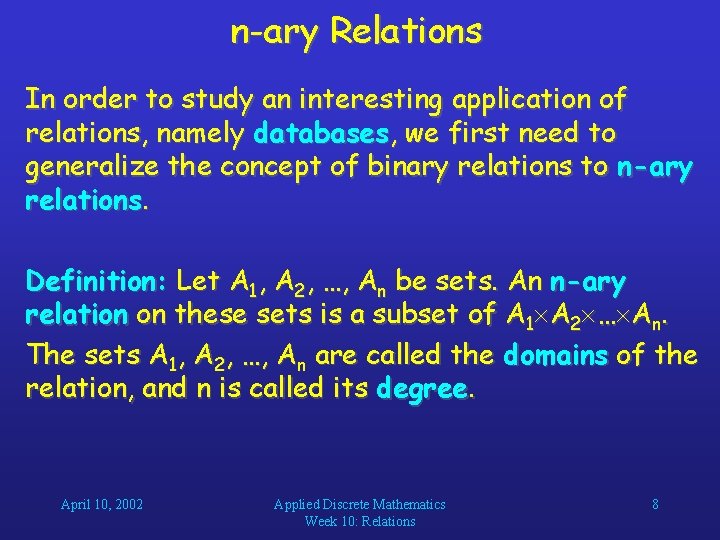
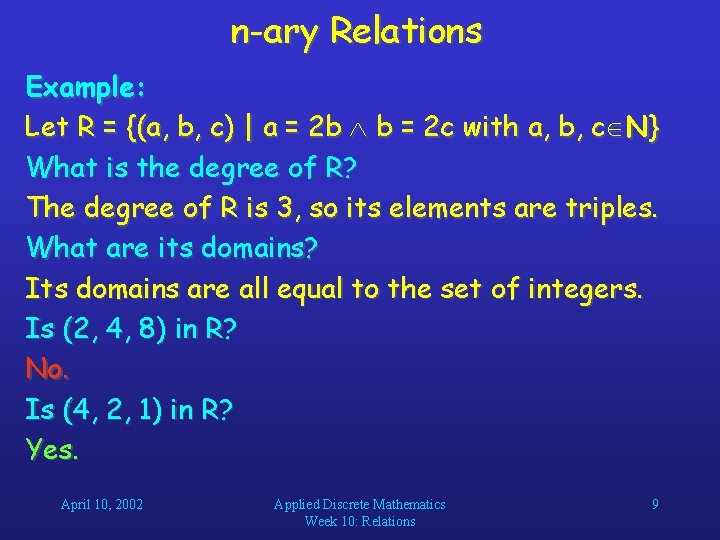
n-ary Relations In order to study an interesting application of relations, namely databases, we first need to generalize the concept of binary relations to n-ary relations. Definition: Let A 1, A 2, …, An be sets. An n-ary relation on these sets is a subset of A 1 A 2 … An. The sets A 1, A 2, …, An are called the domains of the relation, and n is called its degree. April 10, 2002 Applied Discrete Mathematics Week 10: Relations 8
n-ary Relations Example: Let R = {(a, b, c) | a = 2 b b = 2 c with a, b, c N} What is the degree of R? The degree of R is 3, so its elements are triples. What are its domains? Its domains are all equal to the set of integers. Is (2, 4, 8) in R? No. Is (4, 2, 1) in R? Yes. April 10, 2002 Applied Discrete Mathematics Week 10: Relations 9
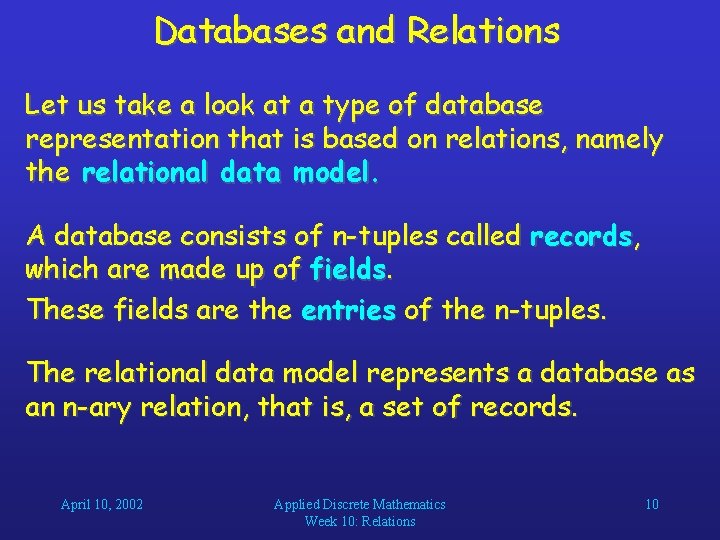
Databases and Relations Let us take a look at a type of database representation that is based on relations, namely the relational data model. A database consists of n-tuples called records, which are made up of fields. These fields are the entries of the n-tuples. The relational data model represents a database as an n-ary relation, that is, a set of records. April 10, 2002 Applied Discrete Mathematics Week 10: Relations 10
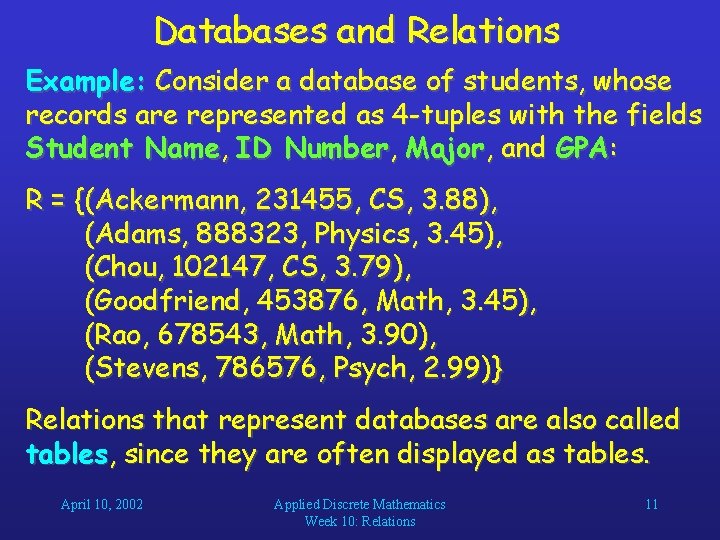
Databases and Relations Example: Consider a database of students, whose records are represented as 4 -tuples with the fields Student Name, ID Number, Major, and GPA: R = {(Ackermann, 231455, CS, 3. 88), (Adams, 888323, Physics, 3. 45), (Chou, 102147, CS, 3. 79), (Goodfriend, 453876, Math, 3. 45), (Rao, 678543, Math, 3. 90), (Stevens, 786576, Psych, 2. 99)} Relations that represent databases are also called tables, since they are often displayed as tables. April 10, 2002 Applied Discrete Mathematics Week 10: Relations 11
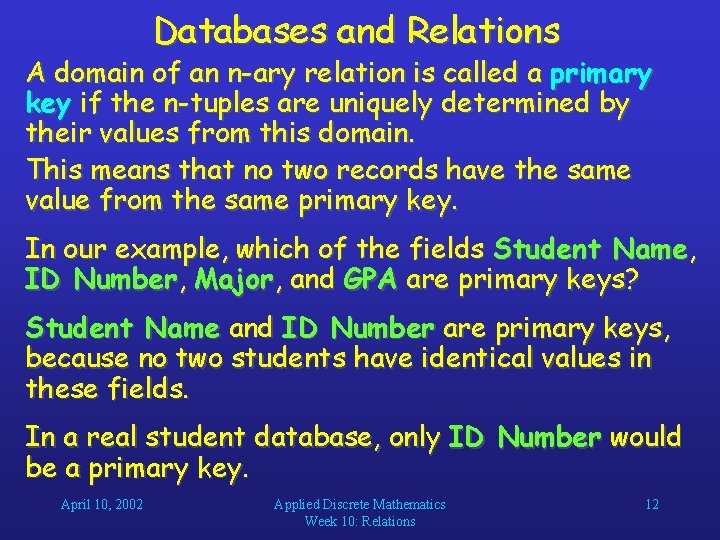
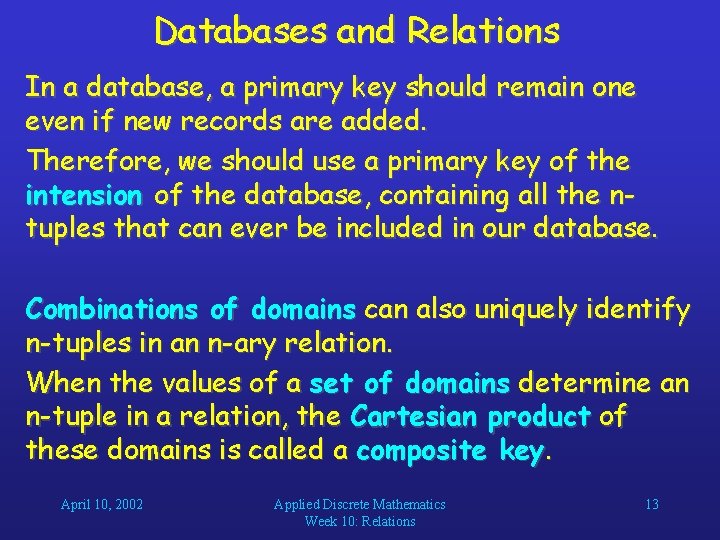
Databases and Relations A domain of an n-ary relation is called a primary key if the n-tuples are uniquely determined by their values from this domain. This means that no two records have the same value from the same primary key. In our example, which of the fields Student Name, ID Number, Major, and GPA are primary keys? Student Name and ID Number are primary keys, because no two students have identical values in these fields. In a real student database, only ID Number would be a primary key. April 10, 2002 Applied Discrete Mathematics Week 10: Relations 12
Databases and Relations In a database, a primary key should remain one even if new records are added. Therefore, we should use a primary key of the intension of the database, containing all the ntuples that can ever be included in our database. Combinations of domains can also uniquely identify n-tuples in an n-ary relation. When the values of a set of domains determine an n-tuple in a relation, the Cartesian product of these domains is called a composite key. April 10, 2002 Applied Discrete Mathematics Week 10: Relations 13
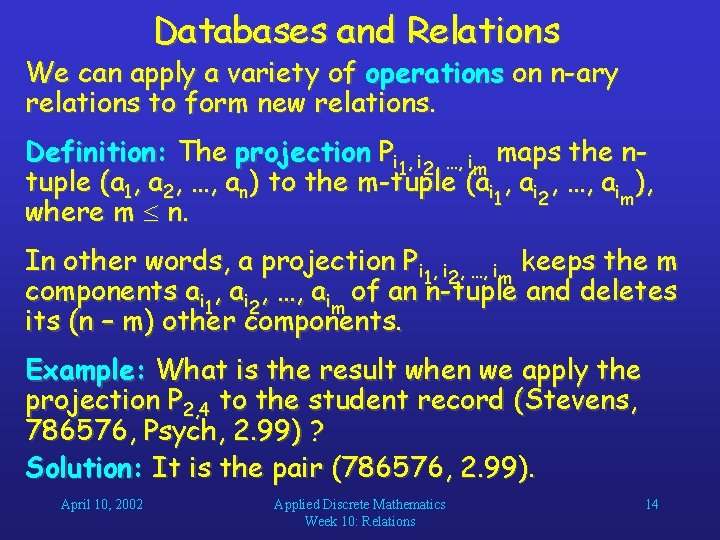
Databases and Relations We can apply a variety of operations on n-ary relations to form new relations. Definition: The projection Pi 1, i 2, …, im maps the ntuple (a 1, a 2, …, an) to the m-tuple (ai 1, ai 2, …, aim), where m n. In other words, a projection Pi 1, i 2, …, im keeps the m components ai , …, ai of an n-tuple and deletes 1 2 m its (n – m) other components. Example: What is the result when we apply the projection P 2, 4 to the student record (Stevens, 786576, Psych, 2. 99) ? Solution: It is the pair (786576, 2. 99). April 10, 2002 Applied Discrete Mathematics Week 10: Relations 14
Databases and Relations In some cases, applying a projection to an entire table may not only result in fewer columns, but also in fewer rows. Why is that? Some records may only have differed in those fields that were deleted, so they become identical, and there is no need to list identical records more than once. April 10, 2002 Applied Discrete Mathematics Week 10: Relations 15
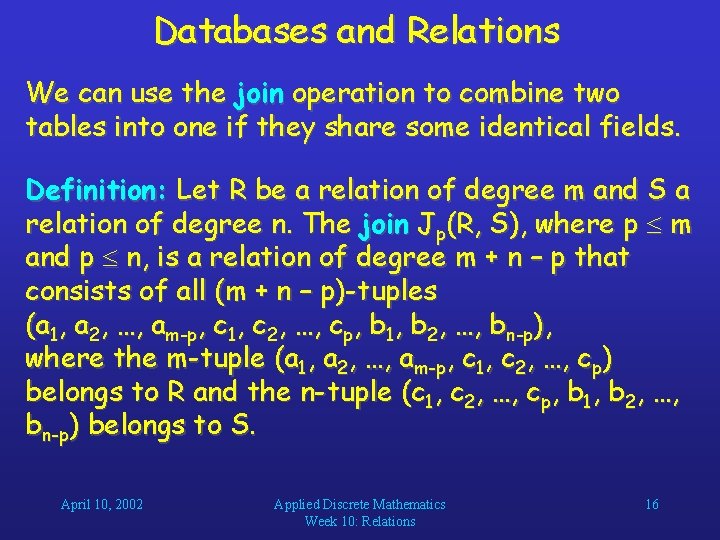
Databases and Relations We can use the join operation to combine two tables into one if they share some identical fields. Definition: Let R be a relation of degree m and S a relation of degree n. The join Jp(R, S), where p m and p n, is a relation of degree m + n – p that consists of all (m + n – p)-tuples (a 1, a 2, …, am-p, c 1, c 2, …, cp, b 1, b 2, …, bn-p), where the m-tuple (a 1, a 2, …, am-p, c 1, c 2, …, cp) belongs to R and the n-tuple (c 1, c 2, …, cp, b 1, b 2, …, bn-p) belongs to S. April 10, 2002 Applied Discrete Mathematics Week 10: Relations 16
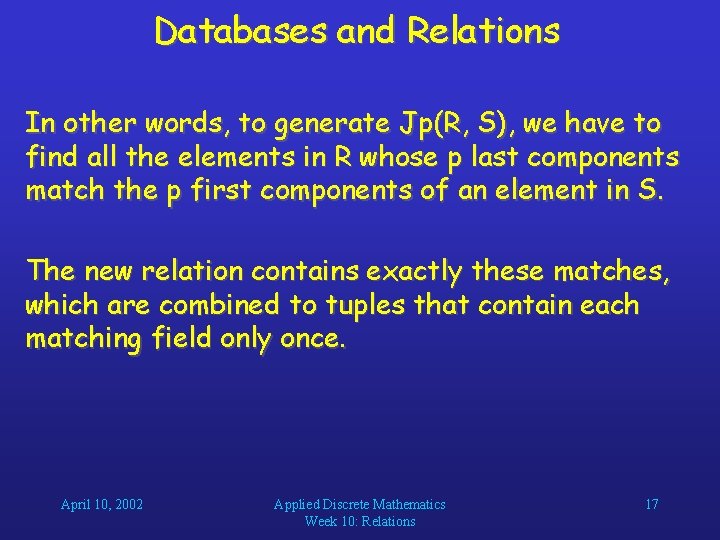
Databases and Relations In other words, to generate Jp(R, S), we have to find all the elements in R whose p last components match the p first components of an element in S. The new relation contains exactly these matches, which are combined to tuples that contain each matching field only once. April 10, 2002 Applied Discrete Mathematics Week 10: Relations 17
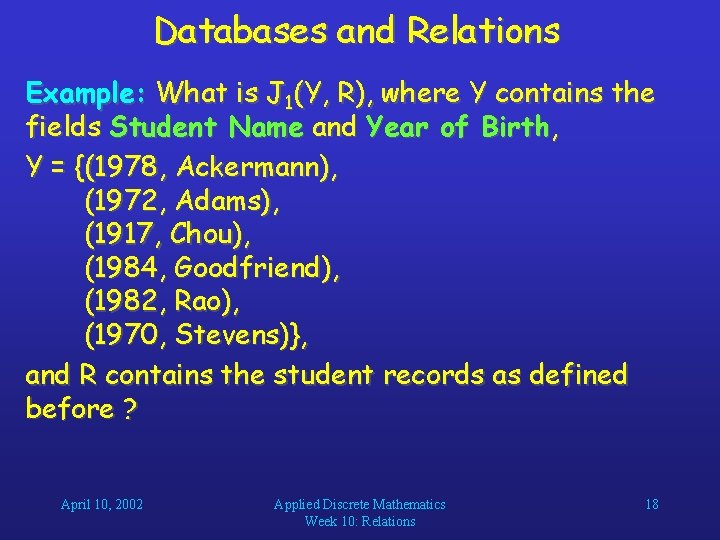
Databases and Relations Example: What is J 1(Y, R), where Y contains the fields Student Name and Year of Birth, Y = {(1978, Ackermann), (1972, Adams), (1917, Chou), (1984, Goodfriend), (1982, Rao), (1970, Stevens)}, and R contains the student records as defined before ? April 10, 2002 Applied Discrete Mathematics Week 10: Relations 18
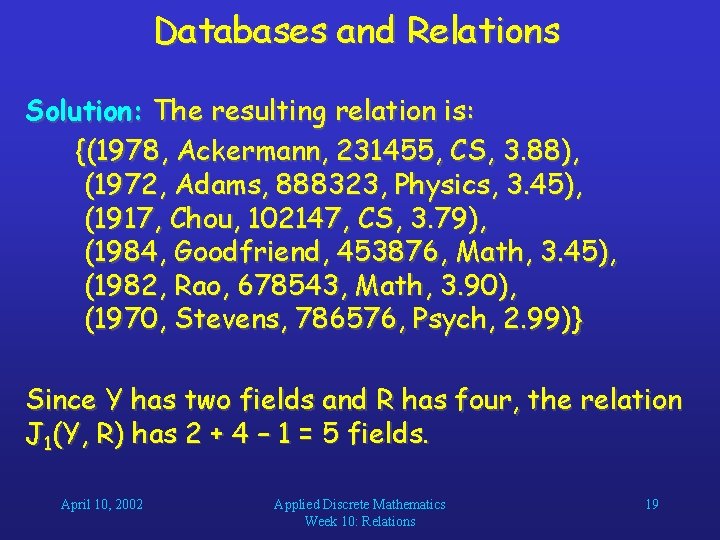
Databases and Relations Solution: The resulting relation is: {(1978, Ackermann, 231455, CS, 3. 88), (1972, Adams, 888323, Physics, 3. 45), (1917, Chou, 102147, CS, 3. 79), (1984, Goodfriend, 453876, Math, 3. 45), (1982, Rao, 678543, Math, 3. 90), (1970, Stevens, 786576, Psych, 2. 99)} Since Y has two fields and R has four, the relation J 1(Y, R) has 2 + 4 – 1 = 5 fields. April 10, 2002 Applied Discrete Mathematics Week 10: Relations 19
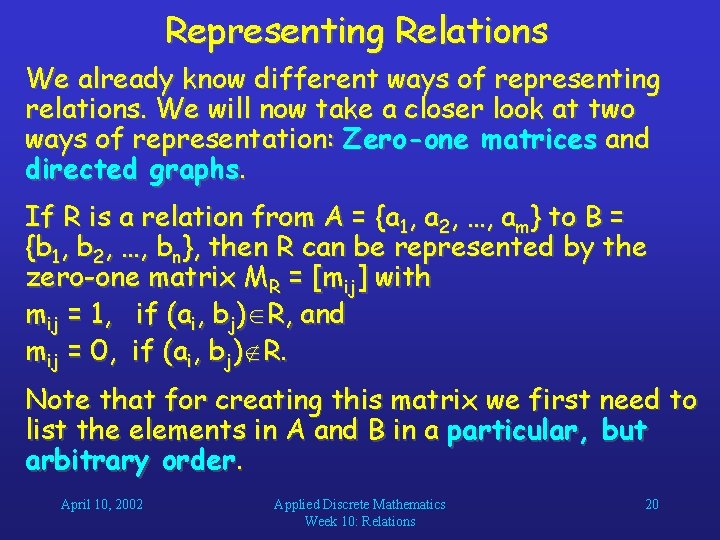
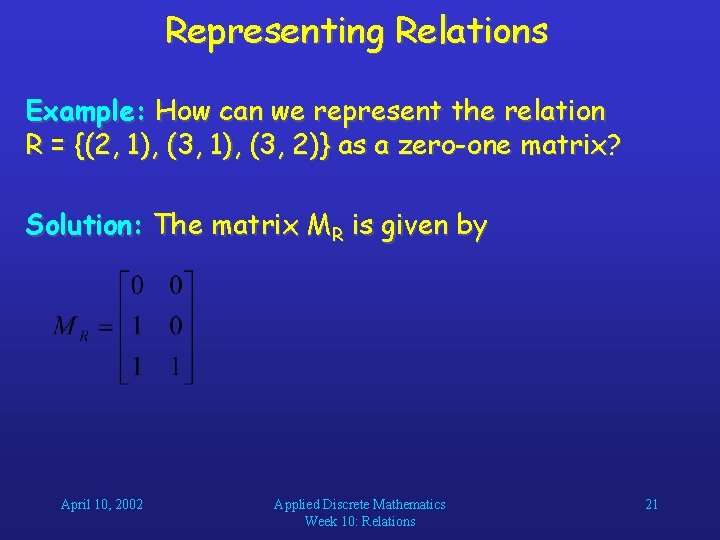
Representing Relations We already know different ways of representing relations. We will now take a closer look at two ways of representation: Zero-one matrices and directed graphs. If R is a relation from A = {a 1, a 2, …, am} to B = {b 1, b 2, …, bn}, then R can be represented by the zero-one matrix MR = [mij] with mij = 1, if (ai, bj) R, and mij = 0, if (ai, bj) R. Note that for creating this matrix we first need to list the elements in A and B in a particular, but arbitrary order. April 10, 2002 Applied Discrete Mathematics Week 10: Relations 20
Representing Relations Example: How can we represent the relation R = {(2, 1), (3, 2)} as a zero-one matrix? Solution: The matrix MR is given by April 10, 2002 Applied Discrete Mathematics Week 10: Relations 21
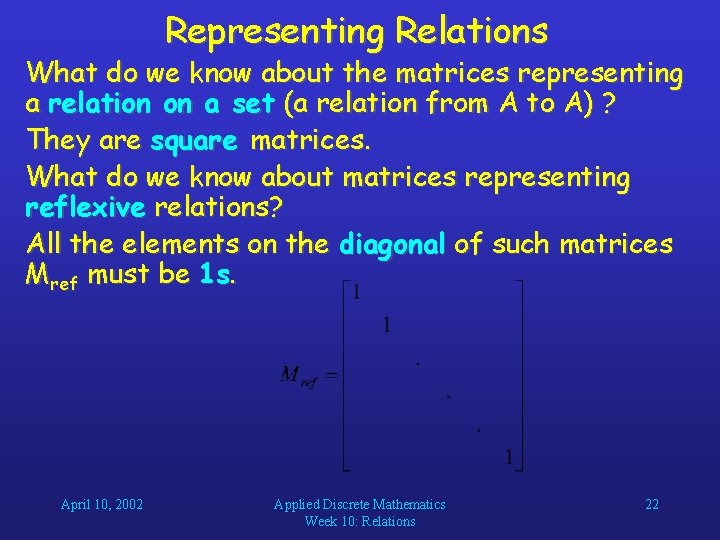
Representing Relations What do we know about the matrices representing a relation on a set (a relation from A to A) ? They are square matrices. What do we know about matrices representing reflexive relations? All the elements on the diagonal of such matrices Mref must be 1 s. April 10, 2002 Applied Discrete Mathematics Week 10: Relations 22
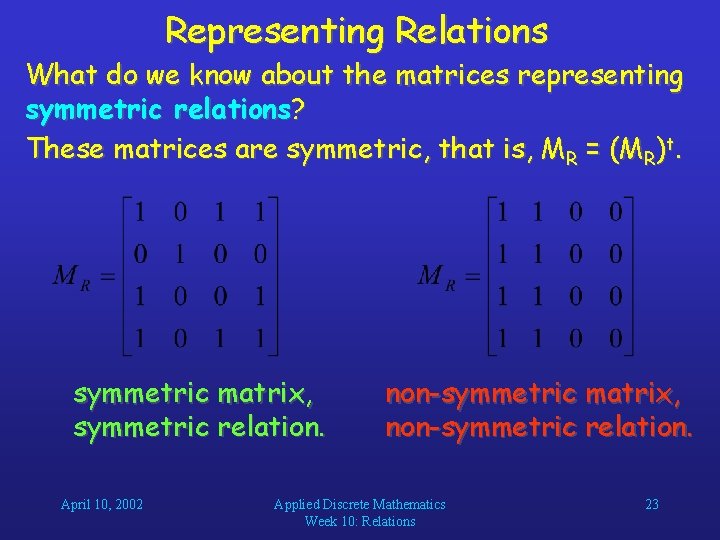
Representing Relations What do we know about the matrices representing symmetric relations? These matrices are symmetric, that is, MR = (MR)t. symmetric matrix, symmetric relation. April 10, 2002 non-symmetric matrix, non-symmetric relation. Applied Discrete Mathematics Week 10: Relations 23
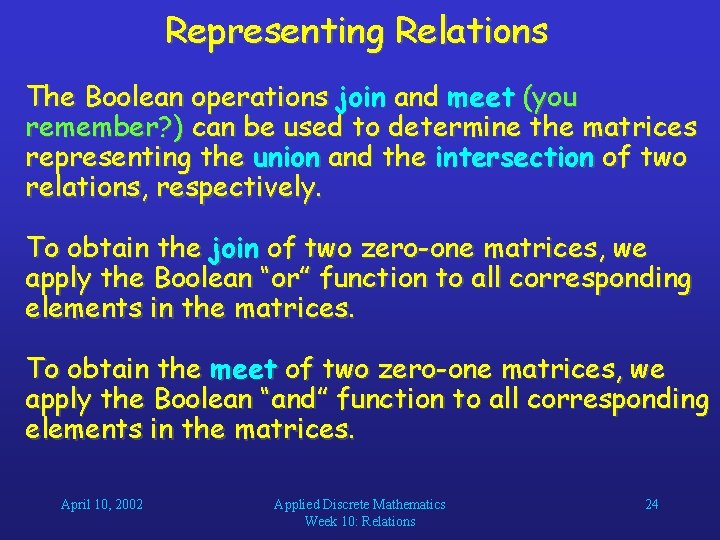
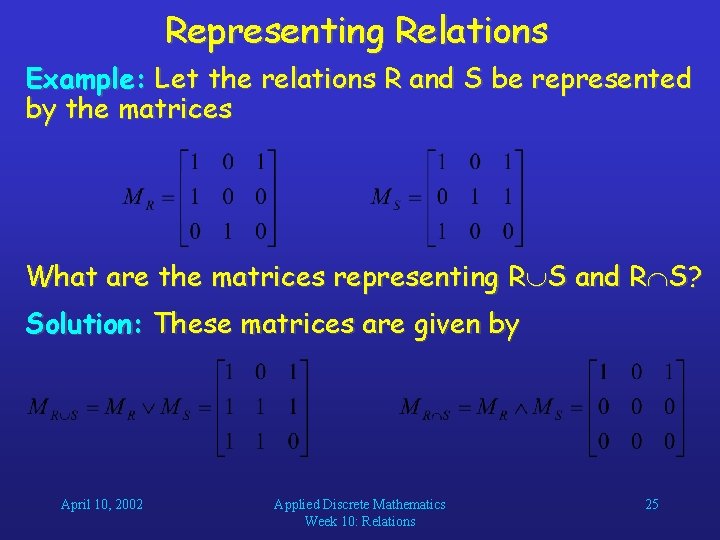
Representing Relations The Boolean operations join and meet (you remember? ) can be used to determine the matrices representing the union and the intersection of two relations, respectively. To obtain the join of two zero-one matrices, we apply the Boolean “or” function to all corresponding elements in the matrices. To obtain the meet of two zero-one matrices, we apply the Boolean “and” function to all corresponding elements in the matrices. April 10, 2002 Applied Discrete Mathematics Week 10: Relations 24
Representing Relations Example: Let the relations R and S be represented by the matrices What are the matrices representing R S and R S? Solution: These matrices are given by April 10, 2002 Applied Discrete Mathematics Week 10: Relations 25