
Counting in Binary As you know the binary
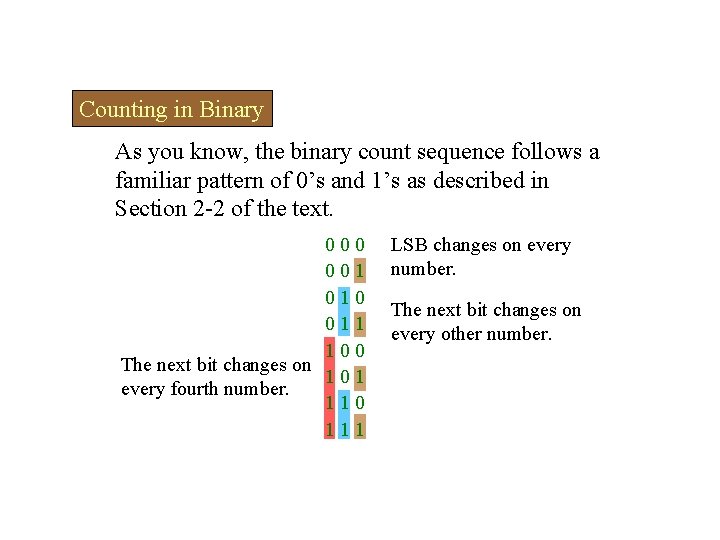
Counting in Binary As you know, the binary count sequence follows a familiar pattern of 0’s and 1’s as described in Section 2 -2 of the text. 000 001 010 011 100 The next bit changes on 101 every fourth number. 110 111 LSB changes on every number. The next bit changes on every other number.
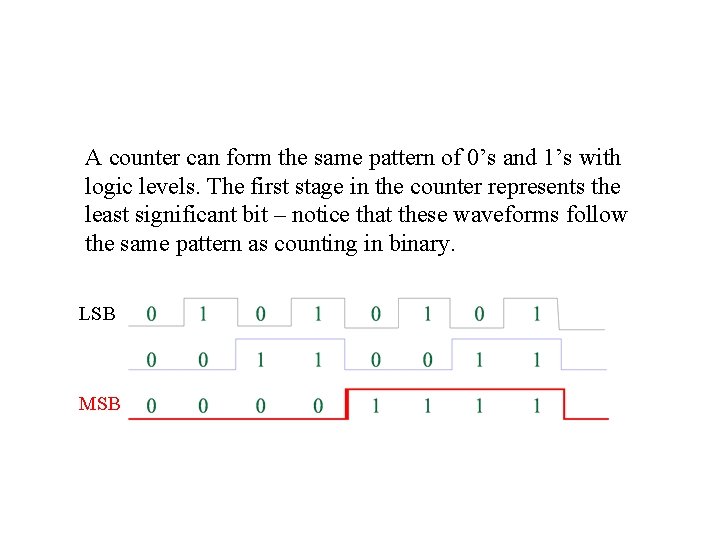
A counter can form the same pattern of 0’s and 1’s with logic levels. The first stage in the counter represents the least significant bit – notice that these waveforms follow the same pattern as counting in binary. LSB MSB
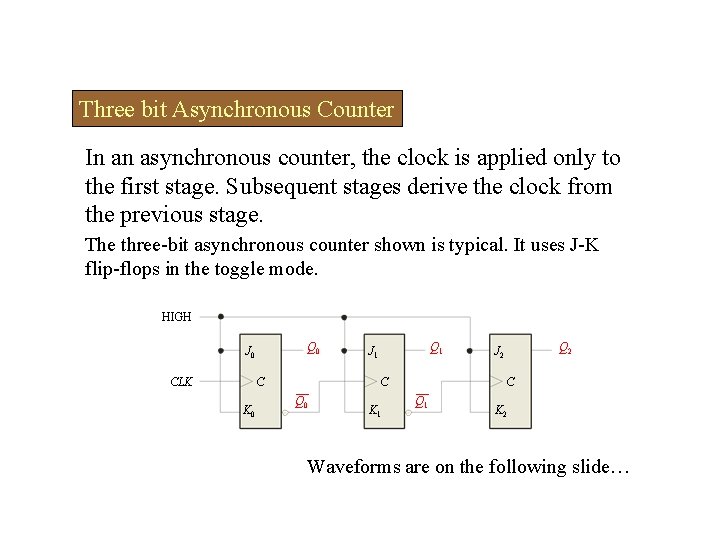
Three bit Asynchronous Counter In an asynchronous counter, the clock is applied only to the first stage. Subsequent stages derive the clock from the previous stage. The three-bit asynchronous counter shown is typical. It uses J-K flip-flops in the toggle mode. HIGH Q 0 J 0 CLK C K 0 Q 1 J 1 C Q 0 K 1 Q 2 J 2 C Q 1 K 2 Waveforms are on the following slide…
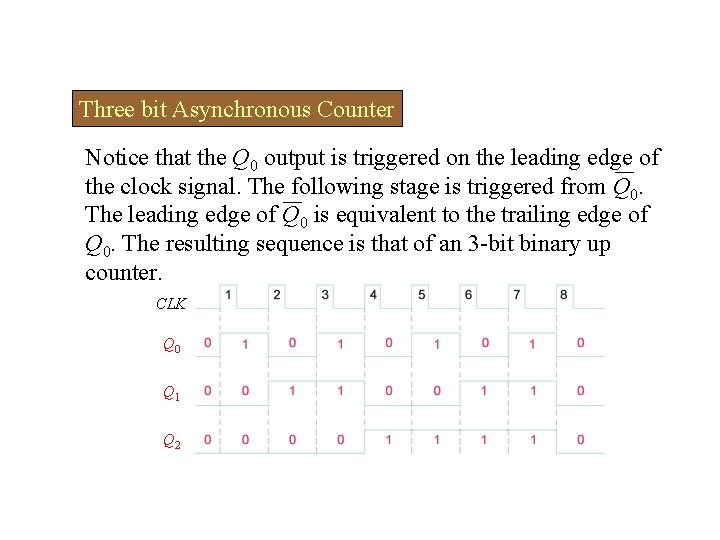
Three bit Asynchronous Counter Notice that the Q 0 output is triggered on the leading edge of the clock signal. The following stage is triggered from Q 0. The leading edge of Q 0 is equivalent to the trailing edge of Q 0. The resulting sequence is that of an 3 -bit binary up counter. CLK Q 0 Q 1 Q 2
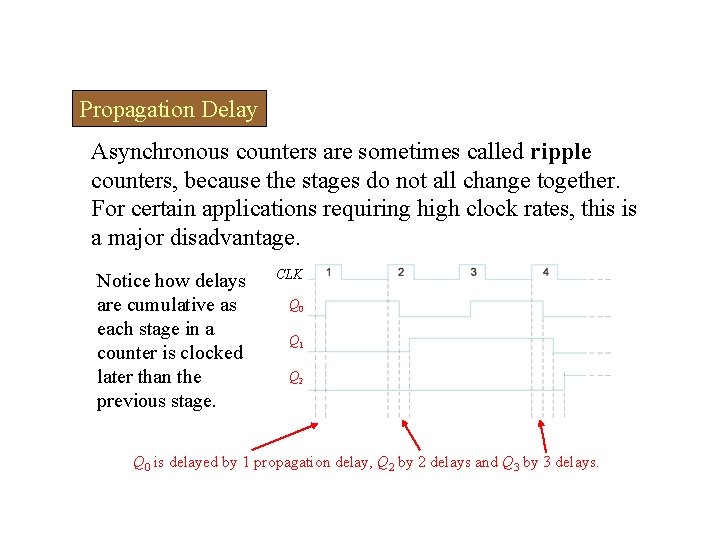
Propagation Delay Asynchronous counters are sometimes called ripple counters, because the stages do not all change together. For certain applications requiring high clock rates, this is a major disadvantage. Notice how delays are cumulative as each stage in a counter is clocked later than the previous stage. CLK Q 0 Q 1 Q 2 Q 0 is delayed by 1 propagation delay, Q 2 by 2 delays and Q 3 by 3 delays.
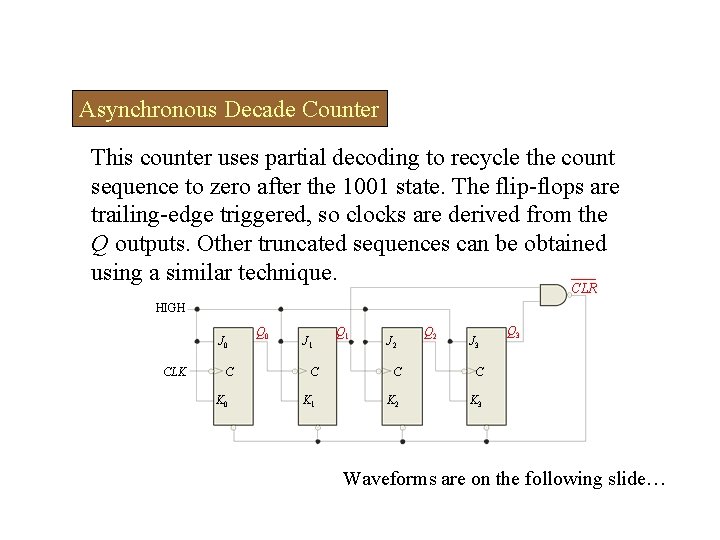
Asynchronous Decade Counter This counter uses partial decoding to recycle the count sequence to zero after the 1001 state. The flip-flops are trailing-edge triggered, so clocks are derived from the Q outputs. Other truncated sequences can be obtained using a similar technique. CLR HIGH J 0 CLK C K 0 Q 0 J 1 Q 1 J 2 Q 2 J 3 C C C K 1 K 2 K 3 Q 3 Waveforms are on the following slide…
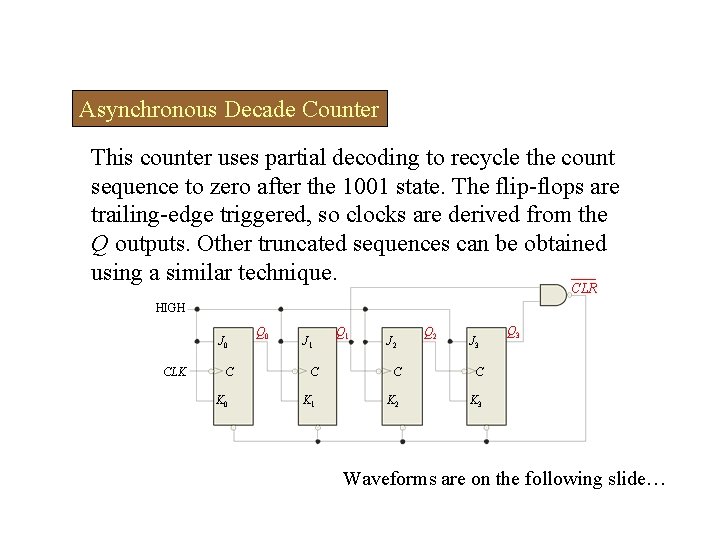
Asynchronous Decade Counter This counter uses partial decoding to recycle the count sequence to zero after the 1001 state. The flip-flops are trailing-edge triggered, so clocks are derived from the Q outputs. Other truncated sequences can be obtained using a similar technique. CLR HIGH J 0 CLK C K 0 Q 0 J 1 Q 1 J 2 Q 2 J 3 C C C K 1 K 2 K 3 Q 3 Waveforms are on the following slide…
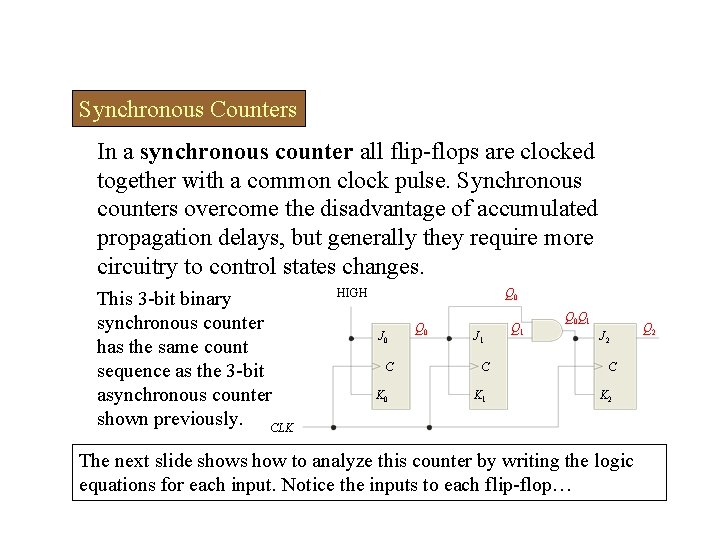
Synchronous Counters In a synchronous counter all flip-flops are clocked together with a common clock pulse. Synchronous counters overcome the disadvantage of accumulated propagation delays, but generally they require more circuitry to control states changes. This 3 -bit binary synchronous counter has the same count sequence as the 3 -bit asynchronous counter shown previously. CLK HIGH Q 0 J 0 C K 0 Q 0 J 1 Q 0 Q 1 J 2 C C K 1 K 2 The next slide shows how to analyze this counter by writing the logic equations for each input. Notice the inputs to each flip-flop… Q 2
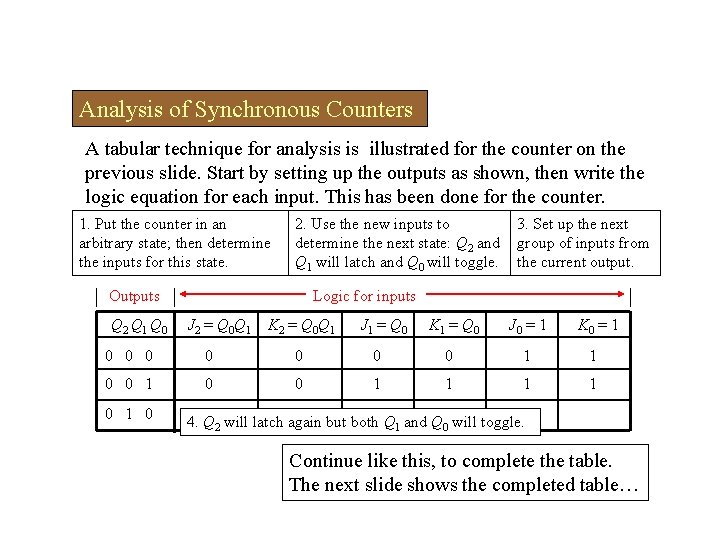
Analysis of Synchronous Counters A tabular technique for analysis is illustrated for the counter on the previous slide. Start by setting up the outputs as shown, then write the logic equation for each input. This has been done for the counter. 1. Put the counter in an arbitrary state; then determine the inputs for this state. 2. Use the new inputs to determine the next state: Q 2 and Q 1 will latch and Q 0 will toggle. Outputs Q 2 Q 1 Q 0 3. Set up the next group of inputs from the current output. Logic for inputs J 2 = Q 0 Q 1 K 2 = Q 0 Q 1 J 1 = Q 0 K 1 = Q 0 J 0 = 1 K 0 = 1 0 0 0 0 1 1 0 1 0 4. Q 2 will latch again but both Q 1 and Q 0 will toggle. Continue like this, to complete the table. The next slide shows the completed table…
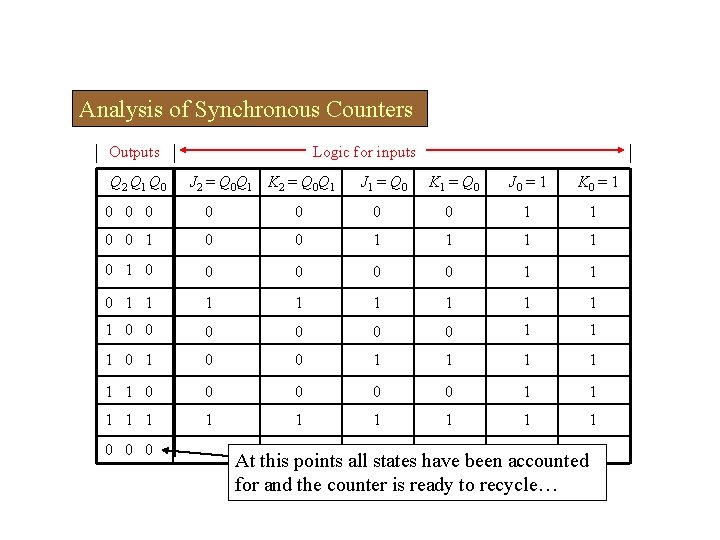
Analysis of Synchronous Counters Outputs Q 2 Q 1 Q 0 Logic for inputs J 2 = Q 0 Q 1 K 2 = Q 0 Q 1 J 1 = Q 0 K 1 = Q 0 J 0 = 1 K 0 = 1 0 0 0 0 1 1 0 1 0 0 0 1 1 1 0 0 0 1 1 1 0 0 0 1 1 1 0 0 0 At this points all states have been accounted for and the counter is ready to recycle…

A 4 -bit Synchronous Binary Counter The 4 -bit binary counter has one more AND gate than the 3 -bit counter just described. The shaded areas show where the AND gate outputs are HIGH causing the next FF to toggle. Q 0 Q 1 Q 2 Q 3
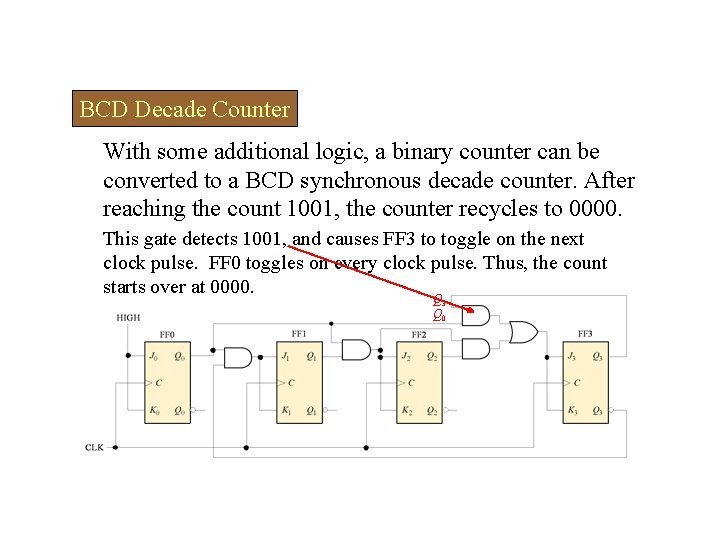
BCD Decade Counter With some additional logic, a binary counter can be converted to a BCD synchronous decade counter. After reaching the count 1001, the counter recycles to 0000. This gate detects 1001, and causes FF 3 to toggle on the next clock pulse. FF 0 toggles on every clock pulse. Thus, the count starts over at 0000. Q 3 Q 0
- Slides: 12