
Counting Crime Methods for Counting Crime Current Crime

- Slides: 28
Counting Crime Methods for Counting Crime? Current Crime Numbers/Trends Explaining the Crime Drop 1
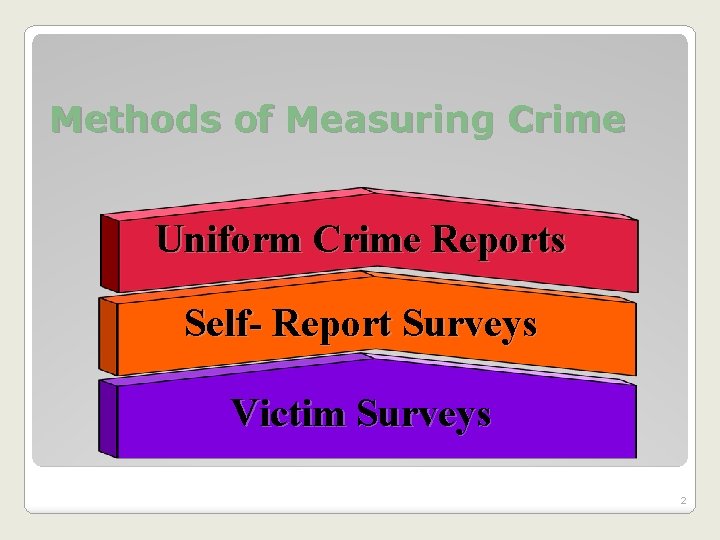
Methods of Measuring Crime Uniform Crime Reports Self- Report Surveys Victim Surveys 2
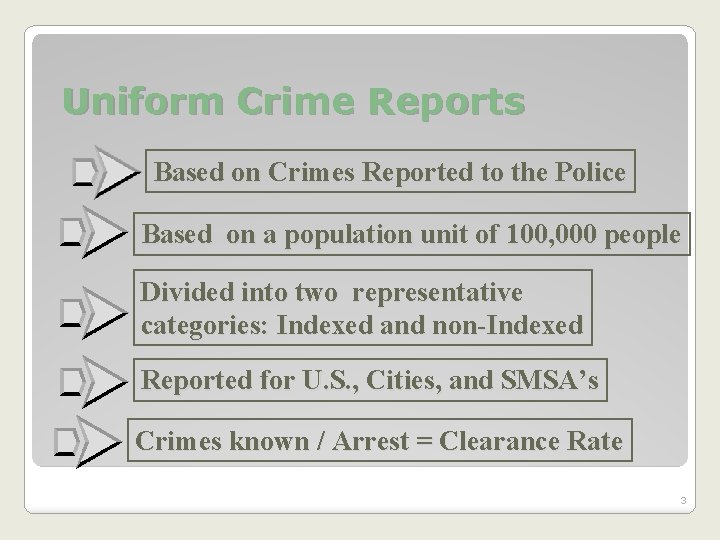
Uniform Crime Reports Based on Crimes Reported to the Police Based on a population unit of 100, 000 people Divided into two representative categories: Indexed and non-Indexed Reported for U. S. , Cities, and SMSA’s Crimes known / Arrest = Clearance Rate 3
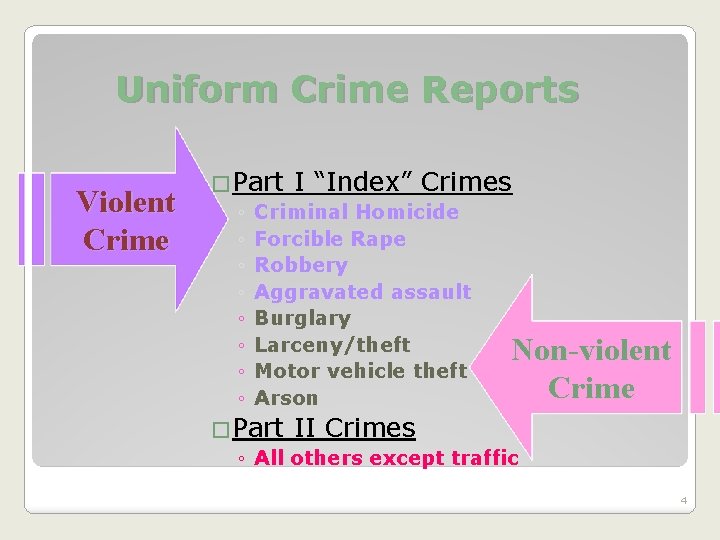
Uniform Crime Reports Violent Crime �Part I “Index” Crimes ◦ Criminal Homicide ◦ Forcible Rape ◦ Robbery ◦ Aggravated assault ◦ Burglary ◦ Larceny/theft Non-violent ◦ Motor vehicle theft Crime ◦ Arson �Part II Crimes ◦ All others except traffic 4
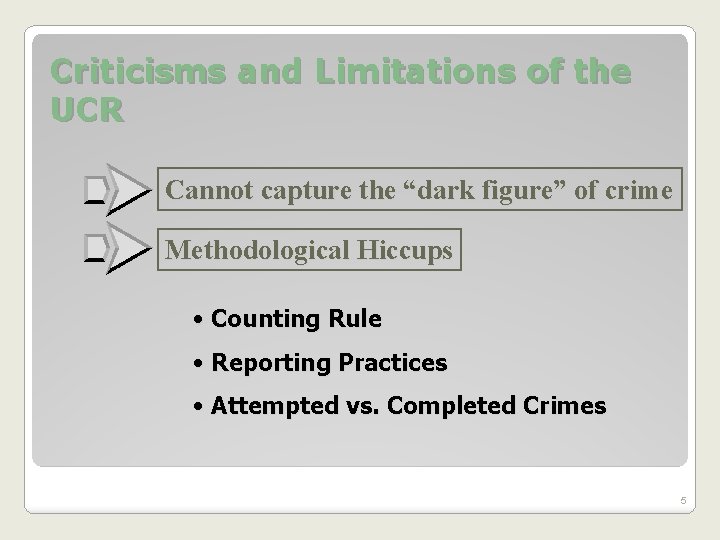
Criticisms and Limitations of the UCR Cannot capture the “dark figure” of crime Methodological Hiccups • Counting Rule • Reporting Practices • Attempted vs. Completed Crimes 5
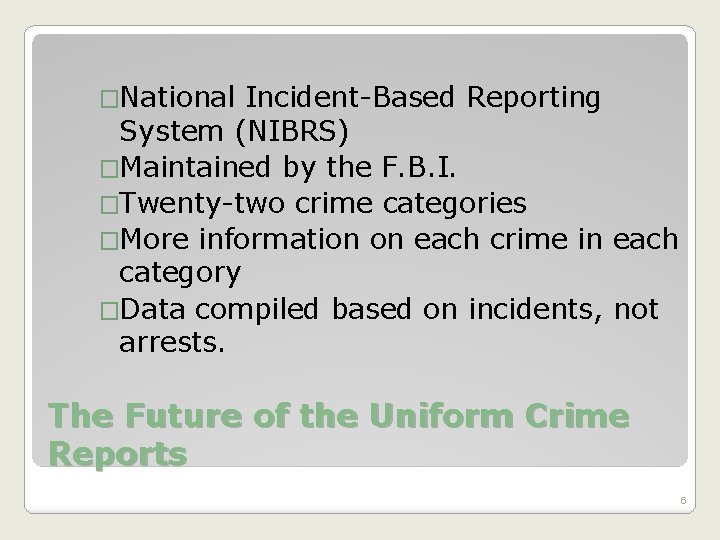
�National Incident-Based Reporting System (NIBRS) �Maintained by the F. B. I. �Twenty-two crime categories �More information on each crime in each category �Data compiled based on incidents, not arrests. The Future of the Uniform Crime Reports 6
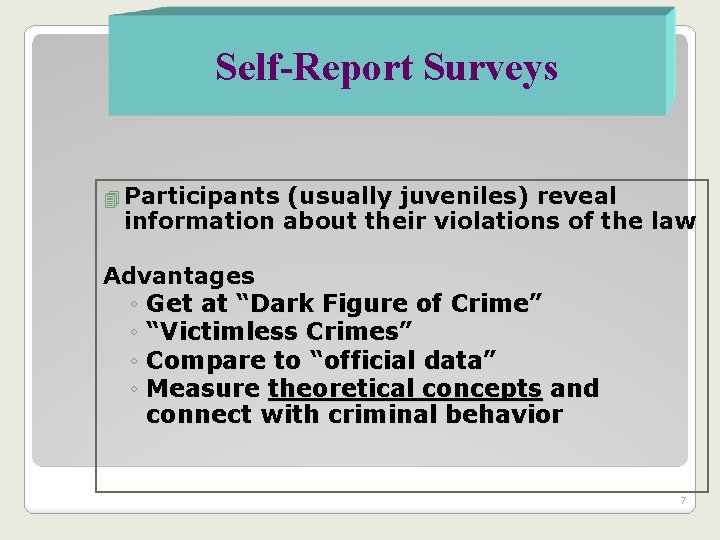
Self-Report Surveys 4 Participants (usually juveniles) reveal information about their violations of the law Advantages ◦ Get at “Dark Figure of Crime” ◦ “Victimless Crimes” ◦ Compare to “official data” ◦ Measure theoretical concepts and connect with criminal behavior 7
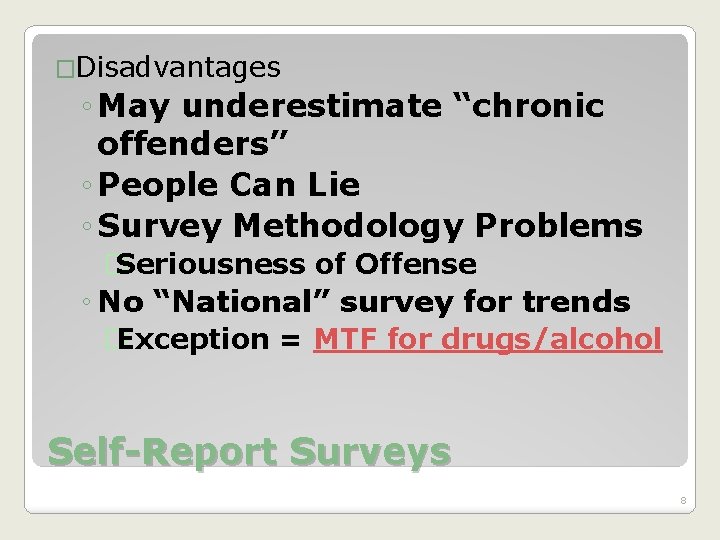
�Disadvantages ◦ May underestimate “chronic offenders” ◦ People Can Lie ◦ Survey Methodology Problems �Seriousness of Offense ◦ No “National” survey for trends �Exception = MTF for drugs/alcohol Self-Report Surveys 8
National Crime Victimization Survey 1. Asks victims about their encounters with criminals 2. Nationally representative sample 3. May also describe people most at risk 4. Limitations: Little information about offenders Cannot assess some crimes Limitations of Survey Research 9
�UCR ◦ Aggregate Data (see trends), Crimes known to police �Self-report ◦ Individual level data, links offender characteristics to criminal offending �NCVS ◦ Aggregate Data (see trends), victimizations REVIEW 10
�Crime Trends ◦ Is crime increasing, decreasing or stable? ◦ Why? �Correlates of Crime ◦ What factors are related to crime? ◦ Geographic location, Age, Race, Gender, Social Class? Crime Trends and Correlates of Crime 11
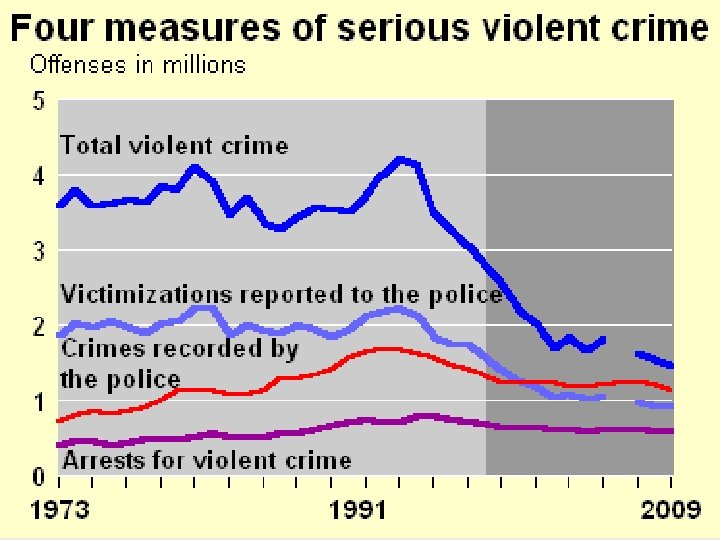
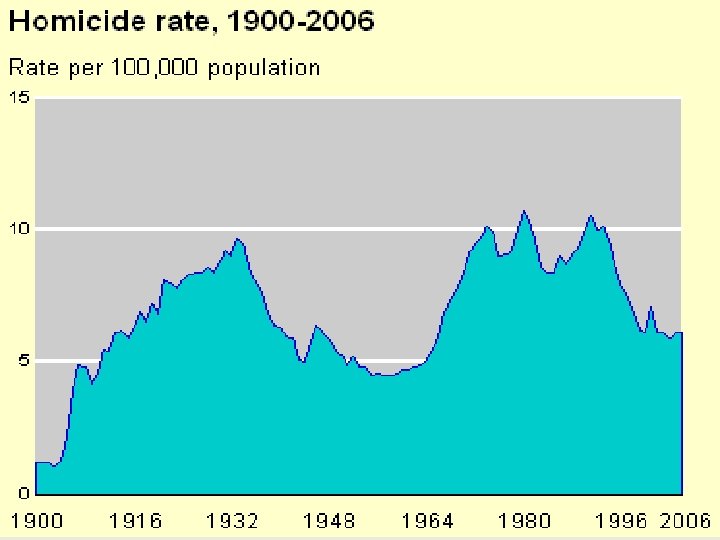
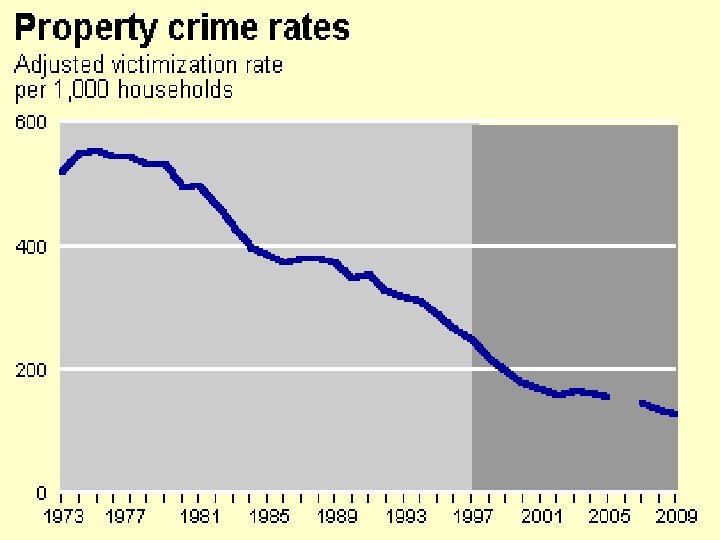
�UCR and NCVS data reveal a steady decrease in violent crime since the mid 1990 s ◦ The decrease is being driven by a sharp decline in violent crime among juveniles. �NCVS indicates a long term trend of decreasing property crime ◦ Some difference with UCR data Crime Trends 12
13
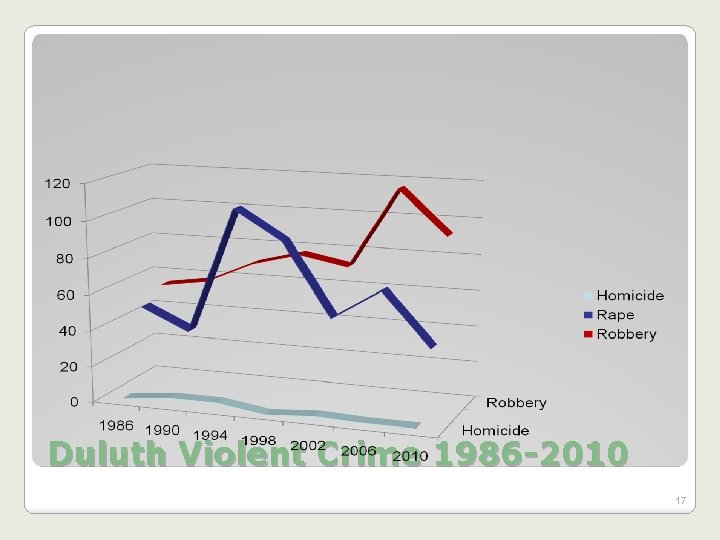
Duluth Violent Crime 1986 -2010 17
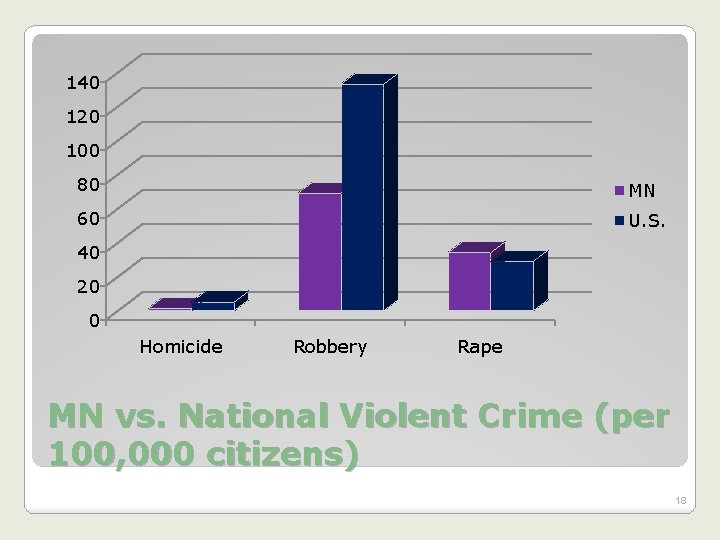
140 120 100 80 MN 60 U. S. 40 20 0 Homicide Robbery Rape MN vs. National Violent Crime (per 100, 000 citizens) 18
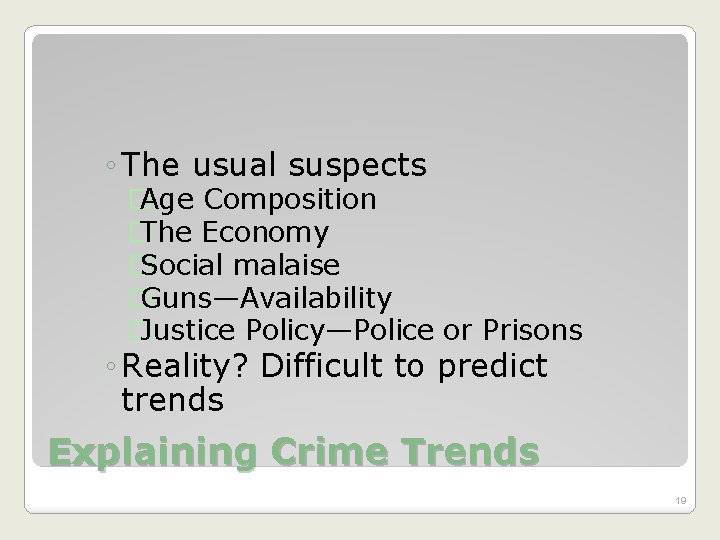
◦ The usual suspects �Age Composition �The Economy �Social malaise �Guns—Availability �Justice Policy—Police or Prisons ◦ Reality? Difficult to predict trends Explaining Crime Trends 19
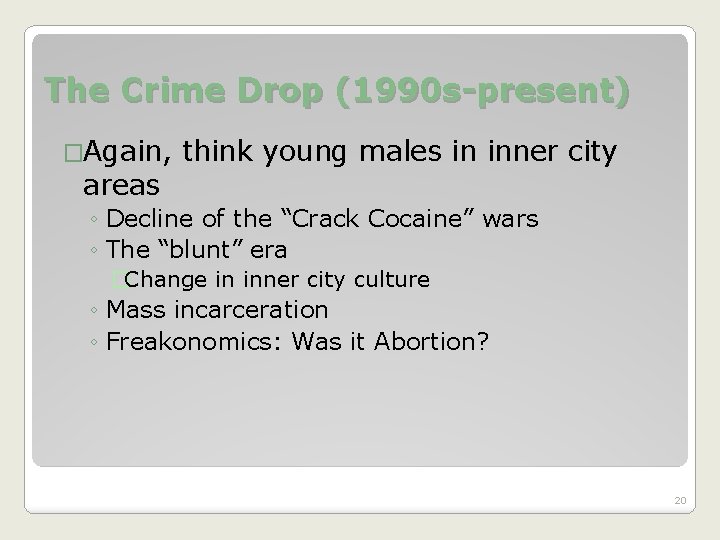
The Crime Drop (1990 s-present) �Again, areas think young males in inner city ◦ Decline of the “Crack Cocaine” wars ◦ The “blunt” era �Change in inner city culture ◦ Mass incarceration ◦ Freakonomics: Was it Abortion? 20
�Demographics ◦ Age ◦ Sex ◦ Race Correlates of Crime 21
�UCR, NCVS, and SR data all indicate that females are more likely than males to commit criminal acts ◦ Socialization? ◦ Biological differences? ◦ Feminist explanations GENDER AND CRIME 22
�SR weak if any relationship �Official data strong relationship �Is relationship due to bias? �How police patrol and interact with minorities �Disparity in how CJS processes minorities? �NCVS data confirms some “true” racecrime relationship. Why does race predict crime? �Relationship to class, neighborhood, culture RACE AND CRIME 23
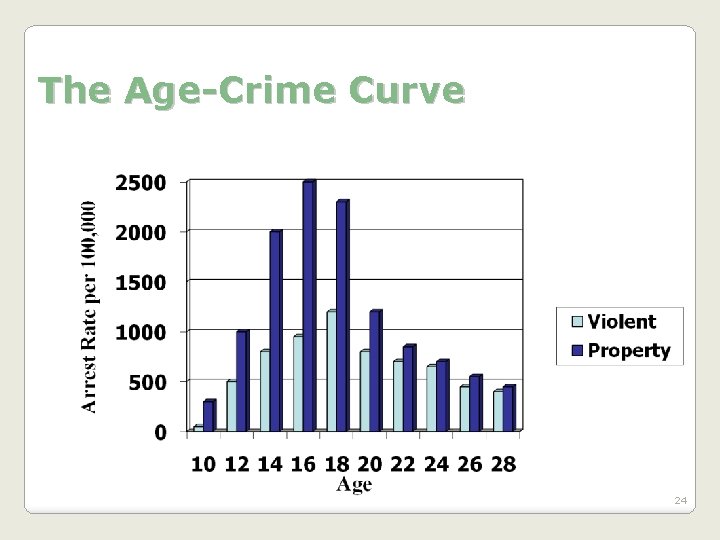
The Age-Crime Curve 24
�Crime is “young” persons game �HOWEVER ◦ There is a group of “chronic” offenders that persist in crime after adulthood ◦ The “Chronic” 6% Age and Crime 25
Cohort studies clearly show that most chronic juvenile offenders continue their law-violating careers as adults. Continuity of Crime Then and …………. . NOW 26
�Criminals and victims tend to look the same demographically ◦ Most crime is intraracial ◦ Victimization for most crimes most likely among �Young �Male �Urban Crime Victimization 27
�We have no “UCR” mechanism to gauge white collar crime ◦ How to assess insider trading, environmental crimes, corporate crime? �Most large corporate crime prosecutions in in a settlement What is counted counts 28