
Counting Chapter 6 1 Chapter Summary The Basics
Counting Chapter 6 1
Chapter Summary The Basics of Counting The Pigeonhole Principle Permutations and Combinations Binomial Coefficients and Identities Generalized Permutations and Combinations Generating Permutations and Combinations (not yet included in overheads ) 2
The Basics of Counting Section 6. 1 3
Section Summary The Product Rule The Sum Rule The Subtraction Rule The Division Rule Examples, and Examples Tree Diagrams 4
Basic Counting Principles: The Product Rule: A procedure can be broken down into a sequence of two tasks. There are n 1 ways to do the first task and n 2 ways to do the second task. Then there are n 1∙n 2 ways to do the procedure. Example: How many bit strings of length seven are there? Solution: Since each of the seven bits is either a 0 or a 1, the answer is 27 = 128. 5
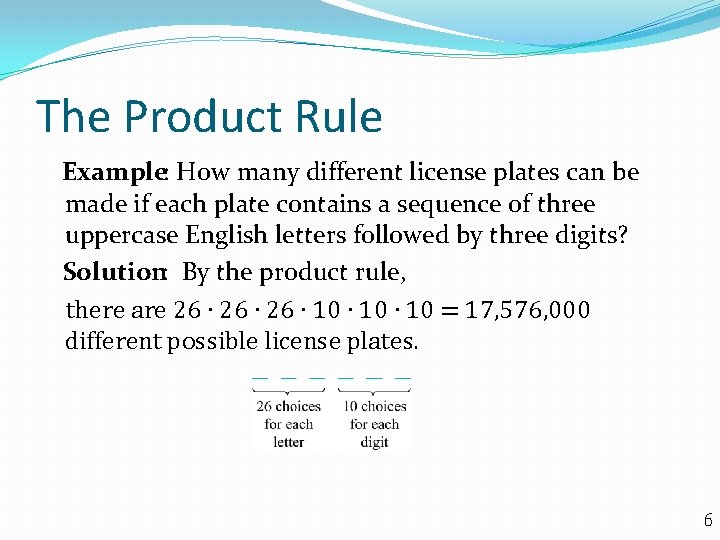
The Product Rule Example: How many different license plates can be made if each plate contains a sequence of three uppercase English letters followed by three digits? Solution: By the product rule, there are 26 ∙ 10 ∙ 10 = 17, 576, 000 different possible license plates. 6

Counting Functions: How many functions are there from a set with m elements to a set with n elements? Solution: Since a function represents a choice of one of the n elements of the codomain for each of the m elements in the domain, the product rule tells us that there are n ∙ ∙ ∙ n = nm such functions. Counting One-to-One Functions : How many one-to-one functions are there from a set with m elements to one with n elements? Solution: Suppose the elements in the domain are a 1, a 2, …, am. There are n ways to choose the value of a 1 and n− 1 ways to choose a 2, etc. The product rule tells us that there are n(n− 1) (n− 2)∙∙∙(n−m +1) such functions. 7
Telephone Numbering Plan Example: The North American numbering plan (NANP) specifies that a telephone number consists of 10 digits, consisting of a three-digit area code, a three-digit office code, and a four-digit station code. There are some restrictions on the digits. Let X denote a digit from 0 through 9. Let N denote a digit from 2 through 9. Let Y denote a digit that is 0 or 1. In the old plan (in use in the 1960 s) the format was NYX-NNX-XXXX. In the new plan, the format is NXX-XXXX. How many different telephone numbers are possible under the old plan and the new plan? Solution: Use the Product Rule. There are 8 ∙ 2 ∙ 10 = 160 area codes with the format NYX. There are 8 ∙ 10 = 800 area codes with the format NXX. There are 8 ∙ 10 = 640 office codes with the format NNX. There are 10 ∙ 10 = 10, 000 station codes with the format XXXX. Number of old plan telephone numbers: 160 ∙ 640 ∙ 10, 000 = 1, 024, 000. Number of new plan telephone numbers: 800 ∙ 10, 000 = 6, 400, 000. 8
Counting Subsets of a Finite Set : Use the product rule to show that the number of different subsets of a finite set S is 2|S|. (In Section 5. 1, mathematical induction was used to prove this same result. ) Solution: When the elements of S are listed in an arbitrary order, there is a one-to-one correspondence between subsets of S and bit strings of length |S|. When the ith element is in the subset, the bit string has a 1 in the ith position and a 0 otherwise. By the product rule, there are 2|S| such bit strings, and therefore 2|S| subsets. 9
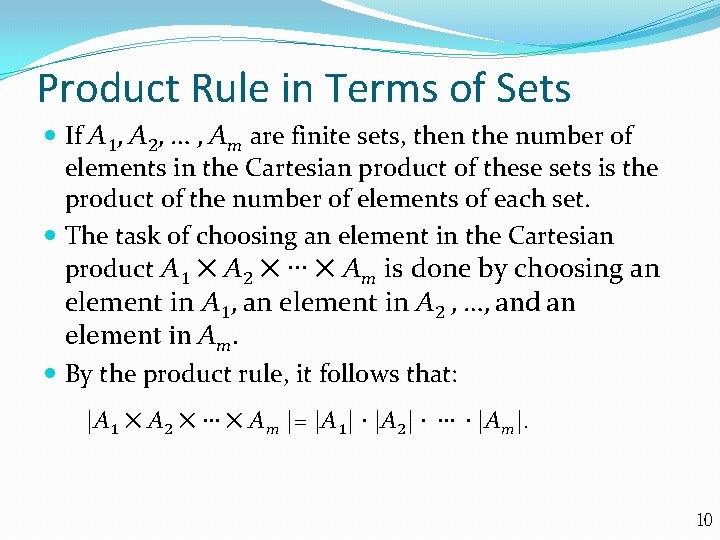
Product Rule in Terms of Sets If A 1, A 2, … , Am are finite sets, then the number of elements in the Cartesian product of these sets is the product of the number of elements of each set. The task of choosing an element in the Cartesian product A 1 ⨉ A 2 ⨉ ∙∙∙ ⨉ Am is done by choosing an element in A 1, an element in A 2 , …, and an element in Am. By the product rule, it follows that: |A 1 ⨉ A 2 ⨉ ∙∙∙ ⨉ Am |= |A 1| ∙ |A 2| ∙ ∙∙∙ ∙ |Am|. 10
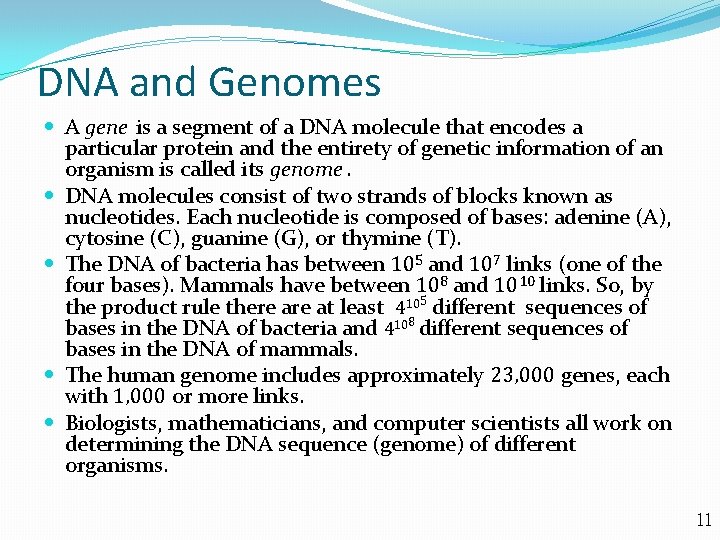
DNA and Genomes A gene is a segment of a DNA molecule that encodes a particular protein and the entirety of genetic information of an organism is called its genome. DNA molecules consist of two strands of blocks known as nucleotides. Each nucleotide is composed of bases: adenine (A), cytosine (C), guanine (G), or thymine (T). The DNA of bacteria has between 105 and 107 links (one of the four bases). Mammals have between 108 and 1010 links. So, by the product rule there at least 4105 different sequences of bases in the DNA of bacteria and 4108 different sequences of bases in the DNA of mammals. The human genome includes approximately 23, 000 genes, each with 1, 000 or more links. Biologists, mathematicians, and computer scientists all work on determining the DNA sequence (genome) of different organisms. 11
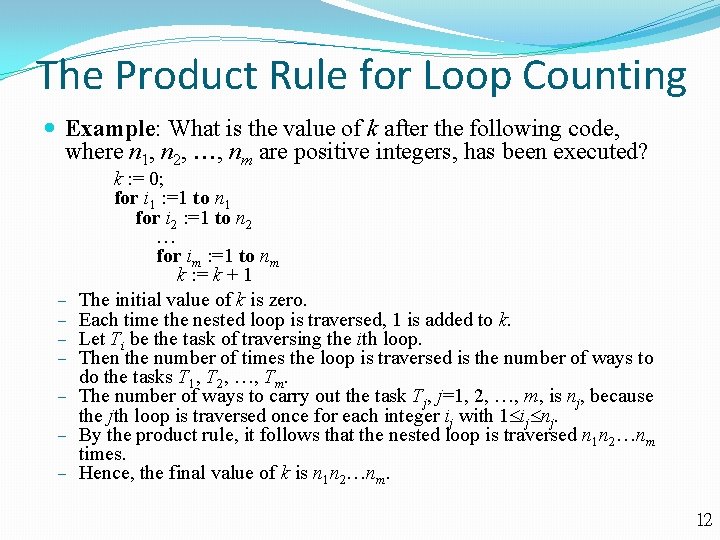
The Product Rule for Loop Counting Example: What is the value of k after the following code, where n 1, n 2, , nm are positive integers, has been executed? - k : = 0; for i 1 : =1 to n 1 for i 2 : =1 to n 2 for im : =1 to nm k : = k + 1 The initial value of k is zero. Each time the nested loop is traversed, 1 is added to k. Let Ti be the task of traversing the ith loop. Then the number of times the loop is traversed is the number of ways to do the tasks T 1, T 2, , Tm. The number of ways to carry out the task Tj, j=1, 2, , m, is nj, because the jth loop is traversed once for each integer ij with 1 ij nj. By the product rule, it follows that the nested loop is traversed n 1 n 2 nm times. Hence, the final value of k is n 1 n 2 nm. 12
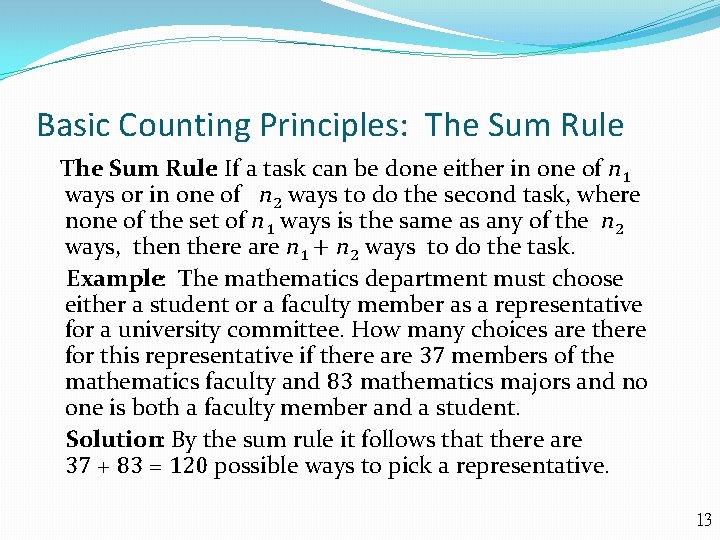
Basic Counting Principles: The Sum Rule: If a task can be done either in one of n 1 ways or in one of n 2 ways to do the second task, where none of the set of n 1 ways is the same as any of the n 2 ways, then there are n 1 + n 2 ways to do the task. Example: The mathematics department must choose either a student or a faculty member as a representative for a university committee. How many choices are there for this representative if there are 37 members of the mathematics faculty and 83 mathematics majors and no one is both a faculty member and a student. Solution: By the sum rule it follows that there are 37 + 83 = 120 possible ways to pick a representative. 13
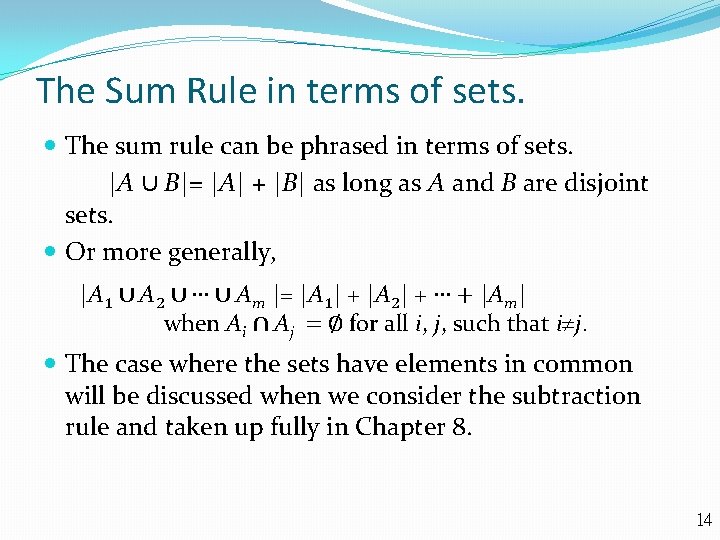
The Sum Rule in terms of sets. The sum rule can be phrased in terms of sets. |A ∪ B|= |A| + |B| as long as A and B are disjoint sets. Or more generally, |A 1 ∪ A 2 ∪ ∙∙∙ ∪ Am |= |A 1| + |A 2| + ∙∙∙ + |Am| when Ai ∩ Aj = ∅ for all i, j, such that i j. The case where the sets have elements in common will be discussed when we consider the subtraction rule and taken up fully in Chapter 8. 14
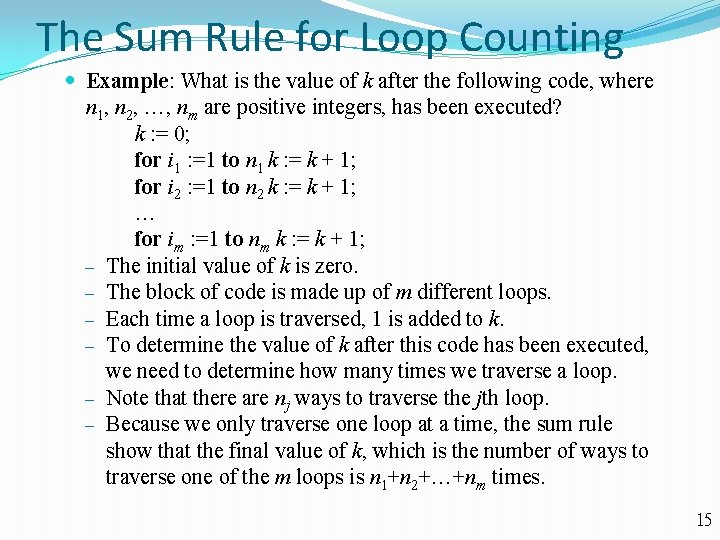
The Sum Rule for Loop Counting Example: What is the value of k after the following code, where n 1, n 2, , nm are positive integers, has been executed? k : = 0; for i 1 : =1 to n 1 k : = k + 1; for i 2 : =1 to n 2 k : = k + 1; for im : =1 to nm k : = k + 1; - The initial value of k is zero. - The block of code is made up of m different loops. - Each time a loop is traversed, 1 is added to k. - To determine the value of k after this code has been executed, we need to determine how many times we traverse a loop. - Note that there are nj ways to traverse the jth loop. - Because we only traverse one loop at a time, the sum rule show that the final value of k, which is the number of ways to traverse one of the m loops is n 1+n 2+ +nm times. 15
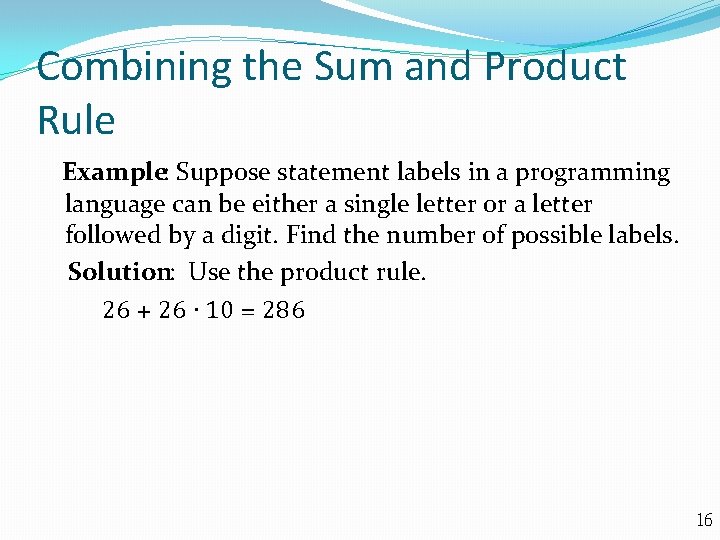
Combining the Sum and Product Rule Example: Suppose statement labels in a programming language can be either a single letter or a letter followed by a digit. Find the number of possible labels. Solution: Use the product rule. 26 + 26 ∙ 10 = 286 16
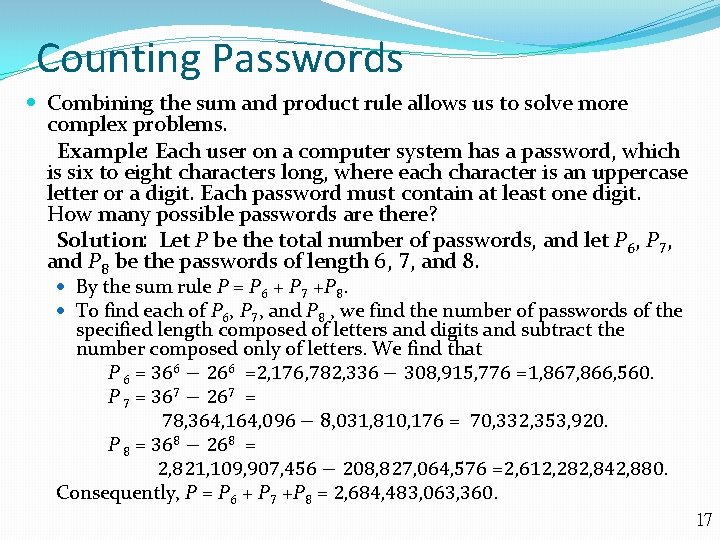
Counting Passwords Combining the sum and product rule allows us to solve more complex problems. Example: Each user on a computer system has a password, which is six to eight characters long, where each character is an uppercase letter or a digit. Each password must contain at least one digit. How many possible passwords are there? Solution: Let P be the total number of passwords, and let P 6, P 7, and P 8 be the passwords of length 6, 7, and 8. By the sum rule P = P 6 + P 7 +P 8. To find each of P 6, P 7, and P 8 , we find the number of passwords of the specified length composed of letters and digits and subtract the number composed only of letters. We find that P 6 = 366 − 266 =2, 176, 782, 336 − 308, 915, 776 =1, 867, 866, 560. P 7 = 367 − 267 = 78, 364, 164, 096 − 8, 031, 810, 176 = 70, 332, 353, 920. P 8 = 368 − 268 = 2, 821, 109, 907, 456 − 208, 827, 064, 576 =2, 612, 282, 842, 880. Consequently, P = P 6 + P 7 +P 8 = 2, 684, 483, 063, 360. 17
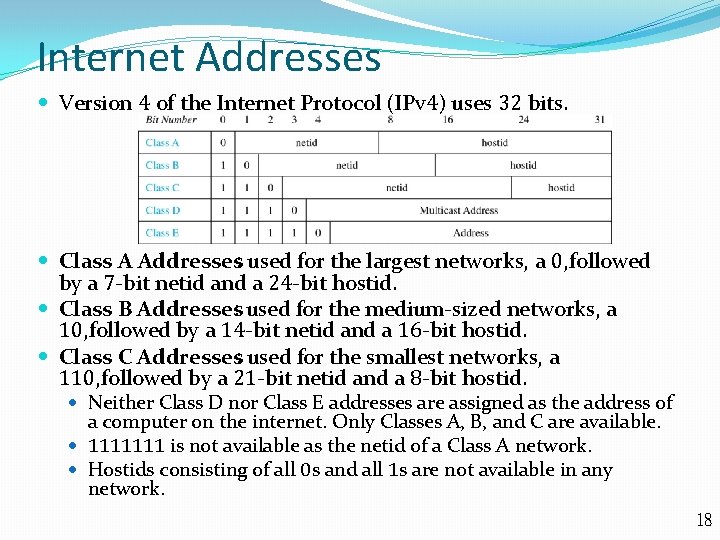
Internet Addresses Version 4 of the Internet Protocol (IPv 4) uses 32 bits. Class A Addresses: used for the largest networks, a 0, followed by a 7 -bit netid and a 24 -bit hostid. Class B Addresses: used for the medium-sized networks, a 10, followed by a 14 -bit netid and a 16 -bit hostid. Class C Addresses: used for the smallest networks, a 110, followed by a 21 -bit netid and a 8 -bit hostid. Neither Class D nor Class E addresses are assigned as the address of a computer on the internet. Only Classes A, B, and C are available. 1111111 is not available as the netid of a Class A network. Hostids consisting of all 0 s and all 1 s are not available in any network. 18
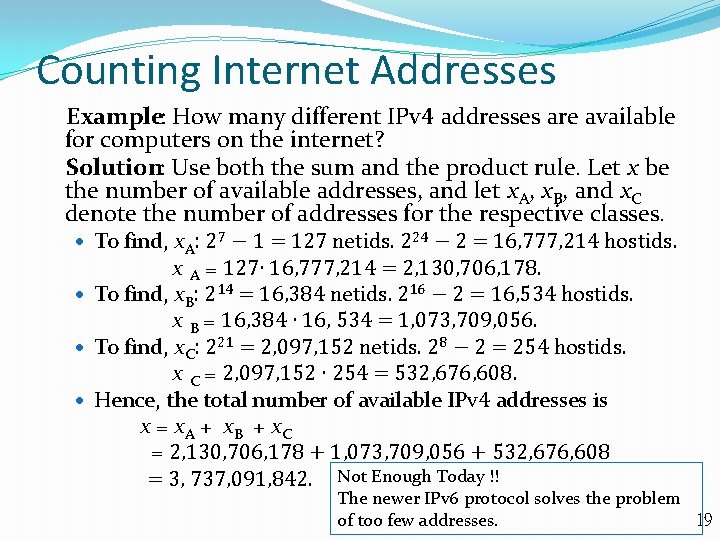
Counting Internet Addresses Example: How many different IPv 4 addresses are available for computers on the internet? Solution: Use both the sum and the product rule. Let x be the number of available addresses, and let x. A, x. B, and x. C denote the number of addresses for the respective classes. To find, x. A: 27 − 1 = 127 netids. 224 − 2 = 16, 777, 214 hostids. x A = 127∙ 16, 777, 214 = 2, 130, 706, 178. To find, x. B: 214 = 16, 384 netids. 216 − 2 = 16, 534 hostids. x B = 16, 384 ∙ 16, 534 = 1, 073, 709, 056. To find, x. C: 221 = 2, 097, 152 netids. 28 − 2 = 254 hostids. x C = 2, 097, 152 ∙ 254 = 532, 676, 608. Hence, the total number of available IPv 4 addresses is x = x. A + x. B + x. C = 2, 130, 706, 178 + 1, 073, 709, 056 + 532, 676, 608 = 3, 737, 091, 842. Not Enough Today !! The newer IPv 6 protocol solves the problem 19 of too few addresses.
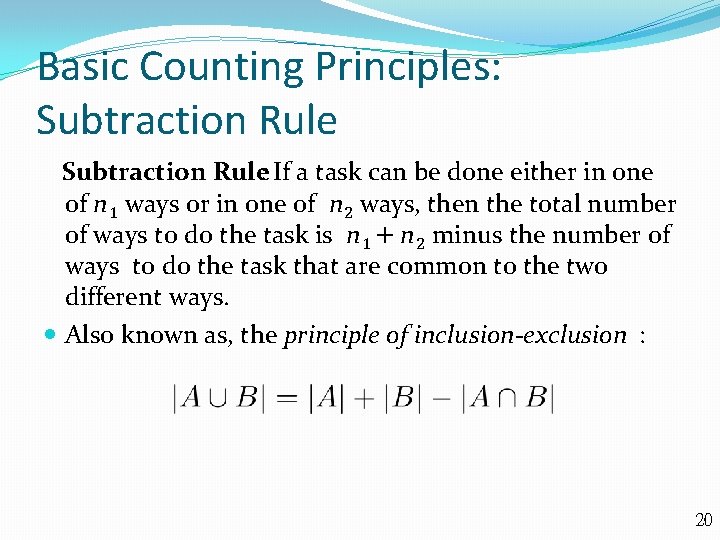
Basic Counting Principles: Subtraction Rule: If a task can be done either in one of n 1 ways or in one of n 2 ways, then the total number of ways to do the task is n 1 + n 2 minus the number of ways to do the task that are common to the two different ways. Also known as, the principle of inclusion-exclusion : 20
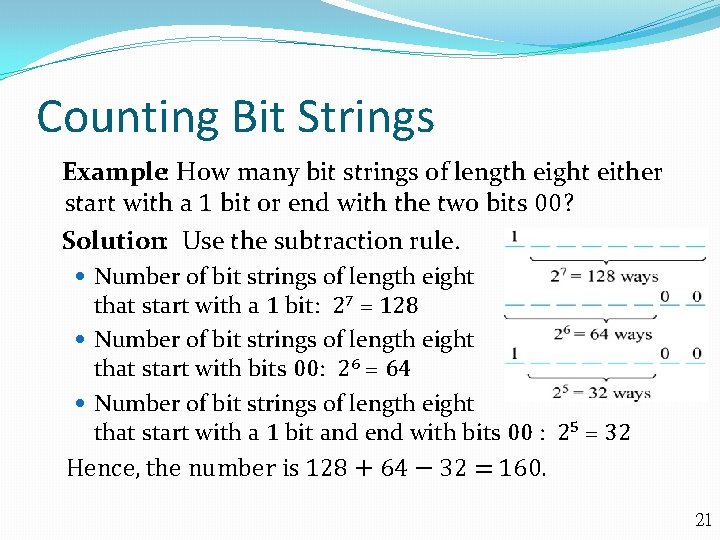
Counting Bit Strings Example: How many bit strings of length eight either start with a 1 bit or end with the two bits 00? Solution: Use the subtraction rule. Number of bit strings of length eight that start with a 1 bit: 27 = 128 Number of bit strings of length eight that start with bits 00: 26 = 64 Number of bit strings of length eight that start with a 1 bit and end with bits 00 : 25 = 32 Hence, the number is 128 + 64 − 32 = 160. 21
Basic Counting Principles: Division Rule: There are n/d ways to do a task if it can be done using a procedure that can be carried out in n ways, and for every way w, exactly d of the n ways correspond to way w. Restated in terms of sets: If the finite set A is the union of n pairwise disjoint subsets each with d elements, then n = |A|/d. In terms of functions: If f is a function from A to B, where both are finite sets, and for every value y ∈B there are exactly d values x ∈A such that f(x) = y, then |B| = |A|/d. 22
The Division Rule for Seatings Example: How many different ways are there to seat four people around a circular table, where two seatings are considered the same when each person has the same left neighbor and the same right neighbor? Select an arbitrary seat at the table and label it seat 1 and label the rest of the seats in numerical order. There are n=4!=24 ways to arrange the four people on the numbered seats. However, there are d=4 ways to select the seat labeled 1 that will lead to the same arrangement. By the division rule, there are n/d = 24/4 = 6 different seating arrangements of four people around the circular table. 23
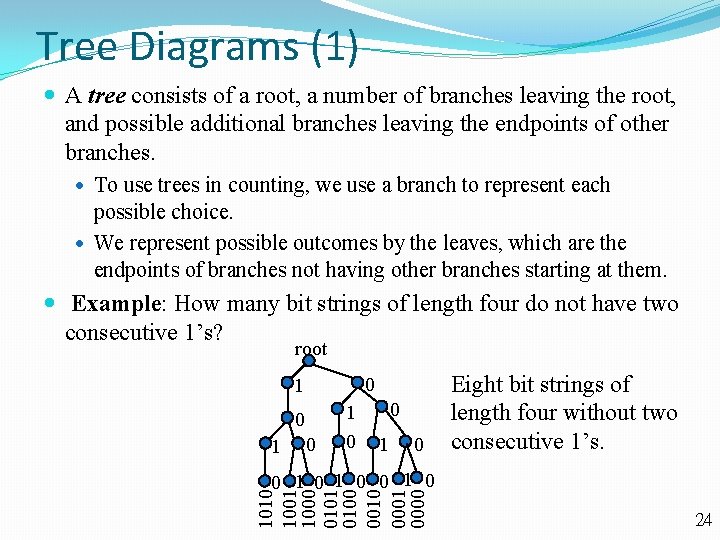
Tree Diagrams (1) A tree consists of a root, a number of branches leaving the root, and possible additional branches leaving the endpoints of other branches. To use trees in counting, we use a branch to represent each possible choice. We represent possible outcomes by the leaves, which are the endpoints of branches not having other branches starting at them. Example: How many bit strings of length four do not have two consecutive 1’s? root 0 1 0 1 0 Eight bit strings of length four without two consecutive 1’s. 1010 1001 1000 0101 0100 0010 0001 0000 0 1 0 24
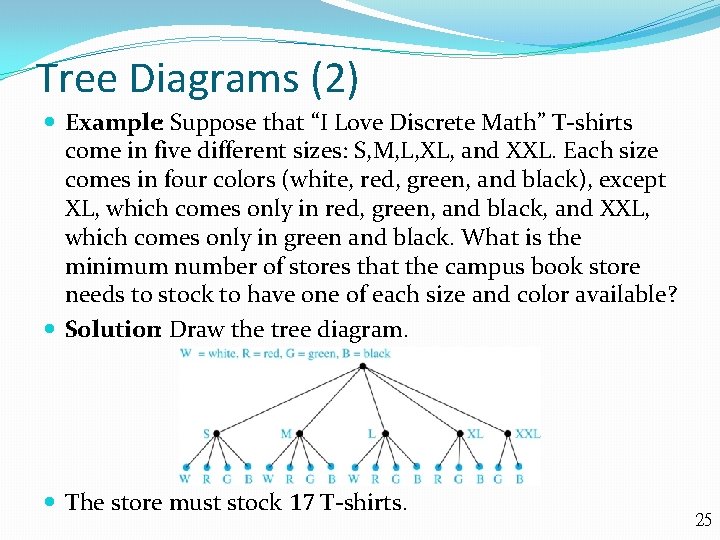
Tree Diagrams (2) Example: Suppose that “I Love Discrete Math” T-shirts come in five different sizes: S, M, L, XL, and XXL. Each size comes in four colors (white, red, green, and black), except XL, which comes only in red, green, and black, and XXL, which comes only in green and black. What is the minimum number of stores that the campus book store needs to stock to have one of each size and color available? Solution: Draw the tree diagram. The store must stock 17 T-shirts. 25
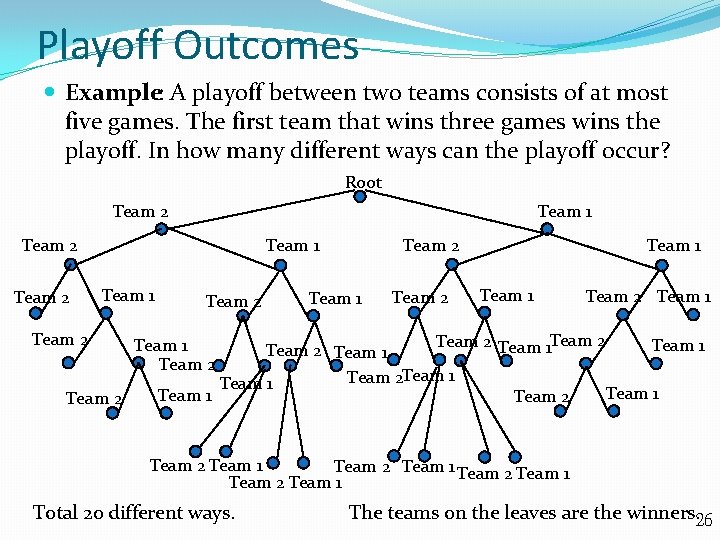
Playoff Outcomes Example: A playoff between two teams consists of at most five games. The first team that wins three games wins the playoff. In how many different ways can the playoff occur? Root Team 2 Team 1 Team 2 Team 1 Team 2 Team 1 Team 2 Team 1 Team 2 Team 1 Team 2 Team 1 Total 20 different ways. The teams on the leaves are the winners. 26
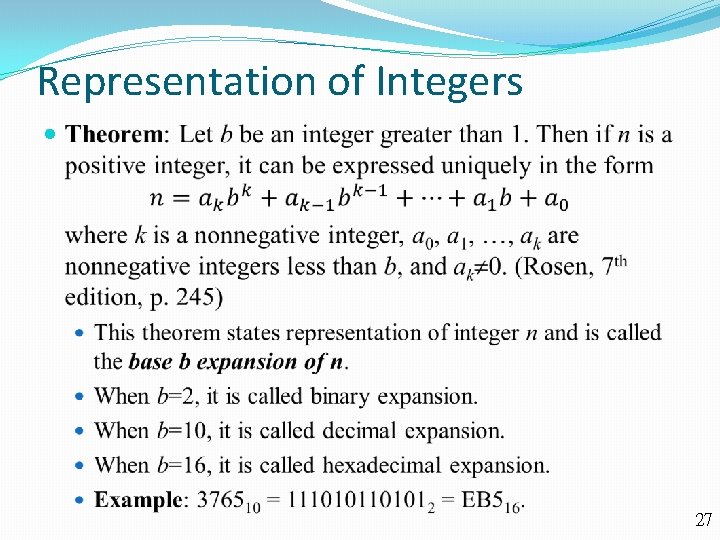
Representation of Integers 27

The Pigeonhole Principle Section 6. 2 28

Section Summary The Pigeonhole Principle The Generalized Pigeonhole Principle 29
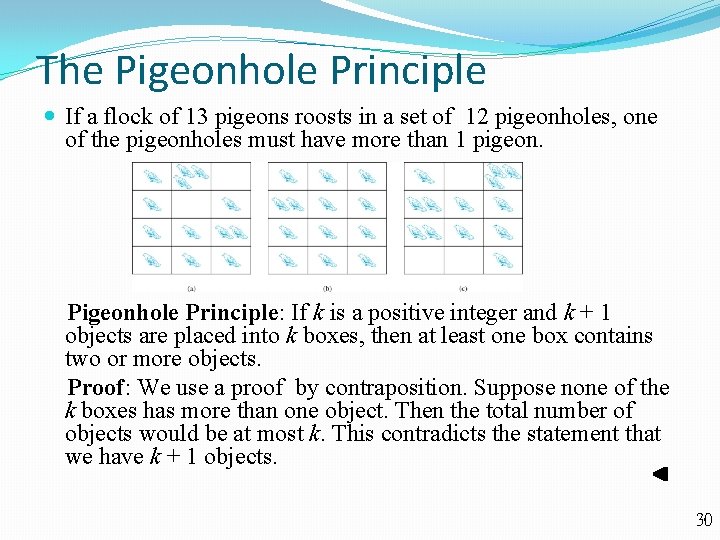
The Pigeonhole Principle If a flock of 13 pigeons roosts in a set of 12 pigeonholes, one of the pigeonholes must have more than 1 pigeon. Pigeonhole Principle: If k is a positive integer and k + 1 objects are placed into k boxes, then at least one box contains two or more objects. Proof: We use a proof by contraposition. Suppose none of the k boxes has more than one object. Then the total number of objects would be at most k. This contradicts the statement that we have k + 1 objects. 30
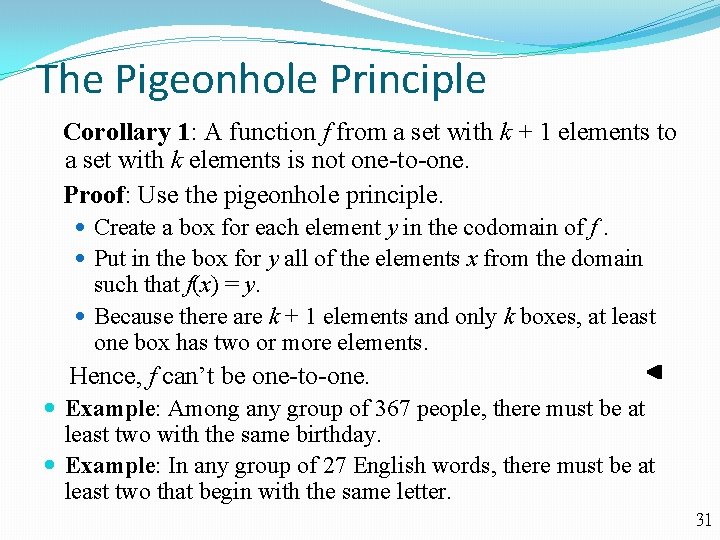
The Pigeonhole Principle Corollary 1: A function f from a set with k + 1 elements to a set with k elements is not one-to-one. Proof: Use the pigeonhole principle. Create a box for each element y in the codomain of f. Put in the box for y all of the elements x from the domain such that f(x) = y. Because there are k + 1 elements and only k boxes, at least one box has two or more elements. Hence, f can’t be one-to-one. Example: Among any group of 367 people, there must be at least two with the same birthday. Example: In any group of 27 English words, there must be at least two that begin with the same letter. 31
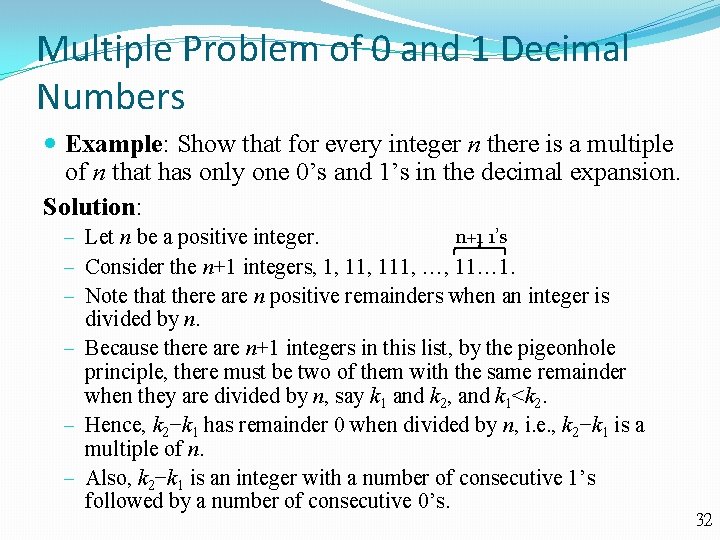
Multiple Problem of 0 and 1 Decimal Numbers Example: Show that for every integer n there is a multiple of n that has only one 0’s and 1’s in the decimal expansion. Solution: n+1 1’s - Let n be a positive integer. - Consider the n+1 integers, 1, 111, , 11 1. - Note that there are n positive remainders when an integer is divided by n. - Because there are n+1 integers in this list, by the pigeonhole principle, there must be two of them with the same remainder when they are divided by n, say k 1 and k 2, and k 1<k 2. - Hence, k 2−k 1 has remainder 0 when divided by n, i. e. , k 2−k 1 is a multiple of n. - Also, k 2−k 1 is an integer with a number of consecutive 1’s followed by a number of consecutive 0’s. 32
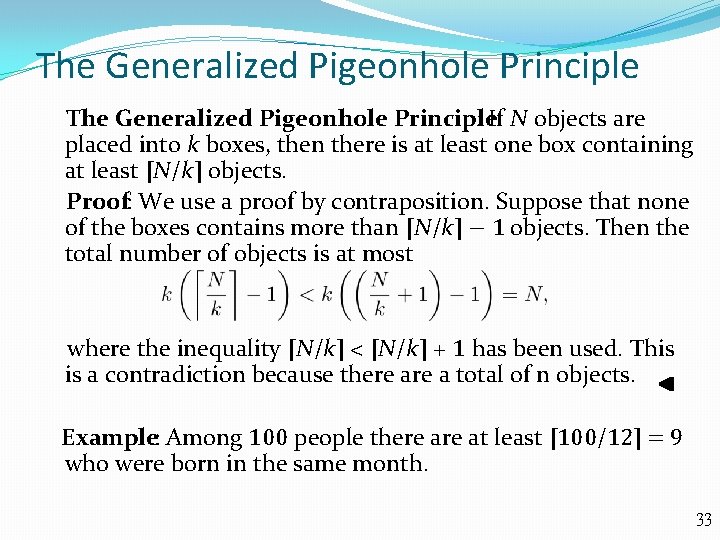
The Generalized Pigeonhole Principle : If N objects are placed into k boxes, then there is at least one box containing at least ⌈N/k⌉ objects. Proof: We use a proof by contraposition. Suppose that none of the boxes contains more than ⌈N/k⌉ − 1 objects. Then the total number of objects is at most where the inequality ⌈N/k⌉ < ⌈N/k⌉ + 1 has been used. This is a contradiction because there a total of n objects. Example: Among 100 people there at least ⌈100/12⌉ = 9 who were born in the same month. 33
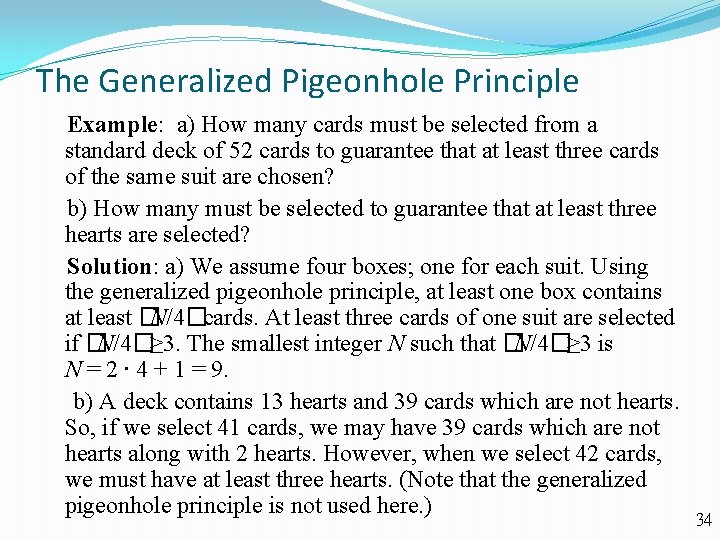
The Generalized Pigeonhole Principle Example: a) How many cards must be selected from a standard deck of 52 cards to guarantee that at least three cards of the same suit are chosen? b) How many must be selected to guarantee that at least three hearts are selected? Solution: a) We assume four boxes; one for each suit. Using the generalized pigeonhole principle, at least one box contains at least �N/4�cards. At least three cards of one suit are selected if �N/4�≥ 3. The smallest integer N such that �N/4�≥ 3 is N = 2 ∙ 4 + 1 = 9. b) A deck contains 13 hearts and 39 cards which are not hearts. So, if we select 41 cards, we may have 39 cards which are not hearts along with 2 hearts. However, when we select 42 cards, we must have at least three hearts. (Note that the generalized pigeonhole principle is not used here. ) 34

Server Connection Problem Not a generalized pigeonhole principle, but similar to it. Example: Suppose that a computer science laboratory has 15 workstations and 10 servers. A cable can be used to directly connect a workstation to a server. For each server, only one direct connection to that server can be active at any time. We want to guarantee that at any time any set of 10 or fewer workstations can simultaneously access different servers via direct connections. A simple way is to connect every workstation directly to every server using 150 connections. What is the minimum number of direct connections needed to achieve this goal? 35
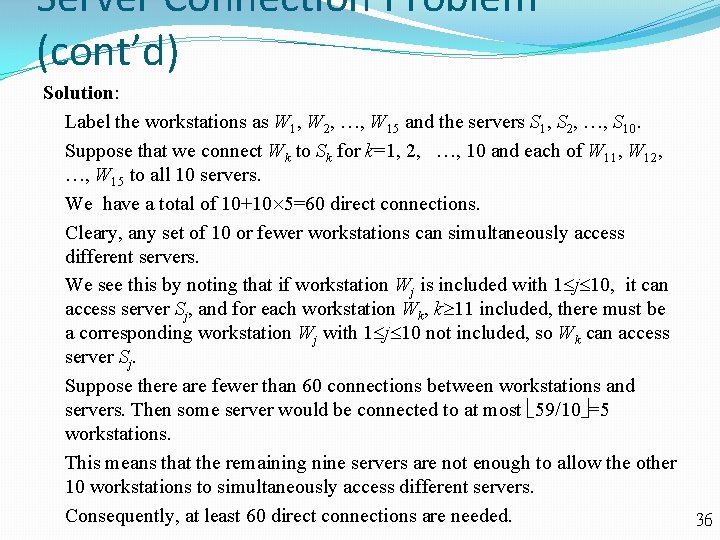
Server Connection Problem (cont’d) Solution: Label the workstations as W 1, W 2, , W 15 and the servers S 1, S 2, , S 10. Suppose that we connect Wk to Sk for k=1, 2, , 10 and each of W 11, W 12, , W 15 to all 10 servers. We have a total of 10+10 5=60 direct connections. Cleary, any set of 10 or fewer workstations can simultaneously access different servers. We see this by noting that if workstation Wj is included with 1 j 10, it can access server Sj, and for each workstation Wk, k 11 included, there must be a corresponding workstation Wj with 1 j 10 not included, so Wk can access server Sj. Suppose there are fewer than 60 connections between workstations and servers. Then some server would be connected to at most 59/10 =5 workstations. This means that the remaining nine servers are not enough to allow the other 10 workstations to simultaneously access different servers. Consequently, at least 60 direct connections are needed. 36
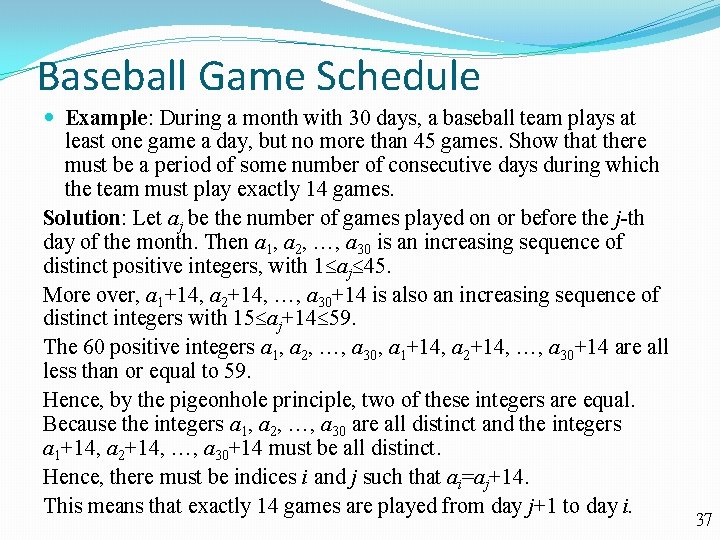
Baseball Game Schedule Example: During a month with 30 days, a baseball team plays at least one game a day, but no more than 45 games. Show that there must be a period of some number of consecutive days during which the team must play exactly 14 games. Solution: Let aj be the number of games played on or before the j-th day of the month. Then a 1, a 2, , a 30 is an increasing sequence of distinct positive integers, with 1 aj 45. More over, a 1+14, a 2+14, , a 30+14 is also an increasing sequence of distinct integers with 15 aj+14 59. The 60 positive integers a 1, a 2, , a 30, a 1+14, a 2+14, , a 30+14 are all less than or equal to 59. Hence, by the pigeonhole principle, two of these integers are equal. Because the integers a 1, a 2, , a 30 are all distinct and the integers a 1+14, a 2+14, , a 30+14 must be all distinct. Hence, there must be indices i and j such that ai=aj+14. This means that exactly 14 games are played from day j+1 to day i. 37
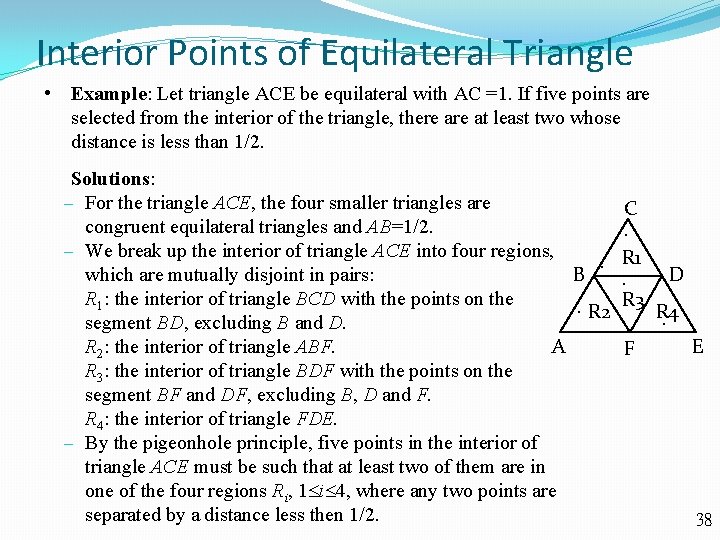
Interior Points of Equilateral Triangle • Example: Let triangle ACE be equilateral with AC =1. If five points are selected from the interior of the triangle, there at least two whose distance is less than 1/2. Solutions: - For the triangle ACE, the four smaller triangles are C congruent equilateral triangles and AB=1/2. - We break up the interior of triangle ACE into four regions, R 1 B D which are mutually disjoint in pairs: R 1: the interior of triangle BCD with the points on the R 3 R 2 R 4 segment BD, excluding B and D. A E R 2: the interior of triangle ABF. F R 3: the interior of triangle BDF with the points on the segment BF and DF, excluding B, D and F. R 4: the interior of triangle FDE. - By the pigeonhole principle, five points in the interior of triangle ACE must be such that at least two of them are in one of the four regions Ri, 1 i 4, where any two points are separated by a distance less then 1/2. 38
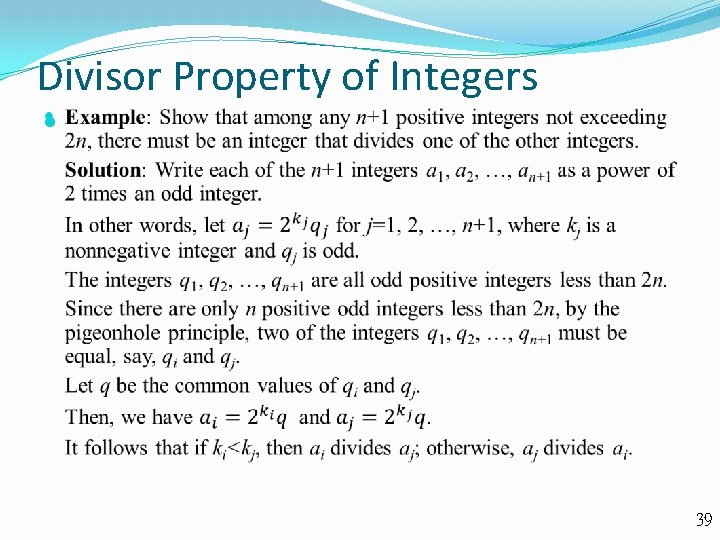
Divisor Property of Integers 39
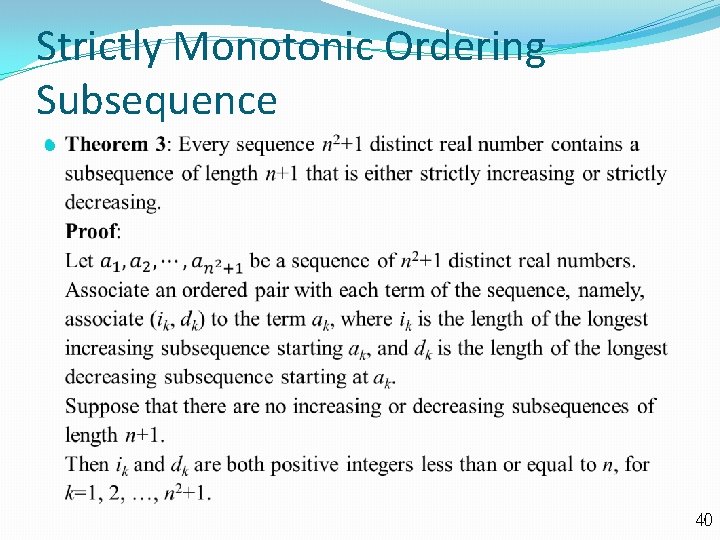
Strictly Monotonic Ordering Subsequence 40
Strictly Monotonic Ordering Subsequence (cont’d) Hence, by the product rule there are n 2 possible ordered for (ik, dk). By the pigeonhole principle, two of these n 2+1 pairs are equal. In other words, there exist terms as and at, with s<t such that is=it and ds=dt. We will show that this impossible. Because the terms of the sequence are distinct, either as<at or as>at. If as<at, then because is=it, an increase subsequences of length it+1 can be built starting at as followed by an increasing subsequence of length it beginning at at. This is a contradiction. Similarly, if as>at, the same reasoning shows that ds must be greater than dt, which is a contradiction. 41
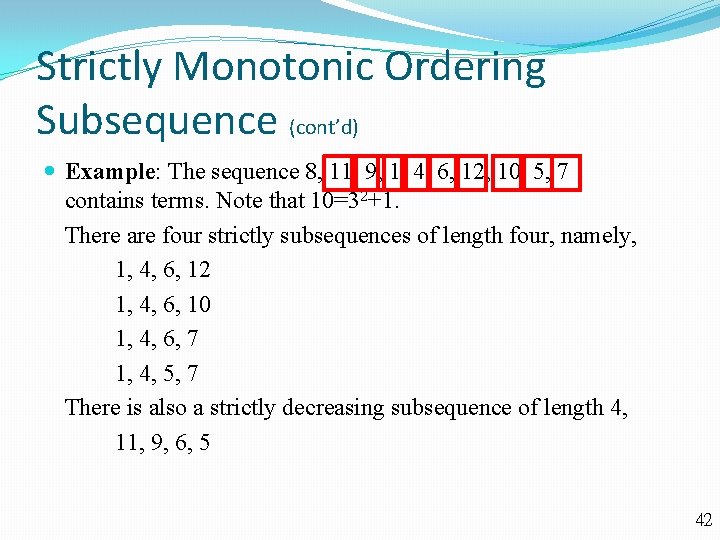
Strictly Monotonic Ordering Subsequence (cont’d) Example: The sequence 8, 11, 9, 1, 4, 6, 12, 10, 5, 7 contains terms. Note that 10=32+1. There are four strictly subsequences of length four, namely, 1, 4, 6, 12 1, 4, 6, 10 1, 4, 6, 7 1, 4, 5, 7 There is also a strictly decreasing subsequence of length 4, 11, 9, 6, 5 42
- Slides: 42