
Counting and Probability Lesson 7 Consider the following
Counting and Probability Lesson 7
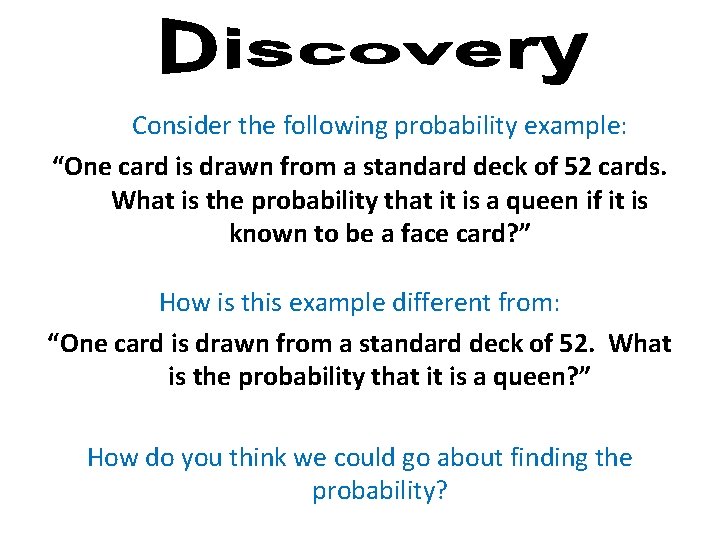
Consider the following probability example: “One card is drawn from a standard deck of 52 cards. What is the probability that it is a queen if it is known to be a face card? ” How is this example different from: “One card is drawn from a standard deck of 52. What is the probability that it is a queen? ” How do you think we could go about finding the probability?
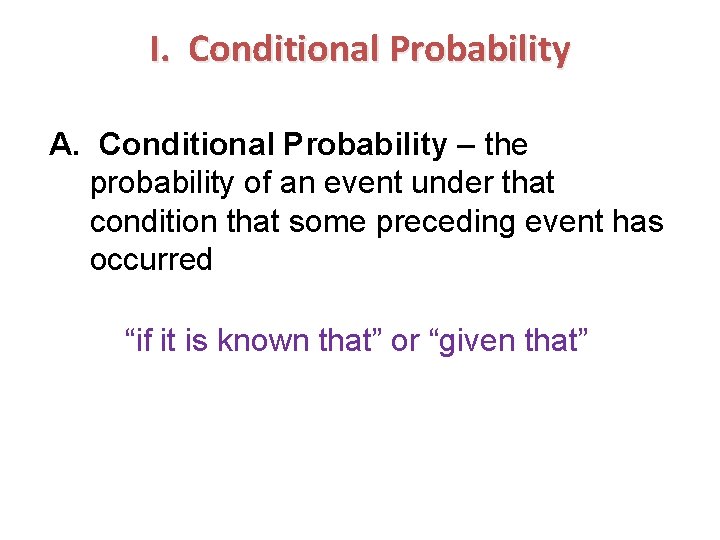
I. Conditional Probability A. Conditional Probability – the probability of an event under that condition that some preceding event has occurred “if it is known that” or “given that”

I. Conditional Probability A. Conditional Probability “if it is known that” or “given that” P(A /B) = # of successful outcomes all outcomes that meet the condition *Note*: Limit the total outcomes to only those that fit the “if it is known that” or “given that” condition.
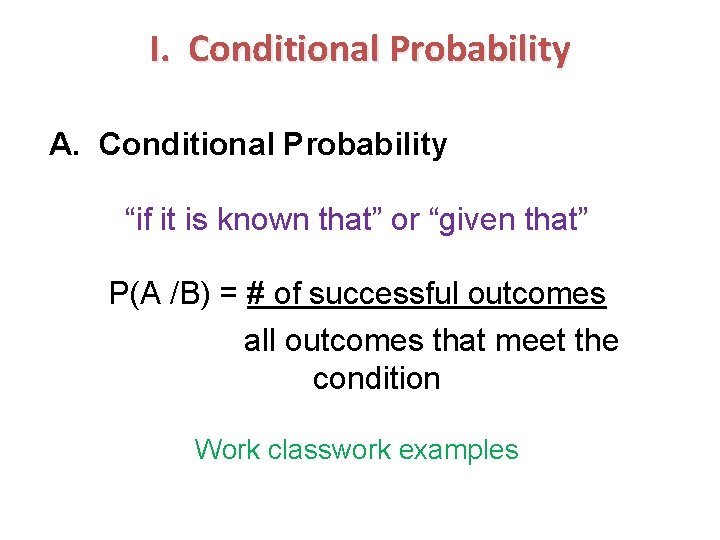
I. Conditional Probability A. Conditional Probability “if it is known that” or “given that” P(A /B) = # of successful outcomes all outcomes that meet the condition Work classwork examples
Now we are going to look at using probability to help us determine what we expect to gain or lose in a situation. Consider the following situation: “A die is rolled, and you receive $1 for each point that shows. If you were to play this game many times, what would you expect your average earnings to be? ”
Consider the following situation: “A die is rolled, and you receive $1 for each point that shows. If you were to play this game many times, what would you expect your average earnings to be? ” How could we use our knowledge of probability to help us solve this problem?
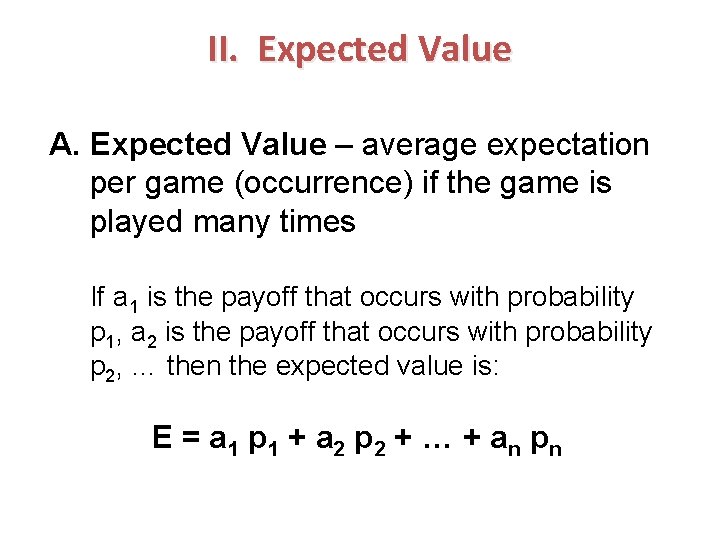
II. Expected Value A. Expected Value – average expectation per game (occurrence) if the game is played many times If a 1 is the payoff that occurs with probability p 1, a 2 is the payoff that occurs with probability p 2, … then the expected value is: E = a 1 p 1 + a 2 p 2 + … + a n pn
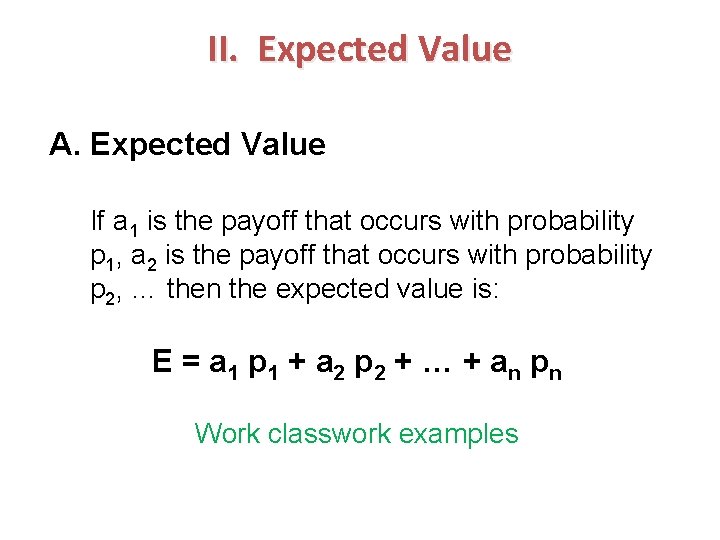
II. Expected Value A. Expected Value If a 1 is the payoff that occurs with probability p 1, a 2 is the payoff that occurs with probability p 2, … then the expected value is: E = a 1 p 1 + a 2 p 2 + … + a n pn Work classwork examples
- Slides: 9