
CounterMissionary Education Zechariah 13 6 Of False Prophets
- Slides: 8
Counter-Missionary Education Zechariah 13: 6 Of False Prophets, Farmhands, … (and Playboys? ) A Counter-Missionary Education Lesson by Uri Yosef, Ph. D. , Director of Education Virtual Yeshiva of the Messiah Truth Project, Inc. http: //virtualyeshiva. com [The article on this topic is located here - http: //thejewishhome. org/counter/Zech 13. pdf] Copyright © Uri Yosef 2011 for the Messiah Truth Project, Inc. All rights reserved July 28, 2011 False Prophets, Farmhands, … (and Playboys? ) 1
Introduction The verse Zechariah 13: 6, as it appears in King James Version (KJV) “Old Testament” translation and in several other Christian translations*, has been a popular so-called "proof text" in the portfolio of Christian missionaries. It is yet another passage claimed to be a prophecy that foretells the crucifixion of Jesus. A rigorous analysis of the Hebrew text of Zechariah 13: 6 with careful attention to the context of the entire 13 th chapter in the Book of Zechariah, demonstrates that the claim is without merit, because it is based on mistranslating this verse and lifting it out of its proper context. * The KJV is among the 6 out of 24 different Christian translations available at the Bible Gateway web-site [http: //www. biblegateway. com/] who translate this passage in the same incorrect manner. July 28, 2011 False Prophets, Farmhands, … (and Playboys? ) 2
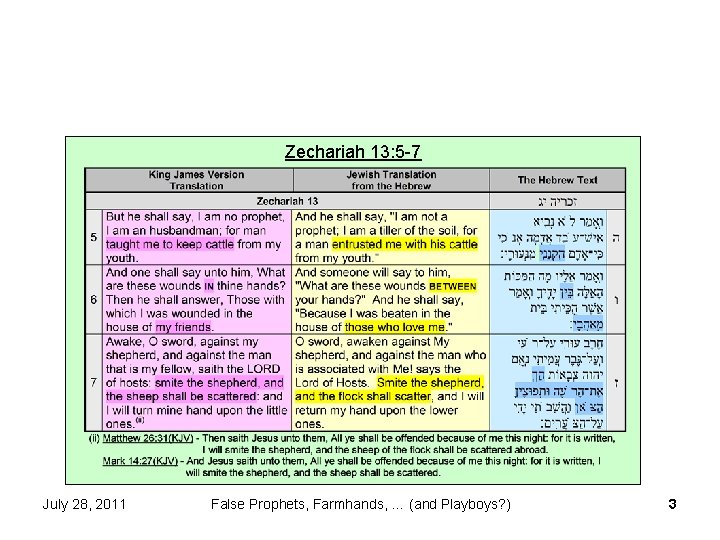
Zechariah 13: 5 -7 July 28, 2011 False Prophets, Farmhands, … (and Playboys? ) 3
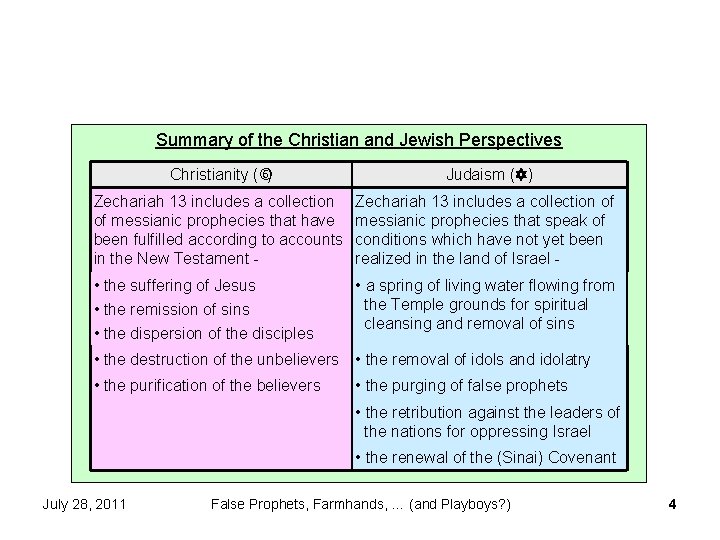
Summary of the Christian and Jewish Perspectives Christianity ( ) Judaism (Y) Zechariah 13 includes a collection of messianic prophecies that have been fulfilled according to accounts in the New Testament - Zechariah 13 includes a collection of messianic prophecies that speak of conditions which have not yet been realized in the land of Israel - • the suffering of Jesus • the remission of sins • the dispersion of the disciples • a spring of living water flowing from the Temple grounds for spiritual cleansing and removal of sins • the destruction of the unbelievers • the removal of idols and idolatry • the purification of the believers • the purging of false prophets • the retribution against the leaders of the nations for oppressing Israel • the renewal of the (Sinai) Covenant July 28, 2011 False Prophets, Farmhands, … (and Playboys? ) 4
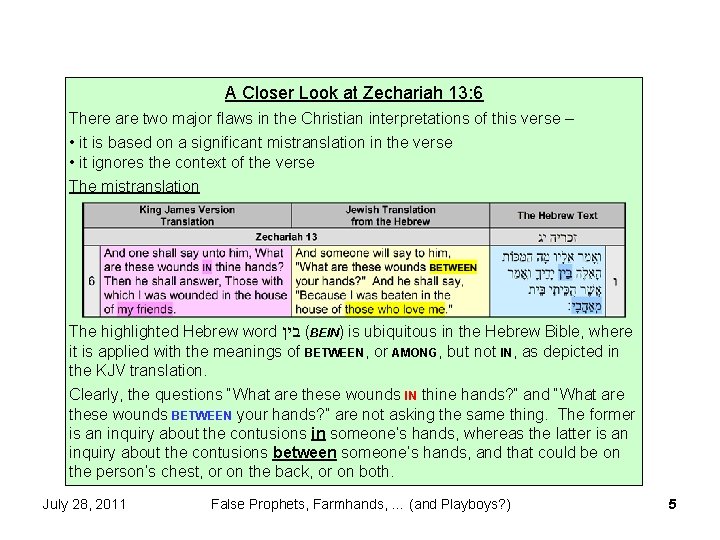
A Closer Look at Zechariah 13: 6 There are two major flaws in the Christian interpretations of this verse – • it is based on a significant mistranslation in the verse • it ignores the context of the verse The mistranslation The highlighted Hebrew word ( בין BEIN) is ubiquitous in the Hebrew Bible, where it is applied with the meanings of BETWEEN, or AMONG, but not IN, as depicted in the KJV translation. Clearly, the questions “What are these wounds IN thine hands? ” and “What are these wounds BETWEEN your hands? ” are not asking the same thing. The former is an inquiry about the contusions in someone’s hands, whereas the latter is an inquiry about the contusions between someone’s hands, and that could be on the person’s chest, or on the back, or on both. July 28, 2011 False Prophets, Farmhands, … (and Playboys? ) 5
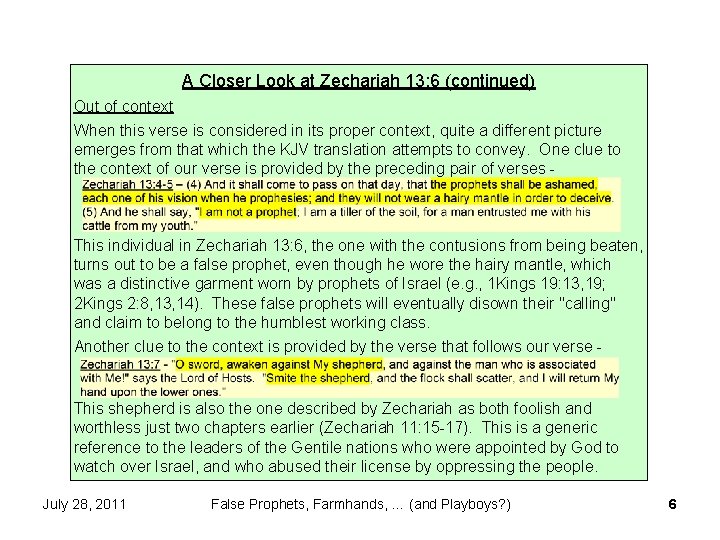
A Closer Look at Zechariah 13: 6 (continued) Out of context When this verse is considered in its proper context, quite a different picture emerges from that which the KJV translation attempts to convey. One clue to the context of our verse is provided by the preceding pair of verses - This individual in Zechariah 13: 6, the one with the contusions from being beaten, turns out to be a false prophet, even though he wore the hairy mantle, which was a distinctive garment worn by prophets of Israel (e. g. , 1 Kings 19: 13, 19; 2 Kings 2: 8, 13, 14). These false prophets will eventually disown their "calling" and claim to belong to the humblest working class. Another clue to the context is provided by the verse that follows our verse - This shepherd is also the one described by Zechariah as both foolish and worthless just two chapters earlier (Zechariah 11: 15 -17). This is a generic reference to the leaders of the Gentile nations who were appointed by God to watch over Israel, and who abused their license by oppressing the people. July 28, 2011 False Prophets, Farmhands, … (and Playboys? ) 6
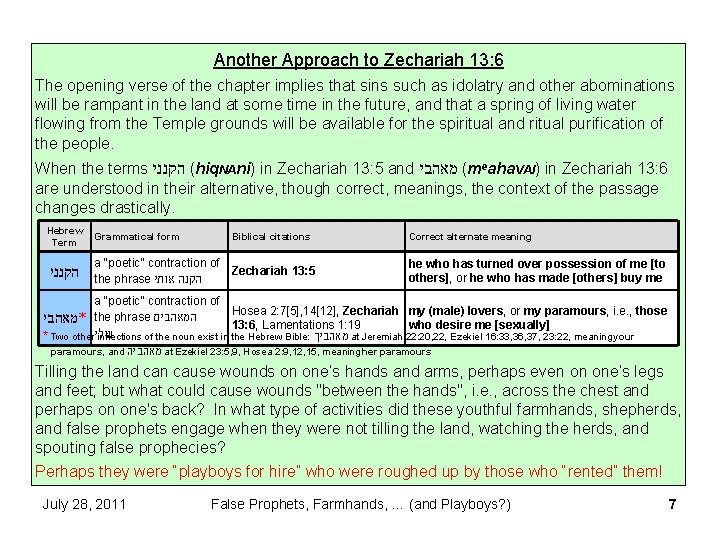
Another Approach to Zechariah 13: 6 The opening verse of the chapter implies that sins such as idolatry and other abominations will be rampant in the land at some time in the future, and that a spring of living water flowing from the Temple grounds will be available for the spiritual and ritual purification of the people. When the terms ( הקנני hiq. NAni) in Zechariah 13: 5 and ( מאהבי meaha. VAI) in Zechariah 13: 6 are understood in their alternative, though correct, meanings, the context of the passage changes drastically. Hebrew Term הקנני *מאהבי Grammatical form Biblical citations a “poetic” contraction of Zechariah 13: 5 the phrase הקנה אותי Correct alternate meaning he who has turned over possession of me [to others], or he who has made [others] buy me a “poetic” contraction of Hosea 2: 7[5], 14[12], Zechariah my (male) lovers, or my paramours, i. e. , those the phrase המאהבים 13: 6, Lamentations 1: 19 who desire me [sexually] * Two other שלי inflections of the noun exist in the Hebrew Bible: מאהביך at Jeremiah 22: 20, 22, Ezekiel 16: 33, 36, 37, 23: 22, meaning your paramours, and מאהביה at Ezekiel 23: 5, 9, Hosea 2: 9, 12, 15, meaning her paramours Tilling the land can cause wounds on one’s hands and arms, perhaps even on one’s legs and feet; but what could cause wounds "between the hands", i. e. , across the chest and perhaps on one's back? In what type of activities did these youthful farmhands, shepherds, and false prophets engage when they were not tilling the land, watching the herds, and spouting false prophecies? Perhaps they were “playboys for hire” who were roughed up by those who “rented” them! July 28, 2011 False Prophets, Farmhands, … (and Playboys? ) 7
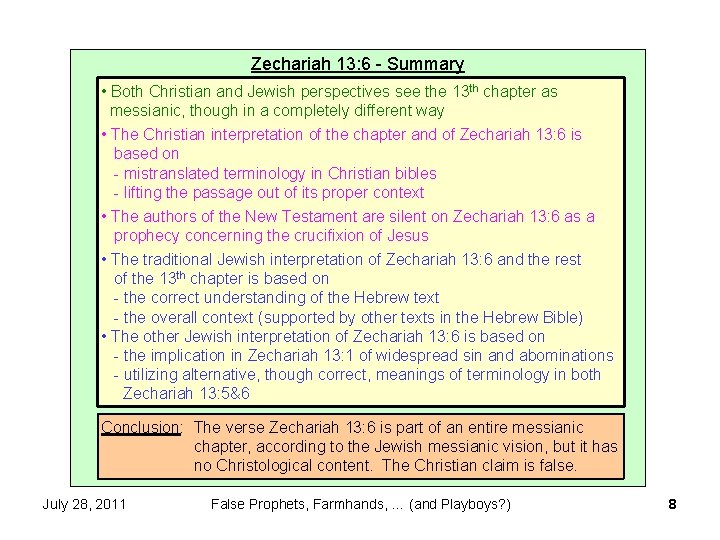
Zechariah 13: 6 - Summary • Both Christian and Jewish perspectives see the 13 th chapter as messianic, though in a completely different way • The Christian interpretation of the chapter and of Zechariah 13: 6 is based on - mistranslated terminology in Christian bibles - lifting the passage out of its proper context • The authors of the New Testament are silent on Zechariah 13: 6 as a prophecy concerning the crucifixion of Jesus • The traditional Jewish interpretation of Zechariah 13: 6 and the rest of the 13 th chapter is based on - the correct understanding of the Hebrew text - the overall context (supported by other texts in the Hebrew Bible) • The other Jewish interpretation of Zechariah 13: 6 is based on - the implication in Zechariah 13: 1 of widespread sin and abominations - utilizing alternative, though correct, meanings of terminology in both Zechariah 13: 5&6 Conclusion: The verse Zechariah 13: 6 is part of an entire messianic chapter, according to the Jewish messianic vision, but it has no Christological content. The Christian claim is false. July 28, 2011 False Prophets, Farmhands, … (and Playboys? ) 8