
Counterion Condensation and Collapse of Polyelectrolyte Chains in
- Slides: 1
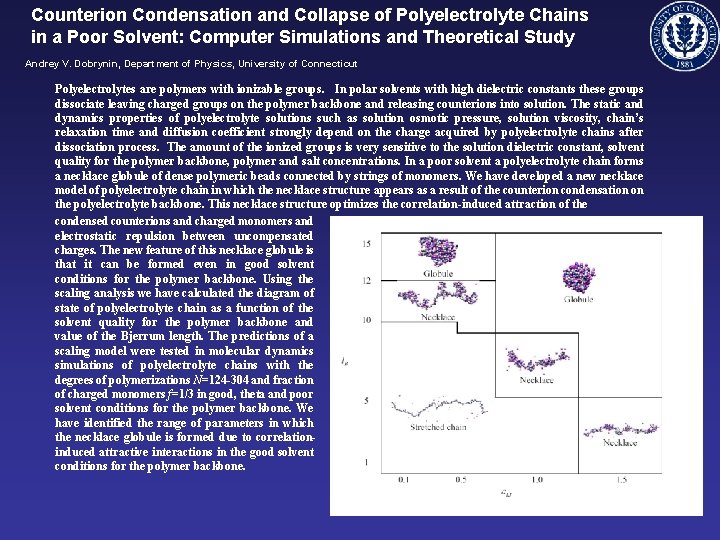
Counterion Condensation and Collapse of Polyelectrolyte Chains in a Poor Solvent: Computer Simulations and Theoretical Study Andrey V. Dobrynin, Department of Physics, University of Connecticut Polyelectrolytes are polymers with ionizable groups. In polar solvents with high dielectric constants these groups dissociate leaving charged groups on the polymer backbone and releasing counterions into solution. The static and dynamics properties of polyelectrolyte solutions such as solution osmotic pressure, solution viscosity, chain’s relaxation time and diffusion coefficient strongly depend on the charge acquired by polyelectrolyte chains after dissociation process. The amount of the ionized groups is very sensitive to the solution dielectric constant, solvent quality for the polymer backbone, polymer and salt concentrations. In a poor solvent a polyelectrolyte chain forms a necklace globule of dense polymeric beads connected by strings of monomers. We have developed a new necklace model of polyelectrolyte chain in which the necklace structure appears as a result of the counterion condensation on the polyelectrolyte backbone. This necklace structure optimizes the correlation-induced attraction of the condensed counterions and charged monomers and electrostatic repulsion between uncompensated charges. The new feature of this necklace globule is that it can be formed even in good solvent conditions for the polymer backbone. Using the scaling analysis we have calculated the diagram of state of polyelectrolyte chain as a function of the solvent quality for the polymer backbone and value of the Bjerrum length. The predictions of a scaling model were tested in molecular dynamics simulations of polyelectrolyte chains with the degrees of polymerizations N=124 -304 and fraction of charged monomers f=1/3 in good, theta and poor solvent conditions for the polymer backbone. We have identified the range of parameters in which the necklace globule is formed due to correlationinduced attractive interactions in the good solvent conditions for the polymer backbone.