
Counterarguments What do they look like Examples of
- Slides: 7
Counter-arguments What do they look like?
Examples of counter-arguments • In general, the strategy is to make it clear quickly that this is someone else’s view. Typical introductory strategies include the following: • Many people [believe/argue/feel/think/suppose/etc. ] that [state the counter-argument here] • It is often [thought/imagined/supposed/etc. ] that [state the counter-argument here] • [It would be easy to/One could easily] [think/believe/imagine/suppose/etc. ] that [state the counter-argument here] • It might [seem/appear/look/etc. ] as if [state the counter-argument here]
Examples of counter-arguments • Another common approach is to use a question: • But isn’t it true that [state the counterargument here]? • [Doesn’t/Wouldn’t/Isn’t] [state the counterargument here]?
Examples of counter-arguments • You can also cite specific writers or thinkers who have expressed a view opposite to your own: • On the other hand, (Fund) argues that. . . • However, (Ngugi) has written, . . . • (Dangarembga) takes the position that. . .
How should the rebuttal be introduced? • In all cases, the job of this transitional language is to show the reader that the opposing view is now being answered. The essay has returned to arguing its own thesis, strengthened by having taken the opposition into account. Here are some typical strategies. These are generic examples; they work best when tailored to suit the specifics of the individual topic. • What this argument [overlooks/fails to consider/does not take into account] is. . . • This view [seems/looks/sounds/etc. ] [convincing/plausible/persuasive/etc. ] at first, but. . . • While this position is popular, it is [not supported by the facts/not logical/impractical/etc. ] • Although the core of this claim is valid, it suffers from a flaw in its [reasoning/application/etc. ] •
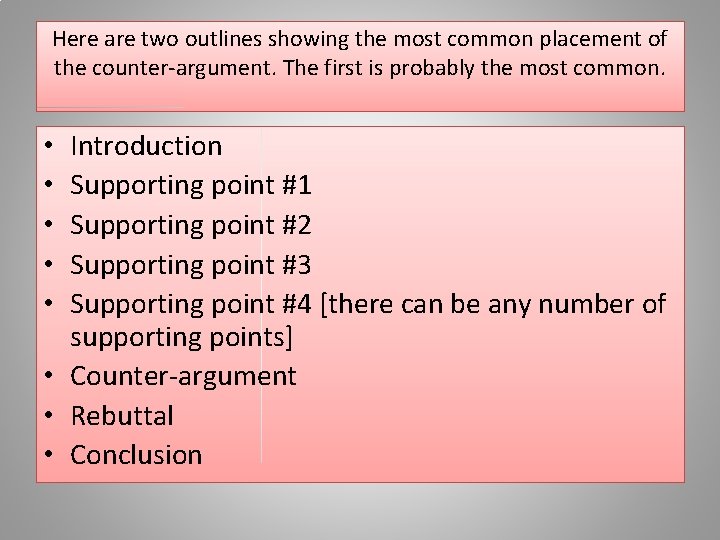
Here are two outlines showing the most common placement of the counter-argument. The first is probably the most common. Introduction Supporting point #1 Supporting point #2 Supporting point #3 Supporting point #4 [there can be any number of supporting points] • Counter-argument • Rebuttal • Conclusion • • •
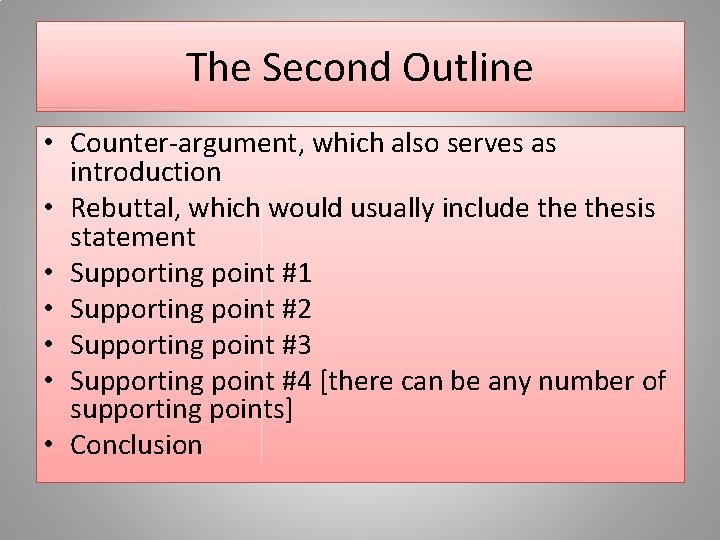
The Second Outline • Counter-argument, which also serves as introduction • Rebuttal, which would usually include thesis statement • Supporting point #1 • Supporting point #2 • Supporting point #3 • Supporting point #4 [there can be any number of supporting points] • Conclusion