
Counter With Cipher Block ChainingMAC Network Security 1
Counter With Cipher Block Chaining-MAC Network Security 1
Counter With Cipher Block Chaining-MAC Objectives of the Topic • After completing this topic, a student will be able to – describe working of Counter with Cipher Block Chaining-MAC. 2
Counter With Cipher Block Chaining-MAC Figures and material in this topic have been adapted from • “Network Security Essentials : Applications and Standards”, 2014, by William Stallings. 3
Counter With Cipher Block Chaining-MAC • The Counter with Cipher Block Chaining. Message Authentication Code (CCM) mode of operation, was standardized by NIST specifically to support security requirements of IEEE 802. 11 Wi. Fi wireless local area networks. 4
Counter With Cipher Block Chaining-MAC • It can be used in any networking application requiring authenticated encryption. • It is defined in NIST SP 800 -38 C. 5
Counter With Cipher Block Chaining-MAC • CCM is a variation of the encrypt-and-MAC approach to authenticated encryption. • It is referred to as an authenticated encryption mode. 6
Counter With Cipher Block Chaining-MAC • “Authenticated encryption” is a term used to describe encryption systems that protect confidentiality and authenticity of communications simultaneously. 7
Counter With Cipher Block Chaining-MAC • The key algorithmic ingredients of CCM are AES encryption algorithm, the Counter mode (CTR) of operation, and the CMAC authentication algorithm. • A single key K is used for both encryption and MAC algorithms. 8
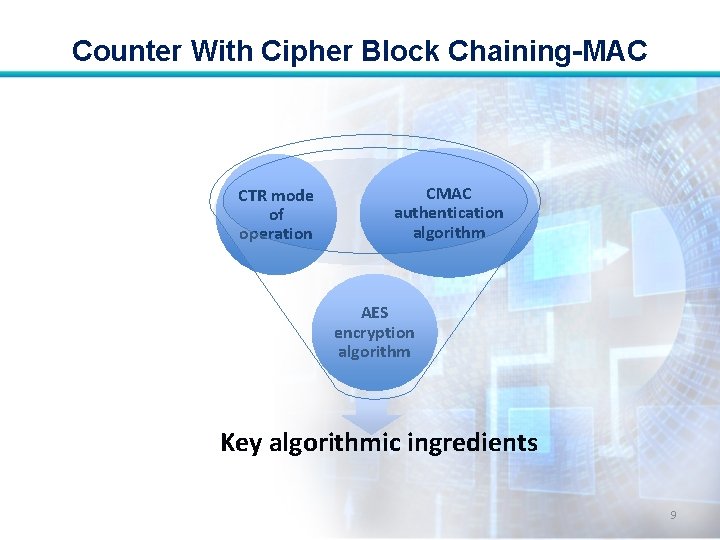
Counter With Cipher Block Chaining-MAC CTR mode of operation CMAC authentication algorithm AES encryption algorithm Key algorithmic ingredients 9
Counter With Cipher Block Chaining-MAC • The input to the CCM encryption process consists of three elements. • 1. Data that will be both authenticated and encrypted. This is the plaintext message P of data block. 10
Counter With Cipher Block Chaining-MAC • 2. Associated data A that will be authenticated but not encrypted. • An example is a protocol header that must be transmitted in the clear for proper protocol operation but which needs to be authenticated. 11
Counter With Cipher Block Chaining-MAC • 3. A nonce N that is assigned to the payload and the associated data. • This is a unique value that is different for every instance during lifetime of a protocol association and is intended to prevent replay attacks. 12
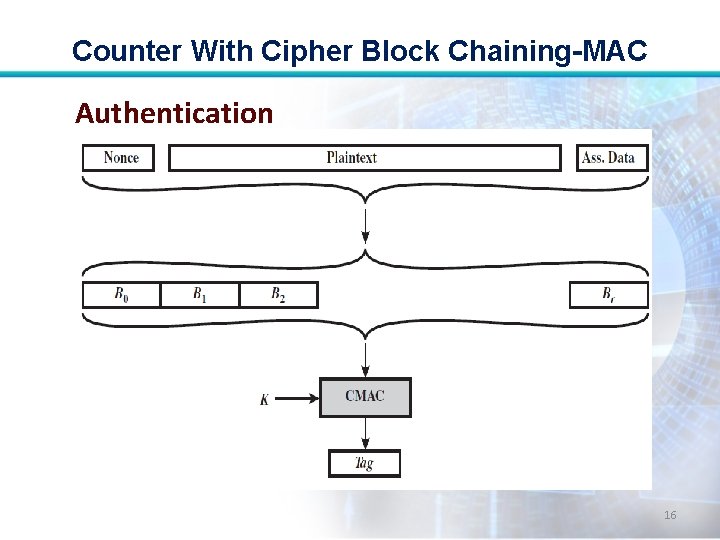
Counter With Cipher Block Chaining-MAC Authentication • For authentication, the input includes the nonce, the associated data, and the plaintext. • This input is formatted as a sequence of blocks B 0 through Br. 13
Counter With Cipher Block Chaining-MAC • The first block contains the nonce plus some formatting bits that indicate the lengths of the N, A, and P elements. • This is followed by zero or more blocks that contain A, followed by zero of more blocks that contain P. 14
Counter With Cipher Block Chaining-MAC • The resulting sequence of blocks serves as input to the CMAC algorithm, which produces a MAC value with length Tlen, which is less than or equal to the block length. 15
Counter With Cipher Block Chaining-MAC Authentication 16
Counter With Cipher Block Chaining-MAC Encryption • For encryption, a sequence of counters is generated that must be independent of the nonce. • The authentication tag is encrypted in CTR mode using the single counter Ctr 0. 17
Counter With Cipher Block Chaining-MAC • The Tlen most significant bits of the output are XORed with the tag to produce an encrypted tag. • The remaining counters are used for the CTR mode encryption of the plaintext. 18
Counter With Cipher Block Chaining-MAC • The encrypted plaintext is concatenated with the encrypted tag to form the ciphertext output. 19
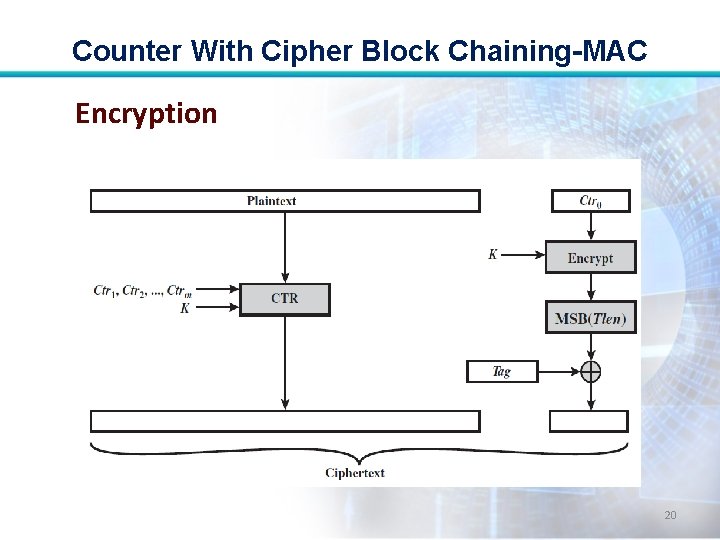
Counter With Cipher Block Chaining-MAC Encryption 20
- Slides: 20