
COUNTABLE E UNCONTABLE NOUNS O QUE SO COUNTABLE
COUNTABLE E UNCONTABLE NOUNS
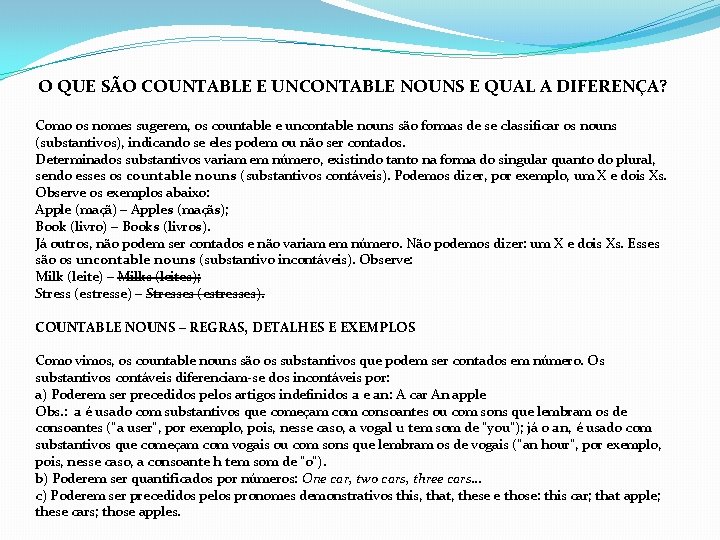
O QUE SÃO COUNTABLE E UNCONTABLE NOUNS E QUAL A DIFERENÇA? Como os nomes sugerem, os countable e uncontable nouns são formas de se classificar os nouns (substantivos), indicando se eles podem ou não ser contados. Determinados substantivos variam em número, existindo tanto na forma do singular quanto do plural, sendo esses os countable nouns (substantivos contáveis). Podemos dizer, por exemplo, um X e dois Xs. Observe os exemplos abaixo: Apple (maçã) – Apples (maçãs); Book (livro) – Books (livros). Já outros, não podem ser contados e não variam em número. Não podemos dizer: um X e dois Xs. Esses são os uncontable nouns (substantivo incontáveis). Observe: Milk (leite) – Milks (leites); Stress (estresse) – Stresses (estresses). COUNTABLE NOUNS – REGRAS, DETALHES E EXEMPLOS Como vimos, os countable nouns são os substantivos que podem ser contados em número. Os substantivos contáveis diferenciam-se dos incontáveis por: a) Poderem ser precedidos pelos artigos indefinidos a e an: A car An apple Obs. : a é usado com substantivos que começam consoantes ou com sons que lembram os de consoantes (“a user”, por exemplo, pois, nesse caso, a vogal u tem som de “you”); já o an, é usado com substantivos que começam com vogais ou com sons que lembram os de vogais (“an hour”, por exemplo, pois, nesse caso, a consoante h tem som de “o”). b) Poderem ser quantificados por números: One car, two cars, three cars… c) Poderem ser precedidos pelos pronomes demonstrativos this, that, these e those: this car; that apple; these cars; those apples.
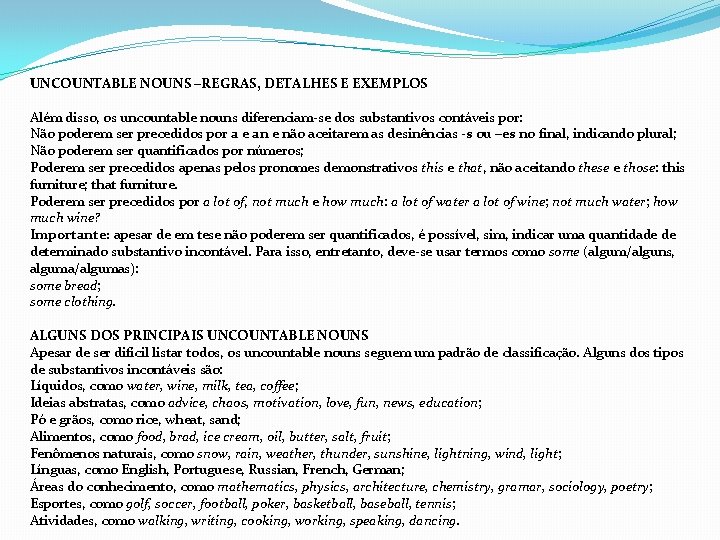
UNCOUNTABLE NOUNS –REGRAS, DETALHES E EXEMPLOS Além disso, os uncountable nouns diferenciam-se dos substantivos contáveis por: Não poderem ser precedidos por a e an e não aceitarem as desinências -s ou –es no final, indicando plural; Não poderem ser quantificados por números; Poderem ser precedidos apenas pelos pronomes demonstrativos this e that, não aceitando these e those: this furniture; that furniture. Poderem ser precedidos por a lot of, not much e how much: a lot of water a lot of wine; not much water; how much wine? Importante: apesar de em tese não poderem ser quantificados, é possível, sim, indicar uma quantidade de determinado substantivo incontável. Para isso, entretanto, deve-se usar termos como some (algum/alguns, alguma/algumas): some bread; some clothing. ALGUNS DOS PRINCIPAIS UNCOUNTABLE NOUNS Apesar de ser difícil listar todos, os uncountable nouns seguem um padrão de classificação. Alguns dos tipos de substantivos incontáveis são: Líquidos, como water, wine, milk, tea, coffee; Ideias abstratas, como advice, chaos, motivation, love, fun, news, education; Pó e grãos, como rice, wheat, sand; Alimentos, como food, brad, ice cream, oil, butter, salt, fruit; Fenômenos naturais, como snow, rain, weather, thunder, sunshine, lightning, wind, light; Línguas, como English, Portuguese, Russian, French, German; Áreas do conhecimento, como mathematics, physics, architecture, chemistry, gramar, sociology, poetry; Esportes, como golf, soccer, football, poker, basketball, baseball, tennis; Atividades, como walking, writing, cooking, working, speaking, dancing.
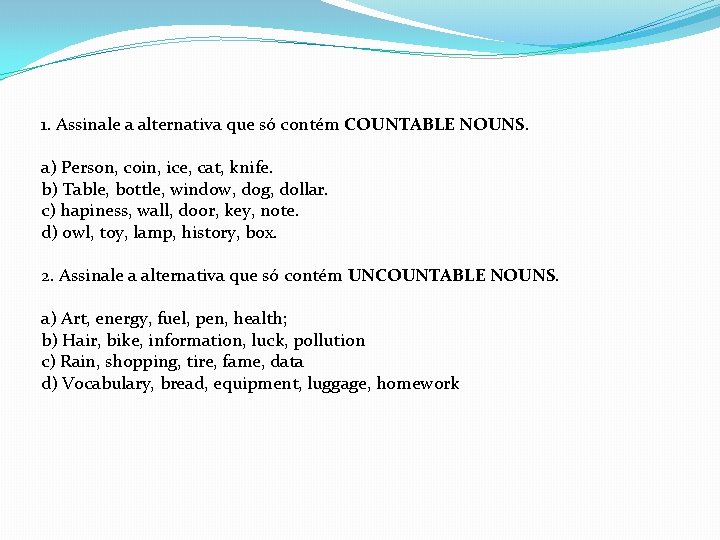
1. Assinale a alternativa que só contém COUNTABLE NOUNS. a) Person, coin, ice, cat, knife. b) Table, bottle, window, dog, dollar. c) hapiness, wall, door, key, note. d) owl, toy, lamp, history, box. 2. Assinale a alternativa que só contém UNCOUNTABLE NOUNS. a) Art, energy, fuel, pen, health; b) Hair, bike, information, luck, pollution c) Rain, shopping, tire, fame, data d) Vocabulary, bread, equipment, luggage, homework
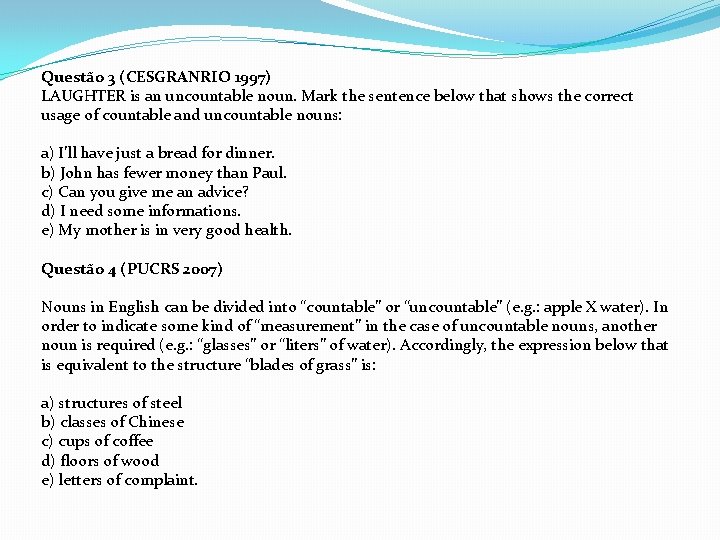
Questão 3 (CESGRANRIO 1997) LAUGHTER is an uncountable noun. Mark the sentence below that shows the correct usage of countable and uncountable nouns: a) I’ll have just a bread for dinner. b) John has fewer money than Paul. c) Can you give me an advice? d) I need some informations. e) My mother is in very good health. Questão 4 (PUCRS 2007) Nouns in English can be divided into “countable” or “uncountable” (e. g. : apple X water). In order to indicate some kind of “measurement” in the case of uncountable nouns, another noun is required (e. g. : “glasses” or “liters” of water). Accordingly, the expression below that is equivalent to the structure “blades of grass” is: a) structures of steel b) classes of Chinese c) cups of coffee d) floors of wood e) letters of complaint.
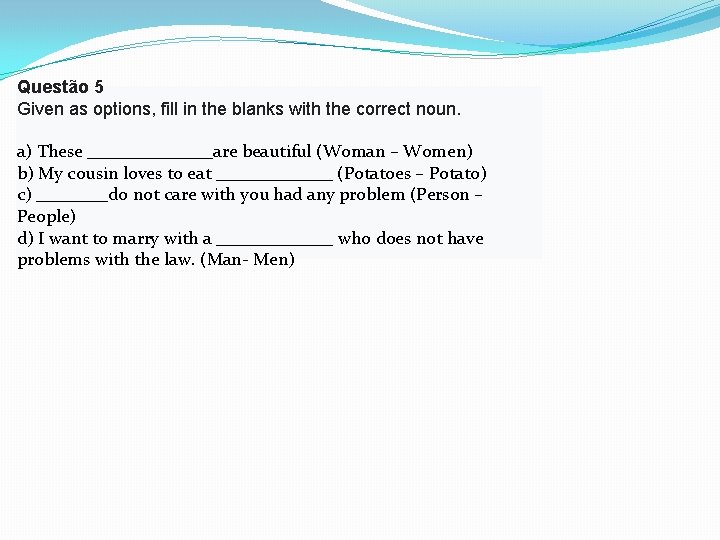
Questão 5 Given as options, fill in the blanks with the correct noun. a) These _______are beautiful (Woman – Women) b) My cousin loves to eat _______ (Potatoes – Potato) c) ____do not care with you had any problem (Person – People) d) I want to marry with a _______ who does not have problems with the law. (Man- Men)
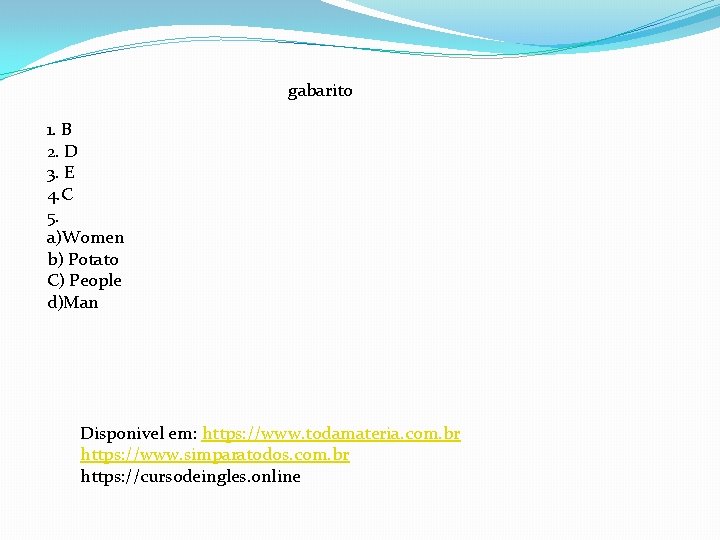
gabarito 1. B 2. D 3. E 4. C 5. a)Women b) Potato C) People d)Man Disponivel em: https: //www. todamateria. com. br https: //www. simparatodos. com. br https: //cursodeingles. online
- Slides: 7