
Count to infinity problem Dr nitin mishra Characteristics
Count to infinity problem Dr nitin mishra
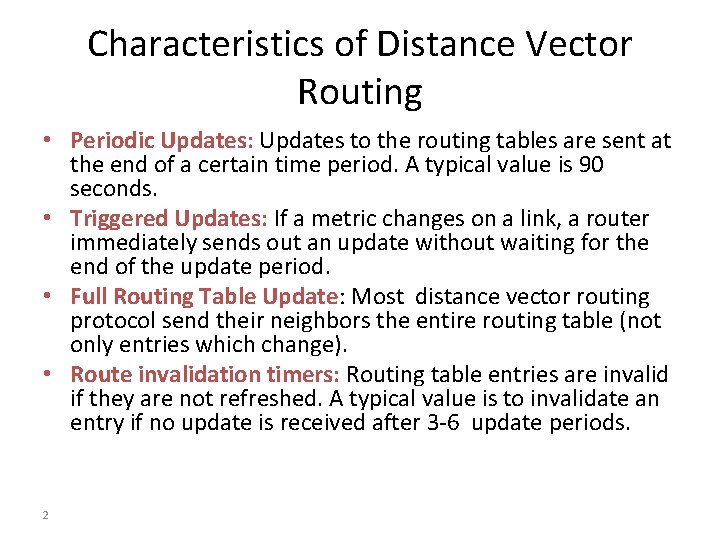
Characteristics of Distance Vector Routing • Periodic Updates: Updates to the routing tables are sent at the end of a certain time period. A typical value is 90 seconds. • Triggered Updates: If a metric changes on a link, a router immediately sends out an update without waiting for the end of the update period. • Full Routing Table Update: Most distance vector routing protocol send their neighbors the entire routing table (not only entries which change). • Route invalidation timers: Routing table entries are invalid if they are not refreshed. A typical value is to invalidate an entry if no update is received after 3 -6 update periods. 2

The Count-to-Infinity Problem A 3 1 B 1 C

Count-to-Infinity • The reason for the count-to-infinity problem is that each node only has a “next-hop-view” • For example, in the first step, A did not realize that its route (with cost 2) to C went through node B • How can the Count-to-Infinity problem be solved? 4
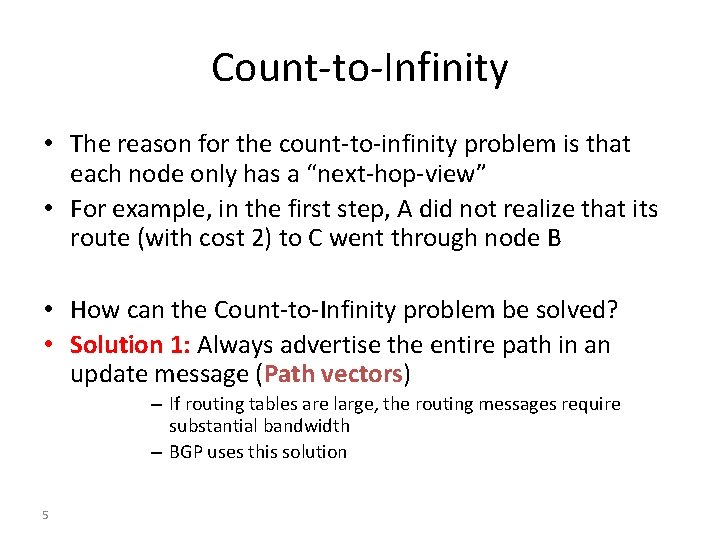
Count-to-Infinity • The reason for the count-to-infinity problem is that each node only has a “next-hop-view” • For example, in the first step, A did not realize that its route (with cost 2) to C went through node B • How can the Count-to-Infinity problem be solved? • Solution 1: Always advertise the entire path in an update message (Path vectors) – If routing tables are large, the routing messages require substantial bandwidth – BGP uses this solution 5

Count-to-Infinity • The reason for the count-to-infinity problem is that each node only has a “next-hop-view” • For example, in the first step, A did not realize that its route (with cost 2) to C went through node B • How can the Count-to-Infinity problem be solved? • Solution 2: Never advertise the cost to a neighbor if this neighbor is the next hop on the current path (Split Horizon) – Example: A would not send the first routing update to B, since B is the next hop on A’s current route to C – Split Horizon does not solve count-to-infinity in all cases! 6
- Slides: 6