
Counselling on DOACs Michael Jackson Lead Pharmacist for



- Slides: 26
Counselling on DOACs Michael Jackson Lead Pharmacist for Cardiology and Cardiothoracic services, BHSCT Anticoagulation Pharmacist BCH
NOACs or DOACs (interchangeable) • NOAC • Non-vitamin K Oral Anti. Coagulants • DOAC • Direct-acting Oral Anti. Coagulants • Group comprises of two technologies • Direct Thrombin Inhibitor – e. g. Dabigatran • Factor Xa inhibitors –e. g. Apixaban, Edoxaban, Rivaroxaban
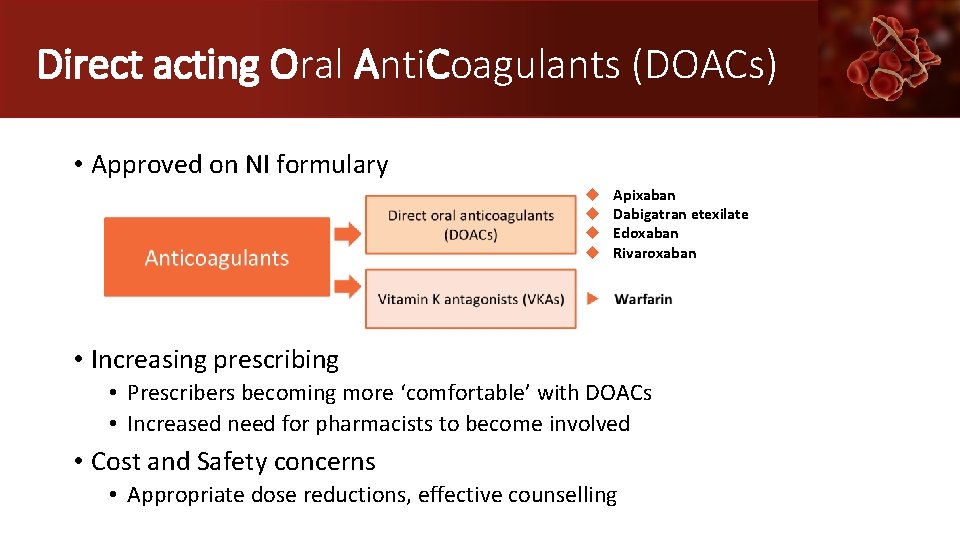
Direct acting Oral Anti. Coagulants (DOACs) • Approved on NI formulary u u Apixaban Dabigatran etexilate Edoxaban Rivaroxaban • Increasing prescribing • Prescribers becoming more ‘comfortable’ with DOACs • Increased need for pharmacists to become involved • Cost and Safety concerns • Appropriate dose reductions, effective counselling
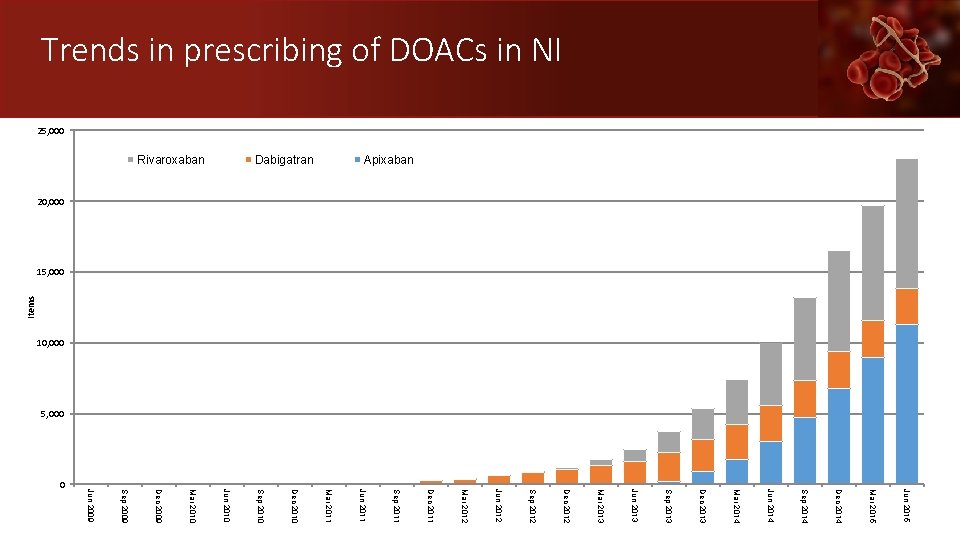
Items Trends in prescribing of DOACs in NI 25, 000 Jun 2015 Mar 2015 Dec 2014 Sep 2014 Jun 2014 Mar 2014 Dec 2013 Sep 2013 Jun 2013 Mar 2013 Dec 2012 Sep 2012 Jun 2012 Mar 2012 Dec 2011 Sep 2011 Jun 2011 Mar 2011 Dec 2010 Sep 2010 Jun 2010 Mar 2010 Dec 2009 Sep 2009 Jun 2009 0 Apixaban Dabigatran Rivaroxaban 20, 000 15, 000 10, 000 5, 000
What are your patients needs? Your patients/customers will have fears and previous beliefs regarding anticoagulants. Effective communication is key to success. To improve adherence to treatments, patient needs: • • • To understand the importance of DOACs To know how to minimise negative outcomes To know that the medicine is working To know who will monitor their progress To know who will answer their questions when help is needed • What can pharmacists do to improve safety and compliance?
What are your practice needs? • To maintain knowledge of DOACs • To know which agent is most appropriate for a patient • To ensure safety of patients on anticoagulants • • Is this the correct dose for the indication? How long is the patient to remain on the anticoagulant? Are there any drug interactions that may cause problems? Is the patient collecting the prescription regularly? – compliance issues? • To ensure follow-up of patients • To provide consistent counselling of anticoagulants
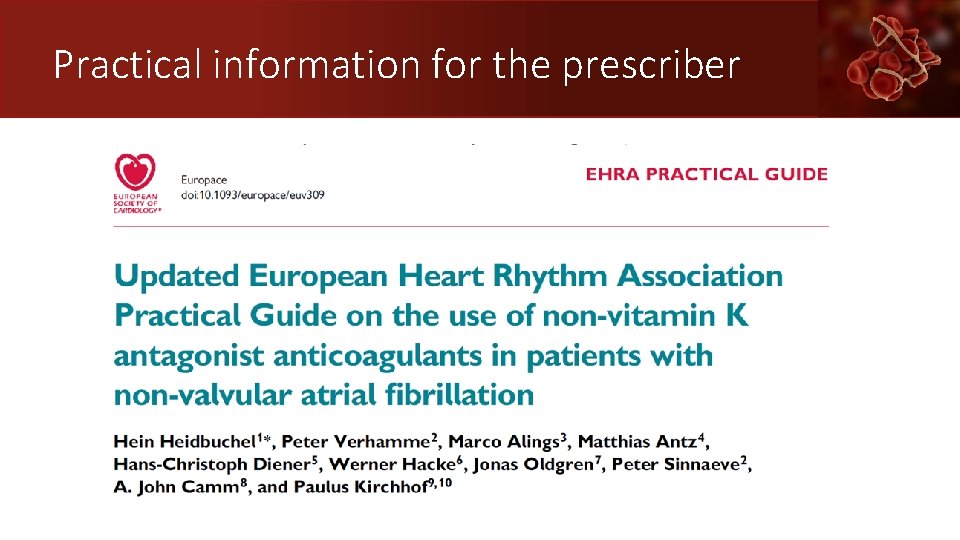
Practical information for the prescriber
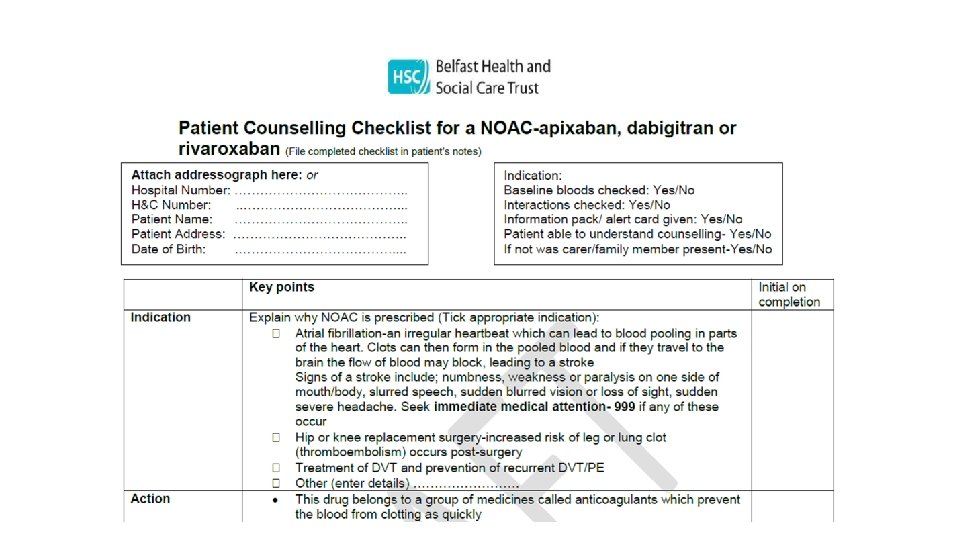
Counselling ‘Checklists’ • Purpose • To standardise education • To act as a recap after counselling has taken place • To provide written confirmation • Written confirmation • Does not necessarily mean effective counselling • If no written confirmation – then has counselling been delivered?
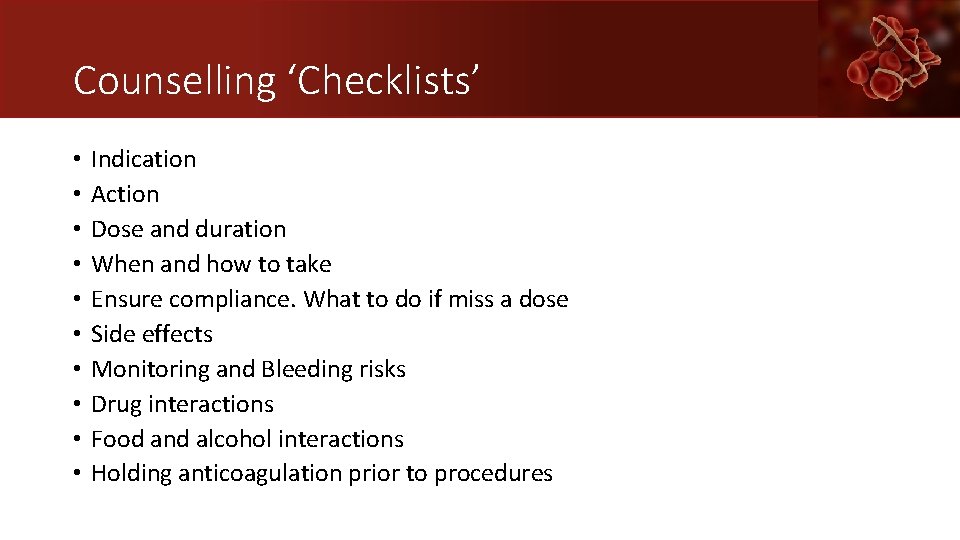
Counselling ‘Checklists’ • • • Indication Action Dose and duration When and how to take Ensure compliance. What to do if miss a dose Side effects Monitoring and Bleeding risks Drug interactions Food and alcohol interactions Holding anticoagulation prior to procedures
Counselling ‘Checklists’ • • • Indication Action Dose and duration When and how to take Ensure compliance. What to do if miss a dose Side effects Monitoring and Bleeding risks Drug interactions Food and alcohol interactions Holding anticoagulation prior to procedures
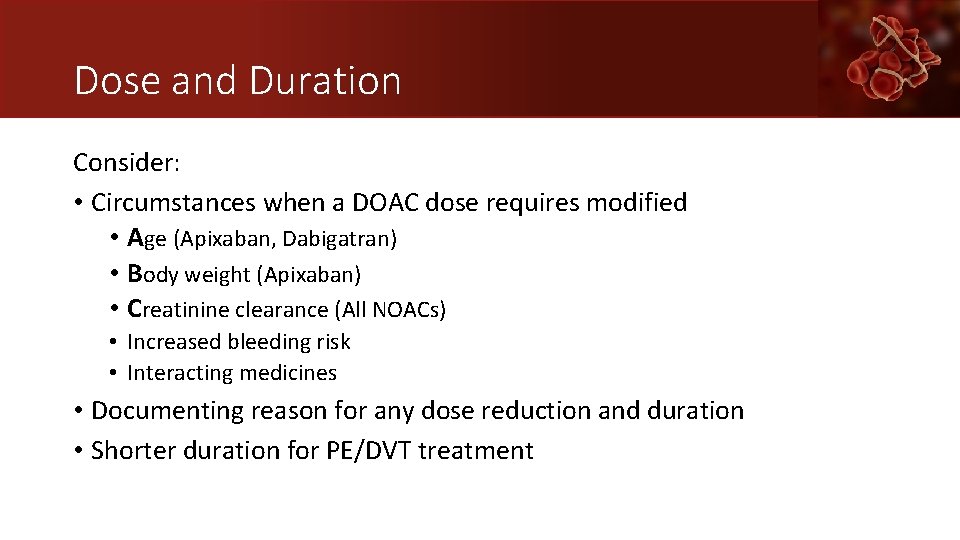
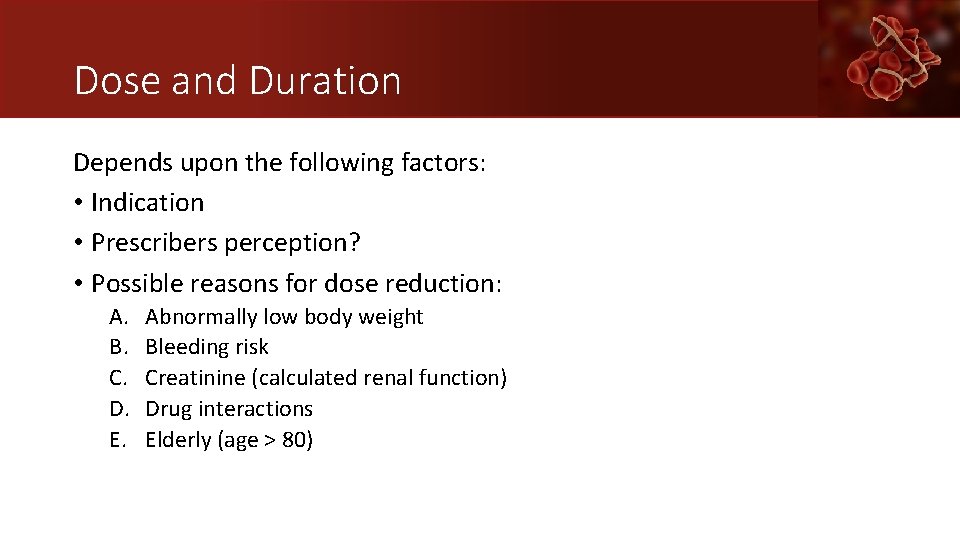
Dose and Duration Consider: • Circumstances when a DOAC dose requires modified • Age (Apixaban, Dabigatran) • Body weight (Apixaban) • Creatinine clearance (All NOACs) • Increased bleeding risk • Interacting medicines • Documenting reason for any dose reduction and duration • Shorter duration for PE/DVT treatment
Dose and Duration Depends upon the following factors: • Indication • Prescribers perception? • Possible reasons for dose reduction: A. B. C. D. E. Abnormally low body weight Bleeding risk Creatinine (calculated renal function) Drug interactions Elderly (age > 80)
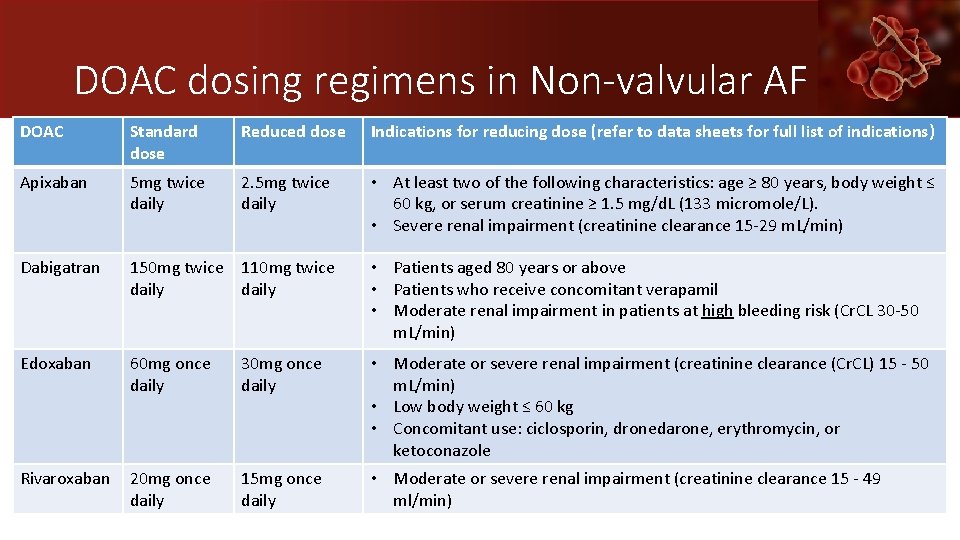
DOAC dosing regimens in Non-valvular AF DOAC Standard dose Reduced dose Indications for reducing dose (refer to data sheets for full list of indications) Apixaban 5 mg twice daily 2. 5 mg twice daily • At least two of the following characteristics: age ≥ 80 years, body weight ≤ 60 kg, or serum creatinine ≥ 1. 5 mg/d. L (133 micromole/L). • Severe renal impairment (creatinine clearance 15 -29 m. L/min) Dabigatran 150 mg twice 110 mg twice daily • Patients aged 80 years or above • Patients who receive concomitant verapamil • Moderate renal impairment in patients at high bleeding risk (Cr. CL 30 -50 m. L/min) Edoxaban 60 mg once daily 30 mg once daily • Moderate or severe renal impairment (creatinine clearance (Cr. CL) 15 - 50 m. L/min) • Low body weight ≤ 60 kg • Concomitant use: ciclosporin, dronedarone, erythromycin, or ketoconazole Rivaroxaban 20 mg once daily 15 mg once daily • Moderate or severe renal impairment (creatinine clearance 15 - 49 ml/min)
DOAC dosing regimens across each stage of VTE treatment Initial VTE treatment Apixaban 1 Rivaroxaban 2 Dabigatran 3 Edoxaban 4 10 mg BD Day 1– 7 Ongoing VTE Treatment Prevention of Recurrent VTE 5 mg BD Day 8 onwards for at least 3 months* 15 mg BD with food Day 1– 21 2. 5 mg BD Following completion of 6 months of treatment with apixaban 5 mg BD or another oral anticoagulant 20 mg OD with food Day 22 onwards for at least 3 months*† Parenteral anticoagulant 150 mg BD For at least 5 days (not to be taken concomitantly with dabigatran) For at least 3 months*† (Dose adjustments to 110 mg BD in patients ≥ 80 years, patients on Parenteral anticoagulant 60 mg OD For at least 5 days (not to be taken concomitantly with edoxaban) concomitant verapamil, and those at high risk of bleeding) For at least 3 months*† (Dose adjustment required to 30 mg OD in patients with Cr. Cl 15– 50 ml/min or body weight ≤ 60 kg or with concomitant use of the following P-gp inhibitors: ciclosporin, dronedarone, erythromycin or ketoconazole. Refer to edoxaban Sm. PC for further information) The duration of overall therapy should be individualised after careful assessment of the treatment benefit against the risk of bleeding *Short duration of treatment (at least 3 months) should be based on transient risk factors (e. g. Recent surgery, trauma, immobilisation) †Longer durations should be based on permanent risk factors of idiopathic DVT or PE. Apixaban: Use with caution in severe renal impairment (Cr. Cl 15– 29 m. L/min). Not recommended in Cr. Cl <15 m. L/min or in patients undergoing dialysis. Rivaroxaban: Consider reduction from 20 mg OD to 15 mg OD (after the initial 15 mg BD for 3 weeks) in patients with moderate (Cr. Cl 30– 49 m. L/min) or severe (Cr. Cl 15– 29 m. L/min) renal impairment if patient’s assessed bleeding risk outweighs risk for recurrent DVT and PE. Use with caution in severe renal impairment. Not recommended in Cr. Cl < 15 m. L/min. Dabigatran: Contraindicated in Cr. Cl < 30 m. L/min. Edoxaban: In patients with moderate or severe renal impairment (Cr. Cl 15– 50 ml/min) the recommended dose is 30 mg OD. Not recommended in Cr. Cl <15 ml/min or in patients undergoing dialysis. Cr. Cl, creatinine clearance; OD, once daily; BD, twice daily. 1. Apixaban Sm. PC. July 2014; 2. Rivaroxaban Sm. PC. August 2014; 3. Dabigatran Sm. PC. June 2014; 4. Edoxaban Sm. PC. July 2015.
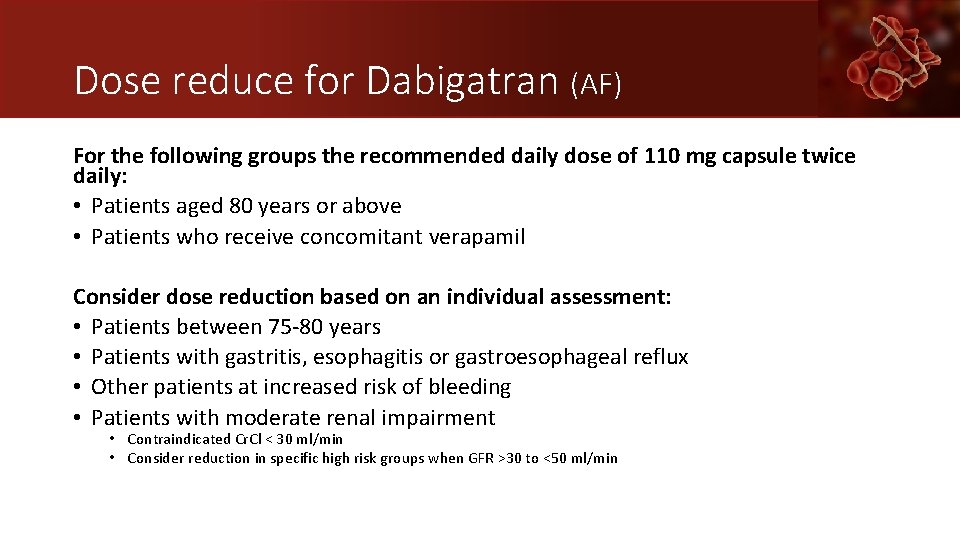
Dose reduce for Dabigatran (AF) For the following groups the recommended daily dose of 110 mg capsule twice daily: • Patients aged 80 years or above • Patients who receive concomitant verapamil Consider dose reduction based on an individual assessment: • Patients between 75 -80 years • Patients with gastritis, esophagitis or gastroesophageal reflux • Other patients at increased risk of bleeding • Patients with moderate renal impairment • Contraindicated Cr. Cl < 30 ml/min • Consider reduction in specific high risk groups when GFR >30 to <50 ml/min
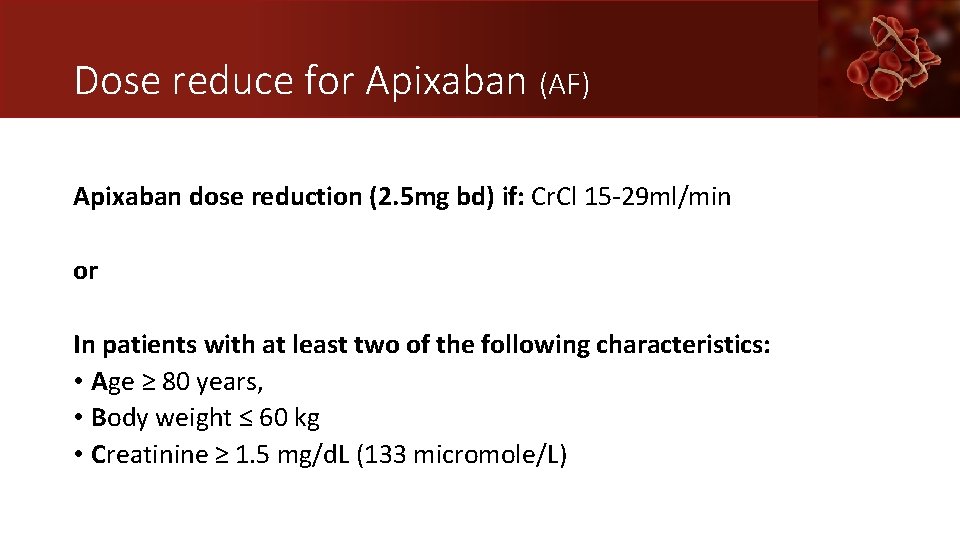
Dose reduce for Apixaban (AF) Apixaban dose reduction (2. 5 mg bd) if: Cr. Cl 15 -29 ml/min or In patients with at least two of the following characteristics: • Age ≥ 80 years, • Body weight ≤ 60 kg • Creatinine ≥ 1. 5 mg/d. L (133 micromole/L)
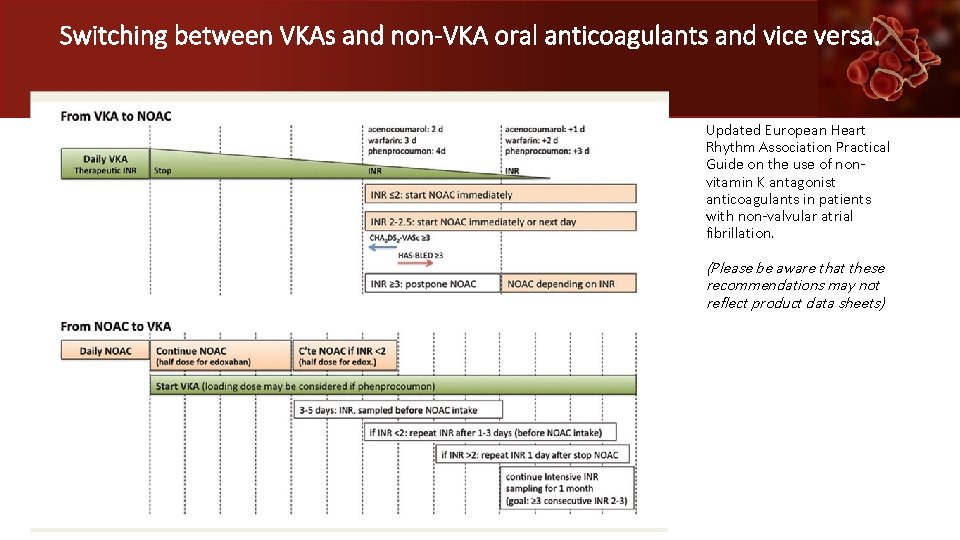
Switching between VKAs and non-VKA oral anticoagulants and vice versa. Updated European Heart Rhythm Association Practical Guide on the use of nonvitamin K antagonist anticoagulants in patients with non-valvular atrial fibrillation. (Please be aware that these recommendations may not reflect product data sheets)
When and how to take • Take with or after food • Apixaban, Dabigatran, Edoxaban • Must be taken with food • Rivaroxaban • Take at same time each day (for twice daily dosing try to take 12 hrs apart) • Dabigatran • Keep capsule in blister until ready to take
Ensure compliance – what to do if missed dose? • Important not to miss doses. • Short acting – effectiveness can wear off if repeated doses are missed. • Provide patient information booklet
Missed doses Dabigatran: A forgotten dose may still be taken up to 6 hours prior to the next scheduled dose. From 6 hours onwards prior to the next scheduled dose, the missed dose should be omitted. No double dose should be taken to make up for a missed dose. Rivaroxaban: Once daily dosing: If a dose is missed the patient should take rivaroxaban immediately and then continue the following day with once daily intake as before. No double dose should be taken to make up for a missed dose. Twice daily dosing: If a dose is missed during the 15 mg twice daily treatment phase (day 1 - 21), the patient should take rivaroxaban immediately to ensure intake of 30 mg per day. In this case two 15 mg tablets may be taken at once. Apixaban: If a dose is missed, the patient should take apixaban immediately and then continue with twice daily intake as before. Edoxaban: If a dose is missed the patient should take Edoxaban immediately and then continue the following day with once daily intake as before. No double dose should be taken to make up for a missed dose.
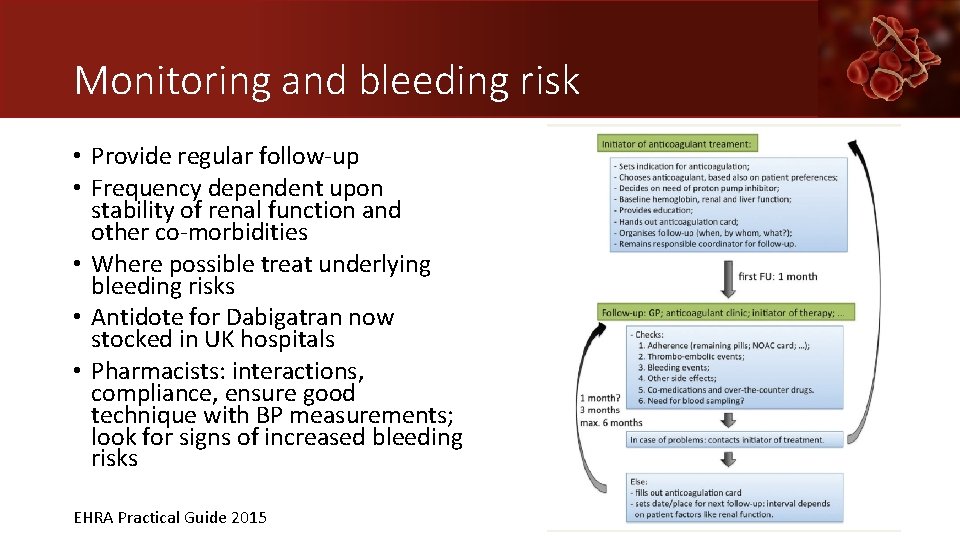
Monitoring and bleeding risk • Provide regular follow-up • Frequency dependent upon stability of renal function and other co-morbidities • Where possible treat underlying bleeding risks • Antidote for Dabigatran now stocked in UK hospitals • Pharmacists: interactions, compliance, ensure good technique with BP measurements; look for signs of increased bleeding risks EHRA Practical Guide 2015
Interactions (check each products data sheet) • Most DOACs are affected by induction or inhibition of CYP 3 A 4 and P-gp • Inhibitors of CYP 3 A 4 and/or P-gp • E. g. Verapamil, Amiodarone, Dronedarone, Erythromycin, Clarithromycin, Itraconazole • Inducers of CYP 3 A 4 and/or P-gp • E. g. Rifampicin, Carbamazepine, Phenytoin
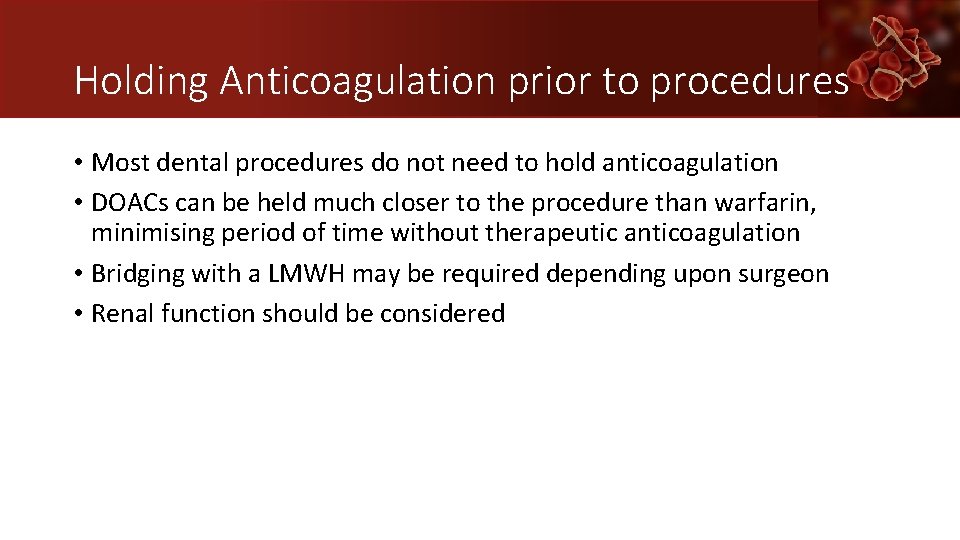
Holding Anticoagulation prior to procedures • Most dental procedures do not need to hold anticoagulation • DOACs can be held much closer to the procedure than warfarin, minimising period of time without therapeutic anticoagulation • Bridging with a LMWH may be required depending upon surgeon • Renal function should be considered
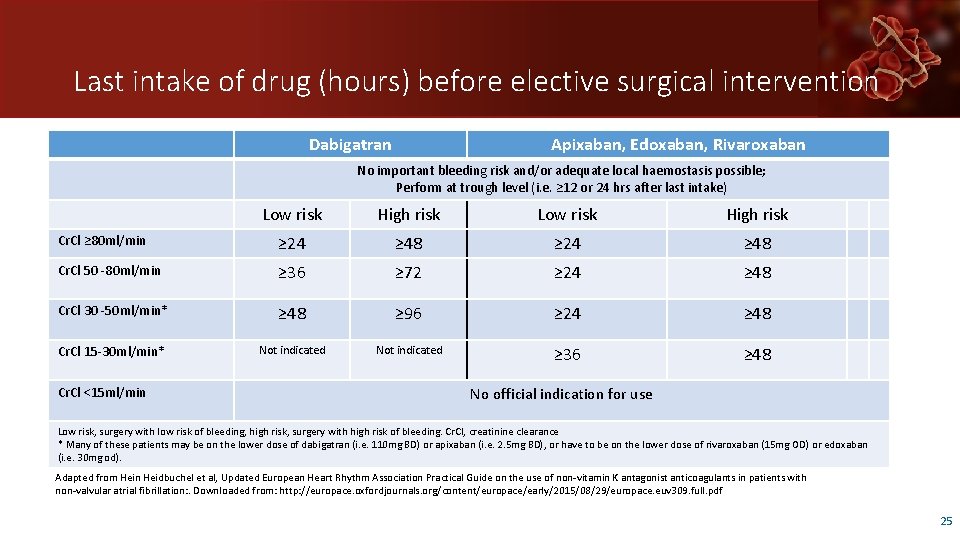
Last intake of drug (hours) before elective surgical intervention Dabigatran Apixaban, Edoxaban, Rivaroxaban No important bleeding risk and/or adequate local haemostasis possible; Perform at trough level (i. e. ≥ 12 or 24 hrs after last intake) Low risk High risk Cr. Cl ≥ 80 ml/min ≥ 24 ≥ 48 Cr. Cl 50 -80 ml/min ≥ 36 ≥ 72 ≥ 24 ≥ 48 Cr. Cl 30 -50 ml/min* ≥ 48 ≥ 96 ≥ 24 ≥ 48 Cr. Cl 15 -30 ml/min* Not indicated ≥ 36 ≥ 48 Cr. Cl <15 ml/min No official indication for use Low risk, surgery with low risk of bleeding, high risk, surgery with high risk of bleeding. Cr. Cl, creatinine clearance * Many of these patients may be on the lower dose of dabigatran (i. e. 110 mg BD) or apixaban (i. e. 2. 5 mg BD), or have to be on the lower dose of rivaroxaban (15 mg OD) or edoxaban (i. e. 30 mg od). Adapted from Hein Heidbuchel et al, Updated European Heart Rhythm Association Practical Guide on the use of non-vitamin K antagonist anticoagulants in patients with non-valvular atrial fibrillation: . Downloaded from: http: //europace. oxfordjournals. org/content/europace/early/2015/08/29/europace. euv 309. full. pdf 25
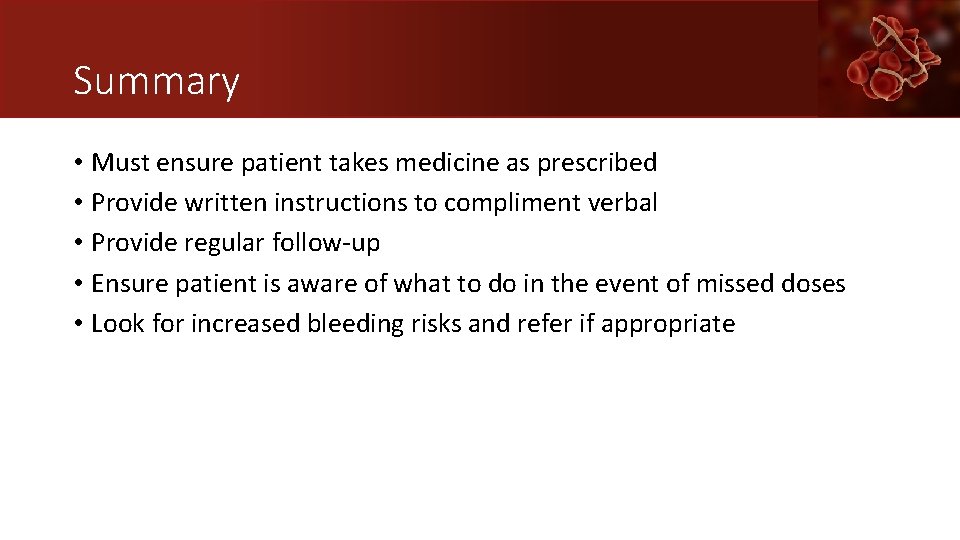
Summary • Must ensure patient takes medicine as prescribed • Provide written instructions to compliment verbal • Provide regular follow-up • Ensure patient is aware of what to do in the event of missed doses • Look for increased bleeding risks and refer if appropriate