
Counseling Supervision A brief overview of the models
Counseling Supervision A brief overview of the models, strategies and issues present in counseling supervision “Do not confine your children to your own learning for they were born in another time” (Hebrew Proverb) Colin Ward, Ph. D. Winona State University, Counselor Education
Outline of the Day Introductions Metaphor Supervision Experience University Expectations for Site Supervision Presentation of Supervision Models Reflective Model Developmental Model Competency Model Presentation of Supervision Strategies Submission of an initial Supervision Plan
A Supervision Metaphor TASK Draw a metaphor that articulates a current supervisee/client that you have some level of professional distress with Now, draw a metaphor of how the supervisory relationship will be different when it is more on track? DEFINITION A figure of speech containing an implied comparison, in which a word or phrase ordinarily and primarily used of one thing is applied to another To include any appropriate mode of expression in which issues of concern are represented differently to facilitate integration of new information and enhancement of conceptual abilities. This may include drawing, painting, music, dance or other modes of translating information into a new format
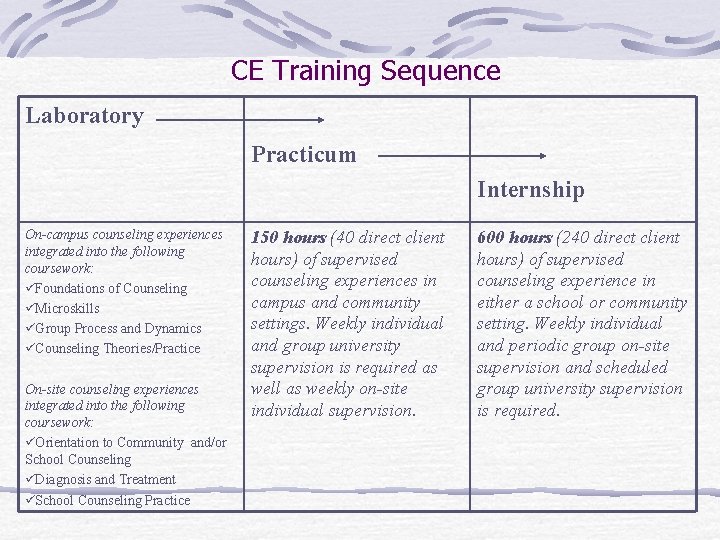
CE Training Sequence Laboratory Practicum Internship On-campus counseling experiences integrated into the following coursework: üFoundations of Counseling üMicroskills üGroup Process and Dynamics üCounseling Theories/Practice On-site counseling experiences integrated into the following coursework: üOrientation to Community and/or School Counseling üDiagnosis and Treatment üSchool Counseling Practice 150 hours (40 direct client hours) of supervised counseling experiences in campus and community settings. Weekly individual and group university supervision is required as well as weekly on-site individual supervision. 600 hours (240 direct client hours) of supervised counseling experience in either a school or community setting. Weekly individual and periodic group on-site supervision and scheduled group university supervision is required.

CE Counseling Supervision Outcomes Goals for University Supervision To teach counselors to develop and test hypotheses. To assist counselors in shifting from a performance laden stance (“Did I do this right? ”) to that of curiosity (What did I learn? To prepare counselors in managing the frustration and tension associated with the ambiguity of the counseling process. To facilitate the counselors self awareness and understanding with regard to their influence (directly or indirectly) on the counseling process To identify and develop their skills not only as a counselor, but also as an advocate, educator, systems consultant, and collaborative group facilitator. Goals for On-Site Supervision To provide one hour a week of individual supervision as well as group supervision when relevant to the site. To orient to the procedures, guidelines, and purpose of the setting To guide toward the acquisition of specific skills and knowledge related to the setting To provide counseling situations in which trainees can gain experience in practical application of methods and techniques To assist in planning for efficient use of time and resources To assist in assessing client potential and prognosis To help develop positive working relationships with supervisors, peers, and related mental health professionals. To submit a mid and final trainee
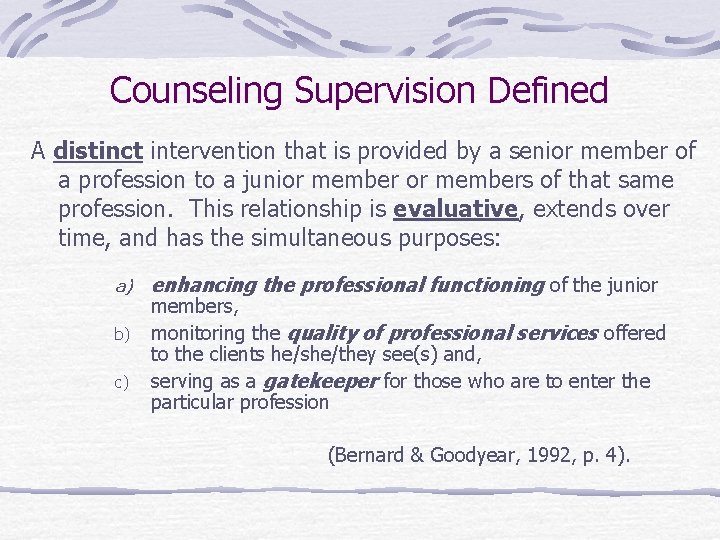
Counseling Supervision Defined A distinct intervention that is provided by a senior member of a profession to a junior members of that same profession. This relationship is evaluative, extends over time, and has the simultaneous purposes: a) b) c) enhancing the professional functioning of the junior members, monitoring the quality of professional services offered to the clients he/she/they see(s) and, serving as a gatekeeper for those who are to enter the particular profession (Bernard & Goodyear, 1992, p. 4).
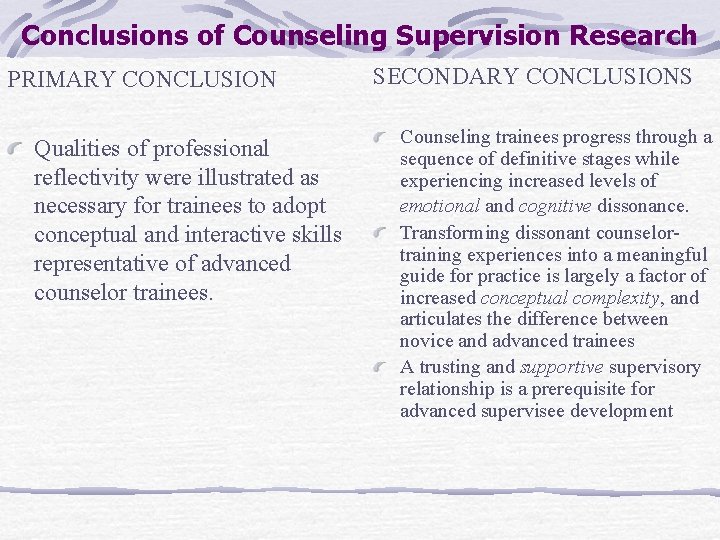
Conclusions of Counseling Supervision Research PRIMARY CONCLUSION Qualities of professional reflectivity were illustrated as necessary for trainees to adopt conceptual and interactive skills representative of advanced counselor trainees. SECONDARY CONCLUSIONS Counseling trainees progress through a sequence of definitive stages while experiencing increased levels of emotional and cognitive dissonance. Transforming dissonant counselortraining experiences into a meaningful guide for practice is largely a factor of increased conceptual complexity, and articulates the difference between novice and advanced trainees A trusting and supportive supervisory relationship is a prerequisite for advanced supervisee development

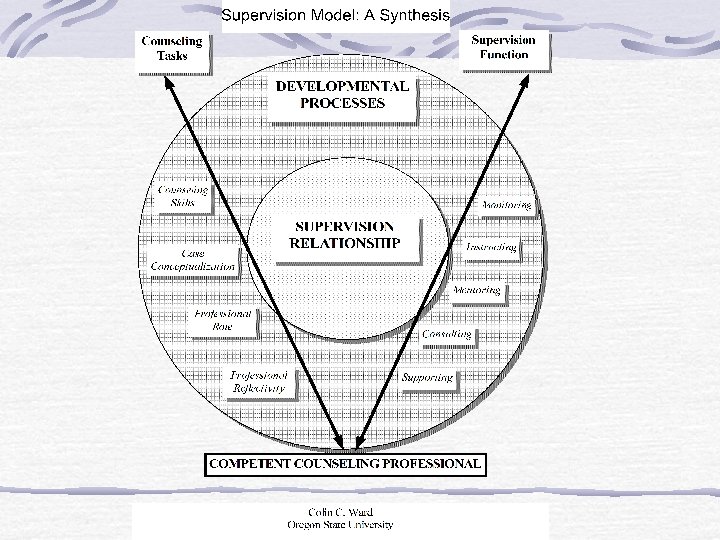
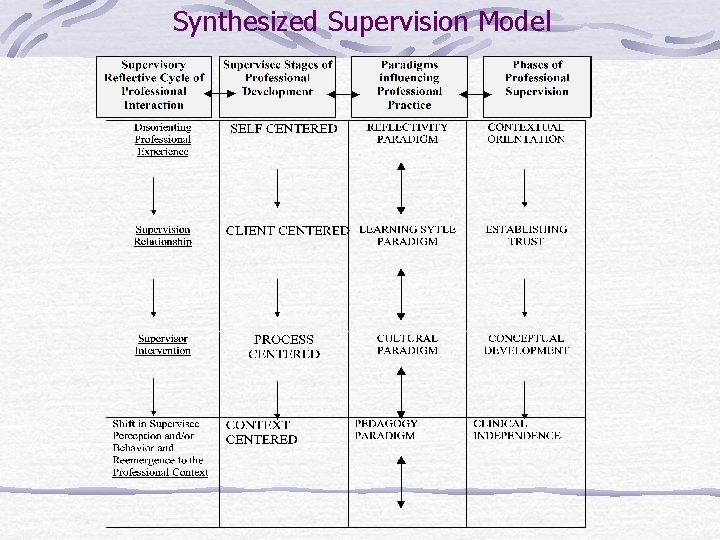
Synthesized Supervision Model
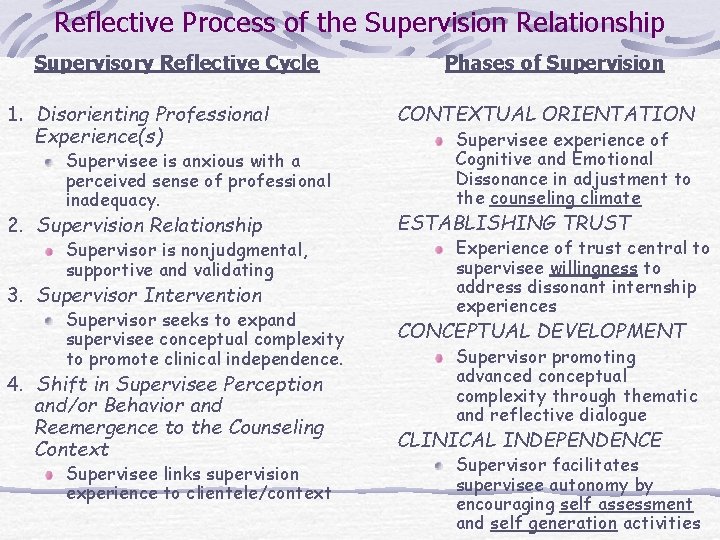
Reflective Process of the Supervision Relationship Supervisory Reflective Cycle Phases of Supervision 1. Disorienting Professional Experience(s) CONTEXTUAL ORIENTATION 2. Supervision Relationship ESTABLISHING TRUST Supervisee is anxious with a perceived sense of professional inadequacy. Supervisor is nonjudgmental, supportive and validating 3. Supervisor Intervention Supervisor seeks to expand supervisee conceptual complexity to promote clinical independence. 4. Shift in Supervisee Perception and/or Behavior and Reemergence to the Counseling Context Supervisee links supervision experience to clientele/context Supervisee experience of Cognitive and Emotional Dissonance in adjustment to the counseling climate Experience of trust central to supervisee willingness to address dissonant internship experiences CONCEPTUAL DEVELOPMENT Supervisor promoting advanced conceptual complexity through thematic and reflective dialogue CLINICAL INDEPENDENCE Supervisor facilitates supervisee autonomy by encouraging self assessment and self generation activities
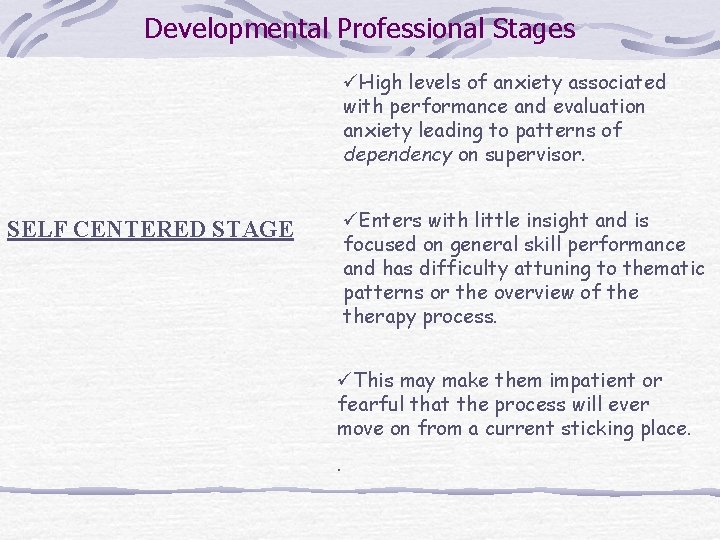
Developmental Professional Stages üHigh levels of anxiety associated with performance and evaluation anxiety leading to patterns of dependency on supervisor. üEnters with little insight and is focused on general skill performance and has difficulty attuning to thematic patterns or the overview of therapy process. SELF CENTERED STAGE üThis may make them impatient or fearful that the process will ever move on from a current sticking place. .
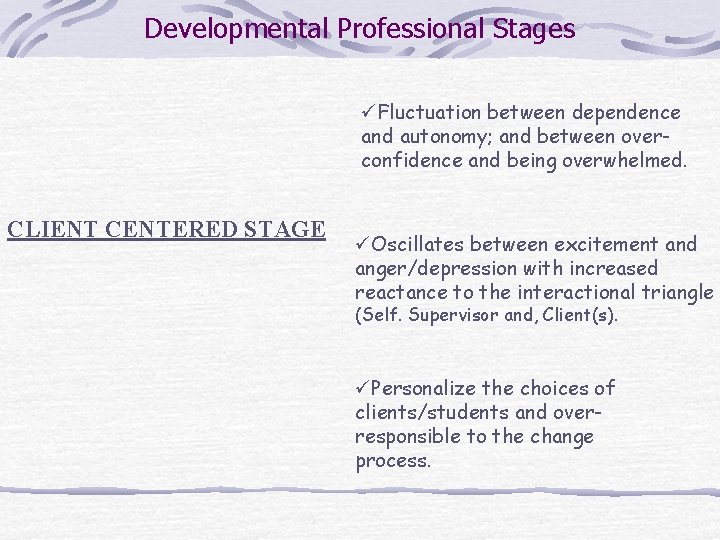
Developmental Professional Stages üFluctuation between dependence and autonomy; and between overconfidence and being overwhelmed. CLIENT CENTERED STAGE üOscillates between excitement and anger/depression with increased reactance to the interactional triangle (Self. Supervisor and, Client(s). üPersonalize the choices of clients/students and overresponsible to the change process.
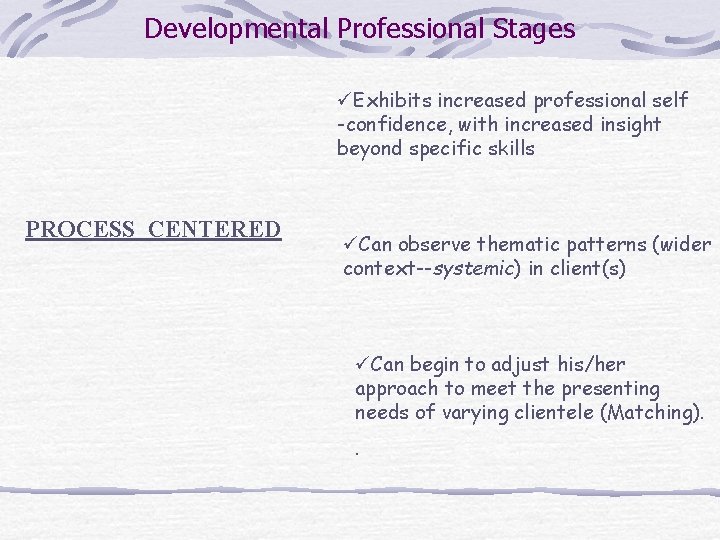
Developmental Professional Stages üExhibits increased professional self -confidence, with increased insight beyond specific skills PROCESS CENTERED üCan observe thematic patterns (wider context--systemic) in client(s) üCan begin to adjust his/her approach to meet the presenting needs of varying clientele (Matching). .
Developmental Professional Stages üHas developed into an integrated practitioner characterized by: PERSONAL AUTONOMY CONTEXT CENTERED INSIGHTFUL AWARENESS STABLE MOTIVATION An awareness of needing to confront own personal and professional problems impacting professional practice and growth.
![Supervisor Role and Strategies SELF CENTERED [Anxiety] • Structure & Instruction 1. • Support](http://slidetodoc.com/presentation_image_h/fb4366d83f9c07a6c10e0ca52cbd7093/image-16.jpg "Supervisor Role and Strategies SELF CENTERED [Anxiety] • Structure & Instruction 1. • Support")
Supervisor Role and Strategies SELF CENTERED [Anxiety] • Structure & Instruction 1. • Support & Accessibility 2. • Corrective & Strength Feedback 3. • Contextual Orientation 4. • Linking Skills to Process 5. 6. CLIENT CENTERED [Confusion] • Challenging & Encouraging: –Differentiation to Prof. Role –Conceptual Complexity –Hypothesis Testing –Linking Process to Client • Modeling • Monitoring PROCESS & CONTEXT CENTERED [Confidence] • Collegial & Encouraging –Professional Growth Plans –Self-Assessment & Emot. Insight –Professional Risk Taking –Linking Self to Process • Consulting 1. 2. 3. 4. 5. 6. 7. 1. 2. 3. 4. 5. Shadowing Experiences Co-Therapy Experiences IPR of Counseling Tapes Live Supervision (i. e. Mirror) Role Play Tape Scripts Case Presentation Peer/Topic Seminar Frozen Fish Bowl Issue/theme/ethics Review Reflective Guide Illustrative Disclosure Solution Focused Supervision Narrative Supervision Action Research/Advocacy Retrospection Cotherapy Reflective Journaling
Broad Reflective Questions The supervisory relationship provides a context for the review of counselor-trainee intentionality. Counseling supervision, therefore, directs attention to broad questions to be explored with the supervisee: How do I make sense of the dissonant or distressful counseling experiences? What does this mean with regard to my professional skills, theory of change, and gaps in my professional development needing to be addressed? How does this assist in better understanding the world view of the client?
Issues Related to Supervision Parallel Process Dual Relationship Informed Consent Vicarious Liability Isolation & Training
“Life experience is richer than discourse. Narrative structures organize and give meaning to experience but there always feelings and lived experiences not fully encompassed by the dominant narrative” Bruener
- Slides: 19