
Counseling Skills Components of Effective Brief Risk Reduction
Counseling Skills
Components of Effective Brief Risk Reduction Counseling Ø Communication, both verbal & non-verbal; Ø Supporting someone in making decisions when their willingness or ability to act is affected by how they feel.

Components of HIV Prevention Counseling Ø Helping individuals to explore, express, understand accept how they feel so that they can make decisions about behavior change; Ø Different than education, although education can be a component; Ø Good counseling does not = good information giving;
Components of HIV Prevention Counseling Ø It is client-centered: tailored to the behaviors, circumstances and special needs of an individual.

Components of HIV Prevention Counseling Not solving the client’s problem; Ø Not giving advice; Ø Ø The counselor brings a set of skills to help the individual: • reach a better understanding of the issue, • deal with feelings & concerns • assume responsibility for evaluating alternatives and making choices;

Counseling Concepts Concept 1: Focus on Feelings Concept 2: Manage Your Own Discomfort Concept 3: Set Boundaries
Counseling Concept 1: Focus on Feelings Ø In successful helping interactions, the focus is first placed on how an individual feels. Ø If we do not attend to those feelings, the individual will not hear us. Ø Again. . . we’re focusing on the client’s feelings. . . not OUR feelings!
Counseling Concept 1: Focus on Feelings Ø For individuals to engage in honest counseling interactions, we must be willing to bring up, listen to and respond to feeling-level reactions, beliefs and issues. Ø Have you ever been in a situation where you avoided bringing up difficult issues because you were afraid to upset the other person? Ø How might that hinder a counseling session?
Counseling Concept 2: Manage Your Own Discomfort Ø We can’t be expected not to have judgment or uncomfortable reactions. Ø We are expected to recognize judgment & discomfort so that we can keep it from being a barrier.
Counseling Concept 2: Manage Your Own Discomfort Ø What are some things that might trigger discomfort for counselors? Ø How might inability to manage discomfort get in the way of effective counseling? Ø How have you handled this in the past? What suggestions do you have?
Counseling Concept 3: Set Boundaries Ø Individuals must be in charge of their own lives. Ø We need to accept that people may make choices that are not the ones we would want them to make. Ø Client and counselor have unique roles.
Counseling Concept 3: Set Boundaries CLIENTS Ø Are in charge of making decisions about their lives and carrying out those decisions. COUNSELORS Ø Use an empathetic presence in a skillful way to support clients in planning how to reduce risks.
Basic Counseling Skills Skill 1: Asking Open-ended Questions Skill 2: Attending Skill 3: Offering Options, Not Directives Skill 4: Giving Information Simply
Counseling Skill 1: Asking Open-ended Questions Ø Questions that do not elicit “yes” or “no” as responses. Ø What is the purpose of asking open-ended questions? Ø Use of silence.
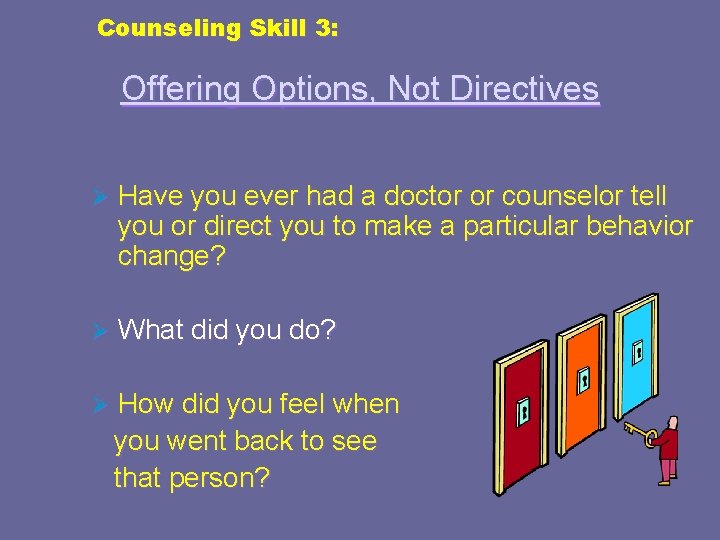
Counseling Skill 3: Offering Options, Not Directives Ø Have you ever had a doctor or counselor tell you or direct you to make a particular behavior change? Ø What did you do? Ø How did you feel when you went back to see that person?
Counseling Skill 3: Offering Options, Not Directives Ø Buffet Approach Ø Using this skill, what are some alternatives to the directive: “You need to use condoms every time you have sex. ”
Counseling Skill 4: Giving Information Simply Ø Giving information that is too complex or giving too much information can overwhelm people. Ø Use visual cues to keep you on track. Ø Give basic information & expand on it with client questions.
Counseling Skill 4: Giving Information Simply Ø Using this skill, share with us a direct answer to this client question: “Isn’t it mainly homosexuals and drug users who get HIV? ”
- Slides: 18