
COUNSELING PSYCHOLOGY DOCTORAL COMPREHENSIVE PORTFOLIO GUIDELINES FOR 2019


- Slides: 26
COUNSELING PSYCHOLOGY DOCTORAL COMPREHENSIVE PORTFOLIO GUIDELINES FOR 2019 -2020 ACADEMIC YEAR
PREREQUISITES FOR COMPS Both of the following must be completed prior to submitting your comprehensive exam portfolio: All required coursework in years 1 and 2 (including summers) Qualifying procedure paperwork must be submitted to the Graduate School (click on link for paperwork) – the committee for this procedure is just your advisor and the training director.
YOUR DOCTORAL COMMITTEE The following is required for your Ph. D committee: At least one CP faculty Two other CEP departmental faculty Faculty member in another department (Graduate School Dean’s Representative) You will need a Minor Faculty if you have a Graduate Minor Talk with your advisor or other committee members to identify any outside committee members
TIMELINE FOR SUBMISSION Ideally, submit your completed portfolio to your committee before or by the first day of the academic year in which you are applying for internship You do not have to wait until the fall of the year you are applying for internship, and can do it sooner provided you completed all the requirements in previous slide
TIMELINE FOR SUBMISSION (2) You can defend your portfolio 2 weeks after the first day of the semester. However, if you are applying for internship, you will need to have your portfolio approved and your Oral Exam passed by no later than Oct. 15. Your committee needs two weeks to evaluate your work So your portfolio is due to your committee by Oct. 1. The training director and training committee need to certify your readiness for internship. Determine an appropriate timeline with advisor Set up a mutually agreed upon schedule and process for writing, editing, and revising with your advisor
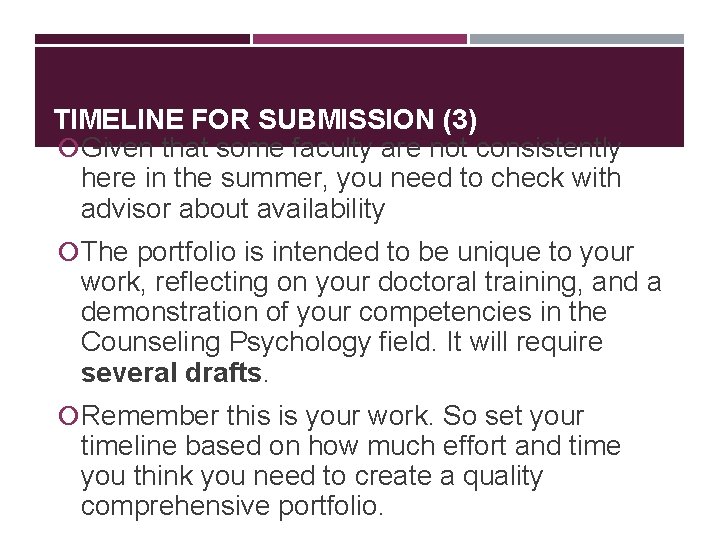
TIMELINE FOR SUBMISSION (3) Given that some faculty are not consistently here in the summer, you need to check with advisor about availability The portfolio is intended to be unique to your work, reflecting on your doctoral training, and a demonstration of your competencies in the Counseling Psychology field. It will require several drafts. Remember this is your work. So set your timeline based on how much effort and time you think you need to create a quality comprehensive portfolio.
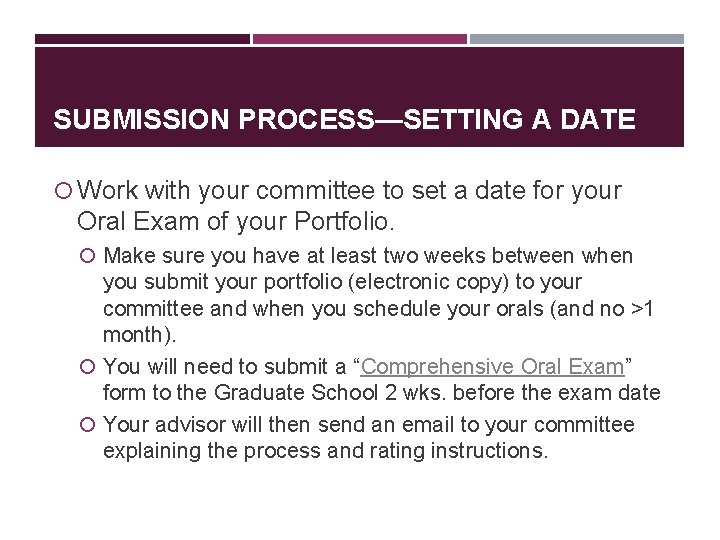
SUBMISSION PROCESS—SETTING A DATE Work with your committee to set a date for your Oral Exam of your Portfolio. Make sure you have at least two weeks between when you submit your portfolio (electronic copy) to your committee and when you schedule your orals (and no >1 month). You will need to submit a “Comprehensive Oral Exam” form to the Graduate School 2 wks. before the exam date Your advisor will then send an email to your committee explaining the process and rating instructions.
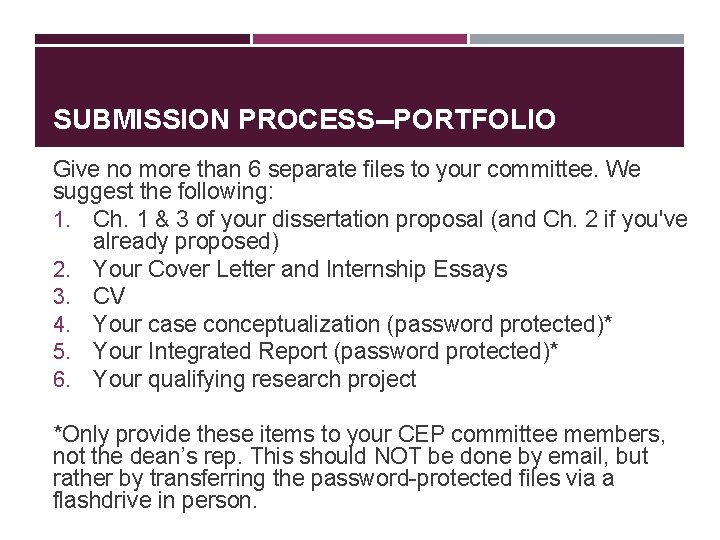
SUBMISSION PROCESS--PORTFOLIO Give no more than 6 separate files to your committee. We suggest the following: 1. Ch. 1 & 3 of your dissertation proposal (and Ch. 2 if you've already proposed) 2. Your Cover Letter and Internship Essays 3. CV 4. Your case conceptualization (password protected)* 5. Your Integrated Report (password protected)* 6. Your qualifying research project *Only provide these items to your CEP committee members, not the dean’s rep. This should NOT be done by email, but rather by transferring the password-protected files via a flashdrive in person.
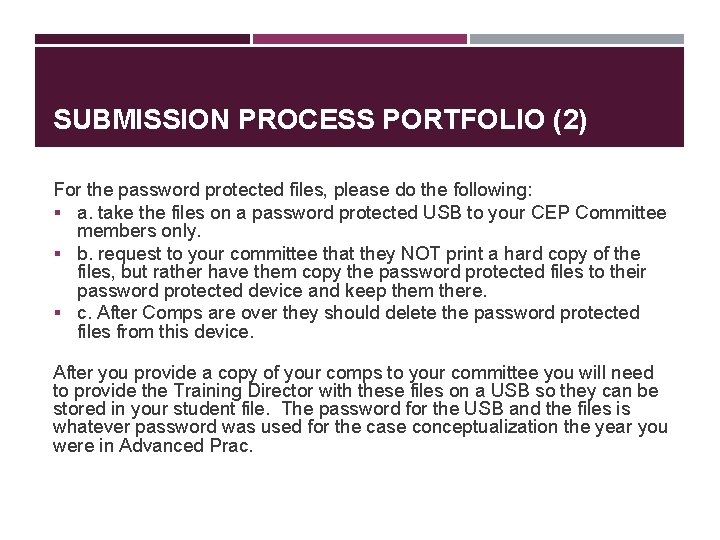
SUBMISSION PROCESS PORTFOLIO (2) For the password protected files, please do the following: § a. take the files on a password protected USB to your CEP Committee members only. § b. request to your committee that they NOT print a hard copy of the files, but rather have them copy the password protected files to their password protected device and keep them there. § c. After Comps are over they should delete the password protected files from this device. After you provide a copy of your comps to your committee you will need to provide the Training Director with these files on a USB so they can be stored in your student file. The password for the USB and the files is whatever password was used for the case conceptualization the year you were in Advanced Prac.
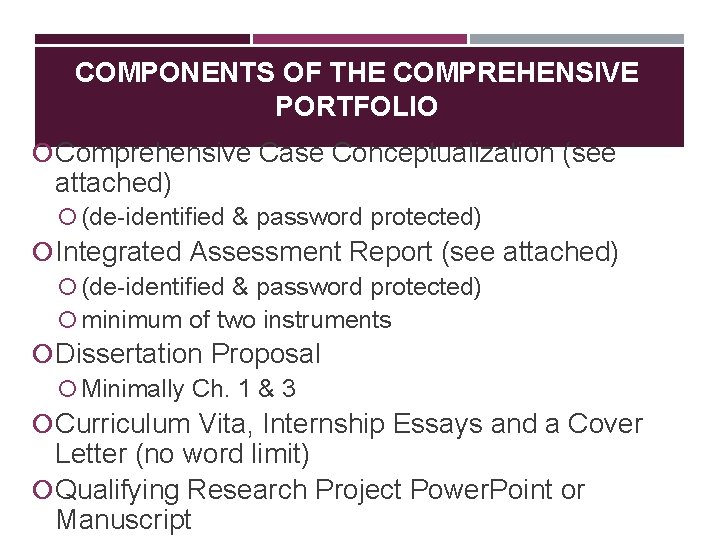
COMPONENTS OF THE COMPREHENSIVE PORTFOLIO Comprehensive Case Conceptualization (see attached) (de-identified & password protected) Integrated Assessment Report (see attached) (de-identified & password protected) minimum of two instruments Dissertation Proposal Minimally Ch. 1 & 3 Curriculum Vita, Internship Essays and a Cover Letter (no word limit) Qualifying Research Project Power. Point or Manuscript
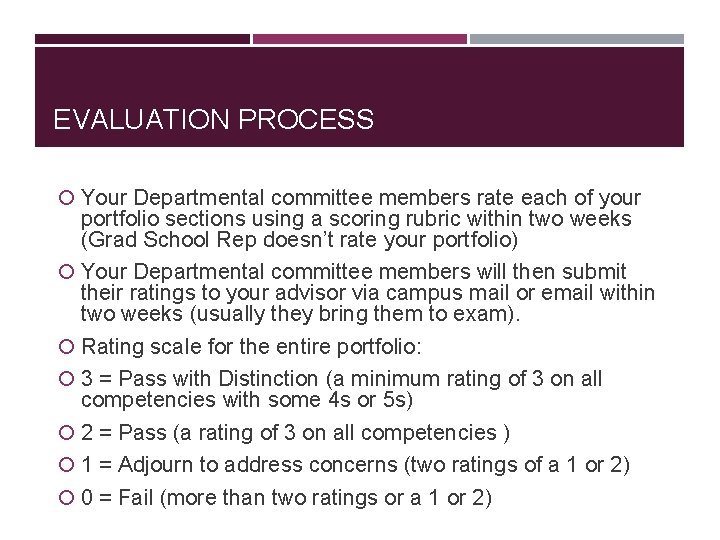
EVALUATION PROCESS Your Departmental committee members rate each of your portfolio sections using a scoring rubric within two weeks (Grad School Rep doesn’t rate your portfolio) Your Departmental committee members will then submit their ratings to your advisor via campus mail or email within two weeks (usually they bring them to exam). Rating scale for the entire portfolio: 3 = Pass with Distinction (a minimum rating of 3 on all competencies with some 4 s or 5 s) 2 = Pass (a rating of 3 on all competencies ) 1 = Adjourn to address concerns (two ratings of a 1 or 2) 0 = Fail (more than two ratings or a 1 or 2)
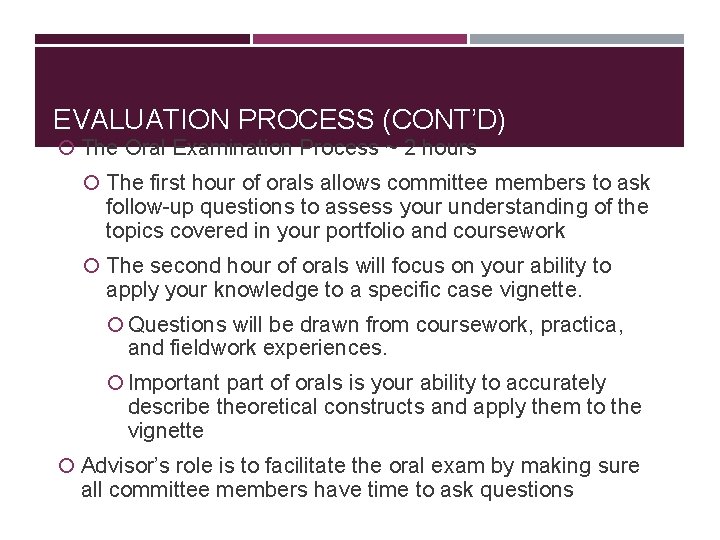
EVALUATION PROCESS (CONT’D) The Oral Examination Process ~ 2 hours The first hour of orals allows committee members to ask follow-up questions to assess your understanding of the topics covered in your portfolio and coursework The second hour of orals will focus on your ability to apply your knowledge to a specific case vignette. Questions will be drawn from coursework, practica, and fieldwork experiences. Important part of orals is your ability to accurately describe theoretical constructs and apply them to the vignette Advisor’s role is to facilitate the oral exam by making sure all committee members have time to ask questions
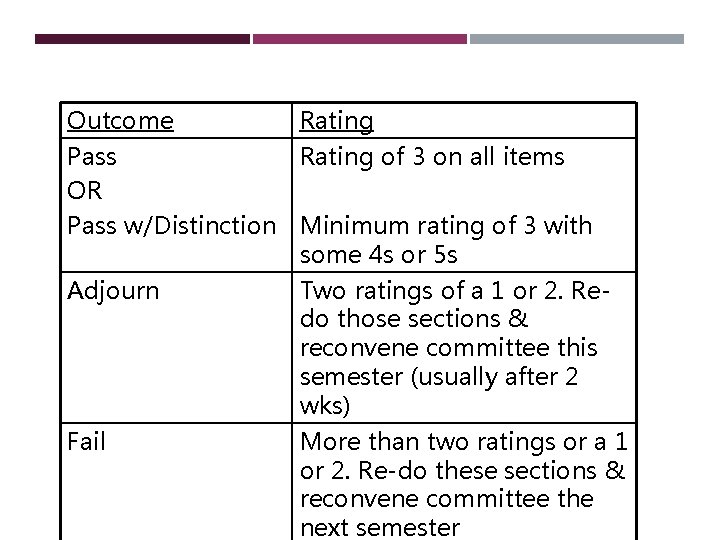
EVALUATION PROCESS (CONT’D) Outcome Rating Pass Rating of 3 on all items OR Pass w/Distinction Minimum rating of 3 with some 4 s or 5 s Adjourn Two ratings of a 1 or 2. Redo those sections & reconvene committee this semester (usually after 2 wks) Fail More than two ratings or a 1 or 2. Re-do these sections & reconvene committee the next semester
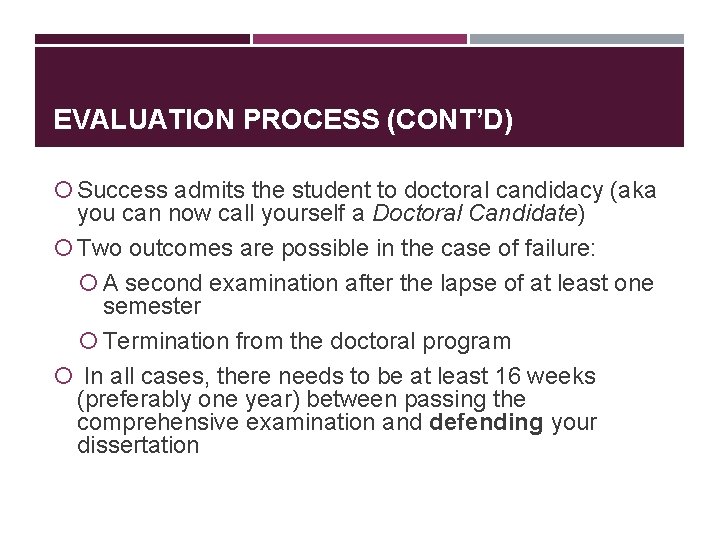
EVALUATION PROCESS (CONT’D) Success admits the student to doctoral candidacy (aka you can now call yourself a Doctoral Candidate) Two outcomes are possible in the case of failure: A second examination after the lapse of at least one semester Termination from the doctoral program In all cases, there needs to be at least 16 weeks (preferably one year) between passing the comprehensive examination and defending your dissertation
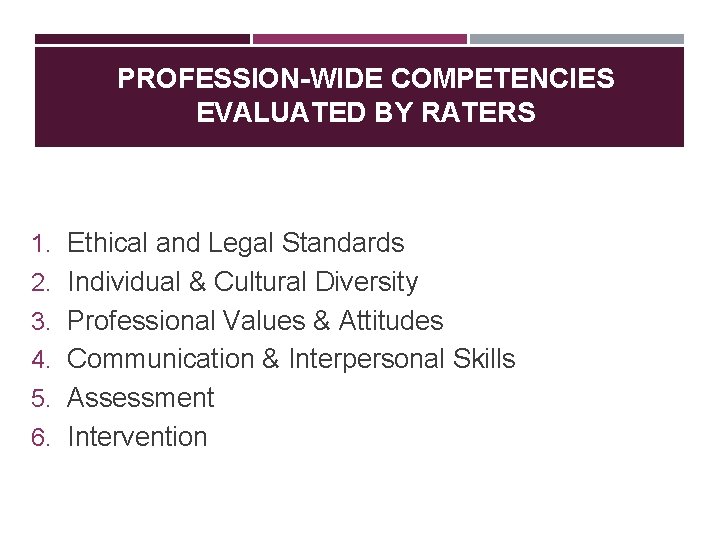
PROFESSION-WIDE COMPETENCIES EVALUATED BY RATERS 1. Ethical and Legal Standards 2. Individual & Cultural Diversity 3. Professional Values & Attitudes 4. Communication & Interpersonal Skills 5. Assessment 6. Intervention
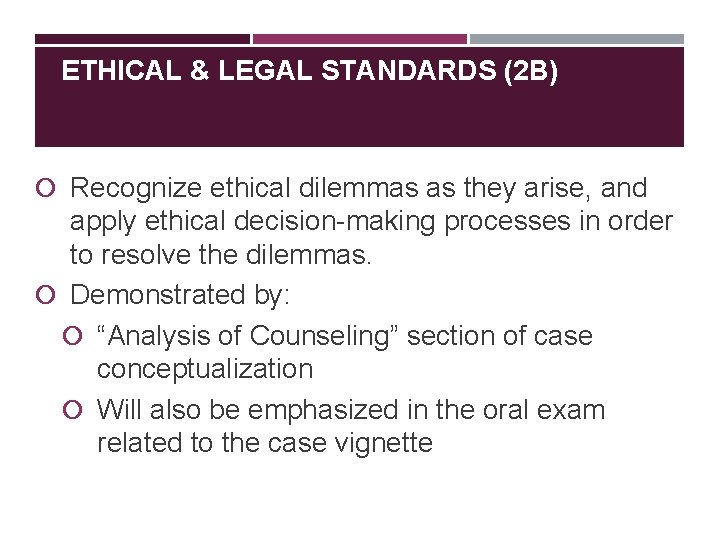
ETHICAL & LEGAL STANDARDS (2 B) Recognize ethical dilemmas as they arise, and apply ethical decision-making processes in order to resolve the dilemmas. Demonstrated by: “Analysis of Counseling” section of case conceptualization Will also be emphasized in the oral exam related to the case vignette
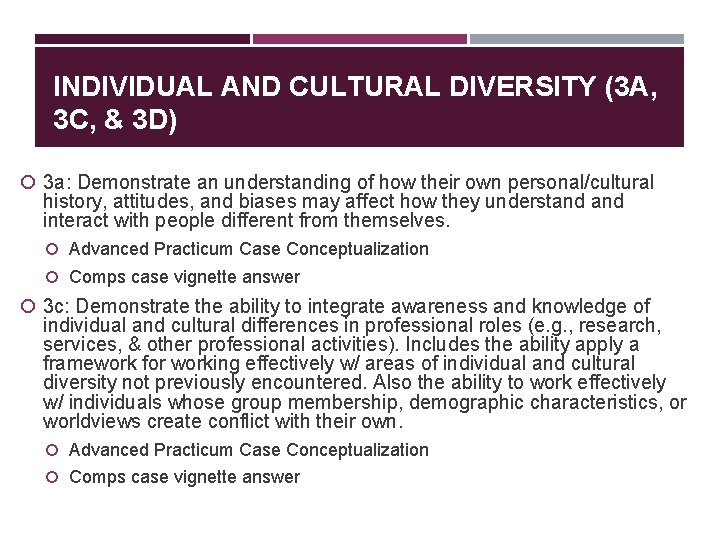
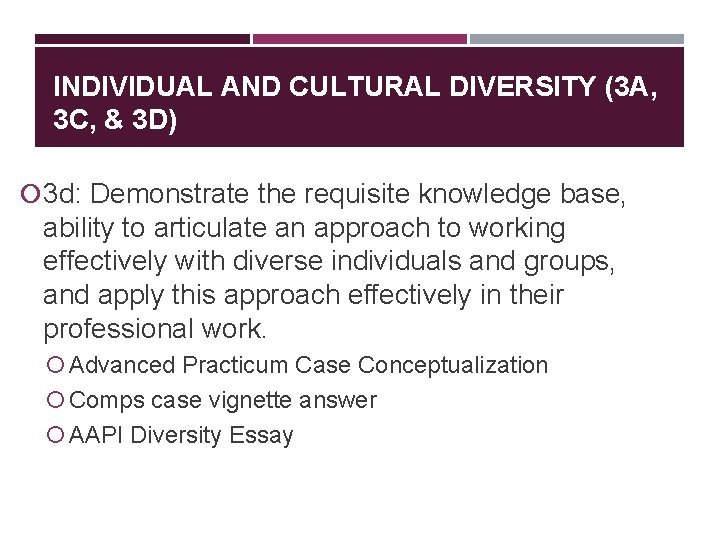
INDIVIDUAL AND CULTURAL DIVERSITY (3 A, 3 C, & 3 D) 3 a: Demonstrate an understanding of how their own personal/cultural history, attitudes, and biases may affect how they understand interact with people different from themselves. Advanced Practicum Case Conceptualization Comps case vignette answer 3 c: Demonstrate the ability to integrate awareness and knowledge of individual and cultural differences in professional roles (e. g. , research, services, & other professional activities). Includes the ability apply a framework for working effectively w/ areas of individual and cultural diversity not previously encountered. Also the ability to work effectively w/ individuals whose group membership, demographic characteristics, or worldviews create conflict with their own. Advanced Practicum Case Conceptualization Comps case vignette answer
INDIVIDUAL AND CULTURAL DIVERSITY (3 A, 3 C, & 3 D) 3 d: Demonstrate the requisite knowledge base, ability to articulate an approach to working effectively with diverse individuals and groups, and apply this approach effectively in their professional work. Advanced Practicum Case Conceptualization Comps case vignette answer AAPI Diversity Essay
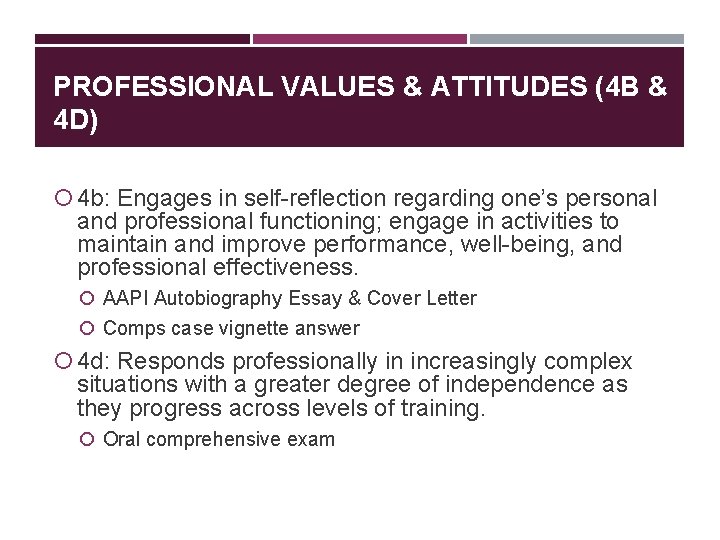
PROFESSIONAL VALUES & ATTITUDES (4 B & 4 D) 4 b: Engages in self-reflection regarding one’s personal and professional functioning; engage in activities to maintain and improve performance, well-being, and professional effectiveness. AAPI Autobiography Essay & Cover Letter Comps case vignette answer 4 d: Responds professionally in increasingly complex situations with a greater degree of independence as they progress across levels of training. Oral comprehensive exam
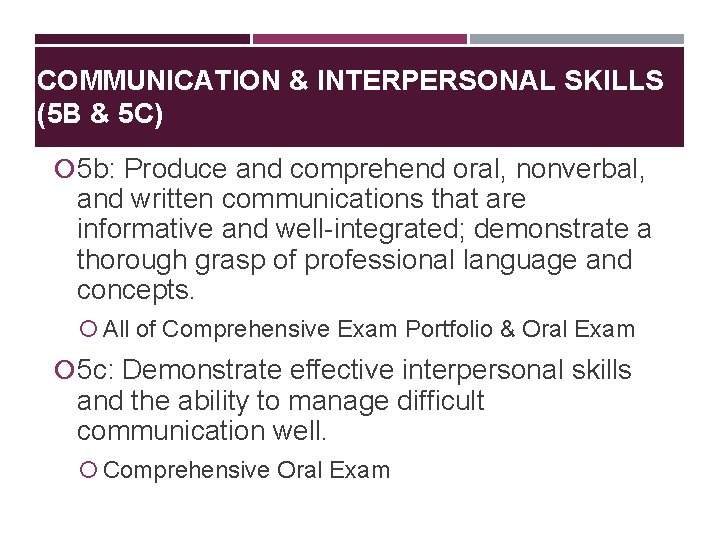
COMMUNICATION & INTERPERSONAL SKILLS (5 B & 5 C) 5 b: Produce and comprehend oral, nonverbal, and written communications that are informative and well-integrated; demonstrate a thorough grasp of professional language and concepts. All of Comprehensive Exam Portfolio & Oral Exam 5 c: Demonstrate effective interpersonal skills and the ability to manage difficult communication well. Comprehensive Oral Exam
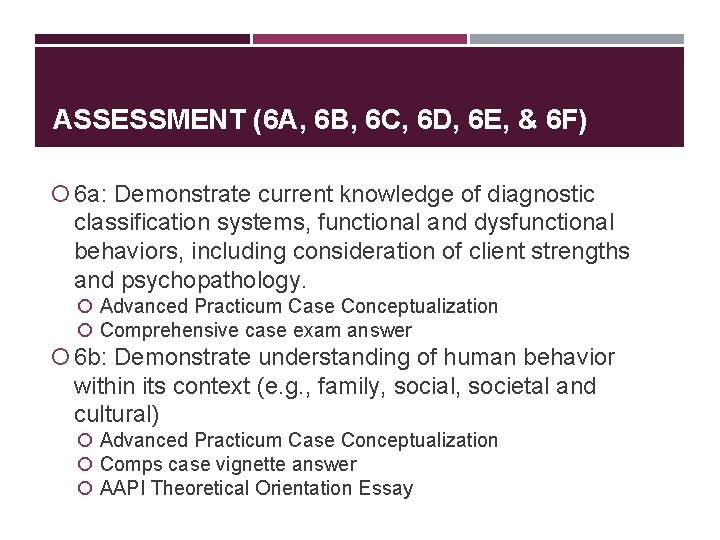
ASSESSMENT (6 A, 6 B, 6 C, 6 D, 6 E, & 6 F) 6 a: Demonstrate current knowledge of diagnostic classification systems, functional and dysfunctional behaviors, including consideration of client strengths and psychopathology. Advanced Practicum Case Conceptualization Comprehensive case exam answer 6 b: Demonstrate understanding of human behavior within its context (e. g. , family, social, societal and cultural) Advanced Practicum Case Conceptualization Comps case vignette answer AAPI Theoretical Orientation Essay
ASSESSMENT (6 A, 6 B, 6 C, 6 D, 6 E, & 6 F) 6 c: Demonstrates the ability to apply the knowledge of functional and dysfunctional behaviors including context to the assessment and/or diagnostic process 6 d: Select and apply assessment methods that draw from the best available empirical literature and that reflect the science of measurement and psychometrics; collect relevant data using multiple sources and methods appropriate to the identified goals and questions of the assessment as well as relevant diversity characteristics of the service recipient. Both assessed by Integrated Assessment Report
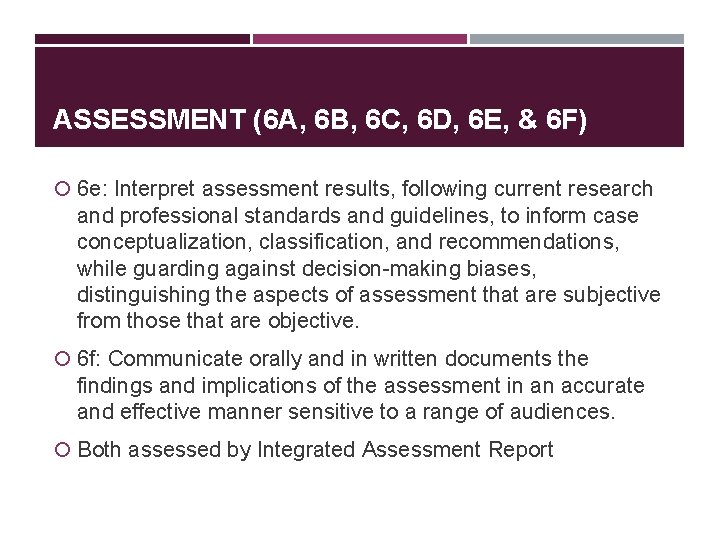
ASSESSMENT (6 A, 6 B, 6 C, 6 D, 6 E, & 6 F) 6 e: Interpret assessment results, following current research and professional standards and guidelines, to inform case conceptualization, classification, and recommendations, while guarding against decision-making biases, distinguishing the aspects of assessment that are subjective from those that are objective. 6 f: Communicate orally and in written documents the findings and implications of the assessment in an accurate and effective manner sensitive to a range of audiences. Both assessed by Integrated Assessment Report
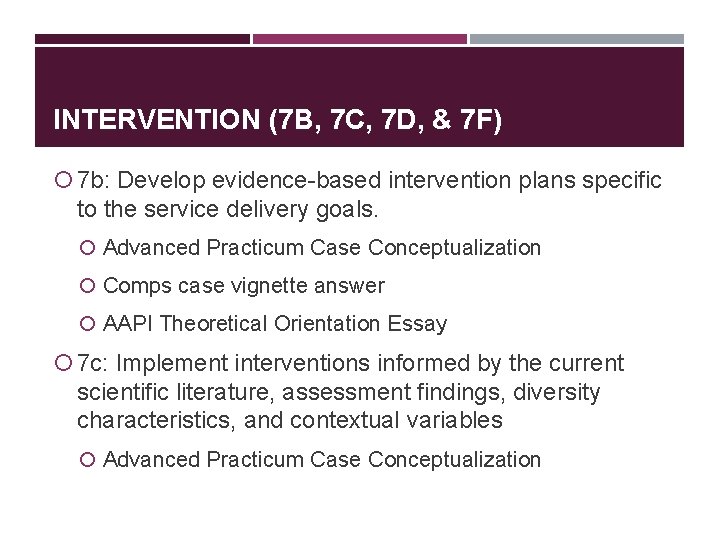
INTERVENTION (7 B, 7 C, 7 D, & 7 F) 7 b: Develop evidence-based intervention plans specific to the service delivery goals. Advanced Practicum Case Conceptualization Comps case vignette answer AAPI Theoretical Orientation Essay 7 c: Implement interventions informed by the current scientific literature, assessment findings, diversity characteristics, and contextual variables Advanced Practicum Case Conceptualization
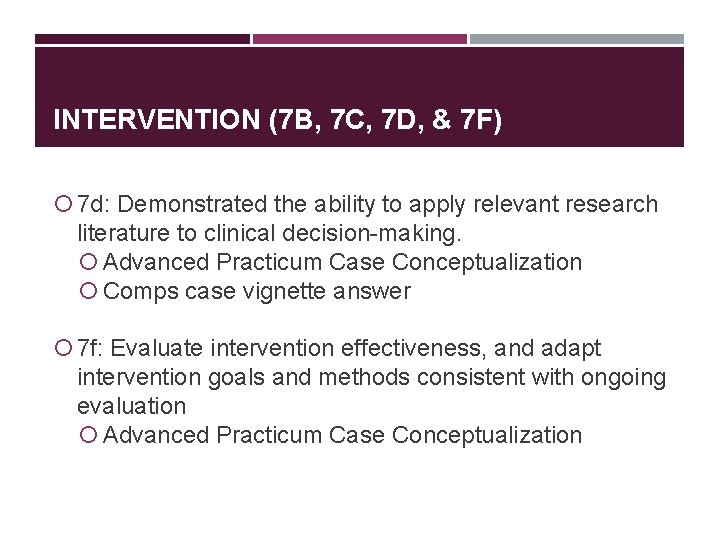
INTERVENTION (7 B, 7 C, 7 D, & 7 F) 7 d: Demonstrated the ability to apply relevant research literature to clinical decision-making. Advanced Practicum Case Conceptualization Comps case vignette answer 7 f: Evaluate intervention effectiveness, and adapt intervention goals and methods consistent with ongoing evaluation Advanced Practicum Case Conceptualization
QUESTIONS?