
COUNSELING IN THE 1999 LEADERSHIP DOCTRINE Counseling Subordinatecentered
COUNSELING IN THE 1999 LEADERSHIP DOCTRINE
Counseling Subordinate-centered communication that outlines actions necessary for subordinates to achieve individual and organizational goals. 3 3 Why should counseling lead to achievement of goals? How is counseling related to leadership?
The Reason for Counseling - To help subordinates develop in order to achieve organizational or individual goals. - This overriding theme of “subordinate development” includes helping subordinates to improve performance, solve problems or attain goals.
The Leader as a Counselor Leaders have a responsibility to develop their subordinates. During counseling, the leader acts primarily as a helper, not a judge. When should a leader counsel to develop subordinates? 3 How can a leader be both an evaluator/judge and a helper/counselor? 3
The Leader as a Counselor The following qualities help the leader to assume an effective role during counseling: - Respect for subordinates Self and Cultural Awareness Credibility Empathy 3 How do these qualities assist leaders in counseling?
Subordinate-Centered (Two-Way) Communication Subordinates assume an active role in the counseling session and maintain responsibility for their actions. The following skills assist leaders in subordinate-centered counseling: - Active Listening - Responding - Questioning 3 Why should the subordinate be active in the session?
Common Counseling Mistakes – Leader’s: – – Likes Dislikes Biases Prejudices
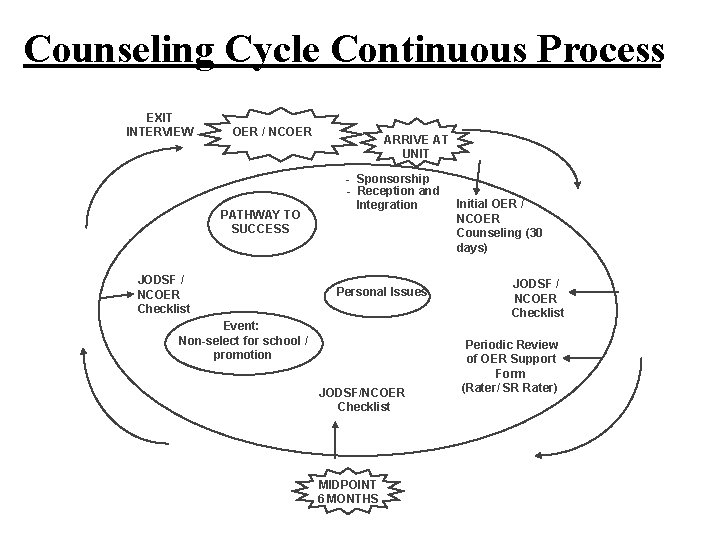
Counseling Cycle Continuous Process EXIT INTERVIEW OER / NCOER PATHWAY TO SUCCESS JODSF / NCOER Checklist ARRIVE AT UNIT - Sponsorship - Reception and Integration Personal Issues Event: Non-select for school / promotion JODSF/NCOER Checklist MIDPOINT 6 MONTHS Initial OER / NCOER Counseling (30 days) JODSF / NCOER Checklist Periodic Review of OER Support Form (Rater/ SR Rater)
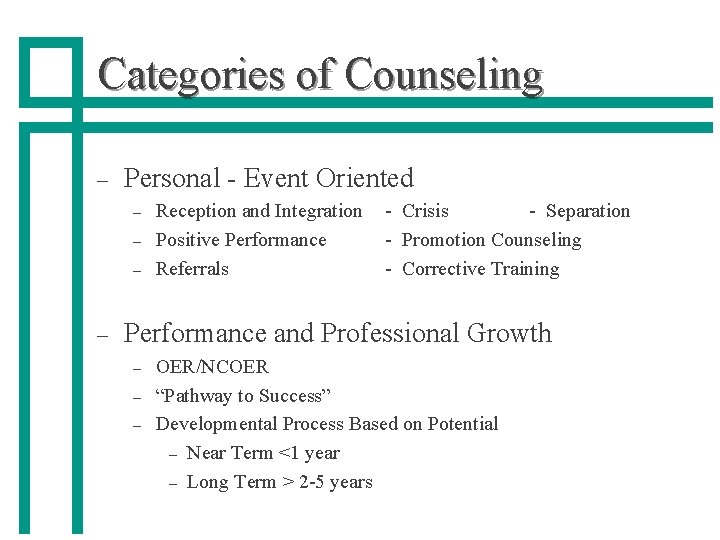
Categories of Counseling – Personal - Event Oriented – – Reception and Integration Positive Performance Referrals - Crisis - Separation - Promotion Counseling - Corrective Training Performance and Professional Growth – – – OER/NCOER “Pathway to Success” Developmental Process Based on Potential – Near Term <1 year – Long Term > 2 -5 years
Approaches to Counseling – Directive – Nondirective – Combined
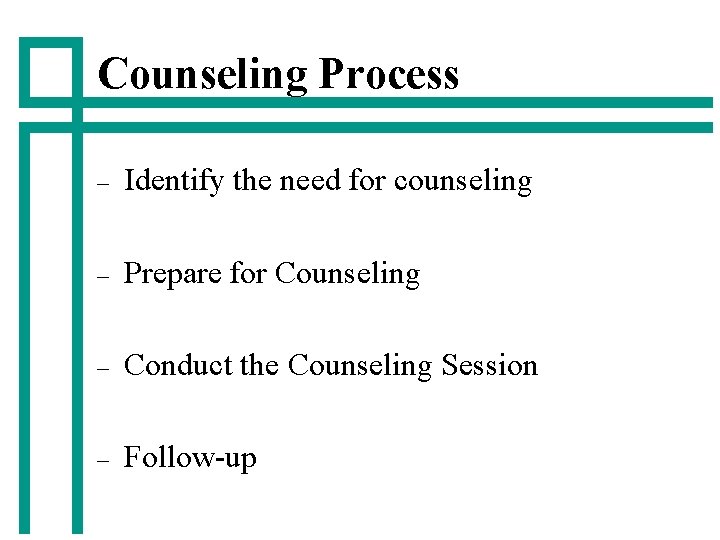
Counseling Process – Identify the need for counseling – Prepare for Counseling – Conduct the Counseling Session – Follow-up
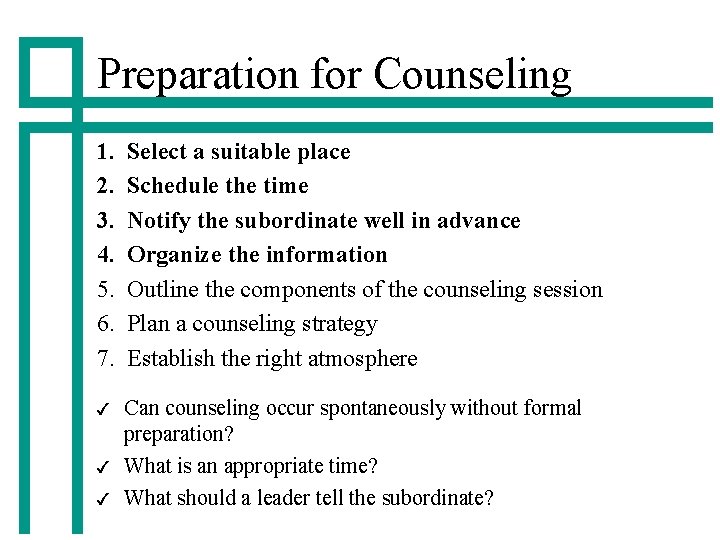
Preparation for Counseling 1. 2. 3. 4. 5. 6. 7. Select a suitable place Schedule the time Notify the subordinate well in advance Organize the information Outline the components of the counseling session Plan a counseling strategy Establish the right atmosphere 3 Can counseling occur spontaneously without formal preparation? What is an appropriate time? What should a leader tell the subordinate? 3 3
Preparation for Counseling 1. 2. 3. 4. 5. 6. 7. Select a suitable place Schedule the time Notify the subordinate well in advance Organize the information Outline the components of the counseling session Plan a counseling strategy Establish the right atmosphere 3 Why should a leader prepare an outline? What is a counseling strategy? 3
The Counseling Session 1. 2. 3. 4. Open the session Discuss the issue Develop a plan of action Record and Close the session
(1) Open the Session - State the purpose of the session. - Establish a subordinate-centered tone. How does a counselor establish a subordinate centered tone? 3 Why is it important to state the purpose of the session? 3
(2) Discuss the Issue - Jointly develop an understanding of the situation. - Support points with facts or observations. - Establish relevance between the issue and individual or unit goals. How does a counselor “jointly develop” an understanding of the situation? 3 Why is it important to support points with fact or observations? 3
(3) Develop a Plan of Action - Actions should facilitate the attainment of goals. - Actions should be specific enough to drive behavior. - Plan may entail contacting a referral agency. Why must the plan be a “plan of action”? 3 When should the plan include a referral? 3
(4) Record and Close the Session - Summarize the counseling session. - Discuss implementation of the plan; check for understanding and acceptance. - Identify leader’s responsibilities. What happens when a soldier does not accept the plan of action? 3 What is follow-up and why is it necessary? 3 What is the leader’s role in implementing the plan? 3
Assess the Plan of Action – If needed, modify the original plan of action – Provides useful information for future follow-up counseling sessions
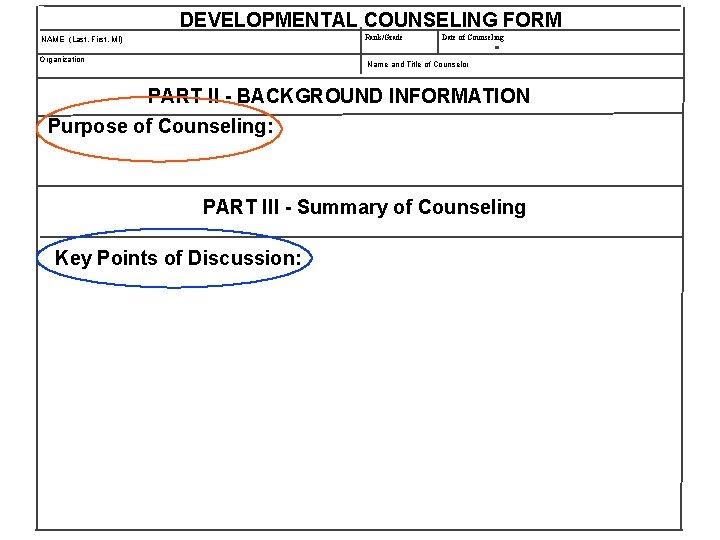
DEVELOPMENTAL COUNSELING FORM Rank/Grade NAME (Last, First, MI) Organization Date of Counseling Name and Title of Counselor PART II - BACKGROUND INFORMATION Purpose of Counseling: PART III - Summary of Counseling Key Points of Discussion:
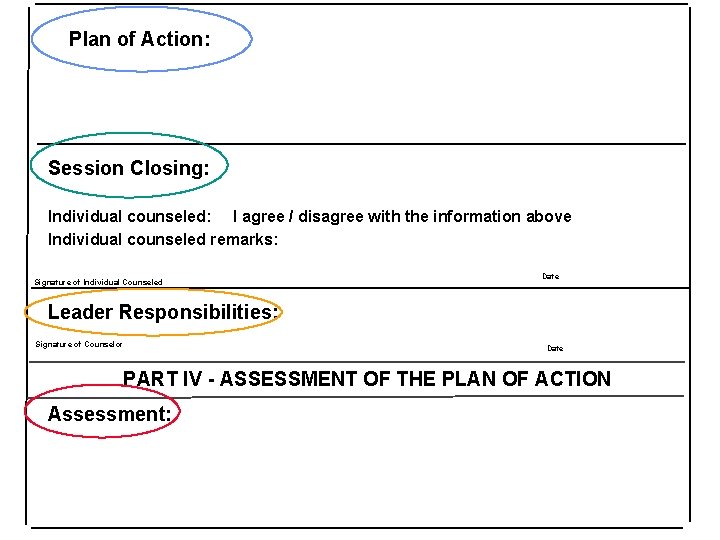
Plan of Action: Session Closing: Individual counseled: I agree / disagree with the information above Individual counseled remarks: Signature of Individual Counseled Date Leader Responsibilities: Signature of Counselor Date PART IV - ASSESSMENT OF THE PLAN OF ACTION Assessment:
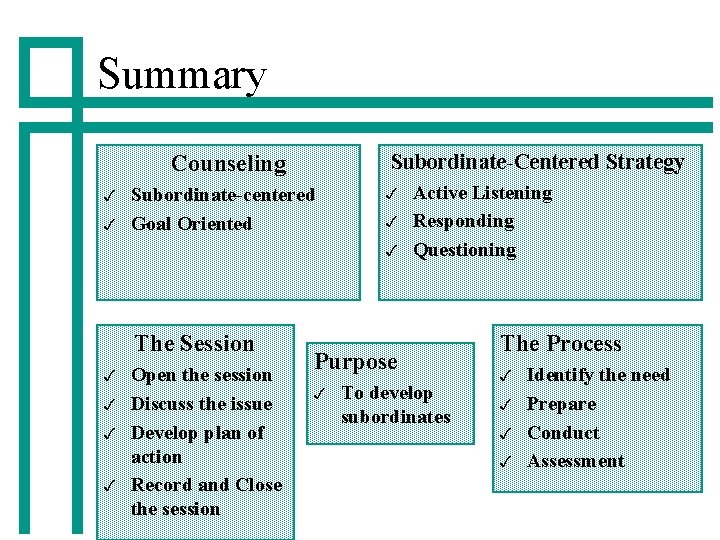
Summary Subordinate-Centered Strategy Counseling 3 3 Subordinate-centered Goal Oriented 3 3 3 The Session 3 3 Open the session Discuss the issue Develop plan of action Record and Close the session Active Listening Responding Questioning Purpose 3 To develop subordinates The Process 3 3 Identify the need Prepare Conduct Assessment
- Slides: 22