
Counseling for FP Use Imarisha Maisha Specific Objectives
Counseling for FP Use Imarisha Maisha
Specific Objectives 1. Demonstrate basic communication skills necessary for effective counseling in FP 2. Demonstrate counseling that is required in FP services 2
Objective § By the end of the module, participants will be able to demonstrate the basic counseling skills for FP use 3
Definition § It is a person to person interaction in which the counselor provides adequate information to enable the client to; • work through particular problems conflicts, feelings and helps find ways to resolve or cope with them • make informed choice and guidance on making the choice that best meets client’s needs and concerns 4
Purpose of FP Counseling § To support a client and her/his partner in choosing the method of FP that suits them best and support them in solving any problem that may arise in the process of selecting or using the chosen method § Counseling provides information, clarifications, and opportunity to make a choice
Qualities of a Good FP Counselor § Personal qualities and attitudes • Empathetic, genuine, respectful (unconditional positive regard) § § § Knowledge about counseling Communication skills Knowledge related to the clients Knowledge and abilities related to contraception Knowledge related to the country’s systems of service delivery 6
Principles of counseling § § § Respect each client to create trust Interact Tailor information to the client Avoid too much information Provide the service that the client needs/wants Help the client understand remember 7
Communication skills § Ability to: § Create an atmosphere comfortable to the client § Present information clearly § Encourage questions § Listen and observe attentively 8
Communication Skills Cont…… § Guide counselor- client interactions § Speak the client’s “language” § Ask questions effectively to encourage the client to share information and feelings 9
Counseling Skills § Active listening § Positive body language § Constructive feedback § Paraphrasing § Seeking clarification 10
Counseling Skills- 2 § Appropriate/effective questioning techniques § Use non technical and simple language § Verbal and non-verbal encouragement
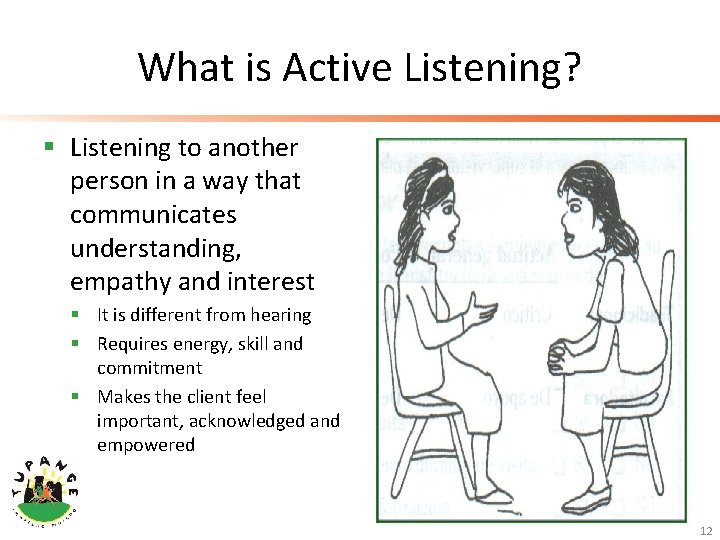
What is Active Listening? § Listening to another person in a way that communicates understanding, empathy and interest § It is different from hearing § Requires energy, skill and commitment § Makes the client feel important, acknowledged and empowered 12
Active Listening : The Do’s (Tips) § § § Do’s Allow client to express himself/ herself Concentrate on what client is saying Allow client to control conversation Accept client’s opinion as valid for himself/herself 13
Do’s Cont…………. § Pay attention to not only words but also client's gestures and behaviors § Prevent emotions from inhibiting active listening no matter what the client is saying 14
Active Listening: Don’ts § Do other things (e. g. , look through papers) when the client is talking. § Daydream or get distracted by surrounding events § Interrupt/Finish the clients sentences § Ask questions that change the subject. 15
Don’t Cont…………………. . § Rebut, criticize, or judge. § Anticipate what the speaker is going to say next. § Ignore the emotional context. § Become angry, defensive, or upset 16
Positive Body Language § Body language includes: § § § Body posture Position of body parts(arms, legs, eyes) Gestures Space Seating § Active listeners use body language to indicate respect, interest and empathy § Body language may have different meanings in different communities or cultures 17
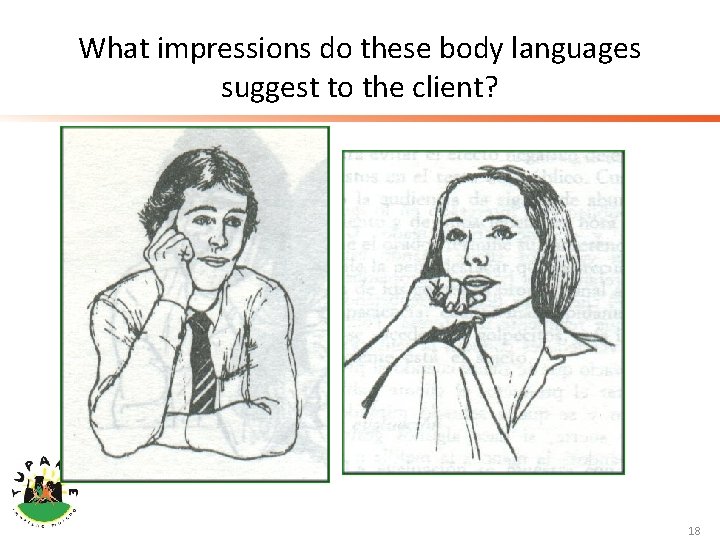
What impressions do these body languages suggest to the client? 18
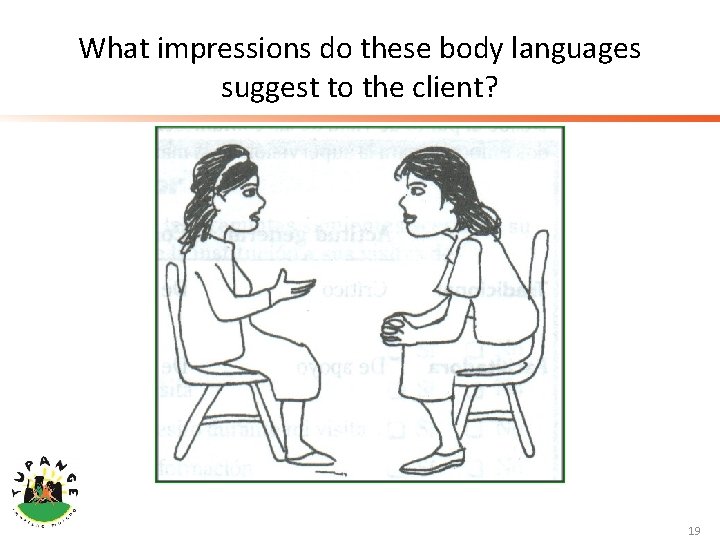
What impressions do these body languages suggest to the client? 19
Verbal and Nonverbal Encouragement § Definition: § This involve the use of words, phrases and gestures that indicate attention and the wish for the person to continue speaking. 20
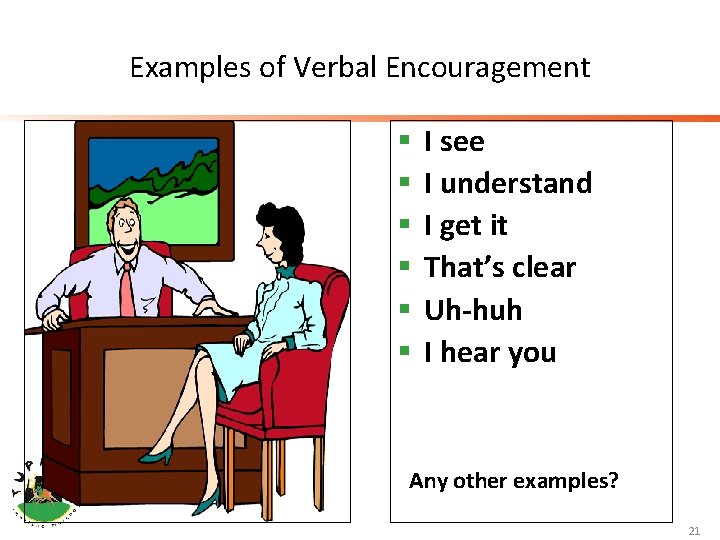
Examples of Verbal Encouragement § § § I see I understand I get it That’s clear Uh-huh I hear you Any other examples? 21
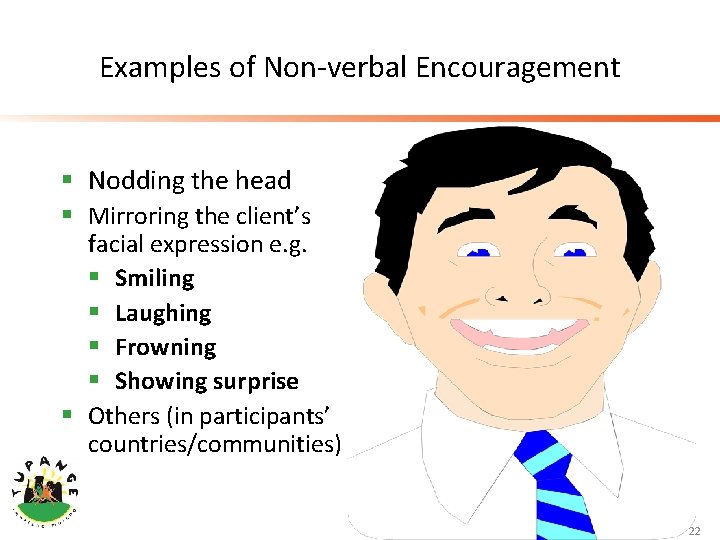
Examples of Non-verbal Encouragement § Nodding the head § Mirroring the client’s facial expression e. g. § Smiling § Laughing § Frowning § Showing surprise § Others (in participants’ countries/communities) 22
Use of simple language and visual aids § § § § Female anatomy : What is the simple language for: Cervix Clitoris Fallopian tubes Ovaries Uterus Vagina 23
Use of simple language and visual aids cont. . § Male anatomy: What is the simple language for: • • • Penis Prostate gland Scrotum Semen Testis Vas deferens 24
Use of simple language and visual aids cont. . § § • • What is the simple language for: Menstruation Fertilization Pregnancy Abortion Miscarriage 25
Paraphrasing: Definition § Paraphrasing is “restating what the speaker said in different words in order to demonstrate attention and encourage the speaker to continue” 26
Examples of Paraphrasing § STATEMENT Ø I want to use IUCD but my sister says that it can travel round the body and stick to the baby’s head. Ø Why do we have to collect these statistics? we never seem to do any thing with them. § PARAPHRASE v You want to use IUCD but you are not sure of its effects on the body v You are questioning the need for collecting data because you don’t see how they are used. is that right? 27
Guidelines for use of Clarification § Admit that you don’t understand exactly what the person is telling you. § Restate the message as you understand it, asking if your interpretation is correct. § Use phrases such as “do you mean…”, “are you saying that…. . ”. § Do not use clarification excessively. 28
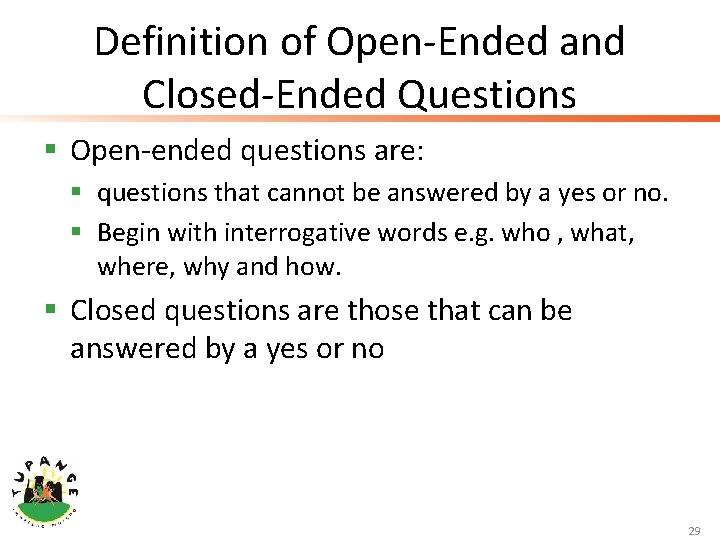
Definition of Open-Ended and Closed-Ended Questions § Open-ended questions are: § questions that cannot be answered by a yes or no. § Begin with interrogative words e. g. who , what, where, why and how. § Closed questions are those that can be answered by a yes or no 29
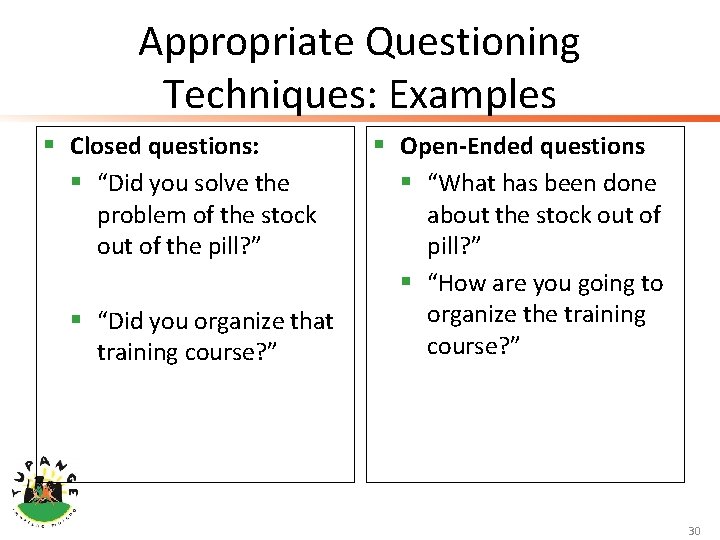
Appropriate Questioning Techniques: Examples § Closed questions: § “Did you solve the problem of the stock out of the pill? ” § “Did you organize that training course? ” § Open-Ended questions § “What has been done about the stock out of pill? ” § “How are you going to organize the training course? ” 30
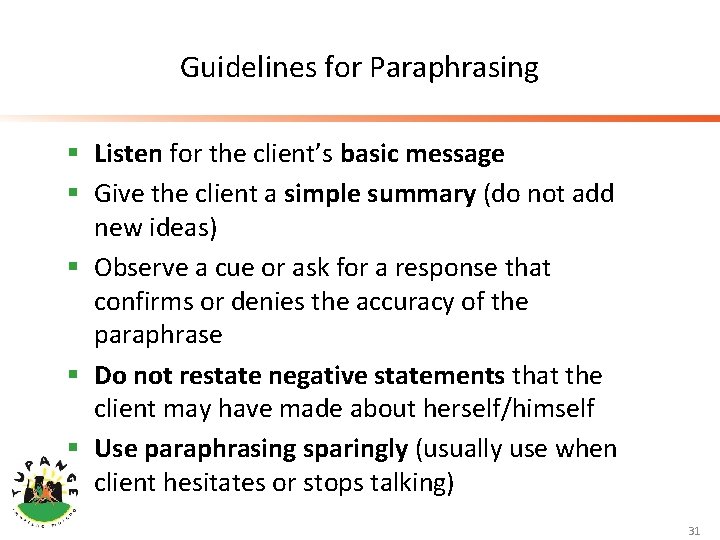
Guidelines for Paraphrasing § Listen for the client’s basic message § Give the client a simple summary (do not add new ideas) § Observe a cue or ask for a response that confirms or denies the accuracy of the paraphrase § Do not restate negative statements that the client may have made about herself/himself § Use paraphrasing sparingly (usually use when client hesitates or stops talking) 31
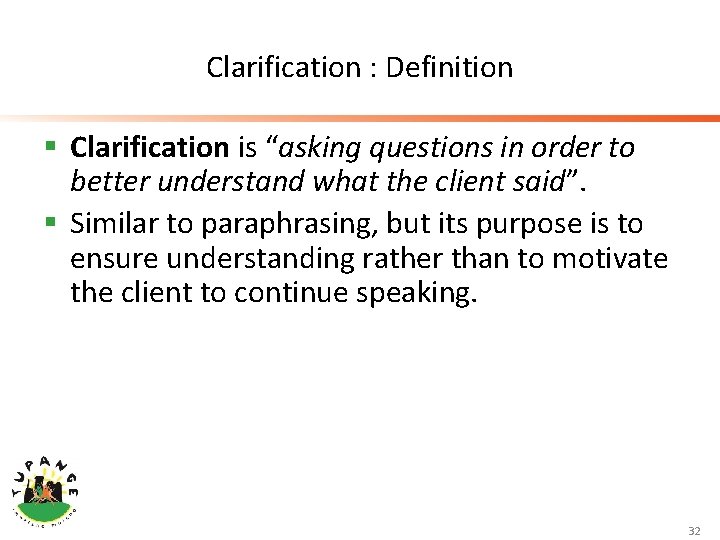
Clarification : Definition § Clarification is “asking questions in order to better understand what the client said”. § Similar to paraphrasing, but its purpose is to ensure understanding rather than to motivate the client to continue speaking. 32
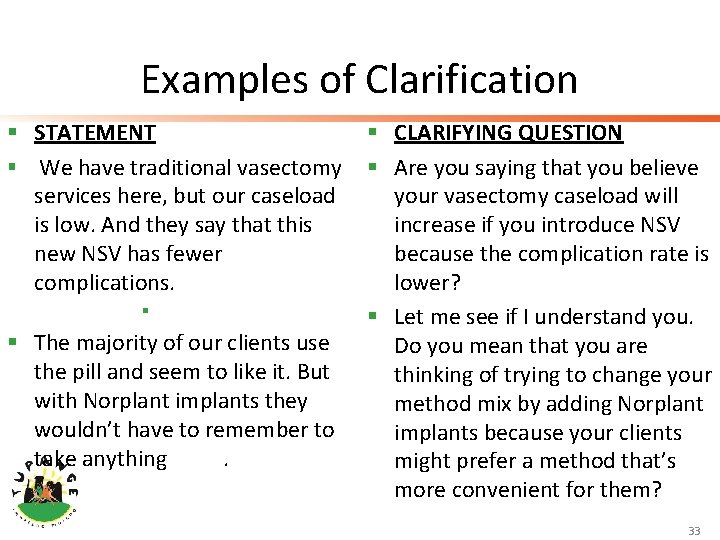
Examples of Clarification § STATEMENT § CLARIFYING QUESTION § We have traditional vasectomy § Are you saying that you believe services here, but our caseload your vasectomy caseload will is low. And they say that this increase if you introduce NSV new NSV has fewer because the complication rate is complications. lower? § § Let me see if I understand you. § The majority of our clients use Do you mean that you are the pill and seem to like it. But thinking of trying to change your with Norplant implants they method mix by adding Norplant wouldn’t have to remember to implants because your clients take anything. might prefer a method that’s more convenient for them? 33
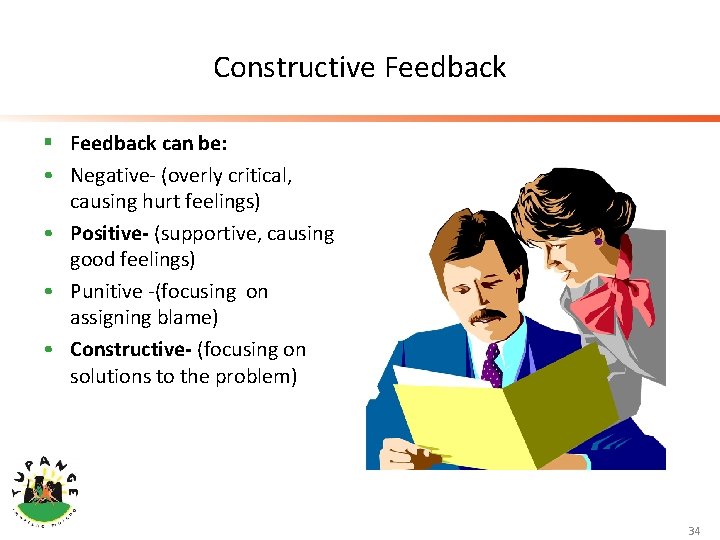
Constructive Feedback § Feedback can be: • Negative- (overly critical, causing hurt feelings) • Positive- (supportive, causing good feelings) • Punitive -(focusing on assigning blame) • Constructive- (focusing on solutions to the problem) 34
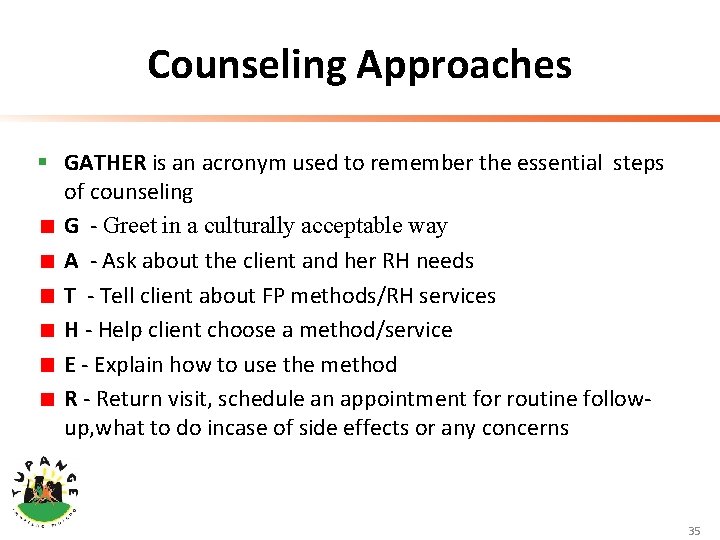
Counseling Approaches § GATHER is an acronym used to remember the essential steps of counseling G - Greet in a culturally acceptable way A - Ask about the client and her RH needs T - Tell client about FP methods/RH services H - Help client choose a method/service E - Explain how to use the method R - Return visit, schedule an appointment for routine followup, what to do incase of side effects or any concerns 35
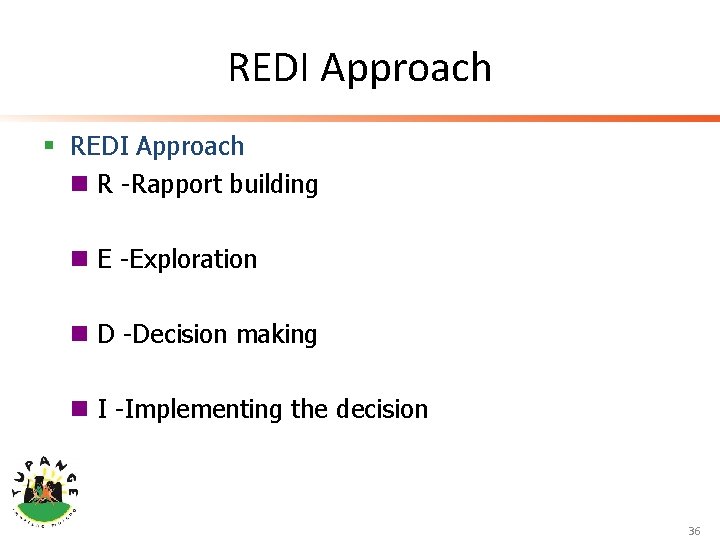
REDI Approach § REDI Approach n R -Rapport building n E -Exploration n D -Decision making n I -Implementing the decision 36
Steps of REDI § § § Step one: Rapport building Welcome the client Make introductions Ensure confidentiality Help the client to relax and feel comfortable 37
Steps of REDI Cont. . § Step two. Exploration § Introduce the subject of family planning § Explore the clients’ needs, risks, sexual lives, social context and circumstances § Provide information about family planning, dual protection, and HIV/STI transmission § Assure confidentiality 38
Steps of REDI Cont. . § Step three. Decision making § Identify decisions the client needs to make § Discuss FP options, HIV/STI prevention and dual protection for each decision made § Weigh the benefits, disadvantages and consequences of each. § Assist the clients to make decisions that are realistic for them to carry out 39
Steps of REDI Cont. . § Step four. Implementing the decision § Make concrete, specific plan for carrying out the decision § Identify the skills that the client will need to carry out the decision § Practice the skills as needed with the provider’s help § Make a plan for follow up 40
Clients Rights § § § § Clients have a right to: Information Access to services Informed choice Safe services Privacy and confidentiality Dignity comfort and expression of opinion Continuity of care 41
Barriers to Effective Counseling § Assignment : Brainstorm § 1. Factors that affect counseling process § 2. How to overcome these barriers. 42
Barriers to effective Counseling Ø Age differences Ø Language differences Ø Education levels Ø Values/beliefs relating to culture/Gender biasness Ø Lack of privacy/ confidentiality Ø Inappropriate non verbal behaviors Ø Judgmental attitude Ø Religious differences 43
§Thank You! 44
- Slides: 44