
Cotton Textile Industry in india Dr Tridibsantapa kundu

Cotton Textile Industry in india Dr. Tridibsantapa kundu
Introduction • The foundations of cotton textile industry were laid in western India at the same time the jute industry was established in Bengal • Unlike the jute industry, cotton textile industry in India was controlled by the Indian capitalists from the very beginning • Its rapid expansion began only after 1870 • Yet in four decades the industry had become one of the world’s largest

Some Early Experiments • 1817 or 1818: The first steam-powered cotton mill was established in the outskirt of Calcutta in by an Englishmen • 1830: Two Frenchmen in Pondicherry set up a spinning mill • 1853: A spinning mill was established at Broach by Jemes Landon, an Englishman
C. N. Davar: The Pioneer of Indian Textile Industry • C. N. Davar was a successful Bombay merchant active in a large number of enterprises • He was broker to two English commercial firms • His own Com. traded to the Far East • He participated in prompting four Bombay banks between 1846 and 1863 • He was active in the formation of Bombay Steam Navigation Com. • He also organized a Com. that imported machinery • He opened the first steam-powered cotton press in Bombay in 1854
C. N. Davar’s Initiatives • Davar tried to estd. a a cotton mill as early as 1851 but was unable to muster financial support • Finally, in 1854 he started a spinning com. with a capital of Rs. 500, 000 contributed by fifty of the city’s leading traders, mostly Parsis. • The Com. Started production in February 1856

Other Cotton Mills in Bombay • By the end of 1860 at least ten mills came out in Bombay • Bombay merchants set up cotton mills in Surat and Kanpur where raw cotton was cheaper
American Civil War Boom • American Civil War and the subsequent economic collapse was a great boom to the emerging Indian cotton industry • The expansion of the industry began as early as 1870 s.
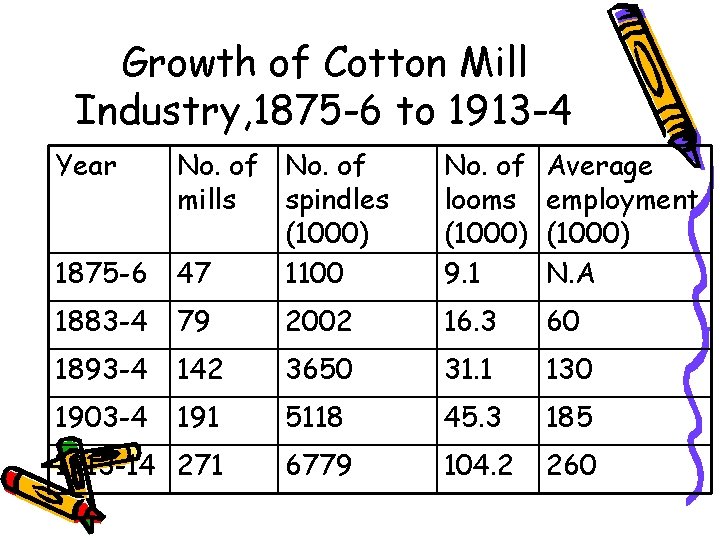
Growth of Cotton Mill Industry, 1875 -6 to 1913 -4 Year 1875 -6 No. of mills spindles (1000) 47 1100 No. of looms (1000) 9. 1 Average employment (1000) N. A 1883 -4 79 2002 16. 3 60 1893 -4 142 3650 31. 1 130 1903 -4 191 5118 45. 3 185 6779 104. 2 260 1913 -14 271

Bombay: The Leader of Indian Cotton Industry • Bombay played a predominant role in the growth of the cotton industry • 32 new mills were erected between 1872 -8 • 12 new mills were opened in a single year, 1874 -5 • 85 mills were in operation by 1914

Ahmedabad: The Second Largest Centre • Ahmedabad emerged as the second largest cotton mill centre in India • By 1914, 49 mills were in operation there
Speciality of the Indian Cotton Industry • British mills tended to specialize in spinning yarn or weaving cloth but do not do both • On the other hand, Indian mills, may often have started as spinning mills but they tended generally to become composite enterprise as they did in the US.
Marketing • Initially their cloth was sold in local market • 75% of the mill made cloth sold in Bombay bazaars was locally manufactured (Reported Manchester Chamber of Commerce, 1867) • The industry quickly found foreign outlets in Middle East and East Asian markets through traditional connections
Concentration on Yarn Production • Indian cotton mills up to the 1 st World War concentrated more on the production of yarn for handloom weavers • They sold over 80% of their yarn to handloom weavers at home and abroad • By 1913 India had become, next to Britain, the world’s greatest exporter of yarn
Impact on British Industry • The rapid expansion of yarn sales had profound impact on the British industry • Yarn export to India declined considerably • The British producers were forced to specialize finer count yarn production • They also faced difficulties elsewhere in Asia
Some Problems faced by the Bombay Cotton Industry • Foreign demand for both yarn and cloth dropped in 1893 • There was a silver crisis in the same year • Tariff agitation generated uncertainty • Bubonic Plague (1896) and the flight of people from the city • A series of crop failure in western India adversely affected the domestic market
Some Other Problems faced by the Bombay Cotton Industry • Rise of Japanese and Chinese cotton mills displaced Indian cotton from Far East to a great extent • Simultaneously, the Bombay cotton mills faced competition form cotton mills elsewhere in India • Bombay cotton mill’s share in mill capacity declined between 1876 and 1914
City’s Move Towards Cloth manufacturing • As competition in yarn market increased, the Bombay mills began to use more of the yarn they produced to manufacture cloth. • This shift was a general tendency through out the country
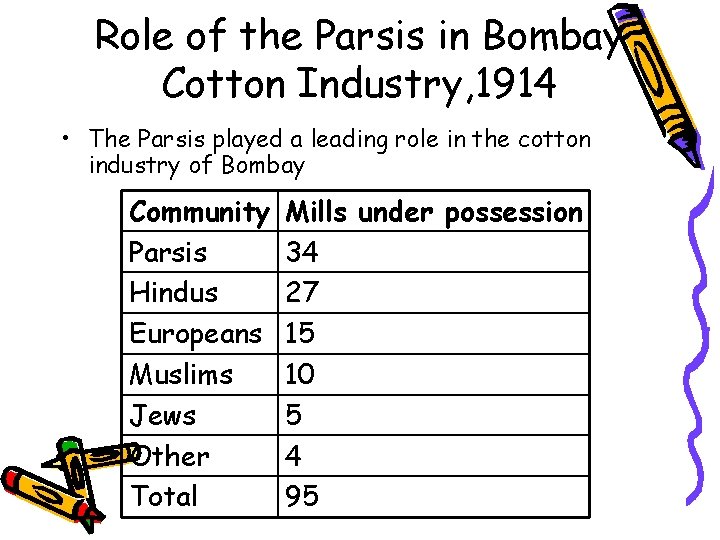
Role of the Parsis in Bombay Cotton Industry, 1914 • The Parsis played a leading role in the cotton industry of Bombay Community Parsis Hindus Europeans Muslims Jews Other Total Mills under possession 34 27 15 10 5 4 95
First World War and After • The demand for cotton cloth increased to a great extent due to war • The cotton industry naturally concentrated more on producing cloth than yarn
Wartime Profit • Wartime profit increased to a great extent • One estimate suggest that in 1920 -1, Indian mills made more than 16 times average profits of the period 190910 to 1913 -14 • It was, undoubtedly a great boom to the industry
Inter War Period • The great wartime boom lasted until 1922 • 1922 -1939: The industry suffered from a continuous economic crisis due to____ • Disappearance of foreign market • Shrinkage of domestic market • Japanese competition
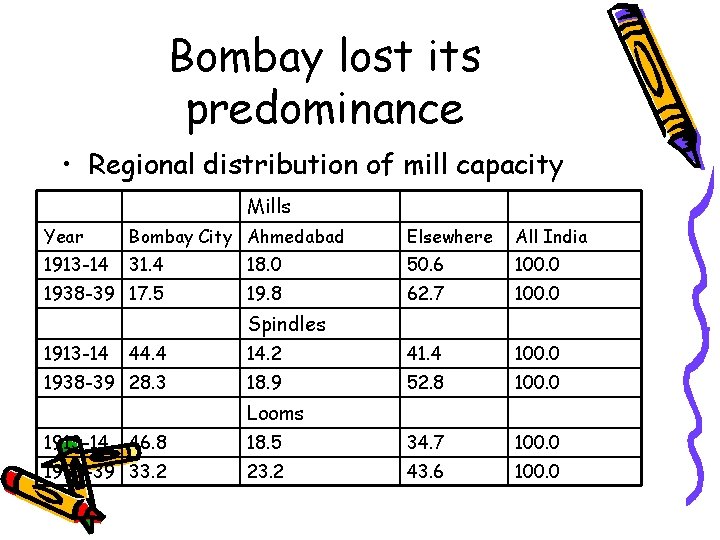
Bombay lost its predominance • Regional distribution of mill capacity Mills Year Bombay City Ahmedabad Elsewhere All India 1913 -14 31. 4 18. 0 50. 6 100. 0 1938 -39 17. 5 19. 8 62. 7 100. 0 Spindles 1913 -14 44. 4 14. 2 41. 4 100. 0 1938 -39 28. 3 18. 9 52. 8 100. 0 Looms 1913 -14 46. 8 18. 5 34. 7 100. 0 1938 -39 33. 2 23. 2 43. 6 100. 0
Industrial Crisis led to Trade Union Movt. • The Bombay mill owners tried to reduce wages to avert their crisis which led to trade union movts. • Bombay became a storm centre of Indian trade union movt. • General strikes were observed in 1928 and 1929 and later in 1934

The End • Thank you again • Tridib Santapa Kundu
- Slides: 24